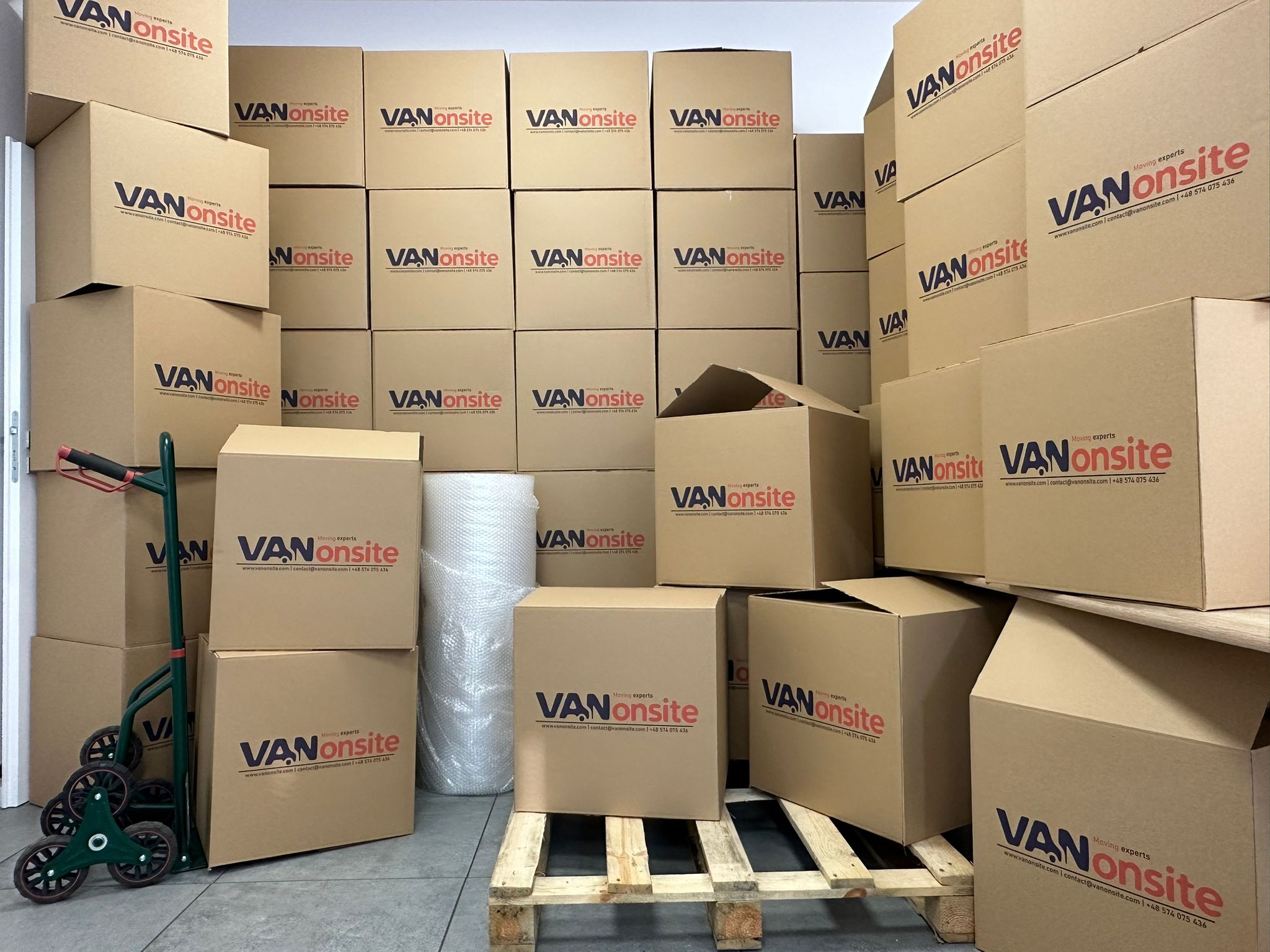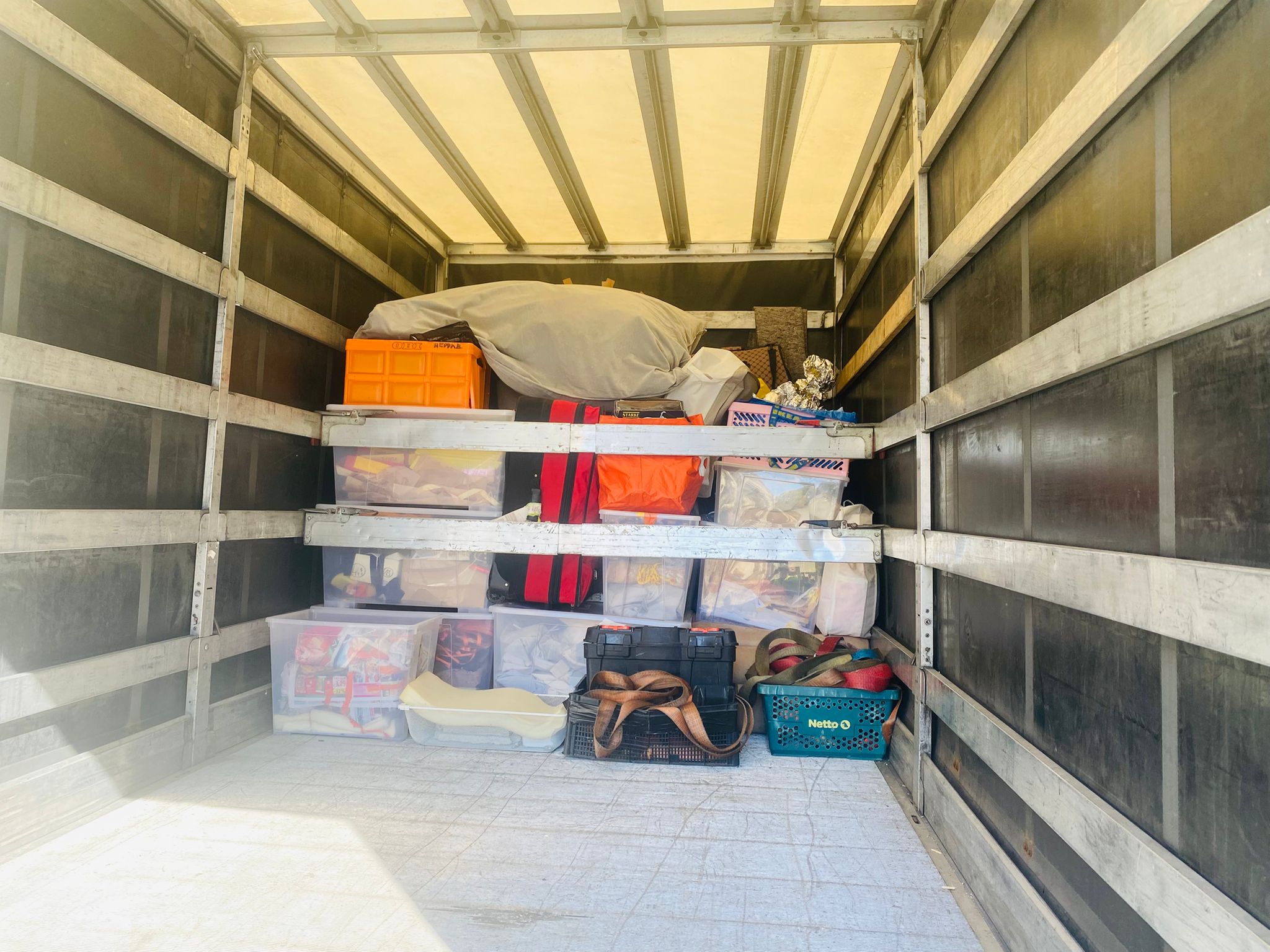
Moving to Germany from Italy can feel like closing one beautiful chapter and opening another before you have fully caught your breath. There is excitement in it, of course. A new city. A fresh routine. New work, new plans, or a long-awaited personal reset. Yet there is pressure too. Even a move within Europe can feel surprisingly intense when your life is packed into boxes and your calendar is suddenly ruled by dates, documents, transport, and costs.
That is why moving to Germany from Italy is never just about crossing a border.
It is about timing the move well. It is about choosing what to take and what to leave behind. It is about protecting fragile items, understanding the true cost of relocation, keeping paperwork close, and making sure the first week in Germany does not feel like a blur of missing chargers, delayed boxes, and unnecessary stress.
Many people assume that because Italy and Germany are both in Europe, the move will be simple by default. In reality, long-distance transport still needs smart planning. Access conditions can differ sharply from one building to another. Move-in and move-out dates can clash. And the smallest mistake, such as underestimating your load or booking too late, can quietly push costs up.
This guide gives you the practical answer fast, then walks you through the move step by step. You will see how to prepare properly, what documents matter, how to budget realistically, and why a reliable man and van or removals service can make the entire journey feel calmer, safer, and far more manageable.
For people moving to Germany from Italy with anything from a few essentials to a full household load, VANonsite offers a strong balance of speed, care, and flexibility. With GPS tracking for every load and a wide range of moving sizes, the company helps take the guesswork out of a cross-border move that already has enough moving parts.
TL:DR
- Start planning 4 to 8 weeks before the move so you have time to compare transport, sort your belongings, and avoid costly last-minute decisions.
- Declutter before packing because cutting even 15% to 25% of your load can reduce both transport costs and moving-day stress.
- Keep important documents with you, not in the main load, especially your ID, accommodation papers, insurance details, and anything you may need on arrival.
- Choose a vehicle size based on real volume, not guesswork, because paying for the wrong amount of space is one of the most common moving mistakes.
- Check access details at both addresses before moving day, including parking, stairs, lifts, and time restrictions for loading or unloading.
- Use a trusted man and van or removals service for a safer move, especially if you want more flexibility, better handling, and GPS visibility during transport.
- Plan your first week in Germany before departure so your essentials, basic groceries, bedding, and daily routine are easier to manage from day one.




Why Moving to Germany from Italy Needs More Planning Than People Expect
At first glance, moving to Germany from Italy can seem deceptively simple. Both countries are in Europe. The route feels familiar. There are no ocean crossings, no container ships, and no dramatic image of a world turned upside down. Yet that surface simplicity often hides the real challenge.
Moving to Germany from Italy still demands careful planning, realistic budgeting, and sharp logistics.
The distance is longer than many people first imagine in practical terms. A move from Milan to Munich is one thing. A move from Naples to Hamburg or Palermo to Berlin is another entirely. Travel time, route planning, loading efficiency, and delivery windows all become more important when the journey stretches across such a large part of Europe.
Then there is the housing side of the move. Italian and German properties can differ significantly in access, expectations, and move-in conditions. One building may have easy parking and a lift. Another may involve narrow streets, restricted delivery hours, a staircase without space to turn, or a move-in schedule that leaves very little room for delay. These details can change the whole rhythm of a move.
Timing matters just as much. Many people moving to Germany from Italy underestimate how tightly connected the dates really are. Move-out day, travel day, key collection, delivery day, and first-week setup all have to align. If one part slips, the rest can start feeling unstable very quickly.
Budget planning is another common weak point. People often calculate the transport itself and stop there. In reality, setup costs can hit fast. Temporary accommodation, groceries, household basics, local transport, parking issues, and first-week purchases can quietly push the real cost higher than expected.
Why this move often feels more complex than expected
- Longer distance than most people assume
- Tight move-in and move-out timelines
- Different property access conditions
- Need for smart packing and realistic volume planning
- Pressure to settle in quickly after arrival
Each of these factors adds friction if it is ignored. Together, they explain why moving to Germany from Italy feels easy only from a distance. Up close, it is a move that rewards preparation.
Long-distance transport still needs structure. Smart packing matters because loose planning creates breakage, wasted space, and slower unloading. Realistic volume planning matters because the wrong vehicle size can turn a simple move into an expensive one. And once you arrive, there is immediate pressure to settle in fast, especially if work, family routines, or a rented property timeline are already waiting.
That is exactly why early planning makes such a visible difference. The more clearly you define the move before moving day, the calmer and cheaper the whole relocation becomes.
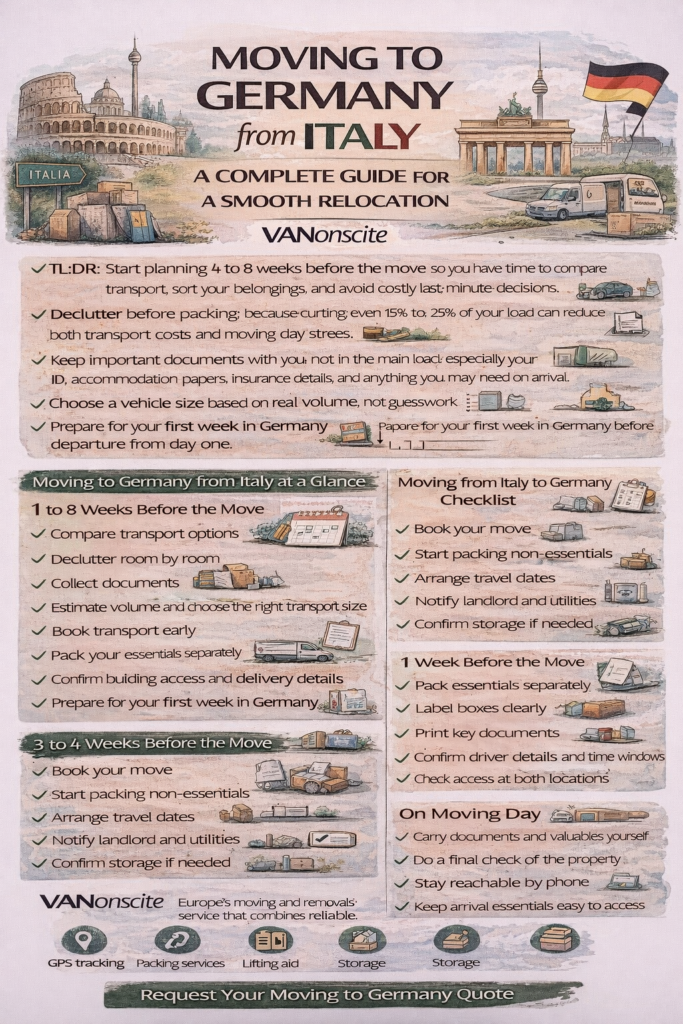
Moving to Germany from Italy at a Glance
If you want the fast version, start here. These are the core steps that make moving to Germany from Italy smoother, safer, and far less chaotic.
- Confirm your move-out and move-in dates.
- Sort what you are really taking.
- Prepare documents and identity papers.
- Estimate volume and choose the right transport size.
- Book transport early.
- Pack your essentials separately.
- Confirm building access and delivery details.
- Prepare for your first week in Germany.
These eight steps may look simple on paper. However, together they create the framework for a move that feels controlled instead of rushed.
Start with the dates because timing drives everything. Without clear move-out and move-in windows, it becomes harder to choose transport, estimate storage needs, or organise the first days after arrival. Even a one-day mismatch can create pressure if you do not see it early.
Sort what you are really taking before you ask for transport. This is where many people moving to Germany from Italy save real money. If you reduce the load by 15% to 25%, you often reduce transport costs and make unpacking much easier too.
Prepare documents and identity papers before the physical packing intensifies. Keep passports or national IDs, accommodation papers, insurance details, employment documents if relevant, and any essential records easy to reach.
Estimate volume honestly. Do not choose a vehicle by instinct. Choose it by the real size of the move. A few extra boxes, a table, or a bulky chair can change the transport fit more than people expect.
Book transport early, especially if your move is tied to strict dates. Early booking gives you better options, more flexibility, and less chance of making a rushed decision that costs more later.
Pack essentials separately so the first 24 to 72 hours in Germany feel manageable. Your documents, chargers, toiletries, medication, and basic first-night items should never disappear into the main load.
Confirm building access and delivery details before moving day. Parking, lift access, narrow stairs, gate codes, and time restrictions can all shape the quality of the move.
Finally, prepare for your first week in Germany before you leave Italy. A calm arrival is rarely accidental. It happens when the basics are already thought through.
Moving from Italy to Germany Checklist
A move from Italy to Germany becomes much easier when it is broken into stages. That is because the most stressful relocations are rarely ruined by one huge mistake. They are usually made harder by many small ones. A late booking. Unclear dates. Boxes packed without a system. Documents buried under kitchen items. A timeline gives structure to all of that.
When you use a proper moving checklist, the relocation feels less like one massive event and more like a sequence of clear steps. That shift matters. It protects your budget, lowers stress, and makes the whole move more predictable.
6 to 8 Weeks Before the Move
This is the preparation stage. The decisions you make here often have the biggest impact on cost and calm.
- compare transport options
- declutter room by room
- collect documents
- check rental agreements
- estimate your load size
- request quotes
Start with the broad picture. Confirm your final move-out date in Italy and your expected move-in date in Germany. If there is any gap between the two, identify it now. Even a short mismatch can change whether you need storage, temporary accommodation, or more flexible delivery timing.
Then begin decluttering room by room. This is one of the most powerful ways to reduce both the cost of moving to Germany from Italy and the stress of unpacking later. Be honest about what you actually use. If an item is bulky, low-value, rarely touched, or easy to replace in Germany, it may not deserve a place in the van.
This is also the right moment to collect your documents, check your tenancy terms, and estimate the real size of your move. Once you have a realistic load picture, you can request quotes that actually match the move instead of guessing.
3 to 4 Weeks Before the Move
This is where the move shifts from planning into action.
- book your move
- start packing non-essentials
- arrange travel dates
- notify landlord and utilities
- confirm storage if needed
By this stage, transport should ideally be booked. Waiting longer can reduce flexibility and make last-minute choices more expensive. Early booking also gives you more control over timing, which matters a lot in a cross-border move.
Start packing non-essential items now. Books, decor, out-of-season clothes, spare kitchenware, and anything you do not need daily can be packed early without disrupting your routine. This approach spreads the workload and helps you see the remaining essentials more clearly.
It is also the right time to arrange your own travel and close out local obligations. Notify landlords, utilities, or any relevant services in Italy so you are not left untangling those details during the final week.
1 Week Before the Move
Now the goal is precision.
- pack essentials separately
- label boxes clearly
- print key documents
- confirm driver details and time windows
- check access at both locations
This week should not be about improvisation. It should be about tightening the move. Build one essentials layer for the first days in Germany. That should include documents, chargers, toiletries, medication, basic clothes, first-night bedding, and a few practical kitchen items.
Label boxes clearly and specifically. “Kitchen” is helpful, but “Kitchen, first week, plate, mug, kettle” is much better. The better your labels, the faster the new place becomes workable.
You should also print key documents, confirm time windows, and recheck access at both addresses. Parking, lift use, stairs, and entry timing can all change how smooth the move feels on the day.
On Moving Day
Moving day should feel focused and controlled.
- carry documents and valuables yourself
- do a final check of the property
- stay reachable by phone
- keep arrival essentials easy to access
Keep passports or IDs, keys, wallets, phones, laptops, and all key papers with you at all times. Do not let irreplaceable items disappear into the main load.
Before leaving, do one last sweep of the property. Drawers, shelves, sockets, cabinets, and corners are where small but important things are often forgotten. Then stay reachable. Fast communication can make a major difference if any timing, parking, or access detail shifts unexpectedly.
What Documents Do You Need When Moving to Germany from Italy?
Moving within Europe is often simpler than relocating from outside the EU, but documents still matter. In fact, one of the easiest ways to make moving to Germany from Italy feel more organised is to get your paperwork in order early.
Even within Europe, organised documents make the move faster and calmer. They reduce confusion, help with housing and local setup, and keep you from wasting energy searching for papers when you should be settling in.
Core documents to keep ready
- passport or national ID
- tenancy or accommodation documents
- employment papers if relevant
- health insurance documents
- moving inventory if helpful
- pet papers if travelling with animals
That is the core list, but the real difference lies in how you organise it. Do not treat these papers as one loose pile. Build a system before the physical moving process becomes noisy.
A simple document setup that works
- Keep all original documents in one protective folder.
- Print paper copies of the most important records.
- Save digital copies in secure cloud storage.
- Keep urgent documents in your hand luggage or essentials bag.
- Separate identity, housing, insurance, and work papers into clear sections.
This takes very little effort and saves a surprising amount of stress later.
Why paperwork still matters on an Italy to Germany move
Because both countries are in Europe, many people assume the documents are a formality. That assumption is where avoidable stress begins. You may still need quick access to proof of accommodation, identity documents, insurance records, work-related papers, or pet documentation. Even a simple question at the wrong moment can feel much more frustrating when the answer is buried somewhere in a taped box.
Good paperwork does not make the move glamorous. It makes it smoother. And smooth is exactly what most people want.
Documents people often forget
Alongside the core list, some movers also benefit from keeping these ready:
- recent bank statements if useful
- landlord or property contact details
- emergency contact details
- vehicle papers if driving your own car
- medical or prescription information if needed
- supporting family records where relevant
Not every move needs every item, but slight overpreparation is far better than discovering a gap during the first week in Germany.
Useful official sources before the move
If you want the latest reliable guidance, check official sources directly before departure.
These sources are useful for understanding practical rights, registration context, and official information that may affect your move.
A quick overview by moving situation
| Moving situation | Documents that usually matter most |
|---|---|
| Standard private move | ID, accommodation papers, insurance documents |
| Moving for work | ID, accommodation papers, employment documents, insurance |
| Moving with pets | ID, accommodation papers, insurance, pet papers |
| Moving with a full household load | ID, accommodation papers, insurance, moving inventory if useful |
The basic rule is simple. Even within Europe, organised paperwork makes the move faster and calmer. It removes friction from the journey and gives you one less source of stress when you arrive in Germany.
How Much Does It Cost to Move to Germany from Italy?
One of the first questions people ask is also one of the most emotional: how much is this actually going to cost? That question matters because a move between Italy and Germany can be wonderfully efficient when it is planned well, but surprisingly expensive when it is rushed, oversized, or based on guesswork.
The smartest way to understand the cost is not to look for one fixed number. It is to understand what shapes the quote and where people quietly lose money.
Main factors affecting cost
- pickup city in Italy and delivery city in Germany
- total moving volume
- floor level and lift access
- urgency of booking
- need for storage
- fragile or bulky furniture
- packing support or white glove handling
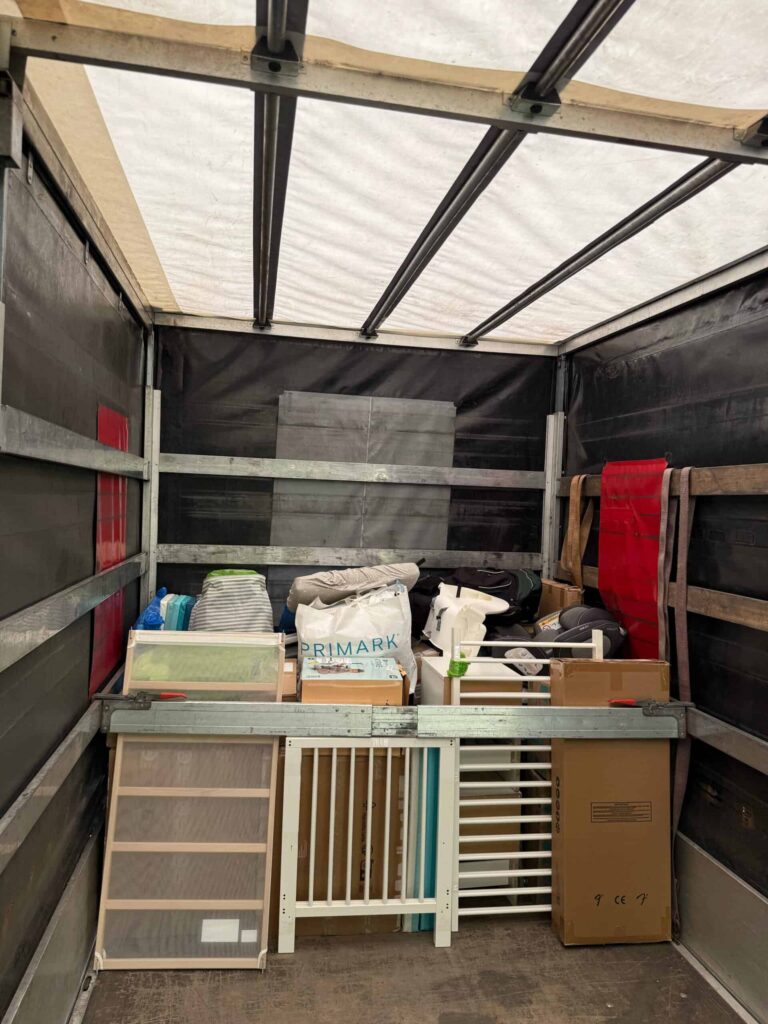
Distance matters, but volume often matters more. A compact move from Turin to Munich with a few boxes and basic essentials is a different operation from a family relocation from Rome to Hamburg with wardrobes, fragile decor, and multiple rooms of furniture. The route changes the transport demand, but the size of the load often determines how much space, handling time, and coordination the move will really require.
Access conditions also change the price more than many people expect. A property with easy parking and lift access is one thing. A narrow street in an old Italian city centre, a building with strict delivery hours, or a fourth-floor apartment without a lift is another. These details affect how fast and how efficiently the move can happen.
Timing matters too. If you book early, you usually gain better flexibility and calmer decision-making. If you leave the booking too late, especially when the dates are fixed, urgency can drive the cost upward.
A practical way to think about vehicle size
| Moving option | Capacity | Weight limit | Best for |
|---|---|---|---|
| Moving One | 1 m3 | 100 kg | Boxes and personal essentials |
| Moving Basic | 5 m3 | 300 kg | Small room or light flat move |
| Moving Medium | 10 m3 | 500 kg | One-room or partial home move |
| Moving Premium | 15 m3 | 1100 kg | Small household move |
| Moving Premium Plus | 30 m3 | 3500 kg | Large flat or family move |
| Moving Full House XXL | 90 m3 | 20000 kg | Full property relocation |
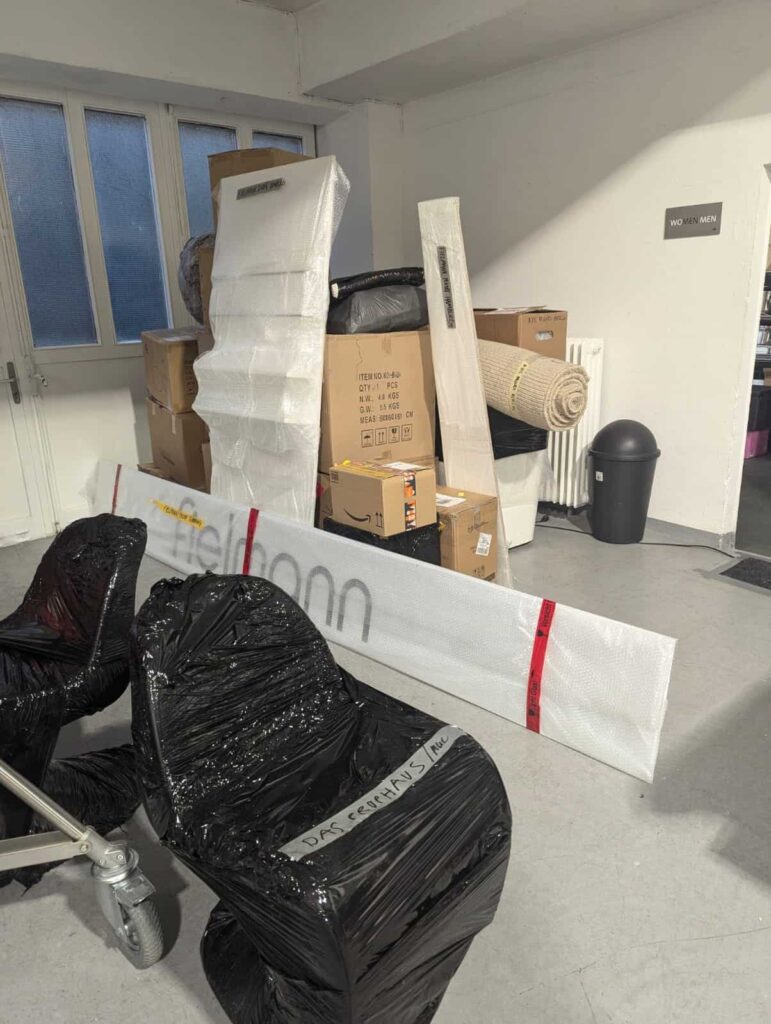
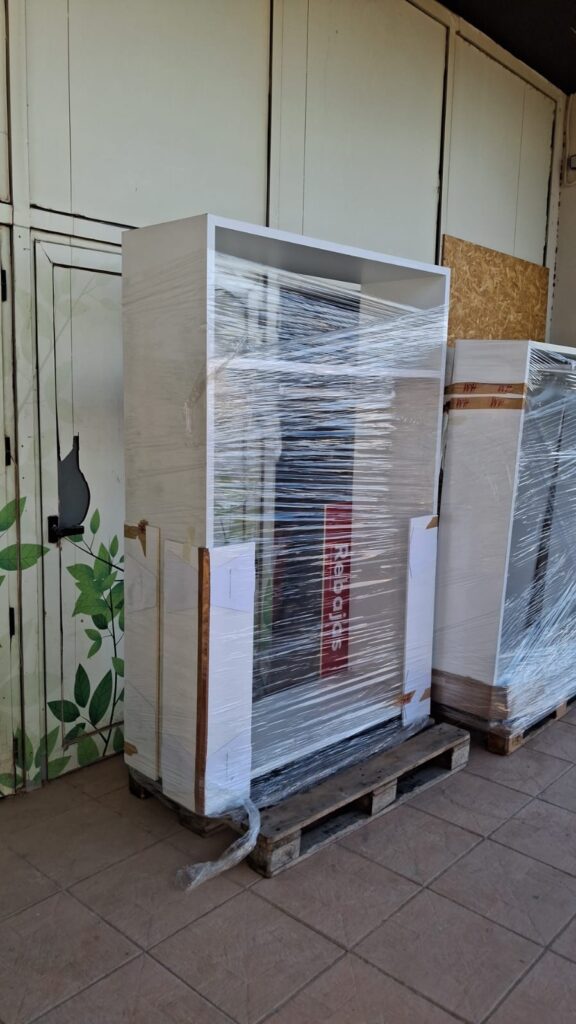
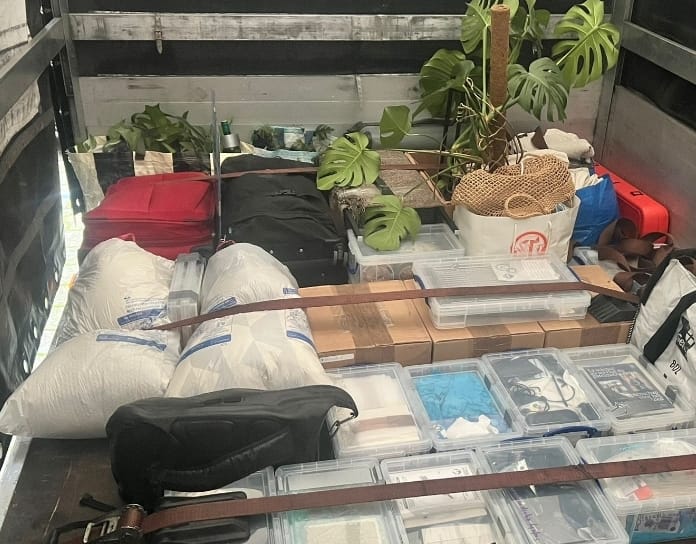
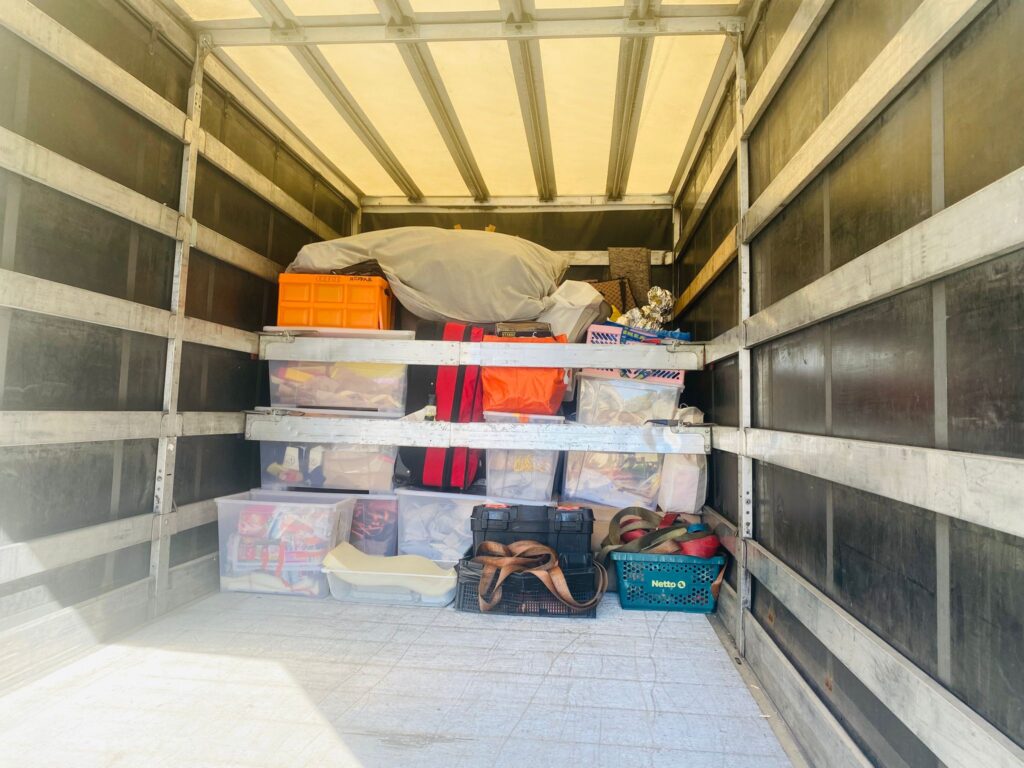
This table helps transform a vague idea into something measurable. It also shows why vehicle matching matters so much. Paying for far too much space wastes money. Choosing too little space creates stress, awkward loading, and the risk of extra complications on moving day.
Typical move scenarios from Italy to Germany
| Move type | Typical load | Likely fit |
|---|---|---|
| Minimal move | Clothes, documents, tech, a few boxes | Moving One |
| Light apartment move | Boxes, kitchen basics, small furniture | Moving Basic |
| One-room move | Bed, desk, chair, boxes, household items | Moving Medium |
| Small household | Furniture, fragile items, packed rooms | Moving Premium |
| Family relocation | Multi-room load, appliances, larger furniture | Moving Premium Plus |
This is exactly why realistic volume planning matters. If you underestimate the move, you risk choosing the wrong setup. If you overestimate it, you may pay for space you never needed. The best result usually comes from matching the vehicle to the real load instead of guessing based on instinct.
Hidden costs people often forget
Transport is only one part of the overall moving bill. Many relocations become more expensive because the setup costs were underestimated.
- temporary accommodation if dates do not align
- first groceries and household essentials
- utility setup or local deposits
- storage fees if the new property is not ready
- parking restrictions or access-related delays
- extra packing materials
- replacing missing everyday basics on arrival
That is why a 10% to 15% buffer above the expected moving cost is often a very smart idea. It protects you from turning every small surprise into a frustrating financial problem.
How to reduce the cost without making the move harder
A lower-cost move is not always the move with the cheapest initial quote. Very often, it is the move that has been prepared with the most discipline.
Many people moving from Italy to Germany can reduce costs by trimming 15% to 25% of their load before booking. That one decision can lower transport needs, reduce handling time, and make the move much easier to unpack at the other end.
It also helps to:
- book early instead of late
- move only what you truly use or value
- choose the right vehicle size, not the biggest by default
- avoid transporting low-value bulky items
- use storage only when it solves a real timing problem
This is where a reliable man and van or removals partner becomes especially valuable. A strong provider does not simply move boxes. They help make sure the service size, route logic, and handling level actually fit the move. That is one of the reasons VANonsite works so well for relocations from Italy to Germany. The company combines multiple vehicle sizes, flexible service options, careful handling, and GPS tracking that gives you much more visibility during transit.
What Should You Take When Moving from Italy to Germany?
One of the most practical decisions in the whole process is deciding what actually deserves to travel with you. This is where moving to Germany from Italy becomes very real. Once the dates are set and the quote is coming together, you need to look at your things with honesty.
A leaner move is often a cheaper and calmer move. It lowers transport costs, makes loading faster, simplifies unpacking, and helps the new place feel organised much sooner.
What to take
You should prioritise the things that help you function quickly, settle comfortably, and avoid unnecessary spending after arrival.
- documents
- daily essentials
- clothes for the season
- tech and chargers
- valuable or hard-to-replace items
- a few comfort items
Documents always come first. Your ID, accommodation papers, insurance details, work documents if relevant, and any urgent personal records should stay with you, not inside the main load.
Daily essentials matter because the first days in Germany should feel manageable, not chaotic. Toiletries, medication, a towel, simple bedding, and a few useful kitchen basics can make the first night dramatically easier.
Clothes should be packed with realism. Bring the clothes you actually wear and the layers that fit the season. A smaller, useful wardrobe is much more valuable than dragging along bags of options you never touch.
Tech and chargers are essential because so much of modern daily life depends on them. Phones, laptops, adapters, chargers, and key devices help with communication, maps, banking, documents, and daily routine from the moment you arrive.
Valuable or hard-to-replace items also deserve a place if they justify the transport. The same goes for a few comfort items. A favourite lamp, a familiar mug, framed photos, or one or two room details can make the emotional landing much softer.
What to leave behind
Some things create more cost and effort than value.
- bulky low-value items
- duplicate kitchenware
- furniture that costs more to move than replace
- decorative clutter
- unused clothing and storage fillers
This is where the real savings often hide. Cheap furniture, duplicate pans, random storage fillers, or clothes that have not been worn in a year may feel harmless at home, but they become costly once every cubic metre matters.
If a piece of furniture is heavy, low-value, and easy to replace in Germany, it is often smarter to leave it behind. The same applies to duplicate kitchenware and decorative clutter. These are the things that quietly inflate the move without making life better afterward.
A simple decision rule before packing
Ask yourself four clear questions before each item goes into the move:
- Will I use this in the first month?
- Is it difficult or expensive to replace?
- Does it improve my daily life in a real way?
- Is it worth paying to transport it from Italy to Germany?
If the answer is “no” to most of those, the item probably stays behind.
A practical breakdown of what belongs where
| Category | Better to take | Better to leave |
|---|---|---|
| Documents | Always | Never pack into the main load |
| Tech | Laptop, phone, chargers, adapters | Broken, outdated, or duplicate devices |
| Clothes | Seasonal, useful, often worn pieces | Unused clothing and duplicates |
| Kitchen items | A few basics for the first days | Bulky duplicates and cheap extras |
| Furniture | Valuable, necessary, hard-to-replace pieces | Low-value heavy items |
| Personal items | Small comfort items | Decorative excess |
This kind of filtering makes a visible difference. Less volume often means lower cost, faster transport, easier unpacking, and a calmer first week in Germany.
When it still makes sense to take more
There are situations where bringing more is absolutely the right choice. If your new property is underfurnished, or if you already own compact items that are expensive to replace, keeping them can be financially sensible. The point is not to move with as little as possible. The point is to move with intention.
That intention is one of the clearest ways to make moving to Germany from Italy more efficient, more affordable, and much less exhausting.


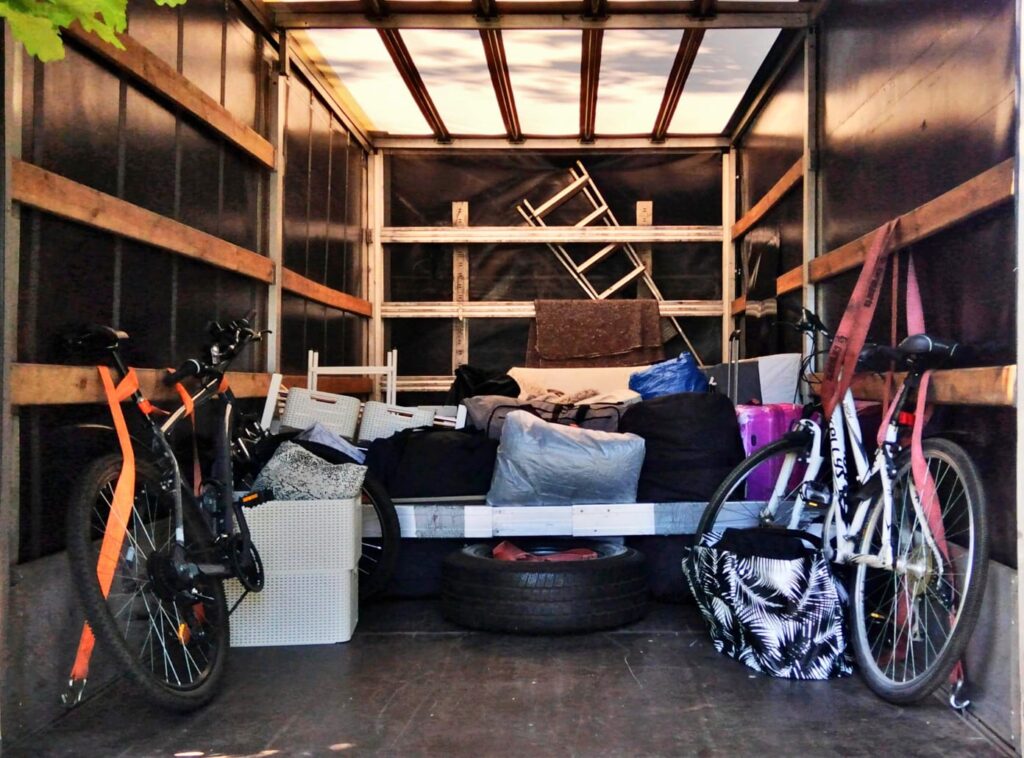
Why a Man and Van Service Makes Sense for Moving from Italy to Germany
When moving to Germany from Italy, many people do not need a huge removals operation. They need something smarter. Something leaner. Something that fits a cross-border move without turning it into an overcomplicated production. That is exactly where a man and van service becomes such a strong option.
For small to medium loads, it often gives the best balance between cost, speed, and control. It is flexible enough for apartment moves, practical enough for urgent timelines, and far easier to manage than trying to organise every detail alone.
Why this option works so well
- ideal for small to medium loads
- good balance between cost and convenience
- easier than DIY for cross-border transport
- flexible for apartment moves and urgent timelines
- practical for people who do not need a full-scale removals package
A move from Italy to Germany does not always mean a full household relocation. Sometimes it is a one-bedroom apartment. Sometimes it is boxes, personal essentials, and a few key furniture pieces. Sometimes it is a partial move that needs speed more than scale. In those cases, a man and van setup can be exactly the right fit.
It removes much of the strain that comes with a do-it-yourself move. No need to manage van rental, fuel, tolls, overnight stops, route pressure, and heavy lifting all at once. That matters because cross-border transport looks simple on paper and exhausting in practice.
Why it often makes more sense than DIY
A DIY move may seem cheaper at first. Yet once you add together the hidden costs, the gap often narrows quickly.
- van hire
- fuel costs
- road tolls
- possible overnight stays
- loading and unloading effort
- higher risk of breakage
- less visibility during transport
For many movers, the bigger issue is not only money. It is energy. When you are already dealing with dates, housing, documents, and first-week planning, doing the entire transport side yourself can become a heavy burden. A good man and van service reduces that weight dramatically.
Trust signals that matter in a cross-border move
When your belongings are travelling from Italy to Germany, reassurance matters.
- GPS tracking for each load
- flexible service sizes
- fast European coverage
- safer handling than improvised transport
These are not cosmetic extras. They change how the move feels. GPS tracking gives you visibility. Flexible service sizes help you avoid paying for space you do not need. Fast European coverage matters when dates are tight. Safer handling protects the things you actually care about.
This is where tailored removals to Germany can make a meaningful difference. If the move is larger, home removals may be the stronger fit. If you are transporting bulky or delicate pieces, furniture removals become highly relevant. And if the final week is already overwhelming, packing services can lift a surprising amount of pressure.
When a man and van service is the smart choice
A man and van option is usually the strongest fit when:
- The move is not a full-house relocation.
- You need a cost-conscious solution.
- The load is compact but still too much for personal travel.
- The route is long enough that DIY becomes draining.
- You want a smoother balance between flexibility and professional support.
That is why this service style fits so naturally into a move from Italy to Germany. It stays practical. It stays efficient. And it gives you support without unnecessary complexity.
Packing Tips for a Move from Italy to Germany
Packing is where many international moves quietly go wrong. Not through one dramatic failure, but through dozens of small frustrations that stack up fast. A charger buried in the wrong box. A cracked plate. A missing towel. A first-night bag that somehow ended up under everything else. Good packing prevents that.
When moving to Germany from Italy, you do not just need things packed. You need them packed in a way that makes arrival easier.
Smart packing habits that save stress
- pack by room and purpose
- label first-week boxes clearly
- protect breakables carefully
- keep chargers, documents, and medication separate
- do not overload boxes with books or kitchen items
- pack for arrival, not only transport
Packing by room and purpose is one of the simplest ways to make unpacking less painful. A random box filled with kitchen tools, cables, shoes, and books creates confusion. A clear box with one practical purpose creates speed.
Label first-week boxes in a way that helps real life. “Bedroom” is useful. “Bedroom, bedding, towel, lamp” is much better. The same applies to kitchen essentials. A mug, plate, kettle, and cutlery set matter a lot more on day one than three boxes of decorative items.
Breakables deserve more care than most people give them. Plates, glasses, lamps, framed pictures, electronics, and fragile decor should be protected with real intention. The longer the route, the more worthwhile that extra care becomes.
A simple system that works on arrival
| Priority level | What goes inside |
|---|---|
| First-day bag | Documents, phone, laptop, chargers, medication, toiletries |
| First-week box | Bedding, towels, basic kitchen items, clothes |
| Main load | Extra clothes, decor, non-urgent household items |
This system works because it mirrors what you actually need. Your first-day bag should stay with you. Your first-week box should be the first thing you open. The main load can wait a little longer because those items are not urgent.
Common packing mistakes to avoid
Packing mistakes are often small in the moment and irritating later.
- mixing multiple rooms in one box
- leaving breakables with too much empty space around them
- packing documents inside the main load
- overloading heavy boxes with books or kitchenware
- forgetting to separate medication and chargers
A move from Italy to Germany is long enough that small packing mistakes can become very obvious when you arrive tired and need something quickly. That is why packing for arrival, not just transport, is such a powerful mindset.
A better way to pack fragile and useful items
A few practical rules make a big difference:
- Wrap breakables individually.
- Cushion empty spaces inside boxes.
- Keep heavy items low and fragile items protected.
- Carry key electronics separately when possible.
- Label delicate boxes clearly.
These steps are simple, but they reduce breakage risk and make unloading calmer. If your move includes especially delicate pieces, careful handling and the right service support become even more valuable.
Common Mistakes When Moving to Germany from Italy
Most bad moves do not collapse because of one catastrophic mistake. They become difficult because several avoidable errors pile up together. The result is the same: more cost, more stress, and a harder landing in Germany.
The mistakes people make most often
- booking too late
- underestimating the volume of belongings
- forgetting access details
- packing too many low-value items
- hiding documents in the main load
- not planning first-week needs
- focusing only on transport cost and ignoring setup expenses
Booking too late is one of the most expensive mistakes. It limits options, raises pressure, and often leads to poorer decisions. Underestimating volume creates the opposite problem. Suddenly the space feels too tight, loading becomes awkward, and the whole move feels less controlled.
Forgetting access details can cause delays or extra frustration on both ends of the route. Packing too many low-value items makes the move heavier without improving life afterward. Hiding documents in the main load creates stress at the worst possible time. Ignoring first-week needs makes arrival feel far rougher than it should.
The last mistake is especially common. People focus on transport cost and forget that the first week has its own price tag. Groceries, local setup, transport passes, household basics, and timing issues all matter.
These mistakes increase stress because they steal control. And when a cross-border move starts feeling out of control, everything feels heavier than it really is.
Your First Week in Germany After Moving from Italy
The first week after a move is when the emotional side of relocation really shows itself. The boxes are there. The room or flat is there. The key is in your hand. Yet nothing feels fully settled. That is normal.
The first week can feel disorienting, but a few smart steps can make the new place feel familiar much faster.
A simple first-week plan
- Check the property and your delivered items.
- Organise your documents in one place.
- Set up internet, electricity, and local basics.
- Learn your local transport routes.
- Buy first-week groceries and essentials.
- Unpack the most practical boxes first.
- Build a small routine quickly.
Start with the space itself. Check what has arrived, what works, and what still needs attention. It is much easier to spot issues immediately than several days later.
Then focus on the things that make daily life function. Light. Internet. Phone charging. Water. Food. A bed that is actually ready to sleep in. Those basics transform the emotional tone of the move.
Learning the local transport routes early also matters more than people expect. Once you know how to reach the supermarket, the nearest key spots, and the wider area, the city stops feeling abstract and starts feeling usable.
Small things that make the new place feel easier
- a made bed on the first night
- one clean working light source
- a charged phone and laptop
- groceries and water within reach
- your key papers in one safe place
- one small routine, such as a morning walk or local coffee stop
These details sound minor, but they create familiarity. Familiarity lowers stress. And lowered stress makes it much easier to feel that the move is actually working.
VANonsite Services That Fit Real Moving Situations
A move from Italy to Germany can take many shapes. One person may be relocating a few urgent essentials. Another may be moving a full apartment. Someone else may need help because timing has suddenly changed. That is why service flexibility matters.
Services worth considering
- Last Minute Moving for urgent relocations
- Furniture Removals for bulky or delicate pieces
- Home Removals for full household moves
- Packing Service for a safer, faster move
- White Glove Delivery for premium handling
- Storage for move-in timing gaps
Each of these solves a different kind of problem. Last Minute Moving helps when dates shift and time pressure spikes. Furniture Removals matter when the load includes heavier or more delicate items. Home Removals bring more structure when the move is larger. Packing Service reduces breakage risk and saves energy. White Glove Delivery makes sense for high-value or premium items. Storage becomes extremely useful when move-in and move-out dates do not line up cleanly.
A quick comparison of services
| Service | Best for | Why it helps |
|---|---|---|
| Last Minute Moving | Tight move deadlines | Helps when plans change fast |
| Furniture Removals | Bulky or fragile items | Protects valuable furniture |
| Home Removals | Full home relocations | Adds structure and support |
| Packing Service | Busy schedules or fragile loads | Saves time and reduces breakage risk |
| White Glove Delivery | Premium or delicate items | Adds careful handling |
| Storage | Gaps between move-out and move-in | Makes timing easier |
This is one of the quiet strengths of VANonsite. The company can adapt to the move instead of forcing the move into one rigid shape.
FAQ About Moving to Germany from Italy
Is moving to Germany from Italy easy?
It is easier than some international moves because both countries are in Europe, but it still needs planning. Distance, timing, volume, access, and first-week setup all matter much more than people first expect.
How much does it cost to move from Italy to Germany?
The cost depends mainly on route, load size, access conditions, timing, and service level. A small essentials move will cost far less than a larger household relocation with furniture and fragile items.
Is a man and van service enough for moving from Italy to Germany?
In many cases, yes. It is often ideal for small to medium loads, apartment moves, and people who want a better balance between cost and convenience without booking a full-scale removals package.
What documents should I keep with me during the move?
Keep your ID, accommodation papers, insurance documents, work papers if relevant, and any urgent personal records with you at all times. These should never disappear into the main load.
How can I reduce the cost of moving from Italy to Germany?
Declutter early, book early, and choose the right transport size. Cutting 15% to 25% of unnecessary volume can make a visible difference to both cost and stress.
Can I move furniture from Italy to Germany safely?
Yes, absolutely. The key is proper packing, careful handling, and a secure transport setup. Professional support makes a major difference when the load includes delicate or bulky items.
Conclusion
Moving to Germany from Italy can feel much smoother than people fear when it is prepared with care. A lighter load, a smarter plan, and the right transport partner can transform the whole experience.
The real goal is not simply to get your things from one country to another. It is to arrive ready. Ready to open the door, unpack the essentials, and begin the next chapter with more calm and less chaos.
That is why good planning matters so much. And that is why a moving partner that combines flexibility, visibility, safety, and speed can make such a real difference.
For anyone preparing for this kind of relocation, VANonsite offers practical support that feels reassuring rather than overcomplicated.
DIY Move from Italy to Germany vs Professional Moving Service
| DIY move from Italy to Germany | Professional moving service |
|---|---|
| More planning pressure | Less stress and better coordination |
| Higher physical effort | Professional handling |
| Harder to estimate van space | Easier vehicle matching |
| Less visibility during transport | GPS tracking for reassurance |
A DIY move can still work for very small, low-risk relocations. Yet once the distance, timing, or volume becomes more serious, professional support often saves far more stress than people expect.