
Moving to Switzerland can transform your career, lifestyle and financial future. Yet the relocation process demands careful preparation. Residence permits, customs clearance, compulsory health insurance and a competitive housing market can quickly overwhelm anyone who arrives without a clear plan.
Switzerland is not a member of the European Union, so moving furniture and personal belongings from an EU country still involves customs formalities. A simple local man and van service may not have the knowledge, documents or insurance needed to manage that border crossing safely.
This guide explains every major stage of moving to Switzerland, from checking your residence rights and selecting a canton to importing household goods and registering after arrival. It also shows how professional removals to Switzerland can make the journey more secure, predictable and far less stressful.
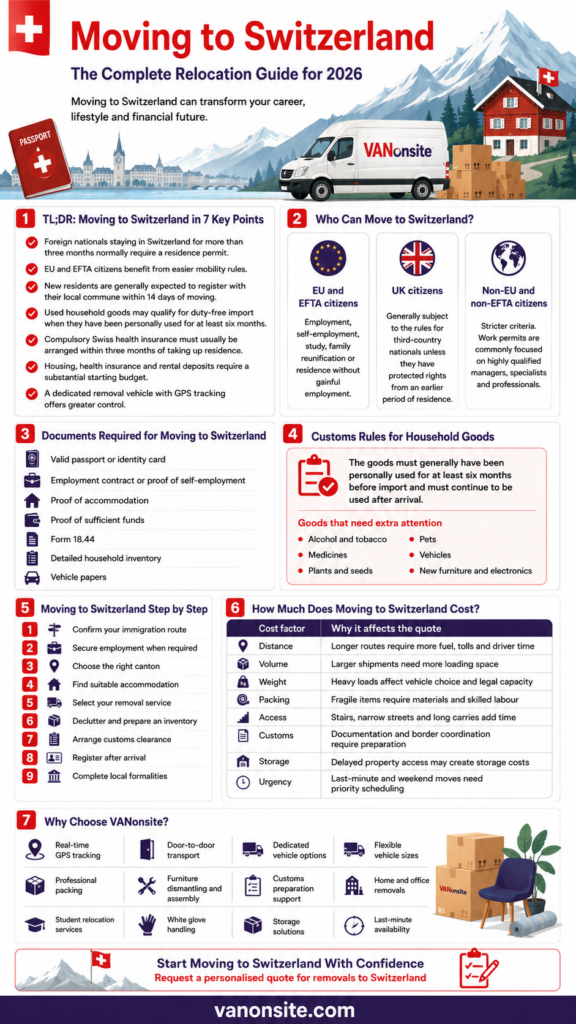
TL;DR: Moving to Switzerland in 7 Key Points
- Foreign nationals staying in Switzerland for more than three months normally require a residence permit.
- EU and EFTA citizens benefit from easier mobility rules, while applicants from third countries face stricter employment and permit requirements.
- New residents are generally expected to register with their local commune within 14 days of moving.
- Used household goods may qualify for duty-free import when they have been personally used for at least six months and will remain in use after arrival.
- Compulsory Swiss health insurance must usually be arranged within three months of taking up residence.
- Housing, health insurance and rental deposits require a substantial starting budget, even when your Swiss salary is attractive.
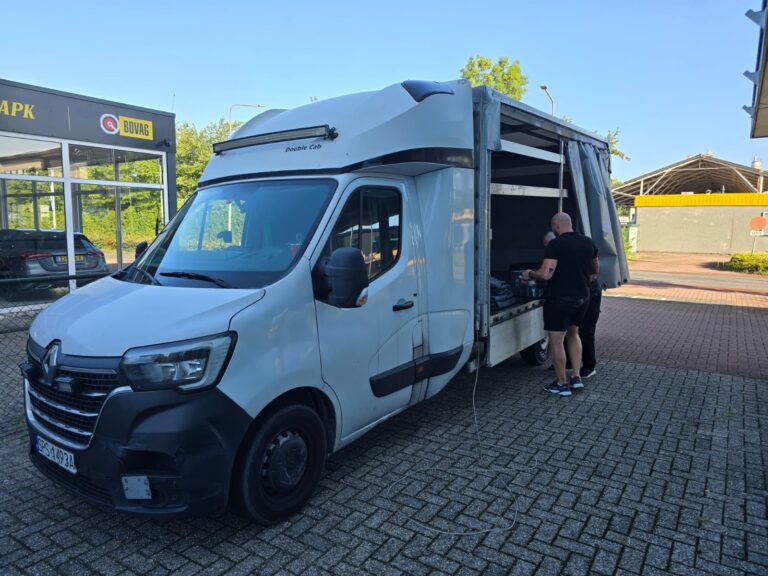
- A dedicated removal vehicle with GPS tracking offers greater control than shared transport or a basic man and van service.
Is Moving to Switzerland a Good Idea?
For many professionals and families, moving to Switzerland is an exceptional opportunity. The country offers access to powerful industries, excellent transport connections, respected schools and an outdoor lifestyle shaped by mountains, forests and lakes.
The financial potential is also significant. The median gross monthly wage for a full-time employee was CHF 7,024 in 2024. However, salaries vary considerably by sector, qualifications, region and seniority. High earnings must also be compared with rent, health insurance, childcare and daily living costs.
Main advantages
- Strong salaries and employment opportunities
- Reliable public transport
- Clean, well-maintained cities
- Political and economic stability
- High-quality healthcare and education
- Excellent access to nature
- Multilingual, international workplaces
Challenges to prepare for
- Expensive and competitive housing
- Mandatory individual health insurance
- Different cantonal rules
- Customs procedures for household goods
- Strict requirements for third-country citizens
- Regional language differences
- High childcare costs
- Formal administration and residential rules
Moving to Switzerland works best when you compare your expected income with the real cost of living in your chosen canton. A lower salary in a more affordable area may leave you with more disposable income than a prestigious role in central Zurich or Geneva.
Who Can Move to Switzerland?
Your nationality, employment status and reason for residence determine which rules apply. All foreign nationals who intend to remain in Switzerland for longer than three months normally need a permit. EU and EFTA citizens benefit from the Agreement on the Free Movement of Persons, while the conditions for third-country nationals are more restrictive.
EU and EFTA citizens
EU and EFTA nationals can move to Switzerland for employment, self-employment, study, family reunification or residence without gainful employment, provided they meet the relevant conditions.
A person with an unlimited employment contract, or a contract lasting at least 365 days, may qualify for a B EU/EFTA permit. This residence permit is normally valid for five years, provided the qualifying conditions continue to be met.
Shorter employment contracts may lead to an L permit. Cross-border workers who live in a neighbouring country and work in Switzerland may require a G permit.
UK citizens
UK citizens moving to Switzerland after Brexit are generally subject to the rules for third-country nationals unless they have protected rights from an earlier period of residence. A Swiss employer will usually need to support the work permit application before employment begins.
Do not book a full household move until your legal route, job offer and expected start date are sufficiently secure.
Non-EU and non-EFTA citizens
Applicants from third countries face stricter criteria. Work permits are commonly focused on highly qualified managers, specialists and professionals whose skills meet an economic need.
The employer usually begins the authorisation process with the relevant cantonal authority. Depending on nationality, the applicant may also need an entry visa. A residence permit from an EU country does not automatically create a right to work in Switzerland.
For current requirements, consult the Swiss State Secretariat for Migration and the migration authority in your destination canton.
Documents Required for Moving to Switzerland
Paperwork can determine whether your relocation feels controlled or chaotic. Prepare original documents, certified translations where necessary and secure digital copies.
Immigration and registration documents
Prepare a valid passport or identity card, visa where required, employment contract or proof of self-employment, residence permit documents, proof of accommodation and evidence of sufficient funds. Families may also need birth certificates, marriage certificates, school records and medical documents. Students should carry proof of enrolment, while regulated professionals may need recognised qualifications.
Official guidance is available through the Swiss government residence portal and the State Secretariat for Migration.
For customs clearance, prepare form 18.44, a detailed household inventory, proof that you are transferring your residence, your Swiss tenancy or property documents, employment evidence, vehicle papers and invoices for recently purchased goods.
The inventory should be practical and specific. Use descriptions such as “10 boxes of used clothing”, “one dining table” and “four chairs”. Clearly identify alcohol, vehicles, valuable collections and new items.
Customs Rules for Household Goods
The transfer of your main residence to Switzerland is the central condition for importing qualifying household effects duty-free. The goods must generally have been personally used for at least six months before import and must continue to be used after arrival.
This rule can cover furniture, personal possessions, collections, animals and qualifying vehicles. New goods or items acquired shortly before the move may be subject to taxes or duties.
Goods that need extra attention
- Alcohol and tobacco
- Food and agricultural products
- Medicines
- Weapons
- Plants and seeds
- Animal products
- Commercial stock
- New furniture and electronics
- High-value collections
- Pets
- Vehicles
Customs offices have specific opening hours and not every border crossing handles household removals. Confirm the route in advance. A professional international mover can help prepare the inventory and coordinate the crossing, reducing the risk of an expensive delay.
Current customs requirements and form 18.44 are available from the Federal Office for Customs and Border Security.
Moving to Switzerland Step by Step
- Confirm your immigration route. Establish whether you are moving for work, study, family reunification, retirement or another recognised reason.
- Secure employment when required. Compare the salary with taxes, insurance, rent, childcare and commuting costs.
- Choose the right canton. Review the local language, housing market, schools, taxes and travel time to work.
- Find suitable accommodation. Confirm that the address can be used for registration.
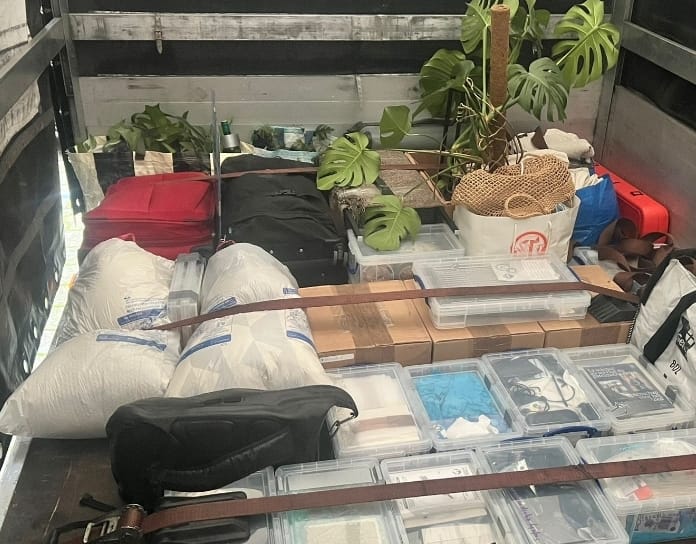
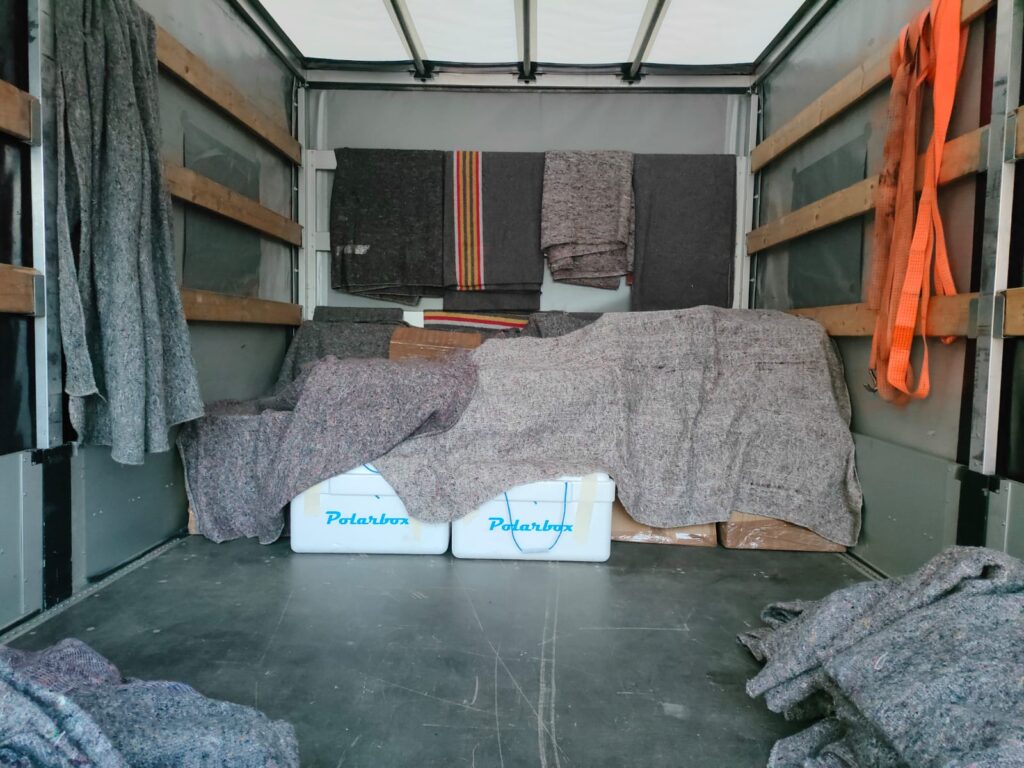
- Select your removal service. Compare capacity, customs support, insurance, tracking and delivery times. A cheap man and van may suit a few boxes, but a complete household needs stronger protection.
- Declutter and prepare an inventory. Sell, donate or recycle unwanted items. Clearly identify recently purchased goods and restricted products.
- Arrange customs clearance. Complete the necessary documents and confirm that your chosen border crossing handles household removals.
- Keep essentials with you. Passports, contracts, medication, valuables and essential clothing should not travel deep inside the removal vehicle.
- Register after arrival. Residents are generally expected to register with their commune within 14 days. Foreign nationals arriving for work must complete the required registration before starting employment.
- Complete local formalities. Arrange health insurance, banking, utilities, school registration, tax matters and vehicle procedures.
How Much Does Moving to Switzerland Cost?
There is no reliable one-price-fits-all answer. The cost depends on distance, volume, weight, property access, packing, customs support and delivery urgency.
| Cost factor | Why it affects the quote |
|---|---|
| Distance | Longer routes require more fuel, tolls and driver time |
| Volume | Larger shipments need more loading space |
| Weight | Heavy loads affect vehicle choice and legal capacity |
| Packing | Fragile items require materials and skilled labour |
| Access | Stairs, narrow streets and long carries add time |
| Customs | Documentation and border coordination require preparation |
| Storage | Delayed property access may create storage costs |
| Urgency | Last-minute and weekend moves need priority scheduling |
| Assembly | Furniture dismantling and rebuilding adds labour |
A detailed quotation should be based on an inventory, photographs or a video survey. This is far more accurate than choosing a vehicle from the number of rooms alone.
VANonsite vehicle capacities
| Moving option | Volume | Maximum weight | Best suited to |
|---|---|---|---|
| Moving One | 1 m³ | 100 kg | Boxes, luggage and micro moves |
| Moving Basic | 5 m³ | 300 kg | Student rooms and small studios |
| Moving Medium | 10 m³ | 500 kg | Studios and compact flats |
| Moving Premium | 15 m³ | 1,100 kg | One-bedroom homes and furniture moves |
| Moving Premium Plus | 30 m³ | 3,500 kg | Family homes and office relocations |
| Moving Full House XXL | 90 m³ | 20,000 kg | Large households and commercial moves |
Choosing the right capacity protects both your belongings and your budget. Too little space can create a last-minute crisis, while an oversized vehicle can increase the price unnecessarily.
Cost of Living in Switzerland
Moving to Switzerland can increase your earning potential, but the starting costs are substantial.
The national average net rent across all dwelling sizes was CHF 1,485 per month in 2024. Zug, Zurich and Schwyz had the highest average rents, while Jura, Neuchâtel and Uri were among the least expensive cantons. Newly advertised properties in popular cities may cost significantly more than the national average.
A residential rental deposit can be as high as three months’ rent. Therefore, a tenant may need several thousand Swiss francs before receiving the keys.
Main monthly expenses
- Rent and additional property charges
- Compulsory health insurance
- Food and household products
- Public transport or vehicle costs
- Electricity and internet
- Mobile phone
- Childcare
- Taxes
- Leisure
- Emergency savings
Create a budget in Swiss francs before moving. Include the rental deposit, first insurance premiums, transport costs and at least one unexpected expense.
Health Insurance
Anyone settling in Switzerland must normally obtain compulsory health insurance within three months of taking up residence. Coverage is generally backdated to the beginning of the insurance obligation, so premiums may also be charged retrospectively.
The average monthly premium for 2026 is CHF 393.30, an average increase of 4.4% from 2025. Actual premiums depend on age, canton, insurer, deductible and insurance model.
Every family member needs individual cover, including children. Compare approved providers through the official Swiss premium comparison tools before selecting a policy.
Finding a Home
The rental market is particularly competitive in Zurich, Geneva, Zug, Lausanne and Basel. Prepare a complete application before attending viewings.
Landlords may request:
- Passport or identity card
- Residence permit
- Employment contract
- Salary statements
- Employer reference
- Previous landlord reference
- Debt enforcement register extract
- Completed application form
- Proof of liability insurance
Before signing, check whether utilities are included, whether pets are accepted, how laundry facilities operate and whether the removal vehicle can stop near the property.
Restricted access can change the moving plan. A narrow road, low garage entrance or apartment without a lift may require extra movers, special equipment or a smaller shuttle van.
Best Places to Live in Switzerland
The best destination depends on your profession, language, housing budget, schools and preferred lifestyle.
| City | Main strengths | Main consideration |
|---|---|---|
| Zurich | Finance, technology, insurance and excellent transport | Very competitive housing |
| Geneva | International organisations, banking and diplomacy | High rent and French-speaking administration |
| Basel | Pharmaceuticals, biotechnology, research and logistics | German is important outside international workplaces |
| Lausanne | Education, technology, sport and lakeside living | Strong demand for housing |
| Bern | Government, healthcare and a calmer pace | Smaller international job market |
| Zug | Multinational business and finance | Among the highest housing costs |
| Lugano | Italian-speaking lifestyle, finance and tourism | Smaller employment market |
Visit the area before signing a long tenancy whenever possible. A short commute on a map can feel very different during peak travel periods.


Finding Work and Settling Your Family
Strong Swiss employment sectors include banking, insurance, pharmaceuticals, biotechnology, engineering, information technology, healthcare, logistics, hospitality, research and international organisations.
Prepare a concise CV that highlights measurable achievements, qualifications and language skills. Check whether your profession requires formal recognition. Before accepting a role, calculate take-home income after taxes, social deductions, rent, health insurance, transport and childcare.
Families should investigate schools before choosing a home. Public education is organised at cantonal level, and the teaching language depends on the region. Prepare school reports, birth certificates, vaccination records and information about special educational needs. Every child needs individual health insurance.
Pet requirements depend on the animal, country of origin and vaccination status. A microchip, rabies vaccination, pet passport or veterinary certificate may be required. Check customs rules, landlord conditions and cantonal restrictions before travelling.
Vehicles imported with household effects must be declared correctly. Prepare registration papers, proof of ownership, insurance and customs documents. Swiss registration, number plates, a technical inspection and a motorway vignette may be required after arrival.
Man and Van or Professional International Removals?
A basic man and van service can work for a compact student move or a few pieces of furniture. For a full household relocation, customs experience and load security become far more important.
| Service | Best for | Main consideration |
|---|---|---|
| Basic man and van | Small, flexible shipments | International support may be limited |
| Shared transport | Lower-cost moves with flexible dates | More handling and wider delivery windows |
| Dedicated van | Fast, direct European relocations | Greater control and predictability |
| Full home removal | Families and complete households | Requires detailed planning |
| White glove delivery | Fragile and high-value items | Specialist handling and placement |
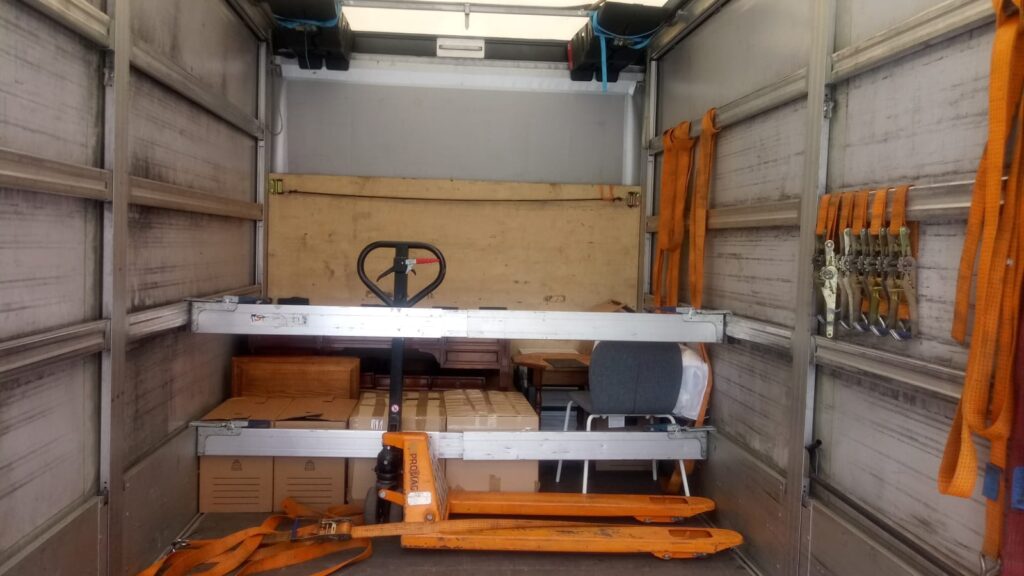
A dedicated vehicle reduces unnecessary transfers between depots and vehicles. It also creates a clearer schedule and allows more accurate GPS tracking.
VANonsite Services for Moving to Switzerland
VANonsite supports residential, student and commercial moves across Europe. Home Removals cover complete apartments and family households, while Furniture Removals are suitable for individual pieces and larger collections.
The Packing Service protects glassware, electronics, artwork and delicate furniture. White Glove Delivery adds specialist handling, careful placement and unpacking for valuable items.
Businesses can combine Office Removals with Office Furniture Installation. Smaller relocations to universities and student accommodation are supported through Student Removals. Storage and last-minute moving options can help when dates change unexpectedly.
Why Choose VANonsite?
Moving to Switzerland requires trust at every stage. VANonsite combines international transport experience with practical support and clear communication.
Customers can benefit from:
- Real-time GPS tracking
- Door-to-door transport
- Dedicated vehicle options
- Flexible vehicle sizes
- Professional packing
- Furniture dismantling and assembly
- Customs preparation support
- Home and office removals
- Student relocation services
- White glove handling
- Storage solutions
- Last-minute availability
GPS tracking gives you visibility while your belongings travel across Europe. Dedicated transport also reduces handling and helps create more precise collection and delivery windows.
Moving to Switzerland Checklist
Three to six months before moving
- Confirm your immigration route
- Secure employment where required
- Compare cantons and cities
- Calculate your budget
- Research housing
- Gather civil documents
- Request moving quotations
- Begin decluttering
Four to eight weeks before moving
- Confirm accommodation
- Book the removal company
- Prepare the inventory
- Complete customs documents
- Arrange packing
- Collect school and medical records
- Check pet, vehicle and border requirements
One week before moving
- Label every box
- Photograph valuable items
- Separate essential documents
- Confirm collection access
- Check customs opening hours
- Prepare medication, clothing and delivery details
After arrival
- Register with the commune
- Complete permit formalities
- Arrange health insurance
- Open a bank account
- Register children and activate utilities
- Complete vehicle procedures
- Learn local recycling rules
Frequently Asked Questions
Can I move to Switzerland without a job?
EU and EFTA nationals may have options when they possess sufficient financial resources and suitable insurance. Third-country citizens face stricter conditions and should confirm eligibility before relocating.
Can I bring used furniture duty-free?
Qualifying household goods can generally be imported duty-free when you transfer your residence, have used them personally for at least six months and intend to continue using them.
How much should I save?
Your reserve should cover transport, temporary accommodation, a rental deposit of up to three months’ rent, initial insurance premiums, food and emergencies.
Is English enough?
English is common in multinational companies, but German, French or Italian may be necessary for local work, administration and integration.
Can I use a man and van?
Yes, particularly for a small shipment. Check that the provider understands Swiss customs, has suitable insurance and offers enough legal vehicle capacity.
Can I track my belongings?
VANonsite provides GPS tracking, allowing customers to follow their shipment during international transport.
Start Moving to Switzerland With Confidence
Moving to Switzerland can offer a rare combination of career opportunity, personal security and extraordinary quality of life. However, success depends on preparation. Confirm your legal status, research your destination canton, calculate the true cost of living and prepare every customs document before collection day.
Your belongings also deserve a carefully controlled journey. Professional packing, suitable vehicle capacity, dedicated transport and GPS tracking can turn an uncertain border crossing into a calm, transparent process.
Request a personalised quote for removals to Switzerland. VANonsite will build the transport plan around your route, schedule, shipment volume and individual requirements.