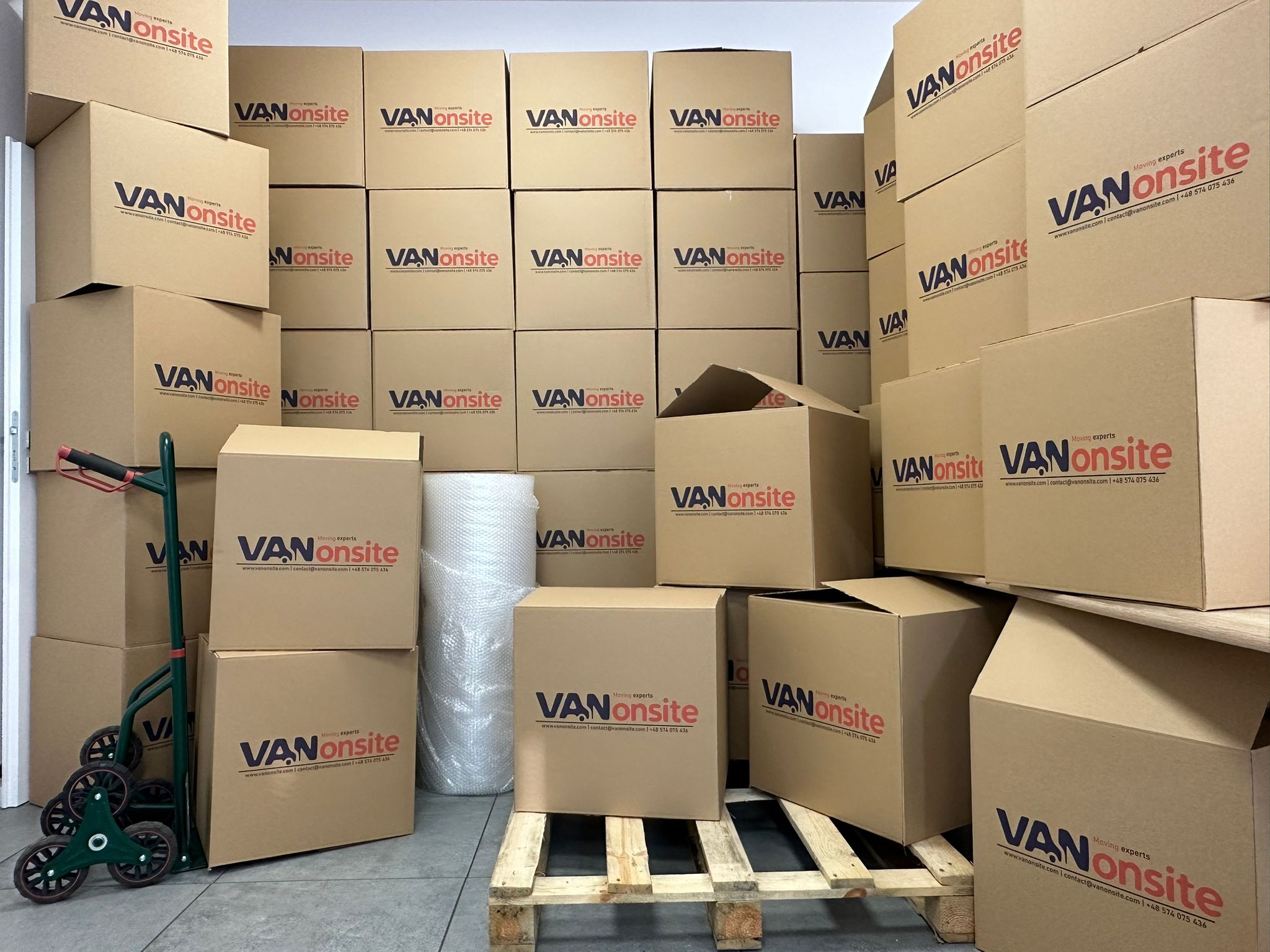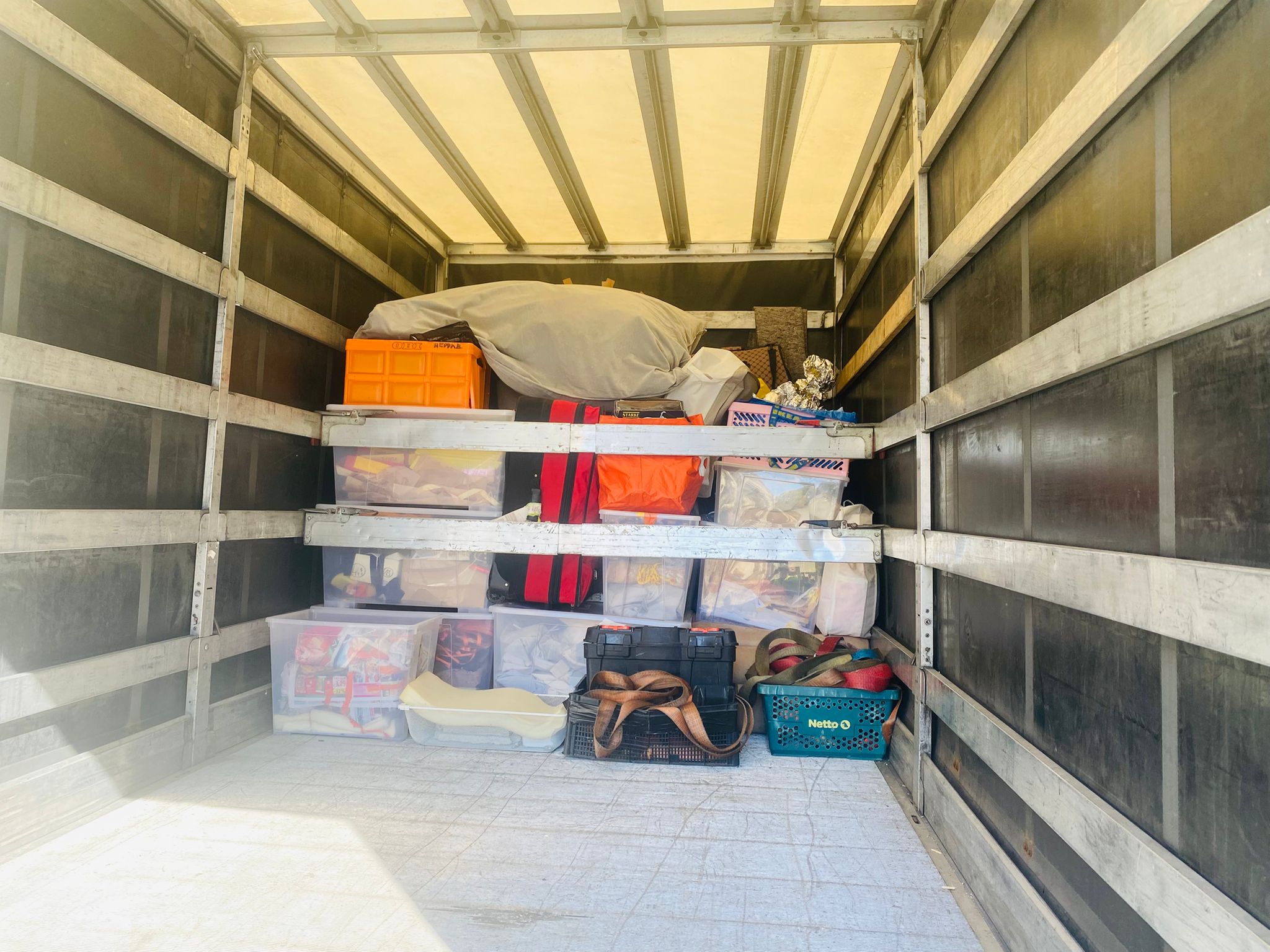
Keys in one hand, the last kettle still warm, and a stack of boxes that suddenly makes France feel real. If you are planning removals to France from UK, you are not just moving stuff. You are moving your life. And after Brexit, the secret to a calm move is simple: clarity beats chaos.
This guide covers removals to France from UK from start to finish, including visas, customs, costs, timing, and van sizing. It also shows when a flexible man and van is the smartest choice for UK to France removals, especially for small to medium loads.
To explore routes and request a quote, start here:
- https://vanonsite.com/removals-to-france/
- https://vanonsite.com/france-removals/moving-to-france-from-uk/
TL:DR
- After Brexit, removals to France from UK can involve customs, so paperwork matters.
- The biggest delay trigger is a vague inventory and mismatched dates.
- Smooth removals UK to France start with volume control, access planning, and clear labels.
- Many routes take 1 to 4 days door to door, depending on distance, access, and customs readiness.
- Man and van is often ideal for small to medium loads because you do not pay for empty space.
- Choose the right m³ vehicle size early to avoid squeezing or a second trip.
- GPS tracking helps you plan key handovers, lift bookings, and arrival windows.
Quick answers first
| Question | Fast answer |
|---|---|
| How long do removals to France from UK take? | Many moves take 1 to 4 days door to door, depending on distance, access, and customs readiness. |
| What paperwork is needed after Brexit? | ID, proof of French address, a numbered inventory, and the right customs documents. |
| Can I move personal belongings duty free? | Often yes if you qualify for residence transfer relief, but you must prove it with clean documents and dates. |
| What is the cheapest way to do UK to France removals? | Reduce volume 20 to 30 percent, avoid peak dates, choose the smallest safe van size, and keep inventory and access details clean. |
| Is man and van good for removals UK to France? | Yes. For small to medium loads, man and van can be fast, flexible, and cost smart. |
| How do I estimate m³ quickly? | Count boxes, multiply standard boxes by 0.07 m³, add 10 to 15 percent buffer, then pick the smallest safe vehicle. |
| What is the number one reason moves get delayed? | A vague inventory, missing proof, or inconsistent address details. If customs has to guess, you wait. |
| What should I keep with me, not in the van? | Passport, key documents, medication, chargers, and your first night essentials. |
| What details make quotes faster and more accurate? | Estimated m³, top 5 largest items, access photos on both ends, and a 24 to 48 hour date window if possible. |
The cheapest total cost for removals to France from UK comes from clarity, not last minute improvisation. When customs can understand your shipment in one glance, and the van can park near the door, the whole move feels lighter.
What changed after Brexit
Brexit changed how UK to France removals are treated.
- The UK is treated as a third country for EU customs.
- Household goods can be treated as an import into France.
- Inventory, proof, and document consistency matter much more.
- Even smaller loads can be checked, so “it’s only a few boxes” is not a strategy.
Official reference:
| Before Brexit | After Brexit |
|---|---|
| Fewer customs steps for household goods | Customs steps can apply, even for smaller loads |
| Inventory was helpful | Inventory is essential |
| Delays were mostly traffic and access | Delays can also come from paperwork quality |
| A messy list still moved | A messy list can trigger questions and waiting |
If you want removals to France from UK to feel predictable, treat the move like two tracks running together.
- Your personal relocation track: visa and residency timing.
- Your goods track: customs, inventory, packing, and delivery access.
Visas and residency basics
The simplest question is the most important.
How long are you staying?
- Up to 90 days in any 180 day period is not the same as living in France.
- If you plan to stay beyond 90 days, a long stay visa is usually needed.
Official links:
- https://france-visas.gouv.fr/
- https://france-visas.gouv.fr/en/long-stay-visa
- https://www.service-public.gouv.fr/particuliers/vosdroits/F16162?lang=en
90 days in 180, explained simply
Think of it as a rolling window, not a calendar reset.
- You can spend up to 90 days in France within any moving 180 day period.
- Day 91 is where many people get caught out, not because they planned badly, but because they assumed the counter resets on the first of the month.
If your plan includes work, renting long term, school, or settling, treat it as a relocation and plan the visa route early.
Mini checklist before you start
- reason for moving: work, family, retirement, study
- expected length of stay: 3 months, 6 months, 12 months
- target move window: aim for 2 to 6 months planning
A practical decision table
| Your situation | What to do next | Why it matters |
|---|---|---|
| staying under 90 days | confirm dates and keep proof tidy | avoids accidental overstays |
| staying over 90 days | use France Visas to choose the right long stay route | visa timing sets your moving date |
| unsure of timeline | plan for the longer scenario first | it is easier to shorten than to rush |
The admin rule that saves weeks
Keep names, addresses, and dates consistent everywhere.
- same spelling across forms
- same address format, including apartment number
- a simple timeline that makes sense: move out, move in, start date
Visa timing affects your move dates. If you are flexible by even 24 to 48 hours on pickup, removals UK to France often become easier to schedule and cheaper to route.
Customs and documents for removals to France from UK
Customs can feel intimidating until you see what it wants, customs wants clarity.
For removals to France from UK, the strongest protection is a clean story. Not complicated, just consistent.
- You can prove who you are.
- You can prove where you are going.
- Your inventory is specific and numbered.
- Your dates make sense.
Official links:
- https://www.douane.gouv.fr/particuliers/vous-demenagez
- https://www.douane.gouv.fr/particuliers/vous-demenagez/en-france-metropolitaine/vous-transferez-votre-residence-principale
- https://www.service-public.gouv.fr/particuliers/vosdroits/F492
- https://www.gov.uk/guidance/check-how-to-declare-personal-goods-you-bring-into-or-take-out-of-the-uk
What customs is really checking
When people worry about customs, they imagine random rules. In reality, customs is looking for three things.
- Identity: who owns the goods.
- Intent: is this a genuine household move or something commercial.
- Clarity: can they match your documents to what is physically in the load.
If you give customs clarity, the process usually stays calm.
Document checklist
| Document | Why it matters | Common mistake |
|---|---|---|
| ID | confirms identity | expired passport |
| Proof of French address | supports destination and residence change | missing apartment number or inconsistent format |
| Inventory | core customs document | vague wording like miscellaneous |
| Customs form or declaration | supports the process | missing signature or wrong version |
| Proof of residence change where relevant | supports relief | dates do not align |
Proof that makes your move feel real
If you want removals to France from UK to be smooth, your paperwork should tell one clear timeline.
Helpful proof often includes:
- a lease, deed, or accommodation confirmation in France
- evidence you are leaving the UK address: end of tenancy, sale, or move out confirmation
- dates that align, not perfect, just believable
Even if you are doing removals UK to France in stages, keep the timeline coherent.
The customs folder that keeps moves smooth
Keep this with you, not inside a sealed box.
- two printed copies of key documents
- PDFs saved offline on your phone
- printed inventory with box count
- a one page summary sheet: name, French address, phone number, pickup address, delivery address
Add one more thing if you can: a short inventory overview line.
- total boxes
- total large items
- one sentence description: household goods, personal belongings
It sounds simple, but it prevents the most annoying delay: someone asking you to explain your own move while you are tired.
The five delay triggers to avoid
- Inventory does not match the box labels.
- Address details are incomplete or inconsistent.
- Dates look rushed or do not align with your move story.
- High value items are not listed separately.
- You used vague words like miscellaneous or various.
Items that can trigger extra questions
For UK to France removals, some categories are more likely to attract attention. You do not need to panic. You just need to label them cleanly and list them clearly.
- high value electronics
- large quantities of new goods
- alcohol and tobacco
- anything that looks like stock for resale
If something looks commercial, customs may ask commercial questions. The simplest defence is clarity.
Even small loads can be checked. Clean paperwork reduces waiting, and waiting is expensive.
Inventory that clears faster
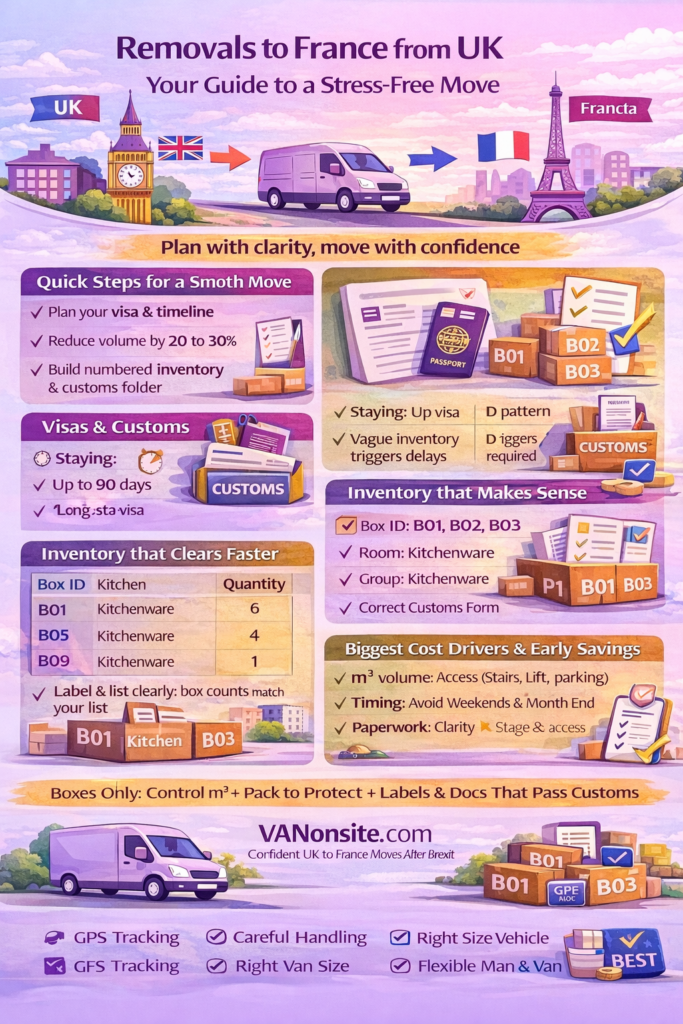
Inventory is the document that does the heavy lifting in removals to France from UK.
Think of it as a map. If your inventory is a fog, customs asks questions. If your inventory is a map, customs checks and moves on.
The simplest inventory system
Use a consistent structure.
- Box IDs: B01, B02, B03
- Room label: kitchen, bedroom, office
- Item group: clothes, books, kitchenware
- High value items listed separately
| Box or item | Room | Item group | Quantity | Notes |
|---|---|---|---|---|
| B01 to B04 | kitchen | kitchenware | 4 | plates wrapped, glasses boxed |
| B05 to B08 | bedroom | clothes and linens | 4 | sealed, labelled |
| B09 | office | cables and accessories | 1 | zip bagged |
| Laptop | office | high value item | 1 | serial number available |
A copy and paste inventory template
| Box or item | Room | Item group | Quantity | Notes |
|---|---|---|---|---|
| B__ | __ | __ | __ | __ |
| B__ | __ | __ | __ | __ |
| __ | __ | high value item | __ | serial number available |
The 10 words that make customs happier
Use plain groups that a stranger can picture.
- clothes
- books
- kitchenware
- linens
- cables
- small electronics
Avoid these words:
- miscellaneous
- stuff
- various
Two checks before pickup
- Box count matches inventory count.
- The Box ID on the tape matches the Box ID on the list.
Print two copies and keep a PDF saved offline.
If customs has to guess, you wait. A clear inventory keeps UK to France removals moving.
The biggest cost drivers, ranked
Price is usually a blend of time and complexity. Reduce both, and removals UK to France becomes calmer and cheaper.
The trick is to spot what looks small but costs big. A 200 metre carry route. A missing lift booking. A van that is one size too small. These are the budget leaks.
| Cost driver | What it changes | How to lower it |
|---|---|---|
| m³ volume | vehicle size, loading time, and whether you pay for air | declutter 20 to 30 percent, disassemble bulky items, pick the smallest safe size with 10 to 15 percent buffer |
| access | stairs, tight turns, long carries add minutes that become money | share photos, book lift slot, plan closest legal stop, clear hallways |
| timing | peak demand raises cost and reduces availability | move mid week, aim mid month, avoid the last 5 days of the month |
| packing quality | loose items slow loading and increase damage risk | pack into boxes, label and number, keep 15 to 20 kg per box, fill gaps |
| customs readiness | missing proof creates delays and sometimes extra charges | clean inventory, consistent address details, complete customs folder |
A cost snapshot you can actually use
| Your situation | What it usually does to the total cost | The smart fix |
|---|---|---|
| you have 10 to 20 percent more volume than needed | pushes you into a larger van | declutter bulky, low value items first |
| you are moving on a weekend or month end | higher demand and fewer options | mid week, mid month, or a wider date window |
| the van cannot park near the door | longer carry time, slower unloading | plan the closest legal stop, share a street photo |
| stairs and no lift booking | slower unloading and extra handling | reserve a lift slot and clear the corridor |
| you packed lots of bags | slow loading and messy inventory | repack into boxes, label and number |
| your inventory is vague | border questions and waiting | numbered boxes and plain item groups |
Fast savings that actually work:
- reduce volume by 20 to 30 percent
- move mid week when possible
- share access photos early
- use a 24 to 48 hour window if you can


Choose the right vehicle size, do not pay for air
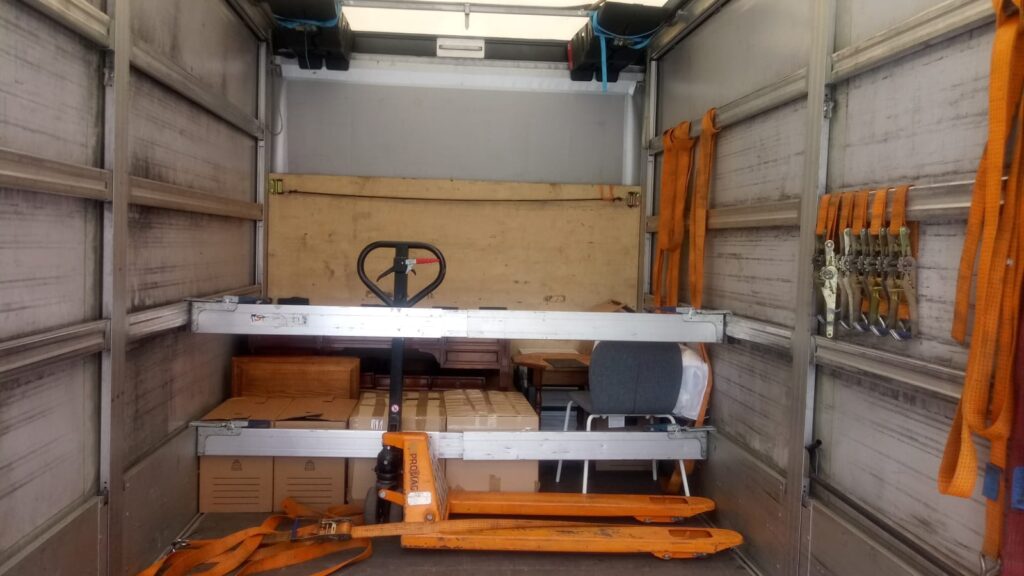
The cheapest mistake is the one that forces a second trip. For removals to France from UK, aim for the smallest safe size, with a 10 to 15 percent buffer.
A simple sizing truth: you do not pay for distance alone. You pay for space and time. The right vehicle size protects both.
| VANonsite option | Volume | Payload | Best for UK to France removals |
|---|---|---|---|
| Moving One | 1 m³ | 100 kg | essentials, urgent boxes, a few suitcases |
| Moving Basic | 5 m³ | 300 kg | student room, small studio, box heavy moves |
| Moving Medium | 10 m³ | 500 kg | studio to light 1 bedroom |
| Moving Premium | 15 m³ | 1100 kg | furniture plus boxes, safer stacking |
| Moving Premium Plus | 30 m³ | 3500 kg | larger flat, heavy furniture, staged moves |
| Moving Full House XXL | 90 m³ | 20000 kg | full home relocations |
Quick m³ estimator
- standard box: 0.07 m³
- large box: 0.10 m³
- suitcase: 0.12 to 0.18 m³
- add 10 to 15 percent buffer
Box count shortcuts
- 10 standard boxes is about 0.7 m³
- 20 standard boxes is about 1.4 m³
- 40 standard boxes is about 2.8 m³
- 70 standard boxes is about 4.9 m³
The sizing rule that prevents chaos
If your estimate is at the top end of a range, go one size up. Squeezing costs time, and time costs money.
Practical examples:
- around 5 m³ with any bulky items: choose 10 m³
- around 10 m³ with a sofa or awkward furniture: choose 15 m³
- around 15 m³ with heavy furniture: consider 30 m³
Why paying for air is expensive
An oversized vehicle means you pay for space you do not use. A too small vehicle means you pay for slow loading, repacking, and damage risk.
The sweet spot for removals UK to France is the smallest safe size with a buffer.
A powerful rule for removals to France from UK: volume chooses the van size, weight chooses whether the plan is safe.
Packing that protects your items
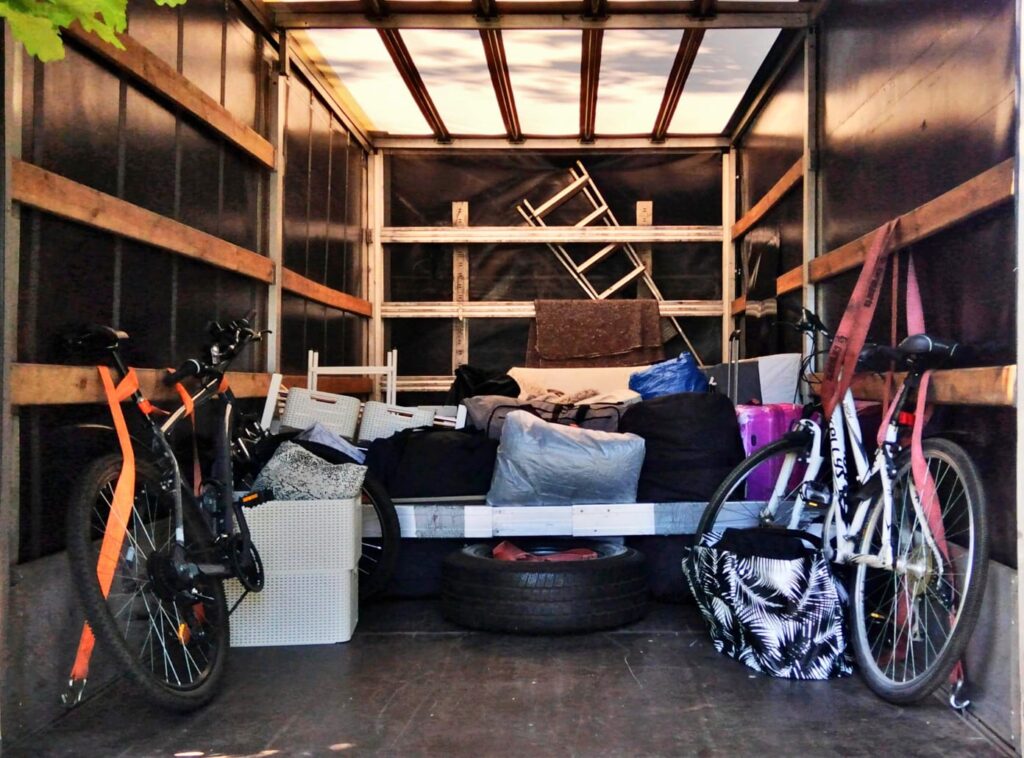
Good packing is not fancy. It is fast, stable, and a little ruthless. When you pack well, loading becomes smooth, boxes stack safely, and your move feels lighter.
For removals to France from UK, packing is also about speed. Strong packing can cut loading time by 20 to 40 percent, which often lowers the total cost of UK to France removals.
The core rules
- keep boxes at 15 to 20 kg
- tape bottoms in an H pattern, then add one extra strip for heavy boxes
- fill gaps so nothing moves inside
- label two sides clearly
- use the 3 second shake test
The 3 second shake test
Shake the box for 3 seconds.
- rattles: add padding
- sags: reduce weight
- flexes: reinforce with tape
A simple label formula
Write the same four lines on every box:
- Box ID: B01, B02, B03
- Room: kitchen, bedroom, office
- Group: clothes, books, kitchenware
- Priority: P1, P2, P3
That label system makes removals UK to France faster because your inventory matches reality.
Packing materials that do the most work
| Material | Why it matters | Best for |
|---|---|---|
| double wall boxes | safer stacking, fewer splits | books, kitchenware, dense items |
| packing paper or bubble wrap | shock absorption | glass, plates, electronics |
| stretch film | fast bundling | chair legs, drawers, cables |
| blankets | soft edge protection | sofa arms, table corners |
| zip bags | no lost screws | bed frames, desks, shelves |
P1 essentials box for your first night
Your first night should not be a scavenger hunt. Make P1 obvious and keep it close.
- documents folder
- chargers and adapters
- toiletries
- medication
- bedding basics
- one change of clothes
- basic cutlery and a mug
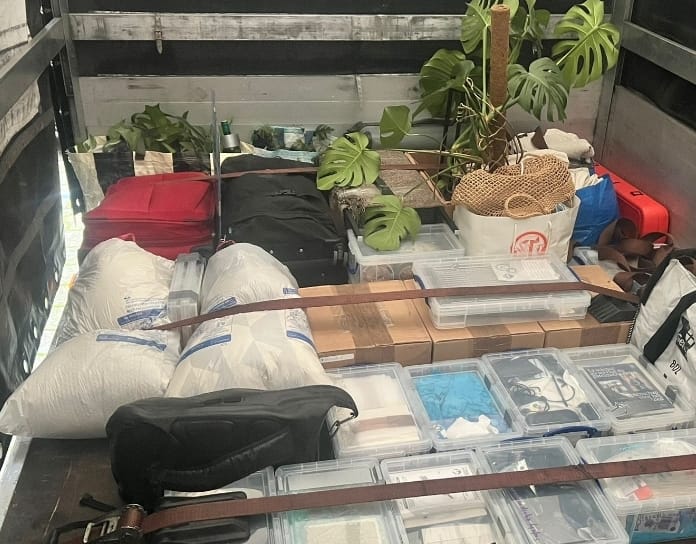
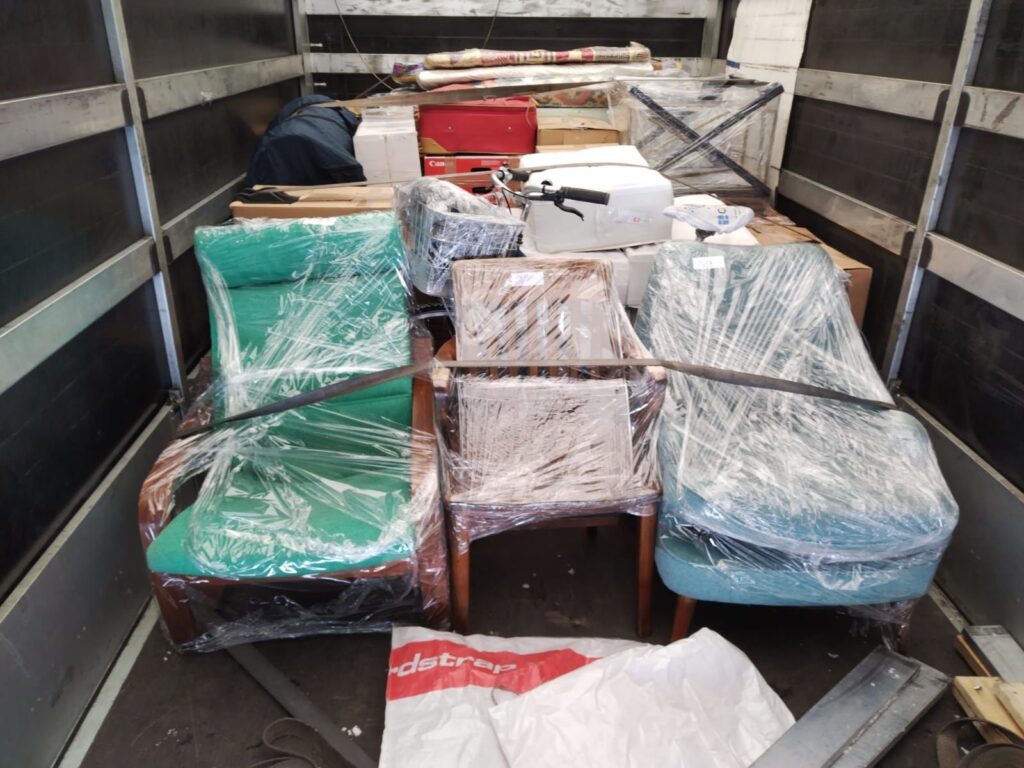
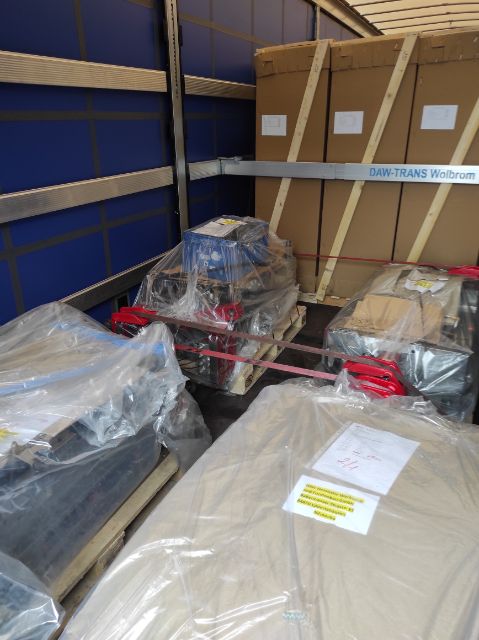
A tiny habit that saves stress: take two quick photos before the van doors close.
- the packed load inside the vehicle
- your P1 box and high value items
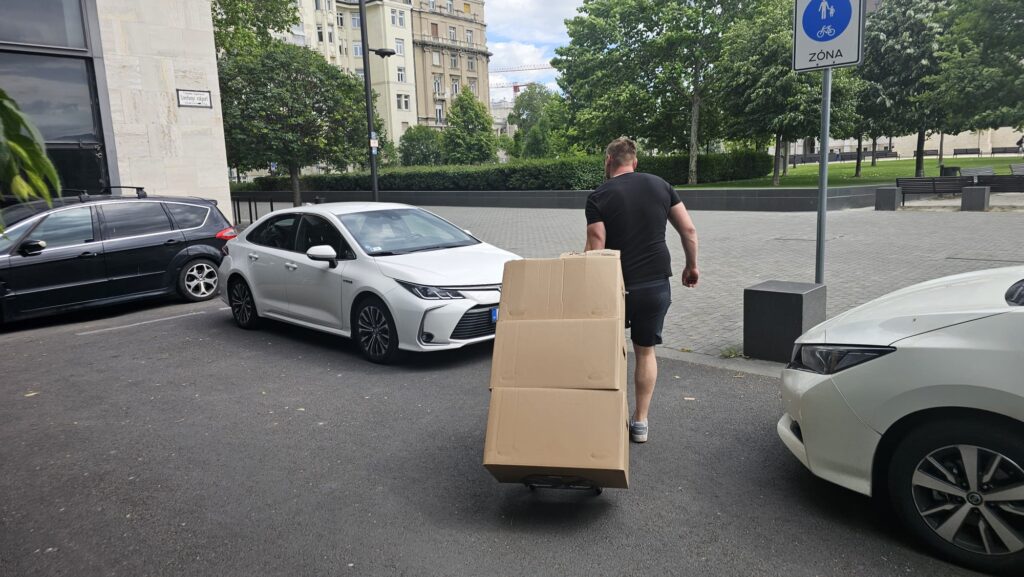
Packing support:

Delivery day in France
Delivery day is decided by access, not effort. If access is clear, the day is quick. If access is messy, even a small delivery can drag.
| Risk | What it causes | How to prevent it |
|---|---|---|
| no parking | long carry distance and delays | share a street photo and closest legal stop |
| stairs, no lift slot | slower unloading and fatigue | book a lift slot and clear corridors |
| narrow street | reroute and waiting | share restrictions and entrance photos |
| quiet hours | forced pause | confirm allowed delivery hours |
| missing door code | waiting outside | confirm code and intercom name |
| long carry route | extra time and box damage risk | clear the path and plan a short carry route |
| tight corners indoors | scuffs and slow unloading | move obstacles and protect edges |
The 10 minute prep that saves an hour
- clear hallways and remove trip hazards
- move fragile decor away from the route
- prop doors open where allowed
- keep a small kit ready: scissors, tape, marker
- keep pets and children safely away from the carrying path
Copy and paste message template
Send this 24 hours before delivery:
- Address: full address, apartment number
- Floor: number
- Lift: yes or no, booking time if any
- Best parking spot: street name, landmark, closest legal stop
- Door code and intercom name: details
- Contact phone number: number
- Access notes: narrow street, gate code, quiet hours, stairs count
- Box count: total boxes and your P1 box ID
This single message can save 30 to 60 minutes on the day and make the handover feel calm.
Timeline for removals UK to France
A good timeline keeps your move cheap and calm. It also protects you from the two classic budget leaks: paying for air and paying for waiting.
| When | What to do | Why it matters |
|---|---|---|
| 12 weeks | decide your visa route, set a realistic move window, start your document folder | keeps dates realistic and stops rushed decisions |
| 10 weeks | declutter 10 percent and list bulky items, get your first m³ estimate | early volume control drops the quote fast |
| 8 weeks | declutter 20 to 30 percent, confirm your pickup and delivery cities, collect proof of French address | reduces m³ and prevents admin loops |
| 6 weeks | draft inventory structure, choose your Box IDs and label format | prevents the number one delay trigger: messy inventory |
| 4 weeks | confirm access details on both ends, parking, stairs, lift slot, door codes | prevents delivery day waiting and carry distance costs |
| 3 weeks | finalise inventory draft, list high value items separately | reduces customs questions |
| 2 weeks | pack non essentials, label and number every box, separate P1 | faster loading and smoother first night |
| 7 days | confirm contacts, check quiet hours, confirm lift booking if needed | avoids last minute surprises |
| 72 hours | print inventory and key docs, save PDFs offline, send access message | protects delivery day |
| 48 hours | seal boxes, final box count, take access photos if anything changed | prevents disputes and delays |
| moving day | box count, photos, sign off, keep customs folder with you | keeps handover calm and verifiable |
| day after | open P1 first, spot check key boxes, recycle packaging | turns chaos into routine quickly |
If you have only 14 days
Keep it brutally simple. Do this in order.
- declutter aggressively and estimate m³ with a 10 to 15 percent buffer
- build inventory first, then pack to match it
- label and number every box, then match Box IDs to the inventory
- confirm access with photos and a parking plan
- keep P1 essentials separate and unmissable
If you have only 7 days
You can still make removals UK to France work, but you must protect two things: inventory clarity and access details.
- estimate m³ fast and choose the smallest safe vehicle size
- pack into boxes, not bags
- write the inventory as you pack, not after
- send access details early: door codes, stairs, lift slot, closest legal stop
Optional services that save time
Sometimes paying for the right service is the cheapest move overall, because it reduces risk, saves hours, and protects fragile items.
- Furniture removals: https://vanonsite.com/furniture-removals/
- best when you have bulky items, tight corners, or stairs
- protects your furniture and speeds up loading with the right handling
- Home removals: https://vanonsite.com/home-removals/
- best for full flat or house moves where coordination matters
- keeps inventory, packing, and delivery planning under one plan
- White glove delivery: https://vanonsite.com/white-glove-delivery-service/
- best for high value, fragile, or presentation sensitive items
- ideal when damage risk is not an acceptable trade off
- Office removals: https://vanonsite.com/office-removals/
- best when downtime costs money
- supports structured packing, equipment protection, and timed delivery
- Student removals: https://vanonsite.com/student-removals/
- best for box heavy moves, small rooms, and flexible dates
- a practical fit for man and van style transport
These pay off when you have fragile items, heavy furniture, tight access, a strict delivery window, or you simply want the move to feel calm and controlled.
Why VANonsite is a smart partner
If you are planning removals to France from UK, you want a service that feels calm and precise. You want a partner that treats planning as part of the job, not a last minute scramble.
VANonsite supports UK to France removals with:
- GPS tracking on every load, so you can plan handovers with less guessing
- careful handling, so your items arrive looking like your home, not like a rushed pile
- right size vehicles for small and medium moves, so you do not pay for air
- a flexible man and van approach for tight streets, tricky access, and short notice changes
What this means in real life
| Common pain point | What VANonsite does | What you get |
|---|---|---|
| you are waiting all day with keys | GPS tracking and clearer arrival planning | less wasted time and fewer missed windows |
| your load feels between sizes | right sizing by m³ and smart buffers | no squeezing, no second trip risk |
| tight access, stairs, narrow roads | flexible man and van approach | smoother pickup and delivery |
| customs stress and border uncertainty | structured planning and inventory readiness | fewer questions and less waiting |
The three details that unlock a smoother quote
Send these early and the plan becomes faster, cleaner, and more accurate.
- your estimated m³ volume and box count
- your top 5 largest or heaviest items
- access notes on both ends: floor, lift, parking distance, door codes, quiet hours
Useful pages:
- https://vanonsite.com/removals-to-france/
- https://vanonsite.com/france-removals/moving-to-france-from-uk/
FAQ
How long do removals to France from UK take?
Many moves take 1 to 4 days door to door, depending on distance, access, and customs readiness. A common time multiplier is access: stairs, long carry routes, strict quiet hours, or lift booking windows.
What documents cause the most customs delays?
The biggest delay triggers are:
- a vague inventory, especially miscellaneous wording
- inconsistent address details, missing apartment number, different formats
- mismatched dates for residence change proof
Fast fix: number every box, match Box IDs to the inventory, and keep your address format identical across documents.
Is man and van safe for UK to France removals?
Yes. For small to medium loads, man and van is often one of the safest and most efficient formats when packing and inventory are clear.
To keep it safe:
- keep boxes at 15 to 20 kg
- use an H tape bottom
- add 10 to 15 percent m³ buffer so nothing is squeezed
Can I move in stages to save money?
Yes. Staged moves can keep each shipment smaller and easier to plan, especially when your housing dates do not align perfectly.
Simple staged plan:
- P1 essentials and the first week boxes
- furniture and main boxes
- leftovers and non essentials
Use a separate inventory per shipment and a new Box ID range each time.
Can I track my shipment?
Yes. VANonsite provides GPS tracking on every load, which helps you plan lift bookings, key handovers, and arrival windows with confidence.
What is the best van size for a studio move?
Many studios fit 5 to 10 m³, depending on furniture and box count.
A practical rule:
- box heavy studio: 5 m³ can be enough
- studio with bulky items: 10 m³ is often safer
- near the top of 10 m³: choose 15 m³ to avoid squeezing
Summary and next step
If you are planning removals to France from UK, the smoothest moves follow one simple pattern: clear dates, clear documents, clear access, and a van size that fits without squeezing.
This guide covered what changed after Brexit, why customs now matters more for UK to France removals, and how to avoid the most common delay triggers: vague inventories, inconsistent addresses, and timelines that do not make sense. You also got a practical way to estimate m³, choose the smallest safe vehicle size with a 10 to 15 percent buffer, and cut costs by reducing volume 20 to 30 percent and avoiding peak dates. Finally, it walked through packing that saves time, delivery day access planning, and a realistic timeline whether you have 12 weeks or only 7 to 14 days.
If you want removals UK to France to feel calm, focus on five actions.
- Plan your visa route and dates early.
- Reduce volume by 20 to 30 percent and estimate m³.
- Build a clean, numbered inventory and keep a customs folder with you.
- Choose the smallest safe vehicle size with a 10 to 15 percent buffer.
- Share access details early so delivery day stays fast.
Start with the France route pages and request a quote with your estimated m³, top 5 largest items, and access photos.