
If you are searching for bad things about living in France, you probably want the truth, not a postcard. France can feel electric and romantic on day one. Then real life arrives with keys, contracts, queues, and forms. That friction is exactly why bad things about living in France is such a popular search.
Here is the twist. Most bad things about living in France are not disasters. They are predictable speed bumps. If you plan them out, they stop stealing your sleep.
This is a complete relocation guide. You will get fast answers, real numbers, and a clear moving plan. You will also see how to move safely with a man and van service built for cross border journeys, including GPS tracking for every load.
Quick reality check
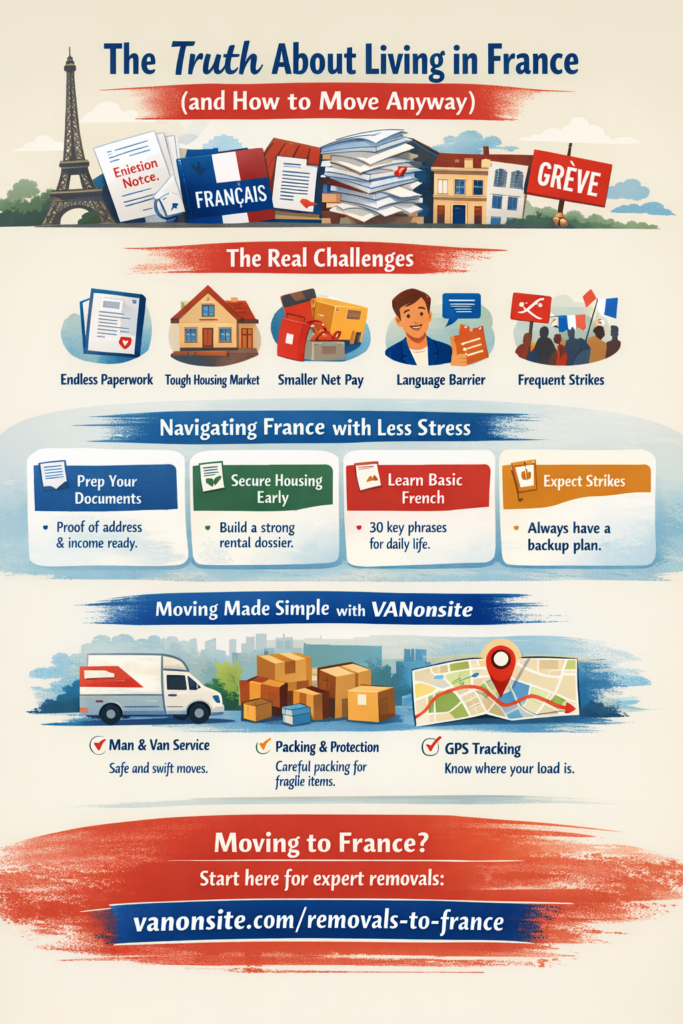
The big bad things about living in France usually come from systems and expectations.
- Paperwork is strict, and sometimes slow.
- Housing can be competitive, especially in major cities.
- Net pay can feel smaller than the headline salary.
- Language matters more than you think.
- Strikes can disrupt plans.
If you want the easiest path, treat this guide like a checklist. That is how the bad things about living in France become manageable.
Why people talk about bad things about living in France
People do not Google bad things about living in France because they hate France. They Google it because they are about to change their life and they want the hidden costs, the awkward moments, and the “nobody told me” details.
Many negatives are trade offs. France protects tenants, consumers, and workers. That protection is powerful once you are settled. At the start, it can feel like you are moving through velvet lined bureaucracy while your to do list grows teeth.
What usually triggers bad things about living in France conversations is the gap between expectation and reality.
- You expect “European move, easy.” You get strict admin steps.
- You expect “I will learn French there.” You need French on week one.
- You expect “I will find housing fast.” You discover dossier culture.
- You expect “public transport will save me.” Then a strike reshuffles your week.
When people list bad things about living in France, they usually mean:
- “I did not expect this much paperwork.”
- “I did not expect housing to be this competitive.”
- “I did not expect strikes to affect my week.”
- “I did not expect daily life to need French.”
Here is the good part. If you plan for these four early, half the bad things about living in France stop being scary and start being routine.
A fast mindset shift that helps: treat France like a system, not a mood. Systems reward preparation.
Bureaucracy and paperwork (the loudest of the bad things about living in France)
If there is one headline for bad things about living in France, it is administration. France loves documents that prove other documents. You may hear the phrase “justificatif de domicile” often. It means proof of address, and it can unlock a lot.
This is why the early weeks can feel circular. You need an address to open a bank account, You want a bank account to rent an apartment and finally, You want an apartment to prove your address. It is not personal. It is process.
The admin milestones that make life easier
Aim to hit these milestones in your first 30 to 60 days:
- Stable address, even temporary
- Bank access for rent and bills
- Local phone number for appointments
- Healthcare pathway started
- A clean dossier file you can reuse
Each milestone chips away at the bad things about living in France feeling.
Documents you may need, depending on your nationality
- EU, EEA, Swiss citizens: you can live in France, but local admin still matters for banking, healthcare, and work.
- Non EU citizens: you may need a long stay visa, then a residence permit process after arrival.
Use official sources first:
- Visas and requirements: France Visas
- Residence and foreigners’ rights: Service Public, foreigners in France
- Day to day procedures and forms: Service Public
Your paperwork stack (prepare this before you move)
Keep both scans and paper copies. Aim for 2 printed sets. That simple habit reduces the bad things about living in France stress fast.
Core documents that cover 80% of situations:
- Passport or national ID
- Birth certificate (often requested)
- Proof of income or work contract
- Rental contract, accommodation certificate, or host attestation
- Recent utility bill or proof of address
- Insurance documents if relevant
- A basic inventory of household items for the move
Smart extras that save you hours later:
- 10 to 20 passport photos
- A short letter of employment or income confirmation
- Copies of recent payslips or bank statements
- A simple “moving folder” in the cloud, with clear file names
The dossier trap (and how to escape it)
In many cities, landlords want a complete dossier before they even reply. This is a common source of bad things about living in France frustration.
Build a single PDF that includes:
- ID
- Income proof
- Work contract or employer letter
- Current address proof
- A short cover note
Keep it clean; Keep it readable; Keep it ready; Speed often wins.
Customs for household goods (especially for non EU moves)
If you are moving from outside the EU, including the UK, customs can be one of the bad things about living in France before you even arrive. You may need an inventory and supporting documents for personal effects.
Start with the official French Customs guidance: Douane.
To make customs smoother, keep your inventory simple and honest.
- Category first: “kitchen items”, “books”, “clothes”
- Then quantity: “6 boxes”, “2 suitcases”
- Then high value items separately: “laptop”, “TV”, “bicycle”
A practical trick: label boxes with both room and priority. Example: “Kitchen, Priority 1.” It speeds up unloading by 20% to 30% in many moves because decisions become automatic.
If you want a tiny upgrade that feels luxurious, add a color sticker per room. It sounds childish. It works fast. And it takes one of the most annoying bad things about living in France off your plate, which is arriving tired and not finding what you need.
Cost of living and housing (where bad things about living in France become personal)
Housing is where bad things about living in France turns emotional. It is not just about money. It is about feeling chosen. In hot markets, you can compete with dozens of applicants. Landlords often expect a complete dossier and fast answers. Sometimes you will feel like you are applying for a job, not a home.
The pressure is higher in Paris, the Riviera, and major student cities during late summer. If you plan your timing, you can cut the stress sharply.
Planning ranges that keep you realistic
These numbers vary by neighborhood and season, but they help you budget without fantasies.
| Expense (monthly) | Paris area | Major city (Lyon, Lille, Bordeaux) | Smaller town |
|---|---|---|---|
| One bed rent | €1,200 to €2,200 | €700 to €1,200 | €450 to €800 |
| Utilities | €120 to €250 | €100 to €220 | €90 to €200 |
| Groceries | €250 to €450 | €220 to €400 | €200 to €360 |
| Public transport | €50 to €100 | €30 to €80 | €20 to €60 |
Want a fast rule for your first budget draft? Add rent + utilities + groceries, then add 25% for everything else. That simple formula stops many bad things about living in France surprises.
The hidden housing costs people forget
These are classic bad things about living in France shocks because they arrive early, when your cash is already tied up.
- Deposit and agency fees in some cases
- First month rent paid upfront
- Moving day parking permits in dense areas
- Furniture replacement if your new place is smaller
- Home insurance (often requested before keys)
- Internet installation delays and setup fees
A solid buffer is 10% to 15% on top of your estimated budget for the first 90 days. If you are moving with a partner, aim for the higher end. Two people create more “first month” costs.
Why rentals can feel strict
The strictness is part of why bad things about living in France gets searched so often. Many landlords want proof you can pay, proof you will stay, and proof you are stable.
Here is what helps most:
- Show income clearly. Clean payslips and contracts win.
- Keep your dossier as one PDF.
- Add a short cover note with three punchy lines.
- Reply fast. In busy areas, speed beats charm.
If you are self employed, do not hide it. Explain it. A short paragraph plus clear financial documents often lands better than silence.
How to win the apartment hunt (without burning out)
Use a simple, disciplined approach:
- Build your dossier early and keep it updated.
- Write a short cover note. Three sentences can beat a silent application.
- Consider a temporary rental for 4 to 8 weeks.
- Be flexible on neighborhoods, not just cities.
- Visit with a checklist so you do not forget basics when you feel excited.
A helpful viewing checklist:
- Noise level at 8am and 8pm
- Heating type and insulation feel
- Water pressure in the shower
- Mobile signal and internet options
- Storage space and stairs or lift access
Those small checks save you from months of regret. They also reduce the most annoying bad things about living in France complaints.
A quick “move in ready” shopping plan
If your home arrives later than you, buy only what makes you comfortable for 7 days.
- Bedding
- One pot, one pan, one knife
- Towels
- Extension cord
- Basic cleaning kit
Everything else can wait. This keeps your costs tight, and it lowers the chance that bad things about living in France becomes “I spent €600 in panic shopping.”
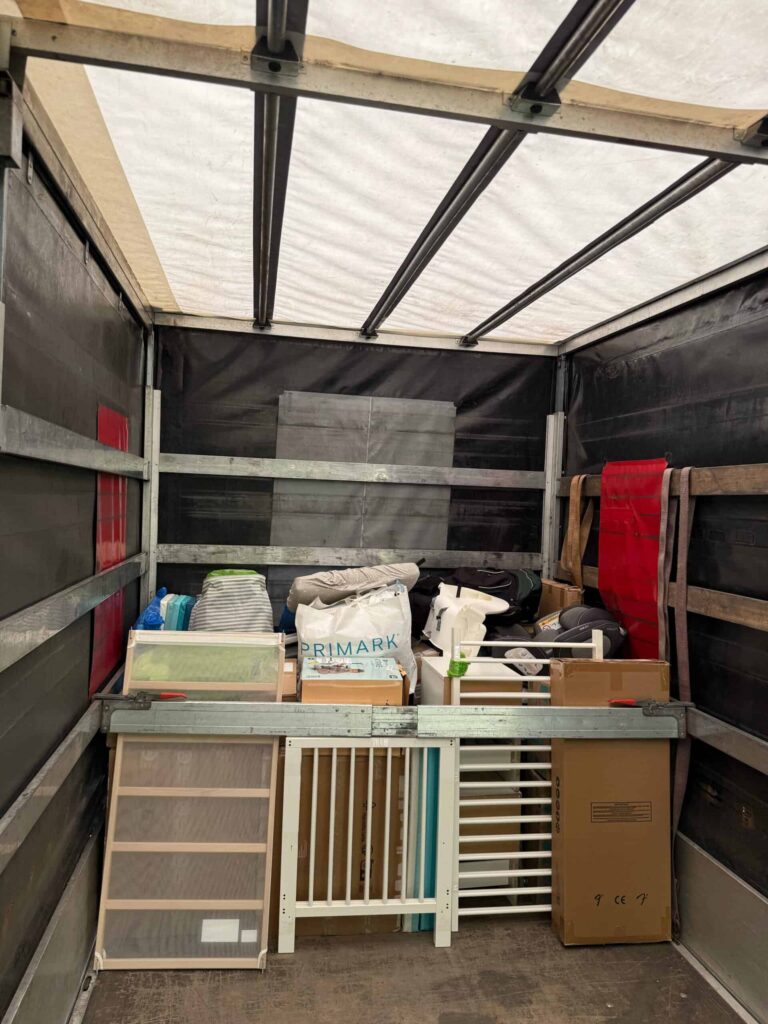
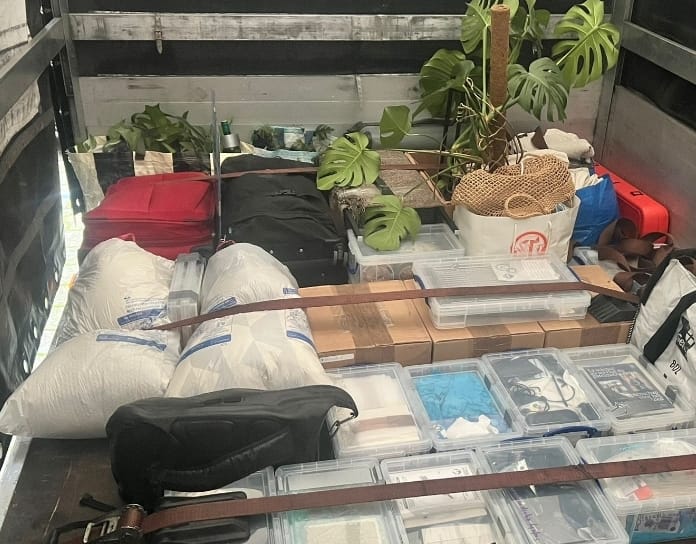
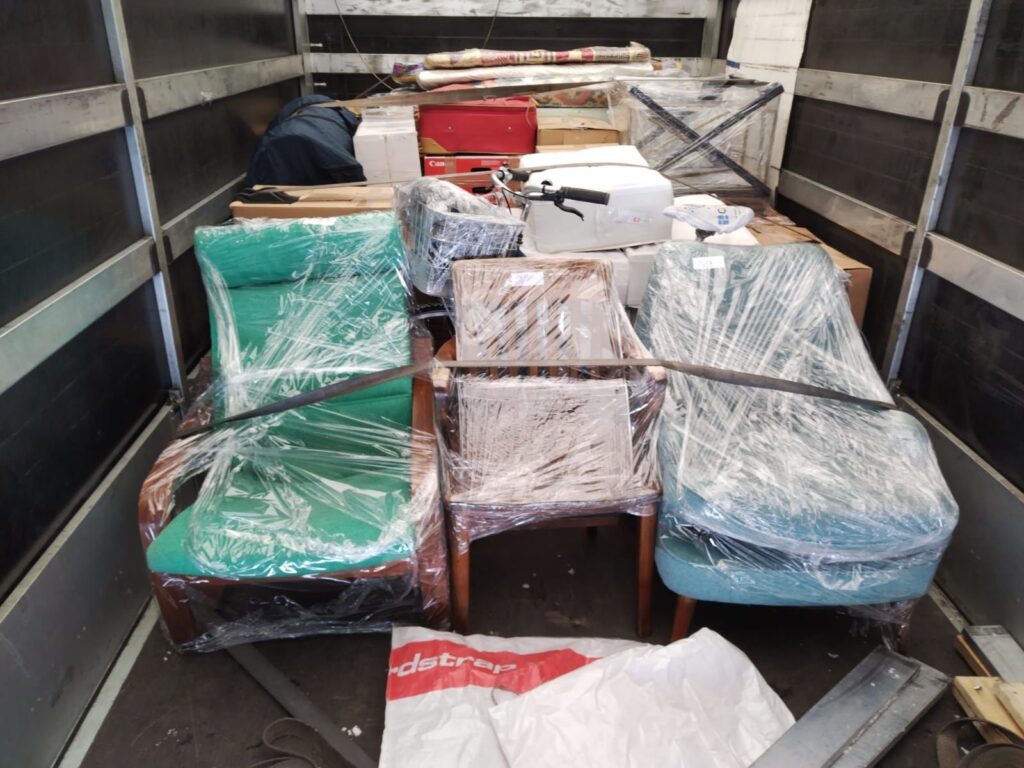
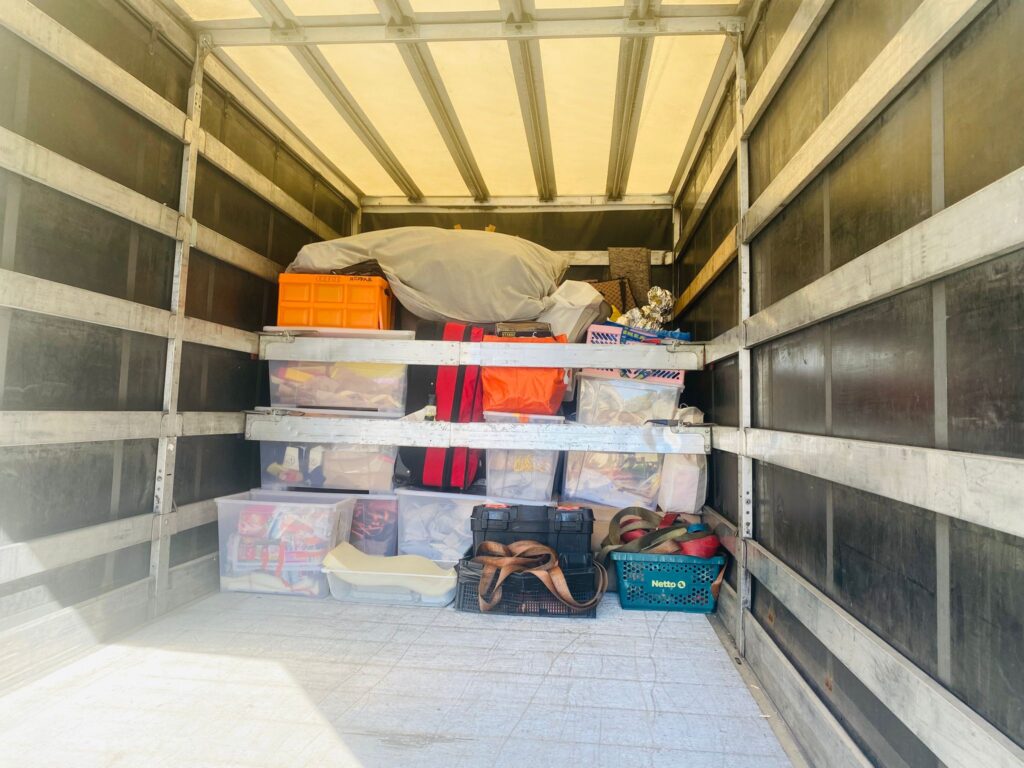
If you want your household to arrive fast and intact, start with Removals to France. A reliable man and van setup with GPS tracking is a quiet comfort when your new address still feels unfamiliar.
Taxes and take home pay (a quiet driver of bad things about living in France)
Money stress is one of the quieter bad things about living in France because it feels personal. Yet it is mostly predictable once you stop looking only at the gross salary.
France funds strong public services through higher social contributions. That means gross salary and net salary can feel far apart. Add rent deposits, setup costs, and a few surprises, and you understand why bad things about living in France threads get spicy.
The three numbers you should track
To stay calm, track three numbers, not one.
- Your monthly net income
- Your fixed monthly costs
- Your one time settling costs
If fixed costs are more than 60% of net income, life feels tight. If they are under 45%, life feels breathable. That simple ratio is a great reality check for bad things about living in France budget fear.
Settling costs people underestimate
These are not glamorous, but they are real.
- Deposits and upfront rent
- Furniture or replacements
- SIM cards and internet setup
- Basic household essentials
- Transport passes and commuting costs
A smart target is €1,500 to €3,500 per adult for settling, depending on city and how furnished your new place is. If that number stings, reduce the risk by arriving with less stuff and buying slowly.
Do this instead of guessing
- Ask recruiters for an estimated net salary.
- Build a 3 month buffer.
- Track recurring costs, not just rent.
- Set up a “settling budget” for one time costs like furniture, SIM cards, and deposits.
A simple monthly budget example
This sample is not a promise, it is a model. It shows why bad things about living in France often starts with “I did not realise the first month was so expensive.”
| Category | Month 1 example | Month 2 onward example |
|---|---|---|
| Rent | €1,000 | €1,000 |
| Utilities + internet | €180 | €180 |
| Groceries | €320 | €320 |
| Transport | €60 | €60 |
| Settling costs | €1,800 | €0 |
| Total | €3,360 | €1,560 |
Month one is a spike. After that, it smooths out. Planning for the spike is how you disarm the most painful bad things about living in France money shocks.
Language barrier and social codes (the sneaky bad things about living in France)
You can survive in English in tourist zones. Daily life is different. The bad things about living in France often show up at the bank, the pharmacy, a school office, or when you call a plumber and your brain suddenly forgets every word you know.
There is also a social rhythm. A small greeting can open doors. Skipping it can close them.
You do not need perfection. You need momentum.
The three social codes that save you daily
- Always start with “Bonjour” in shops, offices, and calls.
- Add “s’il vous plaît” and “merci” more than you think you should.
- Use a soft closing like “Bonne journée” when you leave.
These tiny habits reduce awkwardness fast. They also reduce the “cold vibe” stories that fuel bad things about living in France threads.
A 30 day language plan that actually works
Try this plan for the first 30 days:
- Learn 30 phrases you actually use.
- Use polite openings. “Bonjour” changes the temperature.
- Practice one short phone call script.
- Join one local activity where you speak weekly.
To make this practical, here are high impact phrases that cover most daily tasks:
- “Je voudrais…” (I would like…)
- “Je cherche…” (I am looking for…)
- “C’est possible aujourd’hui” (Is it possible today)
- “Je ne comprends pas” (I do not understand)
- “Pouvez vous répéter plus lentement” (Can you repeat more slowly)
- “Avez vous un document en anglais” (Do you have a document in English)
A simple phone call script you can copy
Phone calls are a classic source of bad things about living in France anxiety. Use this tiny script and read it slowly.
- “Bonjour. Je m’appelle [Name].”
- “Je voudrais prendre rendez vous.”
- “C’est pour [reason].”
- “Quand est ce possible”
- “Merci. Au revoir.”
It looks basic. It works because it keeps you calm.
Where English usually works and where it often fails
| Situation | English often works | French usually needed |
|---|---|---|
| Tourist restaurants | Yes | Sometimes |
| International companies | Often | Sometimes |
| Small local shops | Rare | Yes |
| Doctors and pharmacies | Sometimes | Often |
| Government offices | Rare | Yes |
If you want a sharp shortcut, learn the words you need for your move. Furniture. Boxes. Stairs. Parking. Keys. A man and van team can do the heavy work, but your words still smooth the day.
When your confidence grows, the bad things about living in France lose their bite.
Healthcare access and waiting times (a common bad things about living in France shock)
France has a strong healthcare reputation. Still, access can vary by region. In some areas, finding a general practitioner takes time, and specialist appointments may involve waiting. That gap between “great system” and “real access” is one reason bad things about living in France posts feel intense.
The smart move is to start early, even if you feel healthy.
What to do in your first weeks
- Start your health insurance steps as soon as you have your address basics.
- Choose a local doctor and register as early as possible.
- Keep copies of prescriptions and medical history.
- Ask your insurer what is covered during your transition period.
Official starting points:
- Health insurance and rights: Assurance Maladie (ameli)
- Healthcare guidance and procedures: Service Public, health
A simple healthcare timeline
Use this as a calm checklist. It turns a big unknown into small steps.
- Week 1 to 2: collect documents, proof of address, ID, and any existing insurance papers.
- Week 2 to 4: pick a general practitioner, ask locals for recommendations, book a first visit if possible.
- Month 1 to 2: organise ongoing prescriptions and specialist referrals if you need them.
What to carry with you on move day
This is a tiny kit that prevents huge stress later:
- A list of medications and dosages
- Prescriptions and medical summaries
- Vaccination records if relevant
- Emergency contacts
If you handle this early, you remove one of the most stressful bad things about living in France. You arrive feeling protected, not exposed.
Schools, childcare, and family logistics
For families, bad things about living in France sometimes means paperwork plus timetables. School registration and childcare spots can be competitive in popular neighborhoods, and the process can feel strict when you are still new and tired.
The biggest surprise is timing. In many places, the best options fill early, and the “last minute” approach can turn into one of the most stressful bad things about living in France.
How the school system can surprise newcomers
Even when the quality is strong, the logistics can bite.
- Catchment areas matter. Your address can decide your default school.
- Enrollment can require proof of address, even if you are temporarily housed.
- Some services require separate sign ups: canteen, after school care, transport.
Official starting point for school enrollment information is usually your local mairie and Service Public guidance:
- School enrollment procedures: Service Public, enrolling a child in school
The documents families often need
Exact requirements vary by commune, but these are commonly requested.
- Parent ID and child ID documents
- Proof of address (utility bill, rental contract, or accommodation attestation)
- Child’s birth certificate
- Vaccination record or health booklet details
- Previous school documents if transferring mid year
Pro tip: print one set and keep one digital set. It saves you 30 to 60 minutes every time someone asks again.
Childcare, crèches, and the waiting list reality
Childcare is a frequent topic in bad things about living in France discussions because it can feel like a competition you did not know you entered.
What helps most:
- Contact the mairie early, even before you move, to understand your local options.
- Ask about deadlines and required forms.
- Consider a short term solution for your first month, then upgrade once you learn the area.
A practical family move plan
A calm plan makes the move feel humane. It also keeps your kids from absorbing your stress.
- Pick the neighborhood with school access in mind, not just rent price.
- Collect documents early and store them in a shared folder.
- Visit in person when possible. Relationships help.
- Plan your first two weeks like a soft landing: fewer errands per day, more routine.
Quick comparison table for planning
| Topic | What usually goes wrong | What to do instead |
|---|---|---|
| School enrollment | Missing proof of address | Secure a temporary address document and print copies |
| Canteen and after school care | Forgetting separate sign ups | Ask the school for a full checklist on day one |
| Childcare | Starting too late | Contact the mairie early and join waiting lists |
| Moving day | Kids get overwhelmed | Keep a 72 hour essentials bag and one quiet room |
If you want the practical comfort of a smooth arrival, keep your first week light, and let a man and van team handle the heavy parts.
Driving, tolls, parking, and low emission rules
Driving in France can be smooth on long routes, but toll roads add up. Parking in cities can be strict and expensive. Some zones limit certain vehicles. These everyday costs are part of the bad things about living in France conversation, especially if you rely on a car for commuting.
Tolls and fuel: the hidden monthly drain
A few motorway trips can quietly add €40 to €120 a month, depending on your routes. For many newcomers, that is how bad things about living in France becomes “why is my budget leaking.”
Simple ways to reduce it:
- Use toll roads for long runs only, not short hops.
- Compare routes before you drive. Ten minutes longer can save real money.
- If you commute daily, price the commute before you sign the lease.
Parking: the rule book is not optional
In dense cities, parking can be the most annoying daily bad things about living in France surprise.
- Street parking zones can change block by block.
- Some neighborhoods require resident permits.
- Fines can arrive fast if you guess.
Move day tip: reserve loading space if your city allows it, and plan your building access window. It can save 30 to 90 minutes on a tight relocation schedule.
Low emission zones and the Crit’Air sticker
Some cities have low emission rules that restrict vehicles based on emissions class. If you drive regularly, this can be one of the more expensive bad things about living in France if you ignore it.
Official Crit’Air certificate site:
If you are unsure whether you need it, check your city’s rules and apply early. Delivery times can vary.
Driving licence and car admin
Start with official guidance if you need to exchange or use a licence:
If you are bringing a vehicle, plan admin tasks in a realistic order: address basics first, then insurance and registration steps. That sequence helps you avoid the classic bad things about living in France loop where one missing document blocks everything.
A calm driving plan is simple: know your commute costs, understand parking rules, and handle emissions requirements early.


Strikes, service interruptions, and culture shock
Strikes happen, and they can disrupt trains, schools, and services. This is one of the most visible bad things about living in France because it hits your calendar with no mercy.
The shock is not that strikes exist. The shock is the ripple effect. One delayed train can turn into a missed appointment, a late school pickup, and a day that feels like it was stolen.
Where strikes hit hardest
These are the areas that most often feed bad things about living in France frustration:
- Public transport, especially commuter routes
- Schools and childcare schedules
- Waste collection in some cities
- Administrative appointments that get moved or cancelled
A simple “strike proof” routine
You do not need to become a news addict. You need a backup plan that you can activate in 60 seconds.
- Keep a backup commuting route saved on your phone.
- Build a 20 minute buffer for anything important.
- For critical days, avoid relying on one connection.
- If you have kids, have one emergency pickup contact.
Reduce the chaos on your calendar
- Keep a backup commuting plan.
- Avoid booking critical appointments on high risk days when you can.
- Use a transport partner that communicates and tracks your shipment.
If you are moving, strikes can turn moving day into a pressure cooker. That is exactly why a man and van service with GPS tracking feels like a relief. You are not guessing where your life is. You can see it.
Culture shock is real, and it is not weakness
Some bad things about living in France are not paperwork, they are emotional.
- You may feel lonely even in a beautiful city.
- You may miss small talk, or you may miss space.
- You may feel judged when your French is slow.
This usually fades in 8 to 12 weeks as your routines become yours.
France is also a mosaic. Brittany feels different from Provence. Paris feels different from everywhere. Some bad things about living in France are simply regional surprises.
A helpful way to choose your landing spot is to compare your priorities.
| Priority | City life often offers | Smaller towns often offer |
|---|---|---|
| Career options | More roles, faster networking | Fewer roles, calmer pace |
| Housing | Higher costs, smaller space | Better value, more space |
| Language exposure | Less pressure to speak | More daily French practice |
| Lifestyle | Events, nightlife, intensity | Quiet, nature, routine |
If your move is flexible, visit two regions before you decide. Many bad things about living in France stories are really “I chose the wrong place for my personality.”
The moving plan to France (so the bad things about living in France do not follow you into move day)
A move is emotional. It is also logistics. If you plan it like a project, the bad things about living in France feel less dramatic because you arrive with control.
A great move has one goal: you arrive safe, your items arrive safe, and you can sleep on night one.
The 4 decisions that make your move smoother
Make these decisions early and your stress drops fast.
- Do you want speed or budget as the top priority
- Do you need packing help
- Do you need storage between homes
- What vehicle size fits your real volume
A solid man and van plan is not only transport. It is timing, access, and protection.
A 14 day relocation timeline
- Confirm move date and access windows (lifts, stair rules, parking permits).
- Sort belongings into keep, sell, donate, recycle.
- Photograph fragile items and furniture condition.
- Book packing help if you want speed and fewer breakages.
- Prepare a survival suitcase for the first 72 hours.
- Collect document copies and store them in the cloud.
- Label boxes by room and priority.
- Plan first night essentials: bedding, chargers, kettle, basic tools.
- Confirm insurance and GPS tracking details.
- Do a final walkthrough and take meter photos if leaving a rental.
- Prepare a “no pack” zone for passports, laptops, chargers, medicines.
- Confirm loading and unloading parking rules for both addresses.
- Send your building access notes to the moving team.
- Get cashless payment ready and keep receipts in one folder.
A move day checklist that prevents panic
This is the stuff people forget, then regret. It is also the stuff that turns into bad things about living in France stories.
- Keys, access codes, intercom names confirmed
- Lift reserved if required
- Stair corners protected for large furniture
- Bottles of water, snacks, and a small tool kit
- Trash bags, paper towels, wipes
- Photos of meters and walls before you leave
Packing that protects your life
Packing is where many relocation stories break. It is also where you can win.
VANonsite offers a dedicated Packing Service for people who want less chaos and fewer damaged items. For fragile or high value items, consider White Glove Delivery for careful handling and placement.
If you want a simple rule: pack 25% fewer “random” boxes. Pack more by room and purpose. Your unpacking speed can double.
Box labeling that makes unpacking fast
Labeling is not a cute detail. It is the difference between a calm first night and a chaotic one.
Use this format:
- Room
- Priority (1 to 3)
- Top items inside
Example: “Kitchen, Priority 1, plates, kettle, coffee.”
How GPS tracking reduces moving stress
GPS tracking matters because uncertainty is expensive. It costs time, it costs energy, and it creates the worst kind of anxiety.
With GPS tracked transport, you get:
- Real visibility on where the load is
- Fewer check in calls and fewer unknowns
- Better arrival coordination, especially across borders
That is how your move becomes the calm chapter, even while you are researching bad things about living in France.
VANonsite removals to France (fast, safe, GPS tracked)
When you are reading about bad things about living in France, let your move be the easy part.
VANonsite delivers high quality transport across Europe with a safety first mindset and GPS tracking for every load. Start here:
Choose the right vehicle size
Pick a vehicle based on volume and weight. Then add a little breathing space. Running out of space is a brutal move day version of bad things about living in France.
| Vehicle | Volume | Max load |
|---|---|---|
| Moving One | 1 m3 | 100 kg |
| Moving Basic | 5 m3 | 300 kg |
| Moving Medium | 10 m3 | 500 kg |
| Moving Premium | 15 m3 | 1,100 kg |
| Moving Premium Plus | 30 m3 | 3,500 kg |
| Moving Full House XXL | 90 m3 | 20,000 kg |
Services that match real life
A flexible man and van service matters because every move is different. VANonsite can support:
- Last Minute Moving when time is sharp
- Furniture Removals for heavy, awkward pieces
- Home Removals for full households
- Office removals for business moves with minimal downtime
- Storage for flexible timing
- Student Removals for compact budgets and fast turnarounds
A good man and van move should feel simple: clear communication, careful hands, and live tracking that lets you breathe.
Fast FAQ: bad things about living in France
If you are scanning this section because you are busy, here is the sharp truth. Most bad things about living in France feel loud at the start, then quiet down once you have an address, a routine, and a system for your move.
Are the bad things about living in France the same everywhere?
No. Many bad things about living in France are city specific. Bureaucracy is nationwide, but rent, noise, safety, and daily pace change dramatically by region. Paris can feel intense and expensive. Smaller towns can feel calmer, but sometimes harder for English only life.
What is the biggest pain point for newcomers?
For many people, the biggest of the bad things about living in France is paperwork, especially before you have a stable address. A temporary address and two printed document sets can reduce admin stress fast.
How much money should I keep as a buffer?
A practical minimum is 3 months of fixed costs. If rent and bills are €1,500 a month, aim for €4,500. This single buffer protects you from the nastiest bad things about living in France surprises in month one.
How early should I plan a move to France?
If you want calm dates and the best availability, plan 14 to 30 days ahead. If life forces speed, a man and van move can still be organised quickly, especially with clear access notes and a simple inventory.
Can I move last minute across borders?
Yes. VANonsite supports last minute routes, and GPS tracking keeps you informed even when plans change. If keys shift or your handover time moves, visibility matters.
How do I protect fragile items in transit?
Use professional packing, strong boxes, and room based labeling. Packing is where many bad things about living in France stories begin, but it is also the easiest part to upgrade.
For extra protection, use:
What if I only need to move furniture?
That is common, especially if your new home is furnished. Use Furniture Removals and prepare a quick list: item type, approximate size, and which pieces are fragile.
What if I am moving a full household?
Choose Home Removals and keep a 72 hour essentials bag separate. This avoids the classic bad things about living in France moment where you arrive late and cannot find bedding, chargers, or kitchen basics.
Do you offer storage if my dates do not match?
Yes. Storage is ideal when you are waiting on keys, renovating, or landing in temporary housing. It also reduces stress if your move happens in two steps.
I am relocating for work. Can you move an office?
Yes. Use Office removals and label boxes by team and priority so people can work again fast.
How do I choose the right vehicle?
Estimate volume, then add 10% extra for awkward shapes. If you are uncertain, step up one size. It is cheaper than a second trip and it avoids a move day version of bad things about living in France.
Choose the larger size if:
- You have bulky items like sofas, wardrobes, or bicycles
- You have more than 25 medium boxes
- You have fragile items that need space and padding
Summary
The bad things about living in France are real, but they are not a verdict. They are a checklist. Use that checklist, plan the move, and you arrive with confidence.
If you want your relocation to feel secure, quick, and human, book a man and van partner that treats your life like cargo worth protecting. Start here: Removals to France. VANonsite keeps every load visible with GPS tracking and handles moves across Europe with care.