
Keys in hand. Cartons stacked like a tiny skyline. One suitcase open on the bed, daring you to decide what your next life should weigh.
That is the hidden truth of moving. The van is the last chapter. The real story is decisions, dozens of them, made while you are tired, excited, and slightly terrified.
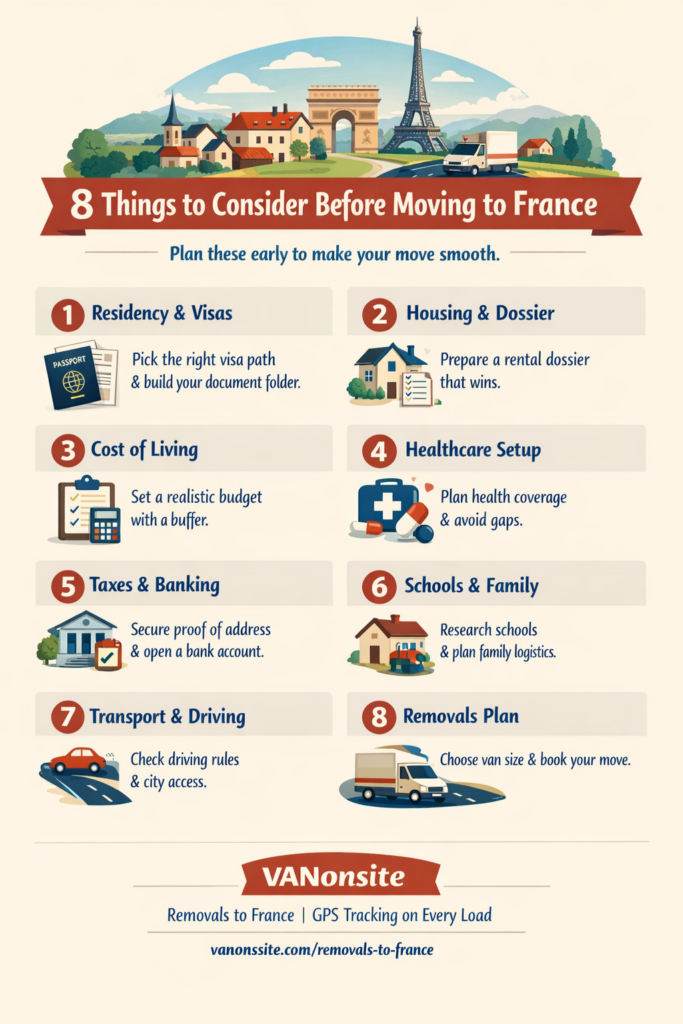
This guide covers the eight things to consider before moving to France that keep your move clean, quick, and surprisingly calm. If you handle these eight choices early, you cut delays, protect your budget, and avoid the kind of stress that turns a dream move into a paperwork marathon.
When you are ready to plan the transport side, including man and van options, start here for routes and quotes: https://vanonsite.com/removals-to-france/
Quick answer
If you want the fastest path, these are the eight things to consider before moving to France.
- Residency status and required documents
- Housing reality and your rental dossier
- Cost of living and your move budget
- Healthcare setup and the transition gap
- Taxes, banking, and proof of address
- Schools, childcare, and family logistics
- Transport, driving, and city access rules
- Your removals plan, timing, van size, and service level
A well planned international move can reduce last minute issues by around 30 to 50%, because the biggest risks are predictable and therefore preventable.
A simple 30 day move timeline
Use this timeline as a quick compass. It keeps the eight things to consider before moving to France practical, not theoretical.
30 to 21 days before
- Confirm your address plan and access details
- Build your document folder
- Start your inventory and decide what you will sell or donate
20 to 14 days before
- Book removals and confirm pickup and delivery windows
- Finalise packing supplies and your label system
- Set up phone, banking, and admin notes for arrival
13 to 7 days before
- Pack non essentials
- Keep an essentials box for the first night
- Confirm lift bookings, parking permissions, and building rules
6 to 0 days before
- Pack essentials last
- Print key documents
- Confirm the handover plan and route updates
A small rule that helps. If you can shift your moving date by 2 to 4 days, you often unlock better routing and smoother availability.
The eight things to consider before moving to France
Residency status and required documents
The first of the eight things to consider before moving to France is simple but powerful. How long are you staying and on what basis. This decision shapes everything else, from your timeline to the paperwork you must carry.
For short stays, many visitors follow the 90 days in 180 days rule. For longer stays, you may need a visa or a residence path. Either way, build a document folder early. It is the calm anchor of the entire move.
Start with official sources and keep your notes in one place.
- France Visas: https://france-visas.gouv.fr/en/
- Service Public, official guidance: https://www.service-public.fr/
- EU residence rights for EU citizens: https://europa.eu/youreurope/citizens/residence/residence-rights/index_en.htm
A practical way to pick the right route
One reason this sits at the top of the eight things to consider before moving to France is that it saves weeks. Once you know your route, you can build one clean pack of evidence and stop second guessing.
Use this quick filter:
- Staying temporarily, no work, and you have funds and coverage: treat it as a visitor style plan and focus on proof.
- Moving for a job, study, or family reason: align every document with that purpose.
- Unsure yet: choose the strictest realistic route and build your folder to that standard.
Keep your story consistent. The same dates; The same spelling of names; The same address format.
Core document folder
| Document | Why it matters | When to prepare |
|---|---|---|
| Passport or ID | identity, travel, admin | 12 to 10 weeks before |
| Proof of address in France | unlocks banking, utilities, admin | as soon as housing is planned |
| Proof of income or funds | visas, rentals, stability | 10 to 8 weeks before |
| Health coverage proof | reduces risky gaps | 10 to 6 weeks before |
| Civil status documents | marriage, birth, family admin | 10 weeks before |
| Copies and scans | backup for worst case moments | 1 day after each document is collected |
Small upgrades that make your folder feel official
- Scan everything into one cloud folder plus one offline backup.
- Rename files clearly, for example Passport Jane Smith, Lease Lyon March 2026.
- Keep printed copies of the top five documents in a slim folder.
- Save a one page summary with your address, key dates, and contact details.
A realistic document timeline
- 12 weeks before: choose your route, start the folder, request any replacement documents.
- 8 weeks before: confirm your address plan and collect proof of funds or income.
- 6 weeks before: confirm health coverage and keep proof accessible.
- 2 weeks before: print, scan again, and pack the folder in your carry bag.
Housing reality and your rental dossier
Housing is often the make or break step, which is why it sits high on the eight things to consider before moving to France.
In many areas, landlords expect a rental dossier that makes your profile feel safe. Think of it as a confidence package, not a pile of pages.
Typical dossier items include:
- ID
- proof of income
- recent bank statements
- employment contract or pension statement
- previous landlord reference if you have one
- a short cover note that explains who you are and why your timeline is stable
Official guidance on renting and tenant rights:
- Service Public, renting: https://www.service-public.fr/particuliers/vosdroits/N19808
The dossier structure that wins fast
A simple structure:
- Page 1: cover note, who you are, move date, job or stability summary
- Page 2: ID
- Page 3 to 5: income or funds proof
- Page 6: bank statements summary
- Page 7: references if you have them
If you can, keep the full dossier under 10 pages.
| Dossier item | What it proves | Quick improvement |
|---|---|---|
| Cover note | stability and intention | keep it to 6 to 8 lines |
| Proof of income | ability to pay | highlight monthly net |
| Bank statements | financial consistency | mark salary inflows |
| Contract or pension proof | reliability | match dates to move |
| References | low risk | include a phone number |
A tiny script that makes you sound confident
When you ask for a viewing, keep it crisp.
- who you are
- when you can move
- what documents you already have ready
It is a small move, yet it signals low risk. That matters.
Avoid the rental traps
Red flags:
- pressure to pay immediately without a viewing or clear contract
- vague identity of the owner or agency
- a deal that is dramatically cheaper than the area average
If anything feels rushed, slow it down.
Moving day reality, access changes cost
| Building issue | Moving day fix | Time saved |
|---|---|---|
| No lift | pre plan smaller loads, protect corners | 30 to 90 minutes |
| Lift needs booking | reserve slot early, confirm in writing | avoids refused delivery |
| Long carry distance | clear the route, keep the entrance open | 20 to 60 minutes |
| Narrow street | plan legal stopping, pick a smaller van if needed | avoids fines and delays |
If your building is tight, this is where man and van shines. A smaller vehicle can be the difference between a smooth drop off and a delivery that stops two streets away.
If you are taking large furniture, consider a specialist approach like https://vanonsite.com/furniture-removals/ or https://vanonsite.com/white-glove-delivery-service/ when the items are high value or awkward.
Cost of living and your move budget
Budget is one of the eight things to consider before moving to France because money stress steals joy.
Build a simple split and give yourself breathing room, plus a buffer. A smart buffer is 10 to 15% of your total moving budget.
| Budget area | Typical share of moving budget | Notes |
|---|---|---|
| Transport and removals | 35 to 55% | biggest levers are volume, route, and timing |
| Deposits and housing setup | 20 to 35% | deposit, first month, agency fees if applicable |
| Admin and documents | 5 to 10% | copies, translations, appointments |
| Essentials and first week | 10 to 20% | phone, groceries, bedding, small basics |
| Buffer | 10 to 15% | protects you from surprises |
The real cost drivers
- Volume and weight
- Flexibility, a 2 to 4 day window can unlock better options
- Service level, self pack vs full packing and dismantling
- Access, stairs, long carry distance, narrow streets, lift bookings
A quick win is to reduce volume early. Cutting volume by 15 to 30% often drops you into a smaller vehicle tier.
Hidden costs people forget
- last minute furniture dismantling
- extra packing materials bought in panic
- temporary storage because keys do not align
- parking fines or paid permits in busy areas
- replacing essentials you accidentally packed, chargers, bedding, kettle
A simple move budget example
If your move budget is €3,000, a clear split might look like this.
| Line item | Example amount | Why it helps |
|---|---|---|
| Removals and transport | €1,350 | keeps the core plan strong |
| Housing setup | €900 | deposit and move in costs |
| Admin and documents | €180 | practical and realistic |
| First week essentials | €270 | protects comfort and routine |
| Buffer | €300 | absorbs surprises |
Packing support, when it fits the story: https://vanonsite.com/packing-services/
Healthcare setup and the transition gap
Healthcare is one of the eight things to consider before moving to France that protects you when life happens.
The goal is to avoid the transition gap where you need care but cannot navigate the system yet. Start early. Keep your plan simple.
Official sources:
- Assurance Maladie: https://www.ameli.fr/
- Service Public: https://www.service-public.fr/
What to prepare before you travel
- copies of prescriptions
- a short medical history summary
- proof of coverage
- emergency contact list
- enough essential medication for at least 30 days, if possible
If you have children or ongoing prescriptions, create a one page sheet with medication names, dosages, allergies, and GP contact details.
Your first 72 hours
- Save emergency numbers and your address in your phone. In France, 112 works across services.
- Locate your nearest pharmacy and note opening hours.
- Keep prescriptions and key medical notes accessible.
- If you have a long term condition, identify the nearest clinic and check how to book.
A calm mindset for healthcare
Think of healthcare setup like a staircase. You do not have to run. You just have to keep climbing, one step at a time.
Taxes, banking, and proof of address
Proof of address is the master key, which is why this stays on the list of the eight things to consider before moving to France.
Useful official links:
- Taxes, Je déménage: https://www.impots.gouv.fr/particulier/je-demenage
- Online change of address: https://www.service-public.gouv.fr/particuliers/vosdroits/R11193
Proof of address, what counts in real life
Common examples that often work:
- rental lease
- utility bill in your name
- home insurance certificate
- formal accommodation attestation with supporting documents
Aim to secure one strong proof of address in the first 7 to 10 days.
Banking, make it quick and clean
Documents that often speed up a bank account:
- ID
- proof of address
- proof of income or funds
- phone number
| Admin step | What it unlocks | A realistic target |
|---|---|---|
| Proof of address | banking, utilities, contracts | first 7 to 10 days |
| Phone number | verifications and logins | first 24 to 72 hours |
| Bank setup start | payments and deposits | week 1 |
| Tax profile update | smoother admin and mail | week 1 to 2 |
A small habit that saves hours
Any time you submit a form, take a photo of it. Save it in the same folder as your documents. Later, when a question appears, you have proof.
Schools, childcare, and family logistics
If you have children, this becomes one of the most emotional eight things to consider before moving to France.
Official guidance:
- Enrolling a child in primary school: https://www.service-public.gouv.fr/particuliers/vosdroits/F1865
What to prepare before you contact a school
- child ID and basic details
- proof of address or your housing plan
- vaccination records or health documents
- previous school records if available
Your first month, family logistics that reduce stress
- create two routines, morning and bedtime
- plan a simple lunch and snack system for the first 2 weeks
- pick one local activity to build belonging
- keep the first month light on major purchases
A quick emotional reset
Your child will mirror your nervous system. So give yourself a gift. Choose one corner of the new home and make it cosy on day one. A lamp. A blanket. Familiar books. It turns a new place into a refuge.
Transport, driving, and city access rules
City access sits on the eight things to consider before moving to France list because it can make or break delivery day.
Official starting points:
- Service Public: https://www.service-public.fr/
- ANTS vehicle admin: https://immatriculation.ants.gouv.fr/
If you are moving into a larger city, check low emission rules and sticker requirements.
Helpful official sources:
- Crit’Air sticker and rules: https://www.certificat-air.gouv.fr/
- Low emission zones information: https://www.ecologie.gouv.fr/zones-faibles-emissions-mobilite
The access checklist that prevents delivery day chaos
- Confirm if your building requires lift booking, then reserve it.
- Ask if there are restricted delivery hours.
- Check the street width and turning space for your vehicle size.
- Confirm legal stopping and loading space. If needed, request a permit.
- Measure the carry distance from curb to door.
A simple benchmark: if carry distance is more than 30 metres, unloading time can jump by 30 to 60 minutes.
Parking and permissions, the quiet budget saver
If your building is central, ask your landlord or building manager about local rules. A five minute message can save a fine. It also saves time.
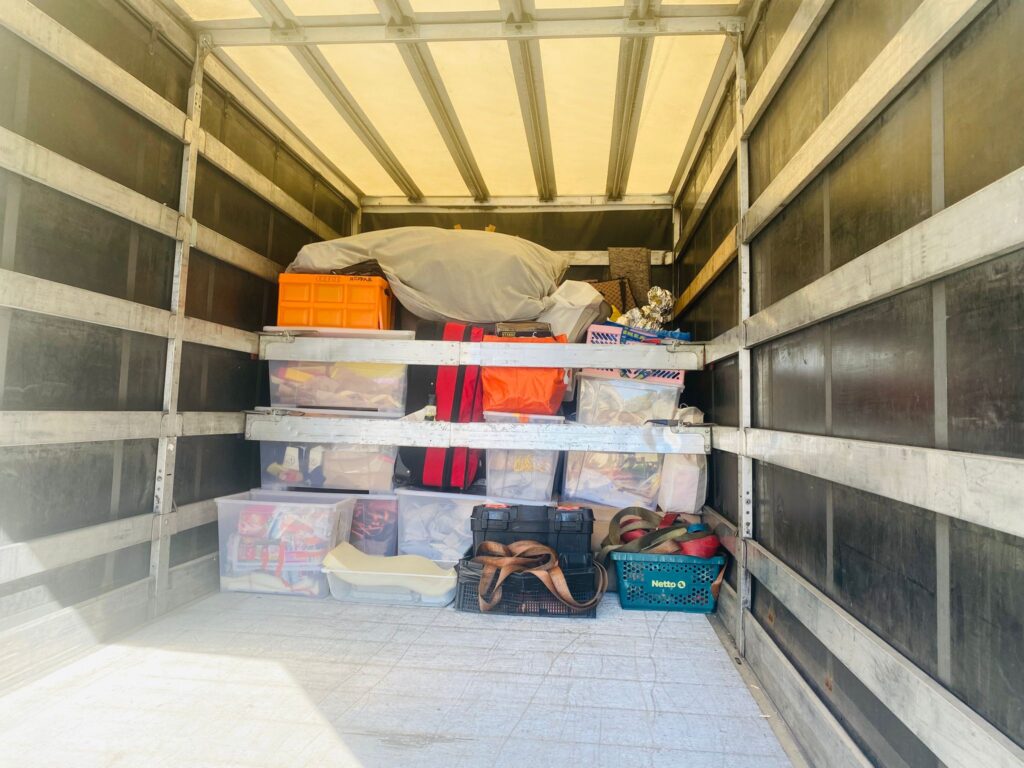
Your removals plan, timing, van size, and service level
This is where planning turns into movement.
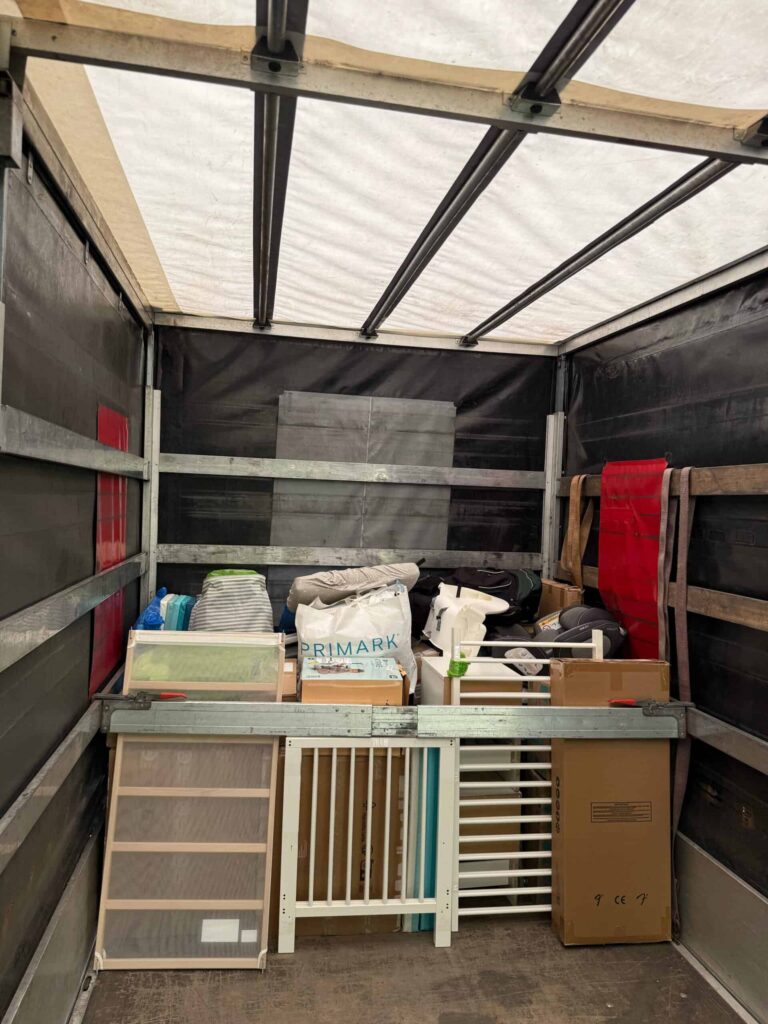
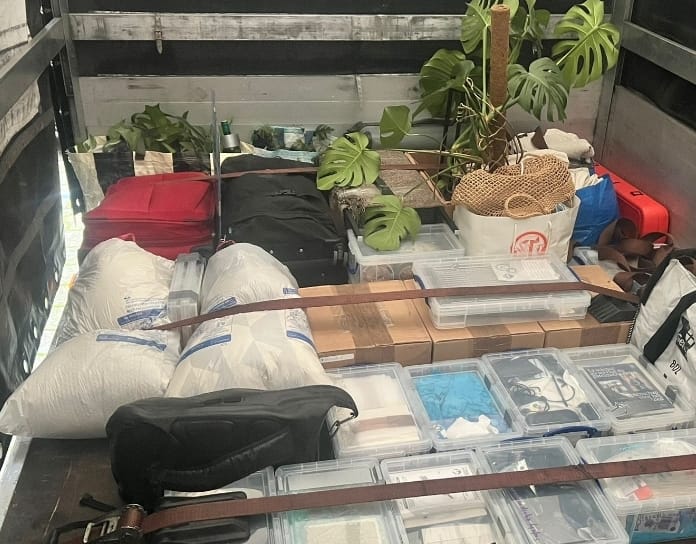
Man and van is ideal when you want speed and fewer transfers. It suits smaller moves, tighter schedules, and loads you want kept together.
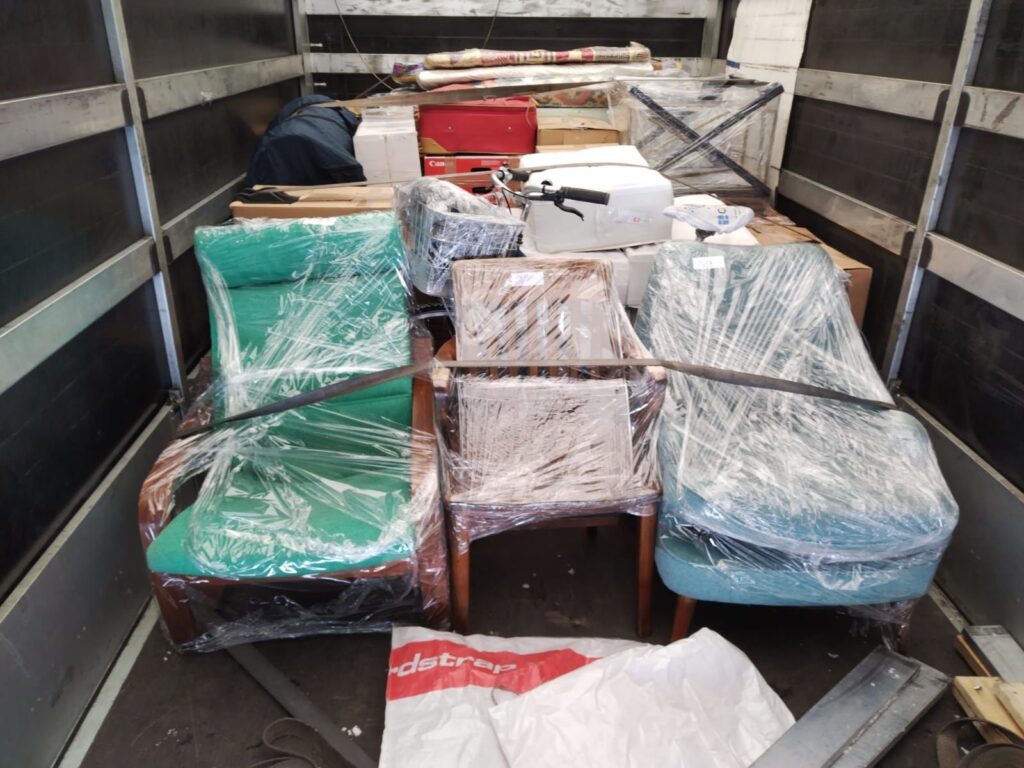
Full removals is worth it for family homes, bulky furniture, complex packing, and when you want the heavy lifting taken off your shoulders.
A practical planning anchor is delivery timing. Dedicated transport is often 2 to 6 days door to door, depending on distance and access. Shared load can take longer but may lower cost.
Booking guidance: in busy periods, plan 3 to 6 weeks ahead to protect your preferred slot.
Plan your move and get a quote here: https://vanonsite.com/removals-to-france/
Supporting services, when relevant:
- Home Removals: https://vanonsite.com/home-removals/
- Furniture Removals: https://vanonsite.com/furniture-removals/
- Packing Service: https://vanonsite.com/packing-services/
- White Glove Delivery: https://vanonsite.com/white-glove-delivery-service/
- Office removals: https://vanonsite.com/office-removals/
- Student Removals: https://vanonsite.com/student-removals/
Choose the right vehicle size
Picking the right van size saves real money. Too small means a second trip or last minute changes. Too large means you pay for air.
| Package | Volume | Payload | Best for |
|---|---|---|---|
| Moving One | 1 m3 | 100 kg | essentials and a few boxes |
| Moving Basic | 5 m3 | 300 kg | student room, small studio |
| Moving Medium | 10 m3 | 500 kg | 1 bed flat |
| Moving Premium | 15 m3 | 1100 kg | 2 bed flat |
| Moving Premium Plus | 30 m3 | 3500 kg | family home |
| Moving Full House XXL | 90 m3 | 20000 kg | large home or office |
Quick hints:
- 10 medium boxes about 0.8 m3
- sofa often 1.5 to 2.5 m3
- double mattress often 0.8 to 1.2 m3
- wardrobe often 0.8 to 2.0 m3
- bicycle often 0.3 to 0.6 m3
A fast method:
- Count boxes and multiply by 0.08 m3.
- Add bulky furniture.
- Add a 10 to 15% buffer.
Timing choices that change the whole experience
- If you can offer a 2 to 4 day window, you often unlock better routing.
- If you need a precise date, choose a dedicated route and confirm access details early.
- If you are moving into a city centre, match the vehicle size to the street reality, not just your volume.
What never goes in the van
- passports and key documents
- medication
- jewellery and irreplaceable items
- chargers and essentials for the first night
- a change of clothes and basic toiletries
- keys, contracts, and anything you need to access the new home
VANonsite offers GPS tracking for every load, so you can plan lifts, parking, and handover timing with confidence.
Packing mini guide
Packing protects your belongings and speeds up delivery day. It also makes your inventory cleaner, which supports the eight things to consider before moving to France.
A label system that works
Write three lines on every box:
- Room
- Priority, 1 to 3
- Two or three key items
Example: Kitchen, Priority 1, mugs, kettle, coffee.
Priority guide:
- Priority 1, you need it in 24 hours
- Priority 2, you need it in the first week
- Priority 3, you can live without it for two weeks
Box weight rules
- keep boxes under 20 kg
- aim for 12 to 18 kg for comfort and speed
- fill gaps so fragile items do not rattle
Essentials box for the first night
- chargers and adapters
- toiletries
- bedding basics
- kettle or coffee essentials
- one set of plates and cutlery
- a small tool kit, tape, scissors
If you want help, link once and keep it relevant: https://vanonsite.com/packing-services/
FAQ
How long does an international move to France usually take?
A good planning anchor is 2 to 6 days for a dedicated door to door run. If you are moving into a tight city centre, add 1 extra day of buffer for access, lift booking, or parking permissions.
Do I need a visa to move to France?
That depends on your nationality and how long you will stay. Start here:
What documents do I need to rent a home?
A rental dossier usually includes ID, proof of income, recent bank statements, and proof of address plans. A clean dossier wins faster when it is short and readable.
How do I set up healthcare in France?
Start early and keep proof of coverage and medical documents accessible:
Is man and van enough for my move?
For a smaller move, yes. Man and van works best for studios and 1 bed flats, smaller furniture sets, and tight move in dates.
How do I choose the right van size?
Estimate your volume, add a 10 to 15% buffer, then pick the closest tier.
How far ahead should I book removals?
In peak periods, 3 to 6 weeks ahead helps. If you can offer a 2 to 4 day delivery window, you often unlock better routing.
Can I track my load?
Yes. VANonsite offers GPS tracking for every load.
Where do I start for routes and a quote?
Summary and next step
These eight things to consider before moving to France are the backbone of a calm relocation.
Choose your residency and document route first. Secure housing and build a dossier that gets read. Set a realistic budget with a buffer. Plan healthcare, banking, and proof of address. If you have children, protect routines early. Then lock in logistics and city access details.
Finally, make the removals plan match your real life. Man and van for smaller fast moves. Full removals for bigger homes, heavier furniture, and tighter schedules.
When you are ready to turn planning into action, start here for routes, options, and quotes: