
The cost of moving to Germany is one of the first things people worry about, and for good reason. A move can feel exciting on paper and expensive in real life. One quote sounds reasonable. Another feels wildly high. Then packing, timing, route length, van size, and extra services start changing the picture.
The reassuring part is this: the true cost of moving to Germany becomes much easier to understand when you break it down into route, volume, access, timing, and service level. Once those elements are clear, the whole relocation starts to feel less like a financial fog and more like a decision you can actually control.
TL:DR
- The cost of moving to Germany can start at around EUR 574.28 for some shorter routes and rise well above EUR 1,500, with the VANonsite page also showing a much higher example of EUR 4,775.00 for Greece.
- VANonsite’s public route examples are based on estimated prices for a 20 m³ van, so they should be treated as price anchors, not fixed universal quotes.
- The final price usually depends on five things most: origin country, route length, moving volume, access at both properties, and timing.
- A man and van service is often the most cost-efficient choice for student moves, compact flats, furniture transport, and part-load relocations.
- Choosing the wrong van size can increase the total moving cost, either by overpaying for unused space or by creating problems with capacity.
- Extra services such as packing, white glove delivery, storage, urgent scheduling, and fragile-item handling can all raise the quote.
- The smartest way to avoid overpaying is to request a realistic quote based on exact route, load size, and access details.
What is the average cost of moving to Germany?
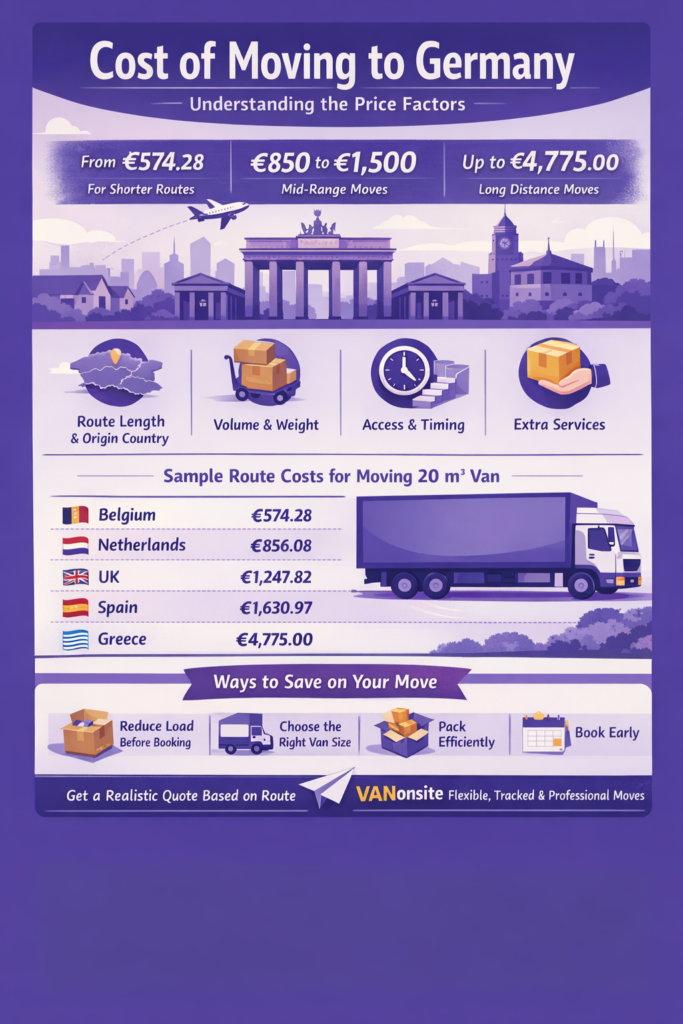
The average cost of moving to Germany can vary sharply depending on where you are moving from, how much you are taking, and how simple the route really is. Based on VANonsite’s public examples for a 20 m³ van, some shorter and simpler routes begin around EUR 574 to EUR 647, while many mid-range routes sit between roughly EUR 850 and EUR 1,500. Longer, heavier, or more logistically demanding routes often rise to around EUR 1,700 to EUR 2,000+, and the Greece example on the public page reaches EUR 4,775.00.
That tells you something important straight away. There is no single universal price for moving to Germany. There is a price range, and that range can be wide.
It also tells you that distance alone is not the whole story. Some routes are shorter but still cost more than expected. Others are longer and yet stay surprisingly competitive. That usually comes down to access, route complexity, demand, service level, and how the load is structured.
The safest way to read these numbers is this: they are useful estimated examples for a 20 m³ van, not fixed one-size-fits-all quotes. They help you understand the market. They do not replace a real assessment of your own move.
Estimated removals to Germany prices from VANonsite
One of the fastest ways to understand the cost of moving to Germany is to look at real public route examples. VANonsite shares estimated average prices for a 20 m³ van, which gives a practical benchmark for planning.
| Country | Distance (km) | Average price (EUR) |
|---|---|---|
| Belgium | 650.6 | 574.28 |
| Netherlands | 576.1 | 856.08 |
| France | 877.5 | 963.44 |
| Italy | 1,182.5 | 976.84 |
| Poland | 517.2 | 1,173.53 |
| United Kingdom | 931.6 | 1,247.82 |
| Spain | 1,869.1 | 1,630.97 |
| Switzerland | 752.6 | 1,768.78 |
| Finland | 1,105.3 | 1,958.28 |
| Greece | 1,802.9 | 4,775.00 |
At first glance, you might expect the cheapest routes to always be the shortest and the most expensive routes to always be the longest. Real transport rarely works that neatly. Distance matters, of course, but it is only one part of the quote.
For example, Poland shows a shorter route than Italy, yet the public average price is higher. Denmark shows a very short distance on the broader VANonsite page, yet its average price sits well above many longer routes. That usually points to other pricing realities such as service demand, route structure, access, cross-border complexity, loading conditions, and the internal cost of delivering the move well rather than simply delivering it cheaply.
This is why route tables are valuable. They give you price anchors. At the same time, they remind you that the cost of moving to Germany is shaped by more than kilometres.
What affects the cost of moving to Germany the most?
A quote only starts to make sense when you know what is pushing it up or keeping it under control. The biggest mistake people make is to focus on one factor only, usually distance. In reality, moving costs are built from a combination of practical details.
The main price factors are:
- pickup country and route length
- total moving volume
- total weight
- property access at both ends
- packing and protection level
- urgency and last minute timing
- whether the move is direct, express, or grouped
- fragile, bulky, or premium items
Pickup country and route length shape fuel exposure, labour planning, and overall route efficiency. A move from Belgium to Germany will not behave like a move from Portugal, Finland, or Greece. Cross-border routes also vary in ferry use, tunnel costs, toll exposure, and overall transport demand, so two moves with similar mileage can still feel very different in price.
Total moving volume matters because it affects vehicle size. Too little space creates problems. Too much space can mean overpaying. Volume is often the hidden hinge of the whole quote, because the chosen vehicle shapes not only the transport cost but also the ease of loading, the speed of the move, and how much breathing room fragile items get on the road.
Total weight matters because not all loads behave the same way. Books, appliances, and dense furniture can push up the transport challenge even when the visual volume looks moderate. A move with 25 light boxes is not the same as a move with gym equipment, tools, solid wood furniture, and packed kitchenware.
Property access is a silent cost driver. A move from a ground-floor property with easy parking is one thing. A move from a narrow city street with four flights of stairs is another. Long walking distances, building rules, limited parking windows, and awkward entrances all add time, effort, and planning pressure.
Packing and protection level also changes the quote. Basic transport is not the same as a carefully protected move involving fragile furniture, electronics, mirrors, or premium pieces. Good protection is not a luxury detail. It often determines whether the move stays efficient or starts creating risk.
Urgency can shift pricing fast. Last-minute relocations often cost more because flexibility, scheduling pressure, and vehicle availability all become tighter. If the move has to happen this week, rather than in three weeks, the quote may reflect that urgency clearly.
Direct, express, or grouped service matters because the structure of the route changes the cost picture. Some people value the most direct solution. Others prefer a more budget-oriented structure. A direct move often costs more than a grouped option, but it may also reduce waiting time and simplify the whole process.
Fragile or bulky items often raise the quote because they increase handling time, protection needs, and sometimes loading complexity. Sofas, wardrobes, pianos, artwork, exercise equipment, and heavy appliances all change the real shape of the move.
A lower number can become a false economy if it leads to weaker planning, less visibility, more stress, or poor handling at the very moment you need the move to feel smooth. That is why the cheapest-looking quote is not always the smartest one.
A practical way to compare quotes is to ask a few direct questions:
- Is this price based on the exact route and exact load?
- Does it include the real access conditions at both properties?
- Is the service direct, grouped, or partially flexible?
- How are fragile items protected?
- Are there any likely add-ons that may appear later?
These questions often reveal the difference between a quote that is only attractive and a quote that is actually dependable.
How much space do you actually need for a move to Germany?
This is one of the most practical questions in the whole process, because the wrong estimate can distort the entire cost of moving to Germany. Overestimate badly, and you may pay for space you do not need. Underestimate badly, and the move can become stressful, inefficient, or more expensive later.
VANonsite offers a clear range of vehicle sizes, which makes it easier to match the move to real life.
| Vehicle option | Capacity | Max load |
|---|---|---|
| Moving One | 1 m3 | 100 kg |
| Moving Basic | 5 m3 | 300 kg |
| Moving Medium | 10 m3 | 600 kg |
| Moving Premium | 15 m3 | 1,100 kg |
| Moving Premium Plus | 30 m3 | 3,500 kg |
| Moving Full House XXL | 90 m3 | 20,000 kg |
A practical reading of these options looks like this:
- Moving One works well for documents, essentials, and a few boxes.
- Moving Basic suits student moves, essentials-only relocations, and very compact loads.
- Moving Medium fits many compact flat moves with a modest furniture set.
- Moving Premium is a strong option for many standard 1 to 2 bedroom household moves.
- Moving Premium Plus suits larger family relocations or heavier furniture combinations.
- Moving Full House XXL is built for major home or business moves where volume and weight both matter.
Here is a more real-life mapping:
| Move scenario | Typical load shape | Suggested size |
|---|---|---|
| A few boxes, bags, and essentials | light and minimal | Moving One |
| Student room or compact studio | lighter, budget-conscious | Moving Basic |
| Small flat with selected furniture | moderate volume | Moving Medium |
| 1 to 2 bedroom home | balanced household move | Moving Premium |
| Larger family move | bulky furniture and more boxes | Moving Premium Plus |
| Full home or major mixed move | very large and complex | Moving Full House XXL |
The smartest way to estimate is to think in rooms, not just in boxes. Bedroom, kitchen, living room, hallway storage, office corner, and all the hidden items in cupboards. Those smaller unseen items often add more than people expect.
It also helps to think in layers of necessity. What are you moving for daily life? What is bulky? What is dense? What can be sold, stored, or replaced more cheaply than transported? This is where many people quietly lower the cost of moving to Germany without sacrificing what matters.
A few practical checkpoints can make the estimate more accurate:
- Count major furniture items first.
- Add appliances and electronics.
- Estimate your number of standard boxes honestly.
- Include hallway, attic, cellar, and storage items.
- Add a margin for the things you always forget until the final week.
That final margin matters. People often remember the sofa and the bed, but forget the vacuum cleaner, drying rack, office chair, lamps, side tables, shoe storage, and seasonal boxes tucked away out of sight.
Is a man and van to Germany cheaper than a traditional move?
In many cases, yes. A man and van service to Germany is often more flexible and more cost-efficient for small or medium relocations than a traditional oversized moving setup.
That is especially true when the move does not require a huge lorry, a full crew structure, or a very heavy, fully staged relocation model. A cleaner, more direct road solution can often reduce both price and friction.
A man and van setup works especially well for:
- student moves
- compact apartment moves
- furniture transport
- urgent relocations
- part-load household moves
The real advantage is not only price. It is also efficiency. A direct road transport model can reduce handling stages, improve route clarity, and cut out some of the excess that makes a move feel bigger and more expensive than it needs to be.
This matters most when the move is real-life sized rather than theoretically large. A one-bedroom flat, a studio with selected furniture, a student relocation, or a part-load move often does not need the cost structure of a much bigger operation.
A man and van model can also work better when timing is tight. If the move needs to happen fast, or if you want a cleaner route with fewer moving parts, a more direct setup can reduce both delay and handling stress.
That is one reason VANonsite can feel attractive here. The service model fits people who want flexibility without giving up structure, tracking, and professional handling.
There is also a psychological advantage. Big traditional moves can come with big traditional pricing, even when the load does not truly justify it. A smarter man and van solution often feels leaner, clearer, and easier to understand. That clarity helps people make better cost decisions instead of paying for scale they do not actually need.
Cost of moving to Germany by type of move
Not every relocation behaves the same way. A student moving with bedding, boxes, and a desk chair is not facing the same cost structure as a family relocating a full household. That is why the cost of moving to Germany is easier to understand when you break it down by move type.
Student removals to Germany
Student moves are usually lighter, tighter on budget, and more sensitive to price efficiency. They often work best with Moving Basic or Moving Medium, depending on whether the student is travelling with only essentials or with some furniture as well.
Because the load is smaller, the main cost drivers tend to be route, timing, and whether the move is urgent. A man and van model is often one of the best-value options here.
Student relocations also tend to reward simplicity. One bed, a desk, a chair, several boxes, bedding, books, kitchen basics, and a suitcase can often be moved far more efficiently than people expect. The cleaner the inventory, the easier it becomes to keep the price under control.
A student move often becomes more expensive when people leave everything to the final week. Urgent booking, poor packing, and weak volume estimates can quickly erase the savings that a smaller move should naturally bring.
Typical student cost drivers include:
- route and pickup country
- whether furniture is included
- timing around term dates and lease dates
- number of boxes and bulky extras
- urgency of booking
This is exactly where a man and van service can feel smart rather than merely cheap. It fits the scale of the move, keeps the structure clear, and avoids the bloated cost profile of a bigger setup.
Home removals to Germany
Home moves usually sit in the middle or upper part of the price range because they involve more furniture, more boxes, and more variables. Bed frames, wardrobes, sofas, tables, appliances, and kitchen items all push the planning up.
The more complete the household move is, the more important accurate volume planning becomes.
For a home move, the quote is often shaped not only by volume, but by the interaction between volume, access, and handling. A modest 1-bedroom move from a house with direct parking can feel easier and cheaper than a smaller but awkward move from a city-centre flat with difficult stairs and long carrying distances.
A practical way to think about home removals is this:
| Home move type | Typical pressure point | Main pricing risk |
|---|---|---|
| Studio or 1-bedroom | limited budget, selective furniture | wrong van size |
| 1 to 2 bedroom home | balanced furniture and box count | underestimating volume |
| Family move | bulky furniture and more boxes | access and timing complexity |
| Full-home relocation | very large load | planning, capacity, and coordination |
Home removals to Germany also create more emotional cost pressure. When people move their full home, they are not only paying for transport. They are paying to protect familiarity, comfort, and the physical pieces of daily life. That often makes careful handling, tracking, and planning feel worth paying for.
Office removals to Germany
Office moves are shaped not only by volume but also by continuity. Timing matters more because disruption costs money. Desks, screens, files, cabinets, and equipment all need to arrive in the right condition and often in the right order.
Office removals also have a hidden financial layer. The transport quote is only one cost. Lost working time, delayed setup, interrupted service, and disorganised arrival can all create bigger indirect costs around the move itself.
That is why office pricing is often influenced by:
- timing sensitivity
- sequencing needs
- technical equipment protection
- access at both commercial properties
- how quickly the new site needs to become operational
A move that looks manageable on a pure transport level can become expensive if the office cannot function properly for days after arrival. In that sense, a better organised move can be cheaper overall, even if the base quote is not the absolute lowest.
Furniture removals to Germany
Furniture-only moves can look simple at first and still become costly if the items are bulky, fragile, premium, or awkward to carry. This is where handling risk starts affecting the quote more directly.
A sofa, wardrobe, dining table, bed frame, or sideboard may not create a full-house move, yet those items still demand care, space, and stable loading. Furniture removals often sit in an unusual middle ground. The total volume may not be huge, but the handling requirement can still be significant.
The most common price drivers in furniture moves are:
- item size and shape
- fragility and finish quality
- stair access and carrying distance
- whether dismantling or special wrapping is needed
- whether the route is direct or time-sensitive
This is another area where VANonsite’s Furniture Removals, White Glove Delivery, and broader man and van model can make strong practical sense. The move can stay lean without becoming careless.
What extra costs should you expect when moving to Germany?
Even when the base transport quote looks clear, additional services and real-world conditions can still change the final number. Knowing this early makes the cost of moving to Germany feel far more predictable.
Common extras include:
- packing materials
- professional packing help
- storage
- white glove delivery
- customs-related costs for non-EU routes if relevant
- delays caused by difficult building access
- oversized or very heavy items
Packing materials are not always dramatic in cost, but they do matter. Professional packing raises the quote more clearly, yet it can also reduce damage risk and save time.
Storage becomes relevant when move-out and move-in dates do not align. White glove delivery matters when higher-value items need more delicate treatment.
For non-EU routes, customs-related handling or coordination may also create added costs depending on the case. The key point is not to assume every move includes the same extras. It does not.
It also helps to split extras into two groups: planned extras and surprise extras.
Planned extras
These are the costs you can usually foresee and choose in advance. Packing materials, professional packing, storage, and white glove handling all belong here. These may increase the quote, yet they usually do so in a controlled way.
Surprise extras
These are the costs people tend to notice too late. Difficult access, badly estimated load size, very heavy items, parking restrictions, rushed timing, and late changes to the inventory can all create pressure that was not reflected in the first assumptions.
A useful way to think about extra costs is this:
| Extra cost type | Usually planned or surprise | Why it appears |
|---|---|---|
| Packing materials | planned | protection and organisation |
| Professional packing | planned | time-saving and damage reduction |
| Storage | planned or semi-planned | timing gap between properties |
| White glove delivery | planned | premium handling need |
| Access difficulty | often surprise | stairs, parking, narrow entry |
| Oversized or heavy items | planned if disclosed early | handling and space demand |
| Non-EU customs handling | planned if route is known | route and paperwork complexity |
This distinction matters because the smartest way to manage the cost of moving to Germany is not to eliminate every extra. It is to prevent avoidable surprises.
A move often stays within budget not because nothing extra appears, but because the likely extras were identified early. That is a much more realistic standard.


How to lower the cost of moving to Germany without taking risky shortcuts
Everyone wants to save money. The smart move is saving without increasing stress, damage risk, or confusion.
The most effective ways to lower the cost of moving to Germany are:
- reduce volume before booking
- choose the right van size
- prepare access details early
- pack clearly and logically
- avoid last-minute booking if possible
- keep fragile items properly protected
- request a realistic quote based on exact details
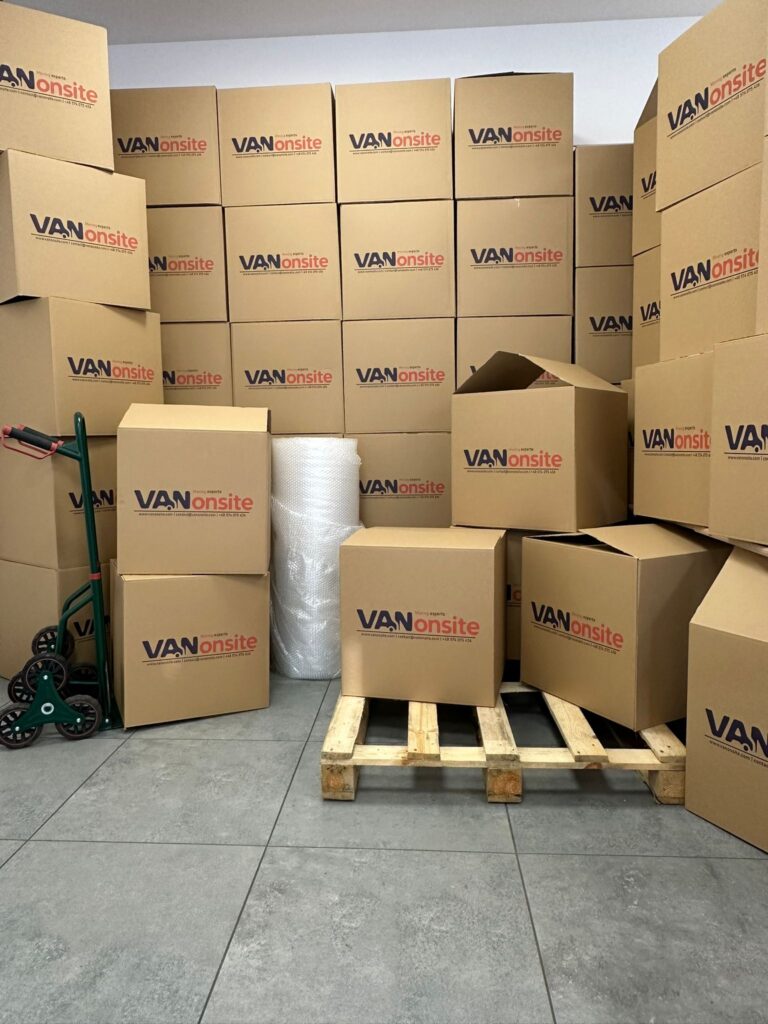
Reducing volume before booking often makes the single biggest difference. Every box, shelf unit, spare chair, or duplicate household item adds up. The more honestly you edit what you are moving, the cleaner the quote usually becomes. Selling, donating, or storing low-value items can sometimes save more than trying to transport everything.
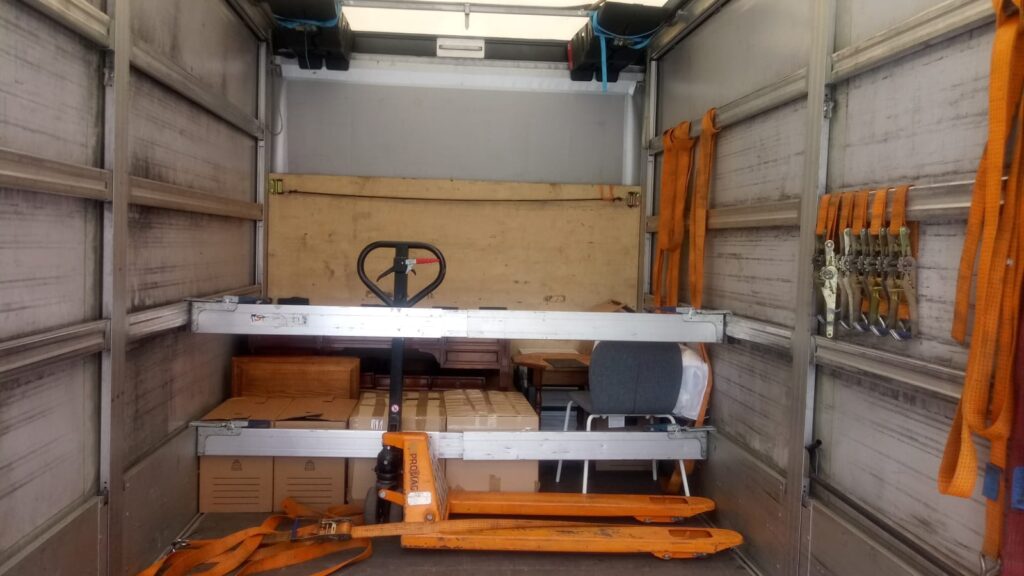
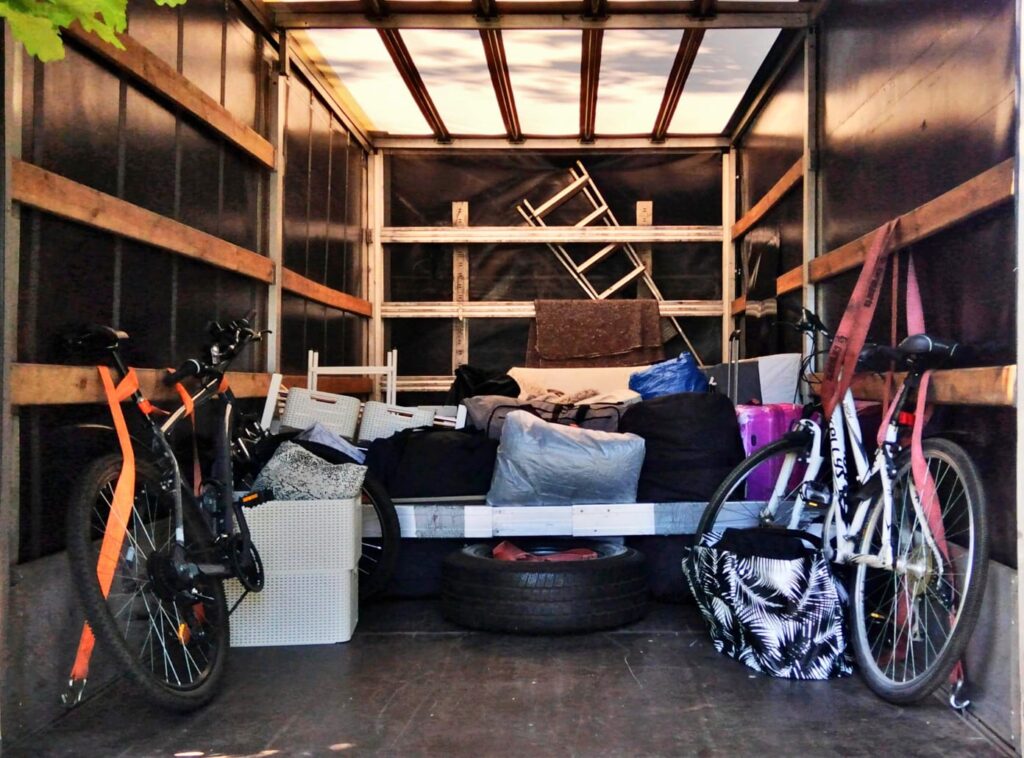
Choosing the right van size is equally powerful. Too small creates friction. Too large can waste money. A move feels much more cost-efficient when the vehicle genuinely matches the load rather than your worst-case guess.
Preparing access details early helps because staircases, lifts, parking, and property layout all affect the real cost. If access is difficult and the mover learns that too late, the quote may no longer reflect the real work involved.
Packing clearly and logically also saves money in indirect ways. Well-labelled boxes, protected fragile items, and grouped essentials reduce loading confusion and help the move stay efficient.
Avoiding last-minute booking is another powerful cost control tool. Early booking usually gives you more flexibility, more structure, and a better chance of avoiding urgency premiums.
Keeping fragile items properly protected does not increase the cost in the same way damage does. A cracked mirror, dented table, or broken screen can wipe out any savings created by weaker preparation.
Requesting a realistic quote based on exact details is the final discipline that ties everything together. A vague quote may look attractive, yet a grounded quote is usually far more valuable.
A few practical habits can help reduce costs without creating risk:
| Saving action | Why it works | What to avoid |
|---|---|---|
| Reduce load volume | lowers space and handling pressure | cutting essential items blindly |
| Book earlier | reduces urgency pressure | waiting until the final week |
| Share exact access details | improves quote accuracy | hiding difficult access |
| Use the right van size | avoids wasted cost or capacity issues | guessing too optimistically |
| Protect fragile items well | lowers damage risk | treating protection as optional |
Saving money should never mean creating a sloppy move. Good savings come from better planning, not from weaker protection.
What documents may affect the cost of moving to Germany?
Documents do not always change the transport price directly. However, missing, unclear, or late paperwork can create delay, added coordination, and avoidable cost.
This matters especially when the move involves non-EU routes, customs questions, residence formalities, or property-related administration after arrival.
Useful official pages include:
- Bundesportal: Register residence
- BMI: Registration in Germany
- Make it in Germany: Housing and registration
- German customs
A simple rule helps here. The clearer your paperwork is, the less likely your move is to drift into delay or extra coordination.
This is especially relevant for non-EU moves, where missing customs details can slow the process far more than people expect. It also matters for anyone managing address registration, residency formalities, or housing administration after arrival in Germany.
A practical way to think about documents is this:
Documents that affect timing
These may not raise the base transport price directly, yet they can still create indirect cost if they are missing or unclear. Delays, rescheduling, and extra coordination all have a price even when they are not listed as a neat line item.
Documents that affect complexity
For non-EU routes in particular, customs-related paperwork can increase the coordination burden. That does not automatically mean the move becomes dramatically more expensive, but it does mean there is more room for avoidable friction.
Documents that affect post-arrival costs
After the move, registration and housing administration may not be part of the transport quote itself, yet they still affect the wider cost of relocating to Germany. That is why it helps to think beyond the van and look at the full process.
A short rule of thumb works well here:
- keep key paperwork accessible
- check official requirements early
- avoid assuming that someone else will handle it
- make sure names, addresses, and dates are consistent across documents
The clearer your paperwork is, the less likely your move is to drift into delay, confusion, or avoidable cost.
Why people choose VANonsite when comparing the cost of moving to Germany
Price matters, but value matters more. People comparing the cost of moving to Germany are rarely looking only for the lowest possible number. They are looking for a quote that protects their belongings, their timing, and their peace of mind.
VANonsite gives several trust signals that strengthen that value:
- GPS tracking for every shipment
- flexible support for urgent and planned relocations
- scalable vehicle sizes
- careful handling of fragile and bulky items
- European moving experience
- useful add-ons such as packing and storage
That matters because a good quote should not only tell you what you pay. It should also tell you what the service protects. Visibility. Flexibility. Care. Route coverage. Real options.
A tracked move often feels more controlled because you are not left guessing where the load is. Flexible support matters because real-life moves do not always follow perfect calendars. Scalable vehicle sizes matter because paying for the wrong capacity, in either direction, is one of the easiest ways to waste money.
Careful handling matters because damage is expensive in both financial and emotional terms. European moving experience matters because cross-border relocations to Germany are shaped by route logic, timing, and country-specific realities that local-only operators may not handle as smoothly.
There is also a deeper reason people choose a provider like VANonsite when comparing prices. They are not only trying to buy transport. They are trying to buy fewer surprises. A clearer quote. A cleaner route. A more predictable moving day. Better contact; Better tracking; Better odds that the move will feel calm instead of messy.
That difference can be difficult to see in a single number, yet it becomes obvious once the move begins. A quote with structure often saves more than a quote with ambiguity. A provider with route experience often prevents problems that never show up in a basic cost comparison.
A useful way to think about value is this:
| What people compare first | What often matters more later |
|---|---|
| base price | route clarity |
| van size | correct capacity match |
| estimated timing | real delivery reliability |
| service label | actual handling quality |
| headline savings | total stress and disruption avoided |
This is why the strongest moving choice is not always the one that looks cheapest in the first minute. It is usually the one that keeps the move visible, organised, and under control from pickup to arrival.
Value is not just about the lowest number. It is about what the quote prevents from going wrong.



Cost of moving to Germany checklist
A simple checklist can save money before the move even begins.
- estimate your load size honestly
- choose the right van size
- compare route examples
- check access at both properties
- decide whether you need packing help
- separate fragile and priority items
- prepare documents early
- avoid unnecessary volume
- confirm timing clearly
- request a realistic quote
That list works because it turns the process into decisions rather than guesswork. And when guesswork drops, the cost of moving to Germany usually becomes easier to control.
A practical way to use the checklist is to break it into stages.
Before requesting quotes
- reduce the load to what you genuinely want to move
- identify bulky, fragile, and high-priority items
- decide whether you need basic transport only or extra services too
Before booking
- confirm access at both properties
- choose the most realistic van size
- compare route examples without treating them as fixed quotes
In the final run-up to the move
- finish packing and labelling clearly
- keep documents accessible
- confirm timing, contacts, and any special instructions
This staged approach makes the checklist easier to use in real life. Instead of becoming a static list, it becomes a moving plan that helps you control the budget step by step.
FAQ about the cost of moving to Germany
What is the average cost of moving to Germany?
It varies widely. Based on VANonsite’s public 20 m³ examples, some routes start around EUR 574 to EUR 647, many sit in the EUR 850 to EUR 1,500 range, and more demanding moves can rise above EUR 1,700 or even much higher. The widest point of the public range is a route such as Greece, where the example rises to EUR 4,775.00. That alone shows why the cost of moving to Germany should always be read as a range rather than a single fixed market number.
Why does the cost of moving to Germany vary so much?
Because route length is only one part of the quote. Volume, access, timing, service level, and handling needs all shape the final number. A smaller move with difficult stairs and urgent timing can cost more than a larger move with easier access and calmer scheduling. The price changes because the real work changes.
Is moving to Germany cheaper with a man and van?
Often yes, especially for small and medium moves. A man and van service usually works very well for student moves, compact flats, furniture transport, and part-load relocations. It often becomes the smartest option when the move is too large for a car but too lean for an oversized traditional setup.
How do I know what van size I need?
Start with volume, then think about weight and bulky items. A studio move is very different from a 2-bedroom household. The clearer the inventory, the easier the size decision. The safest method is to count large furniture first, then boxes, then all the smaller items hidden in storage spaces, cupboards, and utility corners.
What is included in a removals quote to Germany?
That depends on the provider and service level. A quote may reflect route, van size, handling, timing, and any extras such as packing, storage, or white glove delivery. The most useful quotes also reflect real access conditions rather than generic assumptions, because that is where many pricing differences begin.
Are public price examples fixed quotes?
No. They are useful estimated examples. VANonsite also makes clear that prices are calculated internally and sent by e-mail, so your real quote depends on your actual move details. Public examples are helpful for orientation, but a real move always needs a more specific assessment.
What usually makes a quote rise unexpectedly?
The most common reasons are underestimated volume, difficult building access, urgent timing, and late changes to the inventory. Fragile or bulky items can also push the quote up if they require extra protection or more careful handling than originally expected.
Can I lower the cost of moving to Germany without taking risks?
Yes, but the best savings come from better planning, not weaker service. Reducing load volume, choosing the right van size, preparing access details early, and booking before the final rush can all help lower the quote without making the move less safe.
Final thoughts on the cost of moving to Germany
The cost of moving to Germany becomes much less intimidating once you understand what actually shapes the quote. Route, volume, timing, and service level matter far more than guesswork. A smarter move starts with a realistic plan.
That is the real difference between a stressful quote search and a more confident decision. Once you know what drives the number, you stop reacting to random price points and start comparing moves on a much more useful level. Not just how cheap they look, but how well they fit your real route, your real load, and your real timeline.
For some people, the strongest choice will be the lowest workable cost. For others, it will be better visibility, a more direct route, gentler handling, or the right-sized vehicle that prevents overpaying and underplanning at the same time. The smartest move is usually the one that keeps cost, clarity, and control in balance.
If you want a clearer, calmer way to understand your own moving cost, VANonsite offers route-based pricing logic, flexible vehicle sizes, tracked transport, and practical support across Europe. Share your route, your load size, and your timing to get a quote that feels grounded in real conditions rather than vague assumptions.
A move to Germany is a major step. The price should feel understandable, not mysterious. And with the right plan, it can.