
Moving to Germany as a student can feel electric at first. One email from a university changes everything. Suddenly, the future looks bigger, brighter, and a little terrifying. There is excitement in the air, of course. New city, new campus, new people, new rhythm of life. Yet there is pressure too. You are not only preparing for lectures and student life. You are also planning transport, managing a limited budget, sorting documents, finding accommodation, and trying to arrive with enough energy to begin well.
That is why moving to Germany as a student needs more than enthusiasm. It needs a smart plan.
For many students, the hardest part is not the distance. It is the pile-up of small decisions. What should you take with you? What is cheaper to buy after arrival? Which documents need to stay in your backpack, not in a moving box? How much should you budget before the semester starts? And how do you move your things without wasting money on the wrong transport option?
This guide answers those questions quickly and clearly. It shows you how to prepare your documents, estimate your costs, choose what to pack, and organise a move that fits real student life. It also helps you avoid the classic mistakes that turn an exciting fresh start into a stressful scramble.
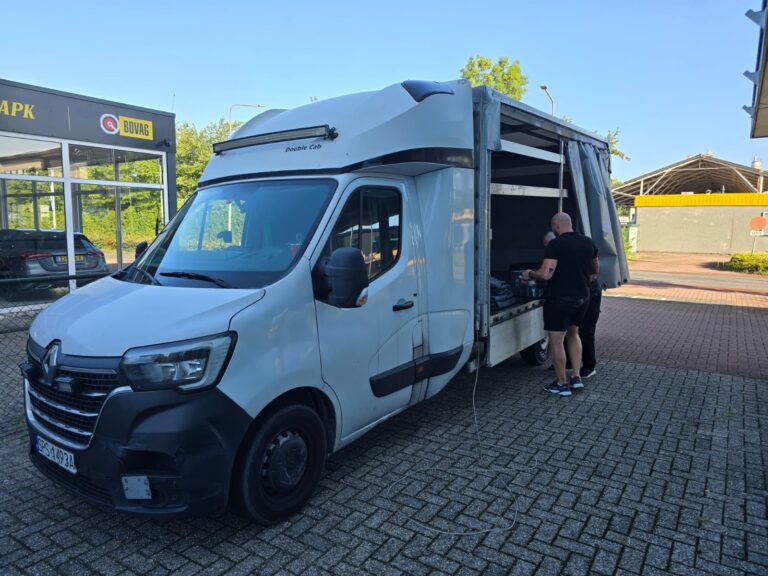
If you are moving to Germany as a student, a reliable man and van or student removals service can make a remarkable difference. Smaller student loads need flexibility, speed, and sensible pricing, not oversized solutions. That is where VANonsite fits naturally. With GPS tracking for every load, practical service options, and support for European student moves, the company helps make relocation feel lighter, safer, and far easier to manage.
TL:DR
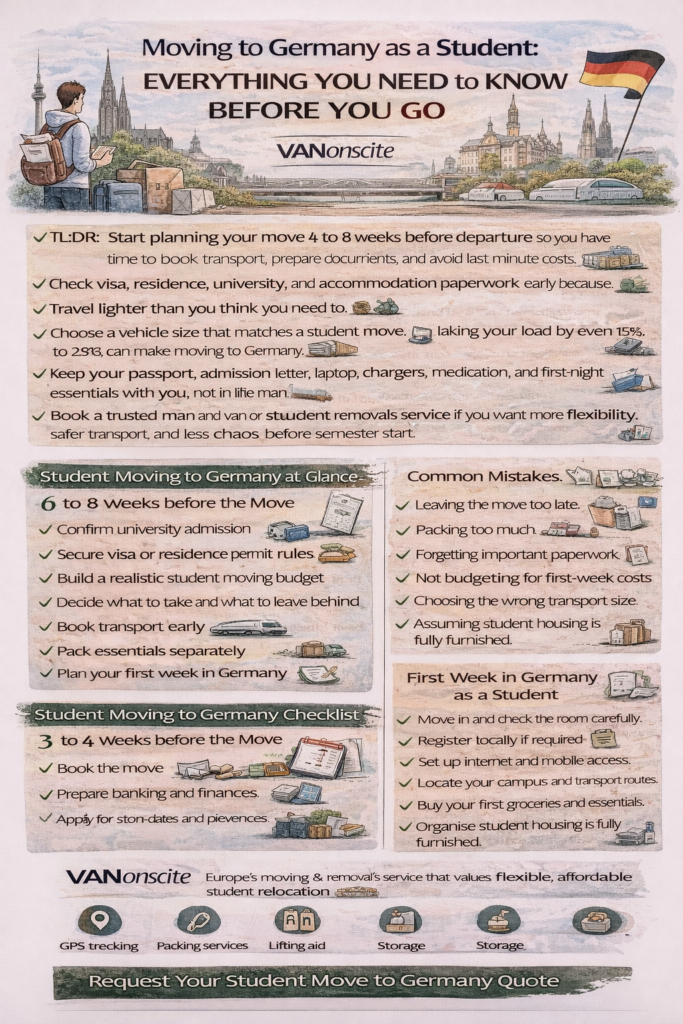
- Start planning your move 4 to 8 weeks before departure so you have time to book transport, prepare documents, and avoid last-minute costs.
- Check visa, residence, university, and accommodation paperwork early because one missing document can create serious stress in your first week.
- Travel lighter than you think you need to. Reducing your load by even 15% to 25% can make moving to Germany as a student cheaper and simpler.
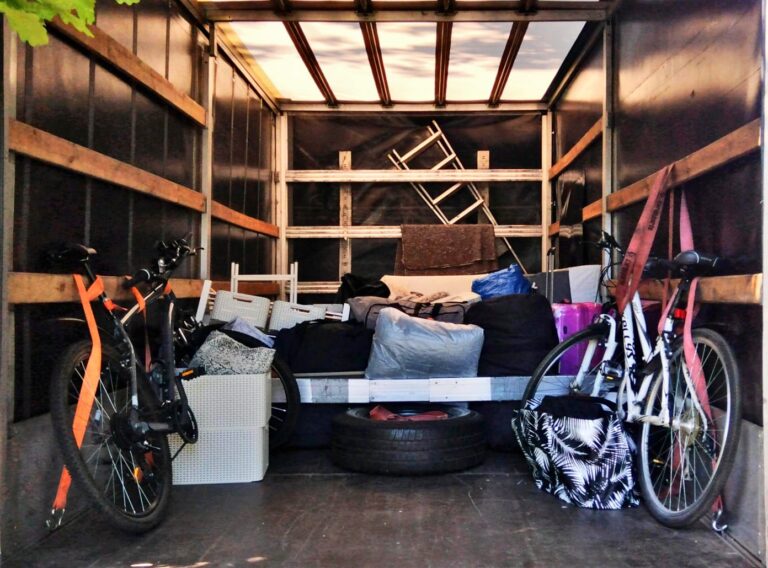
- Choose a vehicle size that actually matches a student move, especially if you are taking boxes, a desk, bedding, or small furniture.
- Keep your passport, admission letter, laptop, chargers, medication, and first-night essentials with you, not in the main load.
- Book a trusted man and van or student removals service if you want more flexibility, safer transport, and less chaos before semester start.
- Plan your first 72 hours in Germany before you leave, including bedding, basic kitchen items, internet access, and your most important documents.
Why Moving to Germany as a Student Can Feel Exciting and Overwhelming at the Same Time
Moving to Germany as a student is one of those life moments that feels thrilling and heavy at once. On one side, there is real excitement. You are about to step into a new academic world, meet new people, build independence, and create the kind of memories that can shape the next decade of your life. On the other side, there is pressure. Deadlines pile up. Housing feels uncertain. Budget limits become painfully real. And even small decisions, like whether to move a desk lamp or buy one later, suddenly feel important.
That emotional split is completely normal.
Germany is one of the strongest magnets for students in Europe. It attracts people with respected universities, strong transport links, vibrant student cities, and, in many cases, a more manageable cost of living than other major Western European study destinations. Still, affordability only works when the move is planned properly. A poorly organised relocation can burn through a student budget far faster than expected.
This is why moving to Germany as a student is not only about choosing a university. It is about handling two separate challenges at the same time. First, there is the academic side: admission, enrolment, housing, health insurance, and official paperwork. Then there is the real-world side: transport, packing, timing, costs, and the pressure to arrive ready before classes begin.
Many students underestimate how intense that overlap can feel. You are not simply changing countries. You are stepping into a new system while trying to keep everything moving at once.
What makes student relocation feel so intense?
- New city
- New language environment
- New routines
- Tight budgets
- Shared accommodation or student housing
- Pressure to settle in fast before classes begin
Each of those factors adds weight. Together, they can make the move feel bigger than expected.
A new city means unfamiliar streets, different transport routes, and a learning curve before daily life starts feeling natural. A new language environment can make even small tasks, such as reading forms or speaking to a landlord, feel more demanding. New routines take time to build. Tight budgets leave less room for mistakes. Shared accommodation can mean limited storage space, awkward move-in timing, or uncertainty around what is already provided. Then there is the countdown to the semester itself, which creates a very real sense of urgency.
This is exactly why transport planning matters more than students often expect. A rushed, improvised move may look cheaper at first, but it can create extra costs, damaged items, poor timing, and a stressful arrival. A well-planned move, by contrast, protects both your budget and your peace of mind.
Moving to Germany as a Student at a Glance
If you want the fast version, start here. These are the key steps that make moving to Germany as a student smoother, cheaper, and less chaotic.
- Confirm your admission and accommodation.
- Check visa or residence permit rules.
- Build a realistic student moving budget.
- Decide what to take and what to leave behind.
- Book transport early.
- Pack essentials separately.
- Plan your first week in Germany.
- Register locally if required.
These steps may look simple, but together they create the backbone of a successful student relocation.
Start with admission and accommodation because everything else depends on them. Without confirmed housing, it becomes much harder to estimate what you actually need to move. For example, a room in student housing may already include some essentials, while a private flat may require far more setup.
Check visa or residence rules early because paperwork delays can place your whole timeline under pressure. If you need additional documents, appointments, or proof of funds, the earlier you know, the easier the move becomes.
Build a realistic moving budget that includes more than transport. Students often focus on the moving fee itself and forget about first-week groceries, deposits, local transport, basic room items, bedding, cleaning supplies, or a temporary stay if move-in dates shift.
Decide what to take with discipline. A lighter move is often a smarter move. If you cut 20% of unnecessary items, you can reduce both transport costs and the stress of unpacking.
Book transport early, especially if your move happens close to the start of term. This is when demand can rise, dates become tighter, and rushed bookings become more expensive.
Pack essentials separately so your first 24 to 72 hours feel manageable. Documents, electronics, chargers, medication, clothes, and toiletries should never disappear into the main load.
Plan your first week in Germany before you leave. That means knowing where you will sleep, how you will reach campus, what you will eat on day one, and where your key papers are.
Finally, register locally if required. That one step can help you move from feeling like you are in transit to feeling like you have truly arrived.
Student Moving to Germany Checklist
A clear checklist turns a chaotic student move into something far more manageable. Instead of trying to remember everything at once, you can work through the move in stages. That matters because moving to Germany as a student usually happens while you are also dealing with housing, university communication, finances, and the emotional weight of leaving home.
The smartest approach is to break the process into simple time blocks. That way, each week has a purpose, and nothing important gets buried under last-minute panic.
6 to 8 Weeks Before the Move
This is the stage where smart preparation saves the most money and stress.
- confirm university admission
- secure accommodation if possible
- compare transport options
- sort what to move
- estimate cubic metres and weight
- collect key documents
At this point, your biggest job is to build clarity. Confirm your place at the university, double-check your course start date, and make sure you understand your accommodation situation. If housing is not fully confirmed yet, keep your moving plan flexible and avoid overcommitting to furniture or bulky items.
This is also the right moment to compare transport solutions. For many students, a man and van option or student removals service makes much more sense than a large removals package. Smaller student loads usually need flexibility and sensible pricing, not unnecessary scale.
Be honest about what you are taking. A student move often feels bigger in your head than it really is. When you measure what you actually need, you can choose a better service size and avoid paying for empty space.
3 to 4 Weeks Before the Move
This is when your move starts becoming real.
- book the move
- prepare banking and finances
- arrange travel dates
- notify landlord or current accommodation
- buy packing materials or book packing support
If you wait too long to book, your options can shrink quickly, especially close to semester start. Good dates disappear, urgency goes up, and prices may rise. Booking now gives you more control.
You should also prepare your financial setup. That means checking how much money you need for the first month, thinking about deposits, and making sure you can access funds easily after arrival. Students often underestimate how expensive the first 7 to 10 days can be.
This is also the best time to start packing properly. Do not wait until the final weekend. Early packing helps you separate essentials from non-essentials, identify what still needs protection, and avoid chaotic boxes filled with mixed items.
1 Week Before Departure
Now it is all about tightening loose ends.
- finish packing
- separate first-week essentials
- print copies of important documents
- label boxes clearly
- confirm move date and delivery details
This week should feel focused, not frantic. Finish the packing room by room. Keep your labels clear and practical. A box marked “kitchen” is helpful. A box marked “first week, plate, mug, kettle, cutlery” is even better.
Print copies of your most important documents even if you already have them digitally. Phones die. Wi-Fi fails. Login issues happen at the worst moment. Paper backups still matter.
You should also build one essentials layer for the first week. That may include bedding, a towel, toiletries, chargers, basic kitchen items, clothes, medication, and study essentials.
On Moving Day
Moving day should be calm, deliberate, and simple.
- carry documents and valuables yourself
- do a final room check
- keep your phone charged
- stay reachable during transport
Keep your passport, admission letter, wallet, laptop, phone, chargers, and anything irreplaceable with you. Do a final check of drawers, shelves, sockets, and hidden corners. Many students leave behind small but important things in the last hour.
Most of all, stay reachable. If there is any change in timing, access, or arrival details, fast communication makes the whole move smoother.
What Documents Do Students Need to Move to Germany?
When moving to Germany as a student, paperwork can feel dry, repetitive, and slightly intimidating. Yet it is one of the most important parts of the whole relocation. One missing document can create days of stress in your first week, especially when you are trying to move into accommodation, complete university formalities, or handle residency questions.
The exact requirements vary depending on your nationality, your study length, and whether you are moving from inside or outside the European Union. Even so, most students should prepare the same core set of documents well before departure.
Essential documents to prepare
- passport or national ID
- university admission letter
- visa or residence permit documents if required
- proof of accommodation
- health insurance confirmation
- proof of financial means if needed
- academic documents and certificates
That list may look manageable, but the real difference lies in how you organise it. Do not treat your documents like loose paperwork thrown into one backpack pocket. Build a clean system before the move.
A simple document setup that saves stress
- Keep all original documents in one protective folder.
- Print spare paper copies of the most important items.
- Save digital copies in secure cloud storage.
- Keep one quick-access set in your hand luggage or essentials bag.
- Separate university papers from travel and identity documents.
This system sounds basic, but it can save you hours of panic when you are tired, travelling, and suddenly asked for proof of enrolment, health insurance, or accommodation.
Why these documents matter so much
Students often assume the biggest challenge is simply getting accepted. In reality, admission is only one part of the process. Once you arrive, paperwork touches everything. It can affect housing, registration, university administration, banking, health cover, and visa-related steps.
That is why moving to Germany as a student becomes much smoother when your paperwork is prepared before you start packing seriously. Good transport helps. Good documents keep the whole move functioning.
Documents that students often forget
Alongside the obvious essentials, some students also benefit from carrying:
- recent bank statements
- passport-sized photos if needed for applications
- translated academic records if relevant
- rental agreement or written housing confirmation
- emergency contact details
- vaccination or medical information if useful
Not every student will need every one of these. Still, being overprepared is much safer than realising too late that you are missing something important.
Useful official sources before you move
Before departure, it is smart to check official information directly so you are working with current rules rather than outdated advice.
These sources are especially useful if you need to confirm residence rules, student visa details, or university-related requirements.
A quick document overview by situation
| Student situation | Documents that usually matter most |
|---|---|
| EU student | ID or passport, admission letter, housing proof, insurance |
| Non-EU student | Passport, visa papers, admission letter, proof of funds, insurance |
| Student in private housing | Rental agreement, ID, admission letter, finances, insurance |
| Student in university housing | Admission confirmation, housing papers, ID, insurance |
The bottom line is simple. Missing one document can turn a manageable arrival into a stressful one. When your paperwork is ready, you gain time, confidence, and a much easier first week in Germany.
How Much Does Moving to Germany as a Student Cost?
One of the first questions students ask is brutally practical: how much will this move actually cost? That question matters because student budgets are rarely forgiving. Every extra box, rushed booking, or overlooked detail can eat into money you need for rent, groceries, transport, or your first month of student life.
The truth is that moving to Germany as a student can be surprisingly affordable if the move is planned well. However, it can also become expensive very quickly if you overpack, book too late, or choose the wrong transport size. The goal is not simply to find the cheapest option on paper. The goal is to choose the smartest option for the load you truly need to move.
What affects the cost most
- departure country and destination city
- volume of belongings
- type of accommodation access
- timing of booking
- extra services such as packing or storage
- urgent or last-minute moving
Distance matters, of course. A student moving from Brussels to Cologne will usually face a smaller transport bill than a student relocating from Lisbon to Berlin. Yet distance is only one part of the picture. Volume often matters even more. A compact move with boxes, bedding, and a laptop setup is very different from a student relocation that includes a desk, small furniture, kitchen equipment, and personal decor.
Access also changes the quote more than many people expect. A building with easy parking and lift access is simpler to manage than a narrow street, a fourth-floor walk-up, or a student residence with tight move-in windows. Then there is timing. If you book late, especially close to semester start, your options shrink and prices can rise.
A simple way to understand student move sizes
| Moving option | Capacity | Weight limit | Best for students who need |
|---|---|---|---|
| Moving One | 1 m3 | 100 kg | Boxes, luggage, essentials |
| Moving Basic | 5 m3 | 300 kg | Typical student room move |
| Moving Medium | 10 m3 | 500 kg | Shared flat or larger student load |
| Moving Premium | 15 m3 | 1100 kg | Student plus furniture and appliances |
| Moving Premium Plus | 30 m3 | 3500 kg | Multi-room or group move |
| Moving Full House XXL | 90 m3 | 20000 kg | Rarely relevant for students, but possible for family-supported moves |
For most students, the sweet spot usually sits somewhere between Moving One and Moving Medium. That depends on whether you are only bringing essentials or building a more complete room setup from day one. If you are moving with just clothing, documents, tech, and a few boxes, a smaller solution often makes perfect sense. If you are taking furniture or moving into a less furnished flat, the load can grow fast.
Typical student move scenarios
| Student move type | What is usually included | Most likely fit |
|---|---|---|
| Minimal move | Clothes, documents, laptop, bedding, a few boxes | Moving One |
| Classic student move | Boxes, luggage, kitchen basics, study setup | Moving Basic |
| Bigger room move | Desk, chair, bedding, boxes, electronics, extras | Moving Medium |
| Student plus furniture | Bed frame, small furniture, appliances, more personal items | Moving Premium |
This kind of comparison helps you avoid one of the most common mistakes in moving to Germany as a student: paying for the wrong amount of space. Too small, and the move becomes awkward and stressful. Too large, and you pay for capacity you do not actually need.
Hidden student moving costs people often forget
Transport is only part of the story. The first days in Germany can cost more than expected, especially when several smaller expenses hit at once.
- rental deposit or reservation fee
- first groceries and household basics
- bedding, lamps, or kitchen items
- public transport for the first week
- temporary accommodation if move-in dates shift
- storage if your room is not ready yet
- extra charges caused by urgent booking or difficult access
This is why many students benefit from building a small buffer of 10% to 15% on top of the moving budget itself. That extra breathing room can protect you from making panicked decisions in your first week.
How to lower the cost without making the move harder
Most students can reduce the cost of moving to Germany as a student by doing two things well: moving only what they truly need and choosing the correct vehicle size.
If you cut 20% of non-essential items, you often reduce both transport cost and unpacking stress. Bulky low-value furniture, duplicate kitchenware, and clothes you no longer wear are classic examples of items that quietly inflate a student move.
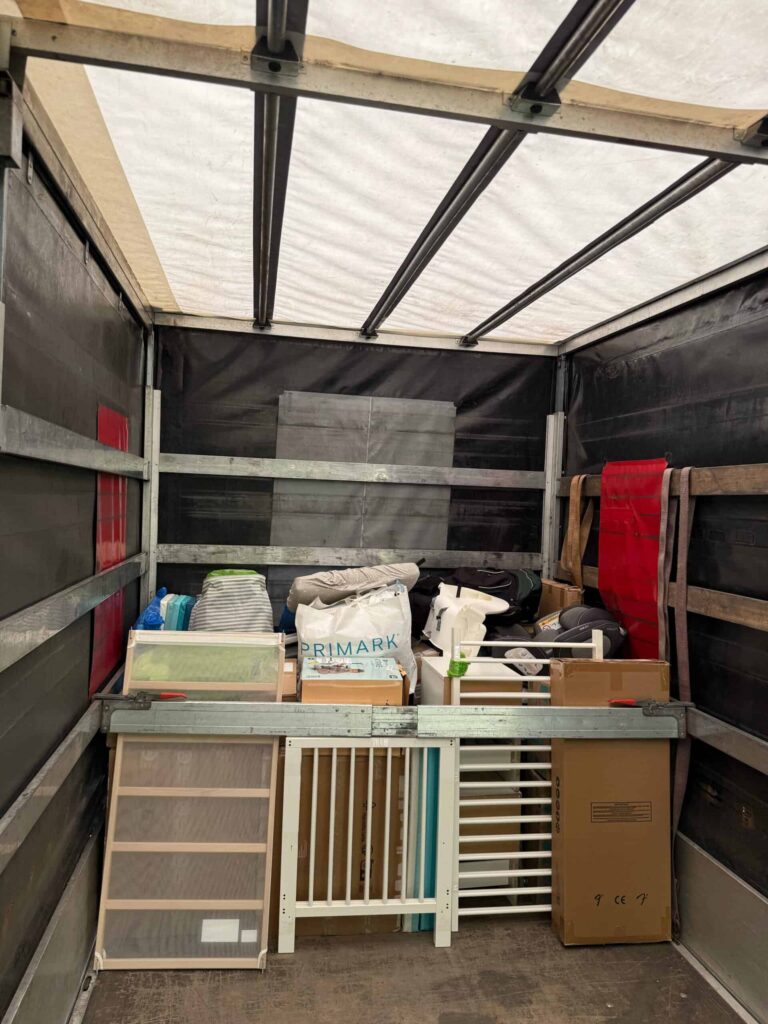
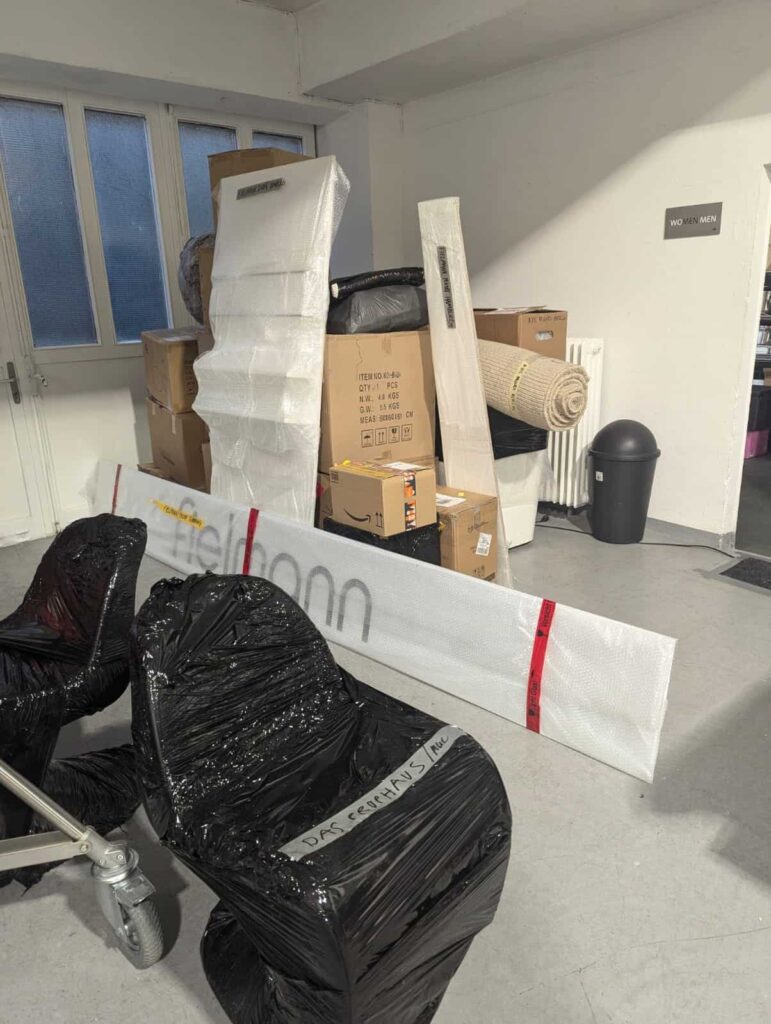
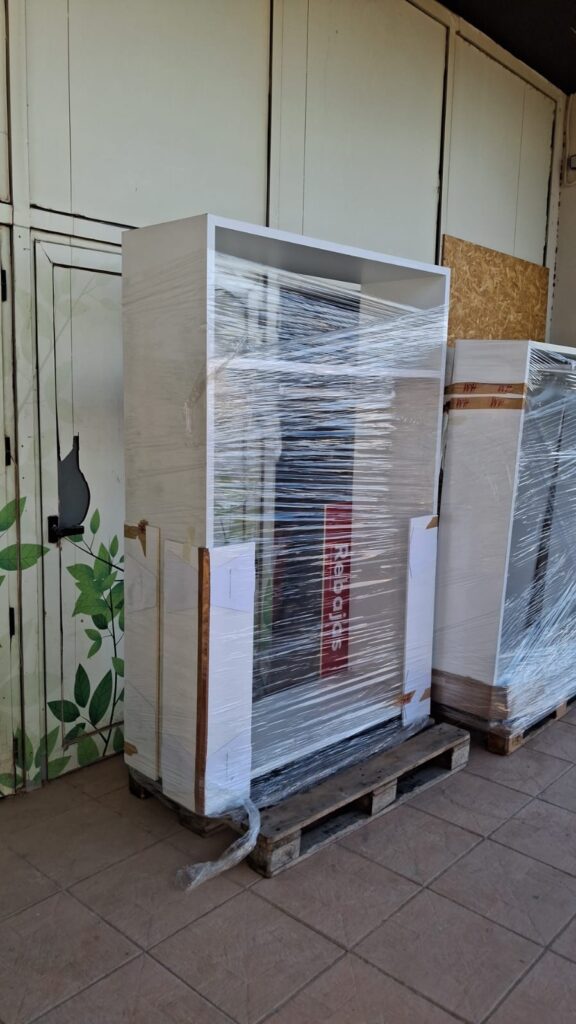
The second key is choosing the right transport setup. This is where a practical man and van service becomes especially useful. Smaller student loads do not need oversized solutions. They need efficient, flexible transport that matches the move properly. That balance is one of the reasons VANonsite works so well for student relocations. The company offers multiple service sizes, GPS-tracked transport, and practical options that suit both tighter budgets and faster timelines.
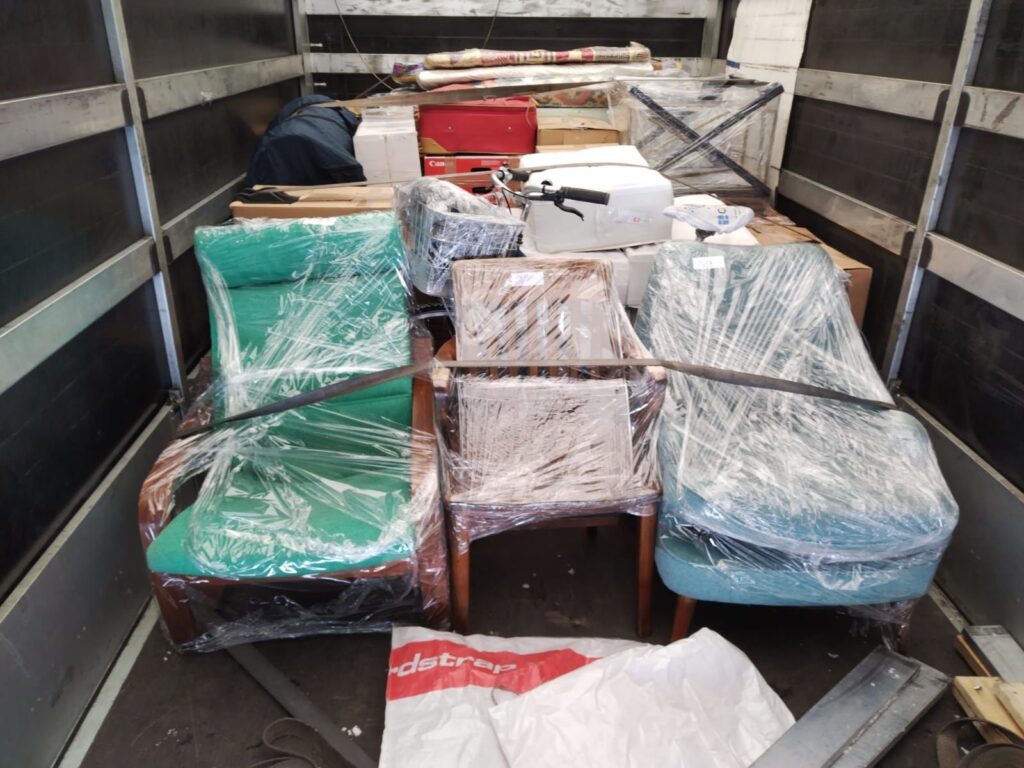
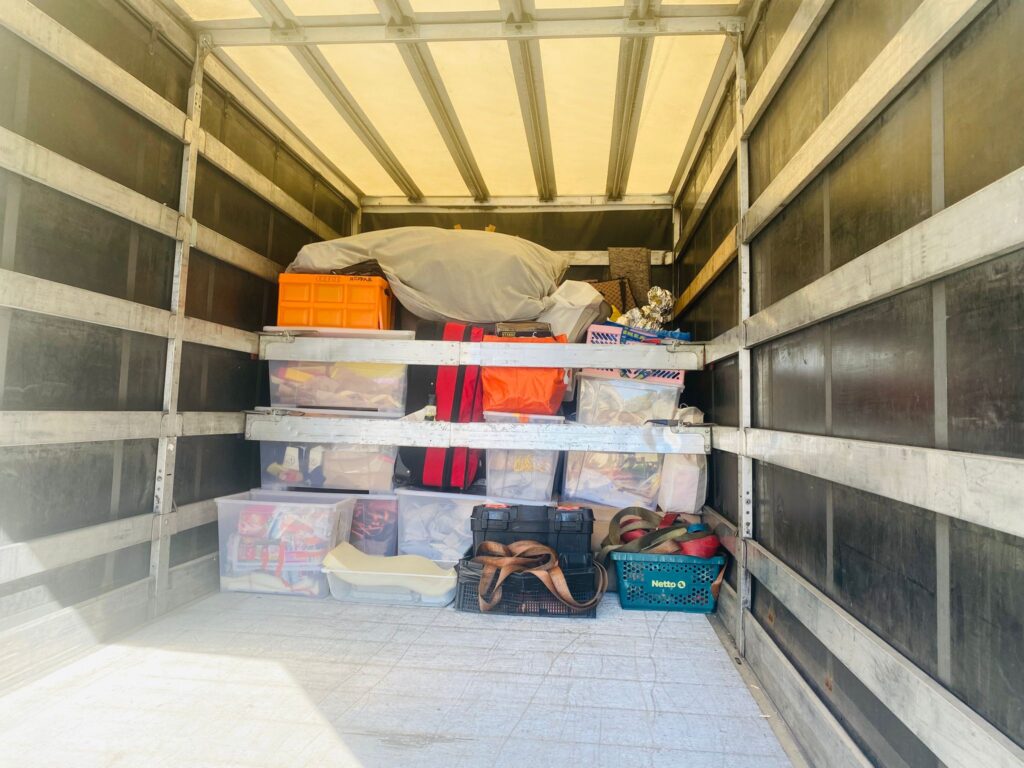
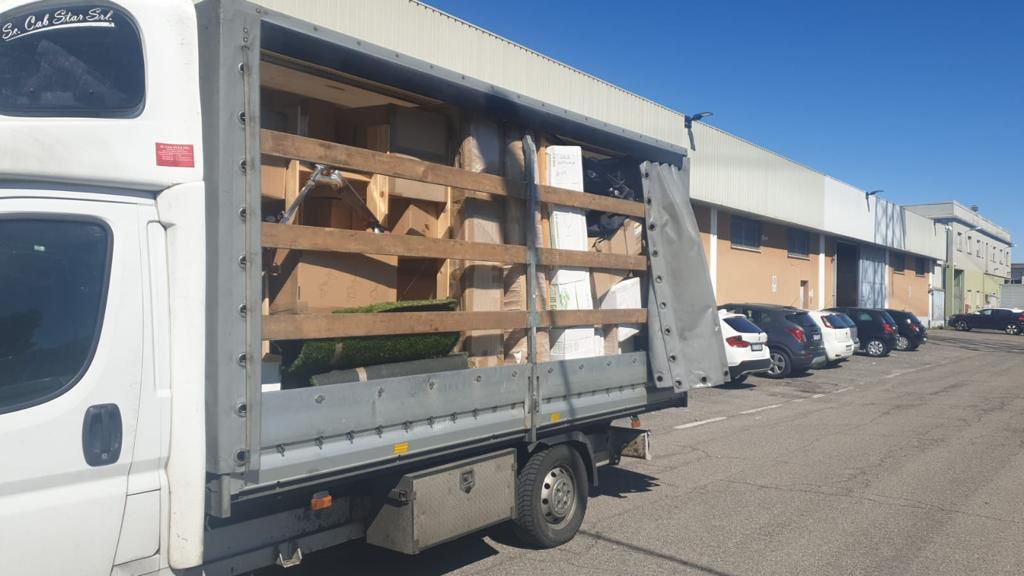
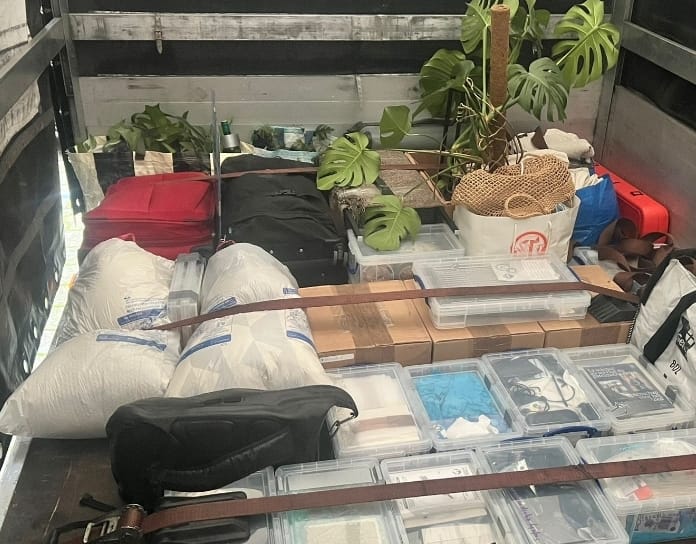
What Should a Student Take to Germany and What Should Stay Behind?
This is where moving to Germany as a student becomes very real. Once the admission letter is printed and the travel date is booked, the next big question appears: what should actually come with you?
The smartest answer is not everything. It is the right things.
Many students make the move harder than it needs to be by packing emotionally instead of practically. They carry too much, pay more, unpack slowly, and arrive feeling buried under items they do not even need in the first month. A more focused move saves money, protects your energy, and makes the first week far easier.
What to take
You should prioritise items that are expensive to replace quickly, hard to function without, or genuinely important for your comfort and studies.
- documents
- laptop and tech essentials
- clothes for the season
- study materials
- a few personal comfort items
- basic room essentials if accommodation is unfurnished
Documents come first, always. Your passport, admission letter, housing papers, insurance documents, and any visa-related paperwork should never be buried inside the main load.
Your laptop and tech setup matter because student life starts quickly. Whether it is lecture notes, enrolment portals, maps, banking apps, or communication with your university, you will need your tech from the very first days.
Clothes should be chosen with discipline. Bring the clothes you actually wear, not every possible outfit from the past three years. Germany’s seasons can be sharp, so practical layering matters more than overpacking.
Study materials can help, but be selective. Heavy books are one of the fastest ways to overload a student move. If material is available digitally or can be bought later, do not carry it by default.
A few comfort items are worth more than they look. A familiar mug, a favourite blanket, a small photo, or one or two personal objects can make a new room feel far less cold in the first week.
If your accommodation is unfurnished or only partly furnished, bring practical basics that you know you will need immediately, such as bedding, a towel, or a simple desk lamp.
What not to take
Some items create more moving stress than real value.
- bulky low-value furniture
- duplicate kitchen items
- clothes you do not wear
- things that are cheaper to replace locally
This is where discipline pays off. A cheap chair, a worn shelf, or random kitchen duplicates may feel harmless, but together they take up space, add weight, and increase cost. In many cases, it is simply smarter to replace those items after arrival.
The same applies to clothing you rarely wear. If it has been sitting untouched for months, it probably does not need to travel across Europe with you.
A simple decision rule for student packing
Ask yourself these questions before each item goes into the move:
- Will I use this in the first month?
- Is it expensive or difficult to replace?
- Does it improve daily life in a real way?
- Is it worth paying to transport it?
If the answer is no to most of those questions, it probably stays behind.
A practical student packing breakdown
| Category | Bring it | Leave it |
|---|---|---|
| Documents | Always | Never leave behind |
| Laptop and chargers | Always | Never pack deep in main load |
| Clothes | What you actually wear | Duplicates and rarely used items |
| Bedding | Yes, especially for first nights | Extra sets you will not use soon |
| Kitchen items | A few essentials if needed | Bulky duplicates and cheap items |
| Furniture | Only if valuable or necessary | Low-cost bulky items |
| Personal items | A small number of comfort items | Decorative clutter |
This kind of filtering makes a huge difference. Trimming the load by even 20% can make the move cheaper, easier to organise, and much less exhausting on arrival.
When it makes sense to bring more
There are cases where bringing more is still the right move. If you already know your accommodation is underfurnished, or if you own compact items that are expensive to replace, taking them can be worth it. The same goes for equipment that directly affects your studies, such as specialist tools, a strong desk setup, or items linked to your course.
The point is not to travel with as little as possible. The point is to move with intention.
When moving to Germany as a student, that intention can save real money and real stress. It also makes it much easier to choose the right transport option, whether that is a compact man and van service or a slightly larger student removals setup.
Why a Man and Van Service Makes Sense for Students
When moving to Germany as a student, flexibility matters almost as much as price. Student moves are rarely huge, but they are often urgent, awkwardly timed, and tied to strict deadlines. You may be moving into a small room, a shared flat, or a temporary student residence. You may be travelling with boxes, bedding, a desk setup, a few personal items, and not much more. In that situation, a large removals package can feel oversized, expensive, and unnecessarily rigid.
That is exactly why a man and van service makes so much sense for students.
It fits the reality of a student move. Smaller loads. Lower budgets. Faster decisions. More flexible timing. And a much better match for city-to-city relocation across Europe.
Why this option works so well for students
- ideal for smaller student moves
- more flexible than large removals packages
- good for city-to-city European relocation
- helpful for urgent moves before semester start
- easier to match with realistic student budgets
A student move usually does not need the complexity of a full family relocation. Most students are not transporting an entire household. They are moving the core of a new life: clothing, documents, electronics, bedding, a few practical room items, and sometimes small furniture. A man and van service is built for exactly that kind of load.
It is also more agile. If your accommodation date changes, your university schedule shifts, or you suddenly need to move faster than expected, flexibility becomes priceless. That is especially true in late summer and early autumn, when student moving pressure often peaks.
Why it often beats a DIY move
At first glance, doing everything yourself can look cheaper. Rent a van, load your belongings, drive to Germany, and save money. In reality, that plan often hides more cost and stress than students expect.
With a DIY move, you may need to cover:
- van rental
- fuel
- tolls
- overnight stays
- physical loading and unloading
- the risk of breakage
- the pressure of navigating everything yourself
That is a heavy burden when you are already preparing for university, housing, and life in a new country. A man and van service removes much of that strain. Instead of spending your energy on logistics, you can focus on arrival, paperwork, and settling in.
Trust signals that matter when choosing transport
For students, reassurance matters. You want to know your things are moving safely, efficiently, and on time.
- GPS tracking for every load
- flexible service sizes
- fast response for urgent dates
- safer transport than improvised DIY moving
These details are not just convenient. They reduce stress in a very real way. GPS tracking gives you visibility during transit. Flexible sizes stop you from overpaying for space you do not need. Quick response matters when student housing or semester dates change at the last minute. And professional handling reduces the chances of arriving with broken electronics, damaged furniture, or complete chaos.
For students who want a more secure and better organised route, tailored removals to Germany can offer a far smoother experience than trying to improvise the whole move alone. This is especially true if you are working with a modest budget but still want the transport to feel reliable.
If you need something even more student-focused, student removals can be a natural fit. If your move is rushed or your items need extra protection, packing services can also take a huge amount of pressure off your final week.
When a man and van service is the smartest choice
A man and van service is especially useful when:
- You are moving from one European city to another.
- You have a student-size load, not a full flat or house.
- You want a more budget-aware option.
- You need flexibility before semester start.
- You want safer, more structured transport without overcomplicating the move.
That combination is exactly why this option works so well for student life. It gives you enough support to feel secure, while still matching the scale and reality of moving to Germany as a student.


Packing Tips for Students Moving to Germany
Packing can either make your student move feel smooth or completely drain your energy before you even arrive. The difference usually comes down to one thing: order.
When moving to Germany as a student, packing is not about cramming everything you own into boxes and hoping for the best. It is about creating a move that works in real life. You want to know where your documents are. You want your chargers within reach. You want your first night to feel manageable, not chaotic.
The smartest packing strategy is simple. Pack by function, not by panic.
Smart packing tips that make a student move easier
- pack by category and use
- label boxes for the first week
- protect electronics carefully
- keep chargers and adapters easy to reach
- use one essentials bag for the first 72 hours
- do not overload boxes with books
Packing by category helps you unpack faster. If one box contains random clothing, cables, kitchen tools, and notebooks, it creates confusion on arrival. If each box has a purpose, the new room starts making sense much faster.
Label boxes with real usefulness in mind. “Bedroom” is fine. “Bedroom, bedding and towel for first night” is much better. The clearer your labels, the faster you can create comfort after arrival.
Electronics deserve special attention. Laptops, tablets, hard drives, headphones, chargers, and adapters are central to student life. Protect them carefully, keep them accessible, and never bury your main devices deep inside the main load.
Books are another classic student trap. They look harmless, but they get heavy very fast. Spread them across smaller boxes, or better yet, leave behind anything you do not need immediately.
A simple packing system that works
One of the easiest ways to reduce stress is to separate your move into three priority levels.
| Priority level | What goes inside |
|---|---|
| First-day bag | Documents, laptop, phone, chargers, medication, toiletries |
| First-week box | Bedding, towels, kitchen basics, clothes, study essentials |
| Main load | Extra clothes, decor, books, non-urgent items |
This system is powerful because it mirrors real life after arrival.
Your first-day bag should stay with you at all times. It contains the items you cannot afford to lose or delay. Your first-week box should be the first thing you open once you reach Germany. It makes the room usable quickly. The main load can wait a little longer because those items are not urgent.
What students often forget to pack properly
There are a few items that regularly create problems when packed badly or packed too deep.
- chargers and plug adapters
- medication
- bedding for the first night
- one towel and basic toiletries
- a plate, mug, and simple cutlery set
- login details or printed copies of key information
These are small things, yet they shape your first 24 hours more than many students realise. A room feels much less intimidating when you can charge your phone, take a shower, make tea, and sleep properly.
A better way to handle fragile items and electronics
Students often travel with more fragile gear than they think. Laptops, monitors, tablets, keyboards, lamps, speakers, and even favourite mugs or small room decor can all be damaged if packed carelessly.
A few simple rules help a lot:
- Wrap electronics separately and securely.
- Keep screens protected from pressure.
- Use soft items, such as clothes or towels, as extra cushioning when needed.
- Avoid mixing fragile tech with heavy books or metal items.
- Label anything delicate clearly.
If your move includes more sensitive belongings or a tighter deadline, professional support can make a real difference. That is where structured transport and optional packing help become valuable, especially when you are moving to Germany as a student and cannot afford broken essentials on arrival.
The golden rule for student packing
Pack for the first week, not just for the journey.
That one mindset shift changes everything. Instead of only thinking about how to get items out of your current room, think about what you will need when you step into your new one. That is the difference between arriving exhausted and disoriented, or arriving tired but prepared.
A great student move is not the one with the most boxes. It is the one where everything important is easy to find, easy to carry, and ready when you need it most.
Common Student Moving Mistakes
Moving to Germany as a student rarely goes wrong because of one huge disaster. More often, the trouble comes from small mistakes that build pressure one after another. A missed document here. An overfilled box there. A budget that looked fine until the first grocery run, the first transport ticket, and the first unexpected purchase all landed at once.
That is why avoiding common mistakes matters just as much as planning the move itself. If you can spot the traps early, the whole relocation becomes lighter, calmer, and much less expensive.
The mistakes students make most often
- leaving the move too late
- packing too much
- forgetting important paperwork
- not budgeting for first-week costs
- choosing the wrong transport size
- not planning for the first night
- assuming student housing is fully furnished
Leaving the move too late is one of the most expensive errors. When students wait until the final weeks, transport options shrink, good dates disappear, and stress rises sharply. That pressure often leads to rushed choices that cost more and work worse.
Packing too much is another classic problem. What feels harmless in one bedroom can become a heavy, expensive, awkward move once every extra item has to cross Europe. Bulky low-value things, duplicate kitchenware, and clothes you rarely wear quietly inflate the cost and the effort.
Forgetting important paperwork can make arrival feel far more intimidating than it needs to. If your admission papers, insurance documents, accommodation details, or visa-related items are not easy to access, even small admin steps can suddenly become frustrating.
Not budgeting for the first week catches many students off guard. The move itself is only part of the cost. Once you arrive, you may need groceries, cleaning supplies, transport, household basics, bedding, mobile data, or a few items for your room. Without a buffer, those first days can feel financially tight very quickly.
Choosing the wrong transport size can also create avoidable problems. Too small, and you risk a chaotic load or needing more space than expected. Too large, and you pay for room you never needed. That is exactly why accurate planning and the right man and van setup matter so much.
Not planning for the first night is a smaller mistake that feels huge in the moment. Arriving tired, hungry, and unable to find your towel, charger, or bedding can make the new place feel instantly harder.
Finally, assuming student housing is fully furnished can lead to disappointment and extra cost. Some rooms are ready to use. Others are bare enough to feel shocking on day one. You need clarity before you move, not after you arrive.
Why these mistakes hit so hard
These mistakes create more than inconvenience. They create friction. They slow down the move, increase spending, and make the emotional landing much harder. Instead of arriving with momentum, students arrive already drained.
A smoother move usually comes down to this: start earlier, pack less, keep your documents close, and plan your first week with more care than you think you need.
Your First Week in Germany as a Student
The first week after moving to Germany as a student can feel surreal. Everything is new, yet nothing feels fully settled. You may be excited in the morning and overwhelmed by evening. That emotional swing is normal. You are learning a city, a room, a campus, and a routine all at once.
The good news is that the first week does not need to feel chaotic. A few smart steps can make the new place feel far less intimidating and far more manageable.
A simple first-week plan that works
- Move in and check the room carefully.
- Register locally if required.
- Set up internet and mobile access.
- Locate your campus and transport routes.
- Buy your first groceries and essentials.
- Organise your documents in one place.
- Build a simple routine before classes begin.
Start with the room itself. Check what is already there, what works, and what you still need. If anything is damaged or missing, it is better to notice it immediately than several days later.
Then deal with essentials that support daily life. Internet access, a working phone connection, a charged laptop, and a few practical groceries can dramatically improve how the new environment feels. You do not need everything perfect. You need the basics working.
Locating your campus and daily transport routes early is also powerful. Once you know how to reach classes, the supermarket, and a few important local spots, the city starts to feel less like a maze and more like a place you can navigate.
Your documents should also get a permanent place right away. Do not leave them inside random bags or half-open boxes. One folder, one safe location, and one simple system can save you from hours of stress later.
What helps the first week feel easier
- a made bed on the first night
- one working light in the room
- a charged phone and laptop
- basic groceries and water
- your key documents in one safe place
- one small routine, such as a morning walk or campus route check
These tiny wins matter more than they look. They create familiarity. And familiarity is often what transforms anxiety into confidence.
The goal is not perfection
You do not need to build your whole new life in three days. You only need to make the new place workable. Once you can sleep properly, eat something simple, find your way to campus, and reach your essentials without digging through chaos, the move begins to feel real in the best way.
That is the emotional shift many students need. The first week in Germany may feel disorienting, but it can also become the week when everything starts to click. With a little structure, the new place stops feeling intimidating and starts feeling possible.
Best VANonsite Services for Students Moving to Germany
Choosing the right service matters because not every student move looks the same. One person is carrying only clothes, documents, and a laptop setup. Another is moving into a shared flat with a desk, bedding, kitchen basics, and small furniture. Someone else is dealing with a sudden housing change just ten days before the semester begins. That is exactly why service flexibility matters so much.
VANonsite works well for student relocations because the company does not force every move into one rigid model. Instead, it offers practical options that can match the real scale, urgency, and complexity of moving to Germany as a student. That makes the whole process feel more controlled and far less wasteful.
VANonsite services that fit student reality
- Student Removals for smaller, budget-aware moves
- Last Minute Moving for urgent relocations
- Packing Service for safer transport and less stress
- Storage for gaps between travel and move-in dates
- Furniture Removals if the student is moving more than just boxes
The strength here is not only variety. It is relevance. Each service solves a different student problem.
Student Removals make sense when you want a move that feels practical, affordable, and scaled to academic life rather than full-house relocation. Last Minute Moving becomes valuable when accommodation falls through, visa timing shifts, or a move date suddenly changes. Packing Service helps when you are short on time, worried about fragile belongings, or simply trying to avoid chaos in the final week. Storage becomes a lifesaver when travel and move-in dates do not line up. Furniture Removals make far more sense when you are taking a real room setup instead of just a few boxes.
A quick overview of what helps students most
| Service | Best for | Why it helps students |
|---|---|---|
| Student Removals | Compact academic relocations | Budget-friendly and practical |
| Last Minute Moving | Tight deadlines | Helps when housing or visa timing changes |
| Packing Service | Fragile or rushed packing | Saves time and reduces damage risk |
| Storage | Delayed move-in | Keeps the move flexible |
| Furniture Removals | Larger room or flat setup | Useful when moving desks, beds, or more |
That table tells a simple story. Students do not all need the same level of support. Some need a lean man and van style move. Others need help with timing. Others need a safer way to move furniture or electronics without taking unnecessary risks.
Which VANonsite option fits which kind of student move?
If you are moving light and want a service that respects a tighter budget, Student Removals are usually the natural starting point. If your move suddenly becomes urgent, Last Minute Moving can protect the timeline. If your final week is already overloaded with university admin, Packing Service can remove a huge amount of pressure. If the room is not ready yet, Storage creates breathing room. If the move includes bulky or delicate pieces, Furniture Removals become the smarter choice.
That is one of the biggest reasons VANonsite stands out in this context. The company feels adaptable. And when moving to Germany as a student, adaptability is often just as valuable as price.
FAQ About Moving to Germany as a Student
How much money should a student save before moving to Germany?
A student should usually prepare for more than just transport. The move itself is only one piece. You may also need money for deposits, first-week groceries, bedding, room basics, local transport, mobile access, and a small emergency buffer. A practical approach is to plan your moving budget, then add at least 10% to 15% for surprise costs.
Is Germany a good country for international students?
Yes, for many students it is an excellent choice. Germany offers strong universities, reliable public transport, good student-city infrastructure, and, in many cases, a more manageable cost of living than other major Western European study destinations. It also gives students access to a rich academic environment and a very strong European location.
What is the cheapest way to move to Germany as a student?
The cheapest move is not always the smartest move. In most cases, the lowest-cost approach is to take only what you really need, reduce the load by around 15% to 25% where possible, and choose a transport size that actually matches the move. For many students, a compact man and van service offers the best balance between cost, speed, and practicality.
Is a man and van service enough for a student move?
In many cases, yes. It is often more than enough for a typical student relocation with boxes, clothes, bedding, tech, and a few practical room items. It becomes an especially strong option when the move is city-to-city, budget-aware, and smaller in scale. If you are moving furniture or more complex loads, you may need a slightly larger service level.
What should I pack first when moving to Germany as a student?
Start with documents, laptop and chargers, medication, admission papers, clothes for the first days, and your first-night essentials. Those items should stay easy to reach and should never disappear into the main load. A smart first-day bag can make the first 24 to 72 hours dramatically easier.
Can I move furniture to Germany as a student?
Yes, but it depends on what the furniture is worth, how bulky it is, and whether it makes financial sense to transport it. If the item is low-value, heavy, or easy to replace locally, it may be smarter to leave it behind. If it is genuinely useful, compact, or expensive to replace, moving it can still be the right choice.
Conclusion
Moving to Germany as a student can feel bold, exciting, and deeply unsettling all at once. That mix is real. So is the pressure. There are forms to organise, boxes to pack, routes to plan, and a new life waiting on the other side of the journey.
The good news is that this move does not need to feel chaotic. With the right preparation, moving to Germany as a student can be smoother, cheaper, and far less stressful than many people fear. A clear plan protects more than your budget. It protects your energy, your timing, and your confidence in the first days after arrival.
Start early. Pack with intention. Keep the essentials close. Choose transport that actually fits the move. And remember that the goal is not simply to get your things to Germany. It is to arrive ready to begin well.
For students who want that move to feel lighter, more secure, and more practical, tailored support from VANonsite can make a real difference. Whether the right fit is Student Removals, a flexible man and van style setup, help with packing, or a fast last-minute solution, the key is choosing a service that respects both your budget and your peace of mind.
DIY Student Move vs Professional Student Removals
| DIY student move | Professional student removals |
|---|---|
| More physical effort | Easier, faster, safer transport |
| More stress before departure | Better planning support |
| Harder to estimate space | Easier vehicle matching |
| Less visibility during transport | GPS tracking for more peace of mind |
The contrast is simple but important. A DIY move can still work for very light, low-risk relocations. However, once timing becomes tighter or the move becomes more complex, professional support often protects both money and energy far better than students expect.