
Moving to Germany from Liverpool sounds exciting for a reason. It carries the promise of a fresh start, a stronger career, a new home, and a different rhythm of life. Yet once the first excitement settles, reality steps in fast. This is not just a matter of loading boxes, booking a van, and heading across Europe. After Brexit, moving to Germany from Liverpool also means dealing with visas, customs, registration, health insurance, housing, and the practical challenge of getting your whole life from one country to another without chaos.
That is exactly why a clear plan matters. The move does not have to feel like a storm. When the big decisions are broken into the right order, everything becomes more manageable. This guide gives you fast answers, practical steps, and a smoother route from Liverpool to Germany, whether you are relocating for work, study, family, or a complete life reset. If you want a move that feels controlled instead of frantic, this is where to start.
TL:DR
- Moving to Germany from Liverpool now involves more than transport because UK nationals must also think about visas, customs, registration, and health insurance.
- Anyone who moves into a residence in Germany must generally register within 2 weeks of moving in, so your housing timeline matters just as much as your moving date.
- If you are taking household goods from the UK to Germany, German customs allows duty-free import of personal property only under specific conditions and generally within 12 months after transferring your normal place of residence.
- British nationals should check the correct entry and residence route before booking the move, because the paperwork differs for work, study, self-employment, and family relocation.
- Keep passports, visa papers, housing documents, insurance proof, medication, chargers, and your first 24 to 72 hour essentials with you personally, not inside the main load.
- Moving costs depend on distance, volume, access, customs complexity, urgency, and whether you need extras like packing, white glove handling, or storage.
- VANonsite helps make moving to Germany from Liverpool smoother with flexible vehicle sizes, careful handling, man and van options, and GPS tracking for every load.
Fast Answer: What Do You Need for Moving to Germany from Liverpool?
If you want the quickest practical answer, here it is. Moving to Germany from Liverpool becomes much easier when you stop treating it like one giant stressful event and start treating it like a sequence. That shift matters because most international moving stress does not come from one dramatic disaster. It comes from five or six smaller problems arriving together and feeding each other. Housing uncertainty. Missing papers. Customs confusion. A badly sized van. A registration deadline that suddenly feels far too close.
That is exactly why a clean structure works so well. It gives the move order before the pressure builds.
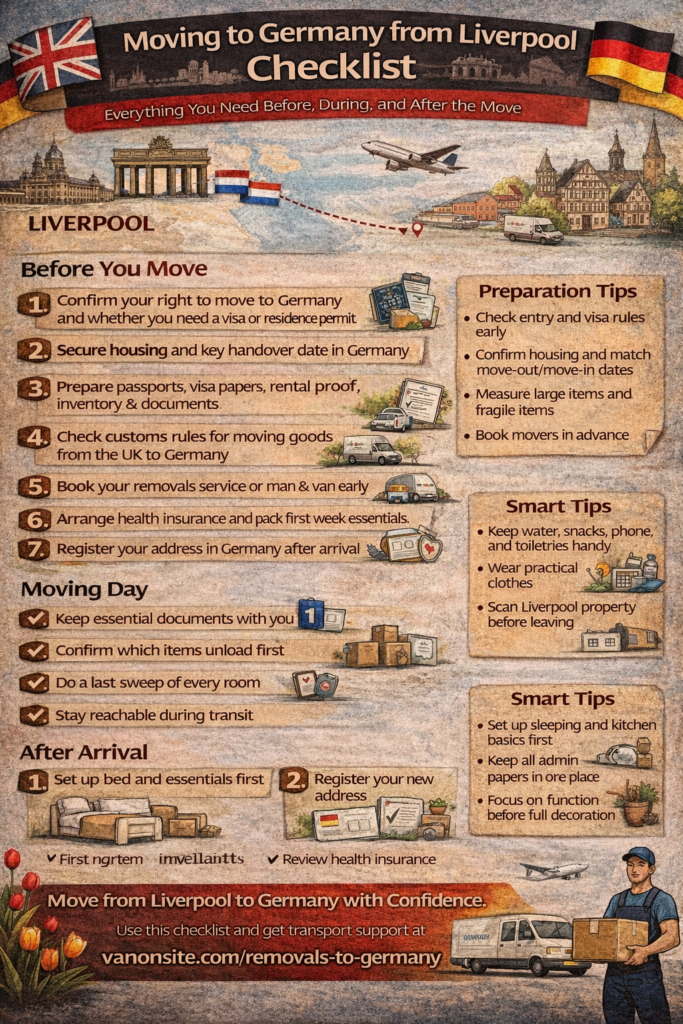
- Confirm your right to move to Germany and whether you need a visa or residence permit.
- Secure housing in Germany.
- Prepare all key documents before leaving Liverpool.
- Check customs rules for moving goods from the UK into Germany.
- Book your removals service or man and van early.
- Arrange health insurance and first week essentials.
- Register your address in Germany after arrival.
That is the backbone of the move. The reason it works is simple. Most relocation stress does not come from one catastrophic problem. It comes from five or six smaller problems hitting at the same time. A housing delay. Missing paperwork. A badly sized van. A customs misunderstanding. A registration deadline sneaking up in the first week.
Each point in that list also carries more weight than it may seem at first glance.
Confirm your right to move to Germany because this shapes everything else. A moving date is only truly useful when it matches the legal route. If you are moving for work, study, family, or self-employment, the paperwork may look different, and that difference changes timing.
Secure housing in Germany because a move is never just about transport. If your key handover does not match your delivery window, even a well organised move can become expensive, awkward, and emotionally draining.
Prepare all key documents before leaving Liverpool because border distance is not the real challenge. Administrative timing is. One missing document can slow registration, insurance, or the practical start of daily life.
Check customs rules early because moving to Germany from Liverpool is now a UK to EU relocation, not a simple domestic move. That means household goods, inventories, and timing need a little more care.
Book your removals service or man and van early because the right service does more than move boxes. It gives the whole relocation structure. When the route is long, the access is tricky, or the schedule is tight, the service fit matters enormously.
Arrange health insurance and first week essentials because you need your life to function from day one, not after three or four stressful days of catching up.
Register your address after arrival because that is one of the moments when the move finally stops feeling temporary and starts feeling real.
The smartest way to think about moving to Germany from Liverpool is in three phases:
- Before departure from the UK: visa checks, documents, customs, housing, transport, packing
- Moving day and transport: timing, access, communication, essential items, protected loading
- The first week in Germany: registration, insurance, unpacking for function, restoring routine
That structure gives the move shape. It turns noise into sequence. And once the move has sequence, it becomes far easier to control.
It also helps emotionally. A long international relocation can feel heavy because everything seems urgent at once. Once you divide it into stages, the pressure changes. You stop reacting to a blur and start completing practical steps.
Before Moving to Germany from Liverpool, What Should You Do First?
The move begins earlier than most people expect. It does not begin when the van arrives outside your home in Liverpool. It begins when you start aligning dates, paperwork, and real life logistics. That early stage matters because it quietly determines whether the whole move feels smooth or shaky.
At the start, your goal is not to do everything. It is to get the foundations right.
- confirm your ideal moving week
- match Liverpool move-out and Germany move-in dates
- measure large furniture and fragile items
- build a realistic relocation budget
- check access conditions in Liverpool and at the German address
These decisions shape everything that follows. If your delivery date beats your key handover by 4 days, the move suddenly becomes more expensive and far more stressful. If you underestimate how much you are moving, the quote becomes less reliable. If you leave the transport decision too late, you stop choosing the best option and start choosing whatever is left.
That is why the early stage should feel calm, precise, and brutally honest. A realistic move is far easier to manage than an optimistic one.
It helps to ask a few hard questions early:
- When do I actually get the keys in Germany?
- Do I need to leave my Liverpool property on a fixed date?
- How much am I truly moving, not what I hope it will fit into?
- What absolutely needs to arrive on day one?
- Am I planning this around work, study, family, or temporary accommodation?
That kind of honesty protects your budget and your sanity. Some moves genuinely suit a compact man and van setup. Others need broader removals support, better furniture handling, and more breathing room. The goal is not to choose the smallest service. It is to choose the one that fits the real move.
A useful way to make the early phase feel less overwhelming is to split it into four practical categories:
- Housing: move-in date, key handover, registration suitability, building access, parking
- Documents: passport, visa path, work or study proof, housing papers, insurance documents
- Transport: van size, loading strategy, fragile item protection, pickup and delivery timing
- Budget: moving service, travel, deposits, customs related preparation, emergency buffer
This framework matters because it stops the move from feeling like one tangled problem. Instead, you begin solving it in parts. That alone can make moving to Germany from Liverpool feel dramatically lighter.
This is also the stage where real volume starts becoming visible. A desk. A bike. A wardrobe. Kitchen boxes. Work equipment. Spare bedding. Winter clothes. Lamps. Storage you forgot about. Very often, what seemed like a moderate move turns out to be 20% to 30% larger than expected.
A few smart early habits can make a remarkable difference:
- take quick photos of each room before asking for a quote
- make a list of your large furniture and heavy items
- decide early what you are definitely not taking
- check whether both properties have stairs, narrow hallways, or poor parking
- leave room in the budget for surprises rather than pretending they will not happen
This is also where removals to Germany becomes a practical starting point. A dependable mover does more than transport items. It reduces uncertainty before the uncertainty spreads.
When the early planning is strong, the rest of the relocation becomes easier to trust. When it is weak, even a well intended move can start to wobble.
Visa and Residence Rules for Moving to Germany from Liverpool
This is one of the most important sections in the whole guide. Moving to Germany from Liverpool is no longer the same as an EU to EU move. The UK is now outside the EU and EEA, which means British nationals are treated as third-country nationals under German residence law.
That does not mean the move is impossible. Far from it. It does mean you should check your legal route before you book your moving date too confidently.
Germany’s official guidance explains that people from countries outside the EU and EEA generally need to meet specific conditions to enter and stay, including a legitimate reason for residence and the appropriate residence status.
At the same time, Make it in Germany notes an important point for UK nationals: citizens of the United Kingdom can enter Germany without a visa for the purpose of gainful employment or company-based vocational training, but that does not mean every long-term move is paperwork free. The correct residence procedure still depends on your purpose and timing.
This is exactly why the visa and residence question should sit near the top of your planning list, not somewhere near the end. People often think transport comes first because it feels concrete. In reality, the legal route shapes the timetable that the transport has to follow.
Do UK citizens need a visa to move to Germany?
Sometimes yes, sometimes not in advance, and that is exactly why this should be checked early. Work, study, self-employment, and family reunion routes are not identical. Germany’s official resources strongly suggest clarifying your exact path before making long-term plans.
A simple way to think about it is this: the question is not only whether you can enter Germany. The real question is how your move is meant to continue once you arrive. That is what makes this section so important.
Which move types usually require more paperwork?
These usually need more care:
- long-term employment moves
- university and study relocation
- self-employment or freelance relocation
- family based moves
- any move involving residence beyond a short initial stay
These routes can look similar on the surface because they all end with the same city, the same boxes, and the same front door. Yet in practice, the paperwork can be very different. That is why assumptions are risky here.
Why this should be checked before booking the move
Because paperwork changes timing. A moving date fixed too early can become a source of pressure if your legal route is not yet fully clear. A well planned move starts with the right residence path, not just the right van.
There is also an emotional side to this. Few things drain momentum faster than feeling ready to move while one legal question is still floating in the background. Once the route is clear, everything else becomes easier to plan with confidence.
For official guidance, review Entry and residence in Germany, Do I need a visa?, Entry process and residence procedure, and Visa types overview.
Documents You Need When Moving to Germany from Liverpool
Documents rarely feel dramatic until one missing paper blocks your next step. Then they become the centre of the whole move. That is why moving to Germany from Liverpool needs a document plan, not just a document pile.
This part of the relocation is easy to underestimate because paperwork looks passive. It sits in folders. It hides in drawers. It feels manageable right up until the moment one missing page delays your journey, your registration, your health cover, or your first major appointment. That is why a strong document setup is not just about organisation. It is about control.
| Document | Why it matters | When you may need it |
|---|---|---|
| Valid passport | Identity and travel | Border crossing, visa, registration |
| Visa or residence application papers | Legal stay | Entry or post arrival formalities |
| German rental agreement or housing proof | Address setup | Registration and admin |
| Employment contract or university letter | Proof of purpose | Work, study, residence paperwork |
| Health insurance documents | Early access to care | First days and local setup |
| Birth or marriage certificates | Family admin | Family relocation, schools, records |
| Vehicle papers | If taking a car | Driving, insurance, import follow up |
| Moving inventory list | Customs and planning | Transport and customs checks |
That table covers the core layer, but the strongest setup goes a step further and creates a real document safety net.
A stronger setup includes:
- originals in one clearly labelled folder
- printed copies of critical documents
- secure digital backups
- a note showing which items are originals
- the most important papers in your personal travel bag, never inside the main shipment
That final point matters more than many people realise. Your passport, visa related papers, housing documents, and insurance proof should never disappear into the van. They belong with you.
This matters even more if your move is tied to a start date, a registration appointment, a university intake, or a family transition. In those situations, missing access to the right document can create a chain reaction that affects far more than a single task.
It also helps to organise papers by use:
- Travel documents for the journey itself
- Settlement documents for registration, work, study, and insurance
- Family or support documents for later admin, schools, or vehicle issues
This small system saves a lot of stress because you stop hunting through one swollen folder and start reaching for the right group immediately.
A more practical way to think about document priorities is by scenario:
- Workers should keep contracts, offer letters, and identity documents together.
- Students should keep enrolment papers, accommodation proof, and passport access simple and immediate.
- Families should separate children’s records, civil status documents, and health related papers early instead of scrambling for them later.
- Drivers bringing a vehicle should keep all vehicle registration and insurance papers in one dedicated place.
One of the most common mistakes in moving to Germany from Liverpool is assuming that the documents can be tidied up later because the physical move feels more urgent. In practice, the exact opposite is true. The physical move is easier to manage when the paperwork is already under control.
A few extra habits can make this part much stronger:
- label one folder as travel day essentials
- keep a digital copy offline as well as online
- avoid splitting vital papers across multiple bags
- keep one short checklist of which documents you must physically carry yourself
- review the folder 48 hours before departure, not 10 minutes before leaving
UK guidance for British nationals living in Germany is here: Living in Germany. For broader relocation guidance, see Moving, living or retiring abroad.
Customs Rules When Moving Your Belongings from the UK to Germany
This is one of the biggest hidden stress points in moving to Germany from Liverpool. The UK is outside the EU customs territory, so taking your household goods into Germany is not the same as a simple domestic or intra-EU relocation.
That one fact changes the emotional texture of the move. People often feel confident about the transport route itself, yet become uncertain the moment customs enters the picture. That uncertainty is understandable. Customs is where assumptions become expensive.
German customs explains that duty-free import of personal property is possible when transferring your normal place of residence to Germany, but only under official conditions. Customs also states that clearance as import duty-free personal property is generally only possible within 12 months after transferring your normal place of residence to Germany. Goods may be imported in separate consignments, but the overall 12 month period still applies.
That matters because timing and evidence are everything here.
What counts as personal property when transferring residence?
In practical terms, this is about your household effects and personal belongings linked to your move. However, customs decisions are based on conditions, not assumptions. This is exactly why a proper inventory matters.
A smart way to think about this section is not to ask only what you are moving, but how clearly you can prove what it is, why it belongs to your household, and how it relates to your relocation timeline.
Why a detailed inventory list matters
A strong inventory list helps with:
- customs clarity
- transport planning
- damage prevention and claims context
- separating urgent essentials from later consignments
It also creates confidence on your side. Instead of guessing what is where, you know. That reduces friction during loading, customs preparation, and arrival.
A stronger inventory usually includes:
- box numbers or labels
- short, plain descriptions of contents
- clear identification of valuable or fragile items
- separate notes for furniture, appliances, and specialist items
- a distinction between what travels first and what may arrive later
Can goods arrive in separate consignments?
Yes, German customs says they can, but the overall 12 month period still applies.
That can be useful in real life because not every move from Liverpool to Germany happens in one clean wave. Some people move in stages. Some begin with essentials and send the rest later. Some use temporary accommodation first and bring the main household only once the permanent address is ready.
That flexibility can help, but it only helps when the paperwork is equally structured.
What about vehicles?
Customs states that if motor vehicles are moved as property connected to a transfer of residence, it must be shown that they were registered in the name of the person transferring residence.
That is exactly the kind of detail that catches people out when they assume customs will be intuitive. The rule may look narrow, yet it carries real practical weight.
This section is also where several smaller mistakes tend to appear:
- relying on a vague inventory instead of a precise one
- assuming customs timing can be sorted after the move has started
- mixing high priority essentials with later consignments without a clear plan
- forgetting that vehicles need their own supporting paperwork
- believing a short route means simple customs
A better mindset is to treat customs as part of the move itself, not as an external technicality. Once you do that, your planning becomes much stronger. The route, the paperwork, the inventory, and the transport timing start to support each other instead of pulling in different directions.
For the official details, see German customs on transferring residence.
Housing Checklist Before You Move to Germany
Housing does more than give you an address. It controls the rhythm of the move. Delivery timing, registration timing, first week function, and even customs confidence all become easier when your housing plan is solid.
That is why this section deserves more attention than people usually give it. A move can look perfect on paper, yet still become messy if the address is wrong for the timing, wrong for registration, or wrong for the volume of what is arriving. Housing does not sit quietly in the background. It shapes the move from the first key handover to the first night in Germany.
Before moving to Germany from Liverpool, check:
- confirm the key handover date
- check if registration is possible at the address
- review building access, stairs, and parking
- decide what must arrive immediately and what can wait
This matters because the van does not unload into theory. It unloads into a real building with real access issues, real timing pressure, and real consequences if something does not line up.
A stronger housing plan should also answer a few practical questions early:
- Is the address ready for move-in on the delivery day?
- Can you realistically register there if needed?
- Is the property suitable for the full shipment, or only for essentials at first?
- Are there access issues that could affect unloading time or cost?
- If the permanent address is not ready, what should travel later instead of now?
Those questions matter because housing and transport are deeply connected. If your new address is up four flights of stairs, has poor parking, or cannot accept the full volume on day one, that changes how the move should be planned. A smaller first shipment, delayed delivery of certain furniture, or temporary storage may become the smarter route.
Temporary accommodation can help, but it is not always ideal. Some temporary stays may not work well for registration, and registration matters quickly once you move into a residence in Germany. Make it in Germany provides useful guidance on housing and registration.
That is why temporary accommodation should be treated as a strategic choice, not just a comforting fallback. It can be useful when:
- you need a short landing period before moving into the permanent home
- the permanent rental starts later than your arrival date
- you want to travel first with essentials and send the main load later
- you need time to inspect access and decide what should arrive in the first shipment
However, temporary accommodation can also create pressure if you assume it will solve everything. If registration is not straightforward there, or if unloading access is poor, it may complicate the move rather than simplify it.
A few smart housing habits can make a remarkable difference:
- request exact key handover timing, not just the date
- ask early about parking, loading access, and stairs
- clarify whether there is a lift and whether large furniture fits it
- decide which items are essential for the first week and which can wait
- avoid assuming that all short term accommodation works equally well for real settlement steps
This is also one of the quiet reasons why good removals support matters. A mover that understands access, timing, and staged delivery can help the housing plan feel far less fragile.


Packing Checklist for Moving to Germany from Liverpool
Packing is where good intentions often collapse into panic. That is why moving to Germany from Liverpool needs a system, not just cardboard and tape.
Good packing is not only about getting everything into the van. It is about protecting your first days in Germany. If you can sleep properly, make tea, find your documents, charge your phone, and unpack work essentials without tearing through ten random boxes, the move instantly feels more humane.
The smartest packing structure has three layers:
- What stays with you personally
- What must arrive first
- What can wait
That simple structure creates order fast. It stops you from treating every belonging like it has the same urgency, because it does not.
Your personal bag should include:
- passports and papers
- medication
- chargers
- keys
- valuables
- first 24 to 72 hour essentials
That bag should stay with you, not vanish into the main load. Even a beautifully organised move feels less secure when the most critical items are no longer within reach.
Your priority boxes should include:
- first night bedding
- toiletries and towels
- kettle, mugs, tea, coffee, and basic kitchen supplies
- work equipment and cables
- children’s comfort items or pet essentials
- basic cleaning supplies
These boxes should not only be packed first in your mind. They should also be easy to identify physically. The point is not simply to own the right items. It is to reach them without wasting energy when you are tired, jet-lagged, or overwhelmed.
Room by room labels matter too. So do fragile stickers. A box labelled Bedroom Day 1 is powerful because it saves real time when you are tired.
A stronger labelling system often includes:
- room name such as kitchen, bedroom, office, bathroom
- priority level such as day 1, week 1, non urgent
- fragile marker when needed
- special notes for upright items, cables, or delicate pieces
That may sound simple, yet it changes the whole feel of arrival. Clear labelling turns unloading into a plan instead of a guessing game.
A few extra habits can make this section much stronger:
- pack one essentials bag per person when more than one person is moving
- keep screws, fittings, and small furniture parts in labelled zip bags
- photograph valuable or fragile items before loading
- separate work devices and their cables instead of scattering them across boxes
- keep cleaning supplies, bin bags, and paper towels easy to reach
This matters differently depending on the type of move.
- Students often need a compact, efficient setup and may have limited storage.
- Professionals may need their laptop, monitor accessories, and desk items ready almost immediately.
- Families need comfort, routine, and quicker access to children’s essentials.
- Pet owners need to protect routine just as carefully as furniture.
This is a natural place for professional support. Packing Service, White Glove Delivery, and Furniture Removals are not luxuries when the move includes fragile or valuable items. They are often the difference between control and chaos.
Used well, packing becomes more than preparation. It becomes the part of the move that quietly protects everything that happens next.
Moving Day Checklist for a Liverpool to Germany Move
Moving day is where all your earlier decisions either support you or betray you. The route may be long, the timing tight, and the emotions sharper than expected. That is why structure matters so much.
A successful moving day is rarely about doing anything dramatic. It is about protecting flow. You want your essentials easy to reach, your fragile items easy to identify, your timing clear, and your head calm enough to make practical decisions as the day unfolds.
Use this checklist:
- keep essential documents with you
- confirm which items unload first
- do a final sweep of every room
- stay reachable during transit
- confirm arrival timing in Germany
Those five steps look simple, yet they remove some of the most common moving day failures. Lost papers. Buried essentials. Forgotten storage corners. Confusion about what should come off the van first. All of those small mistakes create stress far faster than people expect.
A calmer moving day usually follows this rhythm:
- Start with your personal essentials already separated.
- Make sure fragile and priority items are clearly marked.
- Keep your phone charged and your travel bag accessible.
- Sweep every cupboard, shelf, drawer, and storage corner one last time.
- Leave only when the arrival plan is clear.
That rhythm works because it reduces the number of moving parts in your head. Instead of improvising from box to box and room to room, you move through a short sequence that keeps the day under control.
A few extra habits can make the day feel far smoother:
- keep water, snacks, and toiletries within reach
- wear practical clothes and shoes
- keep chargers out of packed luggage
- separate keys from ordinary bags
- keep children’s or pets’ essentials visible and easy to grab
- take quick photos of empty rooms if needed for your own records
If children are part of the move, emotional comfort matters just as much as logistics. Familiar toys, snacks, spare clothes, and a predictable mini routine can make the whole day feel less sharp. The same is true for pets. Their essentials should never be treated like an afterthought.
This is also where GPS tracked transport matters so much. Uncertainty on an international move can be draining. When you can follow the load, the whole day feels more controlled. You stop wondering. You start planning.
That visibility can help with:
- preparing the first evening more calmly
- timing access to the new address
- organising which items should be unloaded first
- reducing the mental strain of waiting without clear information
A good mover does not just move belongings. It lowers the amount of friction inside the day itself. That is one of the quiet reasons a well organised moving day feels completely different from a chaotic one, even when the route is exactly the same.
The First Week After Moving to Germany from Liverpool
The move is not over when the van arrives. In some ways, this is when it becomes real. The first week is where transport turns into daily life.
This is also where many people make the same mistake. They try to finish everything at once. That usually leads to exhaustion, random unpacking, and the feeling that the home is still not working properly after several long days. A smarter goal is not perfection. It is function.
The smartest order is simple:
- Set up the bed and bathroom basics.
- Get the kitchen to a workable level.
- Register the address if required.
- Review insurance and employment or study admin.
- Make the home functional before making it perfect.
That order works because it restores comfort, then admin, then routine. It protects your energy. It also keeps the first week from dissolving into random unpacking and low grade stress.
A stronger way to think about the first week is to split it into three layers:
- Immediate comfort: sleep, shower, food, chargers, medication, clean clothes
- Immediate admin: registration, insurance, work or study paperwork, address related tasks
- Immediate function: kitchen basics, work setup, school items, family routine, pet routine
That structure helps because it gives the first week shape. You stop drifting from task to task and start restoring the parts of life that matter most.
Small wins matter here. A shower without digging through five boxes. A proper cup of tea. A charged phone. A safe folder for your paperwork. These moments are not glamorous, but they make a new place feel liveable.
A few smart first week habits can make a major difference:
- set up the bed on the first night, even if the room is not fully unpacked
- get the bathroom usable before you chase decorative details
- make the kitchen functional with only the basics first
- choose one fixed place for keys, wallets, chargers, and documents
- unpack with purpose rather than opening random boxes for momentum
This also matters differently depending on the move type.
- Students often need a compact setup that becomes usable very quickly.
- Professionals may need internet access, a desk, and work equipment almost immediately.
- Families usually need routine, food, sleep, and children’s comfort before anything else.
- Pet owners need to restore normal feeding and resting patterns as early as possible.
The emotional side of the first week matters more than people admit. A home does not feel safe because everything is perfect. It starts to feel safe when the essential things work. You can rest. You can wash. You can eat. You can find what matters without searching through chaos.
That is why the first week should be treated as part of the move itself, not as a separate phase that somehow takes care of itself. In reality, this is the moment where the relocation either settles into real life or keeps feeling unstable.

Address Registration in Germany After Arrival
Germany’s Federal Ministry of the Interior states that anyone who moves into a residence in Germany must register within 2 weeks of moving in.
That one line makes this step impossible to ignore.
Registration matters because it is often tied to the practical start of life in Germany. It can affect how quickly you can settle into local admin and daily systems. For many people, this is the first real milestone that makes the move feel official rather than temporary.
A stronger way to think about registration is to treat it as one of the first anchor points after arrival. It is not glamorous, yet it often shapes how quickly daily life becomes stable. When this step is handled well, the rest of the first week usually feels more grounded.
Documents commonly needed can include:
- passport
- registration form if required locally
- rental agreement
- landlord confirmation if applicable
Those are the basics, but a stronger plan includes more than just collecting papers. It also means thinking about timing, appointment availability, and how quickly you can act once you have moved in.
A few practical habits can make this easier:
- keep all housing papers in one folder from day one
- check whether your local office needs an appointment
- make sure names and address details match across documents
- avoid burying registration papers inside random boxes after arrival
- handle this early instead of pushing it into the second week without reason
This matters especially for people arriving on a tight schedule. If work starts quickly, if study begins soon, or if family admin is already waiting, a delayed registration step can make everything else feel less settled than it should.
It also helps to understand the emotional weight of this moment. Registration is often one of the first points where the move starts to feel real in a calm, grounded way. The new home stops feeling like a temporary landing point and starts feeling like the place where life is actually continuing.
Make it in Germany also explains housing and registration here: Housing and registration in Germany.
Health Insurance When Moving to Germany from Liverpool
Health insurance in Germany is not something to leave vague until after arrival. Germany’s official health information portal explains the basics here: Health insurance in Germany. GOV.UK also notes that UK nationals who live in Germany usually access the German healthcare system through a statutory insurer, a private insurer, certain temporary use of a GHIC or EHIC in specific cases, or an S1 form in eligible situations.
A practical checklist:
- identify your post move status
- gather proof of insurance
- check what applies from day one
- keep all documents easy to access
Those four points matter because health insurance often feels abstract until it suddenly becomes urgent. People postpone it because it looks technical. Then one question, one appointment, or one practical need makes the uncertainty feel much heavier than expected.
A stronger way to handle this is to turn it into a short action plan rather than a vague background task.
- Confirm your main post-move status.
- Gather every relevant insurance document before travel day.
- Keep proof with your personal essentials, not in the main load.
- Review what needs to be handled in the first week.
- Do not leave the issue floating once you have arrived.
That structure helps because insurance affects far more than medical treatment. It also affects your sense of security. If you feel unsure about coverage, prescriptions, appointments, or what happens in an emergency, the whole first week can feel more fragile.
Different life situations create different routes:
- Employees often need quick clarity because work and insurance connect fast.
- Students should check deadlines and coverage rules before arrival.
- Families should confirm what applies to each family member.
- Self employed movers should allow extra time for comparisons and paperwork.
This is one of the sections where the move becomes more than logistics. You are not only transporting a household. You are setting up a life that needs to function safely and confidently from the beginning.
The emotional value of sorting this early is huge. Few things make a first week feel more fragile than uncertainty around healthcare.
Which VANonsite Vehicle Size Fits Your Move?
Most people underestimate their volume by 20% to 30%. That is why the real move, not optimistic guesswork, should drive the transport choice.
| Service option | Capacity | Max load | Best for |
|---|---|---|---|
| Moving One | 1 m3 | 100 kg | Urgent essentials and critical boxes |
| Moving Basic | 5 m3 | 300 kg | Student move or room contents |
| Moving Medium | 10 m3 | 500 kg | Small flat and furniture |
| Moving Premium | 15 m3 | 1100 kg | One bedroom move |
| Moving Premium Plus | 30 m3 | 3500 kg | Couple or family move |
| Moving Full House XXL | 90 m3 | 20000 kg | Full house relocation |
A man and van setup can work beautifully for smaller loads. However, once the move includes more furniture, more boxes, fragile items, or tighter deadlines, a larger and more structured option is usually the calmer choice.
The biggest mistake here is choosing by instinct instead of choosing by real volume. A move that looks compact in your head can become much larger once kitchenware, boxes, work equipment, lamps, bedding, bikes, and storage are counted honestly. That is why the right vehicle size does more than affect cost. It affects loading pressure, unloading order, handling quality, and the overall calm of the move.
A simple rule of thumb:
- Student move: Moving Basic or Moving Medium
- Solo professional move: Moving Medium or Moving Premium
- Couple move: Moving Premium or Moving Premium Plus
- Family move: Moving Premium Plus or Moving Full House XXL
It also helps to think about each option in real life terms.
Moving One is best when the load is extremely small and urgent, such as critical documents, a handful of essentials, or a few items that must arrive fast.
Moving Basic suits a student room, a compact room move, or a light man and van relocation where volume stays low.
Moving Medium works better once a smaller flat starts including real furniture, work equipment, and more boxes than expected.
Moving Premium often becomes the right choice for a fuller one bedroom move where breathing room matters and tighter packing would create unnecessary stress.
Moving Premium Plus is often the sweet spot for couples or smaller families who need more capacity, more order, and less compromise.
Moving Full House XXL is built for full household relocation, where the move is not selective but complete.
The goal is not to squeeze the move into the cheapest van. It is to choose the van that genuinely fits the move.
A few practical questions can help you choose better:
- are you moving only essentials or an actual household?
- how much bulky furniture are you taking?
- do you have bikes, office equipment, or fragile large items?
- is the move staged, or does everything need to arrive together?
- would a tighter load save money but increase stress and handling risk?
That last question matters. A van that is technically possible is not always the smartest choice. The calmer choice is often the one that gives the move enough space to be handled properly.
This is one of the reasons VANonsite works well for this kind of route. The vehicle range allows the transport plan to fit the actual move instead of forcing the move into a format that was too small, too rigid, or too risky from the start.
How Much Does It Cost to Move to Germany from Liverpool?
The route from Liverpool to Germany is international, post-Brexit, and customs sensitive. That means price depends on more than just kilometres.
Many people start by asking for a single number, yet a better question is this: what actually shapes the price of a move like this? The answer is never just distance. A route can look straightforward on a map and still become more complex because of timing, customs, access, fragile items, or the simple fact that the real load is much larger than expected.
| Cost factor | Why it matters |
|---|---|
| Distance | Affects time and route planning |
| Volume | Affects van size and loading plan |
| Weight | Affects handling and transport |
| Access | Changes labour intensity |
| Customs complexity | Can affect timing and paperwork |
| Packing support | Adds materials and labour |
| Urgency | Last minute moves often cost more |
| Storage | Adds flexibility and service time |
That table gives the structure, but the real lesson is this: a move should be priced honestly, not romantically. If the route crosses borders, needs customs preparation, involves stairs at both ends, or includes a large amount of furniture, the real cost will reflect that.
A very cheap man and van quote may become costly if it ignores customs, real load size, difficult access, or fragile handling. The strongest quotes usually reflect three layers:
- Base transport cost
- Handling complexity
- Optional support services
Base transport cost usually reflects the route, the vehicle size, and the time required for the journey itself. Handling complexity covers the reality behind the move, such as narrow staircases, long walking distances from the van to the building, large furniture, or awkward access. Optional support services include things like packing, white glove handling, storage, or last minute flexibility.
That is how you compare value realistically. Not by staring at the lowest number, but by understanding what the number includes.
It also helps to think in move types rather than abstract price questions:
- Light move: a few boxes, limited furniture, compact man and van setup
- Standard flat move: bed, table, chairs, kitchen items, office gear, and daily living essentials
- Family move: more volume, more complexity, and a stronger need for order from day one
- Premium move: fragile items, valuable furniture, and more careful handling throughout
Each of these creates a different cost structure. That is why moving to Germany from Liverpool should never be reduced to one simplistic price line.
A few details can change a quote more than people expect:
- buildings without lifts
- difficult parking or long carry distances
- last minute booking pressure
- staged delivery or temporary storage
- customs paperwork that is not yet well prepared
- fragile, bulky, or specialist items needing more careful protection
This is where real value begins to matter more than headline price. A suspiciously cheap option can end up costing more once delays, repeated handling, extra labour, or stress start building around it. In practice, hidden friction is expensive too.
That is also why a properly structured quote is reassuring. It shows that the mover is looking at the actual move, not guessing from the postcode pair alone.
Common Mistakes When Moving to Germany from Liverpool
Most moves do not fail because of one dramatic error. They go wrong because small mistakes stack up.
That is what makes this section so important. The biggest relocation problems often begin with harmless assumptions. I will sort customs later. The van will probably fit it all. We can unpack the essentials when we arrive. Registration can wait. The quote looks cheap, so it must be good. Then those small assumptions start pulling against each other until the move feels heavier, slower, and more expensive than it needed to be.
Common mistakes include:
- booking too late
- underestimating the load
- leaving visa checks too late
- not understanding customs requirements
- packing documents into the main shipment
- forgetting first 72 hour essentials
- choosing by price alone
- ignoring building access on both sides
Each one seems small at first. Then it grows.
Booking too late usually means less choice, less flexibility, and more pressure. If your move depends on work, university dates, or tenancy handover, late booking can destabilise the whole plan.
Underestimating the load is one of the fastest ways to create moving day tension. The wrong vehicle size changes loading pressure, handling quality, timing, and sometimes the whole budget.
Leaving visa checks too late can distort the moving timeline before it really begins. When the legal route is unclear, every other decision starts floating too.
Not understanding customs requirements creates exactly the kind of hidden delay that people never budget for emotionally. The route may be clear, but the paperwork still needs structure.
Packing documents into the main shipment is one of those mistakes that feels harmless right until it becomes infuriating. When you need your passport, housing proof, contract, or insurance papers urgently, buried paperwork can slow down everything.
Forgetting first 72 hour essentials can make the arrival feel much harsher than it should. No towel. No charger. No medication. No clean clothes. No kettle. These are small omissions that hit hard after a long move.
Choosing by price alone is one of the most misleading mistakes of all. A cheaper offer that does not reflect the real complexity of the move can create more cost later in delay, damage risk, or confusion.
Ignoring building access on both sides often creates the ugliest surprises. Tight staircases, long carries, bad parking, or difficult unloading conditions can change the day far more than people expect.
There are also quieter mistakes worth noticing:
- leaving furniture measurements until the final days
- not separating essentials from later shipment items
- assuming temporary accommodation will automatically solve every early problem
- treating the first week as unrelated to the move itself
- expecting customs to be simple because the route looks geographically short
Leaving visa checks too late can distort the moving timeline. Poor customs preparation can create hidden delays. A buried passport or contract can ruin the pace of the first week. A van that is too small can create ugly compromises on moving day.
This is why practical planning matters. It prevents small cracks from becoming expensive problems.
The good news is that nearly all of these mistakes are avoidable. Most are not about bad luck. They are about sequence. When the move follows a strong order, the usual mistakes lose much of their power.
Why VANonsite Makes UK to Germany Moves Easier
A good mover does more than transport belongings. It reduces uncertainty. That is why VANonsite fits naturally into moving to Germany from Liverpool.
VANonsite offers:
- fast, careful European transport
- GPS tracking for every load
- flexible options from man and van to full home relocation
- strong fit for students, professionals, families, and premium item moves
- services that reduce friction before, during, and after the move
Those points matter because they translate into something the reader can actually feel: less stress, less guesswork, and a stronger sense that the move is being handled with care instead of rushed from one stage to the next.
What makes this especially valuable is what those strengths mean in practice. High quality transport means your belongings are handled with greater care. GPS tracking means you are not left wondering where your load is. Flexible service means a small student move and a full household relocation do not have to be forced into the same rigid model.
A reliable mover becomes even more valuable on a UK to Germany route because the move involves more than driving from one postcode to another. There is timing to protect, customs structure to respect, housing access to think through, and the constant need to keep the first week in Germany as calm as possible. The best logistics do not simply move boxes. They protect momentum.
That becomes useful across real life situations:
- Students often need speed, value, and a compact but dependable setup
- Professionals may need work equipment protection and a tighter schedule
- Families usually need more order, more space, and a calmer first evening
- Premium item moves benefit from stronger protection and more careful handling
That flexibility matters because different relocations create completely different pressure points. A student may care most about a lean, efficient man and van option that still feels secure. A professional may care more about timing, continuity, and keeping work equipment safe. A family may need stronger organisation, more capacity, and a smoother first 24 hours. A premium furniture move needs patience, protection, and a higher standard of handling throughout.
It also matters that VANonsite supports more than standard transport. Services such as Packing Service, White Glove Delivery, Furniture Removals, Home Removals, Office Removals, and Student Removals help remove smaller stress points before they become bigger ones.
That broader service range matters because most difficult moves are not destroyed by one huge mistake. They are worn down by smaller frictions. Furniture that needed more protection. Boxes that should have been packed more carefully. A first delivery that needed staging. A tighter loading plan than expected. Better support in those moments often changes the feel of the whole relocation.
The value of GPS tracking also deserves more weight than it usually gets. It is not just a nice feature. It changes the emotional experience of an international move. Instead of sitting in uncertainty, you have visibility. Instead of wondering where your belongings are, you can prepare your arrival more intelligently. That kind of clarity can make a huge difference on a long moving day.
If you are planning removals to Germany, this is exactly the kind of support that helps the move feel more controlled from the first quote to the first night in your new home.
FAQ
Do I need a visa when moving to Germany from Liverpool?
In many cases, UK nationals need to think carefully about the right entry and residence route. The exact answer depends on your purpose, such as work, study, self-employment, or family. Check official German guidance before fixing the moving date.
That is why it makes sense to settle the legal route first and let the moving date follow it, not the other way round.
Can I move my furniture from Liverpool to Germany duty free?
Potentially yes, but only under official customs conditions connected to transferring your normal place of residence. Timing, evidence, and the type of goods matter.
A detailed inventory and a clear timeline usually make this part much easier to handle.
How quickly do I need to register my address in Germany?
Germany says that anyone who moves into a residence must generally register within 2 weeks of moving in.
That is one reason why your housing plan matters just as much as your transport plan.
Can I use a man and van for moving to Germany from Liverpool?
Yes. A man and van service can work well for smaller loads, student relocations, urgent items, or partial household transport.
For larger household moves, more fragile loads, or situations with tighter timing, a broader removals setup is often the calmer option.
What should I keep with me instead of packing into the van?
Keep passports, visa papers, contracts, insurance proof, medication, chargers, valuables, and your first 24 to 72 hour essentials with you personally.
In practical terms, anything that protects your journey or your first two or three days should stay within reach.
Is GPS tracking useful on a UK to Germany move?
Yes. It reduces uncertainty and helps you plan your arrival and first evening with more confidence.
On a longer international move, that visibility can feel surprisingly reassuring.
Which van size is best for a family move to Germany?
That depends on the real load, but many family relocations suit Moving Premium Plus or Moving Full House XXL.
The right answer depends on how much furniture, how many boxes, and how much breathing room the move needs.
Is VANonsite only suitable for bigger moves?
No. One of the practical advantages is flexibility. VANonsite can support anything from a lighter man and van move to a much more complex household relocation, which makes it easier to match the service to the real move rather than overcomplicate it.
Final Thoughts
Moving to Germany from Liverpool becomes far less stressful when the move is planned like a sequence, not a storm. With the right checklist and a reliable mover, the transition feels steadier, safer, and more manageable.
That is the deeper goal here. Not perfection. Not fantasy level calm. Just real control at the moments that matter most.
A strong relocation is built on a few powerful things: good timing, honest planning, a practical customs and document strategy, and transport that does not create new problems on top of the old ones. When those parts line up, the move starts to feel less like a gamble and more like a confident next step.
This is exactly why the right mover matters. Not because a van alone solves everything, but because the quality of the transport influences almost every part of the experience. The right mover protects flow. The right mover keeps the move from becoming heavier than it needs to be.
If you want the move to feel smoother, faster, and more secure, choose a moving partner that treats logistics with care. VANonsite does exactly that, whether you need a compact man and van solution or a larger household relocation. When the move matters, dependable transport does more than carry boxes. It protects the start of your new life.