A successful corporate moves project starts long before the first desk leaves the old office. It starts in that tense stretch between business as usual and business disruption, when teams are still working, deadlines are closing in, and even a few lost hours can ripple into missed meetings, delayed onboarding, and rising pressure across the company. This is exactly where many business relocations begin to break down. One supplier handles transport. Another is expected to manage installation. Internal teams are left to direct room placement, troubleshoot problems, and keep operations moving at the same time. The result is often friction, confusion, and a move that feels heavier than it should.
Because a moved business is not automatically a working business. Desks may arrive, yet still sit unassembled. Meeting rooms may be technically delivered, yet remain unusable. Storage can reach the site, but land in the wrong place. Reception furniture can be half installed while clients, candidates, or partners walk through the door. In those moments, the company looks busy, but it is still not ready.
That gap comes at a price. Downtime drains momentum. Poor coordination damages productivity and staff confidence. When transport, furniture handling, planning, installation, and final readiness are split across too many vendors, repeat handling and avoidable delays begin to multiply. Teams lose time. Managers lose visibility. The launch loses sharpness.
That is why joined up corporate moves matter so much. Instead of treating each stage as a separate problem, they bring the whole relocation into one controlled rhythm. Assets are protected, moved, delivered, positioned, and installed with far less friction. The move feels cleaner. The setup feels faster. The business returns to work sooner.
For companies relocating across Europe, opening a branch, upgrading a growing workplace, or resetting an existing office after change, VANonsite supports that smoother path with secure transport, careful furniture handling, practical installation flow, and GPS tracking for every shipment. The result is simple. Less disruption. Better visibility. Faster readiness. A workplace that feels ready from day one.
TL:DR
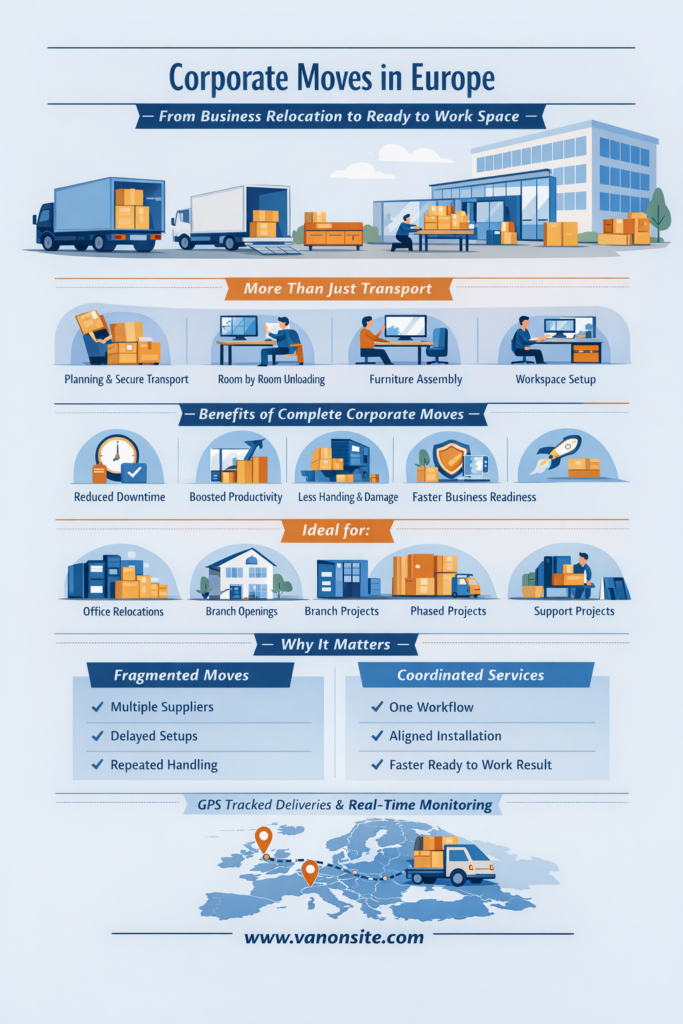
- Corporate moves mean more than transport. They combine planning, moving, unloading, placement, and often installation so a business can return to work faster.
- They reduce downtime, which helps protect productivity, staff focus, customer response, and internal momentum from the very beginning.
- A strong service can include packing, secure transport, room by room unloading, furniture assembly, workspace positioning, and optional storage support.
- They matter most for office relocations, branch launches, workspace upgrades, refurbishments, and phased commercial projects where delays quickly become expensive.
- A man and van option can work brilliantly for smaller business transfers, urgent office changes, or selected item moves, while larger vehicles suit full corporate relocations and heavier loads.
- GPS tracking improves visibility throughout the move, helping teams stay informed, coordinate activity better, and react faster when timing gets tight.
- VANonsite supports businesses across Europe with careful handling, flexible fleet sizes, practical installation flow, and a service model built around real workspace readiness.
What Do Corporate Moves Actually Include?
In practical business terms, corporate moves mean far more than moving desks, boxes, and IT equipment from one address to another. A well managed corporate move covers the full route from planning and protected transport through to room by room placement, furniture installation, and the final setup support that helps a business return to work without avoidable delay. For companies relocating, expanding, refurbishing, or opening a new site, the real goal is not just delivery. It is operational readiness.
That distinction matters because a business relocation can look finished while still failing the people who need to work in it. A boardroom table that arrives but remains unassembled is not ready for meetings. Desks stacked in the wrong area do not support productivity. Storage left in the corridor creates friction instead of order. Strong corporate moves close the gap between physical relocation and real day one functionality.
A complete service can include:
- packing and secure loading to protect furniture, documents, and sensitive business assets
- office removals across Europe for single site and multi site projects
- room by room unloading for faster, cleaner setup
- office furniture installation for desks, meeting rooms, and reception areas
- workspace setup support to improve flow and usability
- storage if needed for phased openings or delayed access
- white glove handling for premium assets and delicate items
- GPS tracked transport for better visibility from collection to delivery
Businesses choose this model because it reduces the gap between movers, installers, and internal teams. Instead of trying to coordinate several disconnected streams under pressure, they can move through one sharper process that supports speed, control, and confidence. That is what makes corporate moves such a smart commercial decision.
Why Corporate Moves Matter More Than Most Businesses Expect
Many companies underestimate how much a relocation can affect the wider business. They focus on the move itself, but overlook the true cost of delays, repeated handling, weak coordination, and incomplete setup. That is why corporate moves matter more than most businesses expect. They do not only determine whether assets arrive. They shape whether the company returns to work quickly or slips into avoidable disruption.
Every delayed working day affects productivity and internal flow. In some cases, a 1 to 3 day delay can slow onboarding, interrupt meetings, reduce staff efficiency, and push back launch plans that were already under pressure. A half ready office also creates a weak first impression. Teams notice when desks are missing, meeting rooms are unusable, and equipment is still sitting in the wrong place. So do clients, partners, and new hires.
Poorly managed corporate moves create another hidden cost. Repeat handling wastes time and labour. Misplaced items force teams to move the same furniture twice. Weak coordination raises the risk of scratched surfaces, damaged fittings, and installation issues that quietly eat into budget and morale. In contrast, coordinated corporate moves improve speed, control, and day one readiness by bringing transport, unloading, and setup into one disciplined flow.
The numbers help explain why this matters. Coordinated delivery and installation can reduce setup friction by 30% to 50% compared with a scattered supplier model. Room based unloading and better planning can also reduce repeat handling significantly, which means less wasted labour and a much faster route to a ready to work office.
| Fragmented Corporate Move | Coordinated Corporate Moves |
|---|---|
| multiple suppliers | one connected workflow |
| delayed furniture readiness | aligned delivery and installation |
| repeated handling | cleaner room by room flow |
| higher damage risk | stronger control and accountability |
| slower day one setup | faster ready to work result |
The real impact is both practical and emotional. A calm relocation supports better focus, stronger morale, and smoother first day performance. It helps people feel that the business is in control at a moment when pressure is naturally high. That is why corporate moves are not a minor operational detail. They are a powerful part of getting a business relocation right.
What a Complete Corporate Move Usually Includes
A complete corporate moves service is not a single delivery or a one day logistical event. It is a connected sequence of planning, protection, transport, placement, and readiness work that turns a relocation into a usable business environment. The strongest corporate projects do not rely on rushed improvisation or internal guesswork. They rely on structure. That structure is what protects momentum when people, furniture, equipment, and deadlines are all moving at once.
This matters because a business move rarely involves only a few desks and boxes. It may include workstations, executive desks, boardroom tables, reception counters, storage walls, shelving, chairs, monitors, cables, branded elements, and specialist items that all require different handling, different timing, and different placement logic. If these stages are disconnected, the business quickly feels the strain. If they are connected, the office becomes usable much faster and with far less disruption.
A practical corporate moves process usually includes these core stages:
- Move planning and timeline mapping
Every smooth business relocation starts with a plan grounded in reality. Access dates, building rules, lift bookings, delivery sequence, and timing windows all need to be aligned early. This stage helps avoid preventable clashes and gives internal teams better control over the wider move. - Asset and furniture review
Before anything moves, the business needs a clear view of what is relocating, what is being replaced, what should be stored, and what will arrive later. This keeps the project leaner, reduces confusion, and helps avoid wasteful transport or last minute setup delays. - Packing and protection
Desks, chairs, meeting tables, storage units, reception furniture, and monitors all need the right level of protection. Good packing is not a cosmetic extra. It protects budgets, prevents damage, and helps preserve the condition of high value office assets. - Transport and cross border delivery if needed
For companies operating across multiple cities or countries, transport involves more than simply getting from A to B. Route planning, access times, delivery restrictions, and commercial deadlines all shape the move. Strong corporate moves keep those variables under tighter control and reduce the risk of expensive surprises. - Room by room unloading
This is one of the simplest ways to cut wasted labour later. Instead of dropping everything into one holding area, furniture and equipment are unloaded directly to reception, workstations, meeting rooms, storage points, and breakout areas. That reduces repeat handling and accelerates the next stages immediately. - Furniture assembly and positioning
Desks, seating, meeting room furniture, storage systems, and reception pieces need more than delivery. They need proper assembly and smart positioning. For businesses that want workstations, support areas, and client facing zones ready faster, professional office furniture installation fits naturally into the process and helps the move progress from transport to real usability. - Final workspace layout and readiness support
Once the larger pieces are in place, the office still needs finishing logic. Positioning, team flow, accessibility, and immediate usability all matter. This is the point where a moved office begins to feel functional instead of temporary. - Optional storage and phased delivery support
Not every business activates in one clean wave. Some teams open in stages. Others wait on fit out work, staffing changes, or landlord approvals. Flexible storage and phased delivery make it easier to keep the workplace organised while the wider project unfolds.
The real strength of complete corporate moves lies in how each stage supports the next. Done well, the relocation feels cleaner, calmer, and far more controlled. That is exactly what businesses need when time, productivity, and first impressions all matter at once.
Corporate Moves Across Europe: Relocations, Expansions, and New Business Sites
Corporate relocations across Europe can look straightforward on paper and still become complicated very quickly in practice. A move after growth, a new branch opening in another country, a satellite office launch, or a refurbishment that requires business assets to move in phases all come with the same challenge. The assets need to arrive safely, the schedule needs to hold, and the office needs to become usable without dragging the business into avoidable disruption. That is why strong corporate moves matter so much in a European context.
Different countries bring different access realities. Some office buildings have strict delivery windows. Some city locations have tight parking rules or restricted unloading access. Some commercial properties require advance lift bookings, contractor registration, or specific handover procedures before anything can be moved in. That means businesses need more than transport. They need visibility, coordination, and careful handling from the start.
This becomes especially important when a company is relocating to a larger office after growth. The new space needs to support more people, more equipment, and more movement without creating a chaotic launch. The same is true when sending furniture to a satellite office or opening a branch in another country. Timing, access, and room placement all become more sensitive when the move spans locations and teams.
Refurbishments add another layer of pressure. A business may need to replace, reposition, or upgrade furniture while parts of the office remain active. In those cases, corporate moves help create a cleaner sequence for moving, storing, delivering, and reinstalling items without turning the workplace into a bottleneck.
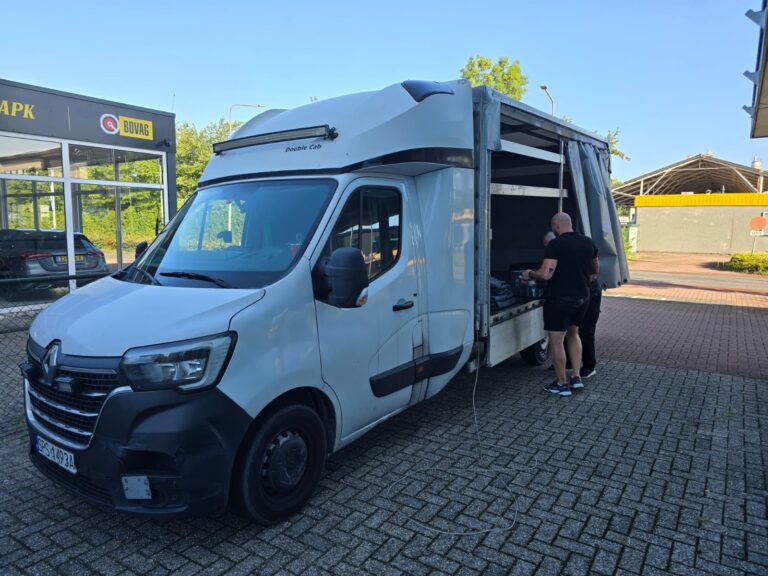
For smaller scale needs, a flexible man and van option can be ideal. It works especially well for urgent corporate transfers, compact deliveries, selected asset moves, or phased changes where speed matters more than volume. That kind of agility can make a major difference when the business needs a fast, focused solution rather than a full scale relocation model.
VANonsite supports European business moves with secure transport, fast execution, GPS shipment visibility, flexible fleet sizes, and strong commercial awareness of office timelines. That matters because workplace projects are rarely forgiving. Teams need to know what arrives first, what capacity is right, and how the schedule will hold under pressure.
The fleet options make that easier to judge:
| Service Option | Capacity | Max Weight | Best For |
|---|---|---|---|
| Moving One | 1 m3 | 100 kg | urgent documents, small office items |
| Moving Basic | 5 m3 | 300 kg | chairs, monitors, boxed supplies |
| Moving Medium | 10 m3 | 500 kg | compact corporate moves |
| Moving Premium | 15 m3 | 1100 kg | medium office relocations |
| Moving Premium Plus | 30 m3 | 3500 kg | large furniture and equipment loads |
| Moving Full House XXL | 90 m3 | 20000 kg | full scale corporate relocations |
The right vehicle depends on the real shape of the move. A quick office refresh or limited transfer may only need a smaller, more agile option. A larger relocation with desks, chairs, meeting room furniture, reception pieces, storage, and equipment will need more structured capacity. A major office launch across multiple zones requires broader support and tighter sequencing. Strong corporate moves make it easier to match transport size to project scope instead of forcing the business into a one size fits all model.
Office Furniture Installation: The Corporate Move Step That Shapes Daily Performance
Office furniture installation is often treated as the final practical task in a corporate relocation. In reality, it is one of the most important stages in the entire move. It shapes how people work, how they move through the office, how safe the environment feels, and how confident the business looks from the moment the doors open. That is why this stage matters so much in well managed corporate moves. Installation is not only technical. It directly affects workflow, comfort, safety, and first impressions.
A poorly installed office can undermine the value of the whole relocation without making much noise at first. Desks placed in the wrong locations can block movement, reduce focus, and waste valuable floor space. Chairs assembled badly can create daily discomfort. Storage set in the wrong zones can interrupt team flow and create low grade frustration that repeats every day. Reception furniture that looks unfinished can weaken the impression the company makes on clients, visitors, and new hires before a single conversation begins.
A strong installation process does the opposite. It transforms furniture into function. It turns a delivered load into a working environment. It supports the way teams collaborate, the way departments move through the space, and the speed at which a business settles back into normal rhythm. That is why professional installation plays such a decisive role in complete corporate moves.
What needs to be installed in a new office
Even a modest office contains more moving parts than most people realise. Before the team can work comfortably, multiple categories of furniture need to be assembled, positioned, checked, and adjusted properly.
Typical installation work includes:
- desks and benching systems
- ergonomic chairs
- boardroom furniture
- reception furniture
- storage systems
- shelving units
- breakout area furniture
Each category affects the office differently. Desks and benching systems shape daily workflow. Ergonomic chairs influence comfort and concentration. Boardroom furniture affects how teams meet, present, and make decisions. Reception furniture creates an immediate visual signal about the business. Storage systems and shelving reduce clutter and improve access. Breakout area furniture supports informal conversation and gives the workplace a more natural, human rhythm.
Why professional installation matters
Professional installation matters because speed alone is not enough. Furniture also needs to be stable, aligned, safe, and positioned intelligently. When installation is handled well, the office becomes usable faster and with far less rework.
The benefits are immediate:
- faster completion across the site
- lower damage risk during assembly and placement
- stronger visual presentation for staff and visitors
- smoother day one readiness with less internal disruption
There is also a more human benefit. People notice when an office feels finished. They notice when desks are straight, chairs are stable, and meeting rooms are genuinely ready to host work. That feeling of order builds confidence fast and helps the team settle in with much less friction.
When to combine installation with transport
In many projects, installation works best when it is coordinated directly with transport. That reduces idle time, limits double handling, and helps the office become operational much faster.
This approach is especially useful for:
- same day office launch
- branch opening
- post renovation return
- rapid office expansion
When furniture arrives and is installed in one managed flow, the team can move faster into setup, onboarding, and everyday work. That joined up sequence is one of the clearest signs that corporate moves are being handled properly.
How to Prepare a Commercial Unit Before a Corporate Move
A commercial unit can look nearly finished and still be completely unprepared for an efficient business relocation. The keys may be in hand. The walls may be painted. The office may even look polished from the doorway. Yet if access is unclear, workspace zoning has not been mapped, utilities are not ready, and furniture placement has not been planned, delivery day can still become chaotic. That is why preparation before a move matters so much. Strong corporate moves do not only relocate assets. They depend on a space that is ready to receive them intelligently.
This preparation stage saves time twice. First during delivery, because the team can move quickly and place items with much less hesitation. Then again on the first working day, because staff are not forced to navigate clutter, shift misplaced furniture, or wait for late adjustments that should have been solved earlier.
Before a corporate move begins, businesses should focus on these practical steps:
- Confirm lease access and handover dates
Everyone involved should be working from the same timeline. If access dates are unclear, the move can start slipping before the first vehicle even arrives. - Check loading bay and service lift access
Many office buildings have restricted delivery procedures, booked lift windows, or service entrance rules that need to be confirmed early. These details can make or break the delivery flow. - Map each zone before delivery day
Reception, workstations, meeting rooms, breakout areas, storage points, and support spaces should all be defined before the first load reaches site. Clear zoning reduces placement errors and accelerates unloading. - Separate priority furniture from secondary items
Not every piece needs to land first. Focus on the items that directly affect usability, such as desks, chairs, meeting tables, reception pieces, and core storage. - Label rooms and work areas clearly
Clear labels save more time than many teams expect. They guide the unloading process, reduce confusion, and help ensure that furniture reaches the right destination without repeat handling. - Schedule installation in the right order
Larger items should be assembled in a sequence that supports movement and layout logic. If the order is wrong, the team can lose hours simply working around its own setup. - Keep fragile and high value items traceable and protected
Monitors, premium desks, glass elements, specialist pieces, and sensitive assets should be clearly identified, tracked, and handled with extra care from delivery to final placement.
A well prepared commercial unit creates a smoother delivery, a calmer launch, and a better experience for the people who will actually use the office. That is one of the clearest reasons why corporate moves work best when the workplace is prepared with the same care as the relocation itself.
Documents and Rules to Check Before an International Corporate Move
An international corporate move can slow down long before the first vehicle reaches the building. In many cases, the problem is not transport itself. It is missing paperwork, unclear building rules, overlooked customs steps, or approvals that were left too late. One absent document or one misunderstood access condition can delay an entire relocation project. That is why the strongest corporate moves treat compliance as part of the move, not as a last minute administrative task.
The good news is that most of these delays are avoidable. For cross border business relocations, the most important checks usually include:
- customs paperwork where relevant, especially when goods cross a non EU border
- VAT and invoicing records for business assets, desks, storage, and equipment
- building access rules, delivery permissions, contractor procedures, and lift booking requirements
- parking permits or unloading permissions in tighter city centre locations
- inventory lists for controlled delivery and room by room placement
- landlord or occupancy approvals before fit out, delivery, or installation begins
If your move includes the UK or another non EU customs step, declarations may be required depending on the route and the goods being moved. GOV.UK provides official guidance on the Customs Declaration Service and customs processes for businesses. Germany publishes official customs guidance for business goods movement through Zoll. In France, business formalities are handled through the official Service Public portal. In the Netherlands, companies can report address changes through KVK and check practical business guidance through official Dutch resources.
Before the move date is confirmed, check these points carefully:
- Confirm whether customs formalities apply
If goods are moving across a non EU border, do not assume domestic rules still apply. UK customs declaration guidance is available on GOV.UK. Germany’s official movement of goods guidance is available through Zoll. - Keep VAT and invoicing records organised
Invoices, asset registers, and ownership records reduce friction if goods need to be declared, checked, or reconciled later. They also make finance and audit work after the move much easier. - Check building access and delivery permissions
Many office buildings have strict service entrance rules, lift booking requirements, loading bay procedures, and contractor conditions. These details can stop a move cold if they are not confirmed early. - Verify local parking and unloading permissions
In busy urban areas, arriving on time is only part of the challenge. The team also needs lawful, practical access to unload safely and efficiently. - Prepare a detailed inventory list
A strong inventory supports customs clarity where needed, protects fragile assets, and makes room by room placement far more accurate once goods reach site. - Confirm landlord or occupancy approvals
Some sites require formal handover, proof of insurance, or written approval before furniture, equipment, or branded assets can be delivered into the building.
For country specific formalities, use only official sources. In France, the online one stop formalities service is available through Service Public. In the Netherlands, business address changes can be reported through KVK.
The goal is not to bury the move in paperwork. It is to remove the avoidable blockers that create expensive delays. When documents, permissions, and access conditions are handled early, the physical side of a relocation becomes dramatically smoother.

Corporate Moves vs Standard Office Moving Service
At first glance, a standard office move and full corporate moves can sound similar. Both involve transport. Both move desks, chairs, storage, and meeting room furniture from one site to another. Yet the real difference becomes obvious the moment the load reaches the new office. Is the business simply receiving assets, or is it moving toward a workplace that is actually ready to operate?
A standard office moving service can be perfectly suitable for simpler projects. If a company only needs items moved to a new address and the internal team is ready to manage unloading, placement, assembly, and setup, a transport focused service may be enough. It solves the movement problem. It does not always solve the readiness problem.
By contrast, strong corporate moves are built for businesses that want more control, more support, and a faster route back to productivity. Instead of ending with delivery, they usually extend into room by room unloading, smarter placement, furniture installation, and stronger coordination across the whole project. That makes them especially valuable for office launches, relocations, refurbishments, branch openings, and phased workspace changes.
The difference is easiest to see side by side:
| Feature | Standard Office Move | Corporate Moves Service |
|---|---|---|
| transport | yes | yes |
| protected packing | optional | often included |
| room by room unloading | limited | structured |
| furniture installation | not always | core part of service |
| workspace readiness | partial | high priority |
| coordination burden | client managed | provider supported |
| ideal for | simple moves | full business relocation and launch readiness |
The technical difference matters, but the business difference matters even more. With a standard move, internal teams often spend extra hours directing unloads, correcting placement mistakes, coordinating installers, and trying to make the office usable under pressure. With full corporate moves, far more of that burden is handled in a more structured way from the start.
That matters when time is expensive. A slow or disjointed launch can affect productivity, morale, onboarding, and even client perception in the first days. Strong corporate moves reduce that risk by helping businesses move from delivery to setup and from setup to daily work with much less friction.
The simplest way to put it is this. A standard office move gets items to site. Strong corporate moves help your business become ready to work.
Who Needs Corporate Moves Most?
Not every business relocation needs the same level of support. However, for many companies, strong corporate moves are the clearest route to a faster launch, lower internal pressure, and a much more controlled working environment. They become especially valuable when timing is tight, the office needs to look right immediately, or the move involves more than simple transport.
The businesses that benefit most are usually the ones with the least room for disorder. They are growing quickly, opening under pressure, coordinating multiple suppliers, or trying to keep teams productive while furniture, equipment, and layout all change at once. In those moments, fragmented logistics create drag. Well planned corporate moves create relief, clarity, speed, and confidence.
Here are the business types that often gain the most from them:
- Startups opening a first office
A first office is more than a new address. It is a visible signal that the business is entering a new phase. It should feel exciting, not exhausting. Founders already have enough to manage, from hiring and launch timing to growth targets and investor pressure. Strong corporate moves remove a heavy layer of practical stress and help the office feel team ready, visitor ready, and business ready from day one. - Scaleups expanding into another country
International growth creates momentum, but it also creates risk. A new branch needs to open quickly, support the team immediately, and look polished from the start. When cross border transport, furniture delivery, and office readiness all need to align, joined up corporate moves can protect that momentum and reduce painful delays. - Established businesses relocating departments
Larger organisations often move under tighter pressure. Multiple teams, valuable assets, and firm internal deadlines leave little room for confusion. A structured corporate moves model helps keep the project accountable, controlled, and far less disruptive for the people who still need to keep the business moving. - Companies redesigning workspaces after growth
Growth changes how an office needs to function. More desks, stronger meeting zones, improved storage, and updated layouts all require practical coordination. In these cases, corporate moves do more than relocate assets. They help reshape the office around how the business now works. - Firms replacing furniture while staying operational
Some companies cannot pause. New desks, chairs, storage units, or boardroom pieces may need to arrive in phases while the office is still active. Strong corporate moves make those transitions cleaner, calmer, and much easier to manage without draining productivity. - Teams using man and van for phased office changes
Not every project needs a full scale relocation. Sometimes a smart man and van option is exactly right for urgent transfers, selected item movement, compact workspace changes, or phased updates across one or more sites.
The common thread is simple. These businesses do not only need transport. They need speed with structure, pressure without chaos, and a workplace that feels ready when people step inside.
How VANonsite Supports Smoother Corporate Moves Across Europe
A successful corporate relocation depends on more than a vehicle and a delivery date. It depends on careful handling, dependable timing, practical sequencing, and a service model that understands how a workspace actually becomes usable. That is where VANonsite stands out. The company supports smoother corporate moves across Europe through a practical blend of speed, control, and operational flexibility that helps businesses move with far less friction.
For companies opening a new office, relocating teams, upgrading workspaces, or managing phased commercial changes, VANonsite brings the kind of support that reduces pressure at every stage. The goal is not only to move desks, chairs, storage, and meeting room furniture. It is to help the whole project feel more organised, more visible, and far easier to control from first collection to final placement.
That support includes:
- office removals across Europe for both compact and large scale projects
- careful handling and secure transport for valuable furniture, equipment, and business assets
- GPS tracking for every shipment, giving teams live visibility and stronger peace of mind
- flexible fleet options for smaller office changes, phased deliveries, and full commercial relocations
- support for furniture logistics and workspace setup flow
- options for urgent, staged, or last minute office moves
- service depth for both compact deliveries and large relocations
One of the biggest strengths is flexibility. Some businesses need a compact solution for selected desks, chairs, monitors, or boxed office items. Others need broader support for reception pieces, boardroom furniture, storage systems, workstations, and multi zone delivery. VANonsite can support both ends of that range, which makes it easier to shape the service around the real needs of the project instead of forcing everything into a rigid model.
Visibility matters too. When deadlines are close and teams are waiting, uncertainty creates pressure fast. GPS tracking for every shipment helps managers stay informed, coordinate on site activity more confidently, and respond faster if timing tightens. That extra clarity can make a real difference during high pressure workplace projects.
There is also a practical advantage in how VANonsite supports the wider setup flow. Corporate relocations do not end at the kerb. Desks need to reach the right rooms. Meeting tables need to arrive in the right sequence. Sensitive assets need extra care. Delivery timing needs to support installation and usability, not compete with them. This is exactly what makes corporate moves feel smoother and more commercially intelligent.
When a corporate move is handled well, nobody notices the logistics. They notice the result. Desks are in place. Meeting rooms are ready. Critical assets arrive safely. The office feels calm, polished, and ready for work. That is the kind of outcome VANonsite is built to support across Europe.
How to Choose the Right Corporate Moves Partner
Choosing the right partner can decide whether a relocation feels controlled or chaotic. On paper, many providers can promise transport, flexibility, and quick turnaround. Yet a true corporate moves partner should offer far more than movement from one address to another. They should understand office deadlines, workspace usability, commercial sequencing, and the hidden moments where a project can lose momentum.
This is where many businesses make the wrong comparison. They focus on price first and capability second. However, the cheaper option can become far more expensive if delays, damaged assets, poor visibility, or weak coordination force the team to spend extra days fixing problems that should have been prevented from the start. In a busy working environment, lost time often means lost productivity, lost focus, and unnecessary frustration.
When comparing providers, use this checklist:
- Do they handle cross border business relocations?
If your move spans countries, you need a partner that understands route planning, building access, customs touchpoints where relevant, and the practical realities of business delivery across Europe. - Can they support installation logistics?
The strongest partner does not treat delivery and installation as separate islands. They understand sequence, room by room unloading, and how workplace readiness shapes the whole launch timeline. - Do they offer secure packing and protected transport?
Desks, meeting tables, monitors, storage systems, reception pieces, and specialist assets all need proper protection. Weak packing quietly increases damage risk and can slow the whole project. - Can they scale from man and van jobs to major office launches?
Some businesses need a compact man and van solution for urgent deliveries or partial office changes. Others need full support for a major launch. A flexible partner should be able to handle both without forcing the project into a rigid template. - Do they provide tracking and visibility?
Relocations feel much heavier when nobody knows where the load is. Shipment visibility helps teams plan installation, internal timing, and on site coordination with far more confidence. - Can they support phased delivery or storage?
Not every workplace project happens in one clean wave. Some teams need temporary storage or staged delivery while fit out work, staffing plans, or access conditions catch up. - Do they understand office deadlines, building rules, and commercial timing?
Lift bookings, delivery windows, service entrances, contractor procedures, and first day readiness all create a commercial environment that is very different from a simple transport job.
The right provider will make the project feel lighter, sharper, and easier to control. They will reduce noise instead of adding to it. That is exactly why VANonsite is such a strong fit for businesses that want dependable corporate moves across Europe. With secure transport, GPS visibility, flexible fleet options, and strong awareness of how offices become truly usable, the service is built to support real readiness, not only delivery.
Frequently Asked Questions About Corporate Moves
What do corporate moves include?
Corporate moves can include planning, protected transport, room by room unloading, furniture assembly, workspace positioning, and final setup support that helps a business return to work faster. In larger projects, this can also include phased delivery, storage, cross border coordination, and installation scheduling that keeps the move aligned with the real needs of the workplace.
Are corporate moves worth it for a small office?
Yes, especially when time is tight. Even a small office can lose momentum quickly if desks, chairs, storage, and meeting furniture are not ready on time. For smaller teams, a delay of even 1 day can feel disproportionate because fewer people are available to absorb disruption and keep operations moving.
Can corporate moves include office furniture installation?
Yes. In many projects, office furniture installation is one of the most valuable parts of corporate moves because it turns delivery into a functional workplace. Instead of receiving assets that still need hours of extra work, the business gets a space that is much closer to being ready for meetings, onboarding, and daily operations.
Do I need a man and van or a larger vehicle for a corporate move?
It depends on the size and urgency of the move. A man and van option can work well for compact office changes, urgent transfers, or phased updates. Larger projects usually need more capacity and stronger sequencing, especially when workstations, reception furniture, storage units, and meeting room assets all need to arrive in the right order.
Can corporate moves work across Europe?
Yes. Strong corporate moves can support relocations, branch launches, refurbishments, and phased workplace projects across Europe, provided the provider can manage logistics, timing, and site access properly. That matters even more when different countries, cities, and commercial buildings all bring different access rules and delivery conditions.
How long does a corporate move usually take?
It depends on office size, furniture volume, access conditions, and whether installation is included. Smaller moves can be completed quickly, while larger projects need more structured planning. The fastest relocations are usually the ones where planning, unloading, placement, and installation all follow one coordinated sequence.
What should be ready before the movers and installers arrive?
Access dates, lift bookings, delivery permissions, room labels, layout plans, and priority item lists should all be prepared in advance. The clearer the site is before arrival, the faster the office can become ready to use. It also helps to identify fragile assets, confirm key contacts on site, and separate high priority furniture from secondary items before delivery begins.
Summary and next steps
A successful business relocation is not only about getting assets from one place to another. It is about timing, coordination, protection, and the confidence that your team can walk in and start working without chaos waiting behind the door. That is the real value of well managed corporate moves.
If your next office move, workspace upgrade, or branch launch needs to feel faster, cleaner, and far less stressful, the right support can change the whole experience. From secure transport and flexible fleet sizes to installation aware delivery flow, phased support, and GPS tracked visibility, VANonsite helps businesses across Europe turn complex relocations into smoother, more controlled outcomes.
When every lost day can affect productivity, morale, and business momentum, professionally managed corporate moves help protect time, reduce disruption, and create a workplace that feels ready from day one. That means fewer delays, less pressure on internal teams, and a much stronger return to business as usual.
If you want your next project to feel simpler, sharper, and easier to control, VANonsite is ready to help with dependable corporate moves across Europe, from compact office changes to full scale business relocations.