
If you are asking, “can I work in Switzerland with a UK passport?”, the fast answer is: not automatically. A UK passport can help you enter Switzerland as a visitor for short stays, but it does not give you an automatic right to take a job, start local employment, become self employed, or move there freely for work.
Since Brexit, most UK nationals who move to Switzerland for work are treated as third country nationals under Swiss immigration rules. That means you may need a Swiss work permit before you can start employment or self employed work. In many employed roles, your Swiss employer must apply through the competent cantonal authority and wait for approval before you begin work.
The exact answer depends on the details. Are you going to Switzerland for a short business meeting, a fixed term role, a permanent job, an internal company transfer, an internship, self employment, or remote work? Will you stay under 90 days or longer? Did you already have residence rights in Switzerland before 1 January 2021? These details matter because visitor entry and work rights are not the same thing.
For short business visits, some activities may be allowed for up to 90 days in a 180 day period without a visa or work permit. However, this does not mean every kind of business activity is allowed. Attending a meeting is not the same as taking a Swiss job. If your activity creates value in Switzerland, involves local clients, or looks like employment, check official Swiss and GOV.UK guidance before travelling.
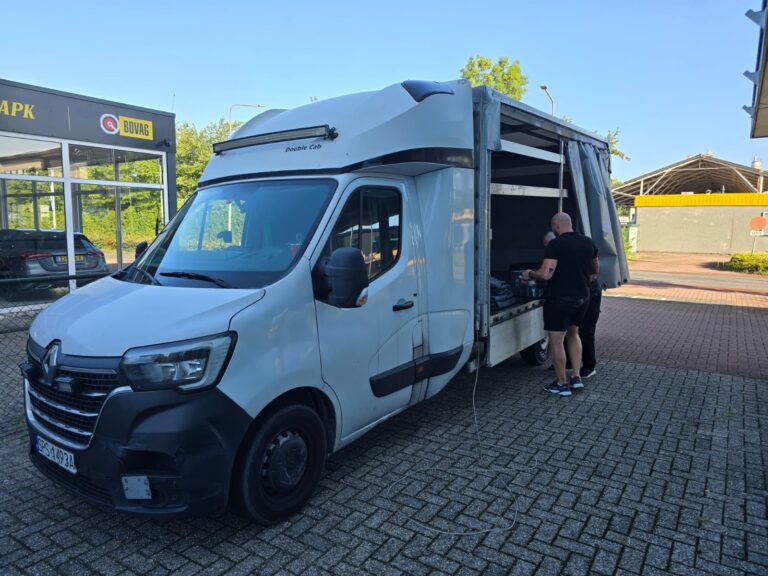
If your plan includes both working and relocating, the permit question is only half the story. You also need to plan the physical move: household goods, customs, inventory, packing, vehicle size, delivery access, timing, storage, and first week essentials. VANonsite supports UK to Switzerland relocations with premium European transport, GPS tracking for every load, flexible vehicle sizes from 1 m3 to 90 m3, man and van options for smaller moves, and services such as Home Removals, Furniture Removals, Student Removals, Office Removals, Packing Service, White Glove Delivery, Storage, Last Minute Moving, and Office Furniture Installation.
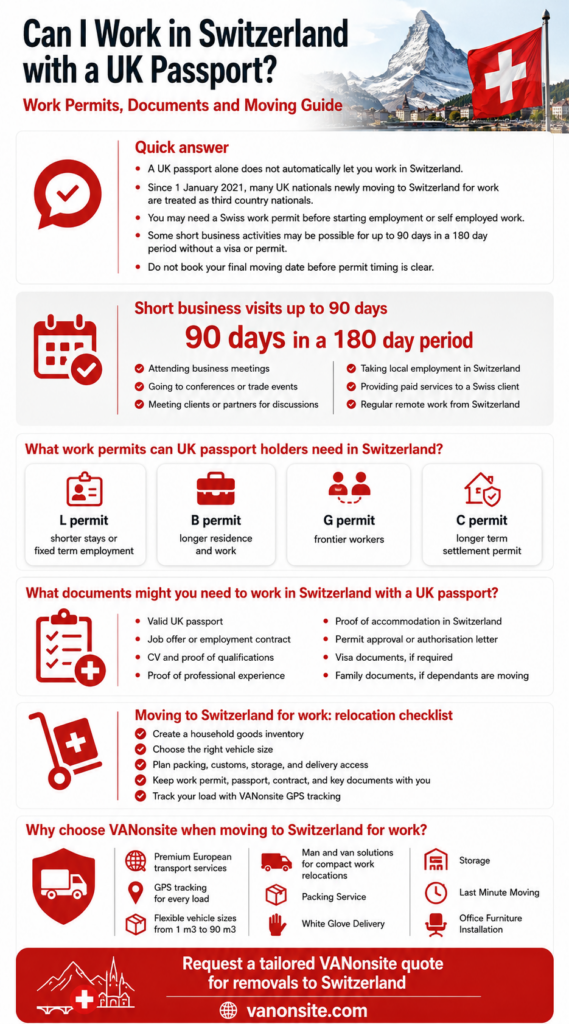
Quick answer
- A UK passport alone does not automatically let you work in Switzerland. It may allow short visitor entry, but work rights are separate.
- Since 1 January 2021, many UK nationals newly moving to Switzerland for work are treated as third country nationals. This usually means stricter permit rules than before Brexit.
- You may need a Swiss work permit before starting employment or self employed work. For employed roles, the Swiss employer often leads the application through the relevant canton.
- Some short business activities may be possible for up to 90 days in a 180 day period without a visa or permit. This depends on the exact activity, so check official guidance.
- Longer stays and most productive work need careful checking. Local employment, client delivery, internships, self employment, paid assignments, service provision, and long term work may require approval.
- Do not book your final moving date before permit timing is clear. Build flexibility into your relocation plan, especially if your job start, housing date, or approval date may shift.
- If you are relocating belongings, plan removals early. Prepare a household goods inventory, check Swiss customs rules, choose the right VANonsite vehicle size, and decide whether you need Packing Service or Storage.
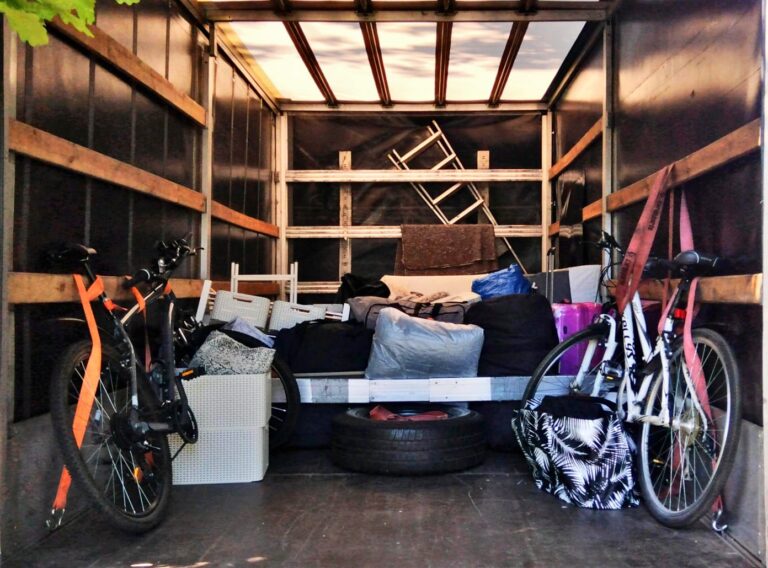
- A man and van option can be ideal for smaller work relocations. It can suit work equipment, documents, suitcases, student or internship moves, compact furniture, and urgent job starts.
- Request a tailored VANonsite quote for removals to Switzerland once you know your job location, likely moving date, inventory, and Swiss delivery address.




Can I work in Switzerland with a UK passport after Brexit?
If you are asking, “can I work in Switzerland with a UK passport?”, the honest answer after Brexit is clear: a UK passport alone is not enough for most work in Switzerland. It may help you enter Switzerland for a short visit, but it does not automatically give you the right to start a job, take paid employment, become self employed, or move there freely for work.
Before Brexit, UK nationals benefited from free movement arrangements with Switzerland through the UK’s former EU position. That changed for most new movers from 1 January 2021. UK nationals newly entering Switzerland for work are generally treated as third country nationals. In practice, this can mean stricter admission rules, work permit checks, quotas, employer involvement, and approval before work begins.
A UK passport may allow you to enter the Schengen area, including Switzerland, for short stays of up to 90 days in a 180 day period, but that visitor allowance does not automatically cover employment. You can cross the border as a visitor and still be unable to work legally.
For many UK citizens, the practical route looks like this:
- You receive or negotiate a job offer in Switzerland.
- Your Swiss employer checks whether the role can be offered to a UK national under the relevant rules.
- The employer usually applies through the competent cantonal authority.
- The application may be assessed against Swiss labour market conditions, quotas, salary, qualifications, and business need.
- You wait for approval before starting work.
- If an entry visa step is required, it normally comes after authorisation is issued.
This is why you should not resign, book a final moving date, ship your household goods, or commit to a Swiss rental contract until your work route is clear. A job start date can feel urgent, but permit timing can depend on the canton, employer, documents, quotas, and whether additional checks are needed.
There are also special cases. UK nationals who already had rights in Switzerland before the end of the Brexit transition period may have different protection under acquired rights arrangements. Short term service providers may fall under different rules. Business visitors may be allowed to do limited activities without a work permit. Self employed workers, interns, contractors, posted workers, and remote workers can face different questions again.
Check the official guidance before making decisions:
- GOV.UK Travel to Switzerland for work
- GOV.UK Switzerland entry requirements
- ch.ch Working in Switzerland as a foreign national
- SEM UK nationals coming to Switzerland to work
- Swiss Embassy UK work permits
Once your work route is clear, the relocation itself needs the same level of planning. If you are moving furniture, work equipment, documents, clothing, books, monitors, or a full household from the UK to Switzerland, VANonsite can help with premium European transport, GPS tracking for every load, flexible vehicle sizes, and man and van options for smaller work relocations.
When can UK citizens work in Switzerland without a work permit?
Some UK citizens can travel to Switzerland for limited business related activities without needing a Swiss work permit, but this area needs careful handling. “Business visit” does not mean “anything work related is allowed”. The rules depend on the activity, duration, who benefits from the work, and whether the activity looks like local employment or service delivery.
GOV.UK guidance explains that British citizens may be able to do some business related activities in Switzerland for up to 90 days in a 180 day period without a visa or work permit. This can include activities such as attending meetings, conferences, trade events, or certain short professional activities. However, the exact list and conditions should always be checked before travel.
Short business visits up to 90 days
A short business visit is usually about presence, discussion, negotiation, observation, or participation. It is not the same as taking a Swiss job or doing productive work for a Swiss employer.
Examples that may be possible without a work permit, depending on the details, can include:
- Attending business meetings
- Going to conferences or trade events
- Meeting clients or partners for discussions
- Attending some short professional events
- Taking part in limited artistic, cultural, academic, or sports activities where rules allow
Even then, the 90 days in a 180 day period limit matters. This is a rolling Schengen limit, not a fresh allowance every time you cross the border. If you travel often in Europe, count your days carefully.
Activities that usually need checking
You should check the rules carefully if your activity involves more than attending or discussing. Work that creates value in Switzerland, serves Swiss clients, or looks like local labour can quickly move into permit territory.
Activities that usually need checking include:
- Taking local employment in Switzerland
- Working for a Swiss company on site
- Providing paid services to a Swiss client
- Installing, repairing, building, or delivering technical work
- Construction or hands on project work
- Training staff or delivering client work
- Self employment carried out in Switzerland
- Internships, placements, or long term assignments
- Regular remote work from Switzerland
- Any paid activity that goes beyond a narrow business visit
Short term service provision can have its own route in some cases. For example, the UK Switzerland Services Mobility Agreement may allow certain UK service suppliers to provide services in Switzerland for up to 90 working days per calendar year using the Swiss notification procedure. This is not a blanket permission for every worker, sector, or activity. Check whether your sector, role, and situation qualify.
Before you travel, ask three simple questions:
- Will I be doing productive work in Switzerland?
- Will a Swiss company, client, site, or project benefit from my work?
- Will I be paid, directed, supervised, or integrated into work activity while physically in Switzerland?
If the answer to any of these is yes, check official guidance before travelling. If you are unsure, ask the Swiss authorities, your employer, or a qualified immigration adviser.
What work permits can UK passport holders need in Switzerland?
If you are wondering which Swiss permit might apply, the answer depends on your job, contract length, employer, canton, salary, qualifications, and whether you plan to live in Switzerland or only work there from across the border.
Swiss permits can feel confusing at first, but the basic idea is practical. A short assignment, fixed term job, permanent role, frontier worker arrangement, and long term settlement are not treated in exactly the same way. UK passport holders newly moving to Switzerland for work usually need approval under third country national rules, so the permit route should be checked before you make firm relocation plans.
Short term work permits
Short term work permits may apply when the job or assignment is limited in duration. This can include fixed term employment, a temporary posting, a specific project, a short assignment, or another time limited activity in Switzerland.
The details matter. A short stay does not automatically mean no permit is needed. The authorities may look at the activity, whether you are doing productive work, who benefits from the work, how long you will be in Switzerland, which canton is involved, and whether your employer or client is Swiss based.
L permit
An L permit is commonly linked with shorter stays or fixed term employment in Switzerland. For example, it may be relevant when a role has a limited contract length or when the stay is expected to be temporary rather than long term.
For UK citizens moving to Switzerland after Brexit, an L permit depends on official approval, the job, employer, canton, available quotas, salary conditions, qualifications, and the wider admission rules for third country nationals. If your job is temporary, you may not want to move a full household immediately. A smaller man and van relocation, Storage, or a phased move with VANonsite can make more sense while your work and housing situation settles.
B permit
A B permit is generally associated with longer residence and work in Switzerland. It may be relevant when someone is moving for a longer employment contract or a more stable role, subject to official approval.
For UK passport holders newly moving to Switzerland, a B permit can still be subject to third country national rules. That may include labour market tests, salary and working condition checks, qualification requirements, employer justification, and quotas. The exact process can vary by canton and job type.
G permit for frontier workers
A G permit is usually linked with frontier workers, meaning people who live outside Switzerland but work in Switzerland. This may apply in some cross border situations, especially where someone lives in a neighbouring country and travels into Switzerland for work.
For UK nationals, this route needs careful checking. It may not be relevant if you are moving your home from the UK to Switzerland. It may be more relevant if you will live in another country near Switzerland and commute across the border.
C permit
A C permit is a longer term settlement permit. It is not usually the first step for a UK citizen newly moving to Switzerland for work. It normally becomes relevant after years of lawful residence, when someone has already built a longer term life in Switzerland and meets the required conditions.
For official information, check:
Who applies for a Swiss work permit, you or the employer?
For most employed roles, the Swiss employer usually takes the lead. That means the employer applies to the competent cantonal authority and provides the job related documents needed for the application. You still need to supply personal documents, qualifications, experience details, passport information, and anything else requested, but the employer is usually central to the process.
This matters because you should not assume that you can arrive in Switzerland with a UK passport and start work while the paperwork catches up. For many UK nationals moving after Brexit, the work authorisation should be granted before employment begins. If an entry visa step is required, that normally happens after the Swiss authorisation has been issued.
The application can involve several checks, depending on the role and canton. These may include:
- whether the employer can hire a third country national for the role
- whether salary and working conditions meet Swiss standards
- whether the worker has the required qualifications or specialist experience
- whether quotas are available
- whether the canton supports the application
- whether federal approval is needed
- whether an entry visa step applies before travel
Cantonal authorities are central because Swiss immigration processes are strongly linked to where the work will happen. A job in Zurich, Geneva, Basel, Zug, Lausanne, Bern, or another canton may be handled through that canton’s process. Rules and timelines can vary, so your employer should tell you which authority is responsible and what documents are needed.
For the worker, the safest approach is to stay organised. Keep your passport, employment contract, CV, qualification certificates, references, salary details, job description, accommodation details, and family documents ready. Do not pack these papers into the removals van. They should stay with you in a secure folder because they may be needed quickly.
Before making irreversible decisions, check the official guidance and speak with your employer. The Swiss Embassy explains the work permit process for entry into Switzerland here: Swiss Embassy work permit guidance.
What documents might you need to work in Switzerland with a UK passport?
If you want to work in Switzerland with a UK passport, documents matter long before the moving boxes appear. A strong application is not only about having a job offer. It is about proving who you are, what role you will do, why you are qualified for it, where you will live, and whether the Swiss employer can support the work permit process.
The exact document list can vary by canton, employer, job type, permit route, and whether dependants are moving with you. Still, most UK citizens planning to work in Switzerland should prepare early. Missing papers can slow down the application, affect the start date, and create pressure around removals, housing, and travel.
For the work permit or employment process, you may need:
- Valid UK passport
- Job offer or employment contract
- Employer application documents
- CV and proof of qualifications
- Proof of professional experience
- Salary and job description details
- Passport photos where required
- Proof of accommodation in Switzerland
- Health insurance details, where relevant
- Permit approval or authorisation letter
- Visa documents, if required
- Family documents, if dependants are moving
- Translated or certified documents, where required
Keep these documents in one secure folder, both digitally and physically. Do not pack them into the removals van. If a canton, employer, border officer, landlord, school, insurer, or relocation contact asks for a document quickly, it should be within reach.
Documents for moving your belongings
A work relocation is not only about employment paperwork. If you are moving household goods, furniture, work equipment, books, monitors, documents, bicycles, tools, or family belongings to Switzerland, you also need practical removals documents.
Prepare these before booking removals to Switzerland:
- Detailed household goods inventory
- UK collection address with postcode, floor level, lift access, parking restrictions and stairs
- Swiss delivery address with postcode, floor level, lift size, building rules and parking access
- Proof of relocation or residence, where applicable
- Receipts for new or high value goods
- Pet documents, if moving animals
- Vehicle documents, if importing a car or motorbike
- Contact details for delivery in Switzerland
A clear inventory helps VANonsite recommend the correct vehicle size. Work relocations often include dense items such as books, documents, monitors, computers, tools, office chairs, and professional equipment. Sharing photos or a short video walkthrough can make the quote more accurate and reduce moving day surprises.
How long does it take to get permission to work in Switzerland?
There is no single guaranteed timeline for getting permission to work in Switzerland with a UK passport. Timing depends on the canton, employer, role, salary, qualifications, document quality, quotas, labour market checks, whether federal approval is needed, and whether an entry visa step applies.
Some applications can move faster when the employer is experienced, the documents are complete, and the role is straightforward. Others can take longer if the canton requests extra information, quotas are tight, qualifications need clarification, or the case involves family members, self employment, specialist status, or a more complex work arrangement.
The safest answer is this: do not plan your relocation as if approval is instant. Treat the work permit process and the physical move as connected timelines. A job start date, apartment handover, removals date, school start, or delivery slot can all be affected if the authorisation takes longer than expected.
Use these practical steps:
- Start before booking a final moving date.
- Ask the employer which canton handles the application.
- Ask what has already been submitted.
- Keep documents ready.
- Do not pack essential paperwork in the removals van.
- Build flexibility into moving dates.
- Use Storage if dates do not align.
- Consider Last Minute Moving if plans change fast.
A careful timeline can prevent expensive stress. You do not want your furniture arriving before you can access the Swiss property, or your essential work documents sealed inside a box when the employer asks for them.
Can I move to Switzerland without a job?
You may be able to move to Switzerland without a job in certain approved situations, but it is not the same as simply arriving with a UK passport and staying freely while you look for work. Since Brexit, UK nationals newly moving to Switzerland usually need to meet Swiss entry, residence, and permit requirements as third country nationals.
Switzerland may allow residence without gainful employment in specific cases, such as study, retirement, private means, family reasons, or another recognised route. However, each route has its own conditions. You may need to show enough financial resources, suitable accommodation, health insurance, acceptance at an educational institution, family status documents, or other evidence required by the canton.
If your real plan is to move first and find a job later, be careful. Entering as a visitor is different from becoming resident. Looking for work is different from being allowed to live in Switzerland long term. If a Swiss employer wants to hire you, the work permit process may still need to happen before you begin work.
Before making firm plans, check the official ch.ch guidance on living in Switzerland without gainful employment. You should also speak to the relevant Swiss canton or a qualified adviser if your situation is complex.
From a removals perspective, keep your move flexible. Some customers start with a smaller man and van move for essentials, work equipment, clothing, documents, and personal items. Others use Storage until their housing and paperwork are clearer.
Can I work remotely from Switzerland with a UK passport?
Remote work sounds simple, but working remotely from Switzerland with a UK passport can be legally and practically complex. The fact that your employer is in the UK does not automatically mean you can live in Switzerland and work from a laptop without checking the rules. Immigration, tax, social security, insurance, employment law, and employer compliance can all become relevant once you are physically working from Swiss territory.
Visitor status does not automatically allow remote work from Switzerland. A short stay as a visitor is usually designed for tourism, family visits, business meetings, or limited permitted activities, not for quietly relocating your working life to another country. If you plan to stay longer, work regular hours, serve clients, earn income while physically in Switzerland, or base yourself there for months, you should get proper advice before relying on visitor rules.
Remote work questions can become especially sensitive when:
- you work full time for a UK employer while living in Switzerland
- your stay goes beyond a short visit
- you work with Swiss clients or a Swiss branch
- your employer has no Swiss payroll or compliance setup
- you become tax resident or need Swiss health insurance
- your work involves regulated activity, data, finance, healthcare, legal services, or specialist licensing
- you want to move family members with you
- you are self employed or contracting from Switzerland
If your plan is remote work, the safest answer is: check before you go. Ask the Swiss authorities, your employer, a tax adviser, or an immigration specialist. Make sure your work pattern, length of stay, residence plan, and employer arrangement are allowed.
For relocation planning, remote workers often move dense but compact loads: monitors, laptops, office chairs, desks, documents, books, printers, speakers, lighting, clothing, and personal essentials. A man and van option can be ideal for a focused remote work setup, while larger VANonsite vehicle sizes can support full home moves.
Moving to Switzerland for work: relocation checklist
Moving to Switzerland for work is not just an immigration task. It is a practical relocation project with legal, financial, personal, and logistical moving parts. Your work permit route needs to line up with your housing plan. Your moving date needs to make sense with your job start. Your documents need to stay with you, not disappear into a sealed box.
Use this checklist to connect the legal preparation with the physical move.
- Confirm whether your role needs a permit. Check whether your role is local employment, self employment, a short business visit, service provision, remote work, internship, or another category.
- Ask your employer about the cantonal application process. Ask which canton will handle the application, what documents are needed, whether quotas may apply, and when approval is realistically expected.
- Check passport validity and Schengen entry rules. Count Schengen days carefully if you travel often.
- Prepare employment and qualification documents. Keep your contract, CV, certificates, references, licences, salary details and translated documents ready.
- Check Swiss accommodation and registration requirements. Confirm whether you will move into temporary accommodation, a rental flat, a family home, employer housing, or storage first.
- Prepare health insurance research. People living in Switzerland usually need appropriate health insurance.
- Create a household goods inventory. List furniture, boxes, electronics, work equipment, books, documents, clothing, kitchenware, bikes, tools, and fragile items.
- Request a VANonsite quote for removals to Switzerland. Share postcodes, date range, inventory, photos, floor levels, lift details, parking information, access restrictions, packing needs, and storage concerns.
- Choose the right vehicle size. VANonsite vehicle sizes range from 1 m3 to 90 m3, so the move can match the real load.
- Plan packing, customs, storage, and delivery access. Check Swiss customs rules for household effects and confirm Swiss delivery access before moving day.
- Keep work permit, passport, contract, and key documents with you. Never pack essential paperwork in the removals van.
- Track your load with VANonsite GPS tracking. Once your belongings leave the UK, visibility helps you plan around arrival.
VANonsite vehicle sizes for moving to Switzerland for work
The right vehicle size can change the whole feeling of a move. Too little space creates pressure, awkward loading, crushed boxes, and unnecessary worry. Too much space can mean paying for capacity you do not need. For a UK to Switzerland work relocation, the best choice depends on the real inventory, not only the number of rooms.
Work relocations often include dense and delicate items: books, monitors, laptops, documents, computers, office chairs, tools, printers, clothes, lamps, small furniture, and sometimes a full home office. These items need secure packing and sensible spacing.
| VANonsite option | Capacity | Weight limit | Best for |
|---|---|---|---|
| Moving One | 1 m3 | 100 kg | Documents, work equipment, suitcases, urgent small loads |
| Moving Basic | 5 m3 | 300 kg | Student moves, man and van relocations, small apartments |
| Moving Medium | 10 m3 | 500 kg | One bedroom flats, compact furniture, mixed boxes |
| Moving Premium | 15 m3 | 1,100 kg | Larger apartments, professional relocations, furniture removals |
| Moving Premium Plus | 30 m3 | 3,500 kg | Family moves, larger furniture loads, small office moves |
| Moving Full House XXL | 90 m3 | 20,000 kg | Full house moves, large office relocations, complex European moves |
As a practical rule, leave around 10% to 20% spare capacity where possible. That extra room improves stacking, protects fragile items, supports better weight distribution, reduces pressure damage, and makes unloading easier at the Swiss address.
Before requesting a quote, count boxes, list furniture, flag heavy items, mention fragile pieces, and share photos of work equipment, office furniture, electronics, mirrors, artwork, or anything difficult to replace.


Man and van for UK to Switzerland work relocations
A full removals lorry is not always necessary when you are moving to Switzerland for work. If your relocation is focused, compact, or tied to a fast job start, a man and van service can be a smarter and more proportionate choice.
A man and van option can be ideal for:
- New job relocations with a small load
- Studio or one bedroom apartments
- Work equipment and documents
- Student or internship moves
- Urgent work starts
- Furniture only transport
- Compact home office setups
A smaller move can reduce unnecessary handling, simplify loading, improve timing, and make delivery easier at Swiss apartments where parking, lifts, staircases, and building rules can be strict. Still, smaller does not mean casual. A UK to Switzerland man and van relocation should still include a clear inventory, secure packing, customs awareness, delivery access details, and GPS tracking.
What affects the cost of moving to Switzerland for work?
The cost of moving to Switzerland for work depends on the real shape of your move. A small man and van relocation with work equipment and suitcases will not cost the same as a family move with furniture, fragile items, books, kitchenware, and home office equipment. A useful quote should be based on practical details, not a vague guess.
| Cost factor | Why it matters | What to prepare |
|---|---|---|
| Load volume | Determines vehicle size and loading time | Inventory and photos |
| Weight | Dense work items can affect handling | Flag books, tools, files, IT equipment |
| UK collection access | Flats, city centres, parking and stairs affect collection | Full postcode, floor, lift and parking details |
| Swiss delivery access | Apartments, mountain roads, narrow streets and building rules affect delivery | Full postcode, floor, lift and parking details |
| Packing | Fragile electronics and furniture may need professional packing | List fragile items early |
| Urgency | Job start dates can create pressure | Share deadlines and flexible windows |
| Storage | Permit approval and housing dates may not align | Tell VANonsite if storage may be needed |
| Extra services | Packing, white glove delivery, office installation or furniture removals change scope | List every service before requesting a quote |
Work relocations can be deceptive because some items are small but dense. Books, documents, files, monitors, computers, tools, and office equipment may not fill a room, but they can add weight and require careful handling. For safety, it is often better to leave 10% to 20% spare capacity rather than force the load into the smallest possible vehicle.
You can reduce cost without weakening the move by decluttering, sharing a detailed inventory, choosing the right vehicle size, packing sturdy non fragile items yourself, using professional packing where it adds real protection, being flexible with dates, mentioning access problems early, and using Storage if permit, housing, and job start dates do not align.
Customs and household goods when moving to Switzerland for work
Customs can feel like the dull part of a work relocation, but it is one of the details that can either protect your move or slow it down. If you are moving to Switzerland for a job, your household goods are not simply crossing from one UK city to another. They are entering a country with its own customs rules, import procedures, and documentation expectations.
Switzerland is outside the EU customs union, so household effects, work equipment, furniture, personal items, vehicles, pets, plants, new goods, and high value items may need careful checking before moving day. A clear inventory is one of the most important documents you can prepare.
For many people relocating their place of residence, household effects may be eligible for duty free import when the official conditions are met. Swiss customs guidance links this to transfer of domicile and personal use. In general, imported household articles should have been personally used before the move and should continue to be used after import into Switzerland. New purchases, commercial goods, unusual items, restricted items, vehicles, animals, alcohol, plants, or expensive equipment can need extra checks.
Before your move, check the official guidance:
- Swiss customs household effects
- Swiss relocation import procedure
- GOV.UK declaring personal goods into or out of the UK
A good customs plan should include a detailed household goods inventory, proof of relocation or residence where applicable, receipts for new or high value items, vehicle documents, pet documents, and clear separation of personal and business items.
Do not pack customs documents, work permits, passports, employment contracts, Swiss accommodation papers, vehicle documents, pet documents, or high value receipts in the removals van. Keep them with you in a personal folder.
Packing checklist for a UK to Switzerland work move
Packing for a UK to Switzerland work move is different from packing for a short local move. Your belongings may travel a long distance, pass through border procedures, and arrive when you are under pressure to start work, register locally, set up your home, and find your new rhythm.
Use this checklist before collection day:
- Use double wall boxes for books, files, and electronics.
- Keep boxes under 20 kg where possible.
- Wrap monitors, laptops, printers, speakers, and fragile tech carefully.
- Keep passports, contracts, work permits, and certificates with you.
- Label work equipment separately.
- Photograph high value items before collection.
- Pack a first week work box with chargers, adapters, laptop stand, key documents, stationery, mouse, keyboard, headphones, notebook, medication, and basic office tools.
- Use professional packing for fragile or expensive items.
- Consider White Glove Delivery for premium furniture or specialist equipment.
- Separate everyday essentials from long term boxes.
- Protect furniture corners and legs.
- Bag and label screws and fittings.
VANonsite can support the packing and transport side with flexible vehicle sizes, man and van options for compact work relocations, Packing Service for fragile items, White Glove Delivery for premium pieces, Storage if dates shift, and GPS tracking for every load.
What not to pack in the removals van
Some items should not travel inside the removals van, even if they seem small, valuable, or convenient to pack at the last minute. A UK to Switzerland work relocation can involve customs checks, long distance transport, border procedures, apartment access, and a tight job start date.
Do not pack these items in the removals van:
- Passport and work permit documents
- Employment contract and Swiss accommodation papers
- Medication
- Jewellery and cash
- Laptops needed immediately
- Hazardous chemicals
- Fuels, paints, gas canisters and solvents
- Perishable food
- Plants and soil without checking rules
- Lithium batteries, e bikes or scooters without transport checks
- Restricted, commercial or unusual goods without prior advice
| Category | Examples | Best action |
|---|---|---|
| Carry personally | Passport, work permit papers, employment contract, medication, jewellery, laptop, certificates | Keep in a secure travel bag or document folder |
| Safe for the removals van | Clothes, books, packed kitchenware, furniture, bedding, standard household items | Pack securely and list in your inventory |
| Check before moving | Plants, batteries, alcohol, tools, new goods, vehicle items, pet items, unusual equipment | Confirm rules and tell VANonsite before collection |
Popular Swiss work destinations for UK passport holders
Switzerland has several strong work hubs, and each destination creates a different kind of move. A finance professional moving to Zurich may need a different relocation plan from a researcher moving to Basel, a student moving to Lausanne, or an executive moving to Zug.
| Destination | Common work sectors | Moving focus |
|---|---|---|
| Zurich | Finance, tech, corporate roles | Apartments, premium furniture, work equipment |
| Geneva | NGOs, finance, diplomatic, international organisations | Documentation, high value goods, careful timing |
| Basel | Healthcare, pharma, life sciences, research | Office equipment, professional moves, customs preparation |
| Zug | Finance, commodities, executives | White glove delivery, premium relocation |
| Lausanne | Education, research, students, tech | Smaller loads, student removals, man and van options |
| Bern | Public sector, professional roles, families | Household organisation and careful delivery |
| Lucerne | Tourism, lifestyle, professional moves | Access planning and fragile item protection |
Zurich is one of Switzerland’s strongest destinations for finance, technology, consulting, corporate roles, insurance, startups, and executive moves. Many UK passport holders moving to Zurich need to relocate home office equipment, premium furniture, clothing, documents, monitors, books, and personal items into apartments where parking and lift access can be limited.
Geneva attracts people working in NGOs, international organisations, finance, diplomacy, luxury services, legal work, research, and global business. Moves to Geneva often involve careful documentation, high value items, furniture, work equipment, and precise timing around job starts or housing access.
Basel is a major destination for healthcare, pharmaceuticals, life sciences, research, academia, and specialist professional roles. A move to Basel may include office equipment, scientific documents, books, monitors, IT equipment, furniture, and dense professional items.
Zug, Lausanne, Bern, and Lucerne can also involve very different moving needs, from premium white glove delivery to compact student removals. In each case, VANonsite’s GPS tracking, flexible vehicle sizes, man and van options, Packing Service, Storage, and White Glove Delivery can make the relocation feel more controlled.
Why GPS tracking matters when moving to Switzerland for work
When you are moving to Switzerland for work, timing is not just convenient. It can shape your first week, your first commute, your first client call, and your first night in a new home. Your belongings may include work equipment, documents, clothing, home office furniture, monitors, books, tools, fragile electronics, and personal items you need almost immediately after arrival.
GPS tracking turns a long distance European move from a silent wait into a visible journey. Once your load leaves the UK, you do not want to wonder where your essentials are while you are dealing with permits, housing, registration, insurance, travel, and a new job start. VANonsite offers GPS tracking for every load, helping you follow the movement of your belongings and plan around delivery with more confidence.
GPS tracking helps with job start planning, Swiss delivery coordination, urgent work equipment, fragile items, office relocations, and tight timelines. It does not just show movement. It gives the move a pulse.
Common mistakes UK citizens make when moving to Switzerland for work
Moving to Switzerland for work can be thrilling, but it rewards preparation. A UK passport, a job offer, and a packed suitcase are not always enough. The smartest move is to treat the relocation as two connected projects: getting the right legal route and moving your belongings safely.
Avoid these mistakes:
- Assuming a UK passport gives automatic work rights
- Confusing business travel with employment
- Booking removals before permit timing is clear
- Not checking canton specific rules
- Forgetting Swiss customs documents
- Packing work permit papers in the removals van
- Choosing the cheapest moving option without checking GPS tracking or protection
- Underestimating the volume of work equipment and books
- Not planning delivery access in Swiss cities
- Leaving storage too late when housing or permit dates change
A successful UK to Switzerland work relocation is about sequencing the move intelligently: legal route first, documents close, inventory clear, customs checked, vehicle matched, access planned, and transport visible from collection to delivery.
Why choose VANonsite when moving to Switzerland for work?
Once your work permit route is clear, your physical move should feel just as organised. Moving to Switzerland for work is already full of decisions: permits, employer paperwork, housing, registration, insurance, tax questions, customs, and the first day in a new role. Your removals service should not add more noise. It should give you control.
VANonsite helps turn a complex UK to Switzerland relocation into a structured plan, with safe handling, visible transport, and vehicle options that fit the real load. Whether you are moving a few essentials for a new job, a compact home office, a student room, a full apartment, specialist equipment, premium furniture, or an entire household, the service can scale around the move rather than forcing you into a rigid package.
VANonsite supports that stage with:
- Premium European transport services
- GPS tracking for every load
- Flexible vehicle sizes from 1 m3 to 90 m3
- Man and van solutions for compact work relocations
- Packing Service for fragile electronics and furniture
- White Glove Delivery for premium goods
- Home Removals, Student Removals, Furniture Removals and Office Removals
- Storage when job start and property dates do not align
- Last Minute Moving when plans change fast
- Office Furniture Installation for work setups and business relocations
The strongest benefit is confidence. You can choose a vehicle that suits the real inventory, protect fragile or expensive items properly, keep essential documents with you, and track the load while you focus on the legal and professional side of the move.
Quick quote checklist
The fastest way to get an accurate quote is to make your move easy to understand. Before asking for a tailored VANonsite quote, prepare the essentials below.
| Detail to prepare | Why it matters |
|---|---|
| UK collection postcode | Helps plan route, access, timing, and collection conditions |
| Swiss delivery postcode | Helps assess distance, city access, parking, and delivery planning |
| Preferred moving date or date range | Helps match the move to job start, housing, permit timing, and availability |
| Inventory list | Helps choose the correct vehicle size and avoid surprise volume |
| Photos or video walkthrough | Shows bulky furniture, fragile items, stairs, access, and hidden storage areas |
| Number of boxes | Helps estimate loading time, weight, and vehicle capacity |
| Furniture list | Shows what may need dismantling, wrapping, or careful loading |
| Work equipment list | Identifies monitors, documents, IT items, tools, desks, office chairs, and priority items |
| Floor level at both properties | Stairs and lifts can change the time and handling plan |
| Lift availability | Important for apartments, offices, student buildings, and Swiss city deliveries |
| Parking restrictions | Helps avoid delays, long carry distances, and access problems |
| Packing requirements | Shows whether Packing Service may be needed for fragile or expensive items |
| Fragile or high value items | Helps plan protection, loading position, or White Glove Delivery |
| Storage needs | Useful when permit approval, tenancy dates, or delivery access do not align |
| Office installation needs | Important for desks, meeting tables, workstations, storage units, and business moves |
Request a tailored VANonsite quote for removals to Switzerland and get a moving plan based on your real inventory, not a rough guess.
FAQ
Can I work in Switzerland with a UK passport?
Not automatically. A UK passport alone usually does not give you the right to work in Switzerland. It may allow short visitor entry, but work rights are separate. Since Brexit, many UK nationals newly moving to Switzerland for work are treated as third country nationals, which means a Swiss work permit may be needed before employment begins.
Do UK citizens need a work permit for Switzerland?
Usually, yes, if the plan involves employment, long term work, self employment, productive work, or a paid assignment in Switzerland. For many employed roles, the Swiss employer applies through the competent cantonal authority before the UK citizen starts work.
Can I go to Switzerland for business meetings with a UK passport?
Often, yes. UK citizens may be able to carry out some business visitor activities in Switzerland for up to 90 days in a 180 day period, depending on the activity. However, that does not mean all work is allowed.
Can I move to Switzerland from the UK without a job?
It may be possible in certain approved categories, such as study, retirement, private means, family reasons, or another recognised route, but UK citizens must meet Swiss requirements. Moving without a job is not the same as arriving freely and staying while you look for work.
Can I work remotely in Switzerland for a UK company?
Remote work is complex. Working for a UK employer while physically in Switzerland can raise immigration, tax, social security, insurance, employment law, and employer compliance issues. Visitor status does not automatically make remote work allowed.
Who applies for a Swiss work permit?
For most employed roles, the Swiss employer usually takes the lead and applies to the competent cantonal authority. The worker still needs to provide personal documents such as passport details, CV, qualifications, references, job information, and family documents where relevant.
What documents do I need to move to Switzerland for work?
You may need a valid UK passport, employment contract, employer application documents, CV, proof of qualifications, professional references, salary and job description details, accommodation information, permit approval where applicable, visa documents if required, family documents, and translated or certified papers where requested.
For the physical move, prepare a household goods inventory, UK collection address, Swiss delivery address, proof of relocation or residence where applicable, receipts for new or high value goods, pet documents, vehicle documents, and Swiss delivery contact details.
Can VANonsite help with moving to Switzerland for work?
Yes. VANonsite can support UK to Switzerland work relocations with Home Removals, Student Removals, Furniture Removals, Office Removals, man and van options, Packing Service, White Glove Delivery, Storage, Last Minute Moving, Office Furniture Installation, GPS tracking, and flexible vehicle sizes from 1 m3 to 90 m3.
Start the job in Switzerland without moving chaos
Working in Switzerland with a UK passport starts with the right legal route, but a successful relocation also needs a safe physical move. You need the right documents, the right timing, the right vehicle, and the right level of care for the items that support your everyday life and your first working week.
VANonsite helps you move your home, work equipment, furniture, documents, and essentials with premium European transport, GPS tracking, flexible vehicles, careful handling, Packing Service, Storage, and man and van options for compact work relocations.
Once your work permit route, job location, and moving date are clearer, request your tailored quote for removals to Switzerland and move with more control from the first box to the first working day.