A move from Germany to Belgium can open the door to something exciting: a better job, a calmer lifestyle, a fresh start, or simply a home that fits your next chapter. Still, even a short cross-border move can feel intense. One minute you are comparing routes, boxes, and prices. The next, you are wondering how long the move will take, what paperwork matters, and whether your furniture will arrive exactly as it left.
That is why smart planning matters from day one. The best removals from Germany to Belgium are never just about transporting boxes. They are about protecting your time, your budget, and the things that make a place feel like home. From a compact man and van booking for a smaller move to a full household relocation with packing and white glove handling, the right setup changes everything.
This guide gives you fast, direct answers. You will learn how removals from Germany to Belgium work, what can influence the final cost, how long delivery usually takes, which documents you should prepare, and how to avoid the hidden mistakes that often turn a simple move into a draining one. You will also see how VANonsite can make the whole process smoother with secure transport, fast response times, flexible service levels, and GPS tracking for every load.
For many people, the biggest stress is not the distance itself. It is uncertainty. Will the van arrive on time? Will fragile items survive the journey? Will the whole move spiral into delays and extra charges? A well-organised removals service replaces that tension with clarity. You know what is being moved, when it is leaving, where it is, and when it is expected to arrive.
TL:DR
- Removals from Germany to Belgium can often be completed quickly, but timing depends on distance, access, volume, and any extra services booked.
- A man and van service is often ideal for smaller moves, student relocations, partial furniture transport, and urgent bookings.
- Costs usually depend on cubic volume, weight, pickup and delivery locations, floor access, and packing or storage needs.
- Because both countries are in the EU, the process is usually simpler than overseas moving, although registration and personal document requirements still matter.
- Professional packing can sharply reduce the risk of breakage, delays, and last-minute chaos, especially for fragile or valuable items.
- GPS tracking gives far better visibility during transit, which brings peace of mind and makes planning much easier.
- VANonsite supports removals from Germany to Belgium with secure transport, flexible vehicle sizes, fast communication, and service options for homes, offices, students, and furniture moves.
If you want your move to feel controlled rather than chaotic, start by matching the service to the real size of your relocation. A few boxes and personal items may only need a fast man and van solution. A larger flat, family home, or office move may need packing support, furniture protection, and a bigger vehicle. Either way, the goal stays the same: a safe, swift, and stress-light move from Germany to Belgium.




What to Know Before Planning Removals from Germany to Belgium
Planning removals from Germany to Belgium may sound simple at first because the two countries are close. However, a cross-border move still has moving parts that deserve real attention. Distance alone does not decide whether a move feels smooth or stressful. Timing, access, building rules, parking options, and the actual size of your load often have a bigger impact than people expect.
That is why the smartest approach is to treat the move as a practical project, not a last-minute errand. A short route can still become exhausting if the van cannot park near the building, if the stairwell is narrow, or if your furniture needs disassembly before loading. On the other hand, a well-prepared move can feel surprisingly efficient, especially when the service matches the real scale of the job.
For example, a small man and van booking can be perfect for a student move, a few boxes, or a part-load relocation. It is often the quickest and most economical route when you are not moving an entire household. Yet a larger flat, family home, or office setup needs more structure. In those cases, a full removals service offers better coordination, more protection for furniture, and a calmer moving day from start to finish.
Another point many people overlook is city logistics. Pickups in Berlin, Munich, Frankfurt, or Hamburg can involve access limits, reserved loading zones, and strict time windows. Deliveries in Brussels, Antwerp, Ghent, or smaller Belgian towns may also require advance planning, especially in apartment buildings or busy urban streets. These details may seem minor, yet they can strongly affect timing and labour.
There is also the emotional side of the move. People rarely worry only about transport. They worry about breakage, delays, missed handovers, and whether the whole day will unravel under pressure. That is exactly why choosing the right moving model matters. A lean man and van solution works beautifully for lighter relocations, while more complex moves benefit from added services such as packing, furniture handling, storage, or premium delivery care.
Before booking, it helps to ask a few sharp questions:
- How much are you really moving?
- Do you need help with packing or furniture dismantling?
- Is access easy at both addresses?
- Are any items fragile, valuable, or unusually bulky?
- Are you working with a fixed move-out or move-in date?
The clearer these answers are, the easier it becomes to avoid wasted space, surprise costs, and moving-day friction. In many cases, the most affordable solution is not the smallest van. It is the service that fits the job properly on the first attempt.
A simple overview can help you choose faster:
- Best for small moves: man and van service
- Best for flats and family homes: full removals support
- Best for fragile or premium items: white glove delivery
- Best for busy schedules: packing service and last minute moving
In short, removals from Germany to Belgium work best when speed is balanced with preparation. The route may be straightforward, but the quality of the planning decides whether the experience feels rushed and risky or smooth and reassuring.
How Much Do Removals from Germany to Belgium Cost?
The cost of removals from Germany to Belgium is usually one of the first questions people ask, and rightly so. Nobody wants vague promises or guesswork when budgeting for a move. The truth is simple: price depends on what you are moving, how much space it takes, where it is being collected, where it is being delivered, and how much support you need along the way.
A light move with boxes, suitcases, and a few essentials can cost far less than a full household relocation with sofas, wardrobes, appliances, and fragile furniture. The same route can also be priced differently depending on whether the pickup is from a ground-floor property with easy access or a city-centre apartment with stairs, permit restrictions, and tight loading windows. That is why removals from Germany to Belgium are best priced around the real details of the job rather than rough assumptions.
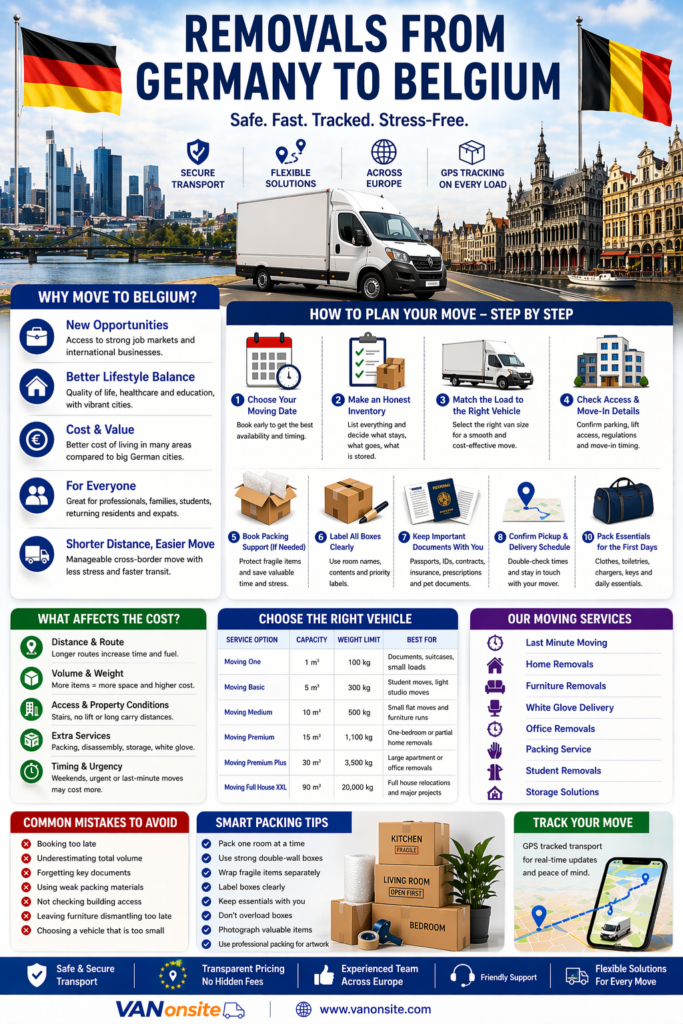
One of the fastest ways to understand the likely service level is to match your move size to the right vehicle option:
| Move Size | Typical Use Case | Vehicle Option | Capacity | Weight Limit |
|---|---|---|---|---|
| Very small move | Boxes, suitcases, essentials | Moving One | 1 m3 | 100 kg |
| Small move | Student room, a few furniture items | Moving Basic | 5 m3 | 300 kg |
| Medium move | Studio or partial flat move | Moving Medium | 10 m3 | 500 kg |
| Large move | 1 to 2 bedroom home | Moving Premium | 15 m3 | 1100 kg |
| Extra large move | Family home move | Moving Premium Plus | 30 m3 | 3500 kg |
| Full property relocation | Large house move | Moving Full House XXL | 90 m3 | 20000 kg |
This kind of structure matters because the wrong vehicle size can create expensive problems. If the load is underestimated, the move may need a second journey, more labour, or last-minute changes. If it is overestimated, you may pay for space you do not need. A well-matched vehicle keeps the move lean, efficient, and far more cost-effective.
Several core factors shape the final quote for removals from Germany to Belgium:
- pickup city in Germany and delivery city in Belgium
- total volume in cubic metres
- weight of the load
- number of movers needed
- packing and unpacking support
- furniture disassembly and reassembly
- floor level, stairs, and lift access
- weekend, urgent, or last minute booking
- white glove handling for delicate or valuable goods
- storage before or after delivery
Each of these details can change the workload in a real way. A medium move from Cologne to Brussels with easy driveway access may be much more straightforward than a smaller move from central Berlin to a narrow street in Antwerp. Likewise, adding professional packing often increases the quote, but it can also save hours of labour, reduce the damage risk, and prevent chaos on moving day.
Customers who book a man and van service for smaller relocations often benefit from a simpler pricing structure because the volume is lower and the moving plan is lighter. This can be ideal for students, young professionals, or anyone transporting selected items rather than an entire property. On the other hand, larger home or office removals usually need more manpower, more protective materials, and tighter coordination, which naturally affects the final price.
It is also worth remembering that urgency has a value. Last minute moves can absolutely be arranged, but compressed timelines may reduce flexibility and increase costs. When a move is booked early, there is usually more room to match the ideal vehicle, the right crew, and the best service combination.
The smartest next step is not to guess. It is to request an accurate quote based on the real load size and service needs. In many cases, the most cost-effective move is not the cheapest-looking option on paper. It is the move planned properly from the start, with the right amount of space, the right level of handling, and no painful surprises halfway through.
How Long Do Removals from Germany to Belgium Take?
One of the biggest worries before an international move is timing. People want to know how long they will be living between boxes, when their furniture will arrive, and how quickly life can return to normal. The reassuring news is that removals from Germany to Belgium can often be completed quickly, especially when the route, access, and load size are planned properly.
Many moves on this route can be completed within 1 to 2 days, depending on the pickup location in Germany, the delivery point in Belgium, and the level of service booked. A smaller move from a well-accessible property is naturally faster than a full household relocation that includes packing, dismantling furniture, stair carries, or time-sensitive building access.
The size and shape of the move matter just as much as the route. A lighter man and van booking is often the fastest option because loading is simpler and the schedule is more direct. A medium home move usually takes more planning time, while a large family house or office relocation may need a staged approach to keep everything safe and organised.
Timing is often influenced by factors such as:
- the pickup city and delivery location
- the amount of furniture and number of boxes
- stairs, lift access, and parking conditions
- whether packing or dismantling is included
- urgency and date flexibility
- special handling for delicate or high-value items
Some moves also take longer because careful handling is worth the extra time. Fragile furniture, electronics, artwork, mirrors, and premium household goods should never be rushed. A slightly longer loading process can make a major difference to safety and peace of mind.
In practical terms, this is what customers can usually expect:
- Small man and van move: often the fastest option
- Medium household move: usually requires more loading and planning time
- Full home or office relocation: may involve a staged schedule
- Packed and protected fragile items: extra handling time, better peace of mind
Last minute moves are possible too, although availability can affect both scheduling and price. When a move is arranged early, there is usually more flexibility to choose the best vehicle, the best timeslot, and the smoothest service setup.
The key point is simple: speed matters, but controlled speed matters more. The best removals from Germany to Belgium are not rushed. They are well-timed, well-coordinated, and built around the real demands of the move.
Required Documents for Moving from Germany to Belgium
Paperwork is rarely anyone’s favourite part of moving, yet it becomes far less stressful when you know exactly what to prepare. For most household removals from Germany to Belgium, the process is simpler than for non-EU relocations because both countries are part of the European Union. Even so, it is wise to organise your documents early so moving day is focused on the move itself, not last-minute searching.
In most cases, you should have these essentials ready:
- a valid passport or national ID
- proof of your new address in Belgium where needed
- rental agreement or property purchase documents if relevant
- a clear inventory list of transported belongings
- evidence that the goods are personal belongings if requested
- business-related paperwork for office relocations if applicable
- pet travel documents if you are moving with animals
A simple folder, either physical or digital, can save a great deal of time. Keep your identity documents, housing paperwork, contact details, and any relocation records together in one accessible place. That way, you are not digging through taped boxes when you need something quickly.
Do you need customs clearance for removals from Germany to Belgium?
In most standard household cases, no complex customs clearance is required in the way it would be for an intercontinental move. Because Germany and Belgium are both in the EU, removals from Germany to Belgium are usually far more straightforward. That said, residents should still check current registration rules, residence obligations, and local administrative steps before the move.
If you are settling in Belgium, it is smart to review the official government guidance in advance. Useful sources include Belgium.be, Commissioner Brussels, the German Federal Foreign Office, and the Your Europe portal.
These sources can help you confirm:
- local registration requirements after arrival
- residence formalities relevant to your situation
- ID and travel document rules
- practical guidance for living and moving within the EU
If the move includes a home office, business equipment, or a company relocation, it is also sensible to double-check any business-related paperwork before the transport date. The same applies if you are moving with pets, valuable collections, or any belongings that may require additional records.
The good news is that the admin side of removals from Germany to Belgium is manageable when handled early. A little preparation here can prevent unnecessary delays later and make the whole relocation feel much more in control.
Step-by-Step Checklist for Removals from Germany to Belgium
A cross-border move becomes dramatically easier when you break it into clear, manageable steps. Instead of trying to solve everything at once, focus on the sequence. That approach cuts stress, reduces mistakes, and gives you a much better chance of keeping the move on time and on budget. For removals from Germany to Belgium, a practical checklist is often the difference between a chaotic day and a move that feels controlled from the first box to the final handover.
Here is a smart step-by-step plan to follow:
- Decide your moving date and destination address
Start with the non-negotiables. Lock in your preferred move date, your delivery address in Belgium, and any key deadlines linked to tenancy, work, or school. This creates the backbone of the whole moving plan. - Estimate your volume and sort what stays, goes, or gets stored
Before you book anything, work out what you are actually taking. Separate essentials from non-essentials. Sell, donate, or store items you do not need immediately. A sharper inventory often lowers moving costs and speeds up loading. - Book the right removals service or man and van option
Small moves usually work beautifully with a fast man and van setup. Larger household or office relocations often need more vehicle space, more labour, and stronger planning. The right service fit can save time, money, and a lot of unnecessary stress. - Prepare essential documents and address details
Keep your ID, rental or property paperwork, contact details, and any move-related records easy to access. For removals from Germany to Belgium, it is far easier when key documents are in one place rather than buried in a random box. - Reserve building access and parking if needed
This step is often ignored until it becomes a problem. If either address has restricted parking, stair-only access, lift booking rules, or time-limited loading zones, sort that in advance. Smooth access can shave hours off a move. - Pack room by room and label every box clearly
Good packing is not just about protection. It is also about speed and clarity. Label each box by room, note fragile contents, and mark priority items that should be unloaded first. - Protect fragile, high-value, and sentimental items
Mirrors, glassware, electronics, artwork, and family keepsakes deserve special care. Use proper wrapping materials, reinforce corners, and keep irreplaceable items clearly marked. This is also where premium handling or white glove support can make a real difference. - Confirm loading time and delivery schedule
Reconfirm timings shortly before move day. Make sure everyone knows the collection window, estimated delivery timing, and any access rules at both ends. Clear communication prevents delays and removes guesswork. - Keep essentials with you for the first 24 to 48 hours
Pack a separate essentials bag with chargers, documents, medication, toiletries, clothes, keys, and anything you will need right away. This simple move can make the first night in your new place feel far less frantic. - Check every item on arrival and settle into your new home
Once the delivery is complete, do a calm walk-through. Check furniture, boxes, and fragile pieces before everything is fully unpacked. A quick review at this stage helps you organise faster and settle in with confidence.
A well-planned move is not only faster. It is calmer, safer, and usually more cost-efficient too. When each stage is handled in the right order, removals from Germany to Belgium feel far less overwhelming and far more predictable.

Choosing the Right Service for Your Move
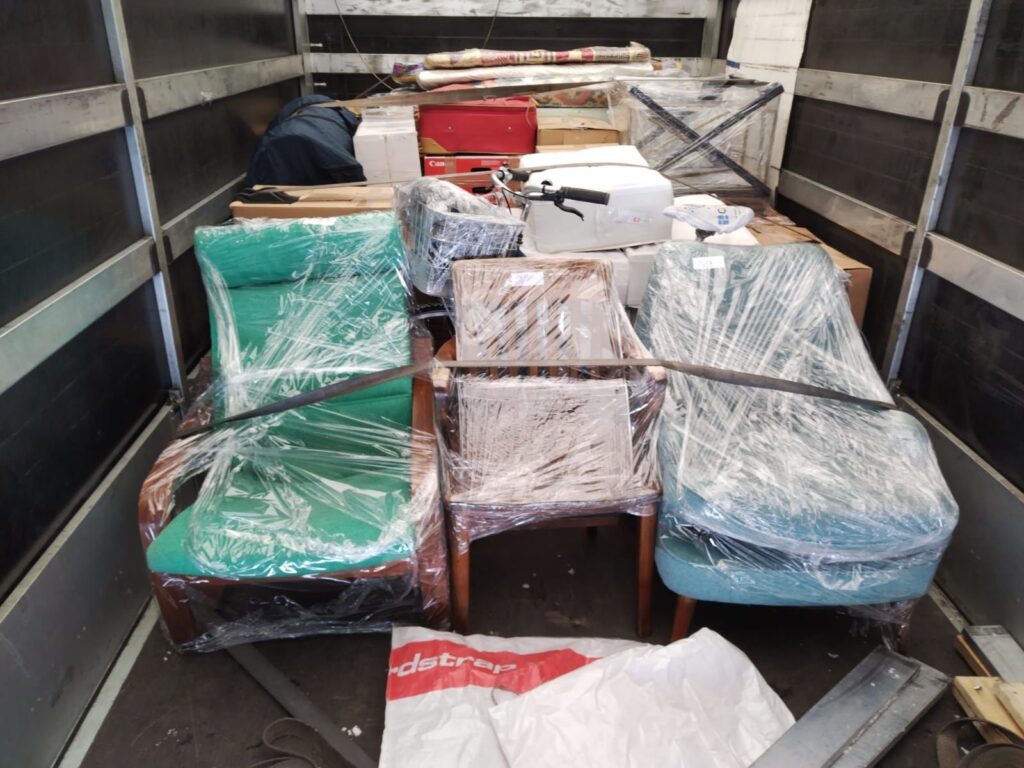
Not every move needs the same level of support. That is where many people either overspend or end up underprepared. Choosing the right service is less about buying the biggest package and more about matching the move to reality. If you are relocating a few boxes and a desk, a man and van service may be the ideal answer. If you are moving a full family home, high-value furniture, or a business setup, you need more structure, more protection, and a more tailored plan.
For removals from Germany to Belgium, the smartest service choice usually depends on four things: volume, urgency, item type, and how much hands-on help you want. Some customers want a lean, fast transport solution. Others want the kind of support that handles packing, lifting, protection, timing, and delivery with as little effort from them as possible.
This comparison makes the options easier to understand:
| Need | Best Service Option | Why It Helps |
|---|---|---|
| Urgent relocation | Last Minute Moving | Fast scheduling when time is tight |
| Household relocation | Home Removals | Designed for full residential moves |
| Heavy or bulky items | Furniture Removals | Better handling for large items |
| Premium care | White Glove Delivery | Ideal for delicate, valuable, or designer items |
| Business relocation | Office Removals | Helps reduce disruption and downtime |
| Packing support | Packing Service | Saves time and improves protection |
| Temporary space | Storage | Useful during transition periods |
| Student relocation | Student Removals | Flexible, practical, budget-aware |
If you are moving an entire flat or house, Home Removals is usually the strongest fit because it is built around the real rhythm of residential moving. It works especially well for customers who want a smoother, more organised experience rather than trying to coordinate every stage alone. If the move centres on wardrobes, sofas, dining tables, or oversized items, Furniture Removals offers more focused handling and better protection for bulky pieces.
For customers on a tight deadline, Last Minute Moving can be a real lifesaver. Some relocations arrive out of nowhere: a sudden job offer, a tenancy issue, a delayed key handover, or a family situation that changes overnight. In those moments, speed matters. Yet speed should never come at the expense of control. That is where a responsive removals partner earns trust.
If your move includes fragile, designer, or high-value items, White Glove Delivery adds another layer of reassurance. This is the premium route for pieces that need more than basic transport. It is ideal for delicate furniture, statement interiors, carefully finished surfaces, and items that simply deserve gentler hands.
Professional packing can also transform the moving experience. With Packing Service, customers save time, reduce the risk of damage, and avoid the exhausting scramble that often happens in the final 48 hours before departure. Likewise, if your move includes a timing gap between collection and final delivery, storage can keep the transition flexible rather than stressful.
Some moves are smaller, sharper, and more budget-sensitive. That is why Student Removals can be such a smart choice for university moves, first flats, and part-load relocations. For these customers, a man and van model often delivers the perfect balance of speed, affordability, and practicality.
Business customers have different priorities again. Office relocations are not only about transport. They are about continuity, timing, and minimising disruption. In those cases, Office Removals offers a more suitable framework for handling equipment, furniture, documents, and moving-day coordination.
It also helps to think beyond a single route. If you are planning onward logistics, return transport, or connected services, related route pages such as removals to Germany and removals to Belgium can support a broader moving plan without forcing you into a one-size-fits-all setup.
The right service should feel like relief, not pressure. It should fit the scale of the move, protect what matters, and make the entire process feel more manageable. That is why VANonsite works well for removals from Germany to Belgium. It gives customers the freedom to choose exactly the support they need, whether that means a lean man and van move, a carefully managed home relocation, or a premium delivery service built for exceptional care.
Why a Man and Van Service Works So Well for Smaller Moves
For smaller relocations, speed and simplicity often matter more than anything else. That is exactly why a man and van service is such a strong choice for many customers planning removals from Germany to Belgium. It gives you a practical, flexible solution without the weight of a full-scale moving setup. When the load is modest, the route is clear, and the timeline is tight, this option can feel refreshingly efficient.
A man and van service is especially useful for students, young professionals, single-room moves, part-load transport, and people who only need to move selected furniture rather than an entire property. It also works beautifully for urgent situations. Sometimes life changes fast: a new job starts sooner than expected, a tenancy ends abruptly, or a move date shifts at the last minute. In those moments, a leaner service model can make the whole process easier to manage.
Another reason this option works so well is flexibility. A full household move often requires more planning, more labour, and more moving parts. By contrast, a man and van booking can be ideal when you want a more direct route from pickup to delivery. It is particularly effective for city-to-city and apartment-to-apartment relocations, where the priority is getting a smaller volume moved safely and quickly.
Cost is another powerful advantage. When the move volume is modest, there is no need to pay for more space or more service than you actually need. That can make a real difference for people trying to balance quality with budget. A well-organised man and van service offers a sweet balance: lower complexity, faster turnaround, and dependable transport without unnecessary extras.
There is also a psychological benefit that people often underestimate. Smaller moves can still feel exhausting, especially when you are juggling paperwork, keys, travel, and deadlines at the same time. A good man and van service strips the move back to what matters most. It feels lean, fast, and reassuringly straightforward.
A man and van option is often the best fit when:
- you are moving from a student room or studio flat
- you only need to transport a few furniture items
- your relocation is urgent and time-sensitive
- you are moving between apartments in busy urban areas
- you want a cost-conscious solution for a smaller load
For many customers planning removals from Germany to Belgium, this is the sweet spot between affordability and reliability. It is not oversized. It is not complicated. It is simply a smart way to move when the job is smaller, sharper, and needs to happen without drama.
Packing Tips That Prevent Breakage, Delays, and Stress
Packing is one of the most underestimated parts of any international move. People often treat it as the easy bit, right until boxes split, fragile items crack, cables disappear, and the first night in the new home turns into a frantic search for essentials. For removals from Germany to Belgium, good packing is not just about organisation. It is about protection, speed, and peace of mind.
The first rule is simple: pack for the journey, not just for storage. A box that survives sitting in a hallway may not survive lifting, stacking, transport, unloading, and carrying up stairs. That is why sturdy materials matter. Double-walled boxes are a much safer choice for fragile household items, especially when the load includes kitchenware, décor, glass, or electronics.
It also helps to separate items by type instead of packing in a rush. Glass, ceramics, and electronics should always be wrapped individually. Soft items such as towels, blankets, and bedding can be used as extra cushioning, which adds protection without wasting space. Books should go in smaller boxes because they become surprisingly heavy very quickly. Overpacked cartons are harder to carry, more likely to split, and far more frustrating on moving day.
Labelling is another small habit with a huge payoff. Mark every box by room and add a quick note about the contents. If something is fragile, say so clearly. If it needs to be unpacked first, mark it as priority. This speeds up unloading, reduces confusion, and makes settling into your new place much smoother.
To keep the move practical and low-stress, follow these core packing habits:
- Use double-walled boxes for fragile household items
- Wrap glass, ceramics, and electronics separately
- Label boxes by room and priority
- Keep chargers, medication, and documents with you
- Do not overload small boxes with books
- Photograph valuable items before loading
- Use professional packing support for artwork, mirrors, and designer furniture
One of the smartest things you can do is prepare an essentials bag for the first 24 to 48 hours. Include documents, chargers, medication, toiletries, a change of clothes, keys, and anything you will need immediately after arrival. This single step can spare you a surprising amount of stress.
If you are moving high-value, delicate, or sentimental items, professional help becomes even more worthwhile. Artwork, mirrors, designer furniture, and sensitive electronics often need more than standard wrapping. In those cases, Packing Service can dramatically reduce the risk of damage while saving serious time. It also makes the final loading phase smoother because everything is already protected, labelled, and ready to move.
Professional packing is not just a premium extra. In many cases, it is a practical investment. It can cut down packing time, reduce breakage risk, and make unloading far more efficient once the van arrives in Belgium. For customers who want removals from Germany to Belgium to feel calm rather than chaotic, careful packing is one of the strongest decisions they can make.


Common Challenges During Removals from Germany to Belgium
The most frustrating moves rarely go wrong because of distance alone. They go wrong because small details are ignored until they turn into expensive, exhausting problems. That is especially true for removals from Germany to Belgium, where the route itself may be straightforward, yet the real pressure often comes from access issues, timing gaps, poor coordination, or simple underestimation.
One of the most common problems is building access. Narrow staircases, tight hallways, and properties with no lift can slow the move down dramatically. A sofa that looked easy to carry in theory can suddenly become a stubborn obstacle when it has to pass through a sharp corner on the third floor. In those moments, time disappears quickly, and stress rises even faster.
Parking and loading restrictions are another frequent source of friction. In busy cities and residential zones, vans cannot always stop exactly where customers would like. If there is limited access near the property, restricted time windows, or permit rules in place, loading may take much longer than expected. What seems like a small logistical detail can add serious pressure on moving day.
Another classic mistake is underestimating the real volume of the load. A move that looks modest at first can easily expand once wardrobes, chairs, kitchen items, storage boxes, lamps, and hidden extras are counted properly. When volume is misjudged, the wrong vehicle may be booked, the schedule may tighten, and the entire move can become more expensive than it needed to be.
Packing mistakes create their own set of problems. Fragile furniture, glass, mirrors, and electronics are far more vulnerable when protection is rushed or improvised. Poor wrapping, overloaded boxes, and weak labelling do not just increase the risk of breakage. They also slow unloading, create confusion, and make settling into the new home far more draining.
Weak coordination can be just as damaging as poor packing. If collection times are unclear, building access is not confirmed, or key contacts are not aligned, even a relatively small move can start slipping off schedule. Delays then ripple through the rest of the day. Handover windows narrow, delivery estimates become harder to trust, and the whole move starts to feel uncertain.
Last minute admin gaps add another layer of avoidable stress. Missing address details, incomplete paperwork, forgotten keys, unconfirmed entry instructions, or unresolved move-in timing can all create delays that have nothing to do with the transport itself. Yet they still affect the full experience.
The most common moving challenges usually include:
- narrow staircases and no lift access
- building access rules and parking restrictions
- underestimating total volume
- fragile furniture damage from poor packing
- delays caused by weak coordination
- stress caused by last minute admin gaps
The good news is that most of these problems are preventable. With the right planning, the right service level, and a moving team that understands cross-border logistics, removals from Germany to Belgium become far more predictable. That is where experience matters. Not because problems never appear, but because they are anticipated before they grow teeth.
Why Customers Value GPS-Tracked Moving Services
When customers book removals from Germany to Belgium, one of the biggest hidden stress points is uncertainty. Not knowing where the load is, when it will arrive, or whether the schedule is still on track can quietly drain the confidence out of the whole move. GPS tracking changes that. It brings visibility, reassurance, and a much stronger sense of control during transit.
For many people, this matters more than they expect. A cross-border move already comes with enough moving parts: keys, property access, travel plans, work arrangements, and first-night essentials. The last thing anyone wants is a vague delivery window wrapped in guesswork. When the journey is visible, the move feels more real, more organised, and far less stressful.
GPS tracking improves the moving experience in several important ways:
- better visibility throughout the journey
- more confidence for time-sensitive deliveries
- greater peace of mind for valuable loads
- improved communication and planning
Visibility is the first major benefit. Instead of feeling cut off from the process once the van leaves, customers have a clearer picture of progress. That helps transform the move from a black box into something far easier to follow and trust.
It also matters greatly for time-sensitive deliveries. Some customers need furniture to arrive before a tenancy handover, a work start date, or a scheduled building access slot. In these situations, better tracking supports better planning. It reduces uncertainty and makes it easier to prepare for arrival without unnecessary waiting.
For valuable or fragile loads, GPS tracking adds another layer of reassurance. Whether the move includes designer furniture, electronics, personal keepsakes, or carefully packed household items, visibility creates peace of mind. It helps customers feel that their belongings are not simply in transit, but actively accounted for.
Communication becomes stronger as well. When the location of the load is clearer, updates are easier to give and easier to trust. That creates a smoother experience on both sides, especially when the move involves complex timings, multiple contacts, or access instructions at delivery.
This is one of the reasons VANonsite stands out so naturally for removals from Germany to Belgium. GPS tracking for every load is not just a technical feature. It is a practical advantage that helps customers feel calmer, better informed, and more in control from collection to delivery.
Who Can Benefit from Removals from Germany to Belgium?
This route is not only for one type of customer. In reality, removals from Germany to Belgium can suit a wide range of people, each with very different priorities, budgets, and timelines. Some are moving for career reasons. Others are starting university, relocating family life, or transporting selected furniture to a new property. That is why flexibility matters so much.
These services are especially useful for:
- families moving into a new home
- professionals relocating for work
- students starting a new term
- couples beginning a new chapter abroad
- offices moving equipment and furniture
- expats shipping selected belongings
- people needing furniture-only transport
A family move may require a larger vehicle, careful furniture protection, and a timetable that works around children, key handovers, and school dates. A student, by contrast, may only need a smaller man and van service for boxes, books, and a few essentials. Business customers often focus on continuity, efficiency, and minimising downtime. Customers moving premium furniture may care most about delicate handling and delivery precision.
No two moves look exactly the same. That is precisely why tailored service options matter. The best removals from Germany to Belgium adapt to the real shape of the move instead of forcing every customer into the same model.
Why Choose VANonsite for Removals from Germany to Belgium?
Choosing a removals partner is about far more than finding someone with a van. It is about trusting a company with your schedule, your belongings, and the details that can make or break moving day. For removals from Germany to Belgium, customers usually want the same things: speed, safety, flexibility, and clear communication. VANonsite is built around exactly those priorities.
One of the strongest advantages is focus. European removals come with their own rhythm, expectations, and logistical pressure points. A company that works confidently across this landscape can anticipate issues before they become delays. That matters whether you are moving a few items, a family home, or a business setup.
VANonsite also gives customers access to a wide range of vehicle sizes and service levels. That means the move can be matched to reality, whether you need a lean man and van solution, a larger residential setup, specialist furniture transport, or premium handling for fragile goods. Flexibility here is not a luxury. It is what helps avoid overspending, underbooking, and unnecessary complications.
Another major advantage is visibility. GPS tracking on every load gives customers added control and reassurance throughout the journey. Instead of wondering where the vehicle is or how the route is progressing, customers benefit from a more transparent moving experience.
VANonsite is also well suited to different types of relocation, including:
- small and large home moves
- office removals
- student relocations
- furniture transport
- urgent and last minute moves
- optional packing, storage, and white glove support
The result is a service that feels responsive rather than rigid. Customers can choose the level of support that suits their move instead of paying for a one-size-fits-all package that does not quite fit.
In practical terms, VANonsite stands out because it is:
- flexible for small and large moves
- built for speed without sacrificing care
- transparent in how the service is structured
- suitable for both standard and premium relocations
For anyone planning removals from Germany to Belgium, that combination brings something invaluable: confidence. Not empty promises, but the reassuring sense that the move is being handled with care, pace, and real professional control.
Final Thoughts on Removals from Germany to Belgium
A cross-border move does not have to feel chaotic, expensive, or emotionally draining. When the route is planned properly, the vehicle size matches the real load, and the service level fits the job, removals from Germany to Belgium can be far smoother than many people expect. What looks overwhelming at first often becomes manageable once the process is broken into clear steps and handled by people who understand the rhythm of European relocation.
The real goal is not simply to move belongings from one address to another. It is to protect your time, your budget, your furniture, and your peace of mind while you step into a new chapter. That is why the details matter so much. The right packing, the right timing, the right transport setup, and the right support can turn a stressful move into something calm, efficient, and surprisingly controlled.
For smaller relocations, a flexible man and van option can be the ideal fit. For larger household, office, or premium item moves, tailored support makes all the difference. Either way, the strongest results usually come from matching the service to the move instead of forcing the move into the wrong setup.
VANonsite brings together the qualities that matter most for removals from Germany to Belgium: secure transport, fast response times, flexible vehicle sizes, optional packing and specialist services, and GPS tracking for every load. That combination helps customers feel informed, supported, and far more confident from pickup to delivery.
If you are planning a move soon, this is the moment to make it simpler. Request your tailored moving quote today, tell the team exactly what you need to move, and get the right vehicle fast. A smart move starts with a clear plan and a removals partner you can trust.
Frequently Asked Questions About Removals from Germany to Belgium
How much do removals from Germany to Belgium cost?
The price of removals from Germany to Belgium usually depends on volume, distance, access conditions, and any additional services you choose. A smaller man and van move with a few boxes and selected furniture will usually cost less than a full household relocation with packing, disassembly, or storage. The most accurate way to price the move is to base it on the real load size rather than guesswork.
How long does a move from Germany to Belgium take?
Many routes can often be completed within 1 to 2 days, although timing depends on the pickup location, delivery city, service level, and access at both properties. Small moves are usually quicker, while larger home or office relocations may take longer due to packing, loading complexity, or building logistics.
Is a man and van service enough for my move?
Yes, in many cases it is. A man and van service is often ideal for student relocations, studio flats, single-room moves, part-load transport, and urgent bookings. If you are moving a modest volume and do not need a full removals crew, it can be one of the most flexible and cost-effective solutions.
Do I need special documents to move from Germany to Belgium?
For most household removals from Germany to Belgium, the paperwork is simpler than for non-EU moves because both countries are in the European Union. Still, you should keep a valid passport or national ID, proof of address where needed, and any property or rental documents relevant to your move. For up-to-date guidance, it is wise to check the official information on Belgium.be, Commissioner Brussels, the German Federal Foreign Office, and the Your Europe portal.
Can I book packing help for removals from Germany to Belgium?
Yes. Professional packing support can be a smart choice, especially if the move includes fragile furniture, mirrors, artwork, electronics, or valuable household items. It saves time, improves protection, and can make both loading and unloading much smoother. Customers who want less stress often benefit from adding Packing Service to the move.
What size van do I need for my move?
That depends on how much you are moving. Smaller relocations may fit into Moving One at 1 m3 or Moving Basic at 5 m3, while medium household moves may suit Moving Medium at 10 m3 or Moving Premium at 15 m3. Larger family relocations can require Moving Premium Plus at 30 m3 or even Moving Full House XXL at 90 m3. Choosing the right size matters because too little space can cause delays, while too much space may increase costs unnecessarily.