
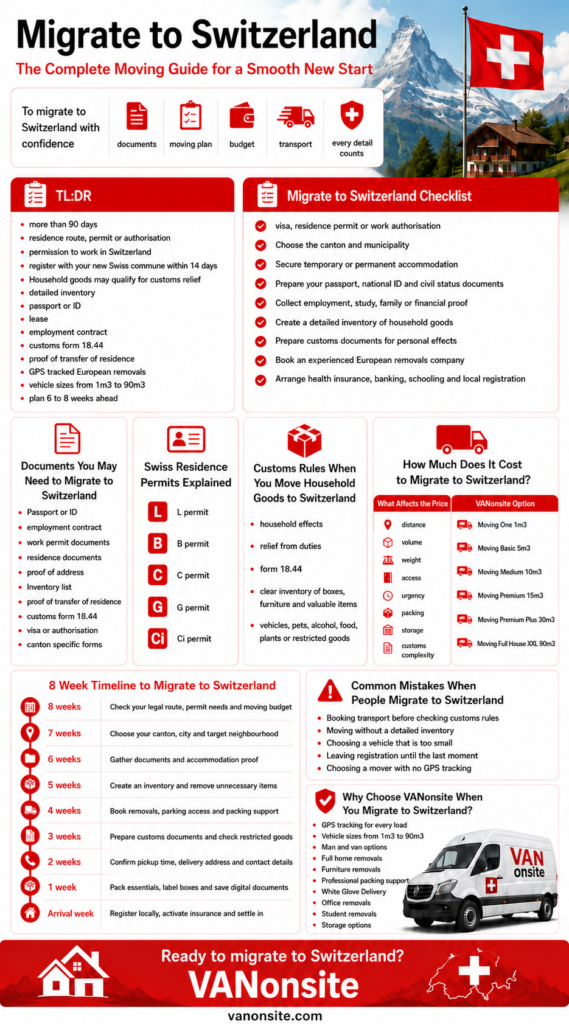
To migrate to Switzerland with confidence, you need more than a packed suitcase and a hopeful calendar. You need the right documents, a clear moving plan, a realistic budget and transport that will not turn your fresh start into a stressful guessing game.
Switzerland is precise, beautiful and demanding. It works like a finely tuned watch: impressive from the outside, even more impressive when every small part is in the right place. That is why planning matters so much. When you migrate to Switzerland, every detail counts, from residence permits and customs forms to the size of the van carrying your furniture across Europe.
VANonsite helps people move to Switzerland with secure, GPS tracked removals, flexible vehicle sizes and careful handling for everything from a few student boxes to a full family home. Whether you need a fast man and van service, Furniture Removals, Home Removals, Packing Service, White Glove Delivery, Office Removals, Storage, Student Removals or Office Furniture Installation, the goal stays the same: your belongings should arrive safely, quickly and without drama.
If you are planning a dedicated relocation route, you can also explore VANonsite removals to Switzerland: https://vanonsite.com/removals-to-switzerland
TL:DR
- To migrate to Switzerland for more than 90 days, you usually need the correct residence route, permit or authorisation.
- Most foreign nationals need permission to work in Switzerland, and the process depends on nationality, job type and canton.
- You should register with your new Swiss commune after arrival, often within 14 days of moving.
- Household goods may qualify for customs relief, but you need a detailed inventory, proof of relocation and the right forms.
- Key documents often include passport or ID, lease, employment contract, permit papers, customs form 18.44 and proof of transfer of residence.
- VANonsite offers GPS tracked European removals, man and van solutions and vehicle sizes from 1m3 to 90m3.
- The safest way to migrate to Switzerland is to plan 6 to 8 weeks ahead, reduce unnecessary items and book experienced cross border removals early.




Can You Migrate to Switzerland?
Yes, you can migrate to Switzerland if you meet the entry, residence, work and financial conditions that apply to your situation. The exact process depends on your nationality, the reason for your move and the canton where you plan to live.
A person moving for a job in Zurich may need a different route from a student relocating to Lausanne, a family joining relatives in Geneva or a business owner planning to settle in Basel. Switzerland is one country, but many practical rules are handled at cantonal or local level. That means your plan should be specific, not vague.
If you want to migrate to Switzerland from an EU or EFTA country, the process is usually more direct because of free movement rules. However, you may still need to register, prove employment or show that you can support yourself. If you are from outside the EU or EFTA area, the requirements are often stricter, especially for work based migration.
For short stays, many visitors can remain in Switzerland for up to 90 days within a 180 day period. That is not the same as moving there. If you plan to migrate to Switzerland for longer than 90 days, you should treat permits, housing and local registration as early priorities.
Useful official sources include:
Migrate to Switzerland Checklist
Before you migrate to Switzerland, build your move around a clean checklist. A good relocation is not one giant task. It is a series of smaller, well timed decisions. Each one reduces pressure. Each one gives you more control.
Start with your legal route, then move to housing, documents, customs and transport. Do not book everything blindly and hope paperwork will somehow follow. Switzerland rewards people who prepare early.
Use this checklist before moving day:
- Confirm whether you need a visa, residence permit or work authorisation.
- Choose the canton and municipality where you plan to live.
- Secure temporary or permanent accommodation.
- Prepare your passport, national ID and civil status documents.
- Collect employment, study, family or financial proof where needed.
- Check whether family members need separate documents.
- Create a detailed inventory of household goods.
- Separate restricted, valuable or unusual items.
- Prepare customs documents for personal effects.
- Book an experienced European removals company.
- Confirm parking, building access, lift access and delivery timing.
- Arrange health insurance, banking, schooling and local registration.
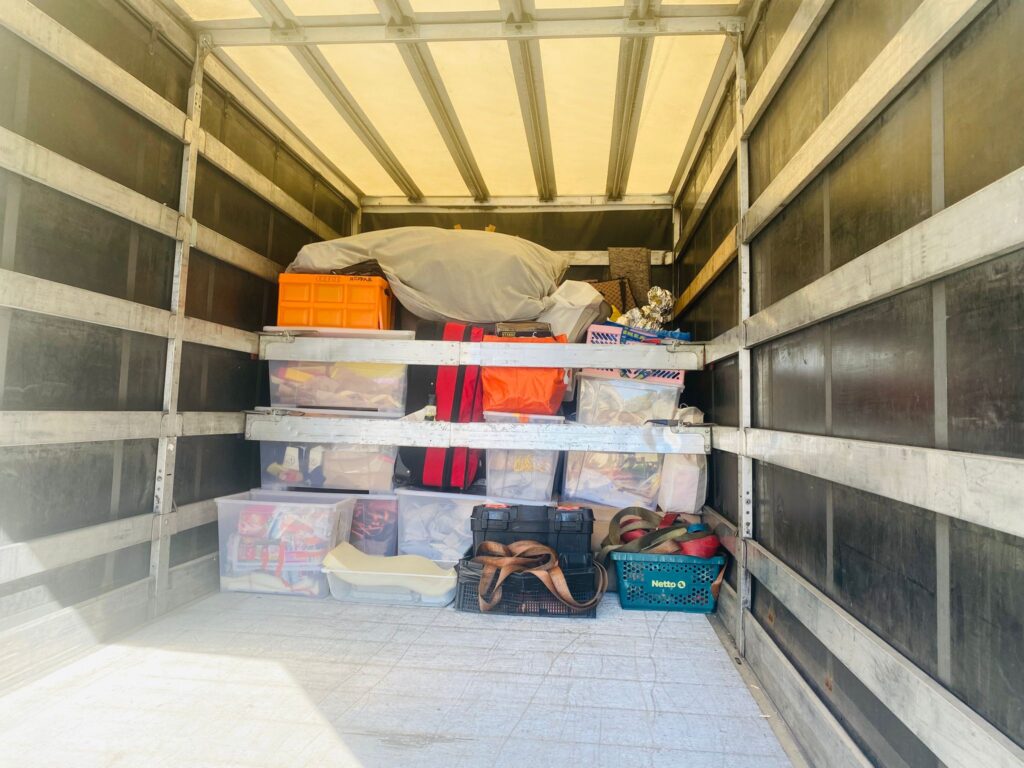
When you migrate to Switzerland with furniture or personal belongings, transport quality matters. A cheap, chaotic move can become expensive very quickly. VANonsite helps match your belongings to the right vehicle size, from Moving One at 1m3 to Moving Full House XXL at 90m3. With GPS tracking on every load, you can follow the journey instead of worrying in silence.
Documents You May Need to Migrate to Switzerland
The documents you need to migrate to Switzerland depend on your nationality and reason for relocation. Still, most people should prepare a strong document folder before they move. Keep printed copies and digital copies. Swiss administration is efficient, but it expects accuracy.
A missing document can slow down work registration, housing, customs or local procedures. Good paperwork is not exciting, but it is powerful. It turns uncertainty into progress.
| Situation | Documents to Prepare | Official Source |
|---|---|---|
| Moving for work | Passport or ID, employment contract, work permit documents if required, Swiss address details | Working in Switzerland |
| Staying longer than 90 days | Passport or ID, residence documents, proof of purpose, proof of address | Swiss residence permits |
| Moving household goods | Inventory list, proof of transfer of residence, customs form 18.44, supporting evidence | Moving household effects |
| EU or EFTA citizens | ID or passport, employment proof or financial evidence, commune registration documents | EU and EFTA residence information |
| Non EU or non EFTA citizens | Passport, visa or authorisation, employer or study documents, canton specific forms | Non EU and non EFTA information |
Before you migrate to Switzerland, check whether documents need translation, apostille or official certification. Requirements may vary depending on your nationality, family status, profession and canton. If you are moving with children, pets, vehicles or high value goods, you may need additional paperwork.
Swiss Residence Permits Explained
Residence permits can feel like a foggy mountain road. The signs are there, but you need to slow down and read them properly.
When people migrate to Switzerland, they often see these permit types:
- L permit: usually short term residence for limited stays.
- B permit: residence permit, often linked to longer stays or employment.
- C permit: settlement permit for long term residents.
- G permit: cross border commuter permit.
- Ci permit: a permit linked to specific family and work situations.
The right permit depends on your nationality, employment, contract length, income, family situation and canton. EU and EFTA citizens often have broader access under free movement rules. Non EU citizens usually face stricter conditions, quotas and employer led procedures.
If you plan to migrate to Switzerland for work, do not leave permit checks until the final week. Work permission is not a small detail. It is one of the central pillars of your relocation.
For official information, check the Swiss State Secretariat for Migration: https://www.sem.admin.ch/sem/en/home/themen/aufenthalt.html
Customs Rules When You Move Household Goods to Switzerland
Customs is one of the most important parts of the decision to migrate to Switzerland with furniture, boxes, electronics and personal belongings. It is also one of the easiest parts to underestimate.
In many cases, household effects can be imported with relief from duties if they are connected to your transfer of residence and meet the official conditions. Swiss customs commonly requires form 18.44 for household effects. You should also prepare a detailed inventory of what you are bringing.
Before moving day, prepare:
- A clear inventory of boxes, furniture and valuable items.
- Proof that you are transferring your residence to Switzerland.
- Lease, employment contract or another supporting document.
- Customs form 18.44 where required.
- Separate details for vehicles, pets, alcohol, food, plants or restricted goods.
- Notes for any goods that will arrive later in a second shipment.
Official customs pages:
A professional moving company cannot remove the need for customs paperwork, but it can make the process calmer and sharper. VANonsite supports structured loading, careful planning and GPS tracked transport, so your belongings are not just somewhere on the road. They are visible, organised and moving with purpose.
How Much Does It Cost to Migrate to Switzerland?
The cost to migrate to Switzerland depends on distance, volume, weight, access, urgency, packing level, storage and customs complexity. A student moving 8 boxes to Bern will have a very different budget from a family moving 60m3 of furniture to Geneva.
The smartest way to control your moving cost is to reduce volume before you move. Even a 10% to 15% reduction in boxes can make packing faster, loading cleaner and vehicle choice more efficient. It also stops you from paying to transport items you may never use again.
| Cost Area | What Affects the Price | Smart Tip |
|---|---|---|
| Removals | Distance, volume, weight, route and urgency | Declutter before booking |
| Packing | Fragile items, glass, artwork and electronics | Use professional packing for high value pieces |
| Customs | Inventory quality, special goods and timing | Prepare documents early |
| Housing | Canton, city, deposit and temporary stay | Secure accommodation before shipping everything |
| Insurance | Health cover, transport cover and valuables | Compare policies before arrival |
| Storage | Delayed keys, permit timing and staged delivery | Use storage to avoid last minute chaos |
VANonsite offers several vehicle sizes, which helps match your move to the right capacity instead of forcing your belongings into a poor fit.
| VANonsite Option | Capacity | Best For |
|---|---|---|
| Moving One | 1m3, 100kg | Suitcases, small boxes and urgent light moves |
| Moving Basic | 5m3, 300kg | Student removals and compact man and van moves |
| Moving Medium | 10m3, 500kg | Studio flats and partial furniture removals |
| Moving Premium | 15m3, 1100kg | One bedroom flats and larger apartment moves |
| Moving Premium Plus | 30m3, 3500kg | Family moves, bulky furniture and office items |
| Moving Full House XXL | 90m3, 20000kg | Large homes, complex relocations and full house removals |
This range matters because a move is not only about price. It is about fit, safety and timing. The right vehicle protects your furniture, your budget and your nerves.
Best Way to Move Your Belongings to Switzerland
The best way to migrate to Switzerland with your belongings is to combine legal preparation with professional transport. Cheap moving can look tempting at first, but weak planning, damaged furniture, missed delivery windows and poor communication can turn it into an expensive lesson.
VANonsite offers practical support for different moving situations:
- Last Minute Moving for urgent relocation needs.
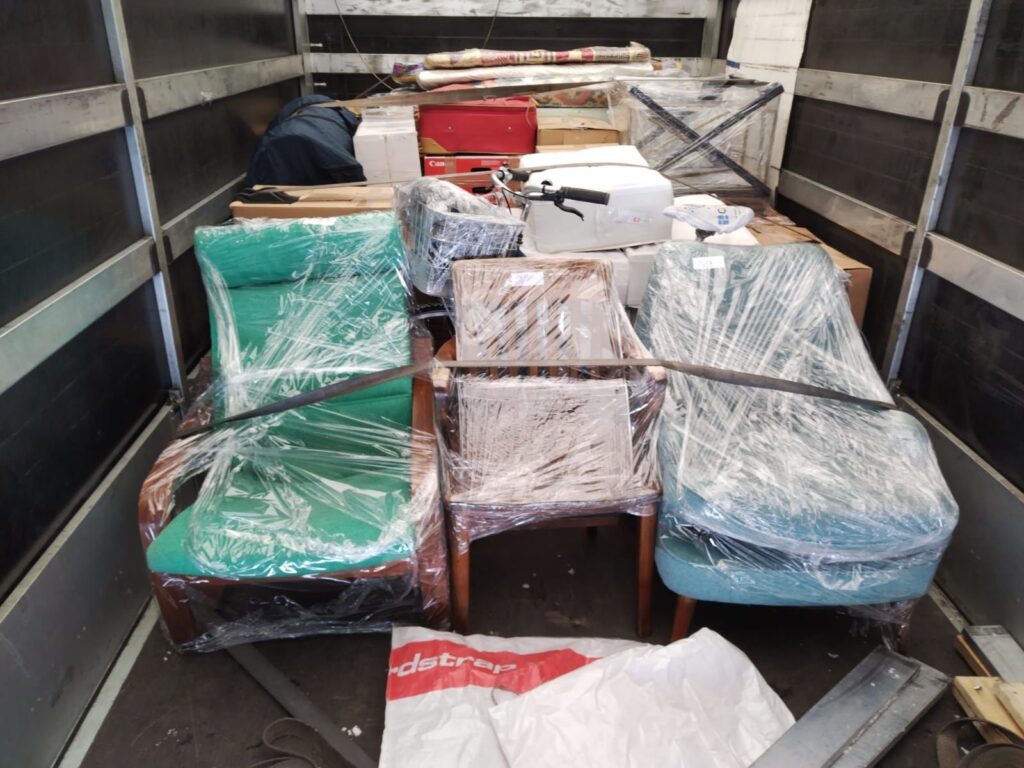
- Furniture Removals for heavy, awkward or delicate pieces.
- Home Removals for apartments and full house moves.
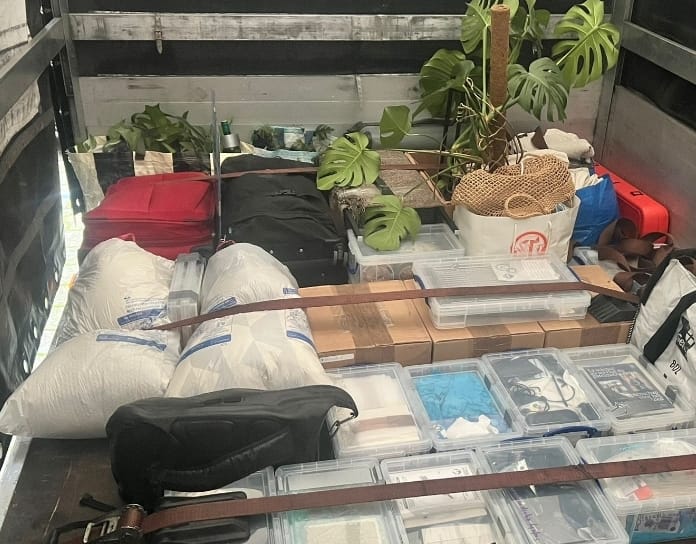
- Packing Service for safer, faster preparation.
- White Glove Delivery for premium, fragile or high value items.
- Office Removals for business relocations.
- Storage for timing gaps between pickup and delivery.
- Student Removals for smaller moves and leaner budgets.
- Office Furniture Installation for workplace setup.
If you need a dedicated European route, visit removals to Switzerland.
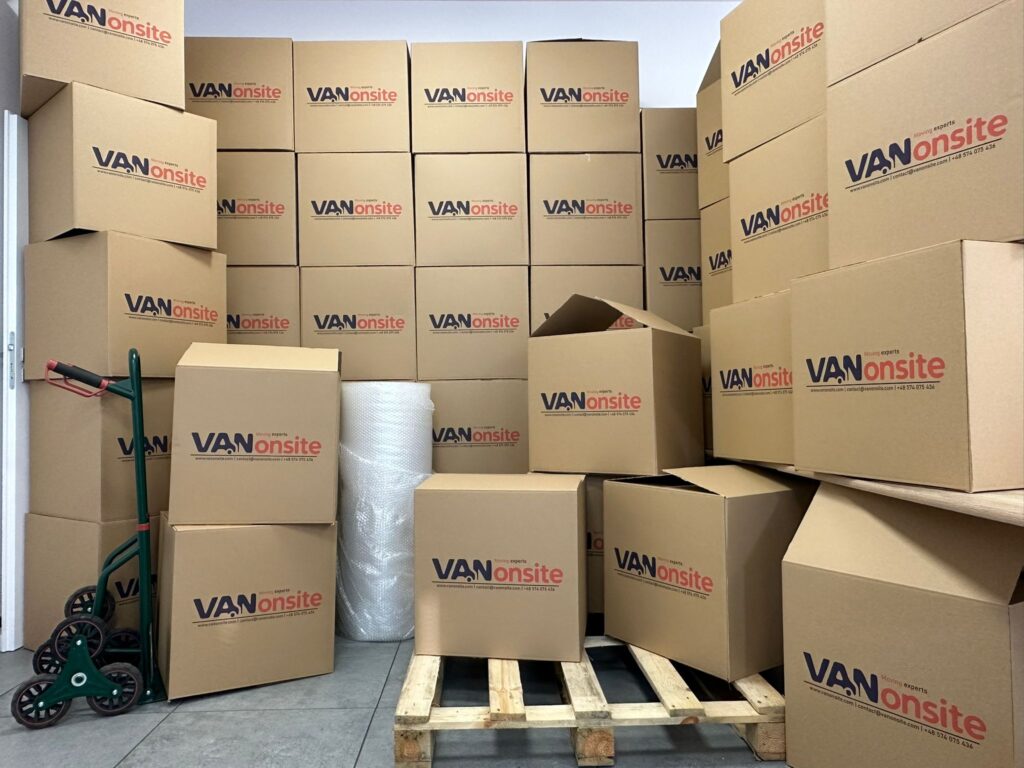
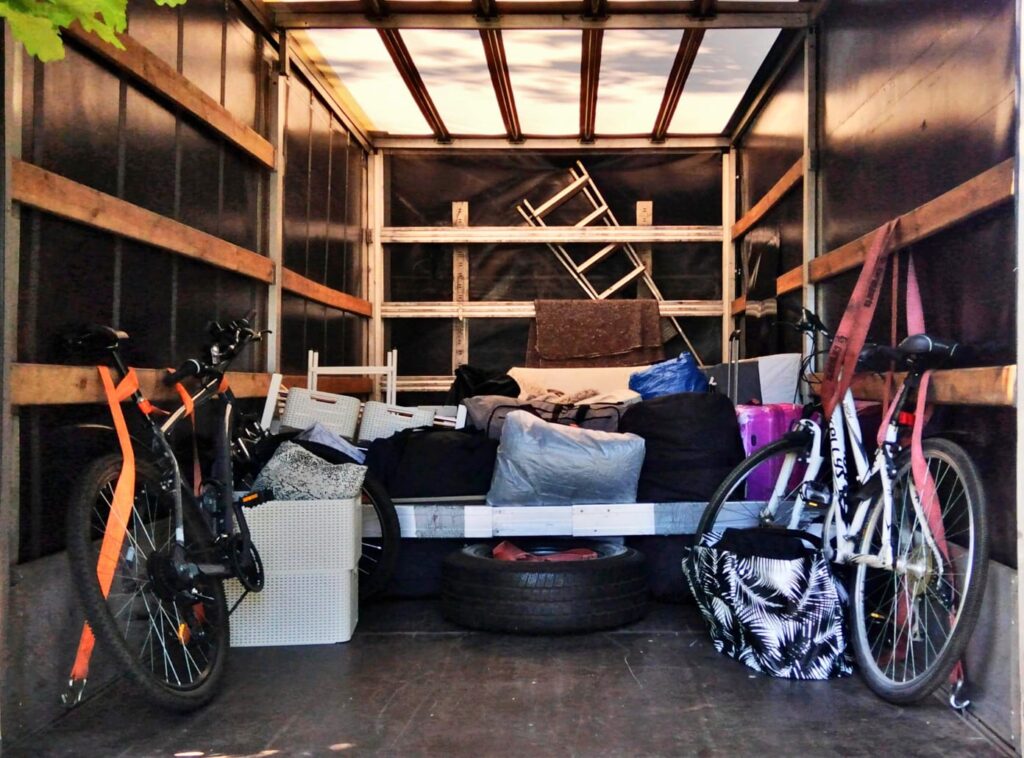
The best removals service is not the loudest one. It is the one that protects your belongings, keeps you informed and arrives with a plan. VANonsite gives every load GPS tracking, which turns uncertainty into visibility. That is powerful when your bed, books, clothes, equipment and memories are crossing borders.

8 Week Timeline to Migrate to Switzerland
A smooth relocation is not built in one frantic weekend. If you want to migrate to Switzerland with less stress, start 6 to 8 weeks before your planned move. This gives you enough time to check rules, reduce your load, prepare documents and book the right vehicle.
| Time Before Move | What to Do |
|---|---|
| 8 weeks | Check your legal route, permit needs and moving budget |
| 7 weeks | Choose your canton, city and target neighbourhood |
| 6 weeks | Gather documents and accommodation proof |
| 5 weeks | Create an inventory and remove unnecessary items |
| 4 weeks | Book removals, parking access and packing support |
| 3 weeks | Prepare customs documents and check restricted goods |
| 2 weeks | Confirm pickup time, delivery address and contact details |
| 1 week | Pack essentials, label boxes and save digital documents |
| Arrival week | Register locally, activate insurance and settle in |
This timeline is practical, but it is also emotional armour. Every early decision removes one last minute panic. When you migrate to Switzerland, that kind of calm is priceless.
Registering After You Arrive in Switzerland
After you migrate to Switzerland, local registration is one of your first official steps. In many cases, you should register with your new commune within 14 days of moving. If you are moving for work, the timing may be especially important, so check local requirements before arrival.
Bring the documents requested by your commune. These may include:
- Passport or national ID.
- Residence or permit documents.
- Lease or address confirmation.
- Employment contract if relevant.
- Marriage certificate or birth certificates for family members where required.
- Passport photos if requested.
- Health insurance details when available.
Official information is available here: Notification of departure and registration
Registration may feel like a small administrative task, but it anchors your new life. It connects you to local services, official records and the next practical steps in Switzerland.
Housing, Insurance and First Week Essentials
People often focus so hard on permits and transport that they forget the first week. Yet the first 7 days after you migrate to Switzerland can decide whether you feel steady or scattered.
Focus on the essentials first:
- Confirm your accommodation and handover details.
- Register with the commune.
- Arrange mandatory health insurance within the required timeframe.
- Open or prepare a bank account.
- Set up mobile service and internet.
- Learn local waste and recycling rules.
- Check public transport passes.
- Save emergency numbers and local medical contacts.
Keep one arrival box close to you. Put documents, chargers, toiletries, medication, bedding, basic kitchen items and one change of warm clothes inside it. Do not bury the things you need on day one under 40 identical boxes.
This is another reason careful packing matters. VANonsite Packing Service can help protect fragile items, organise boxes logically and reduce the chaos that often follows delivery day.
Common Mistakes When People Migrate to Switzerland
Most relocation problems do not begin with one dramatic disaster. They begin with a tiny loose thread. One missing form. One vague inventory. One under sized van. One rushed packing day. Then the thread pulls tighter.
Avoid these mistakes when you migrate to Switzerland:
- Booking transport before checking customs rules.
- Assuming every canton has exactly the same process.
- Forgetting the difference between short stay and long stay rules.
- Moving without a detailed inventory.
- Packing fragile items too late.
- Choosing a vehicle that is too small.
- Forgetting to plan parking or building access.
- Leaving registration until the last moment.
- Moving high value goods without proper packing.
- Choosing a mover with no GPS tracking or weak communication.
A professional removals team helps you control many of these risks. VANonsite focuses on safety, speed and visibility, so your move does not depend on luck. It depends on planning.
Why Choose VANonsite When You Migrate to Switzerland?
When you migrate to Switzerland, your belongings are not just cargo. They are the objects that make a new country feel like home: your kitchen table, your child’s bed, your favourite chair, your winter coats, your books, your work equipment and the fragile, ordinary, irreplaceable pieces of your life.
VANonsite is built for European moves where timing, safety and communication matter. Customers can choose flexible support depending on their move size, budget and urgency.
VANonsite offers:
- GPS tracking for every load.
- Vehicle sizes from 1m3 to 90m3.
- Man and van options for compact and urgent moves.
- Full home removals for larger relocations.
- Furniture removals for bulky or delicate items.
- Professional packing support.
- White Glove Delivery for premium goods.
- Office removals and office furniture installation.
- Student removals for smaller, agile moves.
- Storage options when dates do not line up.
The promise is simple: your move should not feel mysterious. You should know what is happening, where your belongings are and what comes next.
If you are ready to migrate to Switzerland, VANonsite can help you plan the journey with care, strength and serious attention to detail. Start with the dedicated route page here: removals to Switzerland
FAQ: Migrate to Switzerland
How do I migrate to Switzerland?
To migrate to Switzerland, check your entry and residence rights, confirm whether you need work permission, choose your canton, secure accommodation, prepare documents, plan customs and book reliable removals. For stays longer than 90 days, residence formalities become especially important.
Do I need a permit to migrate to Switzerland?
In many cases, yes. If you plan to migrate to Switzerland for work or stay longer than 90 days, you usually need the correct residence or work authorisation. The exact route depends on your nationality, job, study status and canton.
Can I migrate to Switzerland from the EU?
EU and EFTA citizens generally have a more direct route than non EU nationals, but they still need to follow Swiss rules on work, residence and local registration. Always check official Swiss pages before making final plans.
Can I bring my furniture when I migrate to Switzerland?
Yes, you can bring furniture and household goods when you migrate to Switzerland. You should prepare a detailed inventory and check Swiss customs requirements for household effects, including form 18.44 where applicable.
What is the easiest way to move furniture to Switzerland?
The easiest way is to use a removals company experienced in European cross border transport. VANonsite offers Furniture Removals, Home Removals, Packing Service, GPS tracking and man and van options for different move sizes.
How early should I book removals to Switzerland?
For a planned relocation, 4 to 6 weeks ahead is a sensible minimum. For a larger move, 6 to 8 weeks gives more breathing space. VANonsite may also support Last Minute Moving depending on route and availability.
Is it expensive to migrate to Switzerland?
Switzerland can be expensive, but moving costs depend on volume, distance, access, urgency, packing and storage. Reducing your load by 10% to 15% before moving can help control cost and simplify the process.
Do I need customs documents for my belongings?
Yes, if you migrate to Switzerland with household goods, you should prepare customs documents, an inventory and proof of transfer of residence. Some goods need extra attention, especially vehicles, pets, food, alcohol, plants and restricted items.
Do I need to register after moving to Switzerland?
Yes. In many cases, you should register with your new commune within 14 days after moving. Check your local commune requirements because documents and procedures can vary.
Can VANonsite help with a small move to Switzerland?
Yes. VANonsite offers compact man and van options, including Moving One at 1m3 and Moving Basic at 5m3. These are useful for students, single room moves, urgent shipments and smaller relocations.
Final Advice Before You Migrate to Switzerland
To migrate to Switzerland with confidence, do not chase the move at the last minute. Lead it. Start with your legal route, then housing, then documents, then customs, then removals. Each step makes the next one lighter.
Switzerland is not a chaotic destination. It is crisp, structured and exact. Your move should match that energy.
With GPS tracked loads, flexible vehicle sizes, professional packing options and European removals experience, VANonsite helps you move with less fear and more control. Whether you need a man and van move, full home removal, office relocation, storage, student relocation or White Glove Delivery, your belongings are handled with care from pickup to arrival.
Ready to migrate to Switzerland? Request your VANonsite quote today and plan your move with a team that treats safety, timing and communication as seriously as you do: removals to Switzerland