
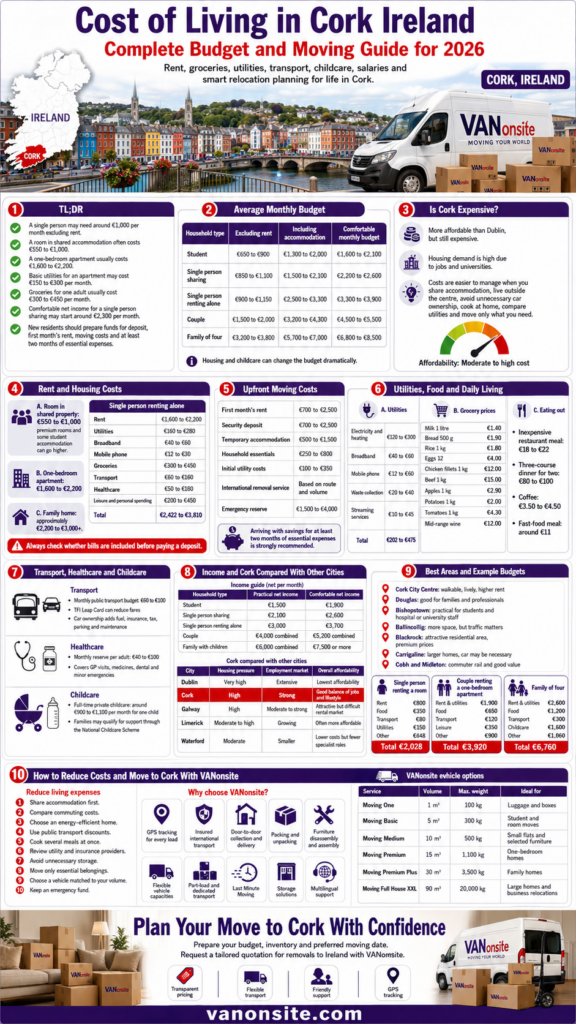
Cork combines the energy of a major European city with the warmth and slower rhythm of a regional centre. It offers strong employment opportunities, respected universities, a vibrant food scene and easy access to Ireland’s southern coast. However, the cost of living in Cork Ireland can be high, particularly for people who need to rent a private apartment.
A single person may need approximately €1,000 per month before rent. A family of four can spend around €3,500 to €3,800 before accommodation, depending on childcare, transport and lifestyle choices. Housing remains the largest expense. A room in a shared property may cost between €550 and €1,000 per month, while a private one-bedroom apartment can cost from €1,600 to more than €2,000.
The average cost of living in Cork Ireland depends heavily on where you live, whether you share accommodation and how often you use a car. Careful preparation is therefore essential. This guide covers rent, food, utilities, transport, healthcare, childcare and relocation expenses, helping you build a realistic budget before moving.
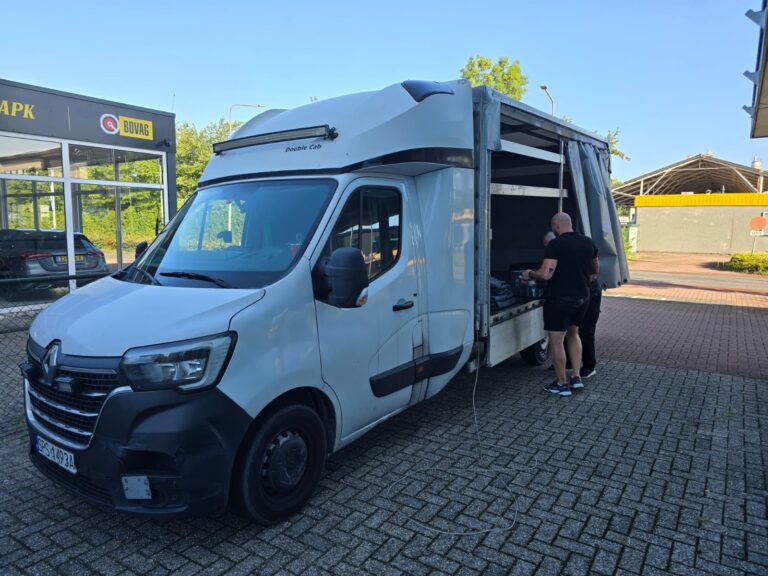
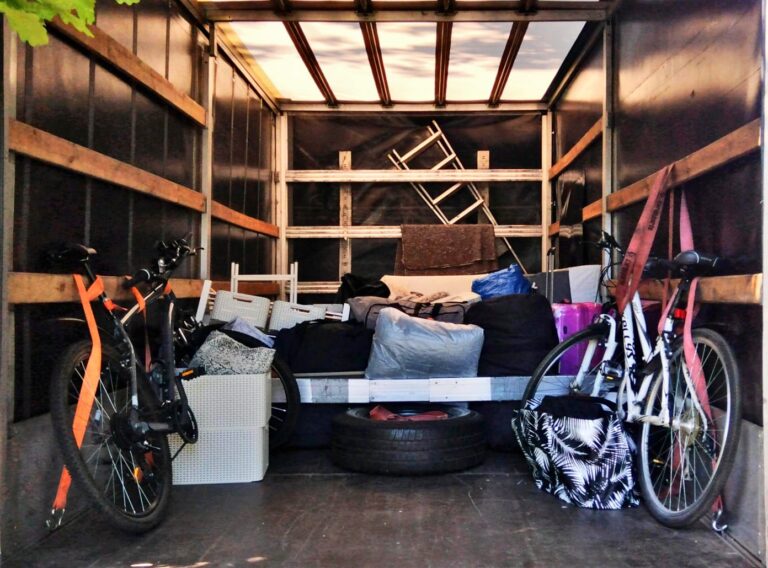
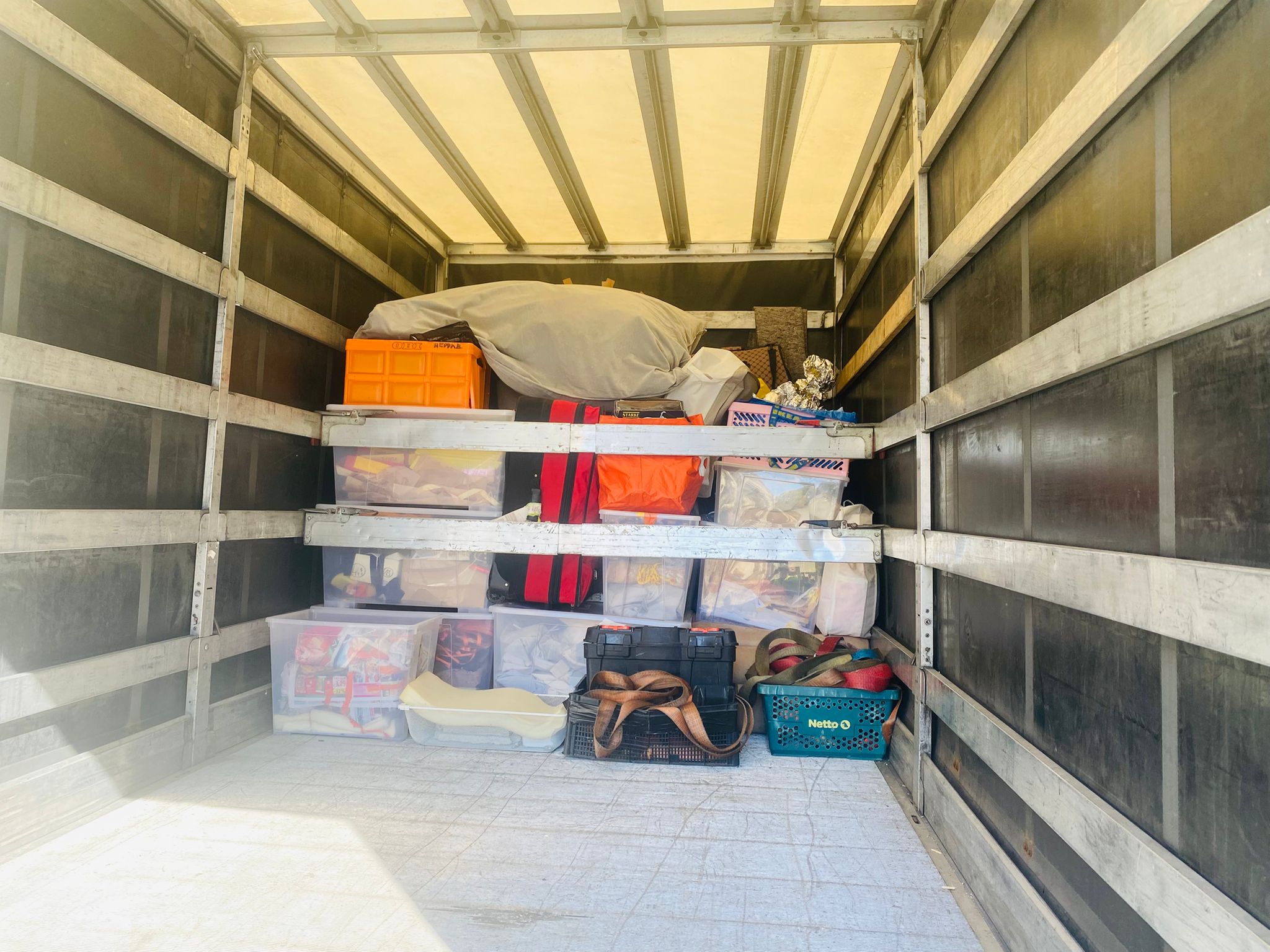
Anyone planning an international relocation can also arrange professional removals to Ireland with VANonsite.
TL:DR: Cost of Living in Cork Ireland
- A single person may need around €1,000 per month excluding rent.
- A room in a shared property often costs between €550 and €1,000 per month.
- A one-bedroom apartment usually costs between €1,600 and €2,200 per month.
- Basic utilities for an apartment may cost from €150 to €300 per month.
- Groceries for one adult usually cost between €300 and €450 per month.
- A comfortable net income for a single person sharing accommodation may start at around €2,300 per month.
- New residents should prepare money for a deposit, first month’s rent, transport and at least two months of essential expenses.




What Is the Average Cost of Living in Cork Ireland?
The average cost of living in Cork Ireland varies significantly between students, professionals, couples and families. Someone renting a room and using public transport will have a very different monthly budget from a family renting a three-bedroom home and paying for childcare.
A realistic budget should include more than rent and groceries. It should also account for utilities, transport, healthcare, insurance, mobile services, leisure and emergency savings.
| Household type | Excluding rent | Including accommodation | Comfortable monthly budget |
|---|---|---|---|
| Student | €650 to €900 | €1,300 to €2,000 | €1,600 to €2,100 |
| Single person sharing | €850 to €1,100 | €1,500 to €2,100 | €2,200 to €2,600 |
| Single person renting alone | €900 to €1,150 | €2,500 to €3,300 | €3,300 to €3,900 |
| Couple | €1,500 to €2,000 | €3,200 to €4,300 | €4,500 to €5,500 |
| Family of four | €3,200 to €3,800 | €5,700 to €7,000 | €6,800 to €8,500 |
These figures are practical planning ranges. Car ownership, private healthcare, regular travel and full-time childcare can increase the living expenses in Cork Ireland considerably.
Is Cork Expensive to Live In?
Cork is expensive compared with many European cities, although it is often more affordable than Dublin. The greatest challenge is not always the headline rental price. It is the combination of high demand, limited availability and the need to make decisions quickly.
Cork attracts professionals working in pharmaceuticals, technology, healthcare, manufacturing, education, finance and logistics. It is also home to major universities and a large student population. This creates intense demand for rooms, apartments and family homes.
The cost of living in Cork Ireland becomes easier to manage when you:
- Share accommodation during the first months
- Live outside the city centre
- Choose a property near a bus or rail connection
- Avoid unnecessary car ownership
- Prepare meals at home
- Compare utility and insurance providers
- Move only the belongings you genuinely need
Cork is not a low-cost destination. Still, it can offer an excellent quality of life when housing costs and income are carefully balanced.
Rent and Housing Costs in Cork
Housing is the largest part of the living cost in Cork Ireland. Rental prices depend on location, property condition, energy efficiency, furnishing and access to transport.
Renting a Room in Cork
Sharing a house or apartment is usually the most affordable option for students, young professionals and people arriving without a long-term tenancy.
Typical monthly prices may include:
- €550 to €750 for a room in a commuter town or less central area
- €700 to €950 in popular residential districts
- €900 to €1,300 for a premium room near the centre
- €950 to €1,700 for some purpose-built student accommodation
Always check whether electricity, heating, broadband and waste collection are included. A room advertised for €750 may cost closer to €850 after household bills.
Before paying a deposit, ask for a written tenancy agreement, the landlord’s details, an inventory and a receipt. Never transfer money only because someone claims that other tenants are waiting. Rental fraud often relies on urgency and emotional pressure.
Current tenancy information is available through the official Citizens Information renting guide.
Renting a One-Bedroom Apartment
A private apartment offers independence, but it has a dramatic impact on the cost of living in Cork Ireland. A one-bedroom property may cost approximately €1,600 outside the centre and €1,800 or more in central Cork. Premium listings can exceed €2,200.
A single person renting alone might face the following monthly expenses:
| Expense | Estimated monthly cost |
|---|---|
| Rent | €1,600 to €2,200 |
| Utilities | €160 to €280 |
| Broadband | €40 to €60 |
| Mobile phone | €12 to €30 |
| Groceries | €300 to €450 |
| Transport | €60 to €160 |
| Healthcare | €50 to €180 |
| Leisure and personal spending | €200 to €450 |
| Total | €2,422 to €3,810 |
Living outside central Cork may provide more space and lower rent. However, commuting, fuel, insurance and parking can reduce the saving.
Renting a Family Home
A two or three-bedroom home may cost from approximately €2,200 to more than €3,000 per month. Properties with a garden, parking, modern heating or access to popular schools may command higher prices.
Families should also check the property’s Building Energy Rating. Older homes can be difficult and expensive to heat, especially during wet and windy winter months.
Buying Property in Cork
Buying may become attractive for long-term residents, but the upfront costs are substantial. Buyers need to budget for:
- Mortgage deposit
- Property valuation
- Solicitor fees
- Structural survey
- Stamp duty
- Home insurance
- Repairs and renovations
- Furniture and moving costs
A lower purchase price does not always mean better value. Poor insulation, outdated heating and moisture problems can create significant future expenses.
Upfront Costs When Moving to Cork
The first month in Cork is usually much more expensive than an ordinary month. New residents may need to pay rent, a security deposit, temporary accommodation and relocation expenses within a short period.
| Upfront expense | Typical planning range |
|---|---|
| First month’s rent | €700 to €2,500 |
| Security deposit | €700 to €2,500 |
| Temporary accommodation | €500 to €1,500 |
| Household essentials | €250 to €800 |
| Initial utility costs | €100 to €350 |
| International removal service | Based on route and volume |
| Emergency reserve | €1,500 to €4,000 |
Ideally, arrive with enough savings to cover at least two months of essential expenses. Three months is safer if you are moving without a confirmed job or permanent accommodation.
Temporary accommodation can become especially costly. Even a short delay in securing a tenancy may add hundreds of euros to the overall relocation budget.
Utility Costs in Cork
Utilities are another important part of the average cost of living in Cork Ireland. The total depends on property size, insulation, number of residents and heating type.
| Monthly utility | Typical cost |
|---|---|
| Electricity and heating | €120 to €300 |
| Broadband | €40 to €60 |
| Mobile phone | €12 to €30 |
| Waste collection | €20 to €40 |
| Streaming services | €10 to €45 |
| Total | €202 to €475 |
Electric heating can be particularly expensive in older properties. Before signing a tenancy, ask how the home is heated and request recent information about energy use where possible.
A modern, energy-efficient apartment may cost more in rent but less to operate. In contrast, a cheaper property with poor insulation can become uncomfortable and surprisingly expensive.
Grocery Prices and Food Expenses
Groceries for one adult typically cost between €300 and €450 per month. A couple may spend from €550 to €800, while a family of four may need €900 to €1,300.
Typical grocery prices may include:
| Product | Estimated price |
|---|---|
| Milk, 1 litre | €1.40 |
| Bread, 500 g | €1.90 |
| Rice, 1 kg | €1.80 |
| Eggs, 12 | €4.00 |
| Chicken fillets, 1 kg | €12.00 |
| Beef, 1 kg | €15.00 |
| Apples, 1 kg | €2.90 |
| Potatoes, 1 kg | €2.00 |
| Tomatoes, 1 kg | €4.30 |
| Mid-range wine | €12.00 |
The easiest way to reduce living expenses in Cork Ireland is to plan meals, compare supermarkets and buy own-brand products. Cooking larger portions also reduces waste and the temptation to order takeaway food.
Saving €20 each week on groceries creates an annual saving of more than €1,000. Small choices become powerful when repeated consistently.
Eating Out in Cork
Cork has a celebrated food culture, but eating out regularly can put serious pressure on a monthly budget.
An inexpensive restaurant meal may cost around €18 to €22. A three-course dinner for two in a mid-range restaurant may cost €80 to €100 before drinks. A coffee can cost approximately €3.50 to €4.50, while a fast-food meal may cost around €11.
Several lunches, coffees and restaurant dinners can add €250 or more to the monthly cost of living in Cork Ireland.
A separate entertainment budget makes spending easier to control. Cork’s food scene can still be enjoyed without turning every weekend into a financial setback.
Transport Costs in Cork
Cork is compact enough for walking in many central neighbourhoods. Bus services connect the city centre with major suburbs, while commuter rail services operate towards Cobh and Midleton.
A monthly public transport budget may range from €60 to €100. Using a TFI Leap Card can reduce regular fares, while eligible students and young adults may receive larger discounts.
Current fare and route information is available through Transport for Ireland.
Driving in Cork
A car may be useful for families, shift workers and people living outside the city. However, car ownership adds several costs:
- Fuel
- Insurance
- Motor tax
- Parking
- Maintenance
- Vehicle testing
- Depreciation
- Toll charges on some routes
Fuel prices can change quickly, while insurance costs vary according to age, licence history, vehicle type and address. It is wise to request insurance quotations before choosing a suburban property.
Lower rent may not create genuine savings if the location requires daily driving.
Healthcare Costs in Cork
Ireland has a mixed public and private healthcare system. Many residents pay directly for GP visits unless they qualify for a medical card or GP visit card.
A monthly healthcare reserve of €40 to €100 per adult can help cover:
- GP appointments
- Prescription medicines
- Dental treatment
- Eye tests
- Minor emergencies
- Insurance contributions
Private health insurance increases monthly expenses but may provide quicker access to selected treatments and hospitals.
Eligibility information for medical cards and GP visit cards is available through the Health Service Executive.
Childcare and Education Costs
Childcare can be the second-largest expense after rent. Full-time private childcare may cost around €900 to €1,100 per month for one child.
Families may qualify for support through the National Childcare Scheme, which offers universal and income-assessed subsidies through participating providers.
School education can also involve additional costs, including:
- Uniforms
- Books
- Digital devices
- School transport
- Meals
- Activities
- After-school care
- Voluntary contributions
University students face a different challenge. Accommodation near University College Cork and Munster Technological University is highly competitive. Private student housing may cost approximately €220 to €400 per week.
Students moving with boxes, clothes, books and a few pieces of furniture may benefit from a compact man and van service rather than booking a large removal vehicle.
Salaries and Recommended Income
Cork has strong employment in pharmaceuticals, biotechnology, technology, engineering, healthcare, finance, education, manufacturing and logistics.
The income needed to live comfortably depends mostly on housing.
| Household | Practical monthly net income | Comfortable monthly net income |
|---|---|---|
| Student | €1,500 | €1,900 |
| Single person sharing | €2,100 | €2,600 |
| Single person renting alone | €3,000 | €3,700 |
| Couple | €4,000 combined | €5,200 combined |
| Family with children | €6,000 combined | €7,500 or more |
These are budgeting estimates rather than official income requirements.
A person earning €3,000 net and paying €850 for a room may enjoy a stable lifestyle. The same income becomes much tighter when rent reaches €1,900.
Cork Compared With Other Irish Cities
Cork is generally cheaper than Dublin, especially for housing. However, the difference is not always dramatic because rental availability remains limited across Ireland.
| City | Housing pressure | Employment market | Overall affordability |
|---|---|---|---|
| Dublin | Very high | Extensive | Lowest affordability |
| Cork | High | Strong | Good balance of jobs and lifestyle |
| Galway | High | Moderate to strong | Attractive but difficult rental market |
| Limerick | Moderate to high | Growing | Often more affordable |
| Waterford | Moderate | Smaller | Lower costs but fewer specialist roles |
Cork’s main advantage is balance. It offers international employers, universities and cultural variety without the scale and intensity of Dublin.
Best Areas to Live in Cork
Choosing the right location can reduce both expenses and commuting time.
Cork City Centre
The centre suits professionals and students who want walkability, restaurants and nightlife. Rent is higher, apartments are often smaller and parking may be difficult.
Douglas
Douglas is popular with families and professionals. It offers shopping, schools and convenient access to several employment areas.
Bishopstown
Bishopstown is practical for students, healthcare workers and university staff because of its proximity to Munster Technological University and Cork University Hospital.
Ballincollig
Ballincollig offers shops, services and family housing. It can provide more space, although traffic should be considered before committing to a daily commute.
Blackrock
Blackrock is an attractive residential district with access to green spaces and the harbour. Some properties command premium prices.
Carrigaline
Carrigaline may suit families seeking larger homes. However, car ownership may become necessary, increasing the overall living cost in Cork Ireland.
Cobh and Midleton
Cobh and Midleton offer commuter rail connections and a strong local character. Housing may provide better value, although evening transport is less flexible than in central Cork.


Example Monthly Budgets
Single Person Renting a Room
| Category | Monthly cost |
|---|---|
| Rent | €850 |
| Utilities | €110 |
| Groceries | €350 |
| Transport | €68 |
| Mobile phone | €20 |
| Healthcare | €60 |
| Leisure | €220 |
| Personal expenses | €100 |
| Savings | €250 |
| Total | €2,028 |
A private apartment could increase the same person’s monthly total to €2,900 or more.
Couple Renting a One-Bedroom Apartment
| Category | Monthly cost |
|---|---|
| Rent | €1,650 |
| Utilities and broadband | €270 |
| Groceries | €650 |
| Transport | €180 |
| Healthcare | €120 |
| Leisure | €350 |
| Personal expenses | €200 |
| Savings | €500 |
| Total | €3,920 |
Couples can reduce per-person costs by sharing rent, utilities and food expenses.
Family of Four
| Category | Monthly cost |
|---|---|
| Three-bedroom rent | €2,500 |
| Utilities and broadband | €350 |
| Groceries | €1,050 |
| Transport or car costs | €500 |
| Childcare | €960 |
| Healthcare | €200 |
| Education and activities | €250 |
| Leisure and personal expenses | €450 |
| Emergency savings | €500 |
| Total | €6,760 |
A family with two children in full-time childcare may spend substantially more.
How to Reduce Living Expenses in Cork Ireland
The greatest savings usually come from housing and transport, not from eliminating every small pleasure.
- Share accommodation during the first months.
- Compare commuting costs before choosing a property.
- Select an energy-efficient home.
- Use public transport discounts.
- Cook several meals at once.
- Review utility and insurance providers.
- Avoid unnecessary storage.
- Move only essential belongings.
- Choose a vehicle matched to the actual volume.
- Keep an emergency fund.
Saving €500 on rent has a much greater impact than cutting one coffee each week. Focus first on the categories that can change the whole budget.
Documents Needed When Moving to Cork
Required documents depend on citizenship, employment status and country of origin. Prepare physical and digital copies of:
- Passport or identity card
- Employment contract
- Proof of address
- Rental agreement
- Bank statements
- Birth and marriage certificates
- Education records
- Driving licence
- Vehicle documents
- Healthcare records
- Household inventory
- Transport documents
A Personal Public Service Number is usually required for employment and access to public services. Official application information is available through Gov.ie.
New employees should also register their employment correctly to avoid emergency taxation. Current instructions are available from Revenue Ireland.
People transferring their normal residence from outside the European Union may qualify for customs and VAT relief on eligible household goods. Review the official Revenue transfer of residence guidance before shipping your belongings.
Choosing the Right Vehicle for Your Move to Cork
Vehicle size affects both price and efficiency. A detailed inventory helps prevent paying for unused capacity.
| VANonsite option | Capacity | Maximum weight | Suitable for |
|---|---|---|---|
| Moving One | 1 m³ | 100 kg | Luggage, boxes and personal items |
| Moving Basic | 5 m³ | 300 kg | Student and room moves |
| Moving Medium | 10 m³ | 500 kg | Small flats and selected furniture |
| Moving Premium | 15 m³ | 1,100 kg | One-bedroom homes |
| Moving Premium Plus | 30 m³ | 3,500 kg | Family homes |
| Moving Full House XXL | 90 m³ | 20,000 kg | Large homes and business relocations |
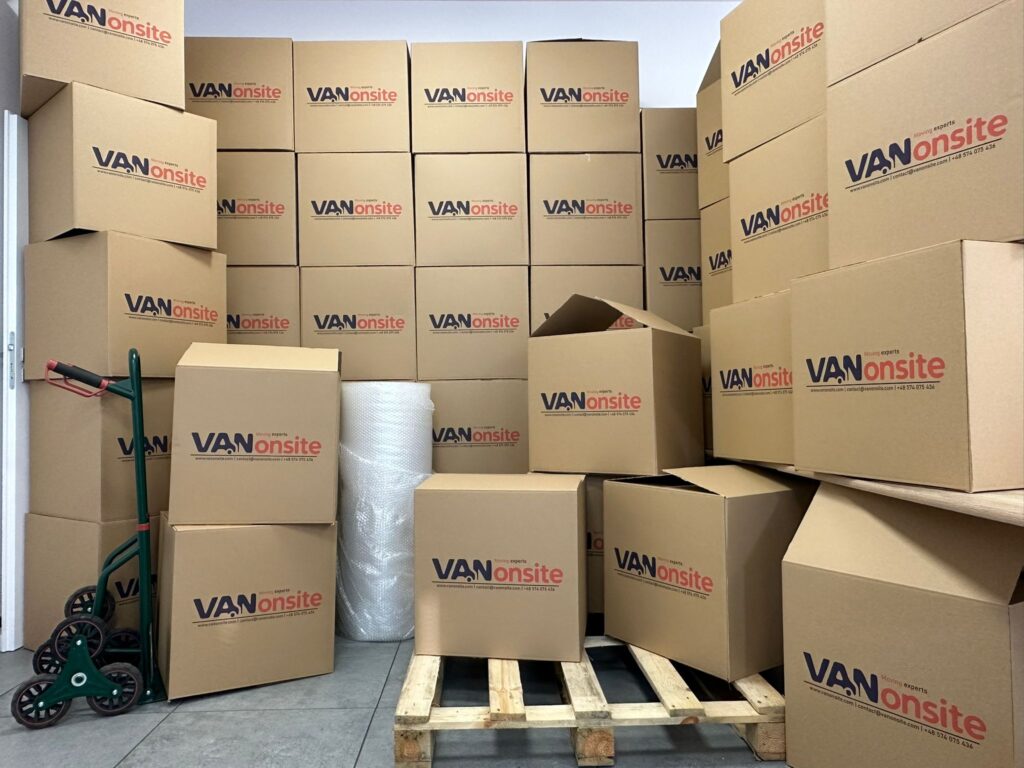
Include the approximate dimensions of sofas, beds, wardrobes, tables and appliances in your inventory. Photos can also help the removal team recommend the correct vehicle.
VANonsite supports small man and van relocations, student moves, household removals and complex office projects.
Moving to Cork With VANonsite
An international move involves more than driving from one address to another. Ferry schedules, access restrictions, loading, packing and delivery timing must work together.
VANonsite provides organised removals to Ireland with:
- GPS tracking for every load
- Insured international transport
- Door-to-door collection and delivery
- Packing and unpacking
- Furniture disassembly and assembly
- Flexible vehicle capacities
- Part-load and dedicated transport
- Last Minute Moving
- Storage solutions
- Multilingual customer support
Customers can also use specialist services such as Home Removals, Furniture Removals, Packing Services, Student Removals, Office Removals and White Glove Delivery.
Professional planning cannot lower Cork’s monthly prices, but it can prevent damaged furniture, incorrect vehicle bookings, storage fees and stressful delivery delays.
Frequently Asked Questions
What is the average cost of living in Cork Ireland?
A single person may spend around €1,000 per month excluding rent. With shared accommodation, a realistic monthly total is approximately €1,600 to €2,200.
How much money do you need to live comfortably in Cork?
A single person sharing accommodation may need a net income of €2,200 to €2,600 per month. Someone renting alone may need €3,300 or more.
Is Cork cheaper than Dublin?
Cork is generally cheaper than Dublin, particularly for rent. However, accommodation remains expensive and highly competitive.
How much is rent in Cork?
A room may cost between €550 and €1,000 per month. A private one-bedroom apartment may cost between €1,600 and €2,200.
Can you live in Cork without a car?
Yes. Living in or near the city centre, Blackrock, Douglas or Bishopstown can make public transport, walking and cycling practical.
How much should I save before moving to Cork?
A single person should ideally prepare enough for a deposit, first month’s rent, moving costs and two to three months of essential expenses. This may require savings of approximately €5,000 to €9,000.
What are the biggest living expenses in Cork Ireland?
Rent is usually the largest expense. Groceries, utilities, transport, healthcare and childcare follow.
Summary
The cost of living in Cork Ireland is influenced mainly by housing, household size and transport choices. A single person can manage expenses more comfortably by sharing accommodation, while private renting requires a significantly higher income.
Families should also prepare for substantial childcare, grocery and transport costs. Before relocating, secure accommodation where possible, create an emergency fund and prepare an accurate inventory of the belongings you want to move.
Cork can be expensive, but it also offers strong career opportunities, excellent education, a distinctive culture and access to some of Ireland’s most beautiful coastal areas. With a realistic budget and a carefully organised move, the city can become a rewarding long-term home.
For secure transport, GPS tracking and flexible vehicle options, request a personalised quotation for removals to Ireland with VANonsite.