
Ireland attracts professionals, students and families with its strong employment market, English-speaking environment, respected education system and remarkable natural scenery. However, anyone planning a relocation must understand the cost of living in Ireland before booking transport or signing a tenancy agreement.
A single person may spend approximately €1,000 per month before rent, while a family of four may need around €3,600 before accommodation. Housing remains the largest and least predictable expense. In Q4 2025, the standardised average rent for a new tenancy reached €2,191 in Dublin City, compared with €1,317 in Waterford City.
Your final budget will depend on where you live, whether you rent alone or share, how often you eat out, whether you need a car and whether your household pays for childcare. This guide explains the average cost of living in Ireland, including rent, groceries, utilities, transport, healthcare and one-off relocation expenses.
Anyone preparing for removals to Ireland should calculate monthly living expenses alongside the cost of transporting furniture, boxes and personal possessions.
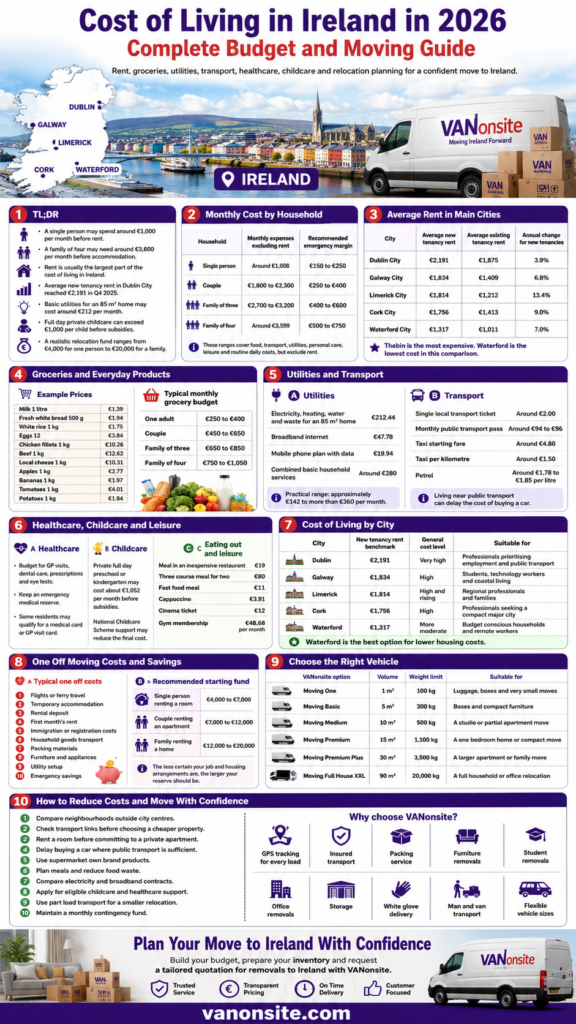
TL:DR: Cost of Living in Ireland at a Glance
- A single person may spend around €1,000 per month before rent.
- A family of four may need approximately €3,600 per month before accommodation.
- Rent is usually the largest part of the cost of living in Ireland.
- Average new-tenancy rent in Dublin City reached €2,191 in Q4 2025.
- Basic utilities for an 85 m² home may cost around €212 per month.
- Full-day private childcare can exceed €1,000 per child before subsidies.
- A realistic relocation fund ranges from €4,000 for one person to €20,000 for a family.




Is Ireland Expensive to Live In?
Ireland is relatively expensive, especially for people renting in Dublin, Cork, Galway or Limerick. The country can still offer an excellent quality of life, but comfortable living requires a realistic income and careful planning.
Housing has the greatest impact on the cost of living in Ireland. A professional renting a private apartment in central Dublin may spend hundreds of euros more each month than someone sharing a house in Waterford or a smaller regional town.
Prices also continue to change. According to Ireland’s Central Statistics Office, the Consumer Price Index increased by 3.4% in the 12 months to June 2026. Housing, electricity, gas, water and other fuels increased faster than the general rate.
The living cost in Ireland is shaped by four major factors:
- Your city or county
- Your accommodation type
- Your transport requirements
- Your household size
For newcomers, the first one or two months are often the most expensive. You may need to pay a deposit, the first month’s rent, temporary accommodation, utility setup charges, moving costs and basic household purchases within a short period.
Average Cost of Living in Ireland by Household Type
The following figures provide practical monthly planning ranges. Rent is excluded because housing costs differ significantly between locations and property types.
| Household | Monthly expenses excluding rent | Recommended emergency margin |
|---|---|---|
| Single person | Around €1,008 | €150 to €250 |
| Couple | €1,800 to €2,300 | €250 to €400 |
| Family of three | €2,700 to €3,200 | €400 to €600 |
| Family of four | Around €3,599 | €500 to €750 |
These estimates include regular daily expenses such as food, transport, utilities, clothing, personal care and leisure. They do not include rent, relocation costs or major unexpected purchases.
A complete monthly budget should normally cover:
- Groceries and household products
- Electricity and heating
- Internet and mobile services
- Public transport or car expenses
- Healthcare and prescriptions
- Clothing and personal care
- Entertainment and eating out
- Childcare or school expenses
- Emergency savings
Although the average cost of living in Ireland may look manageable before rent, accommodation can consume 40% to 60% of a single person’s net income, particularly in Dublin.
Rent and Housing Costs in Ireland
Housing is the most important part of any calculation involving the cost of living in Ireland.
The Residential Tenancies Board publishes standardised rent figures based on registered tenancies. These figures provide a useful market benchmark because they reflect rent actually paid rather than advertised asking prices.
Average Rent in Ireland’s Main Cities
| City | Average new-tenancy rent | Average existing-tenancy rent | Annual change for new tenancies |
|---|---|---|---|
| Dublin City | €2,191 | €1,875 | 3.9% |
| Galway City | €1,834 | €1,409 | 6.8% |
| Limerick City | €1,814 | €1,212 | 13.4% |
| Cork City | €1,756 | €1,413 | 9.0% |
| Waterford City | €1,317 | €1,011 | 7.0% |
These Q4 2025 figures cover different property sizes. They are citywide averages rather than prices for one-bedroom apartments.
Dublin remains the most expensive city in the comparison. However, Limerick recorded the strongest annual increase in new-tenancy rents, reaching 13.4%. Waterford remained the least expensive of the five cities.
Costs to Pay Before Moving In
Before collecting the keys, you may need to cover:
- A security deposit
- The first month’s rent
- Temporary accommodation
- Travel to property viewings
- Furniture and appliances
- Bedding and kitchen equipment
- Utility setup
- Transport to the new property
A couple renting a home for €1,800 per month could need between €4,000 and €5,500 before settling in. This amount may include the deposit, first rent payment, short-term accommodation and essential household items.
A furnished property can reduce setup costs. However, furnished homes may be more expensive or provide furniture that does not meet your needs. Check the inventory carefully before signing the tenancy agreement.
Renting a Room Versus a Private Apartment
Renting a room is one of the fastest ways to reduce the price of living in Ireland.
Shared accommodation allows tenants to divide electricity, heating, broadband and waste charges. The deposit may also be lower. The compromise is less privacy and limited control over shared spaces.
A private apartment provides independence, but one person or one couple must cover the full rent and every bill. For many newcomers, sharing for the first six to twelve months provides valuable financial flexibility.
Grocery Prices and Everyday Products
Food prices vary between discount supermarkets, premium stores, local shops and city-centre convenience stores. Groceries are not cheap, but they remain easier to control than rent.
Average Prices of Everyday Products
| Product | Quantity | Average price |
|---|---|---|
| Milk | 1 litre | €1.39 |
| Fresh white bread | 500 g | €1.94 |
| White rice | 1 kg | €1.75 |
| Eggs | 12 | €3.84 |
| Chicken fillets | 1 kg | €10.26 |
| Beef | 1 kg | €12.62 |
| Local cheese | 1 kg | €10.31 |
| Apples | 1 kg | €2.77 |
| Bananas | 1 kg | €1.97 |
| Oranges | 1 kg | €2.75 |
| Tomatoes | 1 kg | €4.01 |
| Potatoes | 1 kg | €1.84 |
| Onions | 1 kg | €1.38 |
| Lettuce | 1 head | €1.17 |
| Bottled water | 1.5 litres | €1.83 |
These national averages are indicative. Actual prices may be lower during promotions or higher in smaller convenience stores.
Typical Monthly Grocery Budget
| Household | Estimated monthly grocery budget |
|---|---|
| One adult | €250 to €400 |
| Couple | €450 to €650 |
| Family of three | €650 to €850 |
| Family of four | €750 to €1,050 |
Shopping habits can transform living expenses in Ireland. Premium brands, ready meals and frequent takeaways increase spending quickly. Supermarket own-brand ranges, meal planning and batch cooking can create substantial savings.
Food waste also matters. Throwing away €15 of groceries every week costs approximately €780 per year. Planning meals before shopping is one of the simplest ways to protect your monthly budget.
Utilities, Internet and Mobile Costs
Utility bills depend on property size, insulation, heating method and personal consumption. A modern apartment may be relatively efficient, while an older house with electric heating can generate much higher winter bills.
| Service | Estimated monthly cost |
|---|---|
| Electricity, heating, water and waste for an 85 m² home | €212.44 |
| Broadband internet | €47.78 |
| Mobile phone plan with data | €19.94 |
| Combined basic household services | Around €280 |
Basic utility expenses can range from approximately €142 to more than €360 per month.
Before renting, ask for the Building Energy Rating and clarify:
- How the property is heated
- Whether waste collection is included
- Whether meters are individual or shared
- Which broadband providers serve the address
- Whether previous utility bills are available
- When meter readings were last recorded
Do not rely only on a verbal estimate. Previous bills can provide a more accurate picture of the real living cost in Ireland.




Transport Costs in Ireland
Transport expenses depend heavily on location. People living near reliable public transport may avoid car ownership, while households in rural areas may need one or two vehicles.
| Transport expense | Typical cost |
|---|---|
| Single local transport ticket | Around €2.00 |
| Monthly public transport pass | Around €94 to €96 |
| Taxi starting fare | Around €4.80 |
| Taxi journey per kilometre | Around €1.50 |
| Petrol | Around €1.78 to €1.85 per litre |
Current fares vary by route, operator and zone. Official information is available through Transport for Ireland.
Is It Cheaper to Own a Car?
A car may be essential outside major cities, but fuel is only one part of the expense. Car ownership may also involve:
- Motor insurance
- Vehicle tax
- Maintenance and repairs
- Parking
- Tyres
- Breakdown cover
- National Car Test fees
- Loan or finance repayments
If public transport meets your needs, delaying a car purchase can significantly reduce the cost of living in Ireland during your first year.
Eating Out and Entertainment
Ireland has a vibrant restaurant, café and pub culture. However, frequent social spending can quietly increase the monthly budget.
| Item | Average price |
|---|---|
| Meal in an inexpensive restaurant | €19 |
| Three-course meal for two | €80 |
| Fast-food meal | €11 |
| Cappuccino | €3.91 |
| Cinema ticket | €12 |
| Gym membership | €48.68 per month |
Two restaurant meals, several takeaway coffees and one cinema visit each week can add more than €250 to monthly expenses.
You do not need to avoid social activities. Instead, include leisure in your budget from the beginning. A defined allowance makes it easier to enjoy life in Ireland without losing control of your finances.
Healthcare and Medical Expenses
Ireland operates both public and private healthcare systems. Some residents qualify for medical cards or GP visit cards, while others pay directly for appointments or purchase private insurance.
A medical card may cover eligible medical services, prescriptions and hospital care. A GP visit card covers GP consultations but does not automatically cover all treatment.
The Drugs Payment Scheme can limit eligible household spending on approved medicines and appliances to €80 per calendar month.
Official details are available through the Health Service Executive.
When estimating the average cost of living in Ireland, remember to include:
- GP appointments
- Dental treatment
- Prescription medicines
- Eye tests
- Specialist consultations
- Private health insurance
- Travel to medical facilities
Healthcare costs vary between providers. Even households using public services should maintain a separate emergency reserve.
Childcare and Education Costs
Childcare can rival rent as the largest monthly expense for working families.
A private full-day preschool or kindergarten place may cost approximately €1,052 per month before subsidies. The final price depends on the provider, location, number of hours and available government support.
Ireland’s National Childcare Scheme offers universal and income-assessed subsidies through participating providers. Families should check the official National Childcare Scheme before accepting a childcare place.
Additional family expenses may include:
- School uniforms
- Books and supplies
- School transport
- Lunches
- Sports clubs
- After-school care
- Holiday childcare
- International school fees
A family with two young children may face a much higher price of living in Ireland than a couple renting a similar property without dependants.
Salaries, Income Tax and Disposable Income
Gross salary alone does not show whether someone can comfortably afford life in Ireland. The most important figure is net income after Income Tax, Universal Social Charge and Pay Related Social Insurance.
In 2026, a single person without qualifying children generally pays Income Tax at 20% within the standard-rate band and 40% above it. Tax credits reduce the final amount payable.
Employees may also pay Universal Social Charge and PRSI. Pension contributions, health insurance and other payroll deductions can further reduce take-home pay.
Official tax bands and credits are available through Revenue.
A salary that appears attractive may feel less generous after rent and transport are deducted. For example, a professional earning more in Dublin may have less disposable income than someone with a lower salary in Waterford.
Always calculate estimated net income before accepting a job offer.
Cost of Living in Ireland by City
Dublin
Dublin has the country’s largest employment market and strongest public transport network. It also has the highest housing costs.
The city may suit professionals who want to live without a car. However, savings on vehicle ownership can be absorbed by rent. Renting a room in a well-connected suburb may be considerably cheaper than leasing a private city-centre apartment.
Cork
Cork combines major employers, universities and a compact urban environment. Average new-tenancy rent reached €1,756 in Q4 2025.
Although Cork is cheaper than Dublin, Galway and Limerick in the rent comparison, housing supply can still be limited. Newcomers should arrange temporary accommodation before arriving.
Galway
Galway is popular with students, technology workers and international residents. Its coastal location and cultural appeal create strong demand for accommodation.
Average new-tenancy rent reached €1,834, making Galway the second most expensive city in the comparison.
Limerick
Limerick has developed into an important regional employment centre. However, rental prices have increased quickly.
New-tenancy rent reached €1,814 in Q4 2025, following an annual rise of 13.4%. This increase shows why older assumptions about cheaper regional cities may no longer be reliable.
Waterford
Waterford recorded the lowest new-tenancy rent among the five cities at €1,317.
The difference between Waterford and Dublin was €874 per month. Over twelve months, that equals €10,488. Individual property prices vary, but the comparison demonstrates how strongly location influences the cost of living in Ireland.
Monthly Cost Comparison by City
| City | New-tenancy rent benchmark | General cost level | Suitable for |
|---|---|---|---|
| Dublin | €2,191 | Very high | Professionals prioritising employment and public transport |
| Galway | €1,834 | High | Students, technology workers and coastal living |
| Limerick | €1,814 | High and rising | Regional professionals and families |
| Cork | €1,756 | High | Professionals seeking a compact major city |
| Waterford | €1,317 | More moderate | Budget-conscious households and remote workers |
Rent figures are standardised citywide averages and do not represent one specific property type.



One-Off Costs When Moving to Ireland
Monthly expenses are only one part of a relocation budget. The initial move can create several major payments within a short period.
Typical one-off costs include:
- Flights or ferry travel
- Temporary accommodation
- Rental deposit
- First month’s rent
- Immigration or registration costs
- Household goods transport
- Packing materials
- Furniture and appliances
- Utility setup
- Emergency savings
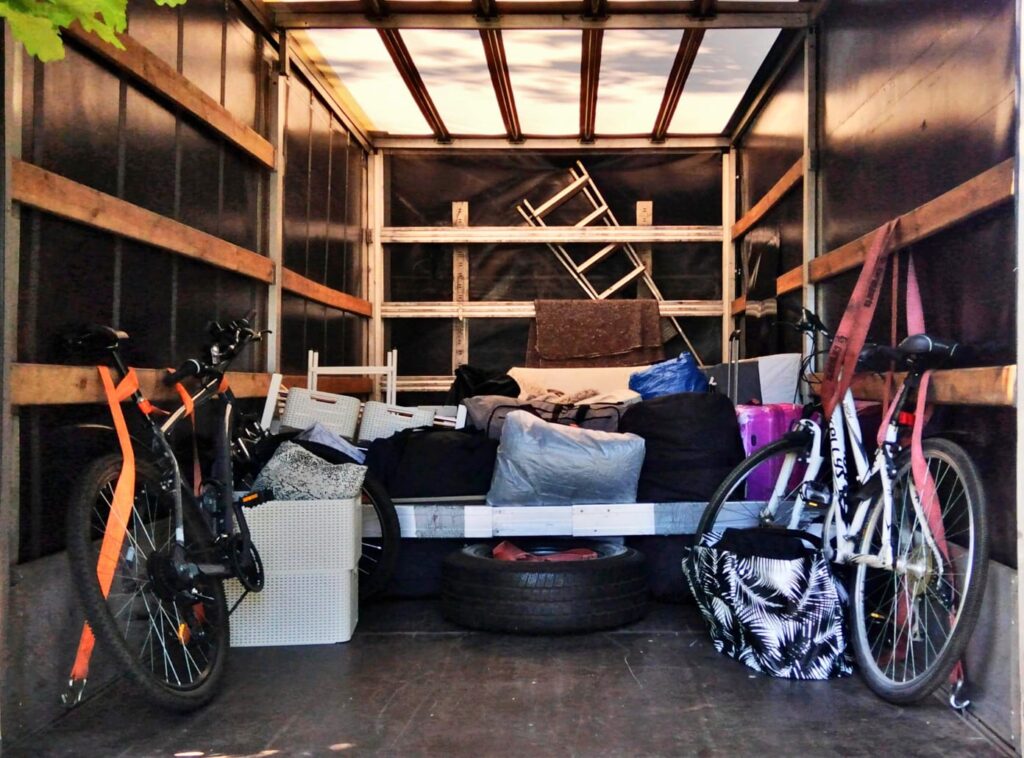
Transporting quality furniture may cost less than replacing everything after arrival. Beds, wardrobes, desks, appliances and specialist equipment can be expensive to buy again.
VANonsite provides international home removals, furniture transport, professional packing, storage, student removals, office removals, White Glove Delivery and Last Minute Moving. Customers can select part-load transport, a dedicated vehicle or a flexible man and van service.
GPS tracking is available for every load, providing clear visibility throughout the journey.
Choosing the Right Vehicle for Your Move
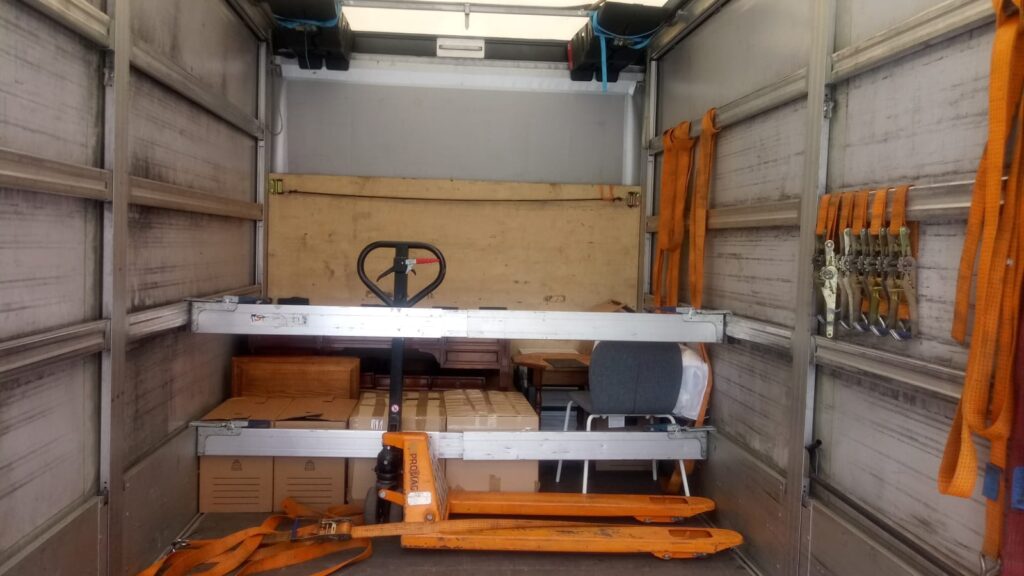
Selecting the correct vehicle prevents customers from paying for unnecessary space.
| VANonsite option | Volume | Weight limit | Suitable for |
|---|---|---|---|
| Moving One | 1 m³ | 100 kg | Luggage, boxes and very small moves |
| Moving Basic | 5 m³ | 300 kg | Boxes and compact furniture |
| Moving Medium | 10 m³ | 500 kg | A studio or partial apartment move |
| Moving Premium | 15 m³ | 1,100 kg | A one-bedroom home or compact move |
| Moving Premium Plus | 30 m³ | 3,500 kg | A larger apartment or family move |
| Moving Full House XXL | 90 m³ | 20,000 kg | A full household or office relocation |
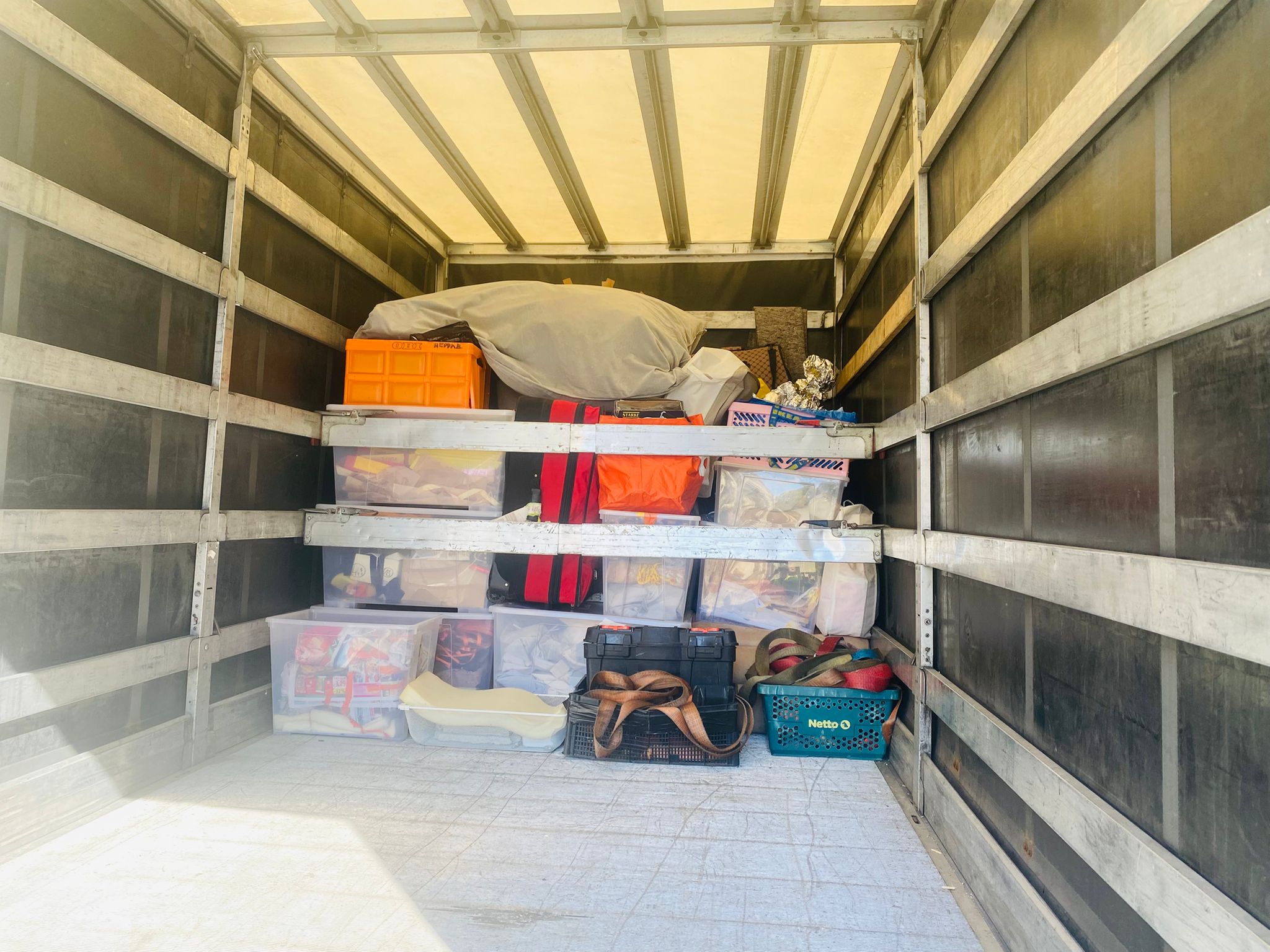
Photographs, measurements and a room-by-room inventory help the removals team recommend the right capacity. They also make the quotation more accurate and reduce the risk of last-minute complications.
Documents Needed Before Moving to Ireland
Documentation requirements depend on nationality and the reason for moving.
EU, EEA and Swiss Citizens
EU, EEA and Swiss citizens can enter Ireland without a visa. Longer-term residence rights depend on circumstances such as employment, self-employment, study or sufficient resources.
Official information is available through Citizens Information.
UK Citizens
British and Irish citizens can move freely and reside in either jurisdiction under the Common Travel Area.
Non-UK family members may face different requirements and should verify their status separately.
Official details are available on the Irish Government website.
Non-EEA Citizens
People from outside the EU, UK or Switzerland who intend to work, study or live in Ireland for more than 90 days normally need to register their immigration permission.
Check the official guidance:
Requirements vary according to nationality, employment, education and family status. Always confirm the current rules before booking transport.
How Much Money Should You Save Before Moving?
A strong starting fund gives you time to find suitable housing without accepting the first available option under pressure.
| Household | Recommended starting fund |
|---|---|
| Single person renting a room | €4,000 to €7,000 |
| Couple renting an apartment | €7,000 to €12,000 |
| Family renting a home | €12,000 to €20,000 |
These are practical planning ranges rather than official requirements.
Your fund should cover:
- The deposit and first rent payment
- Four to eight weeks of daily expenses
- Temporary accommodation
- Moving costs
- Transport
- Childcare deposits
- Essential household purchases
- Emergency travel
The less certain your employment and housing arrangements are, the larger your reserve should be.
How to Reduce the Cost of Living in Ireland
Housing decisions create the greatest savings, but smaller changes also protect the monthly budget.
- Compare neighbourhoods outside city centres.
- Check transport links before choosing a cheaper property.
- Rent a room before committing to a private apartment.
- Delay buying a car where public transport is sufficient.
- Use supermarket own-brand products.
- Plan meals and reduce food waste.
- Compare electricity and broadband contracts.
- Apply for eligible childcare and healthcare support.
- Use part-load transport for a smaller relocation.
- Maintain a monthly contingency fund.
Reducing rent by €300 per month saves €3,600 per year. This can have a greater impact than eliminating dozens of small comforts.
However, cheaper accommodation far from work can generate higher transport expenses. Compare the entire budget before making a decision.
Is Moving to Ireland Worth the Cost?
Ireland can be an exceptional place to live, but it rewards preparation.
The country offers career opportunities, respected universities, an English-speaking environment and easy access to dramatic landscapes. However, high rent, limited housing supply and expensive childcare can create real pressure.
The cost of living in Ireland becomes more manageable when employment is confirmed, temporary accommodation is arranged and an emergency fund is available.
Your choice of city matters as much as your salary. Dublin offers opportunity and convenience, while Cork, Waterford and regional locations may provide a better balance between income and monthly expenses.
Frequently Asked Questions
What is the average cost of living in Ireland for one person?
A single person may spend approximately €1,000 per month before rent. Including accommodation, the monthly budget may range from around €2,000 in shared regional housing to more than €3,000 for a private apartment in Dublin.
How much does a family of four need?
A family of four may spend around €3,600 per month before rent. Housing and childcare can push the full monthly budget above €5,000 in more expensive cities.
Is €3,000 per month enough to live in Ireland?
It may be enough for a single person, especially when sharing accommodation. It can be restrictive for someone renting a private apartment in Dublin. For a family, €3,000 after tax may not cover rent, childcare and all regular expenses.
Which Irish city is the cheapest?
Among Dublin, Cork, Galway, Limerick and Waterford, Waterford had the lowest standardised new-tenancy rent in Q4 2025 at €1,317 per month.
How much do groceries cost each month?
One adult may spend between €250 and €400. A family of four may need between €750 and €1,050, depending on diet, supermarket choice and takeaway spending.
Is Dublin more expensive than Cork?
Yes, especially for housing. Average new-tenancy rent reached €2,191 in Dublin City, compared with €1,756 in Cork City.
How much should I save before moving to Ireland?
A single person should consider saving €4,000 to €7,000. A couple may need €7,000 to €12,000, while a family may need €12,000 to €20,000.
Plan Your Move to Ireland With Confidence
The cost of living in Ireland is high, but it becomes far easier to manage when you understand the numbers before relocating.
Housing will probably dominate your budget. Groceries, utilities and public transport are more predictable, while childcare and car ownership can transform the monthly total. Compare cities carefully, calculate your take-home income and maintain a meaningful financial reserve.
Once your budget is ready, organise the physical move with the same precision. VANonsite provides professional removals to Ireland, including packing, furniture transport, part-load options, dedicated vehicles, flexible man and van services and GPS tracking for every load.
With the right plan, moving to Ireland can feel less like an uncertain financial leap and more like a confident step towards a new life.