
Is Ireland cheaper than the UK? Usually not when Ireland is compared with Wales, Northern Ireland, North East England or many smaller British cities. The answer can reverse when Dublin or another Irish city is compared with London, and it can change again once salary, household size, childcare, commuting and the type of home are included. This 2026 guide uses dated official rental and price-level evidence rather than a generic currency conversion. It shows which costs decide the result, how to build a personal comparison, and what to budget separately if the comparison leads to a move from the UK to Ireland.
Is Ireland cheaper than the UK? The short answer
- For most regional UK comparisons, Ireland is usually more expensive: housing is normally the largest reason.
- London is the main exception: an Irish city can be cheaper than London, but the result depends on the property, location and commute.
- Do not compare national averages as if they were identical homes: Irish and UK official rent series use different samples, currencies and methods.
- Compare take-home pay, not gross salary: rent, childcare, transport, energy and healthcare can change the answer.
- Separate monthly living costs from relocation costs: deposit, temporary accommodation and the move itself are one-off items.
- If the numbers work: check the automatic UK-to-Ireland removal estimate using the real addresses, dates and load.




Is the Cost of Living in Ireland Higher Than in the UK?
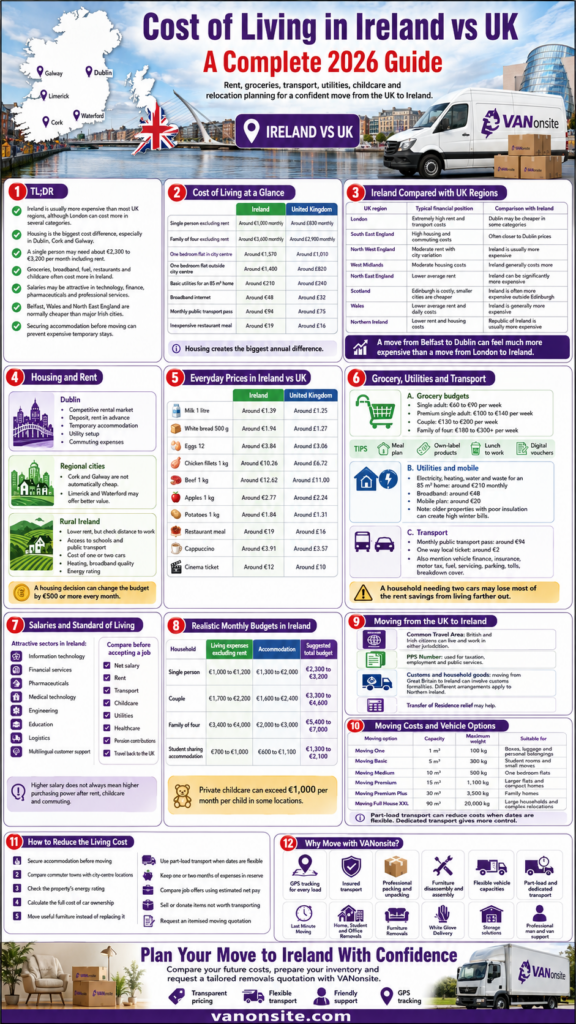
For most households, yes. The cost of living in Ireland vs UK tends to be higher once rent, food, transport, utilities and leisure spending are considered together.
National averages can still be misleading. The UK includes London, one of Europe’s most expensive cities, but also lower-cost regions such as Northern Ireland and Wales. Ireland also contains major differences between Dublin, regional cities and rural counties.
In practical terms:
- Ireland is usually more expensive than Northern Ireland.
- Dublin may be cheaper than central London in selected categories.
- Cork and Galway often cost more than comparable regional UK cities.
- Rural Ireland may offer lower rent, but transport and heating costs can rise.
- A strong Irish salary can offset higher prices.
- Childcare, housing and car ownership can quickly reduce disposable income.
The living cost in Ireland vs UK therefore depends on location and lifestyle, not one national percentage.
Ireland vs UK costs: what the official 2026 data says
Data check: 9 September 2026. The latest available official releases do not produce one perfect Ireland-versus-UK monthly budget. They do, however, show the scale of the housing problem and why location matters more than a headline national average.
| Official measure | Latest published figure | How to use it |
|---|---|---|
| Ireland: standardised average rent in a new tenancy, Q1 2026 | €1,839 nationally; €2,335 in Dublin; €1,432 outside the Greater Dublin Area | Use as a market indicator for someone entering a new tenancy, not as a quote for a specific property. |
| UK: average private rent, July 2026 | £1,393 UK-wide; £1,451 England; £843 Wales; £1,016 Scotland | Use the country and local-area breakdown, not the UK total alone. |
| Northern Ireland: latest available UK-series rent, May 2026 | £875 | This helps explain why a Belfast-to-Dublin move can create a larger housing increase. |
| London and North East England, July 2026 | £2,317 in London; £783 in the North East | The regional spread shows why the same Ireland comparison can produce opposite answers. |
| Ireland: household consumption price level, 2025 | 136% of the EU average; housing costs 190% of the EU average | This confirms broad price pressure, but it is not adjusted for income and is not a personal budget. |
Sources: RTB/ESRI Rent Index Q1 2026, ONS private rent and house prices, and Eurostat 2025 household price levels. The RTB and ONS series are not directly like-for-like: they use different currencies, samples and methods. Use them to understand direction and regional spread, then check actual homes in the areas you are considering.
Ireland Compared With Different UK Regions
The cost of living in Ireland compared to UK regions varies significantly.
| UK region | Typical financial position | Comparison with Ireland |
|---|---|---|
| London | Extremely high rent and transport costs | Dublin may be cheaper in some categories |
| South East England | High housing and commuting costs | Often closer to Dublin prices |
| North West England | Moderate rent with city variation | Ireland is usually more expensive |
| West Midlands | Moderate housing costs | Ireland generally costs more |
| North East England | Lower average rent | Ireland can be significantly more expensive |
| Scotland | Edinburgh is costly, smaller cities are cheaper | Ireland is often more expensive outside Edinburgh |
| Wales | Lower average rent and daily costs | Ireland is generally more expensive |
| Northern Ireland | Lower rent and housing costs | The Republic of Ireland is usually more expensive |
A move from London to Cork may reduce accommodation costs. A move from Belfast to Dublin could increase them dramatically. Compare expected net salary with rent, utilities, transport, childcare and food. Gross salary alone does not show purchasing power.
Are houses cheaper in Ireland than the UK?
There is no reliable yes-or-no answer without naming both locations and whether you plan to rent or buy. The official rental data shows a much more useful pattern. In Q1 2026, the RTB reported a standardised average of €2,335 for new tenancies in Dublin, compared with €1,432 outside the Greater Dublin Area. In the UK series for July 2026, ONS reported £2,317 for London but £783 for North East England; the latest available figure for Northern Ireland was £875 in May 2026.
These are different statistical series and should not be converted into a direct property-to-property league table. They demonstrate the size of the regional gap. Compare current listings for the same property type, bedroom count and commute, then add deposit, furnishing, energy performance and transport.
Renting in Dublin
Dublin combines access to major employers with the highest standardised new-tenancy rent in the Irish data. Prepare verified proof of income and references, but do not transfer money before checking the property and landlord. A central home can reduce commuting costs; a cheaper address outside the centre may require more travel time or a car.
Cork, Galway, Limerick and Waterford
Regional cities should be compared individually rather than labelled simply as “cheaper than Dublin”. The Q1 2026 RTB new-tenancy indicators were €1,903 in Cork City, €2,004 in Galway City, €1,921 in Limerick City and €1,423 in Waterford City. Job location, availability and the commute can matter as much as the headline city figure.
Rural Ireland
A lower advertised rent can be offset by car ownership, fuel, heating, broadband limitations and longer trips to work, school or childcare. Check the property’s Building Energy Rating, the actual commute at working hours and whether the household needs one car or two.
Everyday prices: compare a real basket, not isolated items
A table of one-off supermarket prices becomes inaccurate quickly and rarely matches an individual household. Build a four-week basket from the items you repeatedly buy: staple food, household products, prescriptions, meals out, subscriptions and any child or pet costs. Price the same brands and pack sizes in the Irish and UK locations you are considering.
Eurostat’s 2025 price-level comparison placed Irish household consumption at 136% of the EU average, but the measure is not adjusted for salary. It is evidence that Ireland has broad price pressure, not proof that every Irish basket costs the same percentage more than a UK basket. Your take-home pay and housing choice decide whether the higher price level is affordable.
Grocery costs and a four-week food budget
Start with four recent UK receipts and group the spend into staples, fresh food, household products, convenience purchases and meals outside the home. Re-price the repeat items in Irish supermarkets using comparable pack sizes. This produces a useful household budget instead of a generic estimate for an invented “average” person.
- Separate groceries from takeaways, coffee and lunches bought at work.
- Compare own-label products consistently; switching brand in only one country distorts the result.
- Include toiletries, cleaning products, nappies and school lunches where relevant.
- Add a small buffer for the first weeks, when a new home needs pantry and household basics.
- Review the basket after the first month in Ireland and replace assumptions with actual spending.
Utilities, internet and mobile costs
Energy cost depends on the property, not just the country. Before signing a tenancy, ask for the Building Energy Rating, heating type and any available annual usage history. Confirm whether waste collection, communal heating or service charges are included. Then compare current electricity, broadband and mobile offers for the exact address.
For the UK comparison, use the last 12 months of actual bills rather than a generic monthly estimate. For Ireland, model a low and high winter scenario. This exposes the risk of an older or poorly insulated home without pretending that one national utility number fits every household.
Transport costs in Ireland vs the UK
Transport can reverse an apparently cheaper housing choice. Compare the full door-to-door commute at the hours you will travel, then cost the realistic option: public transport, one car or two cars. Include finance or depreciation, insurance, motor tax, fuel or charging, servicing, parking, tolls and breakdown cover.
Dublin offers the widest public-transport choice in Ireland, but coverage changes by neighbourhood and working hours. Outside larger urban areas, confirm that the timetable supports both the outward and return journey before choosing a home. A lower rent is not a saving if it creates a second-car requirement.
Salaries and the Standard of Living in Ireland Compared to UK
Higher prices do not automatically mean a lower quality of life. The standard of living in Ireland compared to UK depends on income, housing, commuting time and personal priorities.
Ireland can be attractive for professionals in:
- Information technology
- Financial services
- Pharmaceuticals
- Medical technology
- Engineering
- Education
- Logistics
- Multilingual customer support
However, a high salary is not the same as high purchasing power. A professional earning more in Dublin than in Manchester may still have less disposable income after rent.
Before accepting a job offer, calculate net salary, rent, transport, childcare, utilities, healthcare, pension contributions and travel back to the UK.
The standard of living in Ireland compared to UK can be excellent for households with secure employment and manageable housing. It becomes more difficult when rent absorbs a disproportionate share of income.



Build a realistic Ireland vs UK monthly budget
Use three columns: your current UK cost, the verified Irish cost and the difference. Work from net income and real property listings. Do not mix one-off moving expenses into the monthly total.
| Budget line | Evidence to use | Decision question |
|---|---|---|
| Net household income | Irish job offer and official tax calculation | What reaches the account each month? |
| Housing | Comparable live listings plus deposit and furnishing needs | Is the home available at this price and commute? |
| Energy and communications | BER, supplier quotes and current UK bills | What is the winter-risk range? |
| Transport | Real timetable or full car cost | Does cheaper housing create another car? |
| Childcare, school and healthcare | Quotes and eligibility for the household | Which costs change after the move? |
| Food and daily spending | Four-week like-for-like basket | Which habits drive the difference? |
| Travel back to the UK | Expected trip frequency and seasonal fares | Is family travel included? |
Run a base case and a higher-cost case. If the move only works when every estimate is optimistic, reduce the housing target, change the commute or build a larger reserve before committing.
Cost of Living in Southern Ireland Compared to UK
People often search for the cost of living in Southern Ireland compared to UK locations. In most relocation contexts, the correct term is the Republic of Ireland.
The Republic uses the euro, while Northern Ireland uses the pound. The jurisdictions also have different tax systems, healthcare structures, salaries and housing markets.
Belfast is generally cheaper than Dublin, especially for rent. Moving from Belfast to Dublin may therefore create a larger increase than moving from London to an Irish regional city.
Moving From the UK to Ireland
Once you understand the cost of living in Ireland vs UK, the next step is organising the move.
VANonsite provides professional removals to Ireland for individuals, families, students and businesses.
Common Travel Area
British and Irish citizens can live and work in either jurisdiction under the Common Travel Area. Current information is available through the Irish Government Common Travel Area guidance.
People who live in the UK but are not British citizens may require separate immigration permission.
Applying for a PPS Number
A Personal Public Service Number is used for taxation, employment and public services. Check the official PPS Number application guidance.
Customs and Household Goods
Moving personal possessions from Great Britain to Ireland can involve customs formalities. Different arrangements apply to Northern Ireland.
Transfer of Residence relief may allow qualifying household goods to enter without standard import charges. Applications and supporting documents should be prepared before arrival.
Review:
- Irish Revenue Transfer of Residence guidance
- Procedure for importing household goods
- Transfer of Residence rules
Missing paperwork can delay the vehicle and create unnecessary port costs.
How much does it cost to move from the UK to Ireland?
The removal price is separate from the cost-of-living comparison. It depends on the collection and delivery postcodes, usable load volume and weight, access at both properties, ferry plan, dates, packing and any dismantling or specialist handling. A generic bedroom count cannot show whether the load needs shared space or a dedicated vehicle.
| Quote input | What to provide | Why it changes the plan |
|---|---|---|
| Route | Full postcodes in the UK and Ireland | Sets mileage, port positioning and the ferry plan. |
| Load | Room-by-room inventory, photographs and dimensions of large items | Shows usable volume, weight and handling needs. |
| Access | Floors, lift size, parking distance and restricted hours | Determines crew time and equipment. |
| Timing | Preferred date and any acceptable range | Helps compare part-load and dedicated options. |
| Service scope | Packing, dismantling, reassembly and fragile items | Separates transport from labour and materials. |
Price the actual move: use the existing automatic removal estimate, then let a VANonsite route specialist verify the inventory, access and ferry requirements. You can also review the full removals to Ireland service and add professional packing where needed.
How to Reduce the Living Cost in Ireland vs UK
- Secure accommodation before moving.
- Compare commuter towns with city-centre locations.
- Check the property’s energy rating.
- Calculate the full cost of car ownership.
- Move useful furniture instead of replacing it.
- Use part-load transport when dates are flexible.
- Keep one or two months of expenses in reserve.
- Compare job offers using estimated net pay.
- Sell or donate items not worth transporting.
- Request an itemised moving quotation.
Professional Packing Services can also reduce the risk of damage to furniture and fragile belongings.
Why Move to Ireland With VANonsite?
VANonsite supports moves to Ireland with:
- GPS tracking for every load
- Insured transport
- Professional packing and unpacking
- Furniture disassembly and assembly
- Flexible vehicle capacities
- Part-load and dedicated transport
- Last Minute Moving
- Home, Student and Office Removals
- Furniture Removals
- White Glove Delivery
- Storage solutions
- Office Furniture Installation
- Professional man and van support
A student moving several boxes does not need the same vehicle as a family relocating a complete home. VANonsite matches the vehicle and service to the actual volume, weight and route.
GPS tracking provides added reassurance. Customers can follow the shipment while their belongings move through a structured and professionally managed process.
Ireland vs UK cost of living FAQ
Is Ireland cheaper than the UK?
Usually not when Ireland is compared with lower-cost UK regions. The answer can change when an Irish city is compared with London. Housing, take-home pay, childcare and transport normally decide the result.
Are houses cheaper in Ireland than the UK?
Not as a national rule. Official rent data shows large regional differences inside both countries. Compare the same property type and commute in two named locations, and separate renting from buying.
Is Dublin more expensive than London?
It depends on the property and location. The latest official rent indicators show very high costs in both markets, but the Irish and UK series use different methods and currencies. Current comparable listings and net income give a better personal answer.
Is Belfast cheaper than Dublin?
Current official rent indicators point to a substantial gap between Northern Ireland and Dublin, but taxation, salaries, healthcare and transport also differ. Compare the whole household budget, not rent alone.
How should I compare the cost of living in Ireland and the UK?
Use net household income, comparable current housing, 12 months of UK bills, Irish supplier quotes, a four-week food basket, the real commute, childcare and healthcare. Run both a base case and a higher-cost case.
Can British citizens move to Ireland without a visa?
British and Irish citizens can live and work in either jurisdiction under the Common Travel Area. Other UK residents may need separate immigration permission, so check their status before planning the move.
Do I need customs documents when moving furniture to Ireland?
Customs procedures can apply when goods move from Great Britain to Ireland; arrangements differ for Northern Ireland. Transfer of Residence relief may be available when the conditions and documentation are met.
How do I estimate a UK-to-Ireland removal?
Enter both postcodes, dates and the load in the automatic calculator. A VANonsite specialist then checks the inventory, access, ferry plan, packing and handling details before the move is confirmed.
Summary: Is Moving to Ireland Worth the Higher Cost?
The cost of living in Ireland vs UK is usually higher when Ireland is compared with Northern Ireland, Wales, North East England, the Midlands or smaller British towns. The difference becomes less dramatic when Ireland is compared with London or expensive parts of South East England.
Housing remains the most important expense. A competitive salary can support an excellent standard of living, but only when rent, transport and childcare remain manageable.
Before moving, calculate expected net income and create separate budgets for monthly living expenses and relocation. Include rent deposits, temporary accommodation, transport and an emergency reserve.
Once the numbers are clear, organise your removals to Ireland with a provider that can match the vehicle, schedule and service to your needs. VANonsite combines secure handling, GPS tracking and flexible moving solutions to make the journey calmer, safer and more predictable.