
Claiming UK pension living in Ireland is usually possible if you have built up enough qualifying years on your UK National Insurance record. Moving to Ireland does not erase the pension rights you earned while working in England, Scotland, Wales or Northern Ireland.
You can normally continue receiving an existing UK State Pension after relocating. You can also make a new claim from Ireland when you approach State Pension age. Because Ireland is in the European Economic Area, eligible UK State Pension payments made there usually continue to receive annual increases.
A successful retirement move involves more than the pension itself. You also need to consider Irish tax residence, healthcare, banking, currency conversion, customs documents and the safe transport of your belongings.
This guide explains how claiming UK pension living in Ireland works in 2026, how UK and Irish contribution records interact, and how to organise the move with fewer delays.
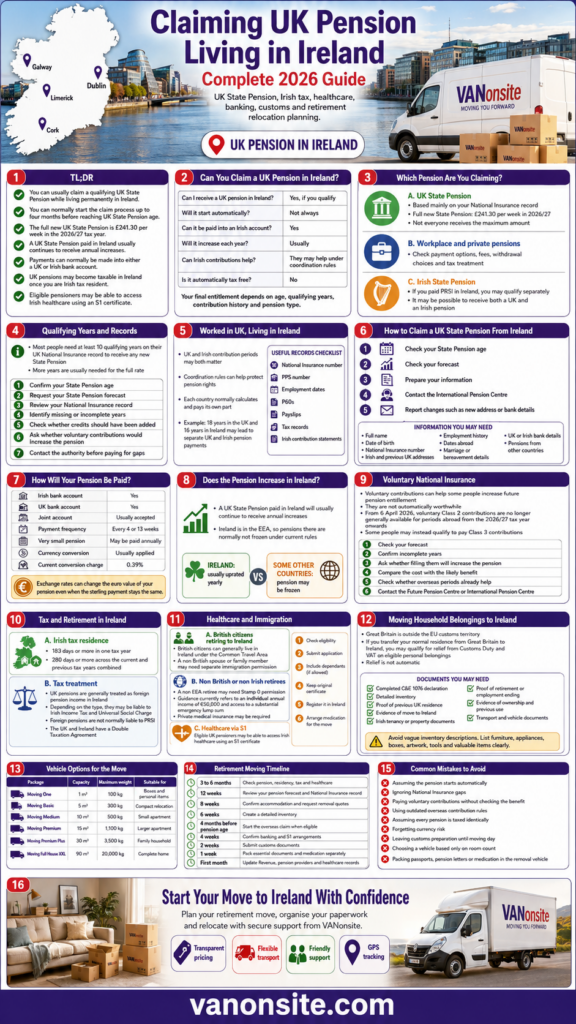
TL:DR
- You can usually claim a qualifying UK State Pension while living permanently in Ireland.
- You can normally start the claim process up to four months before reaching UK State Pension age.
- The full new UK State Pension is £241.30 per week in the 2026/27 tax year.
- A UK State Pension paid in Ireland usually continues to receive annual increases.
- Payments can normally be made into either a UK or Irish bank account.
- UK pensions may become taxable in Ireland once you are Irish tax resident.
- Eligible pensioners may be able to access Irish healthcare using an S1 certificate.




Can You Claim a UK Pension While Living in Ireland?
Yes. Claiming UK pension living in Ireland is possible if you meet the relevant eligibility conditions.
The main factor is your National Insurance record. Your current address does not cancel the pension rights you built while working in the UK. You can continue receiving the pension after moving, or claim it for the first time from Ireland.
The UK State Pension does not always begin automatically when you reach the qualifying age. You normally need to make a claim and provide the Department for Work and Pensions with your personal details, contribution history and bank information.
| Question | Direct answer |
|---|---|
| Can I receive a UK pension in Ireland? | Yes, if you qualify |
| Will it start automatically? | Not always |
| Can it be paid into an Irish account? | Yes |
| Will it increase each year? | Usually |
| Can Irish contributions help? | They may help under coordination rules |
| Is it automatically tax-free? | No |
Your final entitlement depends on your age, qualifying years, contribution history and pension type.
English Pension Living in Ireland: Which Pension Are You Claiming?
People searching for an English pension living in Ireland may be referring to several forms of retirement income.
UK State Pension
The UK State Pension is based mainly on your National Insurance record. For the 2026/27 tax year, the full new State Pension is £241.30 per week. Not everyone receives the maximum amount.
Your payment can depend on:
- Qualifying years
- National Insurance credits
- Gaps in employment
- Contracted-out periods
- Additional State Pension rights
- Pension deferral
- Time spent working abroad
Check your own estimate through the official State Pension forecast service before planning your retirement budget.
Workplace and private pensions
Workplace and private pensions are separate from the UK State Pension. Contact every provider before moving and confirm:
- Retirement date and expected value
- Overseas payment options
- Currency conversion fees
- Withdrawal choices
- Beneficiary details
- Tax deducted before payment
Some schemes pay directly into Irish accounts. Others may prefer a UK account or charge extra for international transfers.
Large lump sums, drawdown income and annuities can receive different tax treatment. Professional advice can be valuable if you hold several pension products.
Irish State Pension
If you worked in Ireland and paid PRSI contributions, check whether you qualify for the Irish State Pension (Contributory). It is possible to receive a UK pension and an Irish pension at the same time if you meet the conditions in both systems.
UK State Pension Living in Ireland: Qualifying Years
Most people claiming the new UK State Pension need at least ten qualifying years on their National Insurance record to receive any payment. The years do not normally need to be consecutive.
Ten years will not usually provide the full pension. The final amount depends on your personal contribution history, including any contracted-out employment.
Before claiming UK pension living in Ireland:
- Confirm your State Pension age.
- Request your State Pension forecast.
- Review your National Insurance record.
- Identify missing or incomplete years.
- Check whether credits should have been added.
- Ask whether voluntary contributions would increase the pension.
- Contact the relevant authority before paying for gaps.
You can review your record through the official National Insurance service.
Do not assume every incomplete year is worth filling. Paying for a gap may not increase your final pension.
Worked in UK Living Ireland Pension: How Contributions Are Counted
The phrase worked in UK living Ireland pension often describes someone who spent part of their career in the UK and another part in Ireland.
Social security coordination rules may help protect your pension rights. If you do not have enough contributions in one country to qualify on that record alone, contribution periods from another eligible country may sometimes be considered when checking minimum eligibility.
This does not usually mean all contributions are transferred into one pension. Each country normally calculates and pays its own part.
For example, someone who worked for 18 years in the UK and 16 years in Ireland may receive a UK State Pension based on National Insurance and a separate Irish pension based on PRSI.
Prepare your National Insurance number, Irish Personal Public Service number, employment dates, P60s, payslips, tax records and Irish contribution statements. Accurate evidence reduces delays and the risk of missing qualifying periods.




How to Claim a UK State Pension From Ireland
Step 1: Check your State Pension age
Your State Pension age may differ from the age at which you can access a workplace or private pension. Use the official State Pension age calculator.
Step 2: Check your forecast
Your forecast shows how much you may receive, when payments can begin and whether further qualifying years could increase the amount.
Step 3: Prepare your information
You may need:
- Full name and previous names
- Date of birth
- National Insurance number
- Irish and previous UK addresses
- Employment history
- Dates spent living abroad
- Marriage, divorce or bereavement details
- UK or Irish bank details
- Information about pensions from other countries
Step 4: Contact the International Pension Centre
Use the official claim State Pension abroad guidance to find the correct form and process. You may also need an International Pensions Direct Payment form for an Irish bank account.
Step 5: Report changes
Tell the authorities about a new address, bank account, marriage, divorce, bereavement, return to the UK or move to another country. Prompt reporting helps prevent interrupted payments or overpayments.
How Will Your UK Pension Be Paid in Ireland?
A UK State Pension can normally be paid into a bank account in Ireland or the UK. For an Irish account, you may need your IBAN and BIC.
| Payment feature | Available option |
|---|---|
| Irish bank account | Yes |
| UK bank account | Yes |
| Joint account | Usually accepted |
| Payment frequency | Every 4 or 13 weeks |
| Very small pension | May be paid annually |
| Currency conversion | Usually applied |
| Current conversion charge | 0.39% |
An Irish account is convenient for everyday bills in euros. A UK account may give you more control over the timing of currency conversion.
Exchange rates can change the euro value of your pension even when the sterling payment remains unchanged. Keep a small financial buffer for less favourable conversion periods.
Does the UK State Pension Increase in Ireland?
A UK State Pension living in Ireland will usually continue to receive annual increases.
The UK normally applies yearly increases when the recipient lives in the EEA, Switzerland or a country covered by a qualifying social security agreement. Ireland is in the EEA.
This matters because UK State Pensions paid in some other countries can be frozen. Under current rules, retiring to Ireland does not normally freeze your qualifying pension.
Voluntary National Insurance After Moving to Ireland
Voluntary National Insurance can help some people increase their future UK State Pension, but it is not automatically worthwhile.
From 6 April 2026, voluntary Class 2 contributions are no longer generally available for periods abroad from the 2026/27 tax year onwards. Some people may instead qualify to pay Class 3 contributions.
Before paying:
- Check your forecast.
- Confirm which years are incomplete.
- Ask whether filling them will increase the pension.
- Compare the cost with the likely benefit.
- Check whether overseas periods already help.
- Contact the Future Pension Centre or International Pension Centre.
Review the current voluntary National Insurance guidance before making a payment.
Will You Pay Irish Tax on a UK Pension?
Tax is a crucial part of claiming UK pension living in Ireland.
A pension does not become tax-free because it is paid into a UK account. Tax residence and the pension type matter more than the bank location.
Irish tax residence
You are generally considered resident in Ireland for tax purposes if you are present there for:
- 183 days or more in one tax year
- 280 days or more across the current and previous tax years combined
Special minimum-day rules apply to the two-year test. Check the official Irish tax residence rules.
Tax treatment
UK pensions are generally treated as foreign pension income in Ireland. Depending on the type, the income may be liable to Irish Income Tax and Universal Social Charge. Foreign pensions are not normally liable to PRSI.
The treatment may differ for a State Pension, private pension, workplace pension, government service pension, annuity or retirement lump sum.
Ireland and the UK have a Double Taxation Agreement designed to prevent the same income from being taxed twice without relief. If you receive several pensions or plan a large withdrawal, obtain professional advice.
Can British Citizens Retire to Ireland Without a Visa?
British citizens can generally live in Ireland under the Common Travel Area.
The arrangement allows Irish and British citizens to move freely between the two jurisdictions and access associated rights, including residence, employment, healthcare and education.
Brexit did not remove these rights. However, a non-British spouse, partner or family member may need separate immigration permission. Check the status of every household member before arranging the move.



Retiring to Ireland If You Are Not British or Irish
Receiving a UK pension does not automatically give a non-British or non-Irish citizen the right to live permanently in Ireland.
A non-EEA retiree may need Stamp 0 permission as a person of independent means. Irish immigration guidance currently refers to an individual annual income of €50,000 and access to a substantial emergency lump sum.
Applicants are normally expected to be financially self-sufficient and may need private medical insurance. Review the official Irish retirement immigration guidance before making financial commitments.
Healthcare for UK Pensioners Living in Ireland
An eligible UK State Pension recipient may be able to access healthcare through an S1 certificate. The S1 confirms that the UK is responsible for funding qualifying state healthcare in Ireland.
Before moving:
- Check S1 eligibility.
- Submit the application.
- Include eligible dependants where permitted.
- Keep the original certificate.
- Register it with the relevant Irish authority.
- Confirm access to local doctors and hospitals.
- Arrange medication for the transition.
- Consider private cover for services outside the public system.
You can begin through the official NHSBSA healthcare cover application.
Moving Household Belongings From the UK to Ireland
Great Britain is outside the EU customs territory. If you transfer your normal residence from Great Britain to Ireland, you may qualify for relief from Customs Duty and VAT on eligible personal belongings.
Relief is not automatic. You may need:
- A completed C&E 1076 declaration
- A detailed inventory
- Proof of previous UK residence
- Evidence of your move to Ireland
- Irish tenancy or property documents
- Proof of retirement or employment ending
- Evidence of ownership and previous use
- Transport and vehicle documents
Use the official transfer of residence guidance before dispatching your belongings.
Avoid vague inventory descriptions. List furniture, appliances, boxes, artwork, tools and valuable items clearly.
Choosing the Right Vehicle for Your Move
| VANonsite package | Capacity | Maximum weight | Suitable for |
|---|---|---|---|
| Moving One | 1 m³ | 100 kg | Boxes and personal items |
| Moving Basic | 5 m³ | 300 kg | Compact relocation |
| Moving Medium | 10 m³ | 500 kg | Small apartment |
| Moving Premium | 15 m³ | 1,100 kg | Larger apartment |
| Moving Premium Plus | 30 m³ | 3,500 kg | Family household |
| Moving Full House XXL | 90 m³ | 20,000 kg | Complete home |
A small man and van service may be ideal for boxes and limited furniture. A full household move may require packing, disassembly, loading support and a dedicated vehicle.
Measure large items and mention narrow entrances, upper floors, stairs and parking restrictions when requesting a quote.
Moving to Ireland With VANonsite
Pension forms, tax, healthcare, banking and customs paperwork all demand attention. VANonsite can manage the physical relocation while you focus on those formalities.
Professional removals to Ireland can include GPS tracking, home removals, furniture removals, packing, white glove delivery, storage, Last Minute Moving, Student Removals, office removals, furniture installation and flexible man and van services.
GPS tracking adds reassurance during an international move. VANonsite can also match the vehicle to the real volume of the load, reducing the risk of paying for unnecessary capacity or discovering that your belongings will not fit.
Retirement Moving Timeline
| Time before moving | Recommended action |
|---|---|
| 3 to 6 months | Check pension, residency, tax and healthcare |
| 12 weeks | Review your pension forecast and National Insurance record |
| 8 weeks | Confirm accommodation and request removal quotes |
| 6 weeks | Create a detailed inventory |
| 4 months before pension age | Start the overseas claim when eligible |
| 4 weeks | Confirm banking and S1 arrangements |
| 2 weeks | Submit customs documents |
| 1 week | Pack essential documents and medication separately |
| First month | Update Revenue, pension providers and healthcare records |
If you already receive the pension, you do not need to submit a new claim solely because you are moving. You should still report your new address and bank details.
Common Mistakes to Avoid
- Assuming the pension starts automatically
- Ignoring National Insurance gaps
- Paying voluntary contributions without checking the benefit
- Using outdated overseas contribution rules
- Assuming every pension is taxed identically
- Forgetting currency risk
- Leaving customs preparation until moving day
- Choosing a vehicle based only on room count
- Packing passports, pension letters or medication in the removal vehicle
Frequently Asked Questions
Can I claim my UK State Pension while permanently living in Ireland?
Yes. You can normally claim a qualifying UK State Pension while living permanently in Ireland. Overseas claims are usually handled through the International Pension Centre.
How many National Insurance years do I need?
You normally need at least ten qualifying years to receive part of the new State Pension. More years are usually required for the full rate.
Will my UK State Pension increase every year in Ireland?
Under current rules, it usually will because Ireland is in the EEA.
Can my pension be paid into an Irish bank account?
Yes. You may need an IBAN and BIC. The payment is usually converted into euros.
Can I receive both a UK and Irish State Pension?
Potentially, yes. If you have qualifying UK National Insurance and Irish PRSI records, you may receive separate payments.
Is a UK pension taxable in Ireland?
It may be. The treatment depends on your Irish tax residence and the pension type.
Do British citizens need a visa to retire to Ireland?
British citizens normally do not need a visa because of the Common Travel Area. Other family members may need separate permission.
Can I use an S1 for healthcare?
You may be eligible if you receive a qualifying UK State Pension or another exportable benefit and live lawfully in Ireland.
Summary
Claiming UK pension living in Ireland is a realistic option for people who built up National Insurance contributions in the UK.
Your pension can normally be paid into a UK or Irish bank account and usually continues to receive annual increases while you live in Ireland. You may also qualify for an Irish State Pension if you previously paid PRSI.
The strongest plan combines pension checks, tax preparation, healthcare arrangements, customs paperwork and a carefully organised move.
VANonsite can manage the physical side of the relocation, from a compact man and van collection to a complete household move. Flexible vehicle sizes, secure packing, GPS tracking and experienced European transport support help you begin your new life in Ireland with confidence.