
Moving from Spain to France: start with access and arrival
Moving from Spain to France involves more than booking a vehicle. The collection address may be available before the French keys are released, a sofa may not fit the lift, and a legal loading space may be on another street. This checklist helps you prepare the inventory, access and handover details before you commit to dates.
Your first planning checklist
Work through these points before requesting transport:
- Separate your preferred collection date, latest move-out date and earliest delivery date.
- List large items, measure them as they will travel, and count boxes by size.
- Confirm access at both addresses: stairs, elevator size, parking distance, entry codes.
- Choose your service level: man and van for compact moves, full removals for households.
- Pack by room, label on two sides, and create one fragile zone.
- Keep documents and first night essentials with you, not in the load.
- Track your load with GPS and coordinate keys and arrival timing.
For transport options and route-wide planning, read our Spain to France removals guide. For availability and a quote, start with removals to France.


What to decide today (date, inventory, access)
Start with the three details that affect the whole job: when each property is available, what is travelling, and how it will reach the vehicle. Record uncertainties rather than turning them into a fixed booking assumption.
1) Date and timing
- Flexible dates: give the earliest and latest acceptable collection and delivery dates.
- Fixed dates: explain the key handover deadline and any booked building access slot.
Ask which dates are confirmed and which are estimates. A delivery ETA is not a substitute for having someone available to open the property.
2) Inventory in two layers
- Large items: beds, wardrobes, sofa, table, appliances
- Boxes: record the quantity and dimensions, including items still waiting to be packed.
A box count alone can hide a heavy library or awkward furniture. Photograph the load, flag anything uncertain and update the inventory if you add items after the quote.
3) Access details at both addresses
Time disappears in stairwells and long carries. Confirm these essentials:
- floor level and elevator availability
- distance from legal parking to the entrance
- any building time restrictions for moves
- key handover plan
A long carry, steps outside the entrance or an unavailable lift can change the handling plan. Measure the actual route from the nearest legal stopping point and include photos of any obstacle.
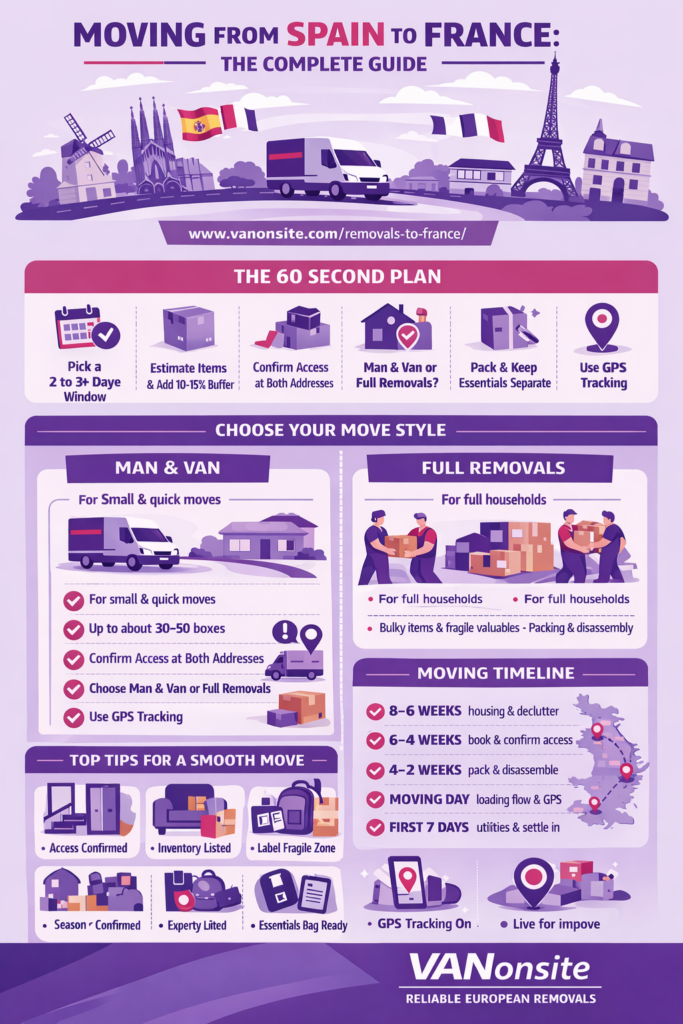
Man and van or full removals, how to choose fast
Choose the service around packed volume, weight, fragile items and the help required at each end. The number of bedrooms is not enough to specify the job.
Choose man and van when:
- you are moving a student load, studio, or compact apartment
- your measured inventory and weight fit the proposed vehicle
- you have agreed who will pack, carry and unload the items
Choose full removals when:
- you have wardrobes, appliances, and bulky furniture
- you want packing, disassembly, and coordinated unloading
- you have fragile items like art, mirrors, or delicate furniture finishes
Quick decision table:
| Your move reality | Best fit | Why it works |
|---|---|---|
| Compact load, fewer fragile items | man and van | a measured load with an agreed handling scope |
| 1 to 2 bedroom home with furniture | full removals | packing and handling coordinated for the listed furniture |
| Premium items and fragile valuables | full removals plus white glove | item-specific protection and agreed placement |
If the options are unclear, ask VANonsite to check the inventory and access photos before confirming a package. Do not select a larger tier solely because of a generic bedroom-size rule.
A working timeline for collection and arrival
Use the stages below as a planning example, not a booking lead-time promise. Work backwards from your actual property handover dates and bring urgent document or access deadlines forward.
If you have less time, combine the preparation stages but still confirm the load, access and delivery arrangements:
| When | Your focus | What to confirm |
|---|---|---|
| 8 to 6 weeks before | housing, paperwork, declutter | property availability and documents needed |
| 6 to 4 weeks before | booking, inventory, access checks | written scope and remaining uncertainties |
| 4 to 2 weeks before | packing system, utilities, address changes | boxes labelled and services arranged |
| 7 to 2 days before | confirmations, disassembly, essentials | keys, contacts and access ready |
| moving day | loading flow, protection, GPS | inventory checked at handover |
| first 7 days | admin basics, utilities, settling in | priority rooms and essential appointments |
8 to 6 weeks before
Check the French property handover date before cancelling services or booking travel from Spain. Confirm who can accept the delivery if you cannot be there.
Do these first:
- Confirm your move in date and any building rules at both addresses.
- Start a France folder: one paper folder plus scans on your phone.
- Decide which bulky items are worth transporting before measuring the final load.
A fast declutter method:
- Sell or donate large, low value items first.
- Remove duplicates: extra chairs, cookware, linens.
- Keep only what you truly want to unpack in France.
6 to 4 weeks before
Request availability once you can describe the load and both properties. Do not wait for every box to be packed, but identify what remains an estimate.
Lock in:
- Service level: man and van for compact moves, full removals for households.
- Inventory: dimensions of large items, box sizes and quantities, heavy or fragile goods.
- Access info: stairs, elevator size, legal parking distance, entry codes.
Access detail to record:
- Measure the carry route from legal parking, including outdoor steps, gates and lift access. Do not assume the van can stop at the front door.
4 to 2 weeks before
Pack non-essential rooms first. Keep an inventory that matches the labels, so a missing box can be identified by number rather than by guessing its contents.
Pack with structure:
- Pack one room at a time.
- Label boxes on two sides with room plus priority.
- Create one fragile zone so delicate items stay supervised.
Simple priority system:
- Priority 1: first night essentials (bedding, toiletries, chargers)
- Priority 2: first week (pots, clothes, tools)
- Priority 3: later (books, decor, seasonal)
7 to 2 days before
This is confirmation week. You stop guessing and lock the plan.
Before the vehicle arrives:
- Disassemble furniture you can live without.
- Defrost the freezer and secure appliance doors.
- Prepare your essentials bag and keep it with you.
- Reconfirm addresses, access instructions, and delivery window.
Essentials bag must include:
- IDs and documents
- chargers and meds
- two days of clothes
- water and snacks
Moving day
Show the crew the agreed carry route, fragile items and anything excluded from the load. Resolve a blocked entrance or changed inventory before loading starts.
Loading points to discuss with the crew:
- Identify heavy items so the crew can plan weight distribution and securing points.
- Keep suitable protective materials available for the agreed packing scope.
- Show fragile items separately and follow the crew’s loading plan.
- Mark first-use shipment boxes clearly; keep personal essentials and documents with you.
Before the final handover:
- Photograph high value items.
- Confirm box count and large item list.
- Note existing scratches on furniture.
First 7 days in France
Prioritise safe sleeping space, working utilities and appointments with deadlines. Adapt the order to your family, work and residence situation rather than assuming one task a day will be enough.
An example order once the load has arrived:
- Day 1: bed, bathroom essentials, basic kitchen
- Day 2: local SIM and internet appointment
- Day 3: paperwork checks and healthcare steps
- Day 4: recycling rules and local services
- Day 5: finish one room and take a real break


Route planning and access checks
Road planning and property access are separate checks. A route suitable for the vehicle may still lead to a street where stopping is restricted, or to a building where the lift must be booked.
Your goal is simple: reduce unknowns.
Regional collection and delivery checks
City names are a starting point, not a distance or delivery-time quotation. These examples show the details to confirm for the exact addresses. The route, vehicle, rest requirements, traffic and handling all affect the schedule.
| Spain region | France region | At pickup | At delivery |
|---|---|---|---|
| Barcelona area | Perpignan, Montpellier, Toulouse | Legal loading spot | Property access |
| Valencia area | Toulouse, Bordeaux | Move-out deadline | Keys and contact |
| Madrid area | Bordeaux, Paris | Loading time | Booked access slot |
| Seville area | Bordeaux, Lyon | Collection date | Separate arrival ETA |
| Malaga area | Marseille, Lyon, Paris | Storage gap | Property ready date |
Two schedule checks that apply to every region:
- Do not treat a car-navigation driving time as the full removal duration.
- Agree how ETA changes will be communicated and who can respond at delivery.
City realities in Spain (Madrid, Barcelona, Valencia, Seville, Malaga)
For each Spanish address, check the actual street and current municipal rules. The prompts below are planning checks, not a statement that every neighbourhood has the same restrictions.
Madrid
- Check legal vehicle access to the pickup street.
- Best move strategy: confirm legal stopping and building access early
Barcelona
- High traffic and complex access in central zones
- Check current ZBE rules for the vehicle and date before planning access.
Valencia
- Check the pickup street, lift dimensions and stopping options.
- Best move strategy: confirm parking distance and elevator size
Seville
- Historic streets can be tight and slow for vehicles
- Confirm whether an agreed collection slot is needed and keep the carry path clear.
Malaga
- Check current street access and likely congestion for your pickup time.
- Best move strategy: avoid peak hours and secure a practical stopping plan
City realities in France (Paris, Lyon, Toulouse, Bordeaux, Marseille, Nice)
Repeat the access check for the French property. Do not assume that arrangements made for the collection in Spain also cover delivery.
Paris
- Tight streets and limited legal stopping points
- Best move strategy: confirm parking, access windows, and elevator rules
Lyon
- Hilly areas and older buildings with stairs
- Best move strategy: confirm stair turns and parking distance
Toulouse
- Check the destination street for vehicle and stopping restrictions.
- Best move strategy: confirm stopping options near the entrance
Bordeaux
- Central access can be controlled and time sensitive
- Best move strategy: plan delivery timing and reduce carry distance
Marseille
- Traffic can spike fast and parking can be tight
- Agree an unloading slot compatible with building and street access.
Nice
- Narrow streets and heavy parking pressure near coastal areas
- Best move strategy: plan access carefully and protect fragile items
Send photos of the entrance and carry route before the quote is confirmed. If access changes, tell VANonsite before the vehicle departs rather than waiting until unloading.
Building access checklist (stairs, elevators, parking)
Provide these details for both properties, even when you are moving only a few items. A compact load can still include a sofa that will not turn on the stairs.
At pickup and delivery, confirm:
- Floor level
- Elevator availability and internal dimensions
- Stair width and number of flights
- Distance from legal parking to entrance
- Tight corners, narrow door frames, low ceilings
- Any booking system for elevator or loading zone
- Entry codes, gates, concierge rules
Measure the usable lift cabin and doorway, not just the manufacturer’s capacity label. If an item will not fit, explain the stair route or ask for an alternative handling plan.
Low emission zones in Spain (ZBE)
Check whether the pickup street is inside a ZBE and which rules apply to the actual vehicle on your date. Municipal restrictions and any authorisation requirements need a separate check from permission to load.
Official starting points for Spanish access checks:
- DGT low-emission-zone dataset: includes boundaries and restrictions reported by participating municipalities; check the relevant town hall for current local conditions.
- DGT guidance on environmental classifications and driving abroad: foreign registration is not a reason to assume unrestricted access.
Before moving day, confirm:
- whether your pickup address is inside a ZBE
- whether any time windows apply
- where legal stopping is allowed
Low emission zones in France (ZFE)
Check current local ZFE restrictions and any pollution-episode measures for your destination and vehicle. Crit’Air classification and permission to stop for unloading are different questions.
Official ZFE resource:
Before confirming delivery, establish:
- whether your delivery address is inside a ZFE
- what time windows apply
- where legal stopping is allowed
The 5 questions that prevent delays
Ask these five questions for both addresses. They remove the classic surprises.
- Where can the vehicle stop legally and safely, and how far is that from the entrance?
- Do we need a reserved loading zone or permission from building management?
- Is there an elevator, and is it big enough for bulky items?
- Are there time restrictions for moves, such as booked slots or quiet hours?
- Who holds the keys, and what is the exact handover plan?
Keep the answers in the same document as your inventory so the person accepting the delivery has them too.
Prepare the carry route before collection
For a man and van or a larger removal, organise the collection area without blocking fire exits, communal access or public space.
- Arrange any required loading permission or reservation through the proper channel.
- Clear a loading lane inside your home, hallway to door.
- Pre group boxes by room near the exit.
- Keep fragile items in one visible zone, separate from heavy items.
- Keep essentials and documents with you, not in the load.
Make box labels visible during handling:
- Put the room name, box number and priority on two sides. The delivery contact can direct a box without opening it or turning a heavy carton.
Choose the right moving style
Service selection is part of the access plan. Check whether the quote covers packing, carrying, disassembly and placement, and whether extra people or specialist handling are needed.
Do not use packing speed as the deciding test. A small load can contain a heavy appliance or fragile cabinet that needs more preparation than several boxes of clothes.
Man and van: check the load and handling scope
A man and van option may suit a compact inventory when its packed dimensions, weight and handling needs match the proposed service. Confirm the collection and delivery arrangements rather than assuming a particular vehicle or transit time.
Choose man and van if:
- you are moving a studio, student room, or compact apartment
- the complete packed load fits the proposed volume and weight limits
- the agreed crew and service cover the lifting required at both properties
To make a man and van move smoother:
- Group boxes by room near the exit.
- Keep fragile items in one dedicated zone.
- Reserve the closest legal parking spot if possible.
A short legal carry route can simplify handling, but there is no universal percentage saving. Tell VANonsite about distances, steps and restrictions so the quote reflects the actual job.
When Last Minute Moving makes sense
Sometimes you do not get a gentle runway. A lease ends early. A job start date changes. A family situation calls you across the border.
VANonsite offers Last Minute Moving, including possible pickup within 1 to 3 days. For this route, availability, the load, access and delivery timing must be confirmed individually. An urgent collection is not a blanket promise of arrival within the same period.
To keep a last minute move under control:
- send photos of large items and give an honest box estimate
- confirm access details at both addresses, especially stairs and parking distance
- keep documents and essentials with you, not inside the load
Give both the urgent deadline and any flexibility. Explain whether you can accept a later delivery or need storage between properties; do not assume either is included.
When White Glove Delivery is worth it
White glove is not about luxury. It is about protecting the items that would hurt to lose. A dining table with a delicate finish. A glass cabinet. Artwork, instruments, or sentimental furniture.
Discuss White Glove Delivery when your inventory includes:
- premium furniture, antiques, or fragile design pieces
- art, mirrors, and glass tables
- high value electronics that need careful handling
Ask which protection, packing and placement steps are included for each delicate item. Photos and condition notes help define the job, but do not replace suitable packaging or the agreed cover terms.
When Storage saves your move
Consider storage if your Spanish move-out date and French key handover do not align. Confirm availability, charges and the onward delivery arrangements before relying on it.
Storage makes sense when:
- your move out date in Spain is earlier than your move in date in France
- renovation is not finished
- you are downsizing and need time to decide what stays
- you want to move furniture now and bring the rest later
For stored items, keep a numbered inventory and separate anything needed during the gap. Ask how retrieval works and whether handling or onward transport is quoted separately.
Student Removals and Office removals
For student accommodation, check arrival hours and who can accept a delivery before choosing Student Removals. A shared flat or residence may have access rules that differ from a private house.
For an office move, agree equipment ownership, data handling, downtime and who will reconnect devices. Labels by desk or department help the receiving team identify what belongs where.
- label IT by desk or department
- keep cables and devices together
- plan delivery outside peak working hours
VANonsite services for moving from Spain to France
Use VANonsite’s transport planning and GPS tracking to coordinate the load with the property handover. Confirm the service scope and delivery contact in writing; tracking does not replace access permission or a confirmed booking.
Check the service and request route availability through VANonsite removals to France. Have your inventory, dates and access notes ready.
Choose the service that matches your move:
- Furniture Removals:
https://vanonsite.com/furniture-removals/ - Home Removals:
https://vanonsite.com/home-removals/ - Packing Service:
https://vanonsite.com/packing-services/ - White Glove Delivery:
https://vanonsite.com/white-glove-delivery-service/ - Office removals:
https://vanonsite.com/office-removals/ - Student Removals:
https://vanonsite.com/student-removals/
Use this table to start a scope discussion, not as an automatic service recommendation:
| Your move | Best fit | What to confirm |
|---|---|---|
| Small load and fast timing | man and van | packed dimensions, weight and agreed crew |
| Full home with bulky furniture | home removals | packing, disassembly and unloading scope |
| Fragile premium items | white glove | protection, cover terms and final placement |
| Tight schedule | last minute moving | availability; collection and delivery confirmed separately |
Ask for written confirmation of the agreed items, service and dates. Flag anything left undecided instead of treating it as included.
Pick the right vehicle size (volume and payload)
The vehicle must accommodate both packed volume and total weight. Bulky, light furniture and dense boxes create different constraints, so check both before confirming a package.
Build the inventory from measurements:
- Measure items in their transport condition, including protective packaging and pieces that cannot stack.
- If you have books, appliances, or gym equipment, check payload as well as volume.
If the packing is incomplete, identify the uncertain items and review them before collection. A percentage allowance cannot confirm that an awkward sofa will fit through a doorway or into a vehicle.
Vehicle tiers explained
The package figures below are volume and payload limits, not a guarantee that a particular number of rooms will fit. Confirm suitability from your actual inventory and the available vehicle.
- Moving One (1 m3, 100 kg): check both limits for a small consignment.
- Moving Basic (5 m3, 300 kg): assess the complete packed load.
- Moving Medium (10 m3, 500 kg): account for furniture shape and non-stackable space.
- Moving Premium (15 m3, 1100 kg): include heavy items as well as packed volume.
- Moving Premium Plus (30 m3, 3500 kg): confirm access and handling for a larger load.
- Moving Full House XXL (90 m3, 20000 kg): confirm the vehicle and full loading plan.
For the general comparison of transport options, use the Spain to France removals guide. This checklist focuses on the information needed to plan collection and arrival.
Check by inventory, not bedroom count
Different homes with the same number of rooms can have very different loads. Record:
- Student room: packed belongings, desk items and any furniture you own.
- Studio: bed, seating, storage and boxes, including what can be dismantled.
- One-bedroom home: each furniture item plus boxes from cupboards and storage areas.
- Two-bedroom home: both rooms, communal furniture and any appliances travelling.
- Family home: loft, garage and outdoor belongings as well as the main rooms.
Two separate constraints to check:
- A wardrobe or corner sofa may need dismantling or extra non-stackable space.
- Lots of books can hit payload limits before you fill the space.
Volume and payload table (Moving One to Full House XXL)
Check the listed package volume against your inventory and confirm the available payload for the proposed vehicle. Weight and usable space are separate limits:
| Vehicle option | Volume | Payload | Planning note |
|---|---|---|---|
| Moving One | 1 m3 | 100 kg | Check the packed consignment and weight. |
| Moving Basic | 5 m3 | 300 kg | Do not assume a studio fits automatically. |
| Moving Medium | 10 m3 | 500 kg | Measure furniture in its travel condition. |
| Moving Premium | 15 m3 | 1100 kg | Include appliances and dense boxes in the weight. |
| Moving Premium Plus | 30 m3 | 3500 kg | Confirm handling and property access. |
| Moving Full House XXL | 90 m3 | 20000 kg | Confirm the proposed vehicle and loading plan. |
Check boxes using their actual outside dimensions:
- Multiply length, width and height in metres to calculate a box’s external volume.
- Add the volumes of the packed boxes rather than relying on a generic count.
- Allow for furniture shape, protective materials and items that cannot be stacked.
Inventory prompts for different load sizes
These are measurement prompts, not promised fits for a package. Record dimensions, weight where known, and whether each item is dismantled.
Compact furniture load
- Bed frame and mattress
- Small sofa or armchair
- Small dining table with 2 chairs
- Number and dimensions of the packed boxes
Load with additional storage furniture
- Bed frame and mattress
- Sofa
- Dining table with 4 chairs
- 1 wardrobe
- Box count plus any items still unpacked
Larger household load
- 2 beds
- Large sofa
- Wardrobes, with dimensions and dismantling plan
- Dining table plus storage units
- Appliances
- Boxes by size, including books and other dense contents
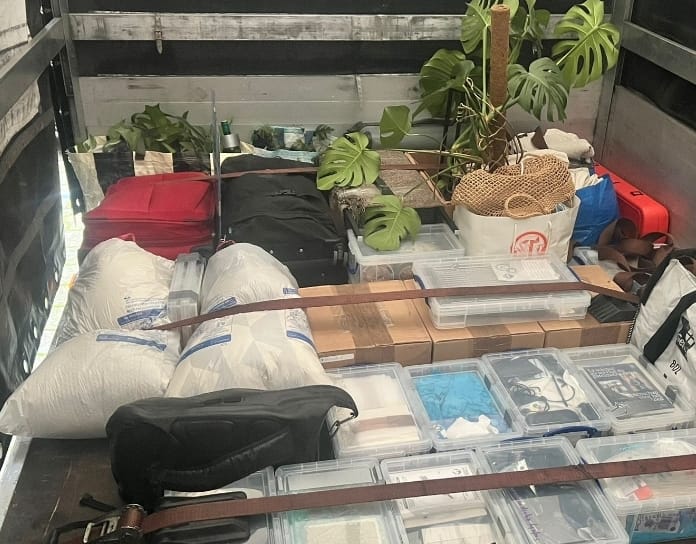
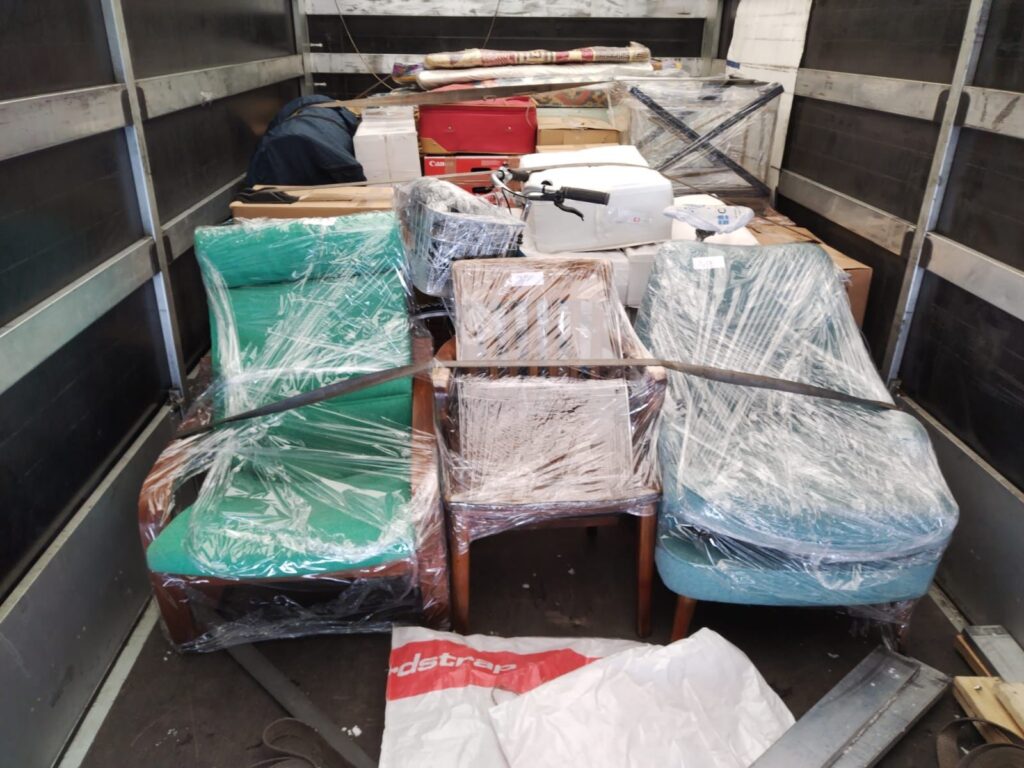
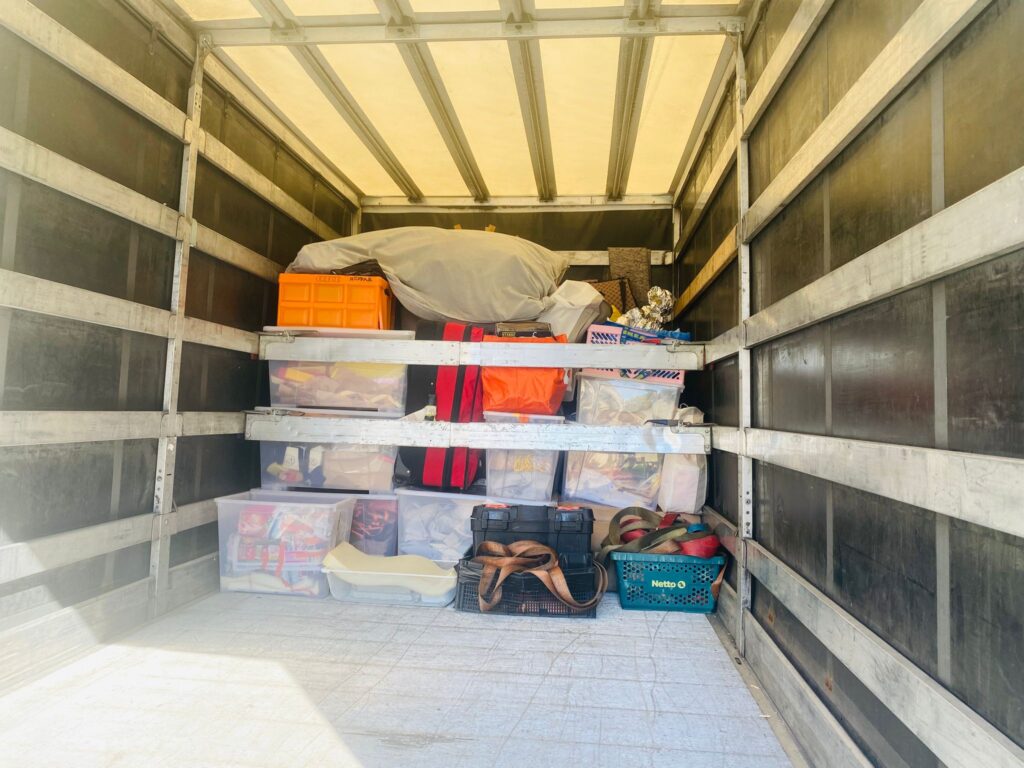
If the load is close to a package limit, send the inventory and photos for review. Confirm the right option before booking rather than assuming an upgrade will always be cheaper or available.
Documents and administration: keep them separate from the load
Transport preparation and permission to live in France are separate tasks. This section gives official starting points, not an individual assessment of your immigration, tax or healthcare position.
Spain: essential admin checklist
Official starting points:
Check the Spanish procedures relevant to your situation and keep these documents accessible:
- passport or national ID
- proof of address in Spain and your new address in France
- work contract or school letter, if relevant
- health coverage documents
France: EU citizen residence guidance
Residence requirements depend on nationality, family status and length of stay. EEA and Swiss citizens are not generally required to hold a French residence permit, but conditions for a longer stay still need checking. Use the official guidance for your circumstances:
Keep the documents requested for your own procedure together, which may include:
- proof of address in France (lease, deed, or formal attestation)
- proof of resources or employment, if relevant
- health coverage information
Non EU family members: visas
A Spanish residence document does not by itself establish the correct French procedure for every non-EU family member. Check each person’s position through the official portal:
Check the application route and current processing guidance for each family member before agreeing a fixed moving date. Do not assume that the same visa or timetable applies to everyone moving from Spain.
Household goods and customs edge cases
Ordinary household moves between mainland Spain and mainland France do not normally require customs formalities. Special territories, restricted goods and movements involving a non-EU country need a separate check. Consult the official rules before assuming the same treatment applies:
Keep an inventory and condition photos of valuable pieces for the transport handover. These records do not replace any documents required for a particular customs case.
Importing a vehicle in France
Bringing your own car is a separate procedure from transporting household belongings. Check the registration requirements before your move:
If you establish your main residence in France, the official guidance requires the registration procedure within one month of settling. The documents depend on the vehicle’s origin and situation; use the linked procedure rather than treating the removal booking as vehicle registration.
The document folder system (paper plus digital)
Carry the originals you need for travel and access. Keep protected digital copies available, including an offline copy in case you cannot connect on arrival.
- One physical folder you carry with you
- One cloud folder with scans
- One offline backup on your phone
Include:
- IDs and civil documents
- proof of address, old and new
- work or study documents
- insurance papers
- mover confirmations and contacts
- inventory list and photos of high value items
Packing that protects and speeds up your move
Pack so that the destination room and handling needs are clear without opening the box. The labels should match your inventory, and the packing should protect the contents during lifting, stacking and transport.
Keep keys, medicines, chargers and travel documents outside the shipment. A box marked open first can still be inaccessible while the vehicle is in transit.
Packing order by rooms
Start with items you do not need before departure and leave daily essentials until last. Adjust the order to the services included in your booking.
- Storage zones: basement, attic, garage, spare room
- Decor and books you do not use weekly
- Guest room and extra linens
- Kitchen extras and rarely used appliances
- Bedroom non essentials
- Daily essentials last
Group packed boxes by room without blocking access or creating unsafe stacks. For a man and van move, confirm which lifting tasks are included before assuming the driver will handle everything.
Labelling for the receiving person
A useful label tells the person at the French property where the box belongs and whether it needs careful handling. Do not write sensitive document details on the outside.
Label every box on two sides with this format:
- Room: Kitchen, Bedroom 1, Office
- Priority: 1, 2, 3
- Notes: Fragile, Heavy, Open first
Use this priority system:
| Priority | Meaning | Examples |
|---|---|---|
| 1 | open first night | bedding, toiletries, chargers, kettle |
| 2 | first week | pots, clothes, basic tools |
| 3 | later | books, decor, seasonal items |
Extra control tip: number boxes by room, like Kitchen 7 of 14, then keep a simple list on your phone.
Fragile items and high value pieces
Fragile goods need protection against movement, impact and stacking pressure. Tell VANonsite about art, glass and delicate finishes before agreeing the packing scope; generic box rules are not enough for every item.
Packing points to discuss for delicate goods:
- Plates travel vertical, not flat.
- Glass gets double protection: wrap plus a snug box.
- Fill empty space so nothing can shift.
- Never mix fragile goods with heavy books.
- Tape cables in labeled bags to the matching device.
Keep fragile items visible and separate before loading. Let the crew decide placement as part of the whole load plan.
If you have premium furniture, art, mirrors, or delicate finishes, consider White Glove Delivery.
Essentials bag for the first 48 hours
This is the bag that saves your first night in France. Keep it with you, not inside the load.
Essentials for 48 hours:
- ID, passports, key documents, spare keys
- chargers and a power bank
- meds and basic first aid
- 2 days of clothes and underwear
- toiletries, towels, wet wipes
- snacks and water
- one set of bed linen
- a small tool kit
Moving day playbook
Before collection, check the agreed inventory, the carry route and the receiving contact. If a lift is out of service or the load has changed, raise it before loading begins.
Prepare these points the night before:
- Put documents, keys, meds, and chargers in your essentials bag.
- Clear hallways and doorways for a straight carry line.
- Mark one corner as do not load for valuables and personal items.
Loading order and damage prevention
The crew should determine loading order from weight, shape, stability and securing points. Give them the complete inventory rather than applying one order to every vehicle.
Confirm these points during loading:
- Heavy items are identified for appropriate weight distribution.
- Furniture is protected and secured for the agreed journey.
- Fragile and non-stackable items are clearly identified.
- First-use shipment boxes are marked; your personal essentials remain with you.
Protection wins:
- Wrap sharp corners to prevent dents and tears.
- Strap tall furniture so it cannot tip during braking.
Photos, inventory, and handover checklist
Before you release the property, check the physical load against the inventory and record any visible condition concerns.
- Photograph high value items before loading.
- Count boxes and write the number down.
- Note existing scratches on furniture.
| Before you leave | Why it matters |
|---|---|
| meter readings photo | prevents billing surprises |
| keys and documents in your bag | avoids the worst delay |
| fridge defrosted, doors secured | protects appliances |
| final room walk through | prevents forgotten items |
GPS tracking and ETA coordination
VANonsite provides GPS tracking. Use arrival updates to coordinate with the person holding the keys, while allowing for traffic, required stops and the agreed delivery arrangements.
GPS tracking helps you:
- share a realistic ETA with your key holder
- align parking and elevator access windows
- reduce waiting time at delivery
Have a contact available to respond if the ETA changes. A location update cannot secure a parking space or unlock the building.
Arrival in France and the first week setup
Start with safe access, sleeping arrangements and essential services. Check appointments and deadlines for your own situation before following a suggested first-week order.
Healthcare and admin essentials
Official health system guidance:
Ameli separates guidance by circumstances, including work, study and inactivity. Check the category that applies to you and the evidence it requests; do not assume the move itself establishes healthcare entitlement.
- passport or national ID
- proof of address in France (lease, deed, or formal attestation)
- work contract or school letter if relevant
- Existing health coverage documents; check separately what cover applies after relocation.
Possible first-week preparation tasks, subject to your actual deadlines:
- Day 1: save your proof of address as a PDF on your phone.
- Day 2: start the health coverage steps you need.
- Day 3: scan key documents and store them in a cloud folder.
- Day 4: set up secure notes for French accounts.
Family support and benefits
Official info:
Check the relevant CAF eligibility rules rather than assuming every arriving family qualifies. Keep the documents requested for your situation ready, which may include:
- proof of address
- IDs for adults and children
- bank details and any school or childcare information
Utilities, internet, local SIM
Arrange electricity, hot water and connectivity around your actual arrival date. If an installation appointment is needed, book it before departure where possible rather than assuming it can be completed immediately.
Priority order:
- Electricity and hot water
- Internet activation or installation appointment
- Local SIM
Unpacking strategy for a calm first night
Unpack what you need to use the home safely before opening every box. Check delivered items against the inventory as you go.
Unpack in this order:
- bed and bedding
- bathroom essentials
- basic kitchen: kettle, mugs, one plate, one pan
- chargers and a document corner
Budget checks before confirming the booking
For the broader transport-cost discussion, see the Spain to France removals guide. Here, check that the quote reflects the inventory, property access, dates and services you have actually agreed.
The 5 biggest price drivers
- Distance and route complexity
- Vehicle tier and payload needs
- Service level: man and van, full removals, packing
- Access difficulty: stairs, elevator limits, long carry distances
- Timing: peak dates and last minute demand
Ask how a changed inventory, unavailable lift, long carry or delayed key handover would be handled. Do not assume every change is included in the initial estimate.
How volume changes cost
Before requesting a revised quote:
- Remove unwanted items from the inventory and provide the updated packed measurements.
- Ask whether the revised load changes the package or handling plan; there is no automatic saving per item removed.
| What you change | What happens | What to verify |
|---|---|---|
| Remove unwanted items before quoting | reassess packed volume and weight | confirm whether the quote changes |
| Arrange the closest legal loading point | measure the remaining carry route | agree access handling and any charges |
| Better labeling and grouping | clear room allocation at delivery | the receiving person can direct the load |
Where upgrades pay off (packing, white glove)
Packing Service pays off when:
- you have lots of glass, dishes, or electronics
- you are short on time
- you need item-specific protection beyond ordinary cartons
White Glove Delivery pays off when:
- you have premium furniture, delicate finishes, art, or antiques
- you want careful carry and safer placement
You can also discuss a mixed packing scope:
- DIY pack clothes and books
- use professional packing for fragile items
Preparation that helps avoid quote changes
Resolve uncertainties before the booking is confirmed:
- request availability once your inventory and property dates are clear
- state which collection or delivery dates can genuinely change
- declutter early
- reduce carry distance with a clear parking plan
- pack by room and label on two sides
- keep fragile items in a dedicated zone
Keep a written list of inclusions, exclusions and undecided costs. Set your own contingency around those facts rather than relying on a universal percentage.
FAQs about moving from Spain to France
How early should I book
Enquire when you know the property dates and can describe the load. Ask about availability for your actual route; there is no single booking lead time that suits every move.
Tell VANonsite whether you have:
- a fixed lease, work or key-handover deadline
- flexible collection and delivery dates
- an urgent need: Last Minute Moving may offer pickup in 1 to 3 days, subject to confirmation; delivery timing is agreed separately
Is man and van enough
It may be, if the complete packed volume, weight and handling needs fit the proposed service. Confirm the crew and lifting scope at both addresses rather than selecting on box count alone.
A good fit:
- studio moves, student rooms, shared flats
- a measured compact load within the proposed vehicle limits
- a few key furniture pieces like a bed, small sofa, table
Not ideal:
- multiple wardrobes and bulky furniture
- a large number of fragile items packed together
- heavy loads like books and appliances that push payload limits
What if I am unsure about vehicle size
Send a measured inventory rather than selecting a tier from the room count:
- Count large items: bed, sofa, wardrobes, table, appliances.
- Count boxes by size and identify what remains unpacked.
- If you have many books, think payload, not only volume.
Include these details for the size check:
- Furniture dimensions as it will travel, including dismantled parts.
- Heavy contents such as books, tools and appliances.
- Fragile or non-stackable pieces requiring protected space.
Ask VANonsite to confirm the appropriate package before booking if any limit is uncertain.
Can I track my shipment
Yes. VANonsite provides GPS tracking for every load.
What about fragile furniture and art
Keep delicate pieces separate before loading, use suitable packaging and photograph their condition. Discuss White Glove Delivery and any specialist requirements before the quote is confirmed.
Do I need to plan for ZBE and ZFE access
Check the current rules for the actual vehicle, addresses and date, including any local authorisation process. Environmental access, parking permission and building access are separate checks.
Summary
For moving from Spain to France, confirm the inventory, property availability and access arrangements together. Match the service to the packed load and handling needed, not to a generic bedroom or box-count formula.
Keep personal essentials with you, label shipment boxes by room, and arrange a receiving contact with the keys. Use tracking to coordinate arrival, then check the delivered items against the inventory.
Get a quote and book your date
Ask VANonsite to review the load, access and dates before confirming your booking. Start with the France service page below:
Prepare these details for a useful quote discussion:
- Pickup and delivery locations, preferred dates and any fixed handover deadline
- Measured furniture, boxes by size, heavy and fragile items
- Access at both addresses: floors, lift dimensions, legal parking and carry distance