
Introduction
Moving countries is not just a change of address. It is a leap. Your brain keeps reaching for familiar habits, the shop on the corner, the neighbour’s hello, the rhythm of your street. And then, one morning, you are packing it all into boxes.
If you are moving from UK to France, you do not need more noise. You need clarity. A plan that reduces risk, protects your belongings, and keeps you on schedule. After Brexit, there is also paperwork. Not impossible paperwork, but paperwork that rewards preparation, especially the inventory and proof of address that customs expects.
This guide is built to help you move with calm confidence. It is structured, data rich, and designed to answer questions fast. You will get realistic cost bands, a week by week timeline, and the document checklist that keeps moving from UK to France flowing; You will also find practical packing advice that prevents the small disasters, scratched furniture edges, cracked glass, missing bolts, that can sour a new start.
You may also see the phrase moving UK to France used throughout. It means the same journey, just a shorter search term. And when you are moving to France from the UK, the heart of the process stays the same: keep your story consistent across documents, choose the right vehicle size, and plan delivery access like it matters, because it does.
VANonsite supports cross border relocations with premium handling, flexible service options, and GPS tracking on every load. When you can see progress, the move feels real, and safer. It also feels calmer, because you are not guessing.
TL:DR
- Most moving from UK to France moves take 1 to 3 days once loaded, with customs and access as the biggest variables
- A detailed, itemised inventory with values in euros prevents the most common border delays
- Proof of French address is a key document when moving UK to France after Brexit
- Decluttering by 20% can reduce cost and may drop you into a smaller vehicle plan
- Direct transport reduces handling and lowers damage risk during moving from UK to France
- Eurotunnel is often fastest, ferry can be flexible, and routes can shift arrival by 2 to 6 hours
- A man and van works for smaller moves, while full house options suit family relocations and keep everything together
- VANonsite offers GPS tracked transport plus packing and white glove options for a safer finish
Quick answers first
If you are moving UK to France, you probably want a clear starting point. Here it is, without the fluff.
Fast answers
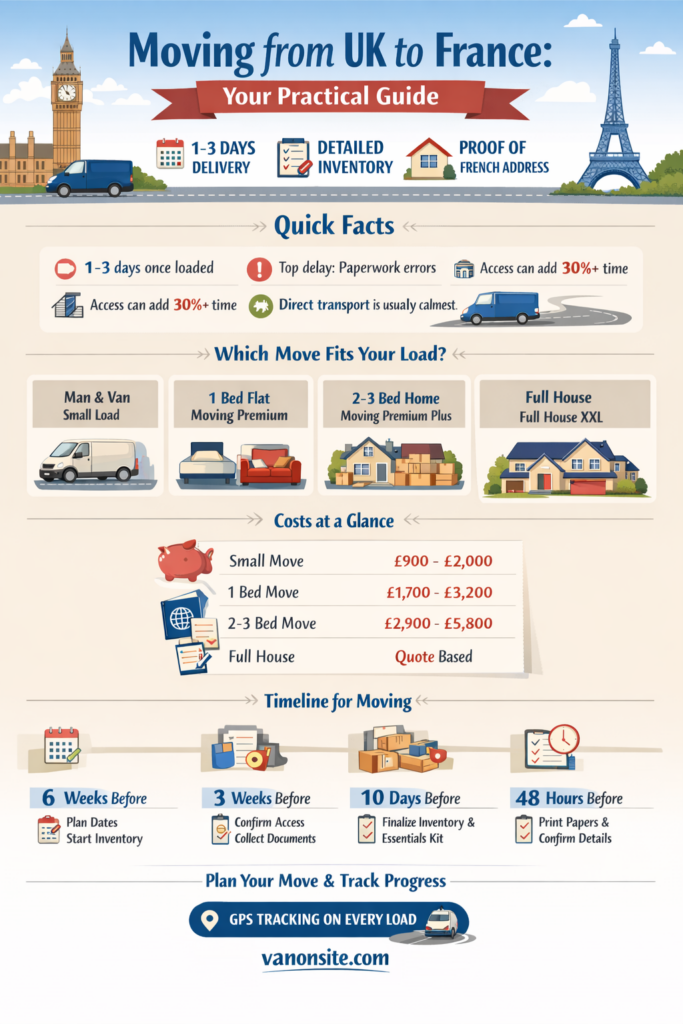
- Typical delivery window for moving from UK to France is 1 to 3 days once loaded.
- The most common delay is paperwork, especially an inventory that is vague.
- Access issues, narrow stair turns, long carries, no lift, can add 30% to 60% more handling time.
- Direct transport is usually the calmest option for moving to France from the UK because it reduces handling.
Quick decision: which service fits your move
| Your situation | Best fit | Why it works for moving from UK to France |
|---|---|---|
| A few boxes and small furniture | man and van | fast, direct, minimal handling |
| 1 bed flat | Moving Premium | stable load, fewer compromises |
| 2 to 3 bed home | Moving Premium Plus | room for bulky items and safe spacing |
| Full family house | Full House XXL | one complete move, less fragmentation |
Five things to confirm before you book
For moving from UK to France, get these answers in one message:
- Is the transport direct or shared
- What is included in protection and packing
- What documents are required for customs
- What is the pickup window and the delivery window
- How you will track progress, especially if you need tight timing
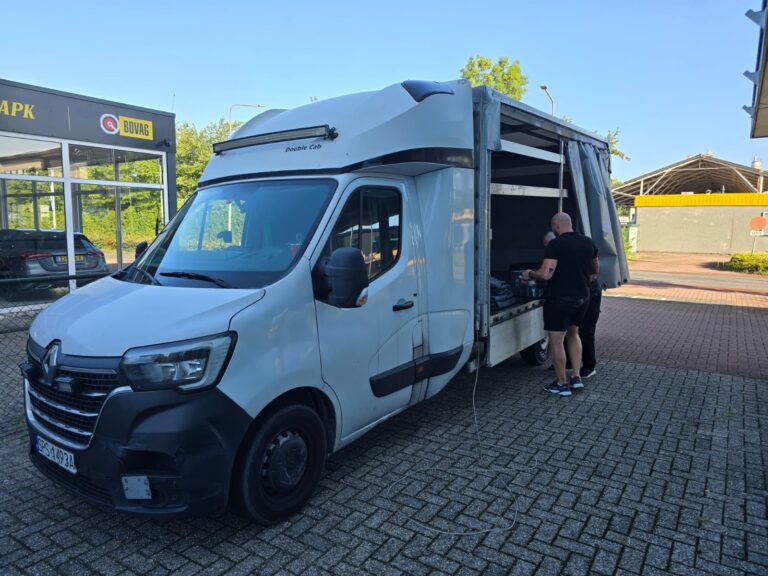
If you are moving a smaller load, a man and van setup can be fast and cost efficient. If you are moving to France from the UK with a full household, larger vehicles keep everything together, which usually feels safer.
Useful internal pages:
- https://vanonsite.com/removals-to-france/
- https://vanonsite.com/france-removals/moving-to-france-from-uk/
- https://vanonsite.com/france-removals/removals-to-france-from-uk/
- https://vanonsite.com/france-removals/international-removals-uk-to-france/
Moving from UK to France after Brexit: what changed
Moving from UK to France after Brexit means your belongings are treated as a declared shipment. That adds customs steps. In practice, it means this: the quality of your paperwork can decide the speed of your move.
What actually changed
For moving UK to France, the big shift is not the driving. It is the border process.
- You need an itemised inventory, not a vague list
- Proof of French address matters more than people expect
- Names, dates, and addresses must match across documents
The “one story” rule
The move is still manageable. The trick is telling one consistent story:
- you are transferring your main residence
- your goods are used, personal, and not for resale
- names, dates, and addresses match across documents
When that story is consistent, moving from UK to France becomes predictable.
The fastest way to avoid delays
If you only do one thing, do this for moving to France from the UK: build your inventory early.
- group by room
- add box numbers
- list quantities
- use realistic values in euros
That one habit removes most last minute panic during moving UK to France.
Costs and budgeting
Costs depend on volume, weight, access, season, and route type. Still, you can plan with realistic bands for moving from UK to France. The key is knowing what actually pushes the quote up or down, so you can control the budget instead of chasing it.
Realistic price bands
| Move type | Best fit | Typical vehicle | Indicative range |
|---|---|---|---|
| Small move | a few boxes, small furniture | Moving Medium | £900 to £2,000 |
| 1 bed move | boxes plus furniture | Moving Premium | £1,700 to £3,200 |
| 2 to 3 bed move | bulky furniture, appliances | Moving Premium Plus | £2,900 to £5,800 |
| Full house | large household | Full House XXL | Quote based |
These are planning bands for moving from UK to France, not a promise. Two moves with the same home size can land in different ranges if one has tight stairs, long carry distance, or last minute timing.
What changes the price most
For moving UK to France, these factors are usually the biggest levers:
- Volume and vehicle size: bigger vehicle, higher base cost
- Access and handling time: no lift, narrow stair turns, or 30 metre carry can increase labour time
- Packing level: self pack vs full packing vs fragile only
- Direct vs shared transport: direct is often faster and simpler, shared can be cheaper but less predictable
- Season and day of week: midweek is often calmer than weekends
A simple way to budget fast
If you want a quick estimate for moving to France from the UK, use this rule:
- Start with the band for your home size
- Add 10% to 15% if access is difficult
- Add 10% to 25% if you need packing help
It is not perfect, but it is accurate enough to plan.
Three ways to save without cutting safety
- Book midweek. Availability can be calmer by 10% to 20%.
- Declutter by 20% to reduce vehicle size and handling time.
- Choose direct transport for fewer touch points and lower damage risk.
Extra savings most people forget
These are small changes that can reduce cost when moving from UK to France.
- Pack books in smaller boxes so weight stays under control and loading is faster
- Disassemble large furniture in advance, legs, headboards, table tops
- Provide clear access photos, entrance, stairs, parking, so the plan is accurate
Timeline: a week by week plan
A smooth relocation is about sequencing. Use this schedule for moving to France from the UK. It keeps paperwork, packing, and logistics in the right order, so you are not fighting fires in the last 48 hours.
6 weeks before
You are building the foundation for moving from UK to France.
- Pick your target dates and preferred delivery window
- Start the inventory list and keep it in one file
- Declutter room by room so you do not pay to move things you do not want
- Collect quick access info, floor number, lift size, parking options
3 weeks before
Now you remove friction.
- Confirm access at both addresses, stairs, narrow turns, carry distance
- Decide on packing help, self pack, partial, or full
- Gather document proofs, passport or ID, proof of French address
- Create a “do not pack” box for documents, chargers, keys, medication
10 days before
This is paperwork week for moving UK to France.
- Finalise inventory values in euros and make it readable
- Photograph high value items and keep receipts for any new purchases
- Prepare a 72 hour essentials kit so you can live on arrival
- Confirm the route choice, Eurotunnel or ferry, and delivery access plan
5 days before
This is the calm tightening phase.
- Finish packing non essentials and label rooms on two sides
- Clear corridors and stair routes for moving day
- Confirm how you will hand over keys and who will be on site
48 hours before
Protect moving day.
- Defrost appliances and drain anything that holds water
- Print documents and save digital copies, inventory, ID, address proof
- Confirm pickup time, contact number, and exact address format
- Charge phones and keep your essentials kit separate
Documents and customs
Because the UK is outside the EU, moving from UK to France involves customs declarations. Many people qualify for relief on used personal belongings when transferring residence, but only if the paperwork is consistent and the inventory is specific. Customs rarely delays moving UK to France because of bad luck. It delays it because the story is unclear.
Official sources you can trust
Use these official pages as your reference points:
- French Customs: https://www.douane.gouv.fr/
- Service-Public: https://www.service-public.fr/
- HMRC: https://www.gov.uk/
Helpful pages:
- https://www.douane.gouv.fr/demarche/vous-souhaitez-connaitre-les-franchises-applicables-lors-du-transfert-de-votre-residence
- https://sites.service-information-publique.fr/vias/guide-particuliers/F492.html
- https://www.gov.uk/guidance/check-how-to-declare-personal-goods-you-bring-into-or-take-out-of-the-uk
Core documents checklist
For moving to France from the UK, prepare a clean document pack, printed and saved digitally:
- Passport or ID
- Proof of French address, lease, utility bill, or property purchase
- Proof you lived outside France for at least 12 months if claiming relief
- Itemised inventory with values in euros
- Signed declaration that the goods are personal and not for resale
Tip: use one exact address format everywhere. A tiny mismatch can slow moving from UK to France at the border.
Inventory format that keeps customs smooth
An inventory is your border passport for boxes. Keep it boring and specific.
| Room | Box no. | Item | Qty | Value EUR |
|---|---|---|---|---|
| Kitchen | 1 | Plates and bowls | 1 box | 60 |
| Living room | 2 | Sofa, 2 seater | 1 | 450 |
| Bedroom | 3 | Wardrobe | 1 | 300 |
| Office | 4 | Monitor | 2 | 260 |
Rules that prevent delays during moving UK to France:
- Avoid vague lines like “miscellaneous”
- Use realistic second hand values, not new retail prices
- Separate any brand new items and keep receipts
- If shipping in stages, keep one master inventory and mark each shipment clearly
Common mistakes that cost time
These are the usual speed bumps when moving from UK to France:
- Missing proof of French address
- Inventory too vague or inconsistent
- Names or dates that differ across documents
- Restricted items packed by accident
Items you should not pack
To keep moving to France from the UK smooth, avoid putting these in the van:
- Aerosols, paint, solvents, flammables
- Gas canisters and fuel containers
- Certain plants, soil, and untreated wood
If you are unsure about an item, ask before it goes in a box.


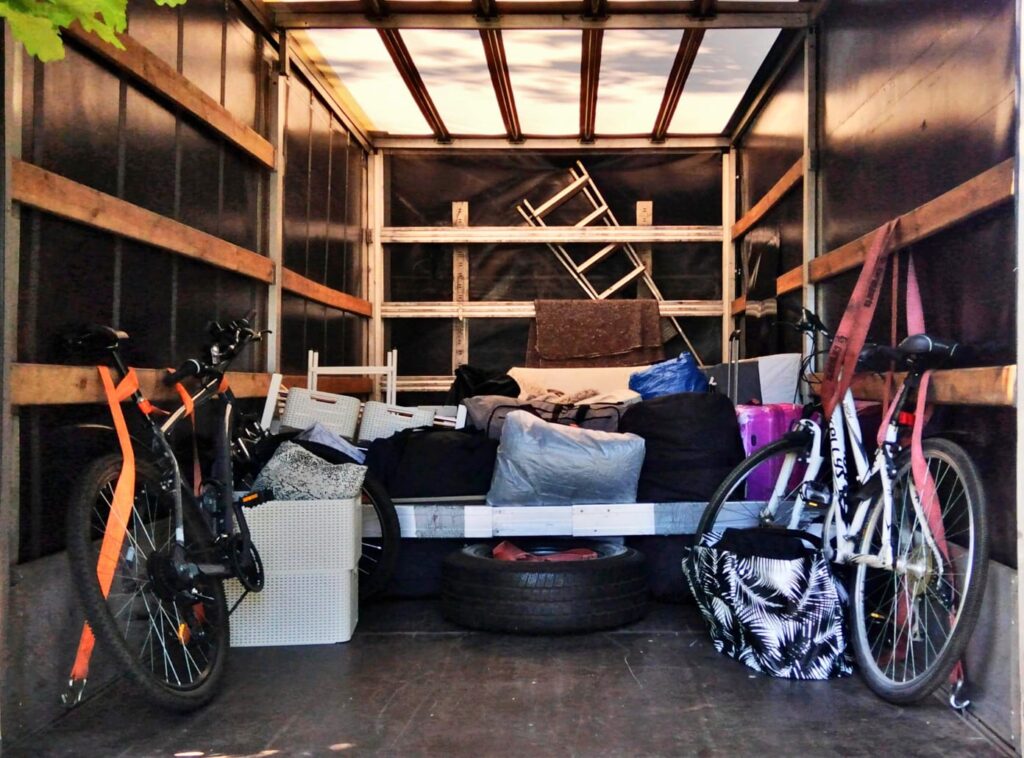
Choosing the right transport option
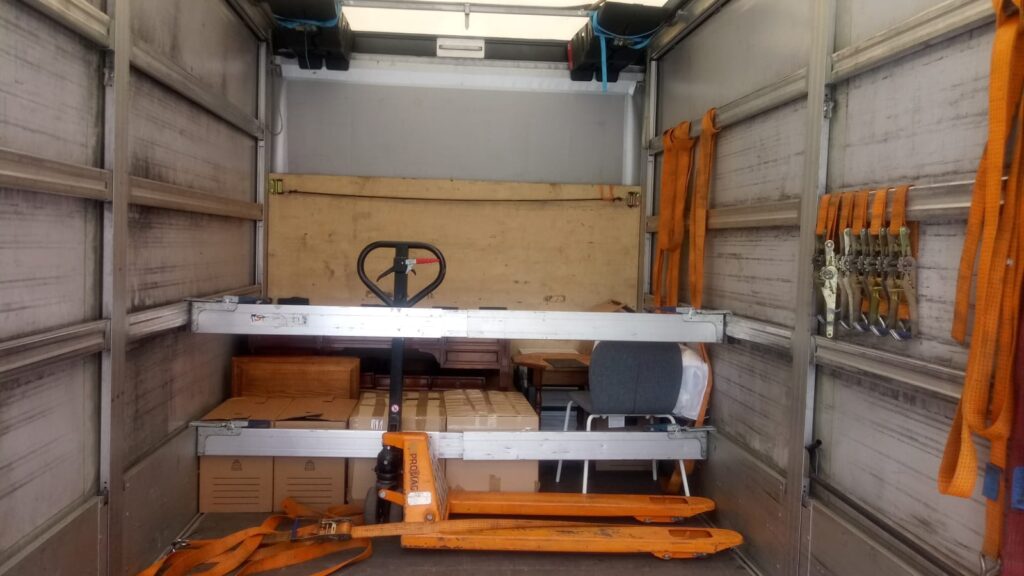
For moving from UK to France, the right vehicle size is the difference between calm and chaos. Too small means tight stacking, more shifting, and sometimes a second trip. Too big means paying for air. The sweet spot is a stable load with breathing space.
VANonsite vehicle options
| Option | Volume | Payload | Best for |
|---|---|---|---|
| Moving One | 1 m3 | 100 kg | suitcase move and a few boxes |
| Moving Basic | 5 m3 | 300 kg | student room or small studio |
| Moving Medium | 10 m3 | 500 kg | small flat, light furniture and boxes |
| Moving Premium | 15 m3 | 1,100 kg | 1 to 2 bed move |
| Moving Premium Plus | 30 m3 | 3,500 kg | 2 to 3 bed move, bulky items |
| Moving Full House XXL | 90 m3 | 20,000 kg | full family house |
Quick fit guide
Use this shortcut when moving UK to France:
- man and van or Moving Medium: a few boxes, small furniture, faster direct option
- Moving Premium: typical 1 bed move with furniture
- Moving Premium Plus: 2 to 3 bed move with appliances and bulky pieces
- Moving Full House XXL: full family house, one complete wave
Two checks that prevent wrong sizing
Before you book moving from UK to France, do these two quick checks:
- Volume check: count boxes and list the biggest items
- Weight check: books, tools, records, and gym equipment can hit payload limits faster than expected
If your load is close to the limit, size up. A little extra space often costs less than damage or a second trip.
Why man and van can be a smart choice
A man and van setup is ideal for moving to France from the UK when you want direct transport, minimal handling, and a tight delivery window. It is especially effective for smaller relocations, short term moves, and student or single room moves.
For families, bigger vehicles keep everything together with fewer transfers. That usually feels safer, faster, and calmer during moving from UK to France.
Packing, protection, and loading
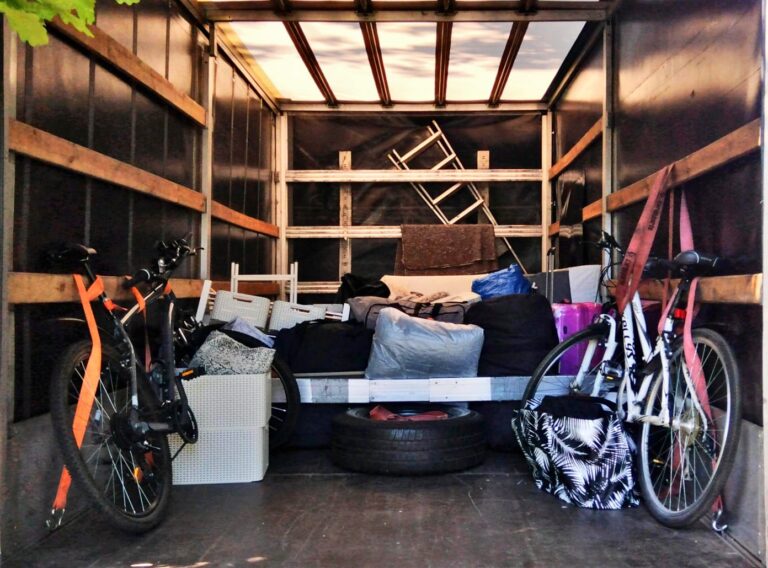
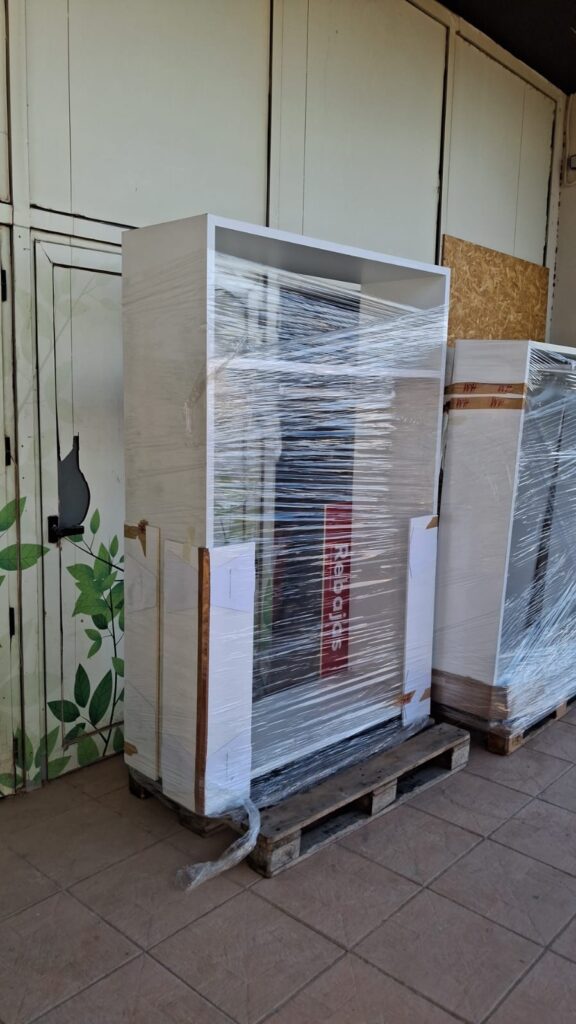
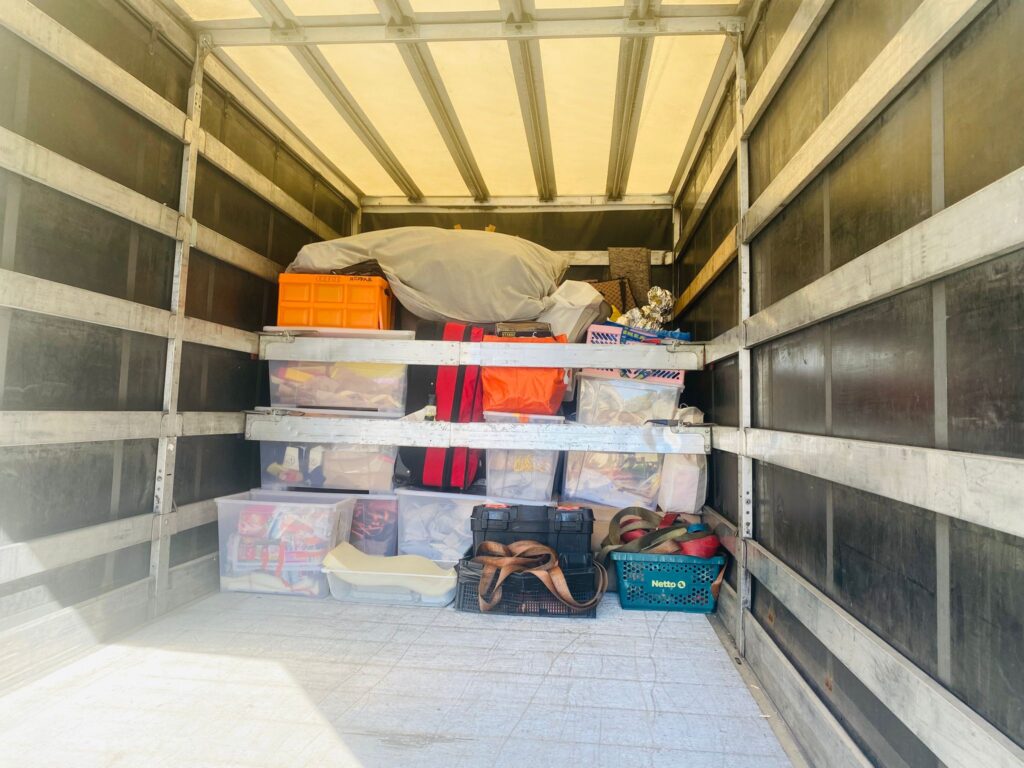
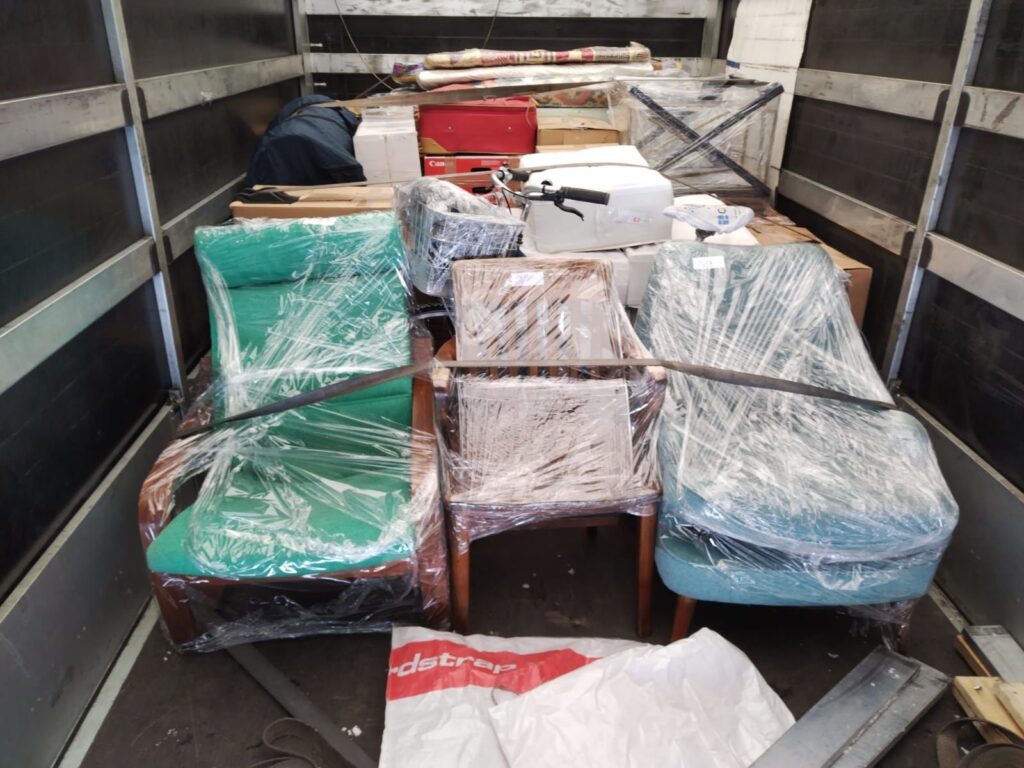
When you are moving from UK to France, packing is not a side task. It is the safety system for your entire move. Most damage happens for one boring reason: movement. Boxes shift, furniture slides, and corners meet door frames. You can prevent most of it with a simple method.
Packing rules that actually work
For moving UK to France, stick to these rules and you will feel the difference on delivery day.
- Keep boxes under 20 kg so they stack safely and carry cleanly
- Tape bottoms in an H pattern and reinforce heavy boxes
- Label two sides with the destination room and a box number
- Separate fragile items and mark them clearly
- Fill empty gaps in boxes to stop internal movement
A fast labelling system
This takes minutes and saves hours when moving to France from the UK.
- Room name on two sides
- Box number, for example Kitchen 07
- Priority tag
- P1 open first
- P2 open within 48 hours
- P3 can wait
What to keep with you
For moving from UK to France, keep these items with you, not in the van:
- Passport and documents
- Medication
- Chargers and keys
- A 72 hour essentials kit
Simple loading logic
A stable van is a quiet move.
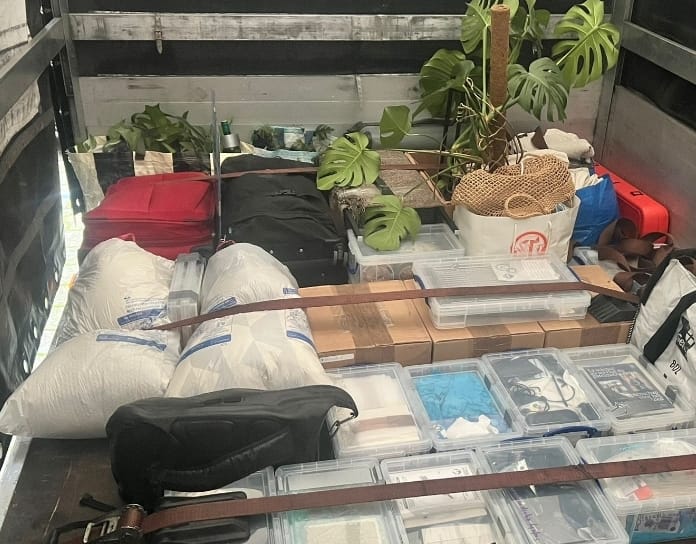
- Heavy items low, fragile items high
- Soft items as buffers between hard edges
- Strap furniture so nothing slides during braking
- Keep a clear path for unloading, do not bury essentials
Packing priorities table
| Priority | What to pack | Why it matters for moving from UK to France |
|---|---|---|
| First | storage, spare room, seasonal items | reduces last minute chaos |
| Next | books, decor, non essentials | easiest to label and stack |
| Then | kitchen non essentials, extra linens | keeps daily life running |
| Last | daily kitchen items, bedding, chargers | protects your first night in France |
If you want to reduce stress further, consider packing support. It can be added alongside your move route planning here:
Routes and delivery planning
For moving from UK to France, you usually choose Eurotunnel or a ferry. Eurotunnel is often fastest. A ferry can feel flexible and gives you a natural break, but weather and peak queues can add time. Route choice can shift arrival by 2 to 6 hours.
Eurotunnel vs ferry
| Option | Best when | Watch outs |
|---|---|---|
| Eurotunnel | tight delivery window, speed matters | strict check in timing |
| Ferry | you want flexible sailings, you want a break | weather, peak queues |
The real decider is access
Access can change the entire rhythm of moving UK to France. A narrow stair turn, no lift, or a long carry can add 30% to 60% more handling time.
Before moving to France from the UK, confirm:
- parking distance from the entrance, ideally under 15 metres
- stairs, lift size, and tight hallway turns
- unloading restrictions in city centres
- whether you need a short stop permission or a loading bay
A simple tip: take two photos. One from the street showing the entrance and parking space. One of the stairwell or hallway. It makes delivery planning precise.
Low emission zones and city centre rules
If you are moving into a low emission zone, check official guidance before delivery day:
- https://www.service-public.fr/particuliers/vosdroits/F35139?lang=en
- https://www.certificat-air.gouv.fr/
If you want more France specific options for removals planning, these internal pages help:
- https://vanonsite.com/removals-to-france/
- https://vanonsite.com/france-removals/removals-to-france-from-uk/
- https://vanonsite.com/france-removals/international-removals-uk-to-france/
Settling in France: first week essentials
The first week after moving from UK to France can feel like living between two worlds. Your body is in France, but your brain is still searching for the old routine. The fastest way to feel settled is to win the basics early: address proof, utilities, and a simple rhythm that makes the new place feel like home.
First 72 hours
For moving UK to France, these actions give you the biggest return:
- Set up electricity, water, and internet to avoid a 7 to 14 day gap
- Keep your address proof organised in one folder, paper and digital
- Photograph the property condition on arrival for deposit clarity
- Build a small essentials station: keys, documents, chargers, and one notebook
Official guidance for moving admin in France:
A simple first week plan
If you are moving to France from the UK, this structure keeps your days calm:
- Day 1 to 2: utilities, internet, local supermarket and pharmacy
- Day 3 to 4: phone plan, banking, insurance updates
- Day 5 to 7: healthcare steps, school or work onboarding, any vehicle admin
Quick checklist to feel settled faster
| Priority | Task | Why it matters |
|---|---|---|
| Must do | Proof of address folder | unlocks most admin steps |
| Must do | Internet setup | work, banking, appointments |
| Should do | Local SIM or plan | delivery codes and verification |
| Should do | Find your nearest pharmacy | peace of mind |
| Nice to do | Learn waste rules | reduces daily friction |
Why VANonsite fits moving from UK to France
When you are moving from UK to France, confidence comes from two things: careful handling and clear visibility. VANonsite is designed to deliver both, without turning the move into a complicated project you have to manage alone.
What makes the experience feel smoother:
- GPS tracking on every load, so you can see progress and plan your day
- Flexible vehicles from man and van to Full House XXL, so your load fits safely
- Add ons that remove pressure, including packing support and white glove handling for fragile or high value items
If you want France specific service pages for planning your route and options while moving UK to France, start here:
- https://vanonsite.com/removals-to-france/
- https://vanonsite.com/france-removals/moving-to-france-from-uk/
- https://vanonsite.com/france-removals/removals-to-france-from-uk/
- https://vanonsite.com/france-removals/international-removals-uk-to-france/
FAQs
How long does moving from UK to France take?
Most moving from UK to France relocations take 1 to 3 days once the van is loaded. The biggest variables are customs processing, route choice, and access at the French address. If your building has tight stairs or a long carry from the curb, handling time can increase by 30% to 60%.
What is the most common cause of delays when moving UK to France?
Paperwork. A vague inventory, missing proof of French address, or inconsistent names and dates across documents are the usual culprits. If you want moving UK to France to stay smooth, build your inventory early, keep it itemised, and make sure every document tells the same story.
Do I need an inventory for moving to France from the UK?
Yes. After Brexit, an itemised inventory is one of the most important pieces of the puzzle for moving to France from the UK. Keep it specific, include quantities, and use realistic values in euros. Avoid vague labels like “miscellaneous”.
What documents do I need for moving from UK to France?
For moving from UK to France, you typically need:
- Passport or ID
- Proof of French address
- An itemised inventory with values in euros
- A signed declaration that goods are personal and not for resale
If you are claiming residence transfer relief, you may need proof you lived outside France for at least 12 months.
Official guidance:
Is Eurotunnel or ferry better?
Eurotunnel is often the fastest choice for moving from UK to France and can save 1 to 3 hours. A ferry can be more flexible, but weather and peak queues can add 1 to 4 hours. If you have a tight delivery window, Eurotunnel usually feels more predictable.
Should I choose direct transport or shared transport?
For moving to France from the UK, direct transport is usually the simplest option. It reduces handling, lowers damage risk, and makes delivery timing clearer. Shared transport can reduce cost, but it can add touch points and extend the timeline.
Can a man and van handle moving from UK to France?
Yes. A man and van setup is ideal for smaller moves, a few boxes, compact furniture, or a student relocation. If you are moving UK to France with a full household, a larger vehicle is often more efficient and safer because your load is not forced into tight stacking.
How can I reduce damage risk?
For moving from UK to France, most damage risk comes from movement.
Quick protection wins:
- Keep boxes under 20 kg
- Fill empty gaps in boxes
- Protect corners on furniture
- Strap items so nothing slides during braking
What should I keep with me, not in the van?
When moving to France from the UK, keep these with you:
- Passport and essential documents
- Medication
- Chargers and keys
- A 72 hour essentials kit
How do I prepare for delivery access in France?
Access planning is a hidden superpower for moving from UK to France. Confirm parking distance, stair turns, lift size, and any unloading restrictions. Two photos help a lot: one from the street showing the entrance and parking, and one of the stairwell or hallway.
If you are moving into a low emission zone, check:
- https://www.service-public.fr/particuliers/vosdroits/F35139?lang=en
- https://www.certificat-air.gouv.fr/
Summary
Moving from UK to France is easiest when you simplify the relocation into three pillars: paperwork, capacity, and timing. Start early with a clean, itemised inventory with realistic values in euros and consistent names, dates, and addresses. Add proof of French address to your document pack, because it is a key requirement when moving UK to France after Brexit.
Next, match the vehicle to your true volume and weight. Decluttering by 20% often lowers costs and reduces handling time, which makes moving to France from the UK calmer and safer. Pack with a system, keep boxes under 20 kg, label two sides, and strap furniture so nothing shifts.
Choose your crossing with your schedule in mind. Eurotunnel is often quickest, while ferries can be flexible. Then plan access at the destination, parking distance, stair turns, lifts, and local restrictions, because access can add 30% to 60% more handling time.
If you want moving from UK to France to feel controlled, VANonsite combines flexible options from man and van to full house transport with GPS tracking on every load, plus add ons like packing support and white glove handling for delicate items.