
Introduction
Checklists are underrated. Not because they are exciting, but because they are mercilessly effective. When you are moving countries, your brain gets noisy. You forget simple things, chargers, documents, that one screw bag for the bed frame. A good checklist turns panic into a plan.
This moving to France from UK checklist is built for real life, not theory. It covers paperwork after Brexit, packing and protection, and the small admin steps that make the first week in France feel steady. It is also designed to give you fast answers, so you are not hunting through forums at midnight.
You will also see practical transport options, from a man and van setup for smaller relocations to full household removals for families. And you will see how VANonsite adds GPS tracking on every load, so the move stays visible and controlled.
TL:DR
- Most removals take 1 to 3 days once loaded, with customs and access as the biggest variables
- A detailed inventory with values in euros prevents the most common border delays
- Decluttering by 20% can reduce cost and may drop you into a smaller vehicle plan
- Use this moving to France from UK checklist to avoid last minute surprises
- Eurotunnel is often fastest, ferry can be flexible, and routes can shift arrival by 2 to 6 hours
- A man and van fits smaller moves, larger vehicles keep full households together
- VANonsite offers GPS tracked transport plus packing and white glove options
Quick answers first
If you are searching for a moving to France from UK checklist, you probably want something you can follow without thinking. The goal is speed and certainty. You want to know what matters first, what can wait, and what can quietly ruin your timeline if you ignore it.
Fast answers:
- Typical delivery window is 1 to 3 days once loaded
- Paperwork and access issues cause most delays
- Tight stair turns and long carries can add 30% to 60% more handling time
- The best stress reducer is a clean inventory plus proof of French address, prepared early
The two biggest “hidden time drains”
- Access: no lift, narrow stair turns, long carry distance, strict parking rules
- Admin gaps: missing a single document, or an inventory that is too vague
If you fix those two early, the rest of the move becomes surprisingly manageable.
Your 60 second pre booking checklist
Before you book a move, confirm:
- Direct or shared transport
- Vehicle size recommendation based on your volume
- Wrapping and protection included
- Customs document requirements
- Delivery window and how updates are provided
Useful pages for planning:
- Removals to France
- Moving to France from UK
- Removals to France from UK
- International removals UK to France
The moving to France from UK checklist by timeline
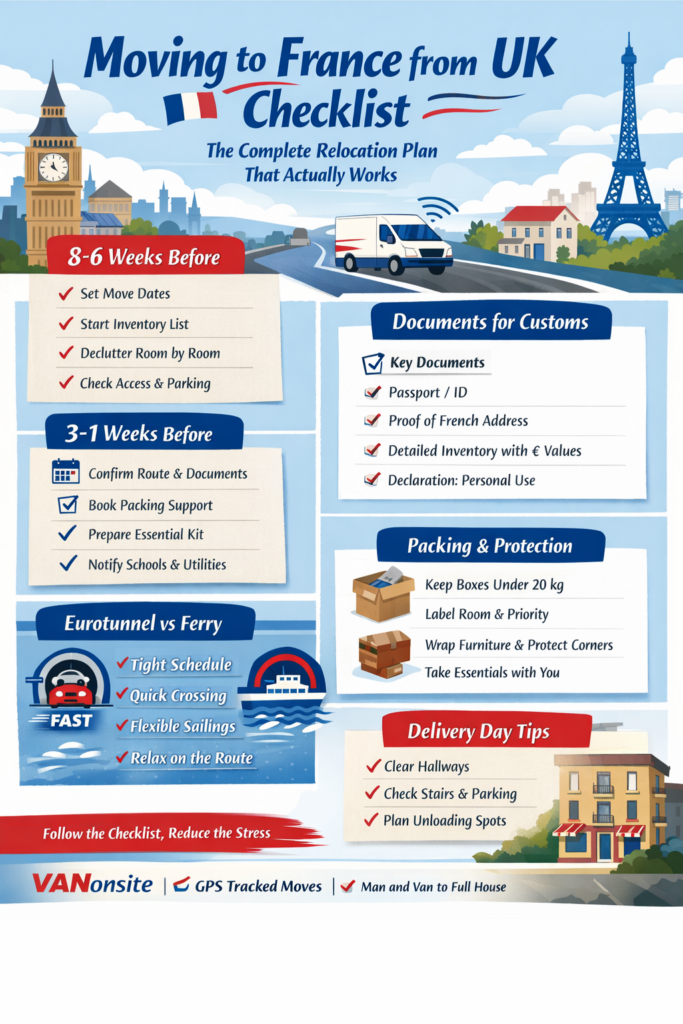
Use the timeline as your spine. If you only follow one thing in this guide, follow this moving to France from UK checklist timeline.
8 to 6 weeks before
This is planning time. You win the move here.
- Choose your target moving week and preferred delivery window
- Start one master inventory file and keep it updated
- Declutter room by room so you do not pay to move things you do not want
- Photograph high value items for peace of mind
- Check access details for both addresses, parking, stairs, lift size, tight corridors
Quick win: If you reduce volume by 20%, you can often reduce the vehicle size, which can reduce the total cost.
5 to 3 weeks before
Now you turn the plan into bookings.
- Confirm your route and delivery window
- Decide on packing support, self pack, partial, or full
- Collect document proofs, ID and French address
- Book time off work and confirm key handovers
- If you are renting, confirm end of tenancy inspection and deposit steps
If you want a calmer week, add packing support early. It is one of the easiest upgrades for the moving to France from UK checklist.
14 to 10 days before
This is paperwork week. It is also the moment most people realise they should have started their inventory earlier.
- Finalise inventory values in euros, keep them realistic and readable
- Prepare a 72 hour essentials kit
- Order packing materials or confirm packing day
- Plan how to move pets if relevant
- Confirm if any furniture needs disassembly
A small habit that helps: label screw bags and tape them to the furniture, not into a random box.
7 days before
Now you protect moving day.
- Pack non essentials
- Label boxes with room and priority
- Disassemble furniture where needed
- Clear hallways and stair routes
- Set aside a do not pack box for documents, chargers, keys, medication
48 hours before
Keep it simple. This is not the time to reorganise your life.
- Defrost appliances
- Print documents and save digital copies
- Confirm pickup time and contact numbers
- Charge phones and keep the essentials kit separate
Moving day
This is execution. Slow is smooth, smooth is fast.
- Keep passports, medication, keys with you
- Walk through the property and check cupboards, lofts, and sheds
- Take final photos for deposit proof
- Keep a clear route from door to van to reduce accidental scuffs
First 72 hours in France
The first days decide how settled you feel.
- Set up utilities and internet
- Organise your proof of address folder
- Unpack essentials first
- Keep receipts and documents in one place
First week in France
Turn the new place into a functioning life.
- Update banking and phone plan
- Follow admin steps via Service-Public
- Find your nearest pharmacy and supermarket
- Learn local waste rules and collection days
For official guidance on moving admin in France:
Documents checklist after Brexit
Because the UK is outside the EU, this part of the moving to France from UK checklist matters. Customs is rarely difficult, but it is unforgiving of vague paperwork. Your goal is simple: prove your goods are personal, used, and connected to a real change of residence.
Official sources
Use these pages as your truth, especially if rules shift:
Helpful pages:
- French Customs: residence transfer relief
- Service-Public: customs relief guide
- HMRC: personal goods guidance
Core documents
Keep one folder, one story. For moving to France from UK checklist planning, these are the essentials:
- Passport or ID
- Proof of French address
- Proof you lived outside France for at least 12 months if claiming relief
- Itemised inventory with values in euros
- Signed declaration goods are personal and not for resale
Proof of French address examples
If you are unsure what counts, these are common options:
- Lease or rental contract
- Property purchase paperwork
- Utility confirmation or a recent bill
- Official letter that shows your name and the French address
Tip: use the exact same address formatting everywhere. One line difference can create questions at the border.
A stronger inventory format
A strong inventory makes this moving to France from UK checklist feel easy. It should be specific enough that a stranger can understand it without guessing.
| Room | Box no. | Item | Qty | Value EUR |
|---|---|---|---|---|
| Kitchen | 1 | Plates and bowls | 1 box | 60 |
| Living room | 2 | Sofa, 2 seater | 1 | 450 |
| Bedroom | 3 | Wardrobe | 1 | 300 |
| Office | 4 | Monitor | 2 | 260 |
If you have high value items, list them separately and add serial numbers where possible.
Rules that prevent delays
- Avoid vague lines like miscellaneous
- Use realistic second hand values
- Separate brand new items and keep receipts
- Keep one master inventory if you ship in stages
- Keep quantities clear, do not mix too many items into one line
Common paperwork mistakes
These are the common reasons moving to France from UK checklist moves slow down:
- Inventory is too vague or uses broad categories
- Proof of French address is missing
- Names or dates do not match across documents
- New items are mixed into used household goods without receipts
Items to keep out of the van
To avoid inspections and delays, do not pack:
- Aerosols, paint, solvents, flammables
- Gas canisters and fuel containers
- Certain plants, soil, untreated wood
If you are unsure about an item, ask before it goes in a box.
Packing checklist for a safe move
Packing is where damage risk is decided. This part of the moving to France from UK checklist is simple, but powerful. Your enemy is movement. If nothing moves, most damage disappears.
Boxes and labelling
- Keep boxes under 20 kg
- Tape bottoms in an H pattern
- Label two sides with room name and box number
- Add priority tags
- P1 open first
- P2 open within 48 hours
- P3 can wait
Add one more label if you want a calmer delivery: the destination floor, for example Bedroom 2nd floor.
Fragile packing rules
For moving to France from UK checklist packing, use this quick method:
- Wrap glass and ceramics individually
- Pack plates vertically, not flat
- Fill voids with paper or soft items so nothing rattles
- Mark fragile on at least two sides
Furniture protection
- Protect corners with guards or thick cardboard
- Wrap with blankets, then stretch film to lock doors and drawers
- Strap items to stop movement
Two small habits that prevent big scratches:
- Keep corner protection on until the item is in its final room
- Do not drag. Lift, or slide on a blanket if needed
Essentials kit
Keep this with you during moving to France from UK checklist moving day:
- Passport, documents, keys
- Medication
- Chargers and extension lead
- Bedding and towels
- Basic kitchen items for one night
- Small tool kit, tape, scissors, marker
A quick pack order
If you want the last week to feel calmer:
- Storage and seasonal items
- Decor and non essentials
- Spare linens and kitchen non essentials
- Daily essentials last, then keep them separate
Vehicle size checklist: choose the right van
Choosing the right vehicle is the moment the move becomes either calm or chaotic. Use this part of the moving to France from UK checklist to avoid tight stacking, rushed loading, and the kind of stress that makes you forget where you packed the kettle.
Here is the truth: people underestimate space because they forget wrapping. Blankets, corner guards, and safe spacing add bulk. That extra 10% to 15% margin is not waste. It is protection.
VANonsite vehicle options
| Option | Volume | Payload | Best for |
|---|---|---|---|
| Moving One | 1 m3 | 100 kg | suitcase move and a few boxes |
| Moving Basic | 5 m3 | 300 kg | student room or small studio |
| Moving Medium | 10 m3 | 500 kg | small flat, light furniture and boxes |
| Moving Premium | 15 m3 | 1,100 kg | 1 to 2 bed move |
| Moving Premium Plus | 30 m3 | 3,500 kg | 2 to 3 bed move, bulky items |
| Moving Full House XXL | 90 m3 | 20,000 kg | full family house |
Quick fit guide
- Small move: man and van or Moving Medium
- 1 bed: Moving Premium
- 2 to 3 bed: Moving Premium Plus
- Full house: Full House XXL
A fast volume check
If you want a quick sanity test for this moving to France from UK checklist, do this:
- Medium box is roughly 0.05 m3
- Large box is roughly 0.08 m3
Example: 40 medium boxes is about 2 m3 before any furniture. Add a sofa, a bed, and a wardrobe, and you can easily push past 10 m3.
A fast weight check
Payload matters as much as volume when moving.
- One medium book box can weigh 15 to 25 kg
- Ten book boxes can weigh 150 to 250 kg
If you have books, tools, records, or gym gear, mention it early. It keeps the plan safe.
Two quick checks
- Count boxes and list the five biggest items
- Identify heavy items, books, tools, records, gym equipment
If you are close to the limit, size up. The cost difference is often smaller than the cost of damage, delays, or a second trip.
The “tight stairs” rule
If either address has difficult access, narrow stair turns, no lift, or a long carry, choosing a slightly bigger vehicle can help. It reduces the need to stack too tightly, and tight stacking is where scuffs and cracks happen.


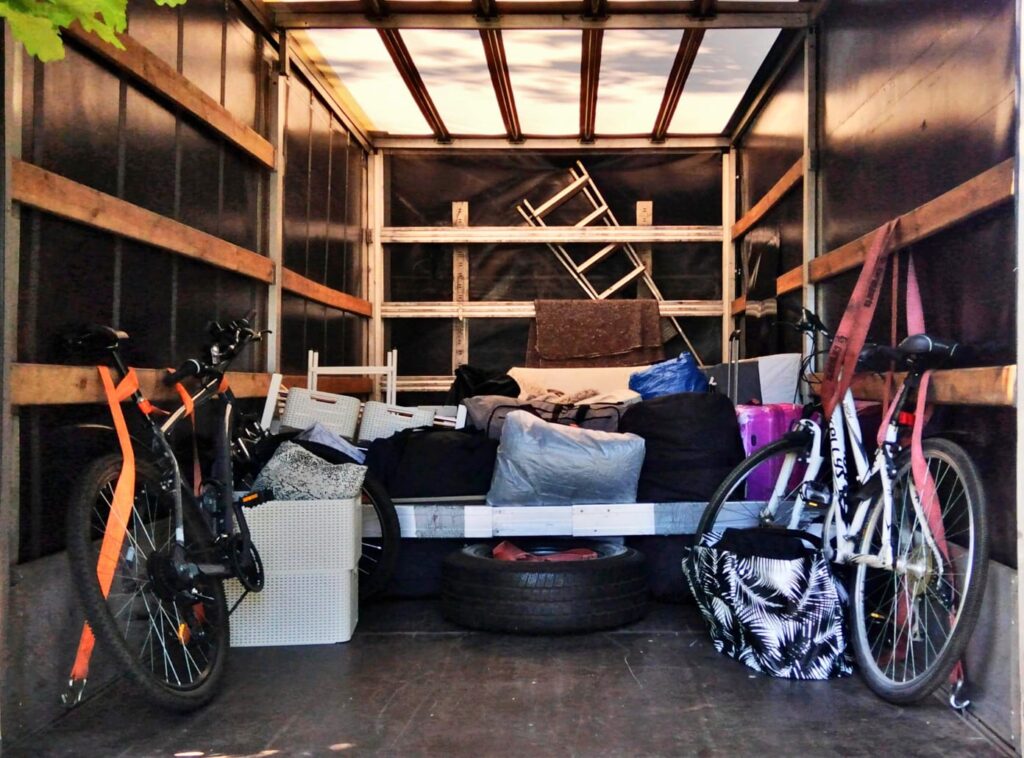
Route checklist: Eurotunnel vs ferry, plus access planning
Route choice changes timing, but access changes everything. This part of the moving to France from UK checklist prevents avoidable delays and last minute chaos.
Eurotunnel vs ferry
| Option | Best when | Watch outs |
|---|---|---|
| Eurotunnel | tight schedule, speed matters | strict check in timing |
| Ferry | you want flexibility, you want a break | weather and peak queues |
Routes can shift arrival by 2 to 6 hours, especially on peak weekends.
Your route decision in one sentence
- Choose Eurotunnel if timing is tight and you want the most predictable crossing.
- Choose a ferry if you want flexibility and do not mind an arrival window that can stretch.
Access planning
Confirm:
- Parking distance from entrance, ideally under 15 metres
- Stairs, lift size, and tight turns
- Unloading restrictions in city centres
- Any time limits for stopping or loading
A simple trick: take two photos. One from the street showing the entrance and parking space. One of the stairwell or hallway. It turns guessing into a plan.
City centre and low emission zones
If you are moving into a low emission zone, check official guidance before delivery day:
Why VANonsite fits this move
A checklist is only as good as the team executing it. VANonsite supports this moving to France from UK checklist with careful handling, flexible vehicles, and GPS tracking on every load. That combination matters because cross border moves have more moving parts. When your shipment is visible and the plan is clean, the whole experience feels calmer.
What you get in plain terms
| What you need | Why it matters for a UK to France move | How VANonsite supports it |
|---|---|---|
| Predictable timing | protects handovers and arrival plans | direct options and clear scheduling |
| Lower damage risk | fewer scratches and breakages | secure loading and protection-first handling |
| Visibility | reduces stress | GPS tracking on every load |
| Flexibility | plans change fast | scalable vehicle sizes plus add ons |
Services that pair well with this checklist
Choose only what you need, keep the move lean.
- Furniture heavy move: Furniture Removals
- Full household move: Home Removals
- Want less hassle: Packing Service
- High value items: White Glove Delivery
If you want a clean planning path, these pages help:
- Removals to France
- Moving to France from UK
- Removals to France from UK
- International removals UK to France
If your move is time sensitive, the GPS tracking alone can feel like a relief. You can plan key handovers, arrivals, and your first night without guesswork.
FAQs
How long does a move usually take?
Most removals take 1 to 3 days once loaded. Customs and access are the biggest variables. If you are moving into a city centre flat with stairs and parking restrictions, allow extra time.
What causes delays most often?
Vague paperwork. The fastest fix is a specific, itemised inventory with values in euros, plus proof of French address, and consistent names and dates across documents.
Is man and van a good choice?
Yes for smaller moves, a few boxes and compact furniture. For full households, larger vehicles are safer and more efficient because you avoid tight stacking and shifting.
What should I keep with me?
Passport, key documents, medication, chargers, keys, and a 72 hour essentials kit.
What is the single most important document for customs?
For moving to France from UK checklist planning, it is usually the itemised inventory with realistic values in euros, backed by proof of French address. That combination prevents most avoidable delays.
How detailed should my inventory be?
Detailed enough that a stranger can understand what is in your shipment without guessing. Use room groups, box numbers, quantities, and clear item names. Avoid “misc” and broad categories like “kitchen items”.
Do I need to pack differently for cross border transport?
Yes. Long distance transport rewards stability.
- Keep boxes under 20 kg
- Fill gaps so nothing moves inside the box
- Protect furniture corners
- Strap large items so they cannot slide
What if my building has no lift or difficult stairs?
Mention it early. Access can add 30% to 60% more handling time and may affect vehicle choice and crew planning. Photos of the entrance and stairwell help a lot.
How do I avoid stress on delivery day?
Use a placement plan.
- Label rooms clearly
- Decide where big items land before unloading
- Keep a clear route from door to destination room
What should I do if my dates change last minute?
It happens more than people admit. If your dates shift, update three things immediately: pickup window, access plan, and inventory status. A flexible mover can often adapt faster if the paperwork is already clean, which is why this checklist starts early.
How do I get a quote that matches reality?
For the most accurate pricing, share:
- Pickup postcode and destination town
- Floor number and lift details at both addresses
- Estimated box count plus your five biggest items
- Any heavy items, books, tools, gym gear
Those four details reduce surprises and help your moving to France from UK checklist stay on track.
Summary
This moving to France from UK checklist is built around what actually makes a relocation succeed: clean paperwork, realistic planning, and stable loading. Start early with one master inventory, then keep it specific with room groups, box numbers, quantities, and realistic values in euros. Pair that inventory with proof of French address and consistent names, dates, and address formatting, because after Brexit that consistency is what keeps customs smooth.
Next, protect the move with practical choices. Declutter by 20% to reduce volume and cost. Pack with stability in mind: keep boxes under 20 kg, tape bottoms properly, label two sides, and protect furniture corners. Choose a vehicle size with 10% to 15% breathing space, especially if access is tight. Then plan the route and the access details like they matter, because they do: Eurotunnel is often fastest, ferry can be flexible, and stairs, carry distance, and city rules can add 30% to 60% more handling time.
If you want your moving to France from UK checklist to feel calmer on the day, VANonsite supports the plan with flexible options from man and van to full house transport, GPS tracking on every load, and add ons like packing support and white glove handling when your items need extra care.