Packing for Germany is not like packing for a trip. It is not about filling two suitcases, zipping them shut, and hoping the rest of life will sort itself out later. A real packing list for moving to Germany decides something much bigger: how your first day, first week, and first month will actually feel once you arrive.
That is why smart packing matters so much. It protects more than your belongings. It protects your documents, your comfort, your routine, your first night of sleep, and your ability to function when everything still feels unfamiliar. A chaotic packing job can make even a well planned move feel exhausting. A sharp, realistic one can make Germany feel manageable from the first hour.
The strongest movers do not pack everything with equal urgency. They pack in layers. What must stay with you. What must be available on day one. What can safely travel in the main load. What can wait. That one shift changes the whole move.
This guide gives a clear, practical, and emotionally steady answer to the keyword packing list for moving to Germany. It covers documents, first week essentials, clothes, electronics, family items, student needs, fragile items, and the smartest way to pack for a serious relocation instead of a short stay.
TL:DR
- Keep your passport, ID, visa papers if needed, medication, chargers, valuables, and first 48 to 72 hour essentials with you personally, not buried in the main load.
- Build your packing list for moving to Germany by priority, not only by room, because timing matters more than category during an international relocation.
- Separate day one essentials from the main household shipment, so you can function immediately even if the rest of the move still feels unsettled.
- Pack for Germany’s seasons with purpose, especially layers, rain ready clothing, and winter basics, but avoid dragging your whole wardrobe without a plan.
- Prepare a dedicated documents folder for registration, housing, health insurance, work, or study, because those papers often matter in the first days.
- Families, students, and professionals should each pack differently, since children’s routines, study needs, and work setup change what feels essential.
- Fragile, bulky, or high value items need stronger packing, and in some cases white glove handling, if you want them to arrive safely and without costly stress.
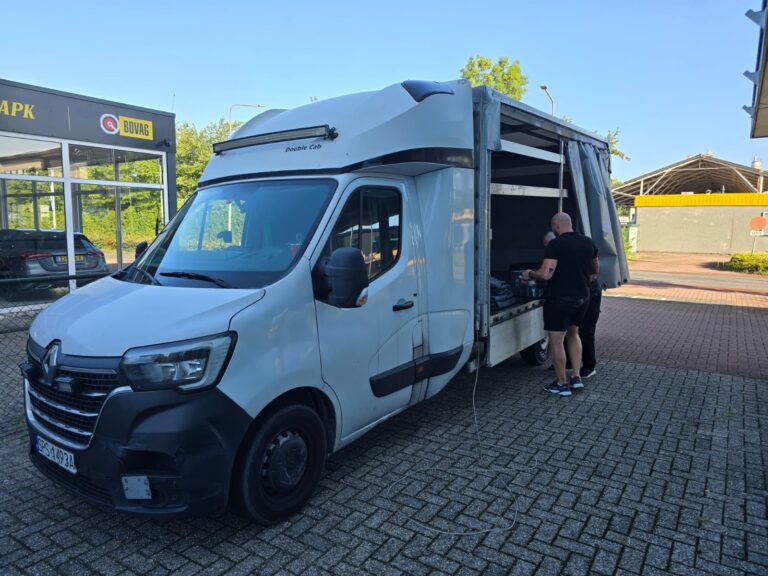
- The right removals setup, from a compact man and van move to a larger household service, can protect your packing effort and make the move far easier from day one.




Fast Answer: What Should Be on Your Packing List for Moving to Germany?
A smart packing list for moving to Germany should never treat every item as equally urgent. That is the mistake that turns an organised relocation into a frustrating one. The real goal is not to pack everything. It is to pack the right things in the right order.
Every strong international packing plan should include five practical layers:
- Legal and identity documents that protect your ability to travel, register, rent, work, study, and settle.
- First 48 to 72 hour essentials that help you function even if the main shipment is delayed, difficult to access, or simply still unpacked.
- Weather appropriate clothing and personal basics that match real life in Germany instead of a holiday version of Germany.
- Electronics, chargers, and work tools that keep communication, work, study, and daily admin moving.
- Home items that genuinely matter for the first phase of life in Germany rather than every object you happen to own.
That is the real answer to the keyword. A good packing list for moving to Germany is layered, practical, and timing based.
The biggest mistake people make is simple. They pack by room or by habit instead of by urgency. They give the same weight to a spare kitchen item as they do to medication, documents, chargers, or the clothes they will actually need in the first week. That creates chaos the moment they arrive.
A better mindset is this:
- what must stay with me
- what must be reachable on day one
- what can travel safely in the main load
- what can wait or be replaced later
Once you start packing with those questions instead of with emotion alone, the move becomes clearer, lighter, and much easier to control.
What to Keep With You During the Move
Some items should never disappear into the back of the van, the bottom of a box, or the middle of a rushed loading plan. They belong with you personally because they do not just matter. They protect your ability to function.
That is why this part of your packing list for moving to Germany is so important. These are not just “important items.” These are survival items for the first days.
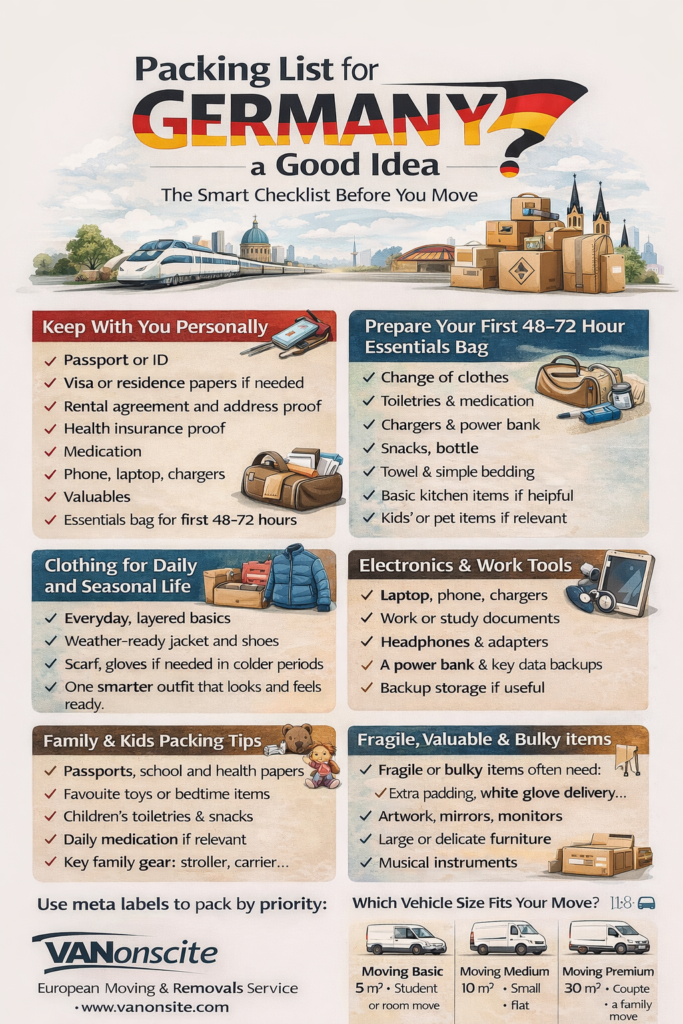
Keep with you, not in the van:
- passport or ID
- visa or residence papers if needed
- rental agreement and address documents
- health insurance proof
- medication
- phone, laptop, chargers
- valuables
- first 48 to 72 hour essentials
The logic behind this list is practical, not dramatic. If your main load is delayed, hard to access, or unpacked later than expected, you still need to move through the first day like a functioning person, not someone locked out of their own life.
Why These Items Need to Stay With You
The first days after an international move rarely feel elegant. Even when the relocation is well organised, there is usually some level of fatigue, overstimulation, and friction. You may be waiting for keys, arranging access, dealing with paperwork, finding your way around a new area, or trying to make the first night feel less disorienting.
That is exactly why the items you carry yourself matter so much. They protect:
- your identity
- your legal status
- your access to housing and registration steps
- your health and routine
- your ability to communicate, work, study, and respond quickly
A missing charger is annoying. A buried passport, lost medication, or inaccessible rental document can turn the first day into a serious problem.
What People Most Often Forget
Some readers remember passports and phones, but forget the quieter essentials that matter just as much once the move becomes real. The most overlooked items often include:
- prescription medication for several days
- printed copies of key documents
- power bank and charging cable
- one full change of clothes
- toiletries for the first night
- glasses, contact lenses, or anything medically routine
- comfort items for children if moving as a family
This is where the difference between travelling and relocating becomes obvious. A relocation does not just need convenience. It needs continuity.
What This Means for a Man and Van Move
A lighter man and van move can feel beautifully efficient, but it also tempts people to over simplify. Because the move looks smaller, they assume they can treat all items casually. That is risky. Even in a compact move, personal carry items should stay separate from everything else.
The same rule applies whether you are moving one room, a student setup, or a larger household. Keep the essentials on you. Let the rest travel.
That single decision can protect the first hours of your new life more than almost any other packing choice.
Documents You Should Never Pack Deep in the Main Load
Your documents should never be treated like ordinary possessions. They are not just papers. They are the thin line between a smooth arrival and a deeply frustrating first week. A buried passport, missing rental agreement, or inaccessible insurance proof can create far more stress than a lost kitchen item or delayed box of clothes ever will.
That is why this part of your packing list for moving to Germany deserves real discipline. Documents should stay organised, reachable, and protected from the beginning of the move to the moment you are fully settled.
| Document | Why it matters | When you may need it |
|---|---|---|
| Passport or ID | Identity and travel | Entry and registration |
| Visa or residence papers if needed | Legal stay | Entry and admin |
| Rental agreement or address proof | Housing and registration | Anmeldung |
| Health insurance proof | Essential coverage | Entry, healthcare, admin |
| Employment or university documents | Proof of purpose | Work, study, insurance |
| Civil status documents if relevant | Family admin | Family setup |
That table shows the core list, but the real value comes from how you carry these documents.
Carry Originals, Copies, and Digital Backups
The safest approach is three layered:
- keep the originals with you personally
- carry printed copies of the most important papers
- store digital backups in a secure, easy to access format
This matters because international moves do not always unfold neatly. Batteries die. Internet access disappears. Boxes get packed more tightly than planned. You may need to show a document when you are tired, standing in a hallway, sitting in temporary accommodation, or trying to solve something quickly at an office or with a landlord.
Printed copies are not old fashioned. They are often the quiet detail that saves time and stress.
Which Documents Matter Most in the First Days
Some documents may matter later, but a few often matter almost immediately. These usually include:
- passport or ID
- visa or residence paperwork if your route requires it
- rental agreement or other address proof
- health insurance confirmation
- work contract, employer letter, or university admission papers
For families, children’s documents and civil status documents can matter early too. That is why one shared folder is not enough if the move involves more than one person. The paperwork should be structured in a way that makes fast retrieval possible under pressure.
Why Germany Makes This Especially Important
Germany rewards preparation, and documents are a clear example of that. Registration, housing, legal status, and health insurance often depend on papers being available at the right time, not eventually. If the move is already emotionally heavy, document chaos makes everything sharper.
For official background connected to this section, readers can check:
- Entry and residence in Germany
- Entry and residence of EU citizens
- Registration in Germany
- Housing and registration
- Health insurance in Germany
- Health insurance overview
- Entry process in Germany
The core rule is simple. If losing access to an item would disrupt your legal entry, housing, registration, health care, study, or work, it does not belong deep in the main load.
Your First 48 to 72 Hour Essentials Bag
Even a very good move can feel chaotic in the first days. Boxes arrive, keys are exchanged, beds are not made yet, the kitchen is only half usable, and your energy is already running low. That is why a separate essentials bag is one of the smartest parts of any packing list for moving to Germany.
This bag is not a bonus. It is your short term survival system. It makes the first night feel manageable and the first morning feel less like an obstacle course.
A strong first 48 to 72 hour essentials bag should usually include:
- change of clothes
- underwear and sleepwear
- toiletries
- medication
- chargers and power bank
- basic kitchen items such as mug, bottle, kettle if relevant
- towel and bedding basics
- snacks and small comfort items
- children’s or pet essentials if needed
Why This Bag Matters So Much
The first days after arrival are rarely the moment when your move looks beautifully organised. They are usually the moment when you are tired, slightly overstimulated, and trying to function while life is still half packed.
That is exactly why fast access matters more than perfect organisation. You do not want to hunt through boxes for a towel, charger, toothbrush, clean clothes, or medication when you are already exhausted.
A good essentials bag protects three things at once:
- physical comfort
- basic routine
- emotional steadiness
That may sound simple, but it is powerful. A hot drink, clean clothes, a charged phone, and the ability to sleep properly can make the difference between a stressful arrival and a manageable one.
What to Add for Families, Students, and Professionals
The right contents may change depending on who is moving.
Families may want to add:
- comfort toys or familiar bedtime items
- nappies, wipes, or children’s hygiene products
- easy snacks for children
- one or two items that protect routine immediately
Students may want to add:
- laptop and charger
- admission or housing papers
- basic study items
- one simple room setup item that makes the first night easier
Professionals may want to add:
- work laptop
- chargers and adapters
- headphones
- notebook or urgent work documents
- one full ready to wear outfit for an early meeting or appointment
The Essentials Bag Should Feel Like Relief, Not Randomness
The best version of this bag is not stuffed with panic items. It is built with clarity. Every item should earn its place by answering one question: will I realistically need this before the main load is unpacked?
If the answer is yes, it belongs here.
That is why the first 48 to 72 hour bag is one of the strongest tools in a successful relocation. It keeps the first phase human. And that matters more than many movers realise before they are standing in their new place, tired, thirsty, and looking for a clean T-shirt in the wrong box.
Clothing Checklist for Moving to Germany
Clothing is one of the easiest areas to overpack emotionally. People look at a wardrobe and start packing memory, mood, and imagined future versions of themselves instead of what they will actually wear in daily life. That is why a strong packing list for moving to Germany should treat clothes as a practical system, not as a panic decision.
Germany rewards clothing that works. Layers. Pieces that suit rain, cold mornings, public transport, walking, work, and ordinary errands. The goal is not to bring your entire wardrobe. The goal is to bring the clothing that will carry you through the first phase of life without making the move heavier than it needs to be.
Everyday Clothing for Daily Life
Start with the clothes you already wear most often in real life, not the ones you keep “just in case.” Everyday clothing should support routine, comfort, and repetition. That means items you can rewear, layer easily, and combine without effort.
A practical everyday clothing base often includes:
- enough underwear and socks for a sensible first cycle
- simple tops and trousers that work across several days
- a few warmer layers such as knitwear, hoodies, or cardigans
- comfortable at home clothing
- one or two smarter outfits for work, appointments, or formal admin moments
- sleepwear that keeps the first nights easy
This is especially important in the first weeks, when you may not have the whole household fully unpacked. A smaller, smarter wardrobe usually works better than a large, chaotic one.
Seasonal Clothing and Outerwear
Germany’s climate is manageable, but it does ask for realism. Readers moving in autumn or winter should respect the cold properly. Readers moving in spring or summer should still remember that weather can shift quickly and rain is never a distant possibility.
The smartest strategy is layering. That means packing clothing that can adjust across temperature changes instead of relying only on heavy single use pieces.
A useful seasonal checklist may include:
- rain ready jacket or coat
- warmer outer layer for colder months
- knit layers for indoor and outdoor flexibility
- scarf, gloves, and winter basics if moving into colder seasons
- lighter layers for warmer periods
- one or two pieces that handle unexpected weather well
The biggest mistake here is packing for a fantasy version of climate. Germany does not require an extreme wardrobe, but it does reward sensible preparation.
Shoes That Actually Make Sense for Germany
Shoes matter more than many people expect because daily life in Germany often includes walking, public transport, changing weather, and a more practical rhythm than people pack for emotionally.
A strong shoe selection usually means:
- comfortable everyday walking shoes
- one weather resistant pair for rain or colder conditions
- one smarter pair if work or formal appointments require it
- indoor comfort footwear if that matters to your routine
Most readers do not need a large shoe collection in the first phase. They need the pairs that genuinely support ordinary life. This is one of the clearest places where smart packing beats emotional overpacking.
The core rule is simple. Pack for the life you will live in Germany, not for every version of yourself that once needed a different outfit.
Electronics, Work Gear, and Daily Essentials
Modern relocation runs on electronics as much as on boxes. Communication, navigation, work, housing messages, registration appointments, banking, study, and problem solving all depend on devices staying charged, accessible, and functional. That is why electronics deserve their own serious place in your packing list for moving to Germany.
For many people, electronics are not optional add-ons. They are part of how life works from the first hour.
A practical electronics and work gear list often includes:
- laptop and phone
- chargers and adapters if relevant
- work documents and tools
- headphones
- hard drives or backups
- internet and setup essentials for remote workers
The Devices You Will Need Immediately
Your phone and laptop are usually the two most important pieces. They support maps, bookings, landlord communication, work, study, digital document access, and contact with family or service providers. If either one is missing, uncharged, or buried in the wrong place, the move feels instantly harder.
That is why these devices should stay close to you, not disappear into general packing.
Chargers, Cables, and Power Access Matter More Than Expected
Many readers remember their laptop and phone, then forget the smaller items that keep them useful. Chargers, cables, and backup power are some of the easiest things to overlook and some of the most annoying things to replace under pressure.
A smarter setup often includes:
- main chargers for every daily device
- one power bank
- charging cables packed neatly together
- extension lead or compact organiser if useful for early setup
- any relevant plug or adapter support if your situation requires it
This is one of those categories where good organisation saves real stress for very little effort.
Work and Study Gear Should Travel Like Essentials
Professionals and students often underestimate how quickly work or study may restart after the move. A laptop alone may not be enough. Think in terms of continuity.
That may include:
- notebook or planner
- headphones for calls or focused work
- hard drives or secure backups
- key documents connected to work or university
- mouse, keyboard, or other core setup tools if they matter to your routine
Remote workers should be especially careful here. Internet related setup items, authentication tools, and anything that protects a stable first working week should be packed with intention, not left to chance.
Daily Essentials That Keep Life Moving
This section is not only about formal work gear. It is also about the small modern essentials that make a move less disjointed. Readers often benefit from packing:
- one organised tech pouch
- headphones for travel and early calls
- backup storage for important files
- one clean place for passwords, codes, or essential digital access information
The main principle is simple. If a device or tool supports communication, work, study, navigation, or fast problem solving, it should be treated like a daily life essential, not like a secondary item.
That is especially true in the first week, when technology often becomes the bridge between uncertainty and control.
Kitchen, Bedroom, and Bathroom Items: What Is Worth Bringing?
This is the point where many international moves become heavier than they need to be. Home items feel harmless when viewed one by one. A mug here. Extra bedding there. Three pans that seem useful. A half used bathroom shelf that looks too practical to leave behind. Yet this is exactly how volume grows without adding much value.
A smarter packing list for moving to Germany should separate emotional habit from real usefulness. The best question is not “Do I own this?” It is “Will this genuinely help me live well in the first phase after arrival?”
Kitchen Basics for the First Week
You do not need a full kitchen on day one. You need enough to avoid feeling helpless. The first week usually calls for function, not completeness.
Useful kitchen basics often include:
- one mug or cup per person
- one water bottle if part of your routine
- a kettle if you rely on tea, coffee, or quick hot water
- basic cutlery and one sharp kitchen knife
- one plate and bowl per person if practical
- one pan or small pot if you expect to cook early
- simple food storage containers
What matters here is daily continuity. A basic, working kitchen helps the new place feel human faster. It also reduces the temptation to spend the first days solving problems that could have been prevented by one small, well packed box.
At the same time, many low value kitchen duplicates are not worth moving across Europe. Cheap extras, random mismatched pieces, and items you barely use are often better left behind.
Bedroom Essentials for Faster Recovery After Arrival
Bedroom items are not just about comfort. They are about recovery. After an international move, good sleep is one of the fastest ways to make life feel manageable again.
The most useful bedroom essentials often include:
- bedding for the first nights
- one pillow you know you sleep well on
- basic blanket or duvet setup if needed immediately
- sleepwear that is easy to reach
- one or two familiar comfort items that make the new space feel less raw
This is one of the categories where bringing the right small things can matter more than bringing many things. A well made bed on the first night can change the emotional tone of the entire arrival.
Bathroom Items You Will Want Immediately
Bathroom items are easy to underestimate because they feel ordinary. Then the first night comes, and suddenly not having soap, toilet paper, a towel, or basic toiletries feels far more exhausting than expected.
The most useful bathroom items to have ready include:
- toothbrush and toothpaste
- soap, shampoo, and basic toiletries
- towel for each person
- toilet paper for immediate arrival
- any daily skin care or hygiene essentials
- basic cleaning wipes or small cleaning items if helpful in the new space
These are not glamorous items, but they are high value in emotional terms. They protect normality.
What Is Worth Bringing Early, and What Can Wait
A useful rule of thumb is this:
Bring early if it supports:
- sleep
- hygiene
- eating and drinking simply
- first week comfort
- routine that would be stressful to rebuild immediately
Let it wait if it is:
- cheap and easy to replace
- rarely used
- duplicated several times already
- bulky but low value
- emotionally familiar but practically unimportant
That distinction keeps your move lighter without making your arrival poorer.
What Not to Pack When Moving to Germany
One of the most liberating parts of a strong packing list for moving to Germany is realising that you do not need to take everything with you just because it already exists in your home. Moving is not only about choosing what comes. It is also about choosing what finally stops following you.
This section matters because overpacking creates three quiet problems at once. It increases cost. It increases stress. And it makes unpacking feel heavier, slower, and more emotionally cluttered.
A useful “do not pack” filter often includes:
- duplicate low value items
- expired products
- things you never use
- cheap furniture that costs more to move than replace
- emotionally random items with no role in your new life
Duplicate Low Value Items
If you own five versions of something but only use one, the move is usually not the moment to protect the full collection. Duplicate low value items often add volume without adding quality of life.
This is especially true for:
- extra kitchen tools
- old storage boxes
- spare decor pieces
- duplicated linens or towels beyond reasonable need
- miscellaneous household bits that have simply accumulated
These items rarely feel important until they start taking up real space in a van.
Expired Products and Things You Never Use
A move has a brutal way of revealing what has simply been sitting around. Half used products, expired items, old toiletries, forgotten cables, and things you have not touched in years do not usually become more important just because you are relocating.
They become heavier.
This is one of the easiest chances to strip the move back to what actually supports your next chapter.
Cheap Furniture That Costs More to Move Than Replace
Not every piece of furniture deserves an international move. Some items are useful only because they are already there. Once transport cost, handling, and space are considered, they may stop making sense very quickly.
This is especially true for furniture that is:
- low quality
- easy to replace
- already worn out
- awkward to move but not valuable enough to justify it
That does not mean readers should throw everything away. It means they should weigh emotional or practical value against transport reality.
Emotionally Random Items With No Role in Your New Life
This may be the most important category of all. Many people do not overpack because they are disorganised. They overpack because objects carry memory, identity, guilt, or old versions of themselves.
Moving to Germany can be a powerful reset. That is why it helps to ask one brave question about certain items: does this belong to my next life, or only to my last one?
Not every sentimental thing needs to travel. Some do. Some absolutely matter. But some are only emotional noise disguised as importance.
A Lighter Move Can Be a Smarter Move
This section should not make readers feel judged. It should make them feel lighter. Letting go of the wrong items does not make a move less complete. It often makes it sharper, calmer, and more affordable.
That matters even more in international relocation, where every unnecessary box affects handling, timing, cost, and energy. A well judged move protects not only space in the van, but also space in your head.
Packing List for Moving to Germany With Family
Moving with family changes the logic of packing completely. A family does not only move things. It moves routines, documents, health needs, school plans, comfort objects, and the emotional stability of several people at once. That is why a family focused packing list for moving to Germany needs more than ordinary organisation. It needs foresight.
For families, the goal is not just to arrive. It is to arrive with enough structure that children feel secure, adults can function, and the first week does not become a chain reaction of small crises.
Children’s Documents Matter Early
Children’s paperwork should never be treated as a later task. If it connects to identity, health, travel, schooling, or family admin, it belongs high on your priority list and close to you during the move.
Family documents often include:
- passports or IDs for each child
- birth certificates if relevant
- school related papers
- health insurance information
- vaccination or medical records where useful
- any official family documents that may matter during setup
These should be organised in a dedicated family folder, not scattered across bags or mixed with general household papers.
Comfort Items and Routine Protect More Than Mood
Children often feel a move long before they can describe it clearly. That is why familiar comfort items matter so much. A favourite blanket, bedtime toy, well known cup, night light, or familiar book can do more to stabilise the first days than many adults expect.
Routine items are not sentimental extras in this context. They are tools of emotional continuity.
Useful family comfort packing often includes:
- favourite sleep items
- familiar toys or books
- simple snacks children already trust
- bedtime basics that make the first evening feel recognisable
- one or two small items that make the new room feel less alien
School Papers and Everyday Family Admin
If school or nursery arrangements are part of the move, keep related documents easy to access. Anything connected to admissions, records, or educational history should never disappear into the main shipment.
This is also where families benefit from over organising a little. Not because paperwork is exciting, but because family moves have less room for confusion.
Medicine and Health Items Need Their Own Layer
Family packing should treat medicine as a separate priority layer. Daily medication, children’s basics, first aid essentials, and items connected to regular health routines need to be packed for immediate access.
For many families, this means keeping:
- prescribed medicine
- children’s pain relief or fever basics where appropriate
- any medically routine items used often
- basic first aid supplies
- health documents connected to ongoing care
The key principle is simple. If a child becoming unwell in the first days would create panic without the item, that item should not be buried in a box.
Stroller, Carriers, and Practical Family Equipment
Families should also think about movement. A stroller, carrier, travel cot, feeding gear, or other daily equipment may be worth prioritising if it makes the first week easier and more functional.
The move will already create enough disruption. Useful equipment that supports real daily life often earns its place more than bulky “just in case” items do.
Family packing works best when it protects three things at once:
- documents and legal readiness
- practical daily care
- emotional stability for children and adults
That is why family relocations often benefit from a more careful removals setup. The cost of disorganisation is simply higher when more than one life rhythm depends on the move working well.


Packing List for Students Moving to Germany
Student moves usually need a different mindset. The goal is not to recreate a full household. The goal is to arrive with what genuinely supports study, basic comfort, and a realistic first phase of life in Germany. That is why the best student version of a packing list for moving to Germany is usually leaner, sharper, and more budget aware.
Students often feel pressure from two sides at once: limited budget and limited space. That is exactly why smart selection matters more than volume.
Study Documents Come First
A student move should always start with paperwork. If an item supports enrolment, identity, housing, health insurance, or your first administrative steps, it belongs at the top of the packing plan.
Important student papers often include:
- passport or ID
- admission or enrolment documents
- housing confirmation
- health insurance proof
- any relevant academic records or letters
- digital and printed copies of key student documents
These papers should stay with you personally, not deep in the main load.
Laptop, Chargers, and Study Essentials
For most students, the laptop is one of the most important things they own during a relocation. It supports study, communication, course access, housing messages, admin, and day to day problem solving.
A practical student tech setup often includes:
- laptop
- phone
- chargers
- headphones
- one notebook or planner
- key digital backups if relevant
This is not the place to improvise. Student life often restarts quickly, and digital readiness protects continuity.
Room Essentials Should Stay Simple
Many student moves become heavier than necessary because people pack for a fantasy adult home instead of a realistic student setup. In most cases, a student needs a workable room, not a fully built household from day one.
Useful room essentials may include:
- bedding basics
- towel and toiletries
- one mug and simple kitchen basics
- a few comfort items that make the room feel less temporary
- clothing that works across study, errands, and daily life
The point is not to make the move tiny. It is to make it efficient.
Seasonal Clothing and First Week Supplies
Students should pack enough clothing for daily life, layering, weather changes, and practical movement around the city. Shoes, outerwear, and first week basics matter more than extra style options that add bulk without helping much.
A smart first week student setup often includes:
- weather appropriate jacket
- everyday clothes that mix easily
- practical shoes
- toiletries
- medication
- snacks or basic comfort items
- one or two items that make the first night easier
Why Student Removals Matter
This is also where a dedicated student removals mindset becomes genuinely useful. Student moves are often lighter, budget aware, and more timing sensitive. A compact setup, sometimes even a man and van solution, can be ideal when the load is realistic and well organised.
The goal is not to move like a family or a full household. The goal is to move smart, arrive stable, and start student life without unnecessary drag.
That is why the best student packing is usually disciplined, not dramatic.
Packing Fragile, Valuable, or Bulky Items Safely
Fragile and bulky items are where a move often stops being a simple packing exercise and becomes a test of judgement. A plate can survive poor packing once or twice. A mirror, instrument, television, artwork, or delicate piece of furniture often cannot. That is why this part of your packing list for moving to Germany deserves more care than ordinary household categories.
The real risk is not only breakage. It is repeated handling, rushed loading, bad stacking, weak materials, and the false confidence that “it will probably be fine.” On an international move, that kind of optimism can become expensive very quickly.
The items that usually need the most protection include:
- mirrors
- artwork and framed prints
- televisions, monitors, and electronics
- musical instruments
- glass, ceramics, and decorative breakables
- delicate or high value furniture
- awkward bulky pieces that are hard to lift or stack safely
Why Fragile Packing Needs Better Materials and Handling
Fragile items are rarely damaged by one dramatic mistake alone. More often, they are damaged by small failures layered together. The wrong box. Too much empty space. Weak wrapping. Pressure from heavier items. A rushed unload. A corner impact that would have been harmless with better padding.
That is why fragile packing should feel intentional.
A stronger fragile packing approach usually means:
- double walled or reinforced boxes where needed
- generous protective wrapping
- corner protection for frames, mirrors, and screens
- clear separation between delicate items and heavy items
- smart internal padding so contents do not shift in transit
- clear labelling that actually affects handling
This is not overprotective. It is realistic. If an item would be expensive, stressful, or impossible to replace, it deserves a higher packing standard.
When White Glove or Furniture Removals Make Sense
Some items are too valuable, too delicate, or too awkward to trust to ordinary packing alone. That is where professional help stops feeling like an upgrade and starts feeling sensible.
White Glove Delivery can make sense when the move includes:
- design led furniture
- artwork or high value decorative items
- delicate electronics or screens
- items that need extra careful placement and handling
Furniture Removals are especially useful when the move includes:
- large furniture pieces
- awkward stair access
- heavy wardrobes, tables, or bed frames
- items that would be costly to damage
This is also where VANonsite fits naturally into the article. Good packing means little if the load is handled carelessly once it leaves your home. Professional support protects the effort you already put into preparing the move.
The core idea is simple. If an item would hurt to replace financially or emotionally, pack it as if it matters.
What Packing Method Makes an International Move Easier?
A successful move is rarely the result of packing harder. It is usually the result of packing smarter. That is why method matters so much. A good packing list for moving to Germany gives you categories. A good packing method tells you how to turn those categories into a move that still makes sense when the pressure rises.
International relocation becomes dramatically easier when items are packed in a way that supports timing, access, and logic. The goal is not just to fill boxes. It is to create order that still works when you are tired, in transit, and trying to make the first week manageable.
Pack by Priority, Not by Room Alone
Packing by room is helpful, but it is not enough on its own. If everything from the bedroom goes into one zone and everything from the kitchen goes into another, you may still arrive with no access to the items that matter most immediately.
That is why priority should come first.
A smarter packing system often uses these layers:
- with you personally
- day one essentials
- first week useful items
- main household items
- late unpack items
This method changes everything. Instead of unpacking blindly, you unpack in the order life actually happens.
Label by Urgency, Not Only by Category
A box labelled “kitchen” tells you where it belongs. A box labelled “open first” tells you when it matters. That difference can save enormous amounts of energy after arrival.
The best labels often include both category and urgency. For example:
- kitchen, open first
- bedroom, night one
- bathroom, immediate use
- work gear, first week
- documents, keep with you
This kind of labelling reduces friction during unloading and unpacking. It also helps anyone assisting with the move understand the real logic of the load.
Separate Day One Items From Day Seven Items
This is one of the most practical distinctions in the whole article. Day one items should never be packed as if they are ordinary household items. They belong in their own visible, intentional group.
Day one items may include:
- toiletries
- bedding basics
- towel
- mug and kettle
- one pan or plate setup
- work or study essentials
- clean clothes
- medication and chargers
Day seven items are different. They may be useful, but they do not need to shape the first night or first morning. Keeping these layers separate makes the move feel far less chaotic.
A Simple Packing Method That Actually Works
If readers want one practical formula, it is this:
- sort by importance before you sort by room
- keep documents and personal essentials with you
- build one true first 48 to 72 hour bag
- label boxes by both category and urgency
- isolate fragile and high value items for better handling
- avoid filling the van with things that do not support your next life
That is the kind of method that makes an international move easier not only on paper, but in real life.
Which VANonsite Vehicle Size Fits Your Move to Germany?
The size of the vehicle shapes more than transport. It shapes how calm the move feels, how well your boxes are handled, and whether the loading day runs with confidence or with last minute improvisation. That is why vehicle size belongs inside a serious packing list for moving to Germany. Packing volume and moving logistics are inseparable.
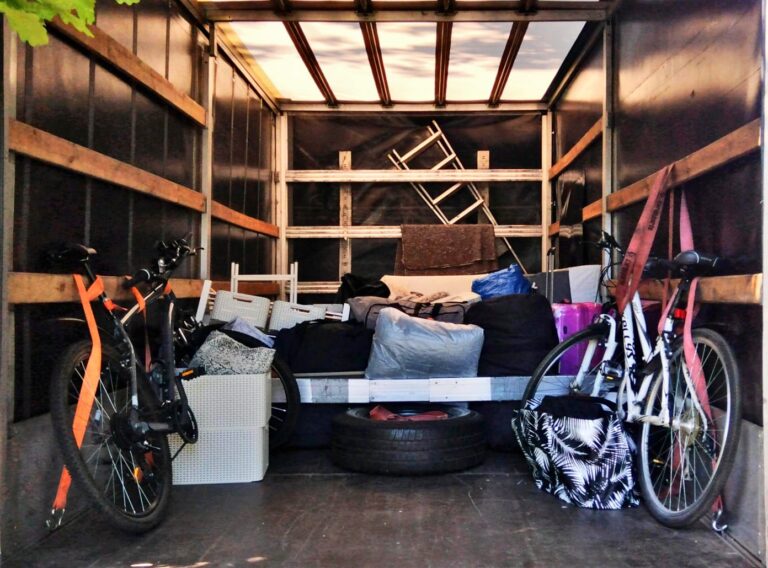
Many people underestimate their load by 20% to 30%. The reason is simple. They picture furniture, but forget the invisible bulk created by boxes, folded clothing, bedding, kitchenware, office equipment, children’s items, cleaning supplies, and the strange in between objects that appear in every real household. On moving day, that gap between assumption and reality can create instant stress.
| Service option | Capacity | Max load | Best for |
|---|---|---|---|
| Moving One | 1 m3 | 100 kg | Urgent essentials and tiny loads |
| Moving Basic | 5 m3 | 300 kg | Student or room move |
| Moving Medium | 10 m3 | 500 kg | Small flat |
| Moving Premium | 15 m3 | 1100 kg | One bedroom move |
| Moving Premium Plus | 30 m3 | 3500 kg | Couple or family move |
| Moving Full House XXL | 90 m3 | 20000 kg | Full house relocation |
The table gives the technical picture. What matters most is how these sizes behave in real life.
Moving One
Moving One works well when the move is extremely focused. It suits urgent essentials, documents, a few high priority personal items, or a very small relocation where speed matters more than volume. It is useful when the real goal is continuity, not moving a home.
Moving Basic
Moving Basic is a natural fit for student moves, room moves, and tighter relocations that need to stay efficient and budget aware. It also works well for some lighter man and van scenarios, especially when the packing is disciplined and the volume has been estimated honestly.
Moving Medium
Moving Medium usually fits readers who start with “I do not have that much” and then discover they do. A small flat, a solo professional move, or a denser student relocation can quickly outgrow smaller assumptions once boxes and daily life items are added.
Moving Premium
Moving Premium is often the safer choice for a one bedroom move or a more substantial one person relocation. It gives better breathing room for furniture, work equipment, and ordinary household items without forcing everything into a tighter and more stressful load pattern.
Moving Premium Plus
Moving Premium Plus makes strong sense for couples and many families. Shared items multiply faster than people expect. Kitchen equipment, bedding, wardrobes, children’s things, office gear, and fragile household pieces add real volume. This size helps keep the move organised instead of cramped.
Moving Full House XXL
Moving Full House XXL is for full scale relocation where the move is complete, not selective. If a household is truly shifting from one country to another, larger capacity protects order, handling quality, and timing. It gives the move room to breathe.
Why Underestimating Volume Hurts the Move
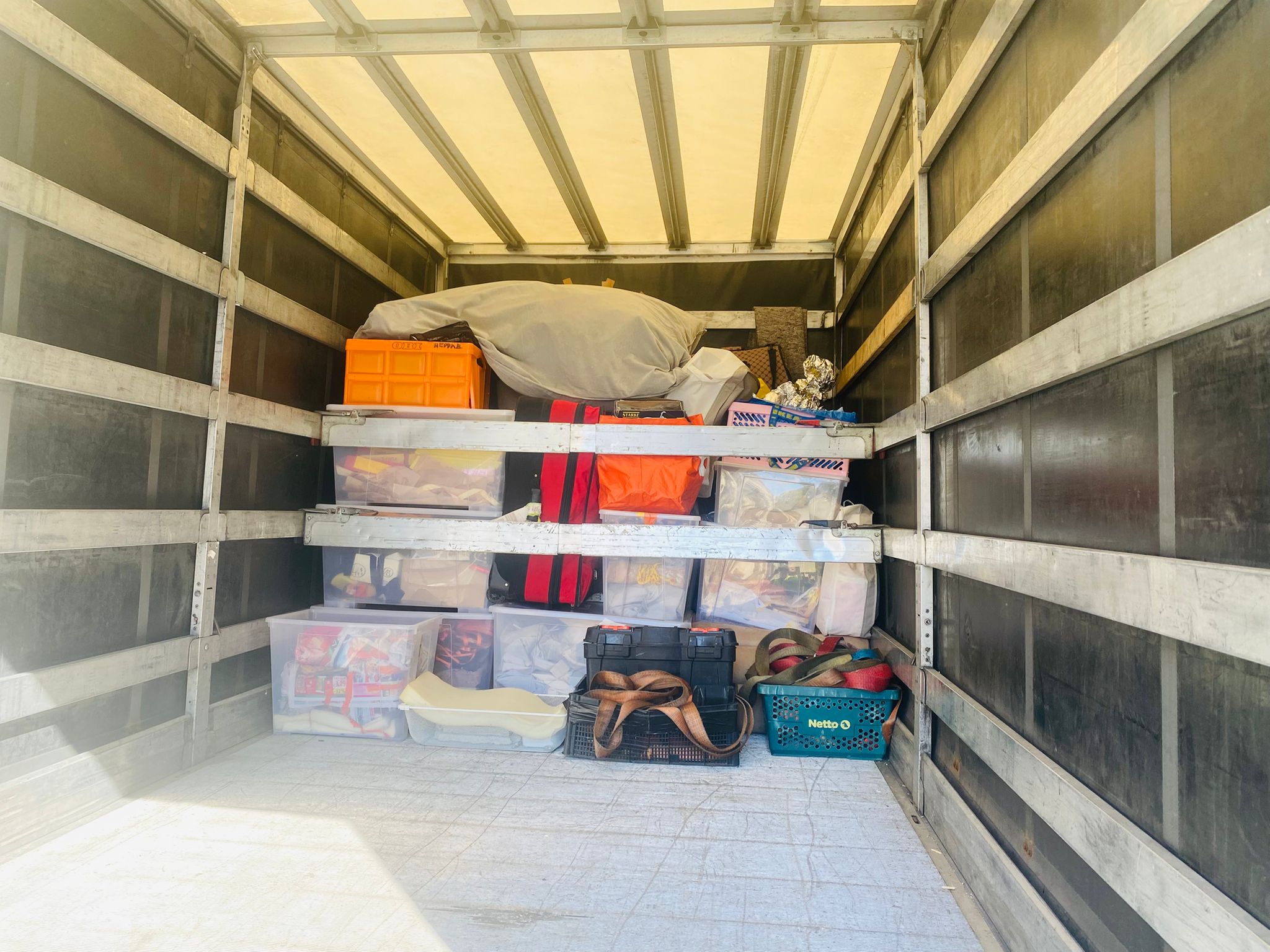
When volume is underestimated, the consequences are rarely elegant. Boxes get stacked too tightly. Fragile items lose breathing space. Loading becomes rushed. The separation between first priority and later priority items starts to collapse. In other words, the quality of the move drops.
That is why honest estimating matters. A slightly larger, calmer setup is often far smarter than trying to squeeze a real life relocation into a vehicle that only fits on paper.
Why the Right Moving Service Protects Your Packing Effort
Packing well means very little if the move itself is careless. A beautifully organised box still ends up at risk if the handling is rushed, the stacking is poor, the timing is vague, or the service around the move does not respect what you were trying to protect.
That is why the right moving service is not separate from a good packing strategy. It is part of it. The real goal is not just to pack carefully. It is to make sure that care survives the journey.
Good Packing Needs Good Handling
There is a quiet frustration many people discover too late. They spend days sorting, wrapping, protecting, and labelling, then hand everything over to a process that treats the whole load as if it were interchangeable. That is exactly where good preparation can be wasted.
A stronger moving service protects:
- the logic of your packing
- the safety of fragile items
- the separation between essentials and later items
- the emotional tone of the first week after arrival
This matters because moving is not just about transport. It is about preserving order under pressure.
GPS Tracking Reduces Uncertainty
One of the most stressful parts of an international move is not always the packing. It is the not knowing. Where is the load now? When will it arrive? Is everything moving according to plan?
GPS tracking matters because it reduces that fog. It gives readers more certainty during a part of the move that can otherwise feel strangely powerless. That clarity helps people stay calmer and plan better around arrival.
Packing Service Can Save Time and Stress
Some moves are too time sensitive, too large, or too emotionally heavy to pack alone without a serious strain. That is exactly where Packing Service becomes more than a convenience. It becomes a stabiliser.
Packing support is especially useful when:
- time before departure is short
- the move includes many fragile items
- the household is large
- a family move needs more structure
- the mover wants more protection and less last minute chaos
Furniture Removals and White Glove Support Protect Valuable Items
Not every item belongs in a generic packing flow. Large furniture, high value pieces, delicate surfaces, and design led items often need more than ordinary handling.
That is where Furniture Removals and White Glove Delivery make practical sense. They protect the items that would be hardest to replace, hardest to repair, or hardest to stop thinking about if something went wrong.
A Man and Van Setup May Suit Lighter Moves, but Not Every Relocation
A man and van setup can be perfect for compact, well judged relocations. Students, room moves, selected essentials, and lighter first stage moves often benefit from that simplicity.
Still, not every relocation should be squeezed into the lightest solution. Families, full flats, bulky furniture, fragile loads, and more complex timing often need broader support. The smartest choice is not always the smallest service. It is the one that protects the move best.
For readers ready to put the packing plan into motion, removals to Germany is the natural next step.
Final Packing Checklist Before Departure
The closer departure gets, the easier it is for even a well planned move to feel scattered. That is why a final checklist matters. It gives the move one last layer of clarity.
A strong final checklist does not add pressure. It removes it. It helps you see that the most important pieces are already in place and that the move is not being held together by memory alone.
Use this final packing checklist before departure:
- Separate documents and keep them with you, along with printed copies and digital backups.
- Prepare your first 48 to 72 hour essentials bag so the first days remain functional even before full unpacking.
- Pack by urgency rather than only by room, especially for items needed on day one and in the first week.
- Label boxes clearly with both category and urgency so unloading stays logical.
- Protect fragile items properly using stronger materials, padding, and better separation.
- Confirm what stays with you and what goes in the van so nothing essential disappears into the main load.
- Double check moving date and address readiness to reduce avoidable arrival stress.
- Do one last essentials check before departure for medication, chargers, documents, keys, and high priority personal items.
If readers want one final rule to remember, it is this: the best packing list for moving to Germany is not the longest one. It is the one that still makes sense when you are tired, travelling, and standing in your new place trying to begin.
A useful final habit is to walk through the move once in your head before departure. Ask yourself simple questions. If I arrive late, do I have what I need? If I cannot unpack immediately, can I still sleep, wash, charge my devices, and find my documents? If the first day is messy, will my packing still support me? Those questions catch problems before they become stress.
That final mental rehearsal often matters more than one extra box ever will.
FAQ
What should I pack first when moving to Germany?
Pack your documents, medication, chargers, valuables, and first 48 to 72 hour essentials first. These are the items that protect your first days and should stay with you, not inside the main load.
What documents should I keep with me?
Keep your passport or ID, visa papers if needed, rental agreement, address proof, health insurance confirmation, and work or study documents with you personally. Carry originals, printed copies, and digital backups.
How many clothes should I bring when moving to Germany?
Bring enough clothing for real daily life, not your entire wardrobe. Focus on layers, weather appropriate outerwear, practical shoes, underwear, and a few versatile outfits that support work, errands, and everyday routine.
Should I bring furniture to Germany or buy it there?
Bring furniture that is valuable, durable, hard to replace, or genuinely important to your daily life. Leave behind low quality, bulky, or cheap pieces that cost more to move than they are worth.
Can I use a man and van for moving to Germany?
Yes, a man and van setup can work very well for lighter relocations, student moves, room moves, or selected essentials. Larger households, fragile items, or more complex moves usually need a broader removals setup.
What should be in my first week essentials bag?
Your essentials bag should include clean clothes, sleepwear, toiletries, medication, chargers, towel, bedding basics, simple kitchen items if useful, snacks, and any children’s or pet essentials that would matter immediately after arrival.
Do I need printed copies of documents when moving to Germany?
Yes. Printed copies are extremely useful if your battery dies, internet is unavailable, or you need to show a document quickly during travel, housing setup, registration, or admin.
How do I avoid overpacking for a move to Germany?
Pack by function, not by guilt. Keep what supports your next life, your first week, and your real daily routine. Leave behind duplicates, expired products, rarely used items, and bulky low value things that add stress without adding value.
What is the biggest packing mistake people make?
The biggest mistake is treating everything as equally important. Good packing depends on priority. Documents, essentials, and day one items should never be packed with the same logic as late unpack household items.
Final Thoughts
A strong packing list for moving to Germany is not about taking more. It is about taking the right things, in the right order, with the right support. That is the difference between arriving tired but functional and arriving tired, frustrated, and immediately behind.
The smartest moves are rarely the most dramatic ones. They are the ones built on clarity. Clear priorities. Clear access to essentials. Clear decisions about what matters now, what matters later, and what does not need to travel at all.
That is why good packing changes more than the boxes. It changes the emotional quality of the move. It gives the first night more comfort, the first week more structure, and the whole relocation more breathing room.
If you are ready to turn your packing plan into a smoother move, choose a service that protects the care you already put into preparing it. VANonsite brings that extra layer of confidence with careful European transport, GPS tracking for every load, flexible vehicle sizes, and support for everything from lighter student moves to full household relocations.
From the first packed box to the final unload, removals to Germany is the natural next step.