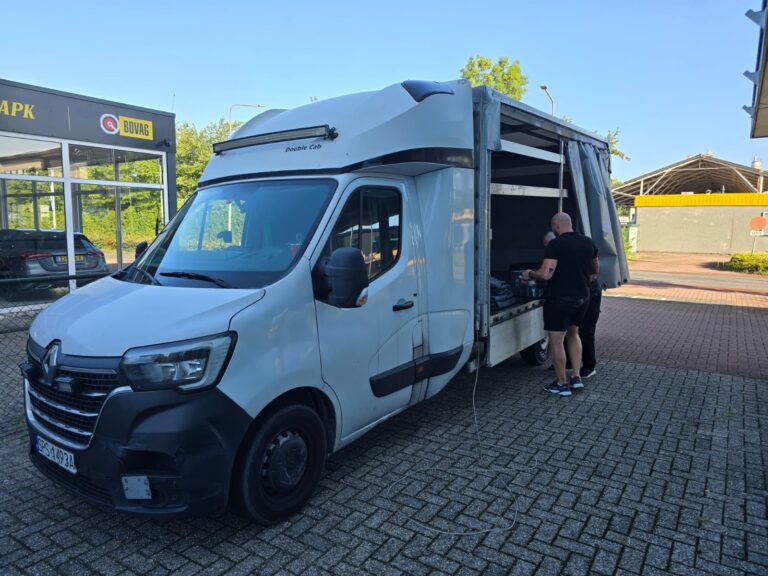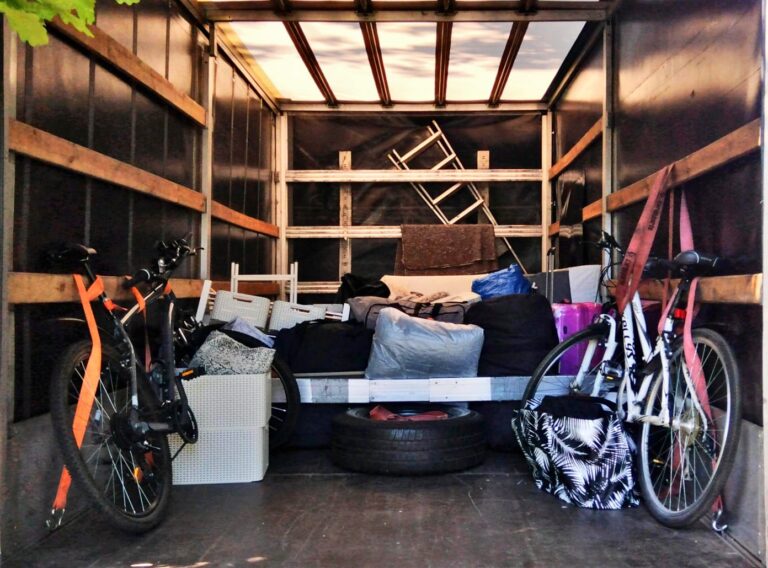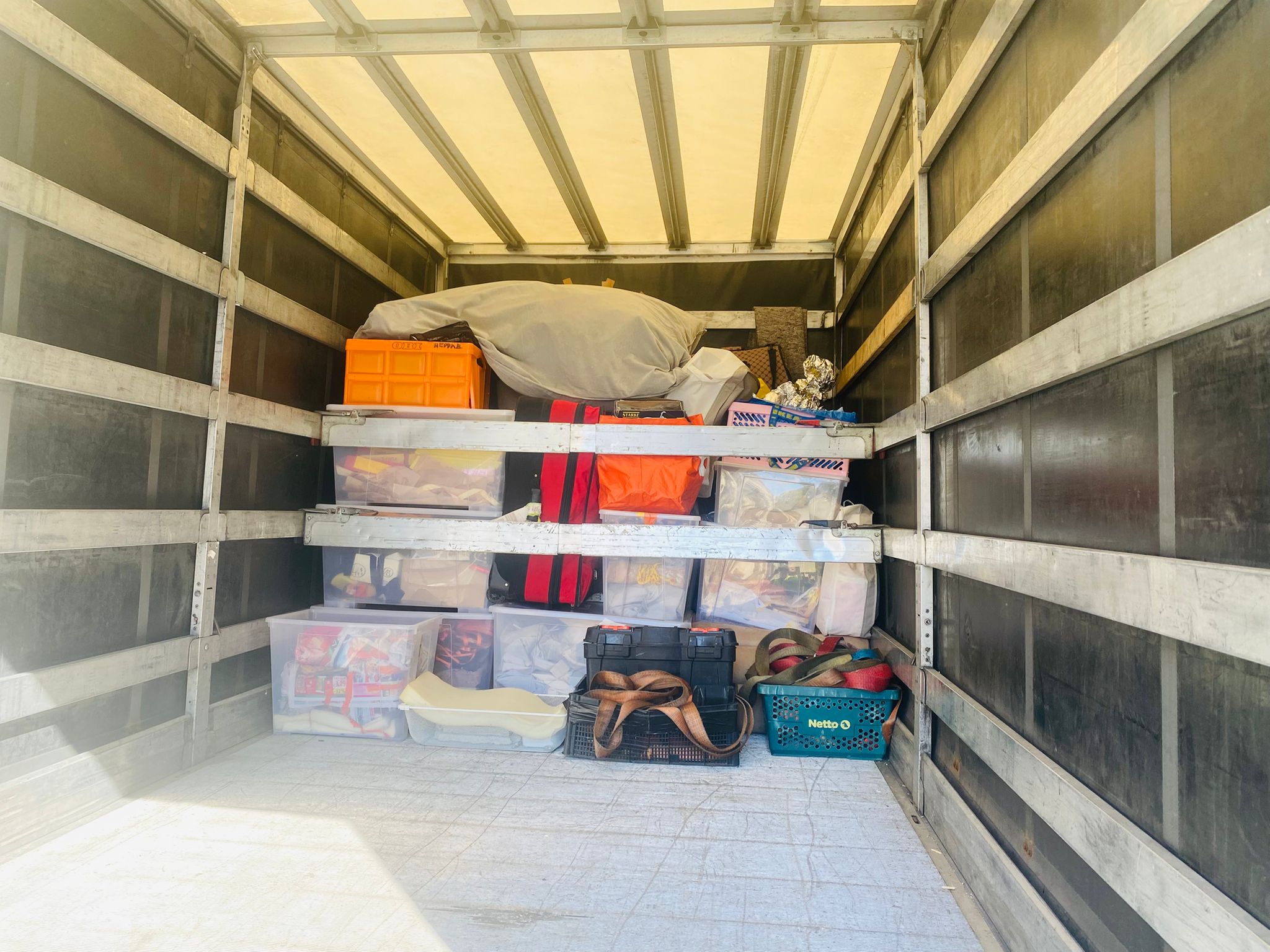

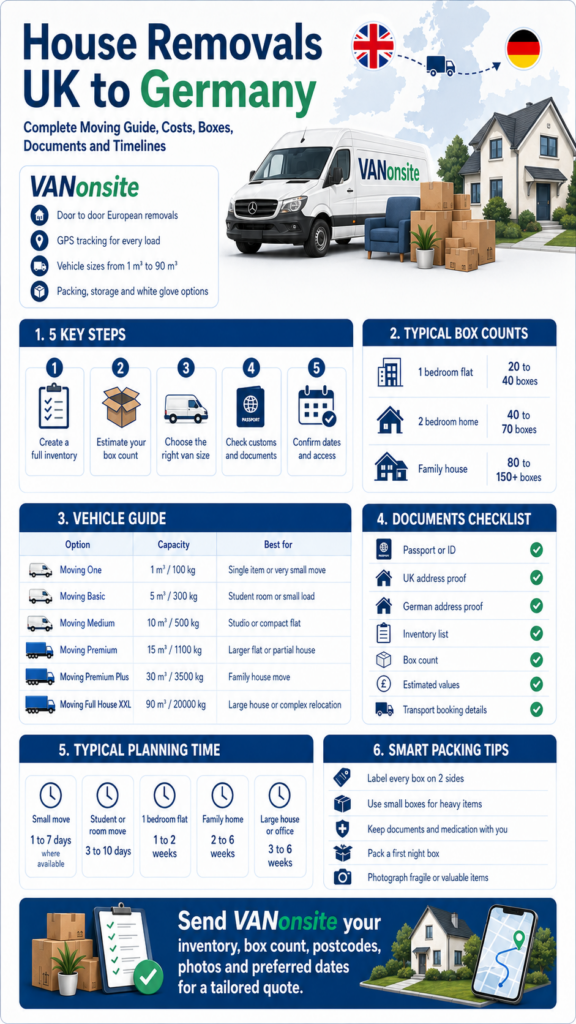
House removals UK to Germany usually come down to five practical steps: create a full inventory, estimate your box count, choose the right van size, check customs requirements, and book a reliable European man and van service. Small moves may fit into 5m3 to 10m3. A larger flat or partial house may need 15m3. A family home can require 30m3, while a large property or complex relocation may need up to 90m3 capacity.
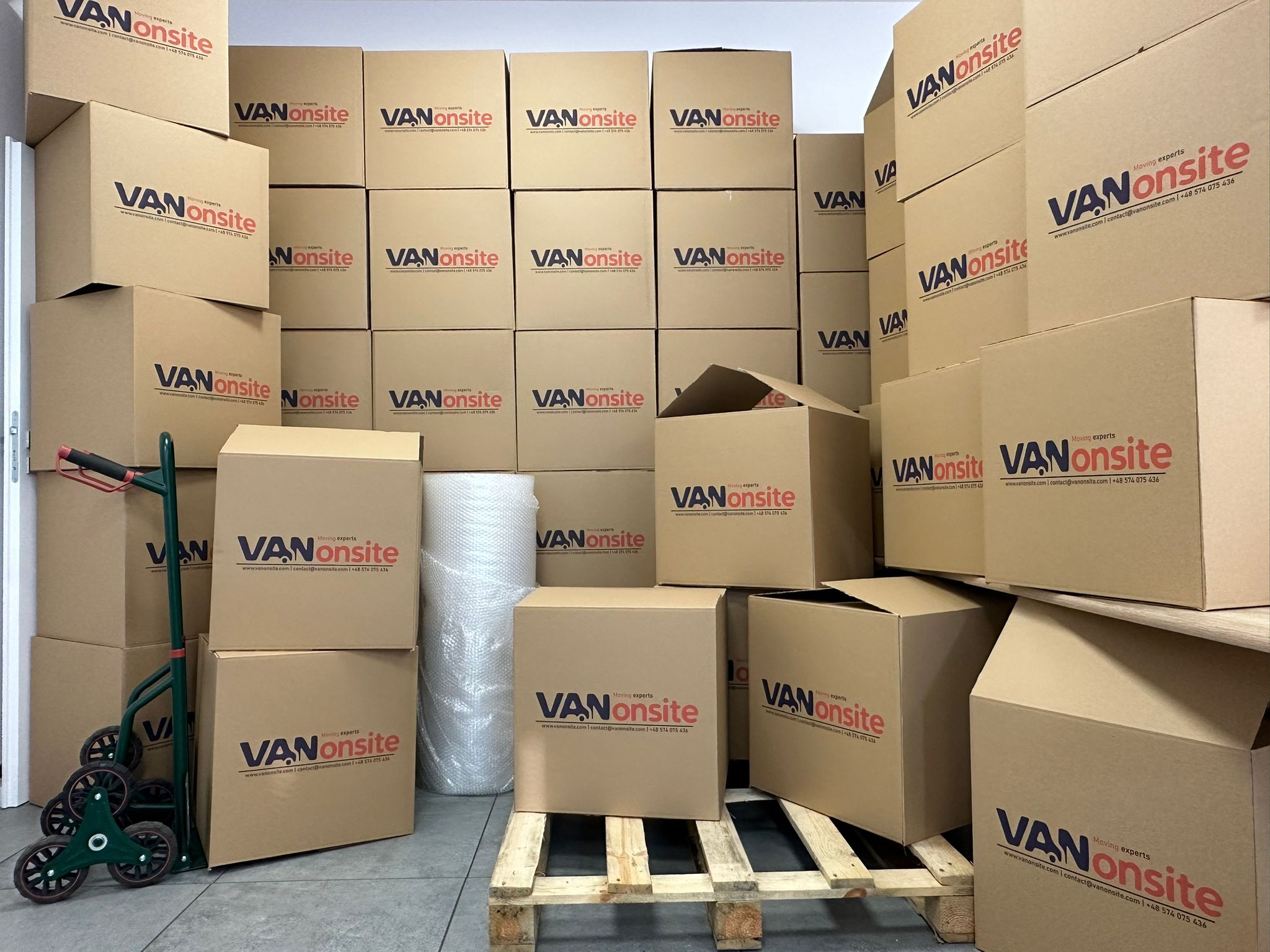
The safest way to plan is to avoid guessing. A one bedroom flat may create 20 to 40 boxes, while a family house can easily reach 80 to 150+ boxes depending on lifestyle, books, clothing, hobbies, kitchenware, office equipment, garage items, and loft storage.
VANonsite supports UK to Germany house moves with GPS tracked transport, careful loading, flexible vehicle sizes, packing support, storage, student removals, office removals, last minute moving, and white glove delivery for delicate or high value items.
| Moving need | VANonsite option | Capacity | Best for |
|---|---|---|---|
| Single item or very small move | Moving One | 1m3, 100kg | A few boxes, one chair, one compact item |
| Student room or small load | Moving Basic | 5m3, 300kg | Boxes, desk, mattress, small furniture |
| Studio or compact flat | Moving Medium | 10m3, 500kg | Boxes, bed, small sofa, desk, wardrobe |
| Larger flat or partial house | Moving Premium | 15m3, 1100kg | Multiple rooms, furniture, appliances |
| Family house move | Moving Premium Plus | 30m3, 3500kg | Full home contents and bulky items |
| Large house or complex relocation | Moving Full House XXL | 90m3, 20000kg | Full house, large property, office relocation |
For a tailored quote, send VANonsite your inventory, pickup postcode, German delivery city, number of boxes, photos of bulky items, access details, and preferred dates. The more precise your details, the easier it is to match the right vehicle, plan loading safely, and avoid last minute surprises.




Moving House from the UK to Germany Is a Big Step
A home does not disappear into boxes quietly. First go the mugs from the kitchen shelf. Then the books, the children’s toys, the winter coats, the mattress, and the desk where late night plans were made. Finally, the rooms start to echo. That is when moving house becomes real.
House removals UK to Germany are not just transport. They are the movement of a life from one country to another, with all the ordinary, precious, awkward things that make a home feel familiar. Boxes, furniture, documents, timing, customs, and delivery access all need to work together.
Moving boxes from UK to Germany may sound simple, but every box adds volume, weight, handling time, and responsibility. A box of books should be packed differently from bedding. A fragile kitchen box needs different care from a wardrobe box. A full house move needs a sharper plan than a few items in the back of a van.
VANonsite brings structure to that pressure. With GPS tracking for every load, flexible vehicles from 1m3 to 90m3, packing support, storage, last minute moving, student removals, office removals, furniture removals, home removals, and white glove delivery, the service can be shaped around the real size and urgency of your move.
Why House Removals UK to Germany Need Careful Planning
House removals UK to Germany are more complex than a local move because they involve distance, customs preparation, ferry or Eurotunnel timing, European road routes, German delivery access, and a full home’s worth of boxes and furniture that must stay protected for hundreds of miles.
A well planned UK to Germany house move starts with:
- A clear inventory of furniture, appliances, boxes, fragile items, and high value belongings.
- A realistic box count, sorted by room and box size.
- The right vehicle capacity for the actual load.
- Protected furniture and properly sealed boxes.
- Checked customs documents and address details.
- Confirmed parking, stairs, lifts, loading zones, and delivery access.
- A practical schedule that accounts for distance, route conditions, and delivery windows.
Since Brexit, household goods moving between the UK and Germany may need more careful paperwork than a domestic move. Personal belongings, furniture, boxes, work equipment, and newer items should be listed clearly. A vague note such as “house contents” is rarely as useful as a proper inventory showing what is being moved and how many boxes are included.
Boxes also need more attention than people expect. Every carton must survive lifting, stacking, road vibration, unloading, and possibly several days in transit. Heavy books should not go into large boxes. Fragile kitchen items need padding. Documents should stay with you. Bedroom essentials should be easy to find after arrival.
Vehicle sizing matters just as much. A 5m3 man and van load might be perfect for a student room, but it will not suit a family home with sofas, wardrobes, beds, appliances, toys, garden items, and 100 boxes. The aim is balance: enough space for safe loading without paying for empty air.
Delivery access in Germany can also change the whole plan. A quiet house outside Cologne is very different from a fourth floor apartment in central Berlin or a narrow street in Munich. Stairs, lifts, parking rules, pedestrian zones, building restrictions, and time windows should be checked before the van arrives.
VANonsite tracks every load, giving customers better visibility while their belongings move from the UK to Germany. When your furniture, boxes, documents, children’s items, work setup, and everyday essentials are on the road, that visibility brings real peace of mind.
What Is Included in a UK to Germany House Removals Service?
A good UK to Germany house removals service should feel organised before moving day begins. You should know what is being collected, how boxes and furniture will be protected, which vehicle is coming, how the route is planned, and what happens when the load reaches your new address in Germany.
With VANonsite, the service can be adapted to the real size of your move. Some customers need a compact man and van option for boxes, a mattress, a desk, and a few pieces of furniture. Others need a larger vehicle for a full household move with appliances, wardrobes, beds, fragile items, children’s belongings, office equipment, and storage contents.
A strong house removals UK to Germany service may include:
- Collection from your UK house, flat, student accommodation, storage unit, or office.
- Loading support for boxes, furniture, appliances, fragile items, and bulky pieces.
- Vehicle matching from 1m3 to 90m3, depending on volume and weight.
- Packing Service for stronger protection and less chaos.
- White Glove Delivery for premium, fragile, delicate, or high value items.
- GPS tracking for every load during transport.
- European road transport from the UK to Germany.
- Delivery to a house, apartment, office, student room, or storage location.
- Support for Home Removals, Furniture Removals, Office Removals, Student Removals, Storage, and Last Minute Moving.
| Service need | How VANonsite helps |
|---|---|
| Small man and van move | Flexible vehicle options for boxes, small furniture, student rooms, and part loads |
| Full house relocation | Larger capacity for furniture, appliances, boxes, and family belongings |
| Fragile or valuable items | Packing Service and White Glove Delivery for safer handling |
| Unclear move in dates | Storage support when timing does not line up perfectly |
| Urgent relocation | Last Minute Moving for time sensitive situations |
| Cross border reassurance | GPS tracking for every load from collection to delivery |
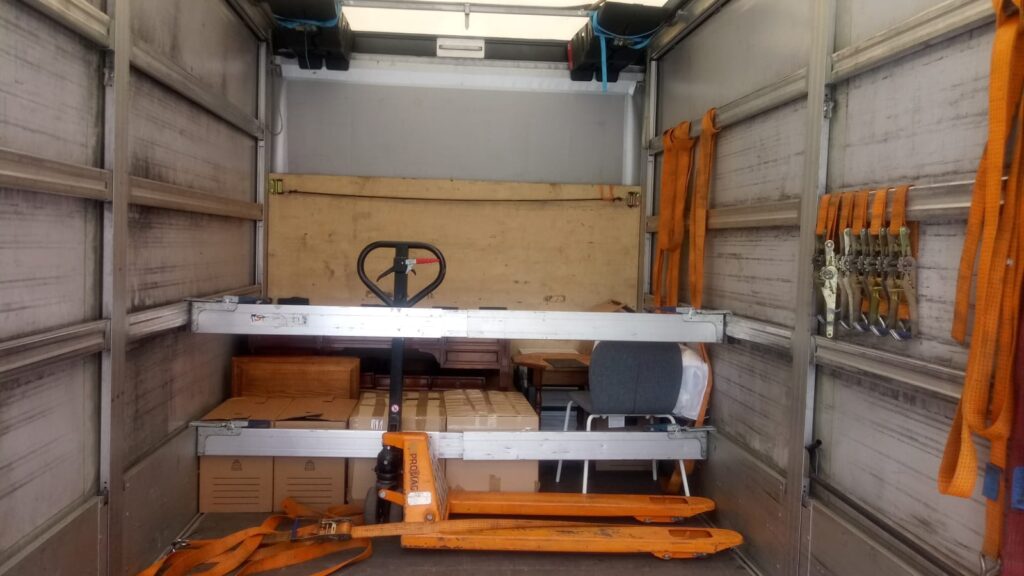
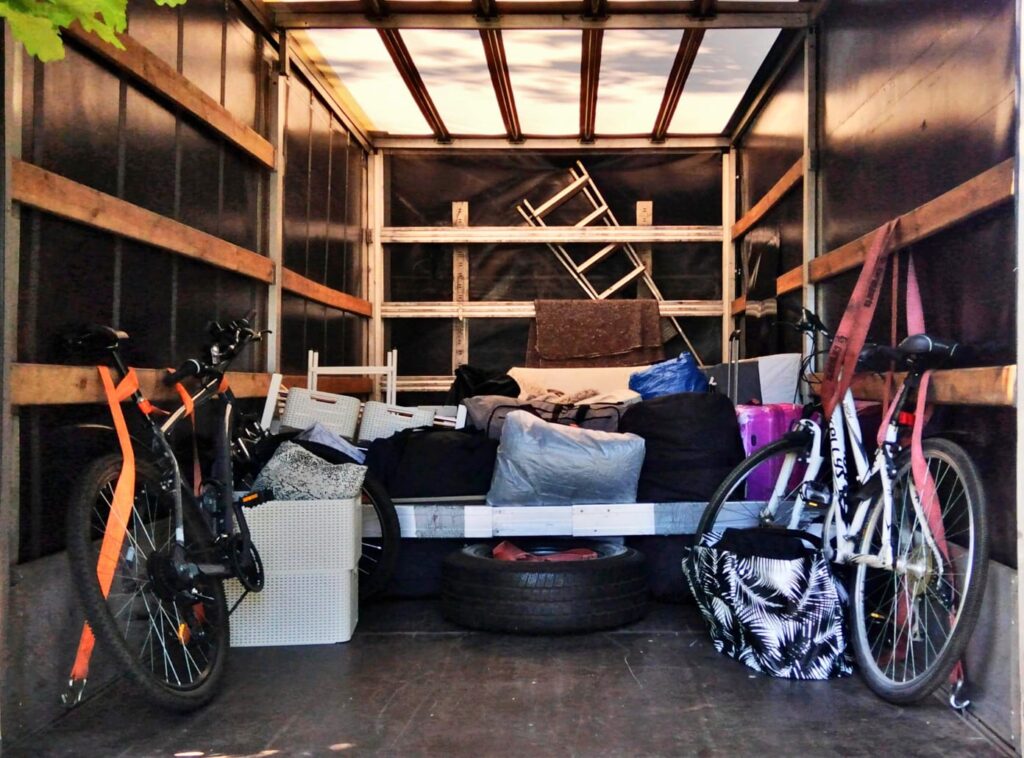
VANonsite’s vehicle range makes planning easier. A very small move may need Moving One at 1m3 and 100kg. A student room may suit Moving Basic at 5m3 and 300kg. A compact flat may need Moving Medium at 10m3 and 500kg. A larger flat may fit Moving Premium at 15m3 and 1100kg. A family home may need Moving Premium Plus at 30m3 and 3500kg. A large house or complex relocation may require Moving Full House XXL at 90m3 and 20000kg.
House Removals UK to Germany: Step by Step
House removals UK to Germany become easier when the process is broken into practical stages. Use the steps below as a roadmap for small man and van moves, student relocations, flat moves, family house removals, and larger European removals.
Step 1: Build a Full Home Inventory
Start with a full inventory before asking for a quote. Include furniture, appliances, boxes, fragile items, garden items, tools, bikes, office equipment, high value belongings, and anything unusually heavy or awkward to carry.
A good inventory should be specific. Instead of “bedroom furniture,” write: one double bed frame, one mattress, two bedside tables, one wardrobe, six medium boxes of clothing, one mirror, and one desk chair.
Practical box count ranges:
- A one bedroom flat may create 20 to 40 boxes.
- A two bedroom home may create 40 to 70 boxes.
- A family house may create 80 to 150+ boxes depending on storage, books, kitchen items, clothing, children’s belongings, hobbies, loft contents, garage items, and home office equipment.
If you have lived in one property for many years, add a 10% to 20% buffer. Homes collect quietly, especially in cupboards, sheds, lofts, under bed storage, and kitchen drawers.
Your inventory should include item names, quantities, bulky furniture dimensions, estimated box count by room, fragile item notes, photos, floor levels, lift availability, parking restrictions, dismantling needs, and items requiring extra care such as glass, marble, mirrors, electronics, or artwork.
Step 2: Estimate the Number of Boxes
Moving boxes from UK to Germany is one of the biggest parts of a house move, and it often gets underestimated. The number and size of boxes can affect van size, loading time, and the overall international removals UK to Germany cost.
| Box type | Typical use | Packing tip |
|---|---|---|
| Small box | Books, tools, heavy kitchen items | Keep heavy items compact so the box can be lifted safely |
| Medium box | Clothes, toys, mixed household goods | Best all round box size for most rooms |
| Large box | Bedding, lampshades, cushions | Use for light bulky items only |
| Wardrobe box | Hanging clothes | Useful for faster unpacking and crease reduction |
| Fragile box | Glassware, plates, ornaments | Use padding and clear labels on at least two sides |
| Document box | Papers, contracts, IDs | Keep key documents separate and easy to access |
Try to count boxes by room: kitchen, bedroom, living room, bathroom, office, children’s room, garage, loft, and garden. This helps with quoting, loading, and delivery in Germany.
Step 3: Choose the Right VANonsite Vehicle Size
Correct vehicle sizing protects both your budget and your belongings. If the van is too small, items may be packed too tightly. If the van is far too large, you may pay for capacity you do not need. The sweet spot is enough space for safe, organised loading.
| Home size | Likely VANonsite option | Capacity | Notes |
|---|---|---|---|
| Few boxes or single item | Moving One | 1m3, 100kg | Very small load or selected belongings |
| Student room | Moving Basic | 5m3, 300kg | Boxes, mattress, desk, light furniture |
| Studio or small flat | Moving Medium | 10m3, 500kg | Good for compact flat contents |
| One to two bedroom flat | Moving Premium | 15m3, 1100kg | More space for mixed furniture and boxes |
| Family home | Moving Premium Plus | 30m3, 3500kg | Strong option for larger household moves |
| Large house | Moving Full House XXL | 90m3, 20000kg | Full property relocation or complex move |
The right choice depends on volume, weight, furniture shape, box count, and access. Send VANonsite photos of each room, a box estimate, and a furniture list if you are unsure.
Step 4: Pack by Room, Not by Panic
Room based packing makes delivery and unpacking in Germany much easier. Pack room by room and label each box clearly. A label such as “Kitchen fragile, do not stack” is more useful than “Box 12.”
A practical packing order is:
- Storage areas and seasonal items.
- Books, decorations, and non essentials.
- Spare rooms and office equipment.
- Kitchen items, with fragile pieces packed early and carefully.
- Clothing and bedroom items.
- Bathroom and personal items.
- Last day essentials.
Step 5: Prepare Customs Documents Early
Because the UK is outside the EU customs territory, moving house from the UK to Germany may involve customs preparation. Requirements can depend on your circumstances, whether you are transferring residence, what you are moving, how long you have owned the goods, and whether anything is new, restricted, high value, or commercial.
Before moving day, check the GOV.UK customs declaration checker and the GOV.UK guidance on declaring personal goods you bring into or take out of the UK. For Germany, review German Customs guidance on transferring residence and staying in Germany.
Useful documents may include passport or national ID, UK address proof, German address proof, inventory list, box count, estimated values, transport booking details, and proof that the goods are personal belongings. Keep important documents with you, not buried inside the main load.
Step 6: Confirm Access, Parking, and Delivery Rules
Before collection, check whether the van can park near your UK property, whether there are loading restrictions, whether stairs or lifts are involved, and whether large items need dismantling. Then check the German delivery address with the same care.
Tell VANonsite early about floor levels, lift availability, narrow stairs, parking restrictions, pedestrian zones, long carrying distances, large items, and delivery time windows.
Step 7: Track the Move and Inspect After Delivery
Once your load is on the road, visibility matters. VANonsite offers GPS tracking for every load, helping reduce uncertainty while your belongings travel from the UK to Germany.
After delivery, check furniture corners, glass, mirrors, electronics, boxes marked fragile, mattresses, and high value belongings. Make sure priority boxes are easy to reach and essential items are not buried at the back of a room.

Moving Boxes from UK to Germany: Practical Packing Advice
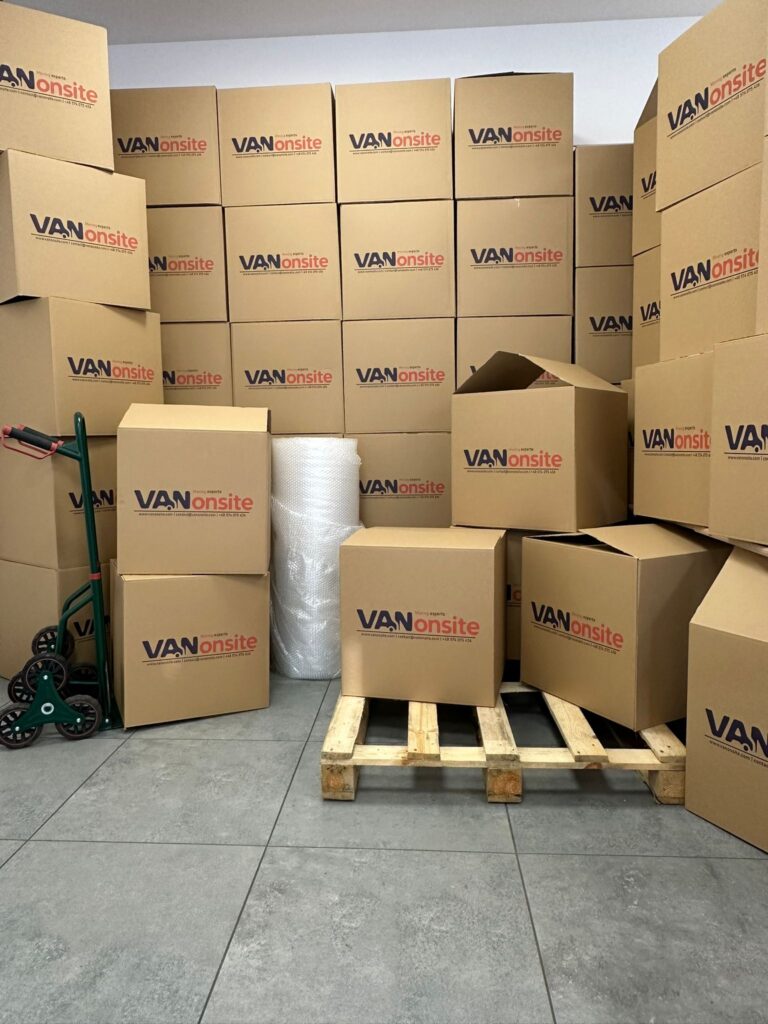
Moving boxes from UK to Germany is not just a packing job. It is a protection job. Every box has to survive lifting, stacking, road movement, unloading, and the final shuffle into a new home.
Use these rules before moving day:
- Use smaller boxes for heavy items such as books, tools, tins, plates, and files.
- Use large boxes only for light bulky goods such as bedding, cushions, lampshades, and soft toys.
- Label every box on at least two sides.
- Use room labels and priority labels together.
- Mark fragile boxes clearly.
- Do not leave empty space inside boxes.
- Keep passports, contracts, customs documents, medication, and key paperwork with you.
- Photograph high value items before packing.
- Create a simple box count sheet by room.
| Label | Meaning | Why it helps |
|---|---|---|
| Kitchen fragile | Glassware, plates, mugs | Helps movers handle carefully |
| Bedroom priority | Bedding, clothes, essentials | Easier first night setup |
| Office urgent | Laptop stand, cables, documents | Faster work setup in Germany |
| Do not stack | Fragile or soft top item | Reduces crushing risk |
| Open first | Essentials | Prevents frantic searching after delivery |
For plates and glassware, use padding between items and avoid hollow gaps. Plates are often safer packed vertically, like records, rather than flat in a heavy stack. For electronics, photograph cable setups before unplugging anything. Keep cables, chargers, stands, and documents together so work can restart faster in Germany.
One of the most useful boxes is the first night box. Include bedding, toiletries, chargers, medication, basic tools, a change of clothes, snacks, cleaning wipes, documents, and anything you need during the first 24 to 48 hours.
VANonsite Packing Service can help customers who do not have the time, confidence, materials, or patience to pack safely before a long European move. It is especially useful for fragile items, larger homes, urgent relocations, and customers who want fewer risks on moving day.
International Removals UK to Germany Cost: What Affects the Price?
The international removals UK to Germany cost depends on the real size of your move, not just the distance between two addresses. A small 5m3 man and van move with boxes, a mattress, and a desk is completely different from a 30m3 family home move with sofas, wardrobes, appliances, children’s furniture, office equipment, and 100+ boxes.
| Cost factor | Why it matters | Impact |
|---|---|---|
| Volume in m3 | Determines vehicle size and space required | High |
| Weight | Affects loading, handling, and vehicle suitability | Medium to high |
| Distance | UK pickup and German delivery city shape the route | High |
| Number of boxes | Adds volume, loading time, and unloading work | Medium |
| Furniture size | Bulky items need more space and stronger protection | Medium to high |
| Access | Stairs, lifts, parking, narrow streets, and long carries affect labour time | Medium |
| Packing support | Saves time and reduces damage risk, but adds service time | Medium |
| Urgency | Last minute moves may need faster scheduling or dedicated planning | Medium to high |
| Customs preparation | Missing or unclear paperwork can create delay risk | Medium |
| Service level | White glove delivery adds extra care for premium or delicate items | Medium to high |
A move from London to Cologne may be simpler than a move from rural Scotland to Munich. A ground floor house with easy parking may take less handling time than a fourth floor apartment with no lift. A home with 40 boxes will not create the same workload as a home with 140 boxes.
To get a realistic quote from VANonsite, prepare:
- UK pickup postcode.
- German delivery city and postcode.
- Total number of boxes, ideally by room.
- Furniture inventory with dimensions where possible.
- Photos of bulky, fragile, or high value items.
- Floor levels and lift details at both addresses.
- Parking or access restrictions.
- Packing support needs.
- Preferred collection and delivery dates.
- Any urgent timing requirements.
A clear quote protects you from the worst kind of moving surprise: the one that appears after everything is already packed.
How Long Do House Removals UK to Germany Take?
House removals UK to Germany can often be arranged faster when the inventory is clear, documents are ready, and access details are known. Timing depends on the size of the move, UK pickup location, German destination, vehicle availability, customs preparation, packing requirements, and whether the move is planned or last minute.
| Move type | Suggested planning time | Notes |
|---|---|---|
| Few boxes or small man and van move | 1 to 7 days where available | Best with a ready inventory and simple access |
| Student or room move | 3 to 10 days | Usually lighter, faster, and simpler to organise |
| One bedroom flat | 1 to 2 weeks | Needs inventory, box count, and packing time |
| Family home | 2 to 6 weeks | More boxes, furniture, documents, and access planning |
| Large house or office | 3 to 6 weeks | Requires capacity planning and a more detailed schedule |
| Last minute move | As soon as possible | Clear details speed up response and vehicle matching |
Route also affects timing. A move to Cologne may follow a different schedule from a move to Berlin, Hamburg, Munich, Frankfurt, Stuttgart, Leipzig, or Dresden. Distance matters, but so do building rules, city access, parking conditions, and delivery time windows.
Customs readiness can influence the schedule as well. If your inventory is unclear or documents are missing, the journey may become slower and more stressful. The fastest way to help VANonsite plan your timeline is to send a complete moving picture: inventory, box count, postcodes, photos, access notes, preferred dates, and any deadline that cannot move.
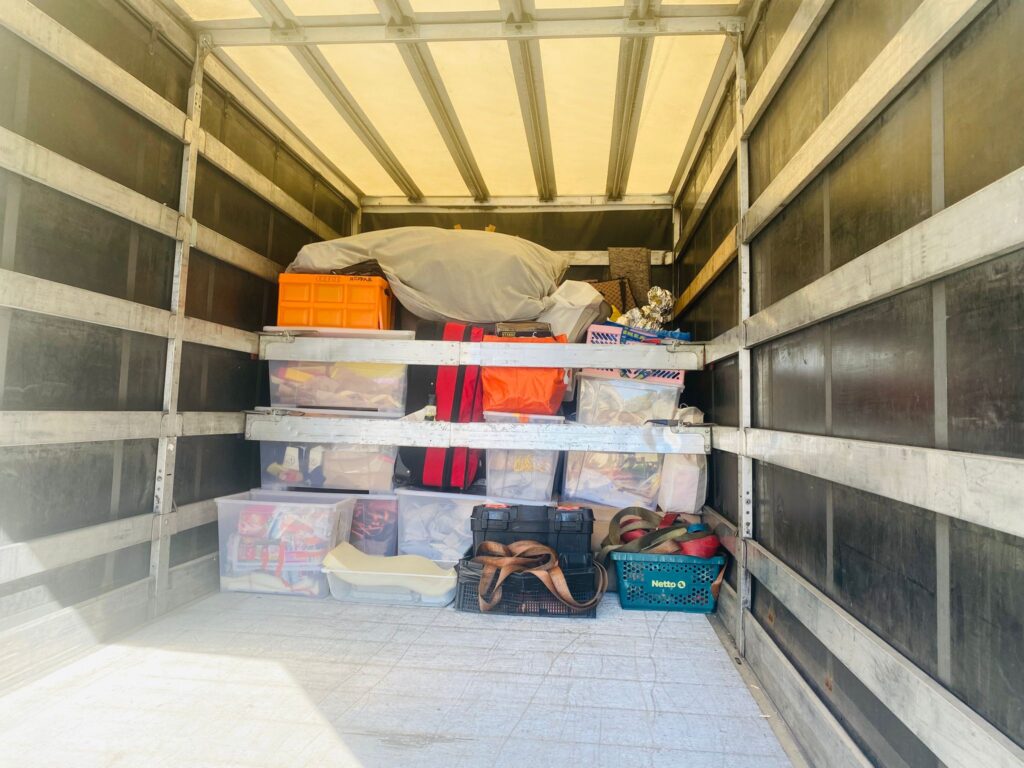
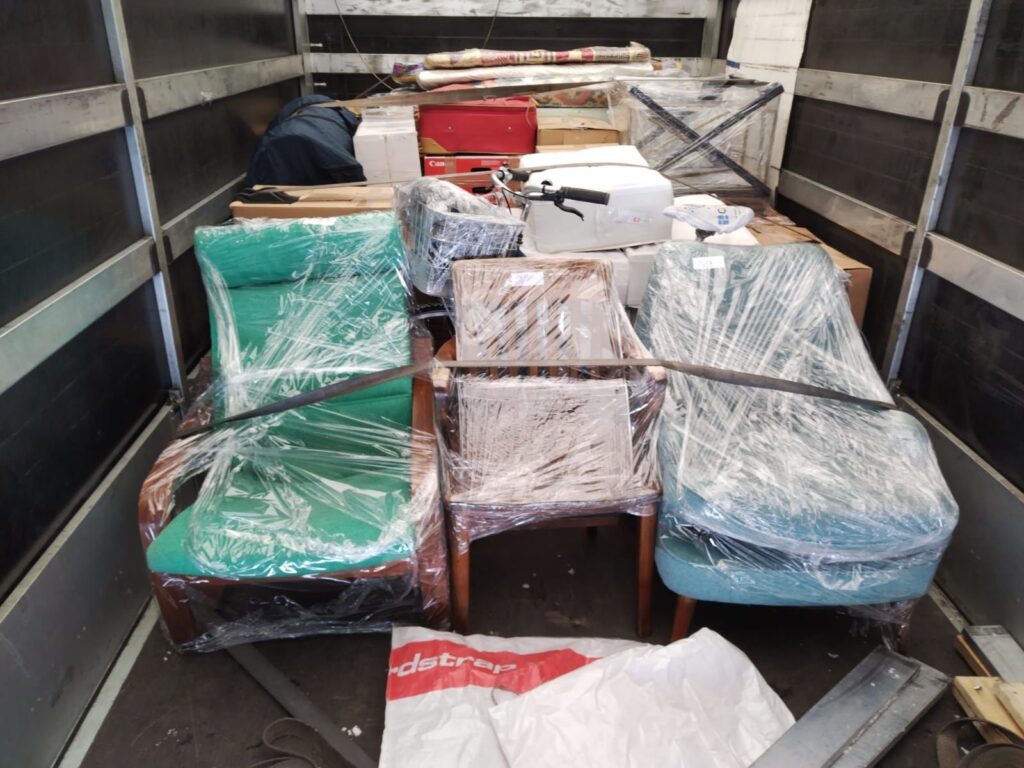
Documents and Customs for Moving House from the UK to Germany
Because the UK is outside the EU customs territory, moving house from the UK to Germany can involve customs preparation. For personal household goods, requirements can depend on whether you are transferring residence, what you are moving, how long you have owned the goods, and whether anything is new, restricted, high value, or commercial.
Before moving day, check the GOV.UK customs declaration checker and the GOV.UK guidance on declaring personal goods you bring into or take out of the UK. For Germany, review German Customs guidance on transferring residence and staying in Germany. Use these official sources as your final reference.
A clear inventory is the heart of the paperwork. Do not describe the shipment as “house contents” or “miscellaneous boxes.” List the main categories and high value items clearly: used household furniture, kitchen items, clothing, books, children’s items, office equipment, personal belongings, and appliances where relevant.
| Document or information | Why it may be needed |
|---|---|
| Passport or national ID | Confirms identity |
| UK address proof | Shows previous residence |
| German address proof | Shows destination and relocation purpose |
| Inventory list | Shows what is being moved |
| Box count | Helps match shipment to inventory |
| Estimated values | Helps describe goods |
| Proof goods are personal belongings | Helps separate household goods from commercial stock |
| Transport booking details | Connects the goods to the move |
| Receipts for high value or newer items | Useful if ownership or value is questioned |
| Work, tenancy, or relocation documents | May support transfer of residence context |
If you are transferring residence, keep evidence that supports the move, such as a tenancy agreement, property purchase document, work relocation letter, registration details, or other proof connected to your German address.
Pay special attention to anything that does not look like ordinary used household goods. New furniture, commercial stock, multiple identical items, expensive electronics, alcohol, plants, food, animal products, or restricted goods may need extra checks or different rules.
A simple document checklist:
- Create a detailed inventory of household goods.
- Count boxes by room or category.
- Add estimated values where needed.
- Prepare proof of identity.
- Prepare UK and German address details.
- Keep transport booking details available.
- Keep receipts for high value or newer items.
- Check whether transfer of residence guidance applies.
- Keep key documents with you, not inside the main shipment.
- Recheck official GOV.UK and German Customs guidance before moving day.
Best Way to Pack a House for a UK to Germany Move
Packing for a UK to Germany move should be done with distance in mind. Your boxes and furniture may be lifted, stacked, secured, driven across borders, unloaded, and carried into a new property where access may be completely different from the UK address.
Start with the items you use least: seasonal clothing, spare bedding, decorations, books, archive documents, garden items, and storage cupboards. Leave daily essentials until the end, but do not leave everything until the final 48 hours.
Pack by room whenever possible. Mixing rooms in one box may feel faster in the moment, but it makes unpacking in Germany harder. Use strong tape and double tape heavy boxes. Books, tools, files, plates, and kitchen items should go into smaller boxes. Large boxes should be saved for light bulky items.
For fragile kitchen items, wrap carefully and fill empty spaces so nothing rattles. Plates are often safer packed vertically, like records. Electronics also deserve a system: photograph cable setups before unplugging televisions, monitors, desktop computers, speakers, routers, and office equipment.
If you are moving appliances, defrost and clean them in advance. Fridges and freezers should be empty, dry, and ready before collection. Keep passports, tenancy papers, customs documents, employment paperwork, insurance documents, medication details, and transport information with you.
Your first night box should include:
- Bedding.
- Toiletries.
- Medication.
- Chargers.
- Snacks.
- Kettle or coffee basics.
- Basic tools.
- Cleaning wipes.
- Important documents.
- Clothes for 24 to 48 hours.
VANonsite Packing Service can help if you are short on time, worried about fragile items, or managing a full family move with too many rooms to pack calmly.
What Should You Move, Store, Sell, or Leave Behind?
One of the smartest ways to reduce the pressure of house removals UK to Germany is to move less, but move better. Every box, chair, lamp, appliance, and forgotten cupboard item adds volume, weight, handling time, and cost.
Use this table to sort your home before the final inventory:
| Move | Store | Sell or donate | Leave behind |
|---|---|---|---|
| Valuable furniture | Seasonal items | Duplicate furniture | Broken flat pack pieces |
| Essential beds and desks | Items needed later | Low value bulky items | Damaged appliances |
| Sentimental items | Documents or archive boxes | Unused décor | Furniture that will not fit |
| Work equipment | Spare household goods | Extra kitchenware | Items with mould or pests |
The “move” category should include items that are useful, valuable, difficult to replace, or emotionally important. The “store” category is useful when dates do not line up perfectly. VANonsite Storage can help bridge the awkward gap between collection and final delivery.
The “sell or donate” category can be liberating. Duplicate chairs, unused décor, spare kitchenware, old lamps, cheap shelving, or low value bulky items may not be worth sending across Europe. The “leave behind” category is where honesty saves money: broken flat pack pieces, damaged appliances, mouldy furniture, unstable shelving, and items that will not fit your German property should be removed from the plan early.
A 10% to 20% reduction in volume can make a real difference to packing time, loading effort, vehicle choice, and the first week in Germany.
Why Choose VANonsite for House Removals UK to Germany?
VANonsite is a strong choice for people who want house removals UK to Germany to feel organised, fast, careful, and visible from collection to delivery. When your whole home is on the road, you do not want vague updates or a van chosen by guesswork. You want a moving plan that respects your time, your belongings, and the size of the change you are making.
The company’s strength is flexibility with discipline. VANonsite can support compact man and van moves, student relocations, apartment moves, full house removals, office removals, packing, storage, white glove delivery, and last minute moving.
Every VANonsite load is GPS tracked. This is one of the most valuable trust signals during international removals because distance creates uncertainty.
| VANonsite strength | Why it matters |
|---|---|
| GPS tracking | Customers know where their load is during transport |
| Flexible vehicle sizes | Helps avoid underbooking, overpaying, or unsafe loading |
| Packing support | Reduces stress and lowers damage risk before a long journey |
| European removals focus | Better suited to cross border moves than a casual local setup |
| Man and van flexibility | Ideal for smaller moves, part loads, students, and urgent relocations |
| Larger vehicle capacity | Supports full house removals and high volume moves |
| White Glove Delivery | Adds extra care for delicate, premium, or high value items |
| Storage option | Useful when UK collection and German move in dates do not match |
| Last Minute Moving | Helps when deadlines are tight and the move cannot wait |
Choosing VANonsite is especially sensible if you want GPS tracking, vehicle options from 1m3 to 90m3, man and van flexibility, packing support, white glove delivery, storage, urgent relocation help, and support for Home Removals, Furniture Removals, Office Removals, and Student Removals.
House Removals UK to Germany Checklist
Use this checklist before booking and again during the final week before collection:
- Confirm your German address and move in date.
- List furniture, boxes, appliances, and fragile items.
- Estimate total boxes by room.
- Photograph bulky and high value items.
- Decide what to move, store, sell, or donate.
- Check customs guidance on GOV.UK and German Zoll.
- Prepare ID, address proof, inventory, and transport details.
- Choose the right VANonsite vehicle size.
- Book packing support if needed.
- Label boxes by room and priority.
- Confirm parking, stairs, lifts, and access rules.
- Keep documents and first night essentials with you.
- Track your load with GPS.
- Inspect boxes and furniture after delivery.
Common Mistakes to Avoid
Even a well planned move can become stressful when small details are missed. Avoid these common mistakes:
- Guessing the box count instead of counting boxes by room and size.
- Underestimating van size once furniture, appliances, and access are considered.
- Mixing rooms in boxes, which makes delivery and unpacking harder.
- Packing heavy books, tools, files, plates, and tins in large boxes.
- Forgetting customs documents or leaving them inside the main shipment.
- Not checking German apartment access, including stairs, lifts, parking, and time windows.
- Leaving parking permits too late at either address.
- Choosing the cheapest quote without checking vehicle size, loading help, packing support, GPS tracking, fragile item handling, access conditions, waiting time, and extra charges.
- Forgetting a first night box with bedding, chargers, medication, toiletries, basic tools, and documents.
- Booking too late during busy periods such as end of month dates, summer, school holidays, student move periods, and work relocation windows.
For larger moves, booking 2 to 6 weeks ahead is usually safer. For urgent moves, clear information helps VANonsite respond faster.
Frequently Asked Questions About House Removals UK to Germany
How Much Do House Removals UK to Germany Cost?
The international removals UK to Germany cost depends on volume, number of boxes, furniture size, total weight, distance, access, urgency, packing support, customs readiness, and service level. A small man and van move with 20 to 30 boxes is very different from a family home relocation with 100+ boxes, sofas, wardrobes, appliances, and fragile items.
For the most accurate quote, send VANonsite your inventory, box count, pickup postcode, German delivery city, photos of bulky items, floor levels, parking notes, preferred dates, and any packing or storage needs.
Can I Book a Man and Van for House Removals UK to Germany?
Yes. A man and van service can work very well for smaller homes, student moves, flat moves, part loads, boxes only, and urgent relocations. VANonsite offers vehicle options from 1m3 to 90m3, so the service can be shaped around the real size of your move.
How Many Boxes Will I Need for Moving House from the UK to Germany?
A one bedroom flat may create 20 to 40 boxes, a two bedroom home may create 40 to 70 boxes, and a larger family home may create 80 to 150+ boxes. The final number depends on lifestyle, storage, books, kitchenware, clothing, children’s belongings, hobbies, loft contents, garage items, and home office equipment.
Do I Need Customs Documents for Moving House from the UK to Germany?
You may need customs documents because the UK is outside the EU customs territory. Requirements can depend on your circumstances, whether you are transferring residence, what you are moving, how long you have owned the goods, and whether anything is new, restricted, high value, or commercial. Check GOV.UK and German Zoll guidance before moving day.
Does VANonsite Offer GPS Tracking?
Yes. VANonsite offers GPS tracking for every load. This gives customers better visibility while their belongings travel from the UK to Germany and helps reduce uncertainty during the international journey.
Can VANonsite Help with Packing?
Yes. VANonsite offers Packing Service for customers who want safer preparation, less stress, and better protection for fragile or high value items. Packing support can be especially useful for full house moves, delicate furniture, glassware, mirrors, electronics, artwork, and urgent relocations.
Can I Move Only Boxes from the UK to Germany?
Yes. VANonsite can support moving boxes from UK to Germany, including small man and van loads, student boxes, flat moves, office boxes, and part loads. A clear box count, room labels, fragile labels, and priority labels help make the move faster and safer.
How Early Should I Book UK to Germany House Removals?
For larger house removals UK to Germany, booking 2 to 6 weeks ahead is usually best where possible. Smaller moves may be arranged faster depending on availability. Last minute moves may also be possible, especially when you can provide a clear inventory, box count, addresses, access notes, and preferred dates quickly.
Ready to Move House from the UK to Germany?
House removals UK to Germany do not have to feel like a storm of boxes, forms, ferry times, customs questions, and unanswered messages. With the right support, your move can become a clear plan: measured, packed, tracked, and delivered with care.
VANonsite gives you the practical tools to move with more confidence: GPS tracking for every load, flexible vehicle sizes from 1m3 to 90m3, man and van options, packing support, storage, last minute moving, home removals, office removals, student removals, furniture removals, and white glove delivery for delicate items.
If you are still planning the wider relocation, explore VANonsite’s guide to removals to Germany for more support on moving from the UK to Germany.
To get a tailored quote, send VANonsite your UK pickup postcode, German delivery city and postcode, preferred collection and delivery dates, furniture and appliance inventory, estimated number of boxes, photos of bulky or fragile items, access details, and any packing, storage, or last minute moving requirements.
Turn the move into a plan, not a panic. Share the details, choose the right vehicle, prepare the documents, and let VANonsite help move your home into its next chapter safely.