Immigration to Ireland can open the door to an exciting new chapter. The country attracts professionals, students, families and entrepreneurs with its English-speaking labour market, respected universities, international companies and close connections with Europe, the United Kingdom and North America.
However, the process is different for every applicant. Your nationality, reason for moving and expected length of stay determine whether you need a visa, an employment permit, immigration registration or additional approval.
Successful immigration to Ireland involves more than obtaining permission to enter the country. You must also arrange accommodation, employment, healthcare, taxes, banking and the transport of your belongings. Planning these elements together can reduce stress, prevent expensive delays and help you settle in more quickly.
Once your legal arrangements are underway, VANonsite can support your removals to Ireland, including packing, secure European transport, GPS tracking and delivery to your new address.
TL:DR: Immigration to Ireland in 7 Key Points
- EU, EEA and Swiss citizens can generally enter Ireland without a visa or employment permit.
- British citizens can live, work and study in Ireland under the Common Travel Area.
- Most non-EEA nationals need the correct immigration permission for stays longer than 90 days.
- Non-EEA professionals usually need an employment permit unless an exemption applies.
- An entry visa, employment permit and residence permission are separate documents.
- New residents may need to arrange immigration registration, a PPS Number, tax registration and healthcare.
- Professional removals planning can simplify packing, customs procedures and household transport.




Can You Immigrate to Ireland?
Yes, you can immigrate to Ireland for employment, education, family reunification, business or another approved reason. The exact requirements depend on your citizenship, intended activities and planned length of residence.
Ireland is a member of the European Union, but it is not part of the Schengen Area. This means that a Schengen visa or residence permit issued by another European country does not automatically give you the right to enter, live or work in Ireland.
Before you emigrate to Ireland, identify the category that applies to you.
| Citizenship category | Visa normally required? | Employment permit normally required? | Immigration registration normally required? |
|---|---|---|---|
| EU or EEA citizen | No | No | No standard IRP registration |
| Swiss citizen | No | No | No standard IRP registration |
| British citizen | No | No | No |
| Non-EEA citizen | Depends on nationality | Usually | Usually for stays over 90 days |
| Non-EEA family member | Depends on circumstances | Depends on permission | Usually |
These are general principles. Applicants should confirm their individual position through the official Irish Immigration Service.
Immigration to Ireland for EU, EEA and Swiss Citizens
Citizens of EU and EEA countries, as well as Switzerland, can generally enter Ireland without a visa. They should carry a valid passport or national identity card.
They also do not normally need an employment permit. This makes Ireland immigration significantly simpler for Europeans moving for work, business or study.
For residence lasting longer than three months, an EU, EEA or Swiss citizen should normally be:
- Employed
- Self-employed
- Studying
- Seeking work under qualifying conditions
- Financially self-sufficient
Students and financially self-sufficient residents may also need appropriate healthcare coverage.
EU, EEA and Swiss citizens do not normally apply for an Irish Residence Permit. However, non-EEA family members may need a separate residence card under EU Treaty Rights.
Immigration to Ireland for British Citizens
British citizens can live, work and study in Ireland under the Common Travel Area.
This arrangement allows Irish and British citizens to move between the two countries and access rights connected with residence, employment, education and healthcare. British citizens do not normally need an Irish visa, employment permit or Irish Residence Permit.
However, these rights apply to British citizens themselves. A spouse, partner or dependent who is not British or Irish may have to follow separate immigration rules.
Mixed-nationality families should therefore check the status of each person before migrating to Ireland.
Official information about the Common Travel Area is available on the Irish Government website.
Immigration to Ireland for Non-EEA Citizens
The process is usually more detailed for citizens from outside the EU, EEA, Switzerland and the United Kingdom.
A non-EEA national may need:
- An employment permit or another form of prior approval.
- An Irish visa, depending on nationality.
- Permission to enter at the border.
- Immigration registration after arrival.
- An Irish Residence Permit.
A visa allows a person to travel to Ireland and request entry. It does not guarantee admission and does not automatically provide the right to work.
Non-EEA nationals planning to work, study, join family or remain for more than 90 days generally need the correct long-term immigration permission. They must usually register after arrival.
Main Immigration Routes to Ireland
Choosing the correct route is one of the most important stages of immigration to Ireland. A visitor permission cannot be treated as a work permit, while student permission does not provide unrestricted employment rights.
Moving to Ireland for Work
For many non-EEA professionals, the process begins with a qualifying job offer.
Ireland operates several employment permit categories, including:
- Critical Skills Employment Permit
- General Employment Permit
- Intra-Company Transfer Employment Permit
- Contract for Services Employment Permit
- Internship Employment Permit
- Dependant, Partner or Spouse Employment Permit
- Sport and Cultural Employment Permit
Eligibility can depend on the occupation, salary, employer, qualifications and current labour market rules.
A Critical Skills Employment Permit is designed for highly skilled positions in areas where Ireland needs qualified professionals. A General Employment Permit covers a wider range of occupations, although additional conditions may apply.
Applicants should check current requirements through the official Department of Enterprise employment permit portal.
A signed job offer does not automatically give a non-EEA citizen permission to start working. The appropriate employment and immigration approvals must be granted first.
Moving to Ireland to Study
Migrating to Ireland as a student requires acceptance onto an eligible educational programme.
Depending on the applicant’s nationality and course, the required documents may include:
- An official enrolment letter
- Proof of tuition fee payment
- Proof of sufficient financial resources
- Private medical insurance
- Academic records
- Accommodation details
- A valid passport
- A study visa, if required
Non-EEA students should confirm that their course supports an Irish immigration permission before paying substantial fees.
Students granted Stamp 2 permission may work a limited number of hours during approved periods. However, studying must remain the main purpose of residence.
A student moving with books, clothing, a computer and personal furniture may benefit from a compact man and van or part-load service rather than paying for excessive airline luggage.
Joining Family in Ireland
The family reunification process depends on the status of the person already living in Ireland.
Different procedures apply when joining:
- An Irish citizen
- An EU, EEA or Swiss citizen
- A British citizen
- A non-EEA employment permit holder
- A person with refugee or international protection status
- Another qualifying resident
Eligible family members may include spouses, civil partners, de facto partners and dependent children. Dependent parents and adult children are considered under stricter conditions.
Visa-required nationals who plan to join family for more than three months may need a long-stay D visa before travelling.
Applicants should review the official family immigration guidance before making travel or removal arrangements.
Moving to Ireland for Business
EU, EEA, Swiss and British citizens generally have broad access to self-employment in Ireland.
Non-EEA entrepreneurs need an immigration permission that specifically allows business activity. Depending on the route, they may need to provide:
- A viable business plan
- Evidence of investment capital
- Professional experience
- Proof of the source of funds
- Revenue forecasts
- Evidence that the business can create employment
Anyone planning to immigrate to Ireland to establish a company should check immigration, tax and company registration obligations before investing.
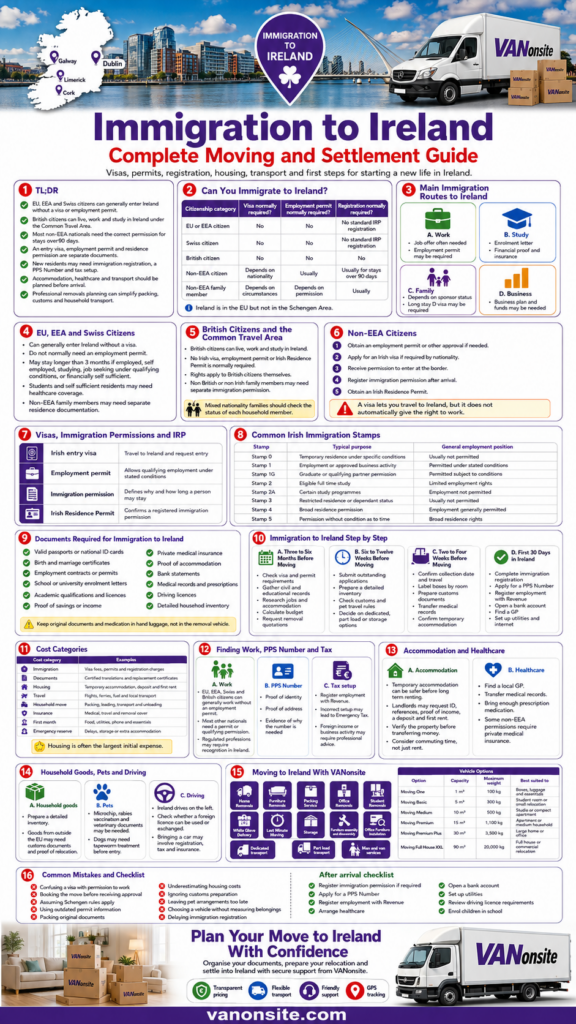
Irish Visas, Immigration Permissions and Residence Stamps
Several different documents may be involved in Ireland immigration. Understanding their purpose can prevent serious mistakes.
| Document or status | Main purpose |
|---|---|
| Irish entry visa | Allows a visa-required person to travel to Ireland and request entry |
| Employment permit | Allows qualifying employment under specific conditions |
| Immigration permission | Defines why and how long a person may stay |
| Irish Residence Permit | Confirms a registered immigration permission |
| Immigration stamp | Shows the conditions attached to residence |
A long-stay D visa is generally used by visa-required nationals coming to Ireland for more than three months. It may apply to work, study or family reunification.
After arrival, the visa holder may still need to register and receive an Irish Residence Permit.
Irish Residence Permit and Registration
People arriving from outside the EU, EEA, Switzerland and the United Kingdom who intend to remain for more than 90 days generally need to register their immigration permission.
The Irish Residence Permit, usually called an IRP, confirms:
- The type of permission held
- The permitted activities
- The expiry date
- The immigration stamp category
Registration should be completed within the period granted after arrival. Applicants must provide documents connected with their immigration route.
Current information is available through the Irish Immigration registration portal.
Common Irish Immigration Stamps
| Stamp | Typical purpose | General employment position |
|---|---|---|
| Stamp 0 | Temporary residence under specific conditions | Usually not permitted |
| Stamp 1 | Employment or approved business activity | Permitted under stated conditions |
| Stamp 1G | Graduate or qualifying partner permission | Permitted subject to conditions |
| Stamp 2 | Eligible full-time study | Limited employment rights |
| Stamp 2A | Certain study programmes | Employment not permitted |
| Stamp 3 | Restricted residence or dependant status | Usually not permitted |
| Stamp 4 | Broad residence permission | Employment generally permitted |
| Stamp 4EUFAM | Qualifying family member under EU Treaty Rights | Subject to permission conditions |
| Stamp 5 | Permission without condition as to time | Broad residence rights |
The exact conditions attached to the permission are more important than the stamp number alone. Residents should always check their individual documents before accepting employment or changing their circumstances.
Documents Required for Immigration to Ireland
The exact documents depend on nationality and immigration route. Nevertheless, preparing a secure file before the move can prevent unnecessary delays.
Common documents include:
- Valid passports
- National identity cards
- Birth certificates
- Marriage or civil partnership certificates
- Children’s birth certificates
- Employment contracts
- Employment permits
- University or school enrolment letters
- Academic qualifications
- Professional licences
- Proof of savings or income
- Private medical insurance
- Proof of accommodation
- Bank statements
- Police clearance certificates when requested
- Medical records and prescriptions
- Driving licences
- Pet travel documents
- A detailed household inventory
Some documents may require certified translations or legalisation.
Keep original immigration documents, medication, contracts and valuable certificates in your hand luggage. Do not place them inside boxes loaded into a removal vehicle.
Immigration to Ireland Step by Step
Three to Six Months Before Moving
Begin by confirming your immigration route and gathering documents.
You should:
- Check visa and employment permit requirements.
- Research employment and accommodation.
- Gather civil and educational records.
- Review school options for children.
- Calculate your initial budget.
- Request removal quotations.
- Decide what to sell, store or transport.
Starting early gives you time to correct missing documents and respond to requests from immigration authorities.
Six to Twelve Weeks Before Moving
Submit outstanding visa or permit applications and confirm the expected arrival date.
Prepare a detailed inventory of your belongings. Decide whether you need dedicated transport, part-load transport, storage or a professional Packing Service.
At this stage, you should also check customs rules, pet travel conditions and access restrictions at the delivery address.
Two to Four Weeks Before Moving
Confirm your collection date and travel arrangements.
Complete the following tasks:
- Label boxes by room
- Prepare customs documents
- Transfer medical records
- Cancel or redirect utilities
- Notify schools and service providers
- Confirm temporary accommodation
- Separate essential items
- Keep documents and medication with you
Your First 30 Days in Ireland
After arrival, focus on actions that affect your right to live and work.
These may include:
- Completing immigration registration.
- Applying for a PPS Number.
- Registering employment with Revenue.
- Opening a bank account.
- Finding a GP.
- Setting up utilities and internet access.
- Enrolling children in school.
- Reviewing driving licence rules.
- Updating your address with relevant authorities.
How Much Does Immigration to Ireland Cost?
The total budget should be divided into immigration expenses and relocation expenses.
| Cost category | Examples |
|---|---|
| Immigration | Visa fees, permits and registration charges |
| Documents | Certified translations and replacement certificates |
| Housing | Temporary accommodation, deposit and first rent |
| Travel | Flights, ferries, fuel and local transport |
| Household move | Packing, loading, transport and unloading |
| Insurance | Medical, travel and removal cover |
| First month | Food, utilities, phone and household essentials |
| Emergency reserve | Delays, storage or additional accommodation |
Housing is often the largest initial expense. A realistic budget should include temporary accommodation, a rental deposit, the first rent payment and several weeks of living costs.
Immigration fees and employment permit thresholds can change. Check current amounts immediately before submitting an application.
Finding Work When Migrating to Ireland
EU, EEA, Swiss and British citizens can generally work in Ireland without an employment permit.
Most other nationals need an employment permit or another immigration permission that specifically allows employment.
Before accepting a position, confirm:
- Whether the occupation is eligible
- Whether the salary meets current requirements
- Whether professional registration is required
- Whether the employer can support the application
- Whether the permit offers a route to longer residence
- Whether family reunification may be available
Doctors, nurses, teachers, architects and other regulated professionals may need to have their qualifications recognised in Ireland.
Prepare an Irish-style CV, research employers and review salary expectations before moving. Starting the job search early can also make it easier to secure accommodation.
Getting a PPS Number and Registering for Tax
A Personal Public Service Number, known as a PPS Number, is used for interactions with Irish public services.
Applicants normally need:
- Proof of identity
- Proof of address
- Evidence explaining why the number is required
Applications can be started through MyWelfare.
People beginning employment should also register with Revenue. Otherwise, emergency tax may be deducted until the employment and tax credits are correctly recorded.
Irish tax liability can depend on residence status, income sources and where work is carried out. Individuals with foreign income, investments or businesses should consider professional tax advice.
Official guidance for people moving to Ireland is available from Revenue.
Finding Accommodation in Ireland
Securing accommodation can be one of the most challenging parts of immigration to Ireland.
In many cases, it is safer to book temporary accommodation and attend property viewings after arrival.
A landlord or letting agent may ask for:
- Proof of identity
- Employment references
- Proof of income
- Previous landlord references
- A security deposit
- The first rent payment
Never transfer a substantial deposit based only on photographs or messages. Verify the property, the identity of the landlord or agent and the tenancy conditions.
Consider commuting time as well as rent. A cheaper property may cost more in practice when transport, fuel and time are included.
Healthcare and Insurance
The Health Service Executive provides public healthcare and social care services in Ireland.
After you immigrate to Ireland, consider:
- Finding a local GP
- Transferring medical records
- Bringing sufficient prescription medication
- Checking eligibility for public healthcare support
- Reviewing private health insurance
- Finding nearby emergency services
Some non-EEA permissions require evidence of private medical insurance. Students and financially self-sufficient residents should pay particular attention to this condition.
The European Health Insurance Card may help during temporary stays, but it does not replace the healthcare arrangements required for long-term residence.
Moving to Ireland With Children
Families should prepare school and medical records before departure.
Useful documents include:
- Birth certificates
- Passports
- School reports
- Vaccination records
- Special educational assessments
- Custody documents
- Parental consent documents
- Certified translations
Research schools before choosing a permanent property. The right home should also offer a practical journey to school and work.
On delivery day, unpack children’s beds, favourite toys and familiar belongings first. A recognisable room can help a child feel safe in an unfamiliar home.


Bringing Household Goods to Ireland
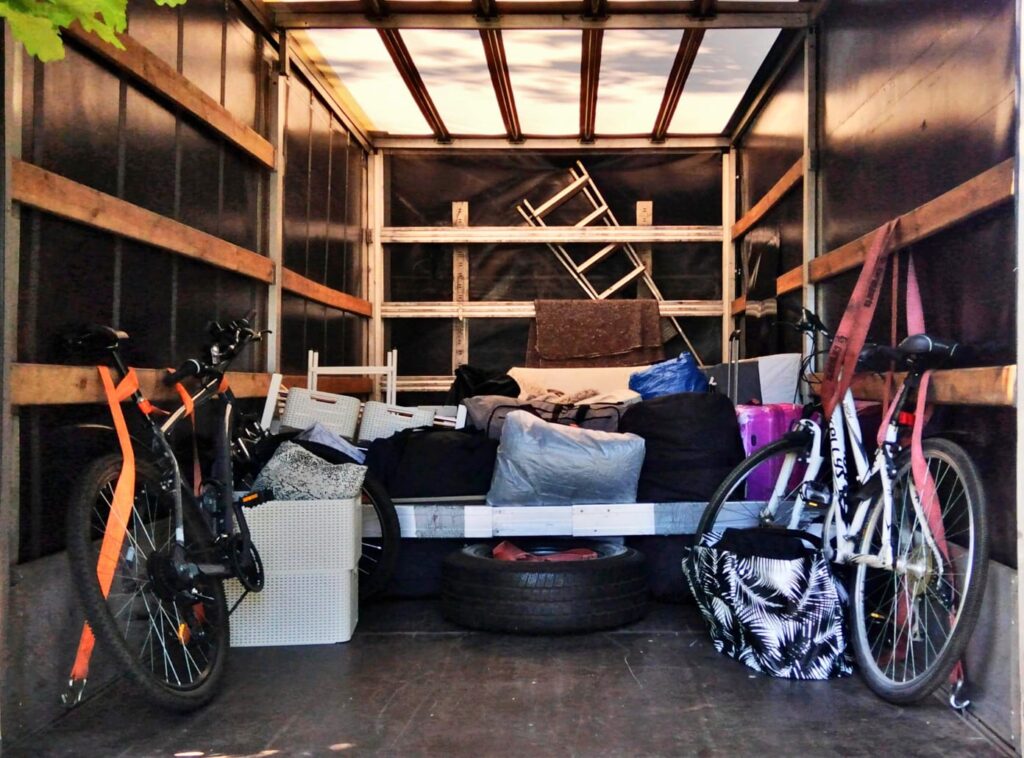
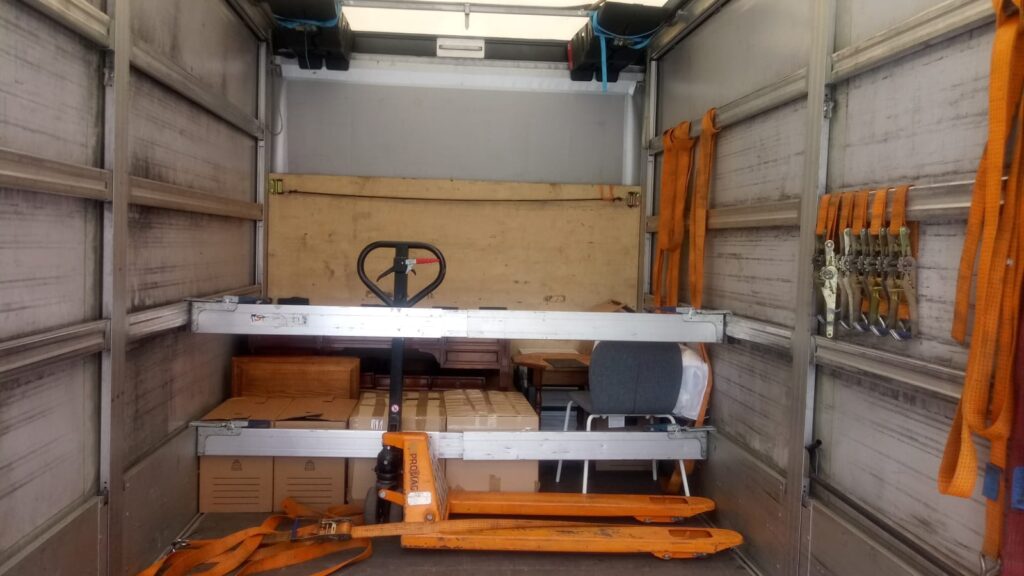
Moving household goods from another EU country is usually more straightforward than importing them from outside the EU.
However, you should still prepare:
- A detailed inventory
- Correctly labelled boxes
- Proof of ownership where relevant
- Transport insurance
- Information about restricted items
- Delivery access details
People transferring their normal residence from outside the EU may qualify for relief from Customs Duty and VAT on eligible household goods.
Irish Revenue may request:
- Proof of previous residence
- Evidence of relocation to Ireland
- Employment or property documents
- Purchase receipts
- Proof of ownership and previous use
- A detailed inventory
The relevant application and supporting documents should be prepared before the goods arrive.
Current rules are available through the Revenue transfer of residence guidance.
Bringing Pets to Ireland
Pet travel requirements depend on the country of origin, species and planned route.
Dogs, cats and ferrets may require:
- An approved microchip
- A valid rabies vaccination
- A pet passport or animal health certificate
- Tapeworm treatment for dogs
- Original veterinary documents
- Advance notification
- A compliance check after arrival
Dogs arriving from many European countries require tapeworm treatment administered within a specific period before entry.
Pets must normally travel with their owner or within five days of the owner’s journey when accompanied by an authorised person.
Check the latest conditions through the official Irish Pet Travel Portal.
Driving and Bringing a Car to Ireland
Ireland drives on the left-hand side of the road.
Before using a foreign driving licence long term, check whether it remains valid and whether it can be exchanged.
Licences issued by EU and EEA countries can generally be exchanged for an Irish licence. Ireland also has agreements with certain recognised states.
Bringing a vehicle into Ireland may involve:
- Vehicle registration
- Vehicle Registration Tax
- Customs procedures
- Motor insurance
- Roadworthiness testing
- Transfer of Residence relief
Information about exchanging a foreign licence is available from the National Driver Licence Service.
Moving Your Belongings With VANonsite
Immigration to Ireland already involves documents, deadlines, accommodation searches and important financial decisions. Your household move should not add further uncertainty.
VANonsite provides professional European removals supported by GPS tracking for every load. Customers can follow the progress of their belongings while an experienced team coordinates collection, transport and delivery.
Available services include:
- Home Removals
- Furniture Removals
- Packing Service
- Office Removals
- Student Removals
- White Glove Delivery
- Last Minute Moving
- Storage
- Furniture assembly and disassembly
- Office Furniture Installation
- Dedicated transport
- Part-load transport
- Man and van services
Which Moving Vehicle Do You Need?
| VANonsite option | Capacity | Maximum weight | Best suited to |
|---|---|---|---|
| Moving One | 1 m³ | 100 kg | Boxes, luggage and essential items |
| Moving Basic | 5 m³ | 300 kg | Student room or small relocation |
| Moving Medium | 10 m³ | 500 kg | Studio or compact apartment |
| Moving Premium | 15 m³ | 1,100 kg | Apartment or medium household |
| Moving Premium Plus | 30 m³ | 3,500 kg | Large home or office |
| Moving Full House XXL | 90 m³ | 20,000 kg | Full house or commercial relocation |
A small man and van service can be ideal for students, professionals and couples moving a limited number of items.
Larger households can reserve suitable capacity based on the real volume and weight of their belongings. This prevents overpaying for unused space and reduces the risk of delays on collection day.
Common Immigration to Ireland Mistakes
Confusing a Visa With Permission to Work
A visa may allow you to travel to Ireland. It does not automatically provide employment rights.
Booking the Move Before Receiving Approval
Avoid committing to irreversible dates until essential visas, permits or family permissions have been granted.
Assuming Schengen Rules Apply
Ireland has its own border and visa policies.
Using Outdated Permit Information
Occupation lists, salary thresholds and application procedures can change.
Packing Original Documents
Passports, certificates and permits should always travel with you.
Underestimating Housing Costs
Include temporary accommodation, a deposit and the first rent payment in your budget.
Ignoring Customs Preparation
An incomplete inventory can delay goods arriving from outside the EU.
Leaving Pet Arrangements Too Late
Vaccination, treatment and documentation deadlines are strict.
Choosing a Vehicle Without Measuring Your Belongings
Estimate the volume and weight before booking transport.
Delaying Immigration Registration
Complete registration within the period attached to your permission.
Immigration to Ireland Checklist
Before Applying
- Confirm your nationality category
- Select the correct immigration route
- Check visa requirements
- Check employment permit requirements
- Gather personal and family documents
Before Travelling
- Receive the required approvals
- Arrange accommodation
- Prepare sufficient funds
- Book household transport
- Create an inventory
- Organise pet travel
- Keep original documents with you
After Arrival
- Register immigration permission if required
- Apply for a PPS Number
- Register employment with Revenue
- Arrange healthcare
- Open a bank account
- Set up utilities
- Review driving licence requirements
- Enrol children in school
Frequently Asked Questions About Immigration to Ireland
Is It Easy to Immigrate to Ireland?
The process is relatively straightforward for EU, EEA, Swiss and British citizens. For non-EEA nationals, the difficulty depends on the chosen immigration route, occupation and supporting documents.
Can I Immigrate to Ireland Without a Job?
EU, EEA, Swiss and British citizens may be able to move without a job, subject to applicable residence conditions. Non-EEA citizens usually need another qualifying basis, such as study, family reunification or an approved business route.
Do British Citizens Need a Visa?
British citizens do not normally need a visa to live and work in Ireland because of the Common Travel Area.
Can EU Citizens Work in Ireland?
Yes. EU and EEA citizens can generally work in Ireland without an employment permit.
How Long Can a Non-EEA Citizen Stay Without Registration?
A short-stay visitor may receive permission for up to 90 days. Anyone coming to work, study or join family for longer generally needs appropriate permission and registration.
Do I Need an Employment Permit?
Most non-EEA workers need an employment permit unless an exemption or another qualifying immigration permission applies.
How Much Money Should I Save?
Prepare enough for immigration costs, travel, removals, temporary accommodation, a rental deposit, initial rent and daily living expenses. An emergency reserve is strongly recommended.
Can I Bring Furniture to Ireland?
Yes. Furniture and household goods can be transported to Ireland, subject to customs and restricted item rules.
Plan Your Immigration to Ireland With Confidence
Immigration to Ireland becomes much easier when the process is divided into clear stages. First, confirm your legal right to enter, live and work in the country. Next, organise accommodation, employment, documents, taxes and healthcare. Finally, prepare a secure plan for transporting your belongings.
Whether you are moving a few boxes, a student room, a family apartment or an entire house, VANonsite can match the vehicle to the size of your relocation.
Every load is tracked by GPS, while flexible transport options, professional packing and experienced European drivers provide greater control throughout the journey.
Explore professional removals to Ireland and request a personalised quotation based on the volume, weight and collection details of your move.