
International removals to Ireland begin with one essential question: where is the shipment coming from? A household move from France or Germany does not follow the same document path as a move from Great Britain, Switzerland or Norway. The route, border status and ferry crossing must be understood before the vehicle is booked.
VANonsite coordinates household goods and furniture moves to the Republic of Ireland from the UK and across Europe. We combine route planning, suitable vehicle capacity, packing support and origin-specific document checks so customers know what must happen before collection, in transit and at delivery.
Get an estimate for your international move to Ireland
Enter the complete collection and delivery addresses and your preferred date. The automatic quote provides an initial route-based estimate. We then review the inventory, access, origin country, transport option and any document support required before confirming the plan.





Choose the right Ireland page for your move
This page is the route-planning overview for international origins. It is designed for customers comparing how a move from the UK, another EU country or a non-EU European country should be organised. More specific services have their own pages:
- For the Great Britain route and its customs sequence, use UK to Ireland removals.
- For a complete property and a room-by-room survey, use house removals to Ireland.
- For Belfast and other UK destinations, use removals to Northern Ireland.
- For the broader destination hub, visit Removals to Ireland.
Keeping these intentions separate helps you reach the guidance that matches the move instead of reading the same generic advice on several pages.
Start with the exact origin country and route
“Europe to Ireland” is not one route. A collection in Paris, Berlin or Amsterdam normally moves from within the EU customs territory. A collection in London begins outside the EU. Switzerland and Norway are also outside the EU, although their road routes cross EU countries before the ferry to Ireland. Islands and remote regions may introduce an additional ferry or local transfer.
The quotation therefore begins with both postcodes, not just the country names. We check practical routing, ferry options, vehicle restrictions, access and whether the goods may cross a non-EU territory in transit. The exact origin also determines which personal information and supporting documents may be relevant.

EU origin, Great Britain or another non-EU origin?
Moving from another EU Member State
A move from an EU Member State to the Republic of Ireland usually has a different customs position from an import arriving from outside the EU. Even so, the shipment still needs an accurate inventory and route plan. Restricted items, excise goods, commercial property, new purchases or a route passing through a non-EU country can require separate checks.
Irish Revenue explains that goods moving from one EU Member State to another through a non-EU country can move under customs control. If the planned route uses Great Britain as a land bridge, the transit arrangement must therefore be considered before dispatch. We confirm the transport path rather than assuming that every European collection is administratively identical.
Moving from Great Britain
Goods moving from Great Britain to the Republic of Ireland enter the EU customs territory. Irish Revenue states that a customs declaration is required for imports from outside the EU, including Great Britain. People transferring their normal residence may be able to claim relief on qualifying used personal property and household effects, subject to the published conditions and evidence.
The published procedure also distinguishes freight and passenger ferry channels. Revenue advises that personal and household effects moving from the UK, excluding Northern Ireland, through the freight channel require a valid Pre-Boarding Notification ID before ferry check-in. The responsible person or representative and required documents should be agreed before collection.
Moving from Switzerland, Norway or another non-EU country
A non-EU European origin can involve export requirements at departure, transit across other countries and import formalities in Ireland. The correct process depends on the origin, route, status of the goods and the customer’s circumstances. We do not treat a Swiss, Norwegian or UK shipment as if it were an ordinary domestic collection.
VANonsite identifies the expected transport records and confirms who is responsible for declarations or customs representation. Final decisions on relief, duty, VAT or admissibility remain with the relevant authorities.
An inventory that works for transport and documents
An international-removals inventory must do more than estimate vehicle space. It should help the crew identify the goods and, where formalities apply, support accurate descriptions. List household furniture, cartons, appliances, bicycles, artwork and outdoor items in clear groups. Add dimensions for bulky pieces and photographs for anything fragile, unusually heavy or difficult to describe.
- Use numbered cartons and match each number to a short description and destination room.
- Separate used personal effects from new purchases or commercial goods.
- Identify alcohol, tobacco, vehicles, tools used in a trade and restricted items before quotation.
- Tell us about batteries, liquids, plants, food, weapons or animal products so suitability can be checked.
- Confirm any item added after the survey before it is loaded.
A description such as “used kitchen utensils” is more useful than “miscellaneous”. The physical load and any accompanying documents should remain consistent throughout the move.
Part load or dedicated transport to Ireland
VANonsite can plan part-load or dedicated road transport where each option suits the shipment and route. The choice affects flexibility, capacity and the way collection and delivery are scheduled.
| Option | Best fit | How planning works | What to consider |
|---|---|---|---|
| Part load | Smaller or medium consignments with flexible dates | Your reserved space forms part of a coordinated European route | Collection and delivery windows depend on route consolidation |
| Dedicated vehicle | Larger, fragile or time-sensitive moves | Vehicle capacity and timing are planned around one booking | Normally requires more dedicated capacity |
| Last-minute option | Urgent moves with a compatible available vehicle and crew | A 1-3 day transport may be possible after route and documents are checked | Timing cannot be promised before live availability is confirmed |
A part load is not automatically the best value for every small shipment. Tight dates, delicate furniture or difficult access can make dedicated transport more appropriate. Equally, a customer with flexible dates may benefit from sharing capacity on a route already serving Ireland. We compare the practical requirements rather than selecting a service only from the volume.
Packing for a European road and ferry route
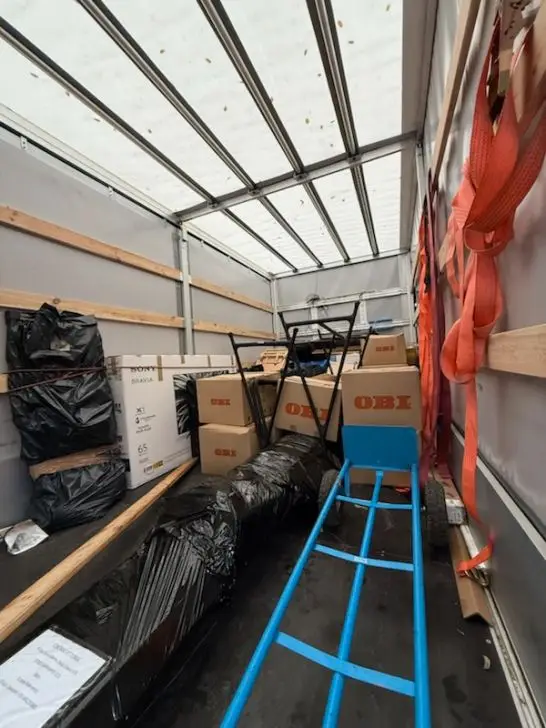
Goods travelling internationally may be handled at collection, during route consolidation and at final delivery. Road vibration, ferry movement and changing access conditions make correct protection important. Use strong cartons, protect furniture surfaces and edges, and keep small fittings with the item they belong to.
Self-packing
When packing yourself, avoid making cartons too heavy, fill empty space so contents cannot move and label fragile boxes on more than one side. Keep passports, medication, keys and essential documents with you. Do not pack an item if you are unsure whether it can legally or safely travel.
Packing support from VANonsite
Our packing services can cover selected fragile items or a wider household pack. The survey identifies materials, dismantling, protection and crew time. This makes the quotation specific to the actual work rather than using a generic packing surcharge.
Customs and residence documents: verify, do not assume
For an origin outside the EU, the customer may need to show evidence of residence, the move to Ireland, ownership and prior use of the goods. Irish Revenue’s transfer-of-residence relief can apply to qualifying used personal property and household effects, but the authority assesses eligibility.
Current official guidance should be checked for the individual move:
- Irish Revenue transfer-of-residence overview explains the types of personal property that may qualify.
- Irish Revenue eligibility rules cover residence, ownership, use and timing conditions.
- Irish Revenue’s import procedure describes forms, supporting documents and the ferry-channel process.
- Revenue guidance on moving goods explains non-EU import, export and transit contexts.
VANonsite can coordinate the agreed transport and document workflow and provide relevant vehicle or shipment information. We do not guarantee relief, clearance time or a particular customs decision. Our customs clearance page gives further service context.
Collection and delivery access across different countries
International route planning can fail at the property even when the long-distance transport is correct. A collection apartment may require a lift booking, parking permit or smaller shuttle vehicle. An Irish rural property may have a narrow lane, low branches or limited turning space. City deliveries may be restricted by loading times or building rules.
Send photographs of steps, gates, lifts and parking areas when access is uncertain. Confirm the floor, walking distance and whether keys are available at both ends. If a property completion date is provisional, tell us early so storage or a flexible delivery arrangement can be considered.
Storage when the Irish property is not ready
A tenancy can end before the destination property is available, or a purchase can complete later than expected. If delivery cannot follow the planned route, storage should be agreed as a separate stage. We need the likely duration, access requirements and final delivery details to plan it correctly.
Do not assume that an international shipment can remain on the vehicle while keys are delayed. Vehicle schedules continue across Europe, and customs or transit arrangements may also depend on the planned movement.
What determines the price of an international move to Ireland?
Price depends on more than distance. The main factors are shipment volume, origin and route, ferry costs, part-load or dedicated capacity, collection and delivery access, crew time, packing, dismantling, storage and any document coordination required.
A useful quotation states its assumptions. Two figures are not comparable if one excludes ferry, access work or packing that the other includes. After the initial automatic estimate, send the inventory and access details so VANonsite can assess the actual move and explain the chosen service.
Why VANonsite for international removals to Ireland?
VANonsite works across European removal routes and understands that Ireland is not a single administrative journey from every origin. We separate EU movements, Great Britain imports and other non-EU origins, then connect the document path with vehicle capacity, ferry timing, packing and access.
Our planning is evidence-led: real postcodes, a usable inventory, photographs or a video survey, and clear responsibility for each stage. That reduces late surprises and gives the customer a route-specific quotation instead of a generic promise.
International removals to Ireland: frequently asked questions
Do all European moves to Ireland need customs declarations?
No single answer covers every origin. A move from within the EU usually differs from an import from Great Britain or another non-EU country. The exact route, goods and any transit through a non-EU territory must be checked.
Can I use part-load transport?
Part load can suit smaller or medium consignments when dates are flexible and the goods are compatible with a coordinated route. The survey and live schedule determine whether it is practical.
Can VANonsite guarantee transfer-of-residence relief?
No. VANonsite can support the agreed transport and document workflow, but eligibility and approval are decided by Irish Revenue under the current rules and the customer’s evidence.
Is a 1-3 day move possible?
It may be possible through Last-Minute Moving when a suitable vehicle, crew, route and document path are available. Timing must be confirmed for the specific shipment.
What information should I send?
Send both addresses, preferred dates, an inventory, photographs of unusual items, access details and the origin-country context. State whether you need packing, dismantling, storage or document support.
Request a route-specific quotation
Use the automatic estimate near the top of the page, then provide the inventory and access information. VANonsite will review the exact international route to the Republic of Ireland and recommend the transport and support appropriate to your move.