
Yes, UK citizens can work in Ireland without applying for a visa or employment permit. British citizens can also live, study, establish a business and become self-employed in Ireland under the Common Travel Area.
These rights remained in place after Brexit because the Common Travel Area is separate from European Union freedom of movement. It gives British and Irish citizens the right to move between both countries and access employment, education, healthcare and selected social benefits.
The legal process is therefore relatively simple. However, starting a new life in Ireland still requires practical preparation. A British citizen working in Ireland will usually need a Personal Public Service Number, correct tax registration, proof of address and documents required by an employer. People working in regulated professions may also need to have their UK qualifications recognised.
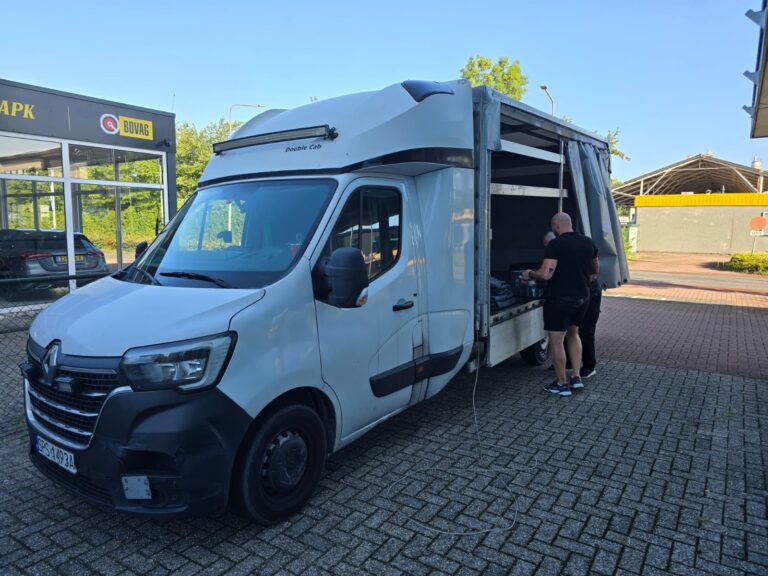
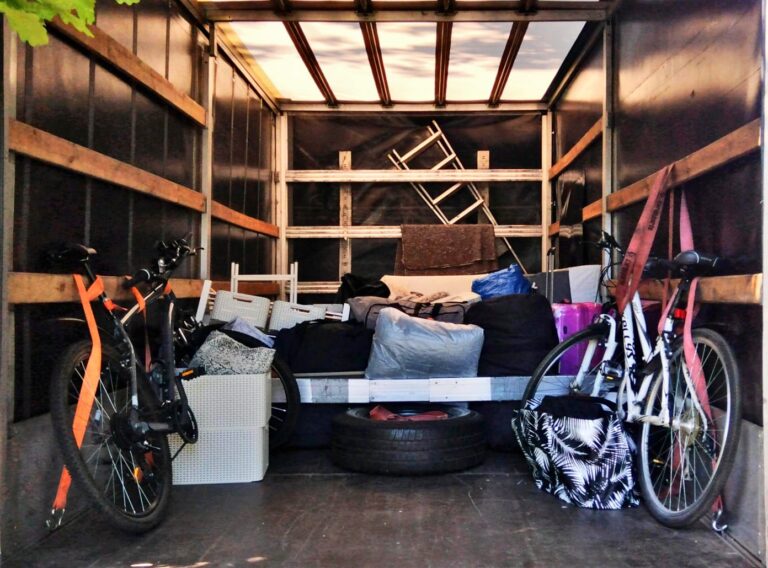
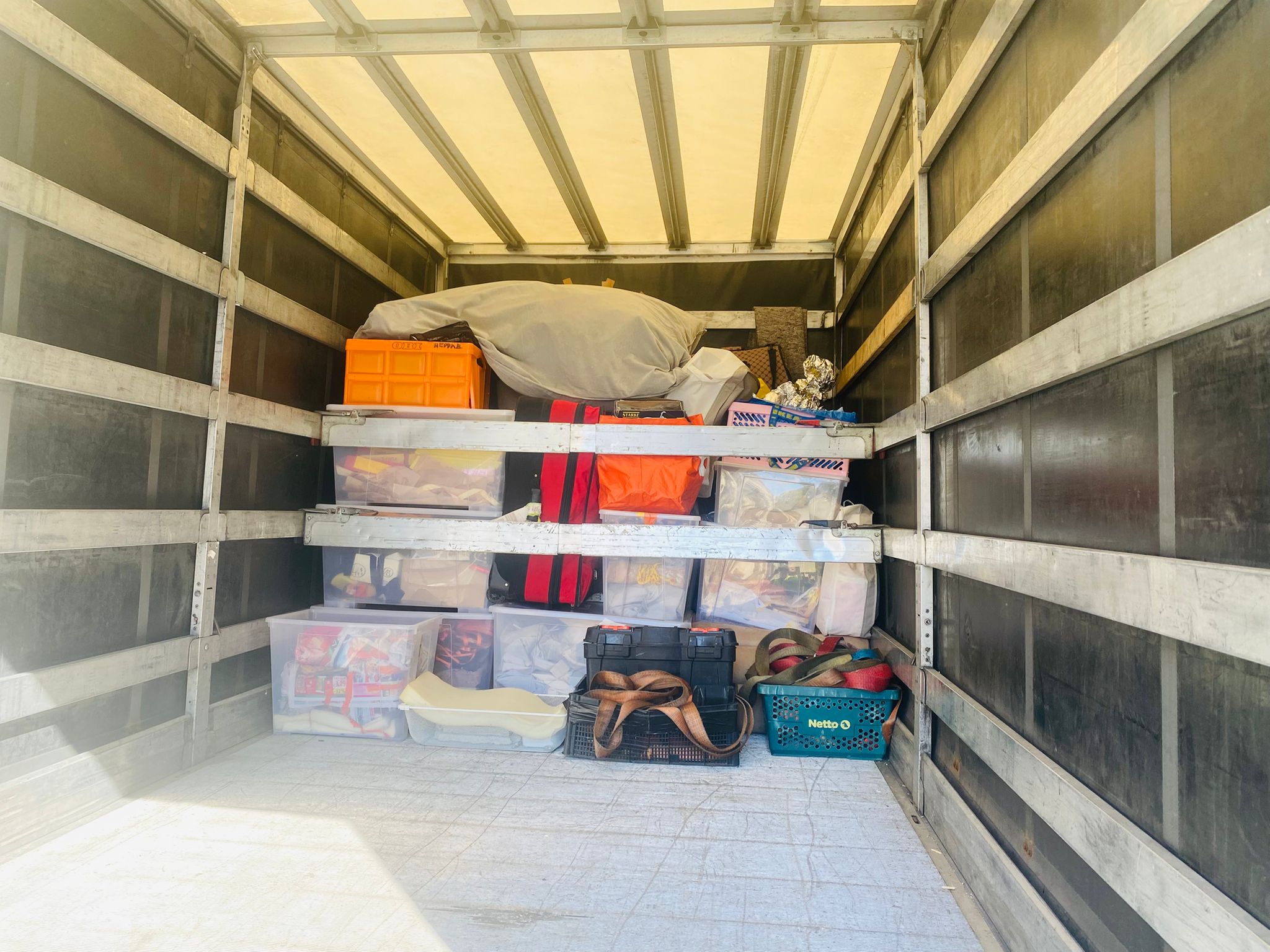
If you are moving for work, the relocation itself deserves the same attention as your employment paperwork. VANonsite provides professional removals to Ireland, including packing, furniture transport, flexible vehicle options, insured handling and GPS tracking for every load.
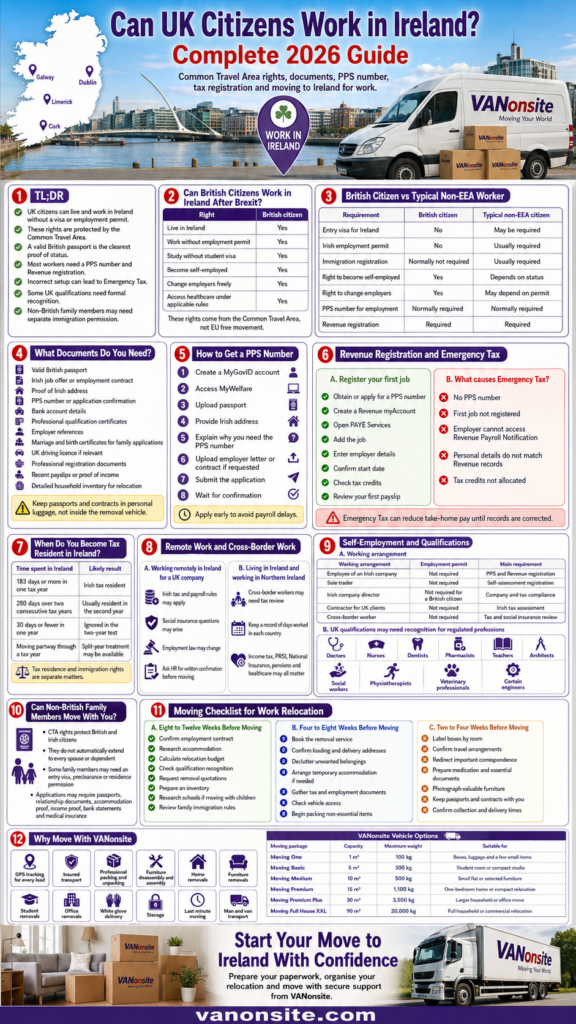
TL:DR
- UK citizens can live and work in Ireland without a visa or employment permit.
- These rights are protected by the Common Travel Area and continued after Brexit.
- A valid British passport is the clearest way to prove British citizenship.
- Most employees need a PPS number and must register their first job with Irish Revenue.
- Incorrect tax registration may result in Emergency Tax being deducted from salary.
- Some UK professional qualifications must be formally recognised before work can begin.
- Non-British family members may need separate immigration permission before moving to Ireland.




Can UK Citizens Work in Ireland After Brexit?
Can UK citizens work in Ireland after the United Kingdom left the European Union? Yes. British citizens continue to have the right to take employment, change jobs, become self-employed and establish a business in Ireland.
These rights come from the Common Travel Area, usually called the CTA. The arrangement covers Ireland, the United Kingdom, the Isle of Man and the Channel Islands.
Under the Common Travel Area, British and Irish citizens can:
- Travel between Ireland and the UK
- Live in either country
- Work without an employment permit
- Study without a student visa
- Access healthcare under applicable national rules
- Access selected social security benefits
- Vote in certain elections
- Become self-employed
The Common Travel Area existed before Ireland and the UK joined the European Union. It does not depend on EU membership, which is why Brexit did not remove the right of British citizens to work in Ireland.
A UK citizen working in Ireland is not treated in the same way as a typical non-EEA worker. British citizens do not need to apply through the Irish employment permit system before accepting a job.
However, CTA rights apply to citizens, not automatically to everyone living in the United Kingdom. Holding a UK work visa, residence permit or permanent residence document does not necessarily give a person the right to work in Ireland.
Can British Citizens Work in Ireland Without a Visa?
British citizens can work in Ireland without applying for an entry visa, residence visa or employment permit. They can accept permanent, temporary, full-time and part-time employment.
They can also change employers without applying for new immigration permission.
Irish employment permits generally apply to people who are not citizens of the European Union, European Economic Area, Switzerland or the United Kingdom. British citizens are therefore exempt from the standard employment permit requirement.
| Requirement | British citizen | Typical non-EEA citizen |
|---|---|---|
| Entry visa for Ireland | No | May be required |
| Irish employment permit | No | Usually required |
| Immigration registration | Normally not required | Usually required |
| Right to become self-employed | Yes | Depends on immigration status |
| Right to change employers | Yes | May depend on permit conditions |
| PPS number for employment | Normally required | Normally required |
| Revenue registration | Required | Required |
The absence of an employment permit does not mean that employers can ignore standard recruitment procedures. A company may still request proof of identity, references, professional certificates, proof of address and a PPS number.
Can I Work in Ireland With a UK Passport?
If you are asking, “Can I work in Ireland with a UK passport?”, the key point is the citizenship recorded in that passport.
A valid British passport is the clearest way to prove that you are a British citizen with the right to work in Ireland. Employers may ask to see and copy it during the recruitment or onboarding process.
Although British and Irish citizens can travel within the Common Travel Area without routine immigration controls, airlines and ferry operators still require identification. Some carriers may only accept a passport for specific journeys, so carrying a valid passport is strongly recommended.
It is also important to distinguish British citizenship from other types of British nationality. A person holding another category of British passport should check their individual immigration status before accepting employment or relocating.
What Documents Does a UK Citizen Need to Work in Ireland?
British citizens do not need a work permit, but they still need documents to begin employment, register for tax, open a bank account and rent a property.
Prepare both digital and physical copies of your most important paperwork. Keeping everything organised can save time during your first weeks in Ireland.
You may need:
- A valid British passport
- An Irish employment contract or job offer
- Proof of your Irish address
- A PPS number or application confirmation
- Bank account details
- Professional qualification certificates
- References from previous employers
- Marriage and birth certificates for family applications
- A UK driving licence if your role involves driving
- Professional registration documents for regulated work
- Recent payslips or proof of income for a tenancy application
- A detailed household inventory for your relocation
Proof of address may include a tenancy agreement, utility bill, bank statement or official letter. Some organisations may accept confirmation from the person providing your accommodation, although requirements can vary.
How to Get a PPS Number in Ireland
A Personal Public Service Number, often shortened to PPS number or PPSN, is a unique reference used when dealing with Irish public authorities.
It is essential for most employees because it connects employment records to the Irish tax system. Revenue uses it to calculate tax credits and deductions correctly.
A PPS number may also be required for:
- Social protection services
- Public healthcare services
- Tax credits
- Selected housing services
- Education services
- Driving licence applications
- Other government registrations
Adults can apply online through MyWelfare. Applicants need a MyGovID account and must provide proof of identity, address and the reason for the application.
How to Apply for a PPS Number
The process usually involves the following steps:
- Create a MyGovID account.
- Access the PPS number service through MyWelfare.
- Upload proof of identity, usually a passport.
- Provide proof of your Irish address.
- Explain why you need a PPS number.
- Upload an employment contract or employer letter if requested.
- Submit the application.
- Wait for confirmation from the Department of Social Protection.
Apply as early as possible. You may be able to start work before the number is issued, but delays can affect tax registration and the amount deducted from your first salary.
Registering Your First Job With Irish Revenue
Anyone working in Ireland from the UK must register correctly with Irish Revenue. Ireland uses the PAYE system for most employees, which means Income Tax and other deductions are taken directly from salary.
Your employer needs your PPS number to request a Revenue Payroll Notification. This tells the employer which tax credits and tax rate bands should be applied.
When starting your first Irish job, you should:
- Obtain or apply for a PPS number.
- Create a Revenue myAccount.
- Open the PAYE Services section.
- Select the option to add a job.
- Enter your employer’s information.
- Confirm the employment start date.
- Check that your tax credits are correctly allocated.
- Review your first payslip carefully.
Register your employment as soon as possible, even if the job is temporary or part-time.
What Is Emergency Tax?
Emergency Tax may be applied when Revenue cannot provide your employer with the information needed to calculate deductions correctly.
This may happen when:
- You have not provided a PPS number.
- Your first Irish job has not been registered.
- Your employer cannot access a Revenue Payroll Notification.
- Your personal details do not match Revenue records.
- Your tax credits have not been allocated.
Emergency Tax can noticeably reduce your take-home pay. Once the information is corrected, overpaid tax may be refunded through payroll or claimed from Revenue. However, preventing the problem is much easier than recovering the money later.
When Does a UK Citizen Become Tax Resident in Ireland?
Immigration rights and tax residence are separate matters.
Can UK citizens work in Ireland without becoming Irish tax residents? Yes, depending on how many days they spend in the country and their individual circumstances. However, income earned for work physically performed in Ireland may still be taxable there.
A person is generally considered resident in Ireland for tax purposes when they spend:
- 183 days or more in Ireland during one tax year, or
- 280 days or more across the current and previous tax years
A year in which a person spends 30 days or fewer in Ireland is normally ignored when applying the two-year test. The Irish tax year runs from 1 January to 31 December.
| Time spent in Ireland | Likely result |
|---|---|
| 183 days or more in one tax year | Irish tax resident |
| 280 days over two consecutive tax years | Usually resident in the second year |
| 30 days or fewer in one year | That year is generally ignored in the two-year test |
| Moving partway through a tax year | Split-year treatment may be available |
Ireland and the United Kingdom have a Double Taxation Agreement. This can prevent the same income from being taxed twice in full, but it does not allow a person to choose freely where tax is paid.
Professional advice may be helpful if you:
- Continue receiving income from a UK employer
- Own rental property in Britain
- Receive dividends or investment income
- Run a UK limited company
- Work in both Ireland and the UK
- Receive a UK pension
- Spend long periods outside Ireland
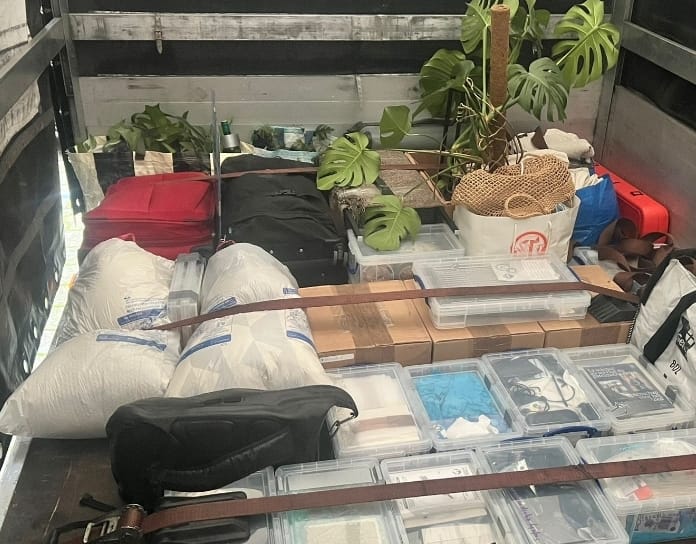


Can You Work Remotely in Ireland for a UK Company?
A British citizen can work remotely from Ireland for a UK company without an Irish employment permit. However, the employer and employee may still have Irish tax, payroll, social insurance and employment law responsibilities.
The location where the work is physically performed matters. Remaining on a UK employment contract does not automatically mean that only UK tax and employment rules apply.
Before moving, ask your employer:
- Does the company permit permanent work from Ireland?
- Can it operate an Irish payroll?
- Will an Employer of Record be needed?
- Where will social insurance contributions be paid?
- Will salary or benefits change after the relocation?
- Could the arrangement create Irish corporate tax obligations?
- Which country’s employment law will apply?
- Is the move temporary or permanent?
Ask for written confirmation from the employer’s HR, payroll or legal team before signing a tenancy agreement or booking removals.
Can You Live in Ireland and Work in Northern Ireland?
British and Irish citizens can live and work on either side of the Irish border under the Common Travel Area.
For example, someone may live in County Donegal and work in Derry, or live in County Louth and commute to Newry.
Cross-border workers may face additional questions involving:
- Income tax
- Tax relief
- National Insurance
- PRSI
- Healthcare
- Pensions
- Hybrid working
- Employer payroll obligations
Where you live, where your employer is registered and where you physically perform your duties can all affect your tax and social insurance position.
Keep an accurate record of the days worked in each country and seek specialist advice if your employment regularly crosses the border.
Can UK Citizens Be Self-Employed in Ireland?
Yes. British citizens can work as sole traders, contractors or company directors in Ireland without applying for an employment permit.
However, self-employed workers must still follow Irish tax, accounting, insurance and licensing rules.
They may need to:
- Register with Revenue
- File annual tax returns
- Pay preliminary tax
- Keep accurate financial records
- Register for VAT when required
- Obtain public liability insurance
- Register a business name
- Follow Irish consumer law
- Check professional licensing requirements
| Working arrangement | Employment permit | Main requirement |
|---|---|---|
| Employee of an Irish company | Not required | PPS and Revenue registration |
| Sole trader | Not required | Self-assessment registration |
| Irish company director | Not required for a British citizen | Company and tax compliance |
| Contractor for UK clients | Not required | Irish tax assessment |
| Cross-border worker | Not required | Tax and social insurance review |
Working for British clients does not automatically place a self-employed person outside the Irish tax system. The location where the business is managed and where the services are performed can be relevant.
Are UK Qualifications Recognised in Ireland?
The right to work does not guarantee automatic recognition of every British qualification.
People entering regulated professions may need to have their qualifications formally recognised before they can legally begin work.
This may affect:
- Doctors
- Nurses
- Dentists
- Pharmacists
- Teachers
- Architects
- Social workers
- Physiotherapists
- Veterinary professionals
- Certain engineers
- Other regulated healthcare workers
Start the recognition process before moving. Applications may require certified certificates, academic transcripts, proof of professional experience, references and evidence of English-language competence.
For non-regulated qualifications, employers may use NARIC Ireland and the Irish National Framework of Qualifications to understand how an overseas qualification compares with an Irish award.
Can Non-British Family Members Move With a UK Citizen?
The Common Travel Area protects British and Irish citizens. It does not automatically give the same rights to every spouse, partner, child or dependent.
A family member who is not British, Irish, an EEA citizen or a Swiss citizen may need an entry visa, preclearance or residence permission before moving.
Applications may require:
- Valid passports
- Marriage or civil partnership certificates
- Birth certificates
- Proof of a genuine relationship
- Evidence of accommodation
- Proof of the sponsor’s income
- Employment documents
- Bank statements
- Medical insurance
- Police clearance documents
Check the latest requirements through Irish Immigration Service Delivery before booking travel or arranging a household move.


Finding a Job in Ireland as a British Citizen
Because British citizens do not need employment permits, they can apply directly to Irish employers.
Popular job search platforms include:
| Platform | Best for |
|---|---|
| JobsIreland | Government-supported vacancies |
| IrishJobs | Professional and corporate roles |
| Jobs.ie | General employment opportunities |
| Technology, finance and international companies | |
| PublicJobs | Public sector vacancies |
| Recruitment agencies | Specialist and temporary positions |
| Company career pages | Direct applications |
| Local business groups | Regional opportunities |
Include a clear right-to-work statement on your CV:
British citizen with the unrestricted right to live and work in Ireland under the Common Travel Area. No employment permit required.
This can remove uncertainty for employers unfamiliar with the rules.
Keep your CV focused on measurable results. Instead of describing only daily responsibilities, show revenue generated, costs reduced, projects delivered or teams managed.
Moving to Ireland for Work From the UK
Once the job is secured, the physical move becomes the next major task. Accommodation, packing, vehicle access, ferry schedules and delivery dates need to be coordinated carefully.
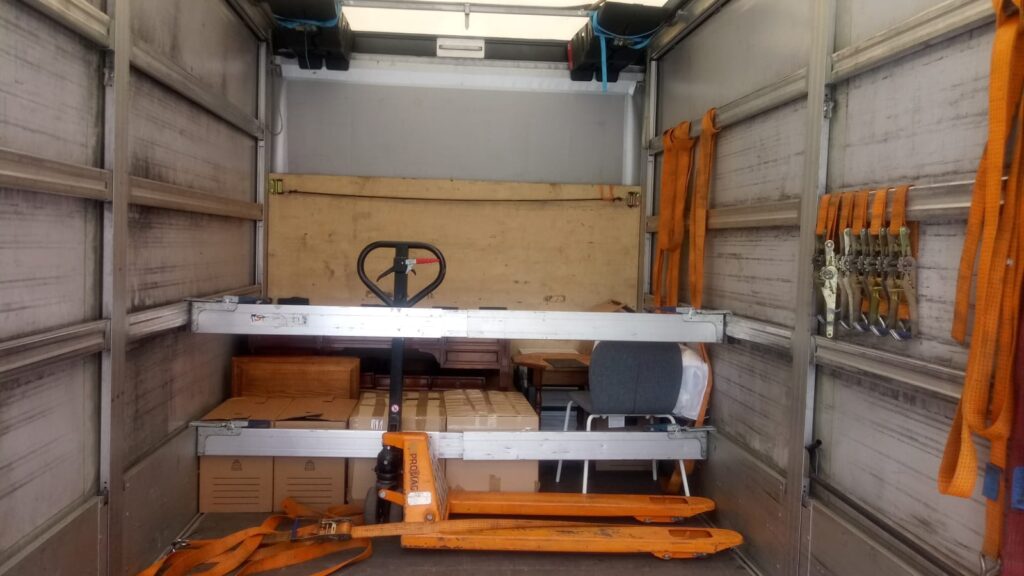
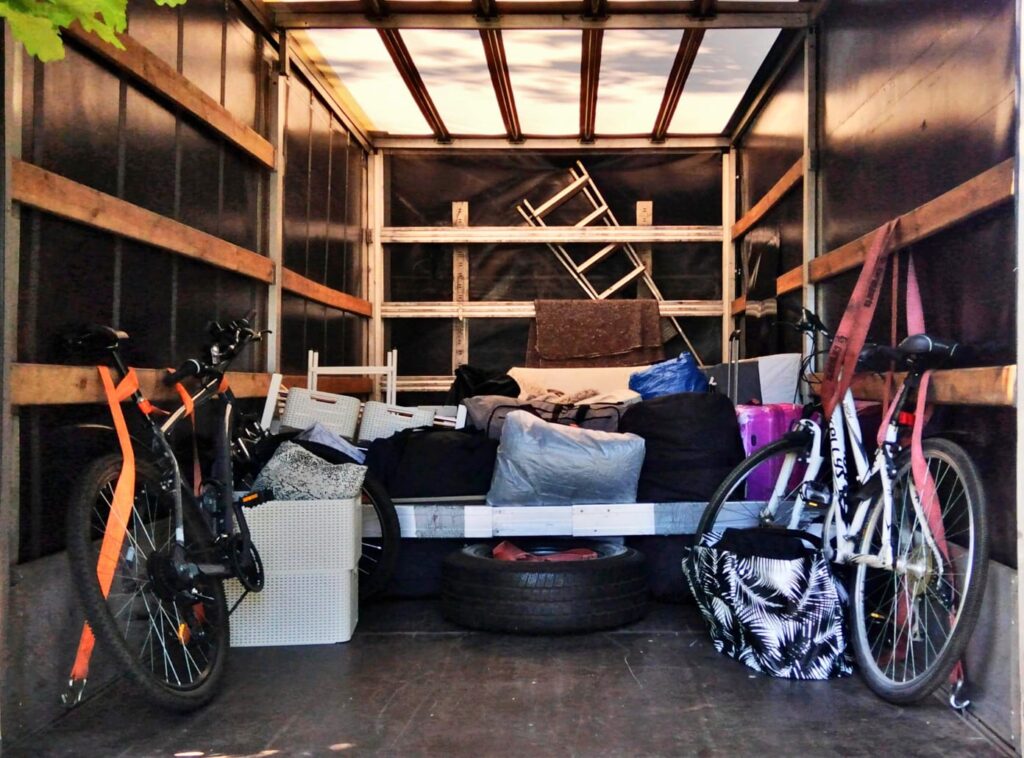
Professional removals to Ireland can reduce the risk of damaged furniture, insufficient vehicle space and last-minute disruption.
Eight to Twelve Weeks Before Moving
- Confirm your employment contract.
- Research accommodation.
- Calculate the relocation budget.
- Check qualification recognition requirements.
- Request removal quotations.
- Prepare an inventory.
- Research schools if moving with children.
- Review family immigration rules.
Four to Eight Weeks Before Moving
- Book the removal service.
- Confirm loading and delivery addresses.
- Declutter unwanted belongings.
- Arrange temporary accommodation if needed.
- Gather tax and employment documents.
- Check access for the removal vehicle.
- Begin packing non-essential items.
Two to Four Weeks Before Moving
- Label boxes by room.
- Confirm travel arrangements.
- Redirect important correspondence.
- Prepare medication and essential documents.
- Photograph valuable furniture.
- Keep passports and contracts in personal luggage.
- Confirm collection and delivery times.
Choosing the Right Vehicle for Your Move
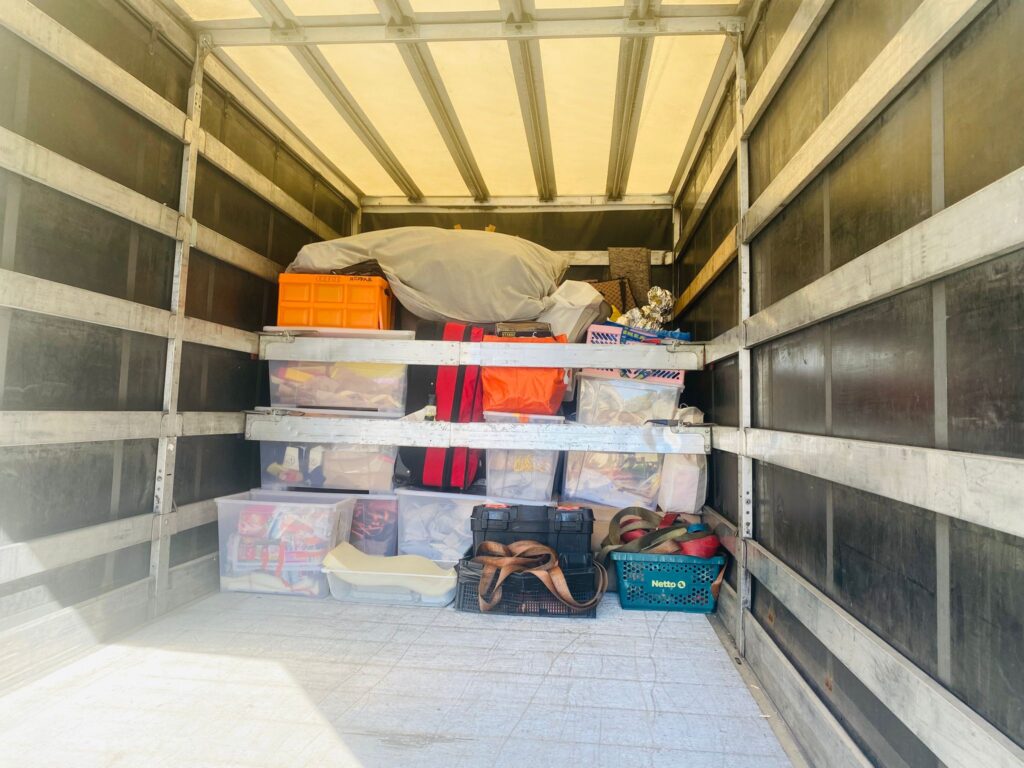
Vehicle selection should be based on volume, weight and the type of belongings being transported. The number of bedrooms alone can be misleading because two similar properties may contain very different amounts of furniture.
VANonsite offers the following vehicle options:
| Moving package | Capacity | Maximum weight | Suitable for |
|---|---|---|---|
| Moving One | 1 m³ | 100 kg | Boxes, luggage and a few small items |
| Moving Basic | 5 m³ | 300 kg | Student room or compact studio |
| Moving Medium | 10 m³ | 500 kg | Small flat or selected furniture |
| Moving Premium | 15 m³ | 1,100 kg | One-bedroom home or compact relocation |
| Moving Premium Plus | 30 m³ | 3,500 kg | Larger household or office move |
| Moving Full House XXL | 90 m³ | 20,000 kg | Full household or commercial relocation |
An accurate inventory helps prevent insufficient loading space, vehicle weight problems, split deliveries and unexpected charges.
List large furniture first, followed by appliances, boxes, bicycles, garden equipment and unusually heavy items.
Man and Van or Full Removal Service?
A man and van service can be ideal for a student, professional or couple moving with a limited number of belongings. It is flexible, efficient and often more economical than reserving a large vehicle.
A complete removal service is usually better for full households, offices, valuable furniture and fixed-date relocations.
| Factor | Man and van | Full removal service |
|---|---|---|
| Best for | Small and flexible moves | Full homes and offices |
| Packing | Usually completed by the customer | Professional packing available |
| Furniture protection | Selected protection | Comprehensive protection |
| Assembly | Optional | Available |
| Vehicle size | Smaller vehicle | Full vehicle range |
| Coordination | Simple | Detailed move management |
| Storage | Available when arranged | Available when arranged |
Customers moving fragile, designer or high-value furniture may also benefit from White Glove Delivery or professional Packing Services.
How VANonsite Supports UK to Ireland Relocations
VANonsite combines European transport experience with careful handling and clear communication. Every load is supported by GPS tracking, allowing customers to follow the movement of their belongings during transport.
Available services include:
- Home Removals
- Furniture Removals
- Packing Services
- White Glove Delivery
- Office Removals
- Student Removals
- Storage
- Last Minute Moving
- Office Furniture Installation
- Man and van transport
- Furniture assembly and disassembly
The service can be adapted to a student move, single-room relocation, office transfer or complete family household. The vehicle and service level are matched to the actual volume, weight and complexity of the move.
Common Mistakes When Working and Moving to Ireland
Avoid these frequent and expensive mistakes:
- Assuming every UK resident has CTA rights
The Common Travel Area applies to British and Irish citizens, not automatically to every UK visa holder. - Delaying the PPS number application
This can affect payroll and increase the risk of Emergency Tax. - Failing to register the first Irish job
Your employer may be unable to access the correct payroll information. - Assuming every UK qualification is accepted
Regulated professions may require formal recognition. - Ignoring remote work tax rules
A UK contract does not automatically prevent Irish tax obligations. - Moving before checking family immigration requirements
Non-British family members may need separate permission. - Underestimating household volume
An incomplete inventory can result in insufficient vehicle space. - Choosing transport based only on price
Insurance, handling standards, GPS tracking and reliability also matter. - Packing passports inside the removal vehicle
Identity and employment documents should remain in personal luggage. - Waiting until the final week to book transport
Ferry schedules and suitable vehicles may have limited availability.
Frequently Asked Questions
Can UK citizens work in Ireland without a visa?
Yes. UK citizens can live and work in Ireland without a visa under the Common Travel Area.
Can British citizens work in Ireland after Brexit?
Yes. Brexit did not remove the rights of British citizens to live and work in Ireland.
Can I work in Ireland with a UK passport?
Yes, provided the passport confirms British citizenship. A valid passport is commonly used to prove identity and the right to work.
Does a UK citizen need an Irish employment permit?
No. British citizens do not need an Irish employment permit to take employment or become self-employed.
Does a British citizen need a PPS number?
A PPS number is normally required for employment, tax registration and access to many public services.
Can a UK citizen work remotely in Ireland for a British company?
Yes, but Irish tax, payroll, employment law and social insurance obligations may apply.
Can my non-British spouse move to Ireland with me?
Possibly, but CTA rights do not automatically extend to non-British family members. Separate permission may be required.
Can UK Citizens Work in Ireland? Final Answer
Can UK citizens work in Ireland? Yes. British citizens can live, work, study and become self-employed in Ireland without a visa or employment permit.
The Common Travel Area protects these rights and remained in force after Brexit. However, anyone relocating should still prepare carefully. A PPS number, Revenue registration, accommodation, qualification checks and tax planning are essential parts of the process.
The physical relocation also requires careful coordination. Choosing the right vehicle, protecting furniture and matching loading dates with ferry and delivery schedules can prevent costly disruption.
VANonsite provides secure removals to Ireland for individuals, students, families and businesses. With flexible vehicle sizes, professional packing, insured transport and GPS tracking for every load, you can focus on your new job while an experienced European removals team manages the journey of your belongings.