
Moving to Switzerland is one of those life decisions that feels both thrilling and deeply serious. On one side, there are alpine mornings, clean cities, efficient trains, strong salaries, safe streets and a quality of life that many people dream about for years. On the other side, there is paperwork, customs, housing pressure, insurance, border rules and the small mountain of practical details that appears the moment you decide, “Yes, I am really doing this.”
If you are searching for moving to Switzerland what to know, the most important answer is simple: prepare early, respect the Swiss system and never treat the move as a casual van trip. Switzerland is not part of the European Union customs area, so your belongings may need formal customs clearance. You may need to prove your right to live or work there. You will normally need to register with your local commune after arrival. You must also arrange Swiss health insurance if you settle in the country.
That might sound intense, but it is manageable. Switzerland rewards people who organise things properly. Once your documents, inventory, route and delivery plan are clear, the move becomes far less intimidating.
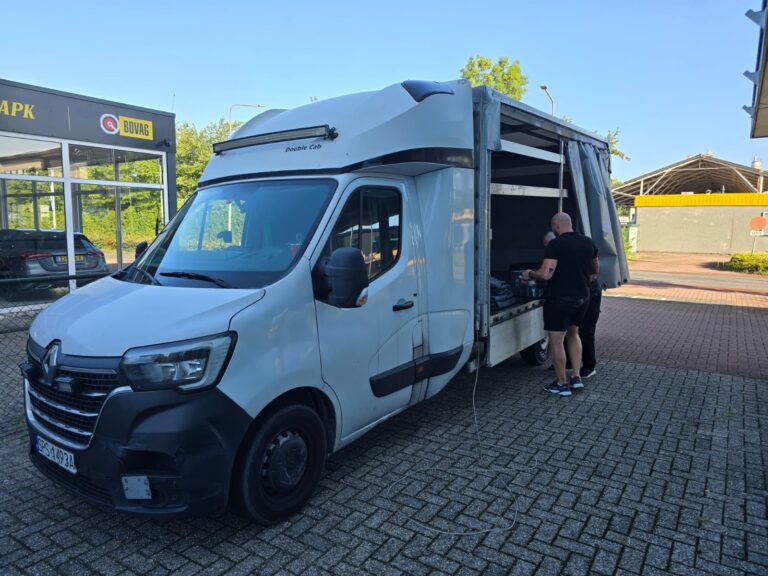
VANonsite helps make international relocations to Switzerland safer, faster and more predictable. With professional European transport, flexible man and van options, GPS tracking for every load and vehicle sizes from 1 m3 to 90 m3, your move can be planned around real needs rather than guesswork. Whether you are moving one room, a full home, student belongings, office equipment or valuable furniture, a calm plan changes everything.
For a smoother start, explore VANonsite’s removals to Switzerland.
TL;DR: Moving to Switzerland What to Know
- Switzerland is not part of the EU customs area, so moving household goods requires proper customs preparation, a clear inventory and, in many cases, Form 18.44.
- Before moving, check your visa, residence permit or work authorisation rules, especially if you are a UK, non-EU or non-EFTA citizen.
- New residents generally need to register with their local commune after arrival, usually within 14 days, depending on the canton and municipality.
- Swiss health insurance is compulsory for people settling in the country and must usually be arranged within 3 months of taking up residence.
- Your moving cost depends mainly on distance, volume in m3, weight in kg, property access, packing needs, timing and whether storage or urgent transport is required.
- A professional man and van service with GPS tracking can make the move safer, faster and less stressful, especially when crossing borders with furniture, boxes, documents or office equipment.
- VANonsite offers flexible removals to Switzerland, from compact 1 m3 moves to large 90 m3 relocations, with options for packing, storage, furniture removals, student removals, office removals and white glove delivery.




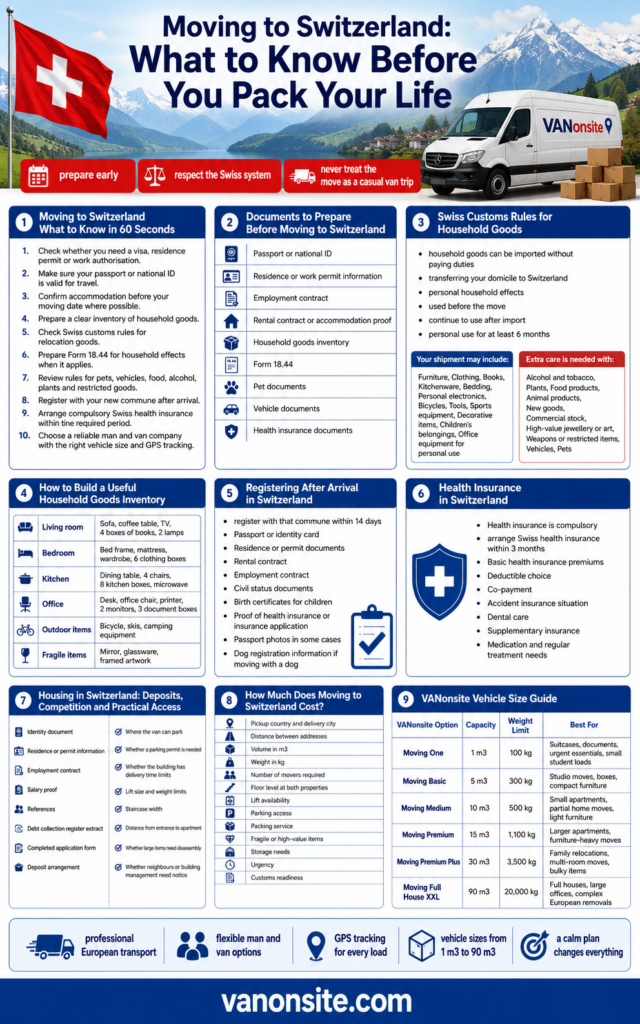
Moving to Switzerland What to Know in 60 Seconds
If you want the quick answer before reading the full guide, here it is. Moving to Switzerland what to know comes down to 10 essential steps:
- Check whether you need a visa, residence permit or work authorisation.
- Make sure your passport or national ID is valid for travel.
- Confirm accommodation before your moving date where possible.
- Prepare a clear inventory of household goods.
- Check Swiss customs rules for relocation goods.
- Prepare Form 18.44 for household effects when it applies.
- Review rules for pets, vehicles, food, alcohol, plants and restricted goods.
- Register with your new commune after arrival.
- Arrange compulsory Swiss health insurance within the required period.
- Choose a reliable man and van company with the right vehicle size and GPS tracking.
The key point is that Switzerland is wonderfully organised, but it expects you to be organised too. It has 26 cantons, and local requirements may vary. A person moving to Zurich may face different practical steps than someone moving to Geneva, Basel, Lausanne or Bern. Registration, vehicle matters, housing procedures and daily admin often depend on your canton and commune.
So, what to know before moving to Switzerland? Do not leave the hard things until the final week. Check your documents first. Build your inventory early. Measure your furniture. Confirm access at the pickup and delivery address. Then choose transport that protects your belongings across borders.
A good move to Switzerland is not just about reaching the destination. It is about arriving with your nerves, schedule and belongings intact.
Why Moving to Switzerland Feels Different From a Standard European Move
Many European moves feel fairly simple. You load the van, drive across a border, unload and start unpacking. Moving to Switzerland is different because the country sits in the heart of Europe but operates outside several EU systems. That affects customs, administration, insurance and sometimes employment.
This does not make Switzerland difficult. It makes it precise.
For example, your household goods may qualify for duty-free import if you are transferring your domicile to Switzerland and the items meet the relevant conditions. Your old sofa, bed, books and kitchenware are different from brand-new items bought just before the move.
This is why your inventory matters. It tells a story. It shows customs that these are personal effects, not commercial goods. When your boxes are labelled, your list is clear and your transport is properly planned, the border feels less like a wall and more like a checkpoint.
VANonsite adds practical reassurance here. The company cannot replace customs authorities or make legal decisions for you, but it can support the transport side with organised loading, careful handling, GPS tracking and vehicle sizing that matches your belongings.
Moving to Switzerland: What Do I Need to Know About Entry, Visas and Permits?
Before you think about sofas and boxes, check whether you have the right to enter, live and work in Switzerland. If your stay is longer than 3 months, foreign nationals generally need a permit. The exact route depends on your nationality, job situation, family status, study plans and reason for moving.
Official Swiss information on residence permits is available here: Swiss residence permits. If you are moving for employment, check working in Switzerland. For travel document requirements, use the official page on travel documents for entering Switzerland.
EU and EFTA citizens usually have a more direct process than non-EU or non-EFTA citizens, especially when moving for work. However, direct does not mean careless. You still need to register, document your purpose of stay and follow local instructions.
UK citizens should be especially careful because the rules changed after Brexit. A UK passport does not create the same rights as EU or EFTA citizenship. If you are a UK citizen moving for work, study, family reasons or retirement, check official Swiss guidance before setting your delivery date.
Non-EU and non-EFTA citizens usually face stricter rules. Work permits may be tied to employer sponsorship, quotas and qualification requirements. In that situation, moving your belongings before your legal position is clear can create unnecessary risk.
Moving to Switzerland what to know at this stage is straightforward: legal status comes before logistics. Once your permission to stay is clear, the physical move becomes much easier to plan.
Documents to Prepare Before Moving to Switzerland
Documents are the quiet backbone of a Swiss relocation. They are not exciting, but they prevent chaos. If you want a move that feels clean and controlled, create a folder before packing begins. Keep printed copies with you during travel, not inside the van.
Here is a practical document overview:
| Document | Why You May Need It | Where to Check |
|---|---|---|
| Passport or national ID | Entry and identity checks | Travel documents |
| Residence or work permit information | Proof of your right to stay or work | Residence permits |
| Employment contract | Work-related registration and permit matters | Working in Switzerland |
| Rental contract or accommodation proof | Local registration and proof of address | Registration guidance |
| Household goods inventory | Customs review of your shipment | Moving household effects |
| Form 18.44 | Customs declaration for relocation goods | Customs procedure |
| Pet documents | Entry rules for dogs, cats and ferrets | Pet travel rules |
| Vehicle documents | Customs and cantonal registration if importing a car | Vehicle relocation |
| Health insurance documents | Compulsory insurance after settling | Health insurance |
A smart document folder should also include marriage certificates, birth certificates, school records, medical prescriptions, vaccination documents, university letters, bank letters and insurance records if relevant.
These are the things to know before moving to Switzerland because one missing page can cause more stress than 30 heavy boxes. You want every official conversation to feel simple. Open the folder, show the document, move forward.
Swiss Customs Rules for Household Goods
Customs is one of the most important parts of moving to Switzerland. Because Switzerland is outside the EU customs area, removal goods must be handled properly when they enter the country.
Swiss customs provides guidance on moving household effects into Switzerland here: moving household effects. The procedure page for relocation imports and Form 18.44 is here: relocation import procedure.
In many cases, household goods can be imported without paying duties if you are transferring your domicile to Switzerland and meet the relevant conditions. As a general rule, the goods should be personal household effects that you used before the move and will continue to use after import. Swiss customs guidance also refers to personal use for at least 6 months before import in connection with duty-free relocation goods.
That detail matters. Customs sees a difference between your used dining table and a stack of new boxed electronics. If you are carrying new goods, high-value purchases or commercial items, check the rules before moving day.
Your shipment may include:
- Furniture
- Clothing
- Books
- Kitchenware
- Bedding
- Personal electronics
- Bicycles
- Tools
- Sports equipment
- Decorative items
- Children’s belongings
- Office equipment for personal use
Extra care is needed with:
- Alcohol and tobacco
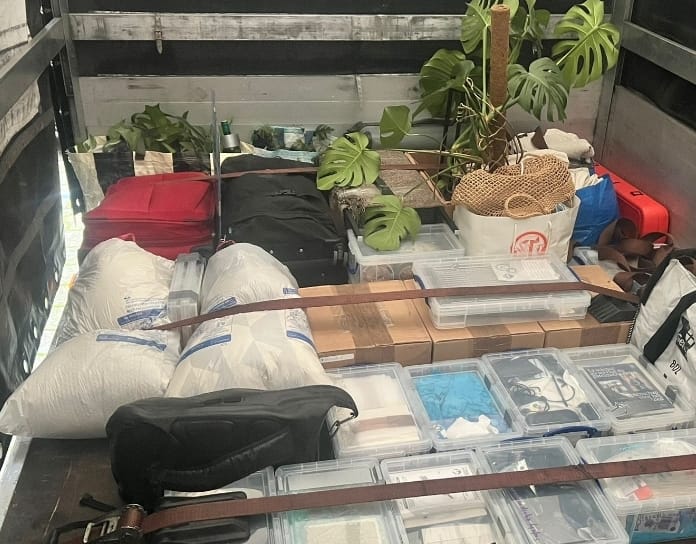
- Plants
- Food products
- Animal products
- New goods
- Commercial stock
- High-value jewellery or art
- Weapons or restricted items
- Vehicles
- Pets
The best way to reduce customs stress is to create a clear inventory. Do not write “many boxes.” Write “8 kitchen boxes, 6 bedroom boxes, 3 boxes of books, 1 bicycle, 1 dining table, 4 chairs, 1 office desk, 2 monitors.”
A professional man and van service also helps because your belongings are loaded in a more organised way. If the shipment needs to be inspected, labelled boxes and a logical inventory can save time.
How to Build a Useful Household Goods Inventory
Your inventory does not need to be poetic. It needs to be useful. Think of it as the map of your move.
Start room by room. List furniture separately, then group boxes by category. Do not hide valuable or unusual items inside vague descriptions. If something is fragile, expensive or difficult to replace, identify it clearly.
A good inventory might include:
| Category | Example Entry |
|---|---|
| Living room | Sofa, coffee table, TV, 4 boxes of books, 2 lamps |
| Bedroom | Bed frame, mattress, wardrobe, 6 clothing boxes |
| Kitchen | Dining table, 4 chairs, 8 kitchen boxes, microwave |
| Office | Desk, office chair, printer, 2 monitors, 3 document boxes |
| Outdoor items | Bicycle, skis, camping equipment |
| Fragile items | Mirror, glassware, framed artwork |
Take photos of valuable items before packing. If you have antiques, designer furniture or specialist equipment, mention them when requesting a quote.
This also helps VANonsite recommend the correct vehicle.
Registering After Arrival in Switzerland
Once you arrive, your administrative work is not over. In general, people moving to a new Swiss commune are expected to register with that commune within 14 days. Some cantons allow online registration, while others require an in-person visit.
You can check the official Swiss page here: notification of departure and registration.
You may need:
- Passport or identity card
- Residence or permit documents
- Rental contract
- Employment contract
- Civil status documents
- Birth certificates for children
- Proof of health insurance or insurance application
- Passport photos in some cases
- Dog registration information if moving with a dog
Local rules can vary, so check your specific commune.
This is one of the most practical answers to moving to Switzerland what to know: arrival is not the finish line. It is the start of local registration, insurance setup, banking, phone contracts and daily life.
Health Insurance in Switzerland
Health insurance is compulsory for people settling in Switzerland. Anyone taking up residence must generally arrange Swiss health insurance within 3 months. The Federal Office of Public Health explains this requirement here: health insurance for people resident in Switzerland.
This is not a detail to ignore. Swiss healthcare is excellent, but the insurance system is a major monthly cost. Premiums can vary by canton, age, insurer and chosen model. Families need to insure each person individually, including children.
When planning your budget, look beyond rent and moving costs. Include:
- Basic health insurance premiums
- Deductible choice
- Co-payment
- Accident insurance situation
- Dental care, where relevant
- Supplementary insurance if wanted
- Medication and regular treatment needs
If you are employed, check whether accident insurance is covered through your job. If you are self-employed, studying, retired or not working, your situation may be different.
What to know before moving to Switzerland is this: your budget should not be built only around rent. Health insurance, transport, deposits and everyday costs can change the real picture quickly.
Housing in Switzerland: Deposits, Competition and Practical Access
Housing is often one of the hardest parts of moving to Switzerland. Cities such as Zurich, Geneva, Lausanne and Basel can have competitive rental markets. Good apartments may receive many applications, and landlords often expect organised paperwork.
A rental application may include:
- Identity document
- Residence or permit information
- Employment contract
- Salary proof
- References
- Debt collection register extract in some cases
- Completed application form
- Deposit arrangement
Temporary accommodation can be useful if your permanent apartment is not ready. It may cost more at first, but it can prevent a rushed decision in a tight rental market.
Once housing is confirmed, think like a mover. Beautiful Swiss buildings can have narrow staircases, limited parking, old lifts or strict delivery rules. Before moving day, check:
- Where the van can park
- Whether a parking permit is needed
- Whether the building has delivery time limits
- Lift size and weight limits
- Staircase width
- Distance from entrance to apartment
- Whether large items need disassembly
- Whether neighbours or building management need notice
Small details become expensive when ignored. A van parked far from the entrance can slow the whole day. A sofa that does not fit through the door can turn a smooth delivery into a wrestling match.
VANonsite can plan more effectively when you provide access information in advance. Photos of entrances, staircases and parking areas are genuinely useful.
How Much Does Moving to Switzerland Cost?
The cost of moving to Switzerland depends on volume, weight, route, access, timing and services. A compact student move is completely different from a family relocation or office removal.
The main cost factors include:
- Pickup country and delivery city
- Distance between addresses
- Volume in m3
- Weight in kg
- Number of movers required
- Floor level at both properties
- Lift availability
- Parking access
- Packing service
- Fragile or high-value items
- Storage needs
- Urgency
- Customs readiness
A move booked early is often easier to schedule. A move booked at the last minute can still be possible, but flexibility becomes more valuable. VANonsite offers Last Minute Moving for urgent relocations, which can help when a job start date, tenancy handover or family situation changes suddenly.
When comparing quotes, do not look only at the final number. Ask what is included. Does the service offer GPS tracking? Is the vehicle size suitable? Are your goods handled carefully? Is the company experienced with European removals? Cheap transport can become painfully expensive when timing fails or damage occurs.
A premium man and van service is not about showing off. It is about reducing risk when your belongings are crossing borders.
VANonsite Vehicle Size Guide
Choosing the right vehicle is one of the smartest ways to protect your budget. Too small, and you face delays or extra trips. Too large, and you may pay for space you do not need.
VANonsite offers a clear range of vehicle sizes:
| VANonsite Option | Capacity | Weight Limit | Best For |
|---|---|---|---|
| Moving One | 1 m3 | 100 kg | Suitcases, documents, urgent essentials, small student loads |
| Moving Basic | 5 m3 | 300 kg | Studio moves, boxes, compact furniture |
| Moving Medium | 10 m3 | 500 kg | Small apartments, partial home moves, light furniture |
| Moving Premium | 15 m3 | 1,100 kg | Larger apartments, furniture-heavy moves |
| Moving Premium Plus | 30 m3 | 3,500 kg | Family relocations, multi-room moves, bulky items |
| Moving Full House XXL | 90 m3 | 20,000 kg | Full houses, large offices, complex European removals |
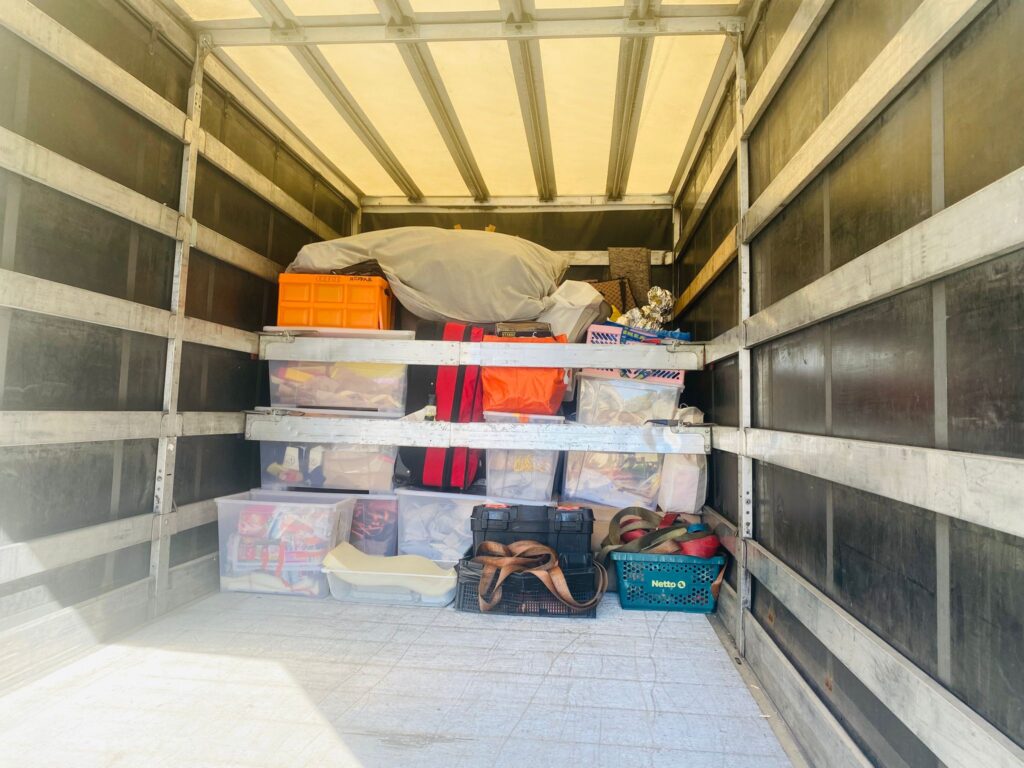
If you are unsure, prepare a list of belongings and ask for guidance. People often underestimate volume. Clothes, books, kitchenware, bedding, small appliances and shoes add up quickly. A few “small extras” can fill a van faster than expected.
Moving to Switzerland what to know includes this simple truth: cubic metres are not abstract. They decide whether your move feels smooth or cramped.
Why a Man and Van Service Works Well for Switzerland
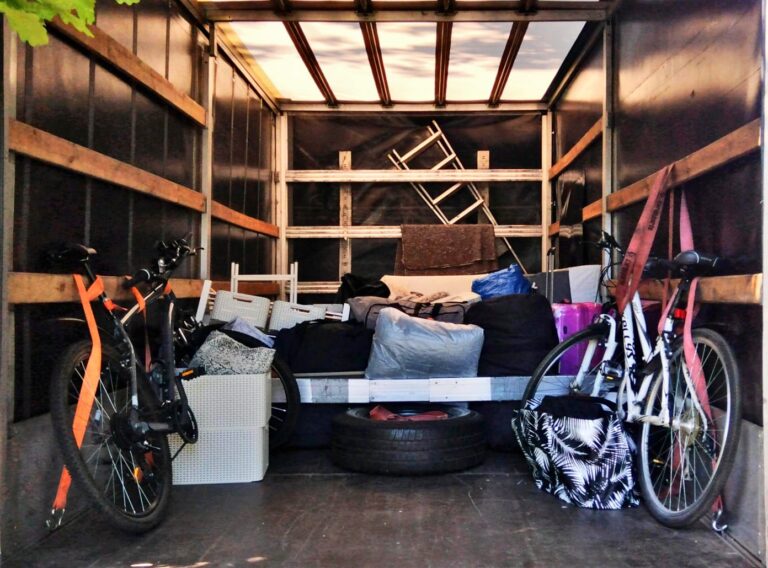
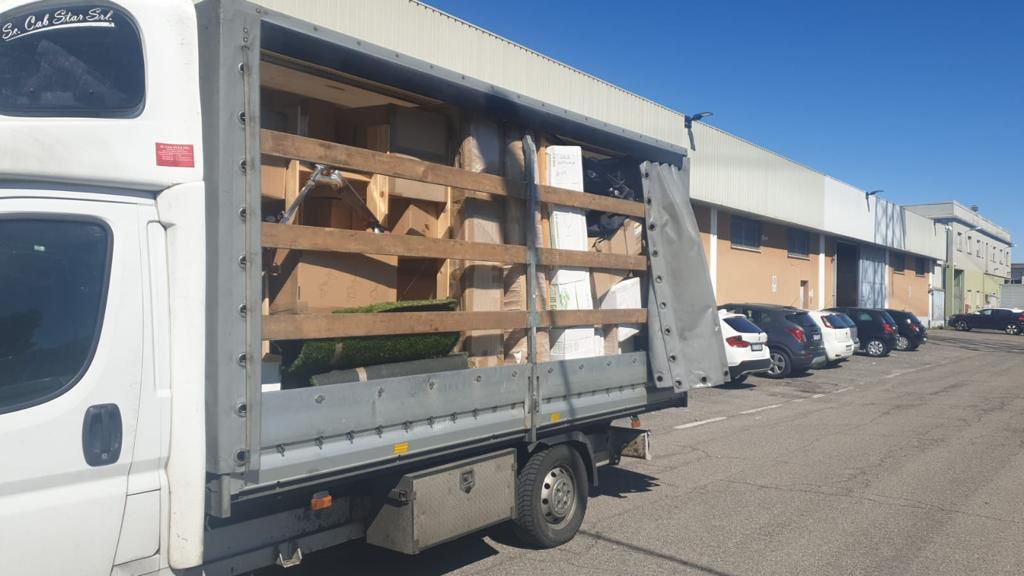
A professional man and van service is often ideal for moving to Switzerland because it is flexible, direct and practical. It works especially well for apartments, student moves, furniture transport, urgent relocations and partial household moves.
Compared with large groupage-style removals, a dedicated man and van solution can offer clearer timing and a more personal process. Your belongings are handled as a specific move, not lost in a maze of mixed shipments.
The best man and van service for Switzerland should offer:
- Clear communication
- Suitable vehicle size
- International route experience
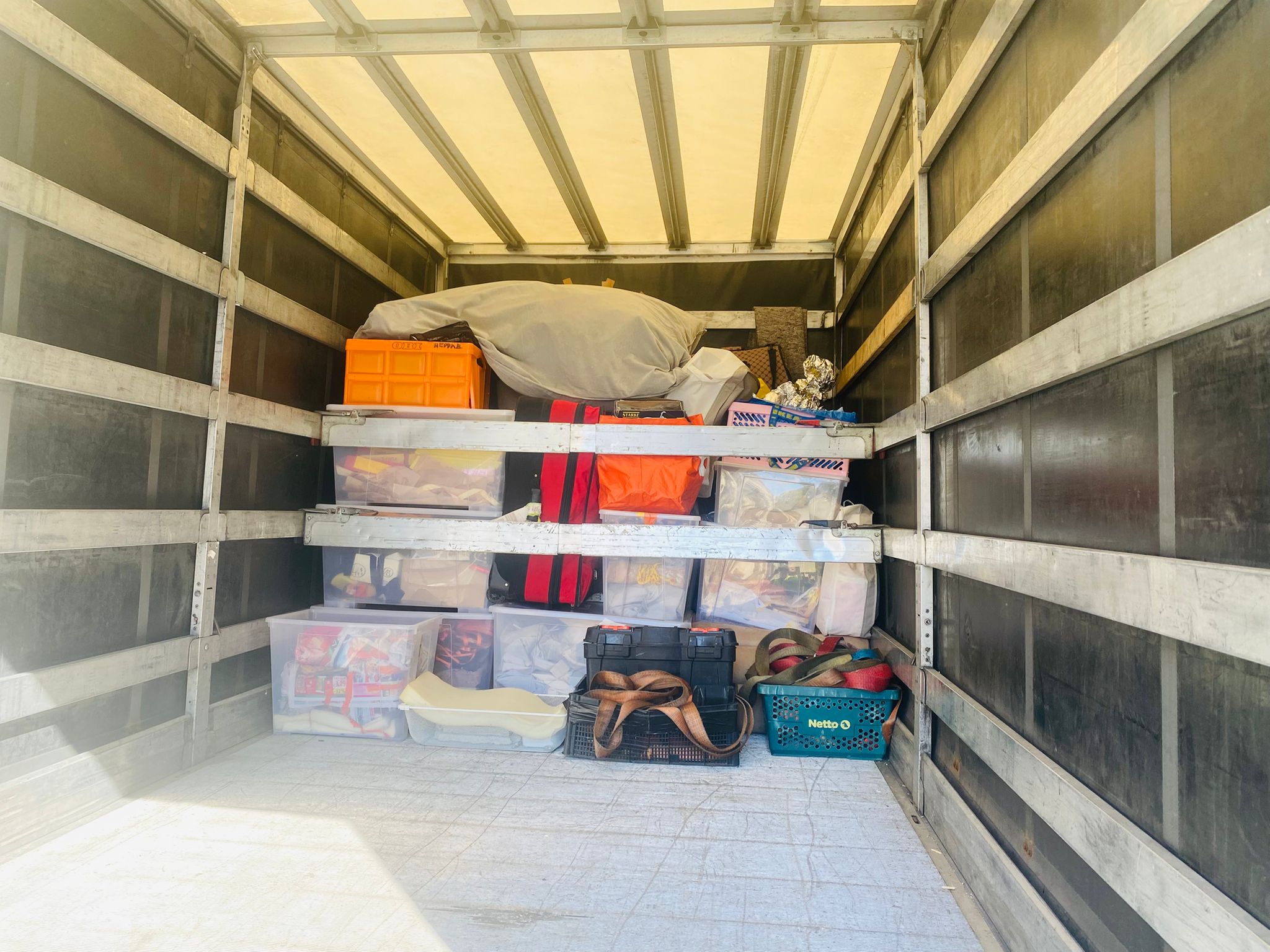
- Careful loading
- Protective materials
- GPS tracking
- Flexible scheduling
- Support for urgent moves
- Awareness of customs documentation needs
VANonsite offers GPS tracking for every load, which is especially valuable on cross-border moves. When your belongings are travelling through Europe, silence can feel heavy. Tracking gives the move a pulse. You know the shipment is moving, not disappearing.
This is why VANonsite’s removals to Switzerland are a strong choice for customers who want a balance of speed, safety and confidence.
Packing for Switzerland: What to Pack First and Last
Packing is where a relocation becomes real. At first, it feels simple. Then you find three drawers full of cables, a shelf of fragile glasses and a cupboard full of things you forgot you owned.
Start with non-essential items. Books, seasonal clothing, decorative objects and spare bedding can be packed early. Leave daily-use items until the final days.
Your “open first” box should include:
- Passport or ID
- Permit paperwork
- Rental contract
- Customs documents
- Phone charger
- Laptop and work essentials
- Medication
- Toiletries
- Basic clothes
- Bedding for the first night
- Pet documents
- Snacks and water
- Basic kitchen items
- Children’s comfort items
- Keys and address details
Label every box by room and priority. “Kitchen, open first” is more useful than “stuff.” Fragile boxes should be marked clearly on multiple sides.
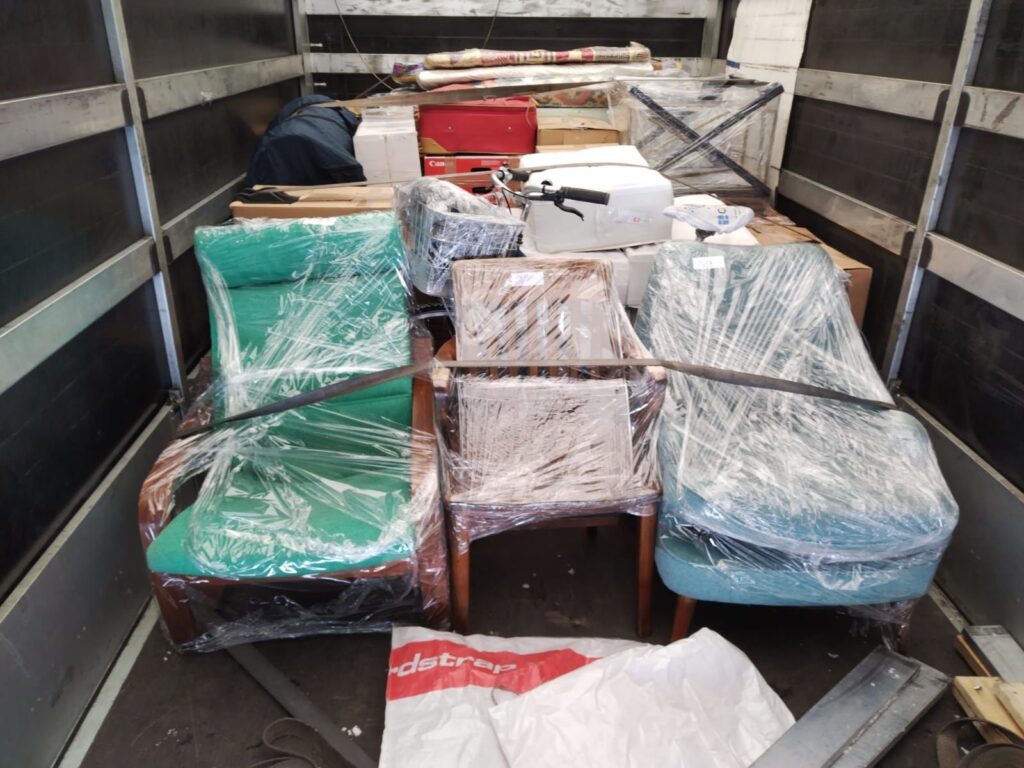
For furniture, remove loose parts, protect corners and wrap delicate surfaces. Glass, marble, mirrors and polished wood need special care. If you own valuable designer pieces, antiques or expensive office equipment, consider White Glove Delivery or professional packing.
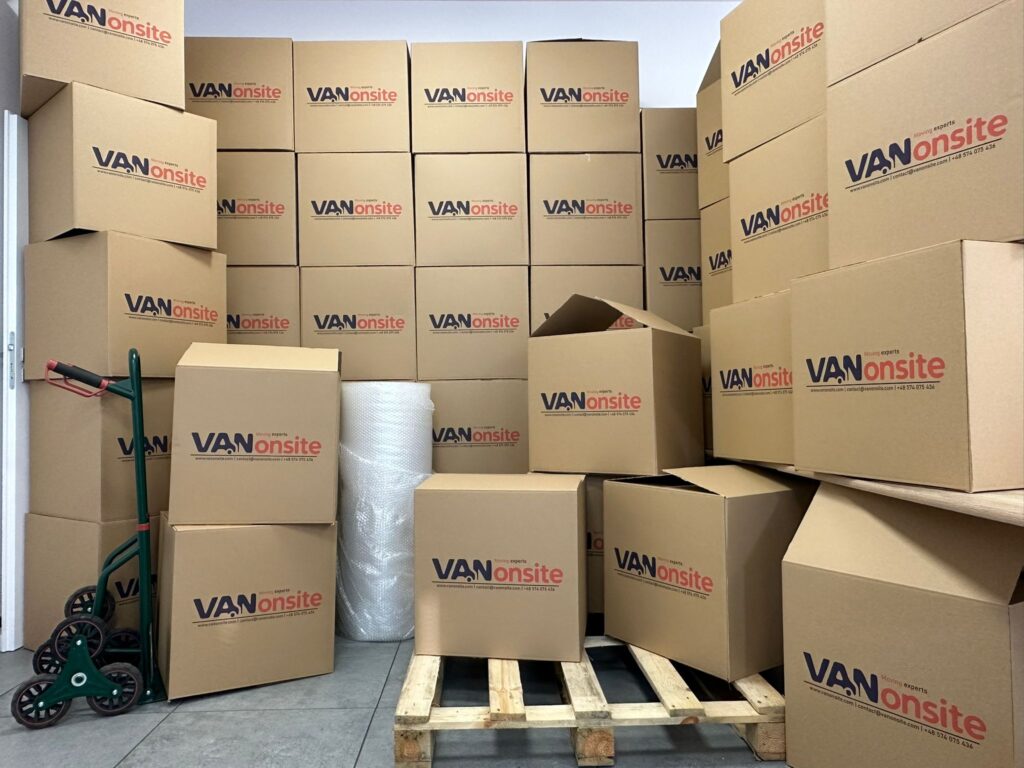
VANonsite’s Packing Service can be especially useful if you are short on time or moving high-value belongings. It can turn a chaotic apartment into a controlled, labelled shipment ready for the road.


Moving Furniture to Switzerland
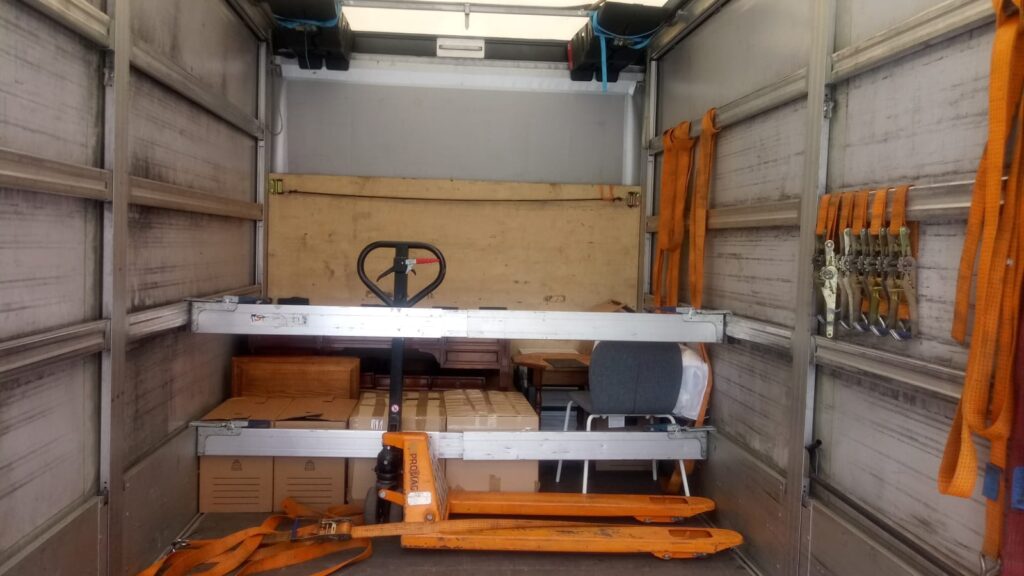
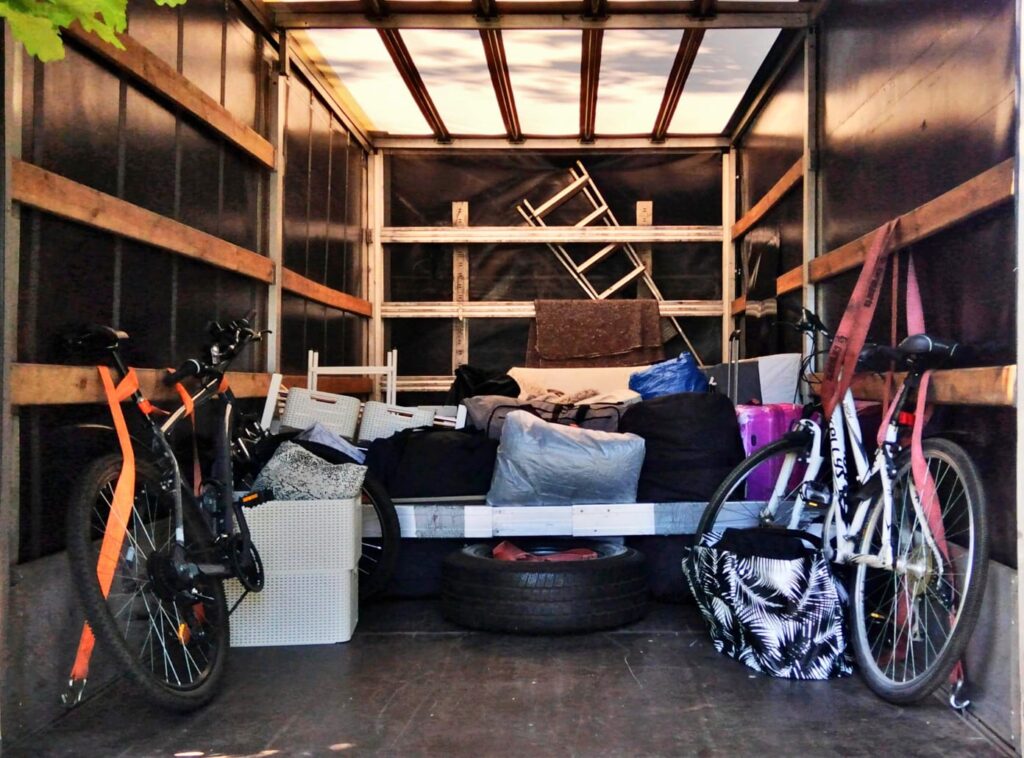
Furniture removals to Switzerland require more planning than a local move. The journey is longer, border processes matter and delivery access can be strict. A badly packed table can suffer on a long road journey. A wardrobe that is not disassembled may not survive narrow stairs.
Before moving furniture, measure:
- Doorways
- Hallways
- Staircases
- Lift dimensions
- Ceiling height where relevant
- Large sofas
- Wardrobes
- Dining tables
- Bed frames
- Office desks
- Fragile cabinets
Disassembly can reduce risk and save space. Keep screws and small parts in labelled bags taped securely to the furniture or packed in a dedicated hardware box.
Protect fragile surfaces carefully. Do not rely on luck. Switzerland may be famous for precision, but gravity still works there.
VANonsite’s Furniture Removals and White Glove Delivery services are well suited for delicate, bulky or valuable items. Some belongings deserve more than a quick wrap and hope. They need patient handling.
Moving With Pets to Switzerland
If you have pets, moving to Switzerland what to know includes animal entry rules. Dogs, cats and ferrets are subject to official requirements. Depending on the country of origin, they may need a microchip, valid rabies vaccination, pet passport or certificate.
Check the official Swiss guidance before travel:
Pet documents should stay with you, not inside the moving load. Bring food, water, medication, a lead, waste bags, a carrier and something familiar from home. Moving is loud and strange for animals. A calm owner and a familiar blanket can make a difficult journey softer.
Pets are not extra cargo. They are family members with paperwork.
Bringing a Car to Switzerland
Bringing a vehicle to Switzerland creates a separate set of tasks. Customs and registration rules apply, and the process can vary depending on your situation.
Swiss customs provides vehicle relocation information here: customs clearance for vehicles during relocation. Swiss guidance on registering a car or motorbike is available here: registering a vehicle. Vehicle testing information is available here: vehicle testing.
A vehicle may qualify as part of relocation goods when conditions are met. Swiss customs guidance says the vehicle must be present during customs clearance.
After customs, registration is handled by the road traffic office in your canton. You will need insurance, and the vehicle may require inspection before Swiss registration.
Treat vehicle import as its own project. Do not bury it inside the general moving checklist.
Moving to Switzerland With Children
Family moves need an extra layer of care. Children feel the emotional weather of a move even when adults try to keep everything cheerful. A new country, new language, new school and new home can be exciting, but also overwhelming.
Before moving with children, consider:
- School registration
- Childcare availability
- Language of instruction
- Commute to school
- Health insurance for each child
- Birth certificates
- Vaccination records
- Favourite items for the first night
- Safe transport of toys, books and furniture
Pack each child a personal arrival bag. Include clothes, toiletries, a favourite toy, books, chargers and comfort items. When everything else is inside labelled boxes, that small bag can feel like an anchor.
If your moving date is close to the start of a school term, arrange documents early. School and commune processes can vary by canton, so check locally.
A professional moving plan also protects family energy. The less time parents spend wrestling with logistics, the more attention they can give to the emotional side of the transition.
Student Removals to Switzerland
Switzerland attracts students to cities such as Zurich, Geneva, Lausanne, Basel and Bern. For students, the move is usually smaller but still important. A laptop, books, clothes, bedding, kitchen essentials and personal items can fit into a compact van, but they still need safe transport.
Student moves often work well with smaller VANonsite options such as Moving One or Moving Basic. These are practical for compact loads, especially when airport luggage is not enough and a full removal truck would be excessive.
Before a student move, check:
- Dormitory or apartment access hours
- Key collection time
- Building rules
- What furniture is already included
- University documents
- Residence requirements
- Health insurance situation
- Banking and phone setup
- First-week essentials
A man and van service can make a student relocation feel less brutal. Instead of dragging heavy suitcases through stations, the belongings travel directly and safely.
Office Removals to Switzerland
Office moves to Switzerland require precision because business disruption has a real cost. A delayed desk or missing monitor can affect productivity, meetings and client work.
Before an office move, create a clear relocation plan. Include:
- Desks and chairs
- Monitors and computers
- Filing cabinets
- Meeting room equipment
- Reception furniture
- Printers and scanners
- Stock or display materials
- Cable management
- IT setup requirements
- Access at both buildings
- Installation needs
- Weekend or evening delivery options
VANonsite offers Office Removals and Office Furniture Installation, which can help businesses move with less downtime. GPS tracking is especially useful for companies because managers need to know where equipment is during transport.
For office relocations, inventory is not only practical. It protects continuity. Label departments, desks and equipment clearly so the new space can come alive quickly.
Storage When Moving to Switzerland
Sometimes dates do not line up. Your old lease ends on Friday, but the Swiss apartment is ready in 2 weeks. Your office furniture arrives before the new premises are accessible. Your family wants to arrive first, then bring the rest later.
Storage can solve this awkward gap.
Storage may be useful when:
- Property handover dates do not match
- You need temporary accommodation
- Renovation work is not finished
- You are downsizing
- You are waiting for customs or admin clarity
- You want to split the move into stages
- Office space is not ready yet
VANonsite offers storage options, which can make a complicated relocation easier to manage. Instead of forcing every item into the new space immediately, you can create breathing room.
Last Minute Moving to Switzerland
Not every move has a neat 12-week timeline. Jobs start suddenly. Rentals are approved late. Family circumstances change. A planned move can become urgent overnight.
Last minute moving to Switzerland is possible, but it requires sharper decisions. You need to prioritise documents, essentials and realistic packing. Do not try to create a perfect move. Create a safe and workable move.
If you need to move quickly:
- Confirm your legal and housing position.
- Prepare your essential documents.
- Build a fast inventory.
- Separate valuables and personal papers.
- Choose the right van size.
- Pack essentials first.
- Use professional help where it saves time.
- Keep communication clear.
VANonsite’s Last Minute Moving service can support urgent European relocations. This is useful for job starts, tenancy deadlines, student arrivals, emergency family moves and sudden office needs.
Speed matters, but reckless speed is dangerous. The goal is not to rush blindly. The goal is to move fast with control.
City Notes: Zurich, Geneva, Basel, Lausanne and Bern
Moving to Zurich
Zurich is one of Switzerland’s strongest business centres, especially for finance, technology, research and consulting. It offers excellent public transport, a polished lifestyle and high demand for housing.
For moving day, check parking carefully. Central areas can be tight, and apartment buildings may have strict access conditions. If you are moving a full home, provide access photos and lift details before booking.
Moving to Geneva
Geneva is international, elegant and multilingual. It attracts people working in diplomacy, NGOs, finance and global organisations. French is widely used, and many people live across borders or move within an international network.
Plan delivery access early. Some streets are busy, and building rules may be specific. If you are moving office equipment or high-value furniture, careful scheduling matters.
Moving to Basel
Basel sits near France and Germany, making it a fascinating city for cross-border life. It is especially strong in pharma, life sciences and research.
Because of its border location, Basel moves can feel geographically simple but still need customs awareness. Do not confuse physical closeness with administrative simplicity.
Moving to Lausanne
Lausanne is lively, scenic and popular with students, academics and professionals. It has beautiful slopes, lake views and a strong cultural rhythm.
Those hills matter on moving day. Check parking, stairs and lift access carefully. A short distance on a map can feel very different when carrying furniture uphill.
Moving to Bern
Bern offers a calmer pace, strong public institutions and a beautiful historic centre. It can be an excellent choice for families and professionals who want stability without the full intensity of Zurich or Geneva.
Historic areas may create access challenges, so parking and delivery planning should not be left until the final day.
Timeline for Moving to Switzerland
A clear timeline turns worry into movement. Use this as a practical planning guide.
| Time Before Move | What to Do |
|---|---|
| 8 to 12 weeks | Check permits, housing, school needs, work documents and budget |
| 6 to 8 weeks | Request removals quotes, prepare inventory and choose van size |
| 4 weeks | Confirm accommodation, check pet and vehicle rules, collect documents |
| 2 weeks | Finalise inventory, label boxes, confirm parking and building access |
| 1 week | Print documents, pack essentials and separate valuables |
| Moving day | Keep passports, paperwork, keys, medication and valuables with you |
| First 14 days | Register with your new commune where required |
| First 3 months | Arrange compulsory Swiss health insurance if settling in Switzerland |
Moving to Switzerland what to know is not one secret. It is a sequence. Each completed step makes the next one easier.
Common Mistakes When Moving to Switzerland
Even organised people make mistakes during relocation. Moving is emotional, and tired people often underestimate details.
Avoid these common problems:
- Booking transport before checking customs rules.
- Packing documents inside the moving van.
- Writing a vague inventory.
- Underestimating volume and weight.
- Forgetting local registration.
- Delaying health insurance.
- Ignoring pet entry requirements.
- Bringing restricted goods without checking.
- Forgetting vehicle customs and registration.
- Choosing a mover without tracking or clear communication.
- Failing to measure large furniture.
- Ignoring parking and lift access.
- Leaving packing until the final night.
- Comparing removals quotes only by price.
- Not keeping first-night essentials separate.
The cheapest-looking move can become expensive if the van is too small, the delivery is delayed or the furniture is damaged. Reliability has value. Visibility has value. Good handling has value.
Why Move to Switzerland With VANonsite?
Moving to Switzerland is a precision job. You need more than a van. You need a moving partner that understands timing, safety, communication and cross-border pressure.
VANonsite offers premium European transport with flexible man and van solutions for different types of moves. The service is designed for people who want their belongings handled carefully and delivered efficiently.
VANonsite can support:
- Last Minute Moving
- Furniture Removals
- Home Removals
- Packing Service
- White Glove Delivery
- Office Removals
- Storage
- Student Removals
- Office Furniture Installation
The vehicle range is one of the biggest advantages. You can choose anything from Moving One at 1 m3 and 100 kg to Moving Full House XXL at 90 m3 and 20,000 kg. That means the move can fit your real load, not the other way around.
GPS tracking for every load adds another layer of trust. When your furniture, clothes, documents, work equipment and personal items are on the road, knowing where they are is deeply reassuring.
Book your move with VANonsite’s removals to Switzerland.
FAQ: Moving to Switzerland What to Know
Moving to Switzerland: what do I need to know first?
First, check your legal right to enter, live or work in Switzerland. Then prepare your customs documents, household goods inventory, accommodation details, registration documents and health insurance plan. After that, choose a reliable man and van service with a suitable vehicle size.
What to know before moving to Switzerland with household goods?
You need to understand Swiss customs rules. Household effects may qualify for duty-free import when you are transferring your domicile and the goods meet the relevant conditions. Prepare Form 18.44 where required and keep a clear inventory.
What documents do I need when moving to Switzerland?
You may need a passport or national ID, permit information, employment contract, rental contract, inventory, Form 18.44, health insurance documents, pet paperwork and vehicle documents if relevant. Requirements depend on your nationality, canton and personal situation.
Can I bring furniture to Switzerland?
Yes, furniture can usually be moved as part of household effects if it meets relocation goods conditions. Measure large items, protect fragile surfaces and list furniture clearly in your inventory.
How soon do I need to register after moving to Switzerland?
In general, you are expected to register with your new commune within 14 days of moving. Check the rules of the commune where you will live.
Do I need health insurance in Switzerland?
Yes. People settling in Switzerland must generally arrange Swiss health insurance within 3 months after taking up residence. Each family member needs insurance.
Can I move to Switzerland with pets?
Yes, but dogs, cats and ferrets must meet Swiss entry requirements. Depending on the country of origin, this may involve a microchip, rabies vaccination and pet passport or official certificate.
What size van do I need for moving to Switzerland?
It depends on your volume and weight. VANonsite offers options from 1 m3 and 100 kg for small loads to 90 m3 and 20,000 kg for full-house or office moves. A clear inventory helps match the right vehicle.
Is a man and van service good for moving to Switzerland?
Yes. A professional man and van service is flexible, direct and efficient, especially for student moves, apartments, furniture transport, urgent relocations and partial home moves.
Is moving to Switzerland expensive?
It can be, especially when housing, deposits, insurance and transport are included. Moving costs depend on distance, volume, weight, access, service level and timing. Planning early helps control the total cost.
Ready to Move to Switzerland Without the Panic?
Switzerland can feel like a promise written in mountain light: cleaner air, safer streets, sharper organisation and a more peaceful rhythm. But before that promise becomes your normal Tuesday morning, you need to move your life across borders and into a real home.
If you came here searching for moving to Switzerland what to know, the answer is clear. Prepare your documents. Respect customs. Register on time. Arrange health insurance. Choose the right van size. Keep your essentials close. And do not gamble with a mover that leaves you guessing.
With VANonsite, your move can be safer, faster and better organised from the first packed box to final delivery. Whether you need compact man and van transport, full home removals, student removals, office relocation, last-minute help, careful furniture removals, storage or white glove delivery, VANonsite gives you a stronger way to start your Swiss chapter.
Book your move with VANonsite’s man and van removals to Switzerland and arrive with confidence.