
Moving to Switzerland can feel like stepping into a postcard with paperwork attached. The mountains are majestic, the trains run with astonishing precision, and the quality of life can be exceptional. Yet behind the clean streets and calm lakes there is a very practical truth: a successful Swiss relocation depends on planning.
For expats moving to Switzerland, the biggest challenge is rarely the distance alone. It is the combination of permits, customs rules, packing decisions, property access, timing, and transport. A single missing document can slow down a border crossing. A poorly measured sofa can become a staircase drama. A rushed moving plan can turn an exciting fresh start into a costly knot of stress.
The good news is simple. With the right checklist, a realistic timeline, and a trusted European moving partner, the process becomes much lighter.
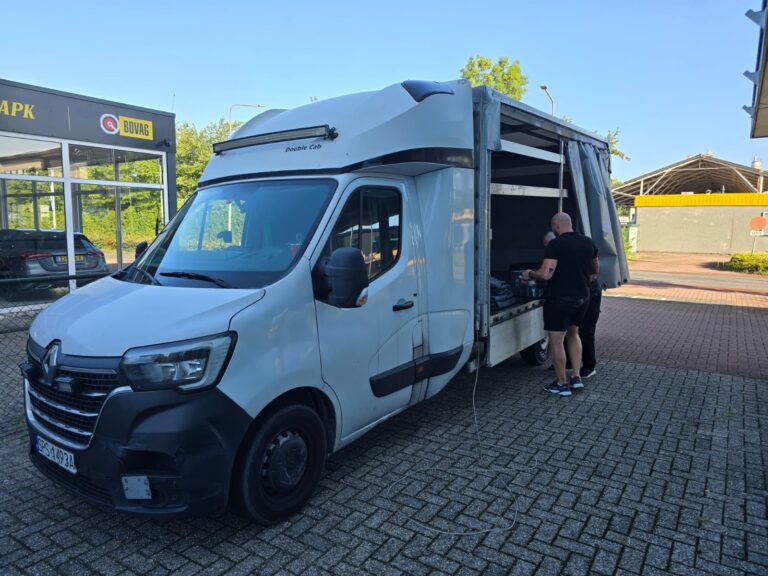
VANonsite supports European relocations with professional man and van services, GPS tracking for every load, flexible vehicle sizes, packing help, furniture removals, storage options, and fast, careful transport. For expats moving to Switzerland, that combination matters. Your belongings are not just cargo. They are your working desk, your child’s favourite chair, your winter coats, your documents, your memories, and the small familiar things that help a new country feel like home.
For a dedicated route and service overview, visit VANonsite’s removals to Switzerland.
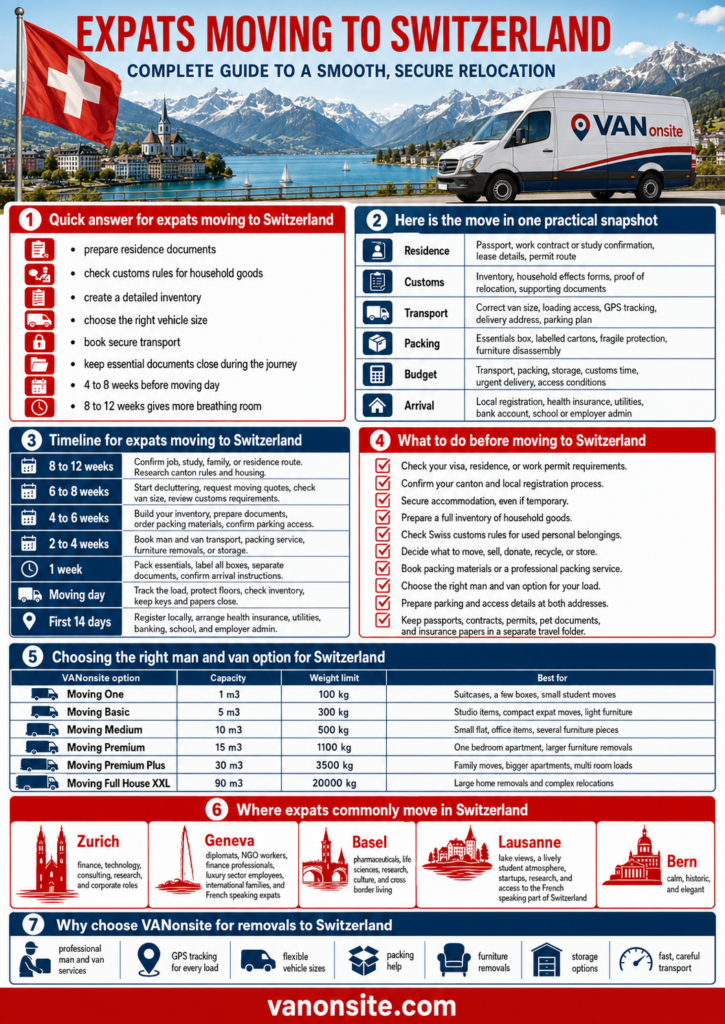
Quick answer for expats moving to Switzerland
Expats moving to Switzerland should prepare residence documents, check customs rules for household goods, create a detailed inventory, choose the right vehicle size, book secure transport, and keep essential documents close during the journey.
The most efficient plan usually starts 4 to 8 weeks before moving day. If the move is larger, includes furniture, pets, office equipment, storage, or multiple addresses, 8 to 12 weeks gives more breathing room. Last minute moves are still possible, especially with a responsive man and van service, but early planning reduces risk.
Switzerland is not part of the EU customs union, so moving household goods into the country is more formal than many relocations between EU countries. This does not have to be frightening. It simply means expats moving to Switzerland should treat documents, inventories, and timing as seriously as packing boxes.
Here is the move in one practical snapshot:
| Area | What expats moving to Switzerland should prepare |
|---|---|
| Residence | Passport, work contract or study confirmation, lease details, permit route |
| Customs | Inventory, household effects forms, proof of relocation, supporting documents |
| Transport | Correct van size, loading access, GPS tracking, delivery address, parking plan |
| Packing | Essentials box, labelled cartons, fragile protection, furniture disassembly |
| Budget | Transport, packing, storage, customs time, urgent delivery, access conditions |
| Arrival | Local registration, health insurance, utilities, bank account, school or employer admin |
For many expats moving to Switzerland, the move is also emotional. You may be leaving friends, a familiar street, or a country where you know how everything works. A good relocation plan gives you more than logistics. It gives you a sense of control.




What to do before moving to Switzerland
What to do before moving to Switzerland? Start with the essentials: confirm your legal route, organise your housing, prepare customs paperwork, decide what to take, and book a reliable man and van service that understands European removals.
Before anything goes into a box, make sure your move has a clear foundation. Switzerland is highly organised, and that is part of its charm. However, it also means vague planning rarely works well. Expats moving to Switzerland should know where they are going, why they are moving, what they are taking, and which documents may be needed before the van arrives.
A strong pre move checklist should include:
- Check your visa, residence, or work permit requirements.
- Confirm your canton and local registration process.
- Secure accommodation, even if temporary.
- Prepare a full inventory of household goods.
- Check Swiss customs rules for used personal belongings.
- Decide what to move, sell, donate, recycle, or store.
- Book packing materials or a professional packing service.
- Choose the right man and van option for your load.
- Prepare parking and access details at both addresses.
- Keep passports, contracts, permits, pet documents, and insurance papers in a separate travel folder.
This checklist gives expats moving to Switzerland a clear route through the fog. Instead of trying to solve everything at once, you move step by step. First the legal side. Then the home. Then the inventory. Then the van. Then the packing. Then the journey.
It also helps to create three separate folders: digital copies, printed copies, and hand luggage originals. Digital copies are useful when you need to send something quickly. Printed copies are helpful at a border, office, or registration desk. Originals should stay with you, not inside a moving box.
VANonsite’s role in this process is practical and calming. A GPS tracked man and van service gives you visibility during the journey. Flexible vehicle sizes help match the move to your actual volume. Packing, storage, furniture removals, and white glove delivery can be added when the move needs extra care.
Timeline for expats moving to Switzerland
A calm relocation is built backwards from moving day. Expats moving to Switzerland should give themselves enough time to handle official steps, property access, packing, and transport without a last week panic.
| Time before moving | Key actions | Why it matters |
|---|---|---|
| 8 to 12 weeks | Confirm job, study, family, or residence route. Research canton rules and housing. | Swiss relocation is easier when the legal and address details are clear early. |
| 6 to 8 weeks | Start decluttering, request moving quotes, check van size, review customs requirements. | Reducing volume by 15% to 25% can sometimes lower transport complexity. |
| 4 to 6 weeks | Build your inventory, prepare documents, order packing materials, confirm parking access. | Customs and loading plans become smoother when details are written down. |
| 2 to 4 weeks | Book man and van transport, packing service, furniture removals, or storage. | Availability can tighten quickly, especially at month end or during summer. |
| 1 week | Pack essentials, label all boxes, separate documents, confirm arrival instructions. | The final week should be controlled, not chaotic. |
| Moving day | Track the load, protect floors, check inventory, keep keys and papers close. | Small details prevent big delays. |
| First 14 days | Register locally, arrange health insurance, utilities, banking, school, and employer admin. | Switzerland rewards fast, accurate administration. |
This timeline is not only for large home removals. It also helps students, professionals, couples, families, and office teams. Even a compact move can become complicated when it crosses borders. That is why expats moving to Switzerland often benefit from early transport planning.
If your relocation is sudden, all is not lost. VANonsite offers Last Minute Moving support where availability allows. This can be valuable when a job start date moves forward, a tenancy ends abruptly, or a family decision becomes urgent. Still, the safest strategy is to book early, prepare carefully, and leave fewer things to chance.
Documents expats moving to Switzerland may need
Documents are the spine of a Swiss move. For expats moving to Switzerland, paperwork can affect entry, residence, employment, customs, pets, vehicles, and local registration. The exact requirements depend on nationality, purpose of stay, canton, family situation, and the length of your stay.
As a starting point, check official Swiss information before you move. Useful sources include ch.ch residence permits, SEM residence permits for EU and EFTA nationals, and ch.ch working in Switzerland.
Common documents may include:
- Valid passport or national identity card.
- Employment contract, assignment letter, or study confirmation.
- Rental contract or proof of address.
- Marriage certificate or birth certificates for family moves.
- Health insurance documents.
- Proof of income or financial means when relevant.
- Residence permit application or registration documents.
- Detailed household goods inventory.
- Customs forms for household effects.
- Pet passport, microchip record, and rabies vaccination proof when moving with pets.
EU and EFTA nationals often follow different procedures from nationals of other countries. Non EU and non EFTA nationals may face stricter entry and work authorisation requirements. Because rules can depend on the canton and personal circumstances, expats moving to Switzerland should avoid relying on casual advice from forums alone.
For customs, the official Swiss customs site explains moving household effects and the relocation import procedure. You can review Swiss customs moving household effects and Swiss customs relocation procedure.
For pets, dog, cat, and ferret rules should be checked before the journey. Official guidance is available from the FSVO pet travel rules and the FSVO entry check for pets.
The safest habit is simple: create a document pack before packing the home. Keep originals with you. Keep copies in the cloud. Keep printed copies in a folder. Never place critical documents inside a sealed moving box.
Customs and household goods when moving to Switzerland
Customs planning deserves special attention because Switzerland has its own import rules. Expats moving to Switzerland should prepare a clear inventory and understand that used household goods may be treated differently from new goods.
Household effects can include furniture, clothes, books, kitchen items, household appliances, sports equipment, bicycles, tools, personal objects, and sometimes vehicles or animals under specific rules. However, conditions matter. Swiss customs information explains that transferring domicile to Switzerland is an important requirement for importing household goods duty free, and items generally need to be personally used and intended for continued use after import.
For expats moving to Switzerland, the practical message is this: do not throw everything into boxes and hope for the best. Write it down. Group it clearly. Make the inventory readable.
A useful household goods inventory includes:
- Your full name and destination address.
- Numbered boxes.
- Description of each box or category.
- Approximate value of goods.
- Furniture list.
- Electronics list.
- Bicycles, tools, musical instruments, or sports gear.
- Items requiring special handling.
- Pet or vehicle details, if applicable.
- Date of move and transport provider details.
A clean inventory does not need to be poetic. It needs to be clear. “Box 12: kitchen plates, mugs, cutlery” is better than “miscellaneous”. “Bedroom: double bed frame, mattress, two bedside tables” is better than “furniture”.
VANonsite can support the transport side with a professional man and van service, safe loading, GPS tracking, and vehicle options matched to your volume. However, official customs rules remain official rules. Expats moving to Switzerland should always check the latest government guidance and prepare documents before loading day.
The smartest move is to treat customs like airport security for your household. Calm, clear, organised, and ready.
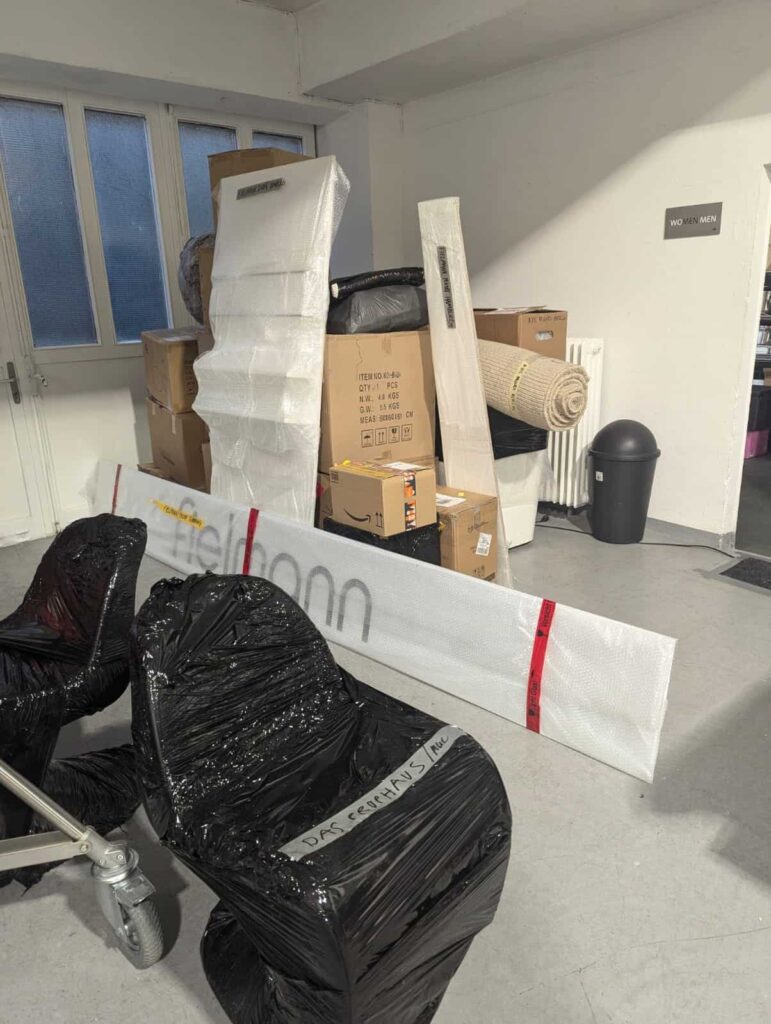
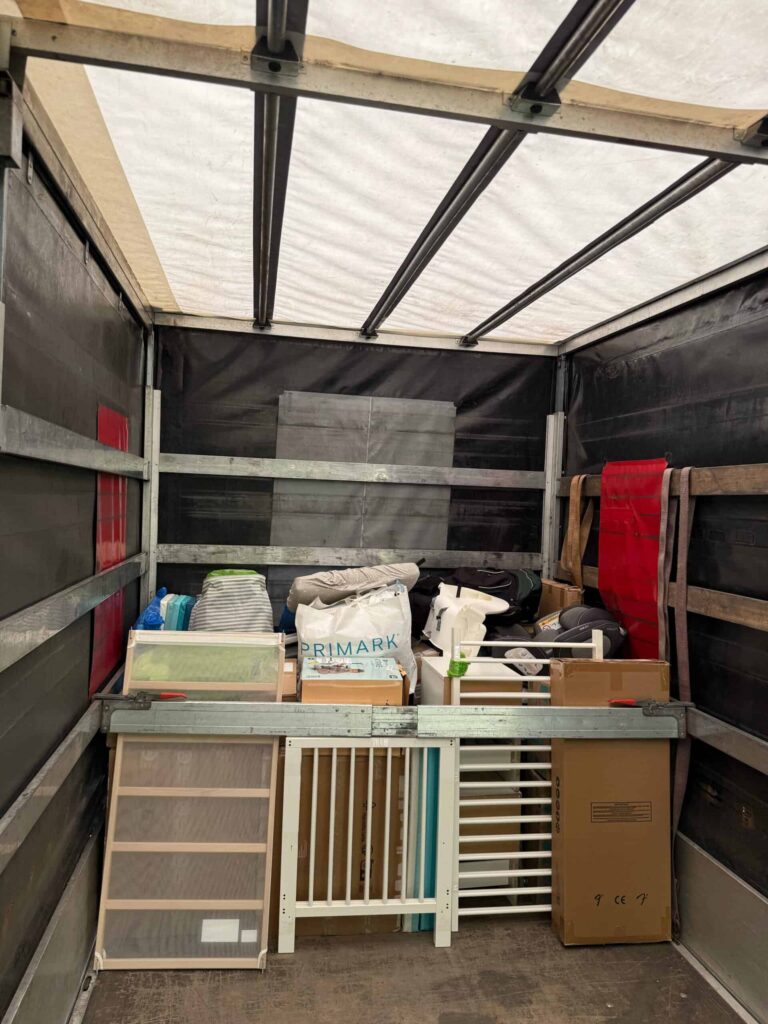
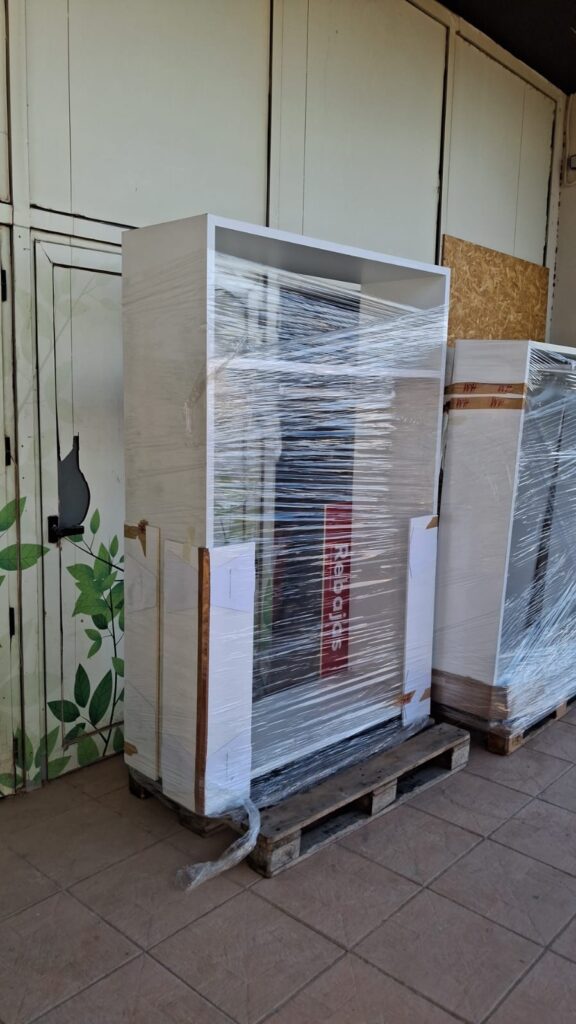
Choosing the right man and van option for Switzerland
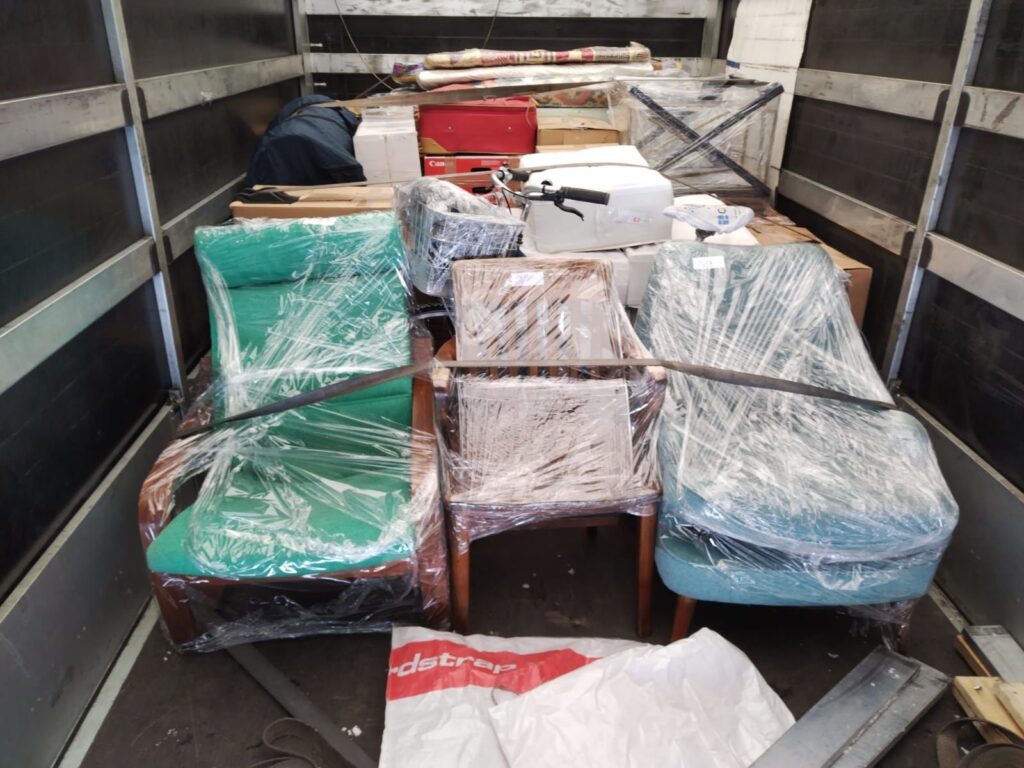
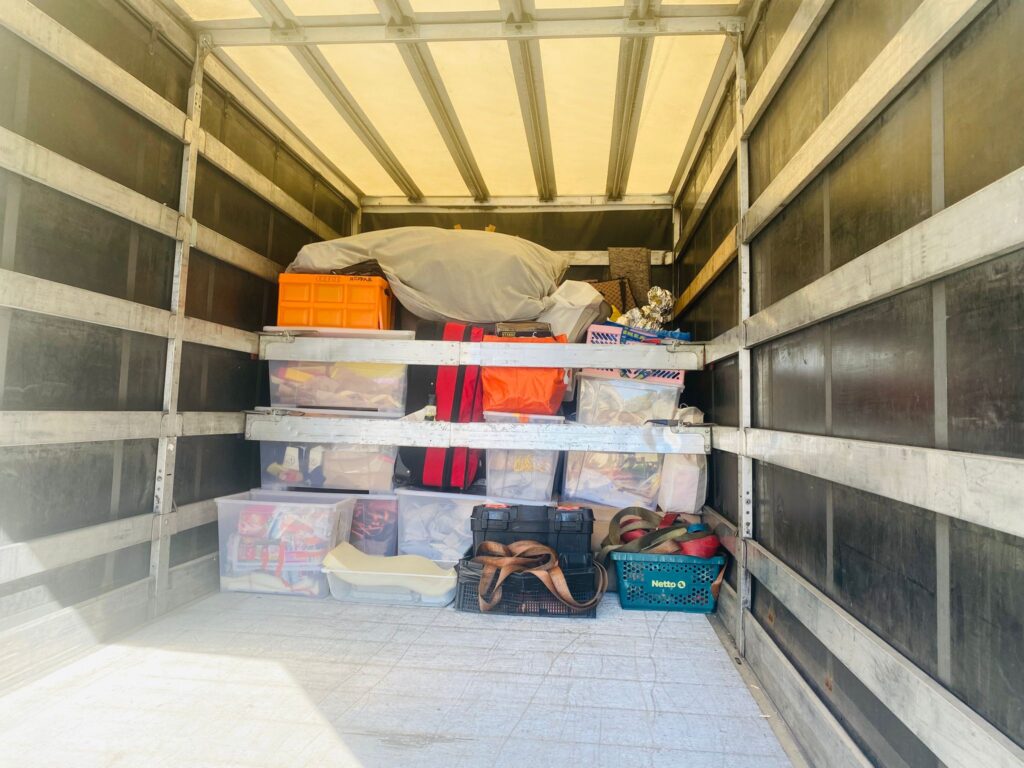
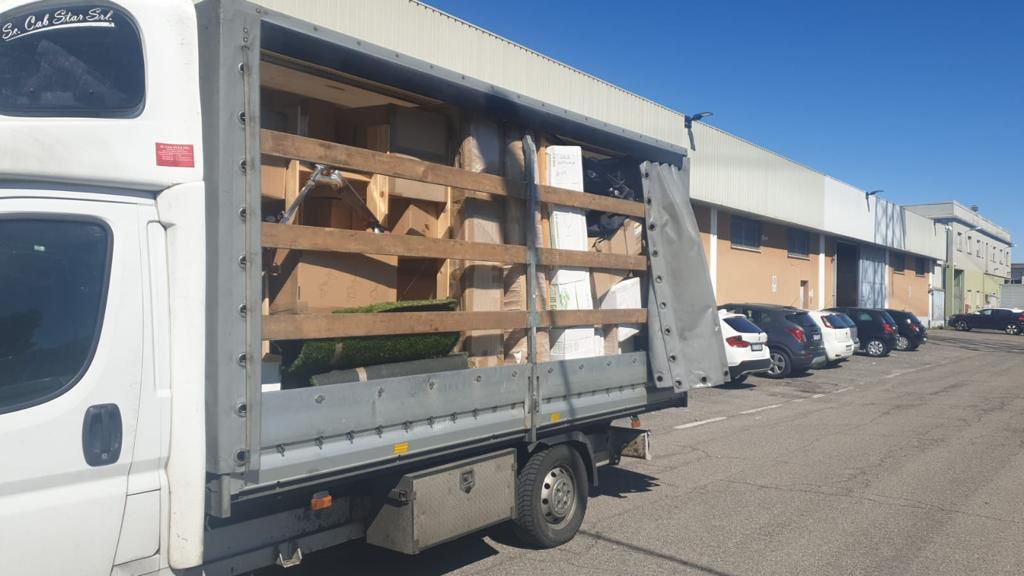
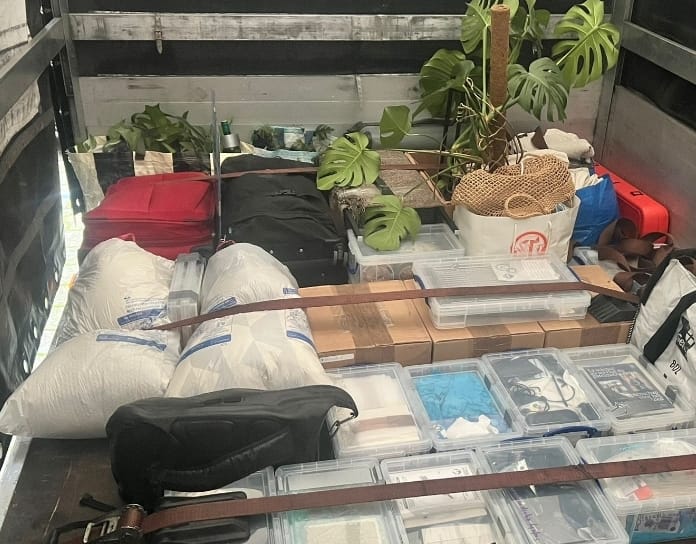
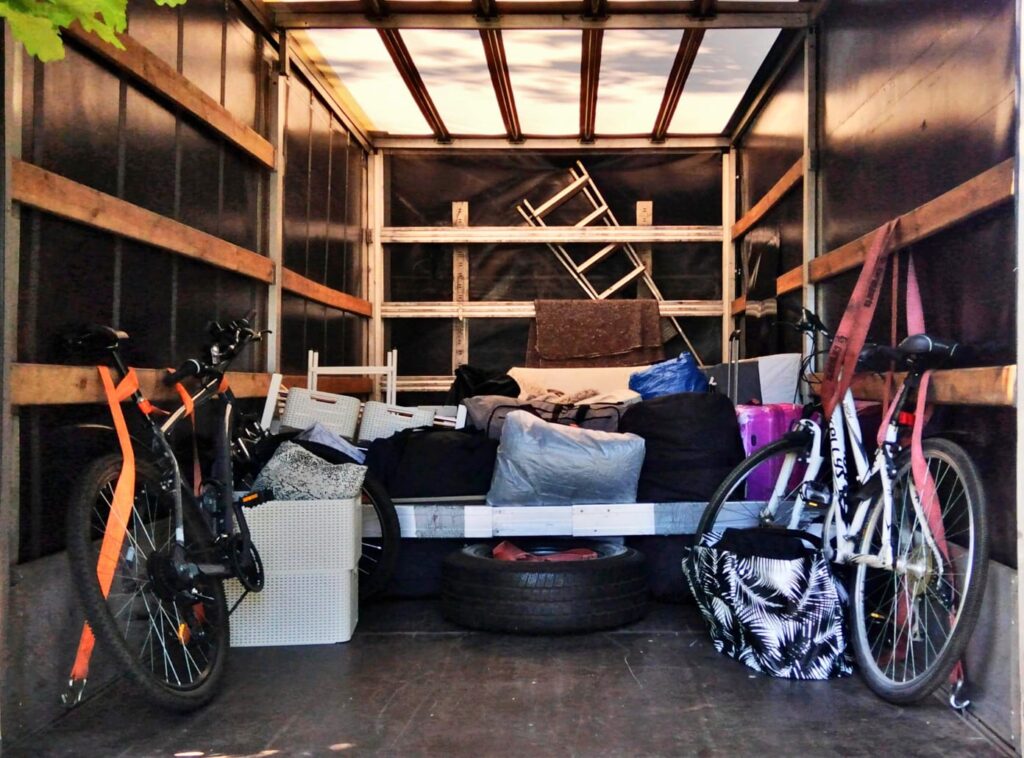
Not every relocation needs a giant truck. Many expats moving to Switzerland arrive with boxes, suitcases, a desk, a chair, a bicycle, and a few precious pieces of furniture. Others bring a full apartment, a family home, or office equipment. The right man and van option depends on volume, weight, distance, access, and urgency.
Choosing too small a vehicle creates pressure. Choosing too large a vehicle can waste money. A good moving plan sits in the middle: enough space for safe loading, but not more than you need.
VANonsite offers several vehicle sizes, from compact moves to full house relocations:
| VANonsite option | Capacity | Weight limit | Best for |
|---|---|---|---|
| Moving One | 1 m3 | 100 kg | Suitcases, a few boxes, small student moves |
| Moving Basic | 5 m3 | 300 kg | Studio items, compact expat moves, light furniture |
| Moving Medium | 10 m3 | 500 kg | Small flat, office items, several furniture pieces |
| Moving Premium | 15 m3 | 1100 kg | One bedroom apartment, larger furniture removals |
| Moving Premium Plus | 30 m3 | 3500 kg | Family moves, bigger apartments, multi room loads |
| Moving Full House XXL | 90 m3 | 20000 kg | Large home removals and complex relocations |
For expats moving to Switzerland, this range is valuable because no two moves look the same. A student moving to Lausanne may need 5 m3. A couple relocating to Zurich may need 10 m3 or 15 m3. A family moving to Geneva may need 30 m3 or more. A full home move with storage, fragile furniture, and multiple rooms may require the XXL option.
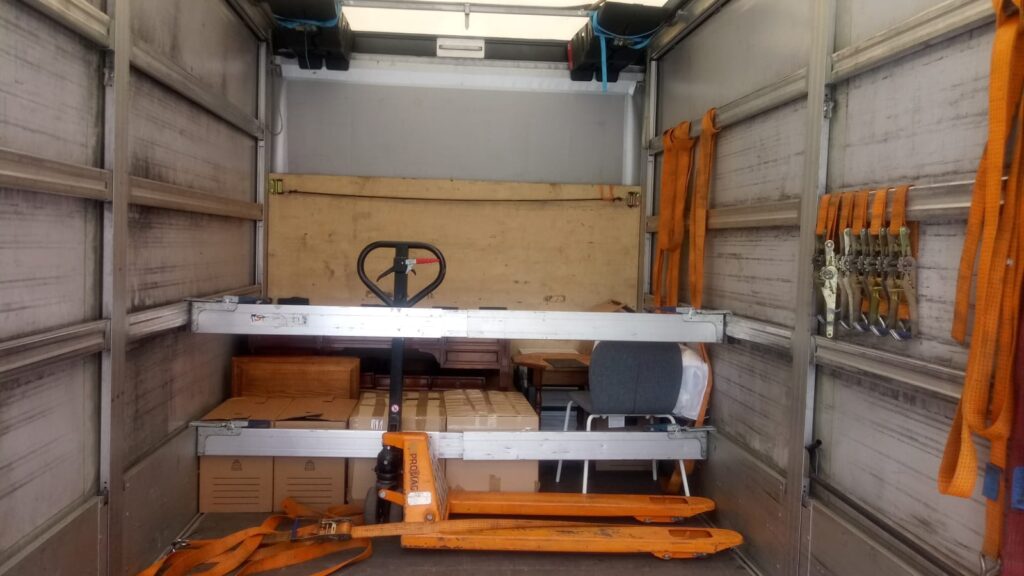
GPS tracking adds another layer of reassurance. When your belongings are crossing borders, you should not have to wonder where they are. VANonsite tracks every load, which gives customers a stronger sense of control during the journey.
A reliable man and van service is not only about a vehicle. It is about timing, communication, handling, route awareness, and trust. For expats moving to Switzerland, those details can change the whole emotional tone of moving day.
Packing for a Swiss relocation
Packing is where a move becomes real. The empty boxes arrive, the cupboards open, and suddenly your life has categories: keep, sell, donate, store, protect, carry by hand.
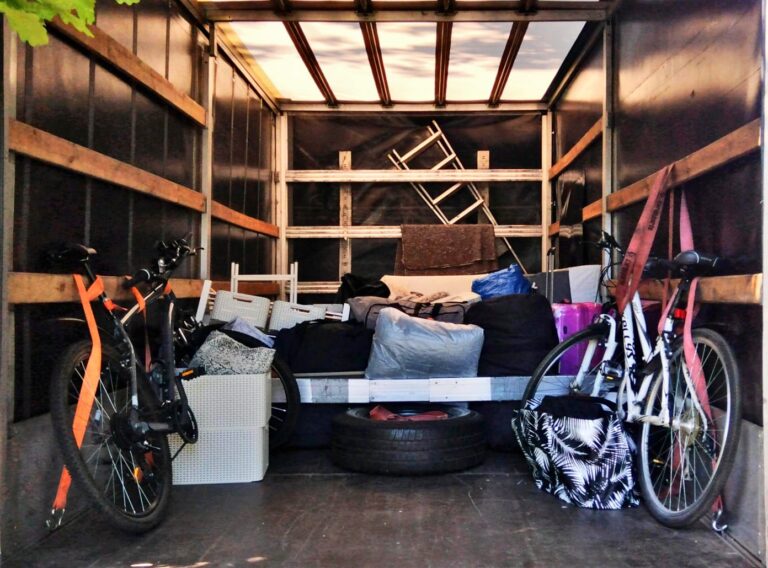
For expats moving to Switzerland, packing should begin with priority, not panic. Start with what you need immediately after arrival. Then move to seasonal, decorative, and rarely used items. Fragile belongings need time and patience. Important documents should never disappear into the general pile.
A strong packing system includes four groups:
- Essentials for the journey.
- Items needed during the first 48 hours.
- Fragile and high value belongings.
- General household goods for room by room unpacking.
Your essentials bag should contain passports, permits, rental documents, work papers, chargers, medication, toiletries, basic clothes, payment cards, snacks, and any pet papers. Your first night box should include bedding, towels, basic kitchen items, a kettle or coffee maker, cleaning wipes, toilet paper, and a change of clothes.
Fragile items need more than hope. Glassware, mirrors, artwork, monitors, lamps, and delicate furniture should be wrapped properly. If an item would hurt to lose, pack it like it matters.
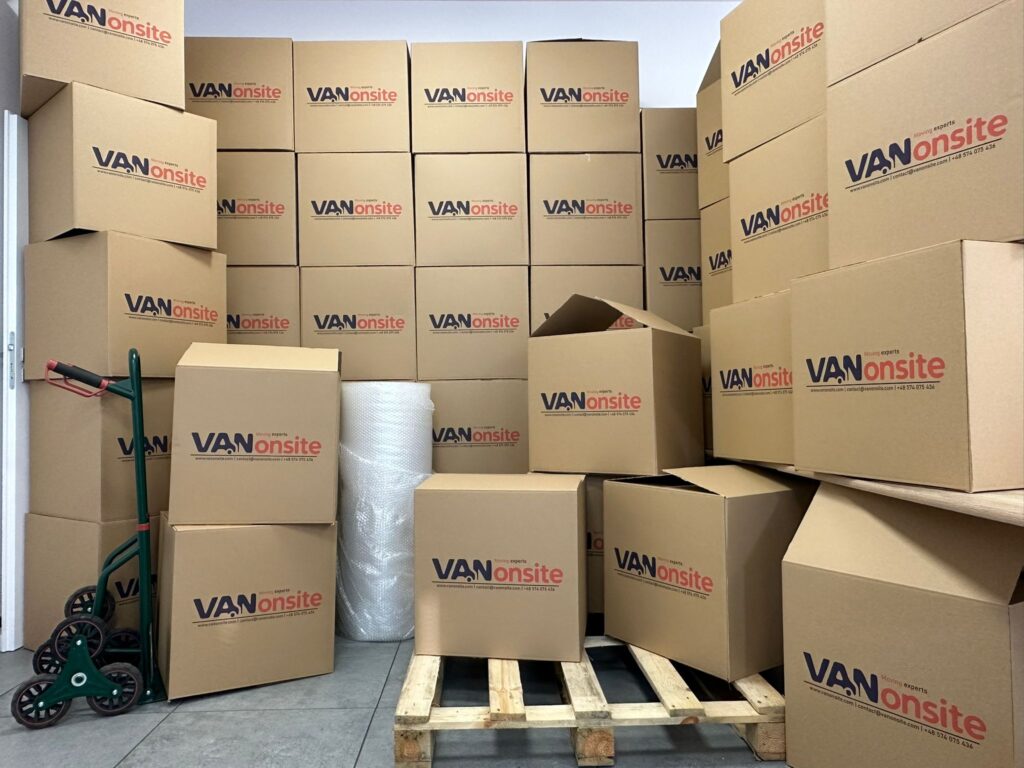
VANonsite’s Packing Service can help expats moving to Switzerland save time and reduce damage risk. Professional packing is especially useful for glass, ceramics, office equipment, mirrors, framed pictures, antiques, high value furniture, and awkward items that do not fit neatly into standard boxes.
Furniture deserves its own plan. Large wardrobes, beds, dining tables, office desks, and shelving may need disassembly. Screws should be bagged and labelled. Parts should be protected. If the furniture is valuable, sentimental, or hard to replace, consider Furniture Removals or White Glove Delivery.
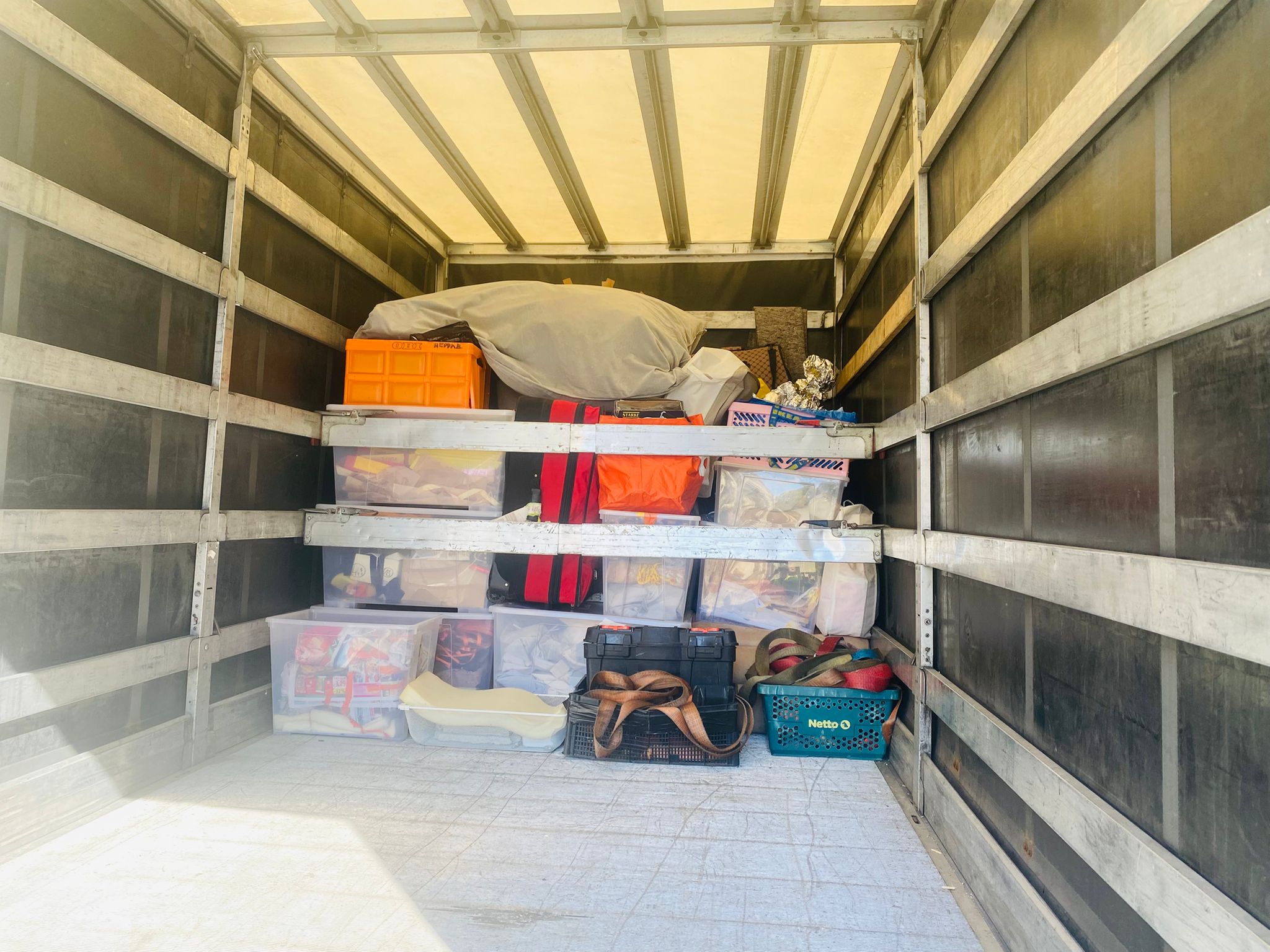
The secret to good packing is not perfection. It is consistency. Label boxes by room. Add short content notes. Mark fragile items clearly. Keep the inventory aligned with the actual load. Small habits save hours on arrival.
Moving furniture to Switzerland
Furniture can be the most expensive, beautiful, annoying, and emotional part of a move. A sofa is never just a sofa when it refuses to fit through a doorway. A dining table is never just a table when it carries years of family meals. For expats moving to Switzerland, furniture decisions should be practical and honest.
Before moving large furniture, check:
- Lift dimensions at the destination.
- Staircase width and turning space.
- Building entrance access.
- Parking distance from the door.
- Delivery time restrictions.
- Floor protection requirements.
- Whether disassembly is needed.
- Whether the item suits the new home.
- Replacement cost in Switzerland.
- Sentimental value.
Swiss apartments can be beautifully designed, but they are not always forgiving to oversized furniture. Older buildings may have narrow staircases. Urban addresses may have strict parking rules. New apartment blocks may require booked delivery windows or floor protection. For this reason, expats moving to Switzerland should measure before paying to transport bulky items.
That does not mean leaving everything behind. Good furniture is often worth moving, especially when it is expensive, custom made, ergonomic, or emotionally important. The key is to plan the handling properly.
VANonsite supports furniture removals with careful loading and suitable vehicle options. A man and van move can be ideal for selected furniture pieces, while larger home removals may require more space and extra planning.
If your furniture is premium, fragile, or needs special attention, white glove delivery can give a more refined experience. This is useful for designer pieces, delicate surfaces, office furniture, and items that need careful placement rather than simple drop off.
Costs expats moving to Switzerland should plan for
The cost of moving to Switzerland depends on more than kilometres. Distance matters, but so do volume, weight, urgency, packing, access, customs time, storage, and the number of people required for safe handling.
For expats moving to Switzerland, the main cost factors are:
- Total distance from pickup to delivery.
- Vehicle size and load weight.
- Number of boxes and furniture items.
- Packing materials and packing labour.
- Disassembly and reassembly.
- Fragile or high value handling.
- Floor level and lift access.
- Distance between parking and entrance.
- Customs preparation and waiting time.
- Storage needs.
- Last minute booking.
- Multiple pickup or delivery addresses.
- White glove delivery requirements.
One of the most effective ways to manage cost is to reduce volume. Cutting your load by 15% to 25% can sometimes shift the move into a smaller vehicle category. That does not mean stripping your life down to nothing. It means asking useful questions: Do I need this? Will it fit? Is it cheaper to replace? Does it have real value? Have I used it in the last year?
Storage can also affect cost, but it can be a smart solution. Many expats moving to Switzerland face a timing gap between leaving one property and entering another. Storage protects belongings while housing, paperwork, or delivery access catches up.
A cheap quote can look tempting, especially during an expensive international move. However, the lowest price is not always the best value. A mover without GPS tracking, clear communication, suitable vehicle size, or careful handling can create expensive problems later. VANonsite focuses on safety, speed, and visibility, which helps customers avoid the hidden cost of confusion.
Where expats commonly move in Switzerland
Switzerland is compact, but its cities have distinct personalities. Expats moving to Switzerland should think about language, work, schools, rent, transport, lifestyle, and access before choosing a destination.
Zurich
Zurich is one of the most popular choices for international professionals. It is strong in finance, technology, consulting, research, and corporate roles. It also offers excellent public transport, clean neighbourhoods, lake access, and a polished city rhythm.
For movers, Zurich can require careful access planning. Central streets, apartment blocks, parking zones, and delivery windows should be checked early. Expats moving to Switzerland for a Zurich job should confirm whether the building allows easy unloading.
Geneva
Geneva attracts diplomats, NGO workers, finance professionals, luxury sector employees, international families, and French speaking expats. It is cosmopolitan, elegant, and close to France.
Relocations to Geneva often involve cross border considerations, compact apartments, and busy urban streets. A well timed man and van delivery can make arrival smoother, especially when moving into central neighbourhoods.
Basel
Basel is strong in pharmaceuticals, life sciences, research, culture, and cross border living. Its location near France and Germany makes it distinctive. Many expats moving to Switzerland choose Basel for professional opportunities and a practical international lifestyle.
Because Basel sits near major borders, route planning can be efficient, but customs and delivery details still matter.
Lausanne
Lausanne offers lake views, a lively student atmosphere, startups, research, and access to the French speaking part of Switzerland. It can be a strong choice for students, young professionals, and families who want beauty without the same pace as Zurich.
Student removals and compact man and van services can work well here, especially for smaller apartments or shared housing.
Bern
Bern is calm, historic, and elegant. It appeals to families, public sector workers, professionals, and people who prefer a slower rhythm. The old town is beautiful, but some addresses require extra attention for access and unloading.
For expats moving to Switzerland with children, Bern can feel grounded and welcoming. As with every Swiss city, early parking checks are wise.
Moving to Switzerland with family
Family relocations carry extra emotional weight. You are not only moving objects. You are moving routines, school mornings, bedtime rituals, toys, work schedules, and the invisible comfort of familiarity.
For families, expats moving to Switzerland should prepare more than a transport plan. School documents, medical records, insurance, childcare, housing size, commute time, and neighbourhood choice all matter. Children may need more time to adjust, even when the move is positive.
A family moving checklist should include:
- School or nursery research.
- Birth certificates and family documents.
- Medical and vaccination records.
- Favourite toys packed in hand luggage.
- First week clothing and bedding.
- Child friendly snacks for the journey.
- Clear labelling for bedrooms.
- Early setup of sleeping areas.
- Storage plan for items not needed immediately.
- A calm explanation of moving day.
The first night matters. If children arrive to familiar bedding, a favourite lamp, or a known blanket, the new home feels less strange. For this reason, families should pack a first night box for each child.
VANonsite can support families with Home Removals, Packing Service, Storage, and suitable vehicle sizes for larger loads. For expats moving to Switzerland with a family, that flexibility can reduce friction during a stressful week.
Moving to Switzerland as a student
Student relocations are often smaller, faster, and more budget sensitive. Still, they need planning. Expats moving to Switzerland for university may arrive with suitcases, bedding, books, kitchen basics, a chair, a monitor, a bicycle, or boxes from a previous flat.
A compact man and van option can be ideal for student moves because it avoids the cost and complexity of a larger removal. VANonsite’s Student Removals can help students move to cities such as Zurich, Geneva, Lausanne, Basel, Bern, and smaller university towns.
Student moves should focus on essentials:
- Documents and university admission papers.
- Laptop, chargers, and study equipment.
- Clothes for multiple seasons.
- Bedding and towels.
- Basic kitchen items.
- Books and course materials.
- Medication and health documents.
- A small arrival budget.
- Clear housing access instructions.
- Contact details for the residence or landlord.
For students, every cubic metre matters. Moving One, Moving Basic, or Moving Medium may be enough depending on volume. The key is to avoid paying for empty space while still leaving enough room for safe loading.
Expats moving to Switzerland for study should also check residence and insurance requirements carefully. Switzerland can feel expensive at first, so a lean, well planned move gives students a stronger start.
Office removals and professional relocations to Switzerland
Not every move is personal. Some expats moving to Switzerland relocate as part of a company transfer. Others move a small business, remote office, studio, or professional equipment. In these cases, speed and precision become even more important because downtime can cost money.
Office removals may include:
- Desks and chairs.
- Monitors and computer equipment.
- Filing cabinets.
- Meeting room furniture.
- Printers and devices.
- Reception items.
- Stock or samples.
- Branded materials.
- Installation needs.
- Sensitive documents.
VANonsite provides Office Removals and Office Furniture Installation, which can support companies relocating staff or equipment across Europe.
Professional moves need a different mindset. Boxes should be labelled by department, workstation, or priority. Cables should be packed logically. IT equipment should be protected carefully. Delivery should be timed to reduce disruption. For expats moving to Switzerland for work, a smooth office setup can help the first week feel productive rather than messy.
A GPS tracked load is especially useful for business moves. When equipment is valuable or time sensitive, visibility is not a luxury. It is operational confidence.


Moving to Switzerland with pets
Pets do not understand relocation plans. They understand smells, routines, voices, stress, and comfort. For expats moving to Switzerland with animals, preparation should begin early.
Dogs, cats, and ferrets generally require a microchip, valid rabies vaccination, and suitable pet documentation. Rules can vary depending on the country of departure and the animal’s situation, so official Swiss guidance should always be checked before travel. Use the FSVO pet travel rules and the FSVO entry check for pets.
A pet move checklist includes:
- Microchip confirmation.
- Rabies vaccination record.
- Pet passport or required certificate.
- Vet appointment before travel.
- Travel crate or harness.
- Food and water.
- Medication.
- Familiar blanket or toy.
- Waste bags or litter supplies.
- Destination pet rules and landlord approval.
On moving day, keep pets away from heavy lifting, open doors, and loud activity. If possible, let them stay in a quiet room or with someone they know. The goal is to protect both the animal and the movers.
For expats moving to Switzerland, pets add tenderness and responsibility to the relocation. A calm plan makes the journey easier for everyone.
Storage for expats moving to Switzerland
Storage can be the unsung hero of international relocation. Many expats moving to Switzerland do not move directly from one finished home into another. There may be a temporary apartment, a delayed lease, a renovation, a probation period, or uncertainty about long term housing.
Storage helps when:
- Your Swiss apartment is not ready.
- You arrive before your furniture.
- You need time to choose a permanent home.
- You are downsizing.
- You want to keep seasonal items separate.
- Your office move has phased delivery.
- You are waiting for customs or access details.
- You want to avoid overcrowding the first apartment.
Instead of forcing every item into a temporary space, storage creates breathing room. It lets expats moving to Switzerland arrive with essentials first and bring the rest when the timing is right.
VANonsite’s storage support can be combined with removals, packing, furniture handling, and man and van transport. This is especially useful when the move has more than one stage.
A staged move can feel more civilized. First, you settle. Then, you decide. Then, you bring in what truly belongs.
Common mistakes expats moving to Switzerland should avoid
Most moving mistakes are preventable. They happen when people rush, assume, or leave decisions too late. Expats moving to Switzerland can avoid many problems with a little discipline before moving day.
The most common mistakes include:
- Leaving customs paperwork until the final week.
- Packing passports, permits, or contracts inside moving boxes.
- Booking a van based on guesswork.
- Forgetting that Switzerland has its own customs rules.
- Underestimating city parking restrictions.
- Moving furniture without measuring the destination.
- Ignoring lift size and staircase turns.
- Failing to label boxes by room.
- Choosing a mover without GPS tracking.
- Forgetting pet entry requirements.
- Keeping too many low value items.
- Not planning storage when housing is temporary.
- Failing to protect fragile items.
- Booking too late during busy moving periods.
- Not preparing a first night box.
Each mistake may look small in isolation. Together, they can create a miserable moving day. A missing document delays customs. A wrong van size causes reloading. A parking issue adds time. An unlabelled box hides the kettle, medicine, or work laptop.
For expats moving to Switzerland, the solution is not complicated. Plan early. Measure honestly. Document clearly. Pack carefully. Choose a moving partner with the right vehicle, communication, and tracking.
A relocation should feel like a clean beginning, not a maze with wet paint and locked doors.
Why choose VANonsite for removals to Switzerland
VANonsite gives expats moving to Switzerland a rare mix of speed, safety, and composure. The service is flexible enough for a compact man and van move, yet strong enough for larger home removals, furniture transport, office relocations, packing, storage, and white glove delivery.
The strongest benefits include:
- GPS tracking for every load.
- Multiple vehicle sizes from 1 m3 to 90 m3.
- Support for small, medium, and full home moves.
- Man and van flexibility for urgent or compact relocations.
- Professional packing support.
- Furniture removals for bulky and fragile pieces.
- White glove delivery for premium items.
- Office removals and furniture installation.
- Storage options for delayed or staged moves.
- European relocation experience.
- Focus on safety, speed, and careful handling.
For expats moving to Switzerland, trust matters because the move crosses borders, languages, roads, and systems. You need more than a driver. You need a moving process that feels clear from first contact to final delivery.
A good relocation partner listens before loading. How many boxes? Which floor? Is there a lift? Are there fragile items? Is there a parking restriction? Are customs documents ready? Is the delivery address permanent or temporary? These questions protect the customer.
VANonsite’s approach helps customers avoid vague planning. Your vehicle is matched to the real size of your move. Your load is trackable. Your belongings are handled with care. Your relocation feels less like a leap into the unknown and more like a controlled transition.
For dedicated support, visit removals to Switzerland.
Final moving checklist for expats moving to Switzerland
Use this checklist before your move. It is simple, direct, and designed to catch the details that often get missed.
| Task | Done |
|---|---|
| I checked my residence or work requirements. | |
| I reviewed official Swiss customs guidance. | |
| I created a household goods inventory. | |
| I prepared printed and digital document copies. | |
| I checked pet rules, if relevant. | |
| I measured large furniture. | |
| I confirmed lift, staircase, and parking access. | |
| I chose the right VANonsite vehicle size. | |
| I booked man and van transport. | |
| I arranged packing support, if needed. | |
| I labelled boxes by room. | |
| I packed a first night box. | |
| I kept passports and key documents with me. | |
| I planned storage, if housing timing is uncertain. | |
| I confirmed arrival time and contact details. |
For expats moving to Switzerland, this checklist can save hours of stress. It also helps you feel mentally ready. Moving is not only physical. It is a decision, a goodbye, a beginning, and a logistical performance all at once.
FAQ: Expats moving to Switzerland
What should expats moving to Switzerland do first?
Expats moving to Switzerland should first confirm their legal route, including residence, work, study, or family requirements. After that, they should secure accommodation, prepare customs documents, create an inventory, and book reliable man and van transport.
What to do before moving to Switzerland?
Before moving to Switzerland, check permit requirements, confirm your canton, prepare a household goods inventory, review customs rules, arrange pet documents if needed, choose the right moving date, and book a trusted moving service. Keep essential papers with you throughout the journey.
Do expats moving to Switzerland need customs paperwork?
Yes, customs paperwork is usually part of the process when moving household goods into Switzerland. Used personal belongings may qualify for duty free import when conditions are met, but expats moving to Switzerland should check official Swiss customs guidance before moving.
Can I use a man and van service for moving to Switzerland?
Yes. A man and van service can be ideal for smaller apartment moves, student removals, selected furniture, urgent relocations, or compact expat moves. Larger homes may need a bigger vehicle or a full home removal plan.
How early should I book removals to Switzerland?
Expats moving to Switzerland should ideally book 4 to 8 weeks before moving day. Larger moves, family relocations, office removals, and summer moves may benefit from 8 to 12 weeks of planning.
Can I move furniture to Switzerland?
Yes, you can move furniture to Switzerland, but you should measure carefully. Check lift size, staircase width, parking access, delivery rules, and whether disassembly is required. VANonsite offers furniture removals and white glove delivery for items that need careful handling.
What VANonsite vehicle size should I choose?
The right vehicle depends on your volume and weight. Moving One suits very small loads, Moving Basic can work for compact moves, Moving Medium is useful for small flats, Moving Premium suits larger apartment moves, Moving Premium Plus is strong for family relocations, and Moving Full House XXL supports large homes or complex moves.
Does VANonsite offer GPS tracking?
Yes. VANonsite offers GPS tracking for every load. This gives expats moving to Switzerland better visibility and peace of mind while their belongings travel across Europe.
Is storage useful when moving to Switzerland?
Storage is useful when your Swiss apartment is not ready, your lease dates do not align, you are moving into temporary housing, or you want to bring belongings in stages. It can make the relocation calmer and more flexible.
What is the biggest mistake when moving to Switzerland?
The biggest mistake is poor preparation. Expats moving to Switzerland should not leave customs documents, inventory, van booking, furniture measurements, or pet rules until the last moment. Switzerland rewards precision, and moving day rewards planning.
Start your move to Switzerland with confidence
Moving to Switzerland is a bold step. It can open the door to better work, cleaner routines, safer streets, stronger infrastructure, and a life that feels beautifully ordered. Yet the journey there needs structure.
For expats moving to Switzerland, the best relocation is not the one that looks cheapest on paper. It is the one that protects your time, your belongings, your documents, and your peace of mind.
VANonsite helps make that possible with GPS tracked transport, flexible man and van services, multiple vehicle sizes, packing support, storage, furniture removals, office removals, and careful European moving experience.
Whether you are moving one room, a student flat, a full apartment, a family home, fragile furniture, or professional equipment, VANonsite can help you arrive with clarity.
Plan your relocation today with VANonsite’s removals to Switzerland and move with speed, safety, and confidence.