
Moving to Switzerland pros and cons are not as simple as “high salaries versus high prices.” Switzerland is a polished, precise and demanding country. It rewards people who plan carefully. It can also punish rushed decisions with expensive surprises, strict paperwork and a rental market that moves faster than most newcomers expect.
Still, for many people, moving to Switzerland is life changing in the best possible way. The country offers clean cities, sharp career opportunities, exceptional public transport, dramatic mountain scenery and a rare feeling of order. You can leave work in Zurich and be by a lake before sunset. You can build a career in Basel, Geneva or Zug while living in a country famous for stability and calm.
The real question is not only whether Switzerland is “good.” It is whether Switzerland is good for your income, your family, your career and your tolerance for rules. This guide gives you a direct, practical and honest breakdown of moving to Switzerland pros and cons, including money, housing, documents, customs, healthcare and the moving process itself.
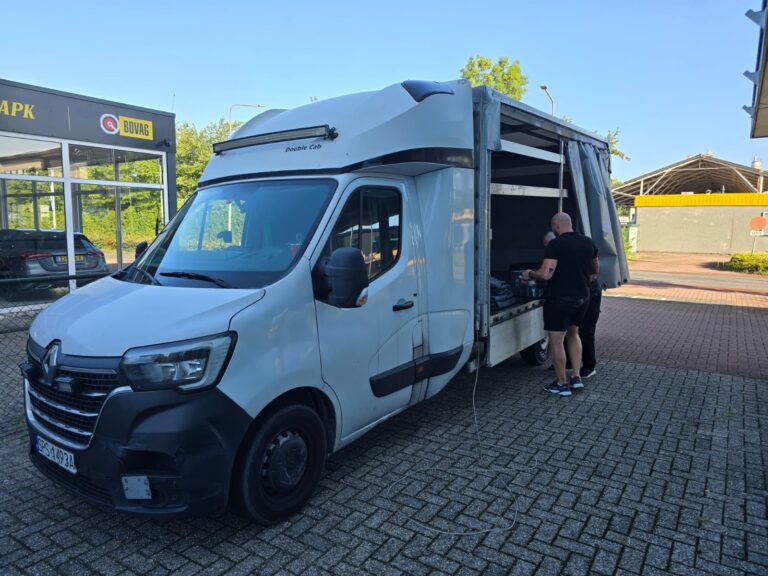
If Switzerland is already on your relocation map, VANonsite offers secure removals to Switzerland with GPS tracking, flexible vehicle sizes and professional European transport for everything from a compact man and van move to a full house relocation.
TL:DR
- Moving to Switzerland can be worth it if you have a strong income, a clear relocation plan and enough savings for the first 2 to 3 months.
- The biggest advantages are high salaries, safety, clean cities, efficient transport, stunning nature and reliable public services.
- The biggest disadvantages are high rent, expensive health insurance, strict paperwork, competitive housing and regional language differences.
- New residents usually need to register with their commune within 14 days of arrival and arrange mandatory Swiss health insurance within 3 months.
- Switzerland is not in the EU customs union, so household goods require proper customs preparation, even when moving from another European country.
- A man and van service can be ideal for students, small apartments, partial moves and urgent relocations, while families may need 30 m3 or more.
- VANonsite supports European moves to Switzerland with GPS tracked transport, packing support, storage options and vehicle sizes from 1 m3 to 90 m3.




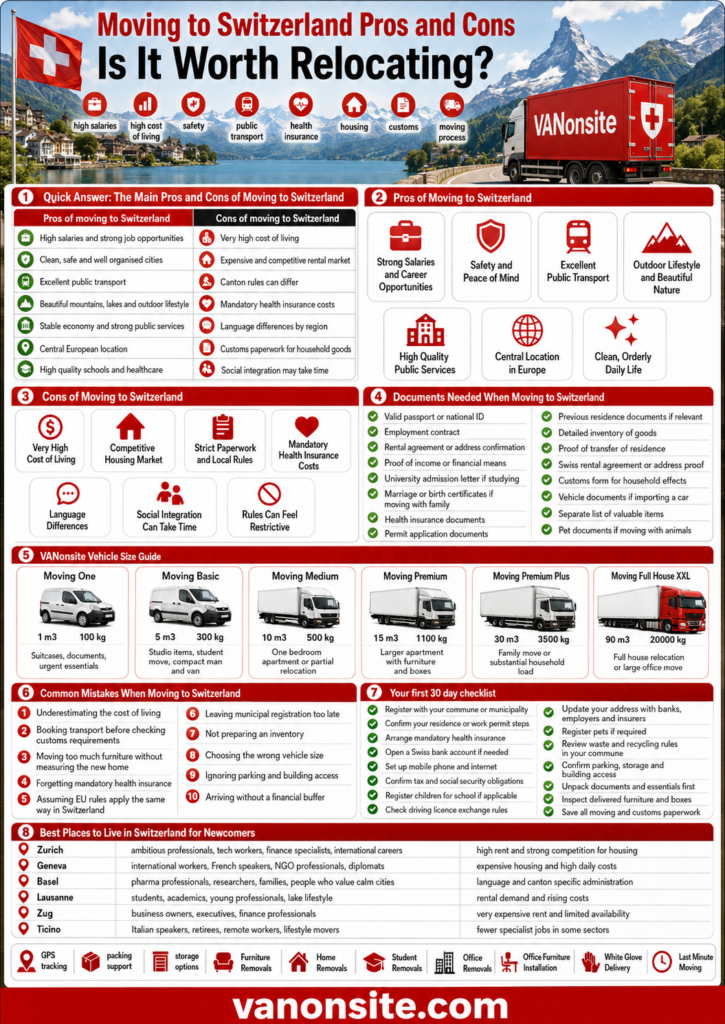
Quick Answer: The Main Pros and Cons of Moving to Switzerland
The quickest answer is this: Switzerland is one of Europe’s most rewarding countries for people who arrive prepared. It offers high earning potential, safety and a spectacular quality of life. However, it is also one of the most expensive places to settle, and the paperwork can feel unforgiving if you leave it until the last week.
| Pros of moving to Switzerland | Cons of moving to Switzerland |
|---|---|
| High salaries and strong job opportunities | Very high cost of living |
| Clean, safe and well organised cities | Expensive and competitive rental market |
| Excellent public transport | Canton rules can differ |
| Beautiful mountains, lakes and outdoor lifestyle | Mandatory health insurance costs |
| Stable economy and strong public services | Language differences by region |
| Central European location | Customs paperwork for household goods |
| High quality schools and healthcare | Social integration may take time |
The pros and cons of moving to Switzerland depend on your salary, canton, housing situation and family needs. A single professional moving to Zurich may have a very different experience from a family relocating to Vaud, Geneva, Basel or Ticino. That is why this guide looks at the whole picture, not only the postcard version.
Switzerland at a Glance Before You Move
Switzerland is small on the map but powerful in daily life. It has around 9 million residents, 26 cantons and 4 national languages: German, French, Italian and Romansh. The most popular expat hubs include Zurich, Geneva, Basel, Lausanne, Zug, Bern and Lugano.
Each region has its own personality. Zurich feels sharp, ambitious and polished. Geneva has an international pulse. Basel is practical, calm and close to both France and Germany. Lausanne brings lake views and student energy. Zug attracts business focused movers. Ticino feels warmer, softer and more Italian in spirit.
Switzerland is especially attractive for people working in:
- Finance
- Pharmaceuticals
- Technology
- Engineering
- Research
- International organisations
- Logistics
- Education
- Healthcare
- Corporate management
However, moving to Switzerland pros and cons should always be judged canton by canton. Taxes, rent, school options, commuting time and even social life can change dramatically depending on where you land.
Pros of Moving to Switzerland
1. Strong Salaries and Career Opportunities
One of the biggest reasons people search for moving to Switzerland pros and cons is money. Swiss salaries can be powerful, especially in Zurich, Geneva, Zug and Basel. For skilled professionals, Switzerland can feel like a career accelerator.
The country rewards precision, qualifications and reliability. If you work in finance, pharma, technology, engineering, consulting, healthcare or international business, Switzerland can open doors that feel almost locked elsewhere.
Yet there is a catch. A high salary does not automatically mean unlimited comfort. Rent, insurance, transport, groceries and childcare can consume a large share of your monthly income. A salary that looks dazzling from abroad needs to be tested against real Swiss expenses.
That said, if your job offer is strong, Switzerland can give you something rare: financial momentum in a stable environment.
2. Safety and Peace of Mind
Switzerland has a quiet kind of confidence. Streets are clean. Public spaces feel controlled. Transport systems are reliable. Rules are taken seriously. For many newcomers, that creates an instant sense of relief.
This matters more than people expect. Safety changes how you live. It affects whether you walk home calmly at night, let children travel independently, or spend weekends exploring new towns without constant tension.
The country is not perfect, of course. No place is. But Switzerland often feels beautifully composed. For families, solo movers and professionals seeking a more predictable life, that calm can be priceless.
3. Excellent Public Transport
Switzerland’s public transport is one of the strongest arguments in favour of relocation. Trains, trams, buses and boats connect cities, villages and mountain towns with remarkable efficiency.
You can live outside a major city and still commute comfortably. You can spend Saturday in the Alps and Sunday by a lake. You can cross into France, Germany, Italy or Austria without turning the journey into a dramatic expedition.
This also helps during relocation. Switzerland’s central European location makes it a common destination for international moves from Germany, France, Italy, the Netherlands, Belgium, Poland and the UK.
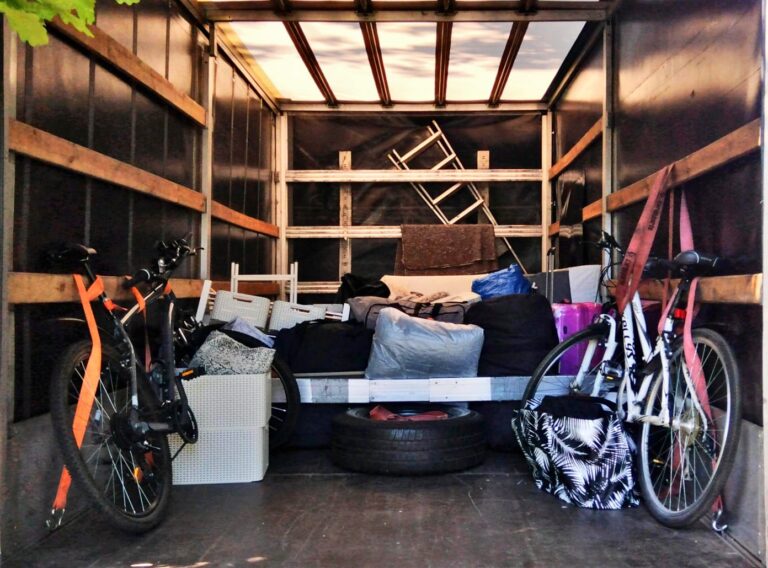
For smaller loads, a man and van solution can be a smart choice. It suits people moving essentials, student belongings, studio furniture or a partial household without paying for unnecessary space.
4. Outdoor Lifestyle and Beautiful Nature
Switzerland gives you mountains before breakfast and lakes after work. That sounds poetic, but it is also practical. Nature is close, clean and easy to reach.
For hikers, skiers, cyclists, runners and families who love fresh air, Switzerland can feel almost unreal. Even busy cities have green edges. Zurich has its lake. Geneva has Alpine views. Lausanne rolls down toward Lake Geneva. Lucerne looks like a painting that became a city.
This outdoor access improves daily life. Weekends become richer. Children grow up close to nature. Professionals who spend the week in offices can reset quickly.
When people discuss the pros and cons of moving to Switzerland, nature is often listed as a soft benefit. In reality, it can become one of the strongest reasons to stay.
5. High Quality Public Services
Switzerland is known for systems that work. Public transport is dependable. Healthcare is high quality. Schools have a strong reputation. Streets are maintained. Waste collection is organised. Administrative processes are usually clear, even when they are strict.
For newcomers from more chaotic environments, this can feel refreshing. There is comfort in knowing that things generally function as promised.
However, Swiss systems expect participation. You must register correctly. You must insure yourself. You must follow local rules. You must respect quiet hours, recycling rules and municipal expectations. Switzerland gives a lot, but it asks for discipline in return.
6. Central Location in Europe
Switzerland sits at the heart of Europe. This is a major advantage for professionals, families and companies.
From Switzerland, you can reach France, Germany, Italy and Austria quickly. International airports in Zurich, Geneva and Basel make travel simple. This is useful if you still have family abroad, work with European clients or plan regular business trips.
For companies, Switzerland’s location is especially valuable. It offers access to major European markets while maintaining a reputation for stability, privacy and premium standards.
7. Clean, Orderly Daily Life
Small details matter. Clean pavements. Safe stations. Well kept parks. Clear signs. Efficient waste systems. Reliable timetables.
These things may not sound thrilling, but they shape your everyday mood. Switzerland removes a lot of small friction from life. You may still face pressure, bills and deadlines, but the environment itself often feels calm and intentional.
For many people, this becomes the hidden luxury of Swiss life.
Cons of Moving to Switzerland
1. Very High Cost of Living
The biggest shock in moving to Switzerland pros and cons is usually cost. Switzerland is expensive, and not in a subtle way.
Rent can be steep. Groceries can feel painful at first. Restaurants are costly. Childcare may be a major monthly expense. Health insurance is mandatory and paid separately. Even parking, waste bags and small household services can surprise newcomers.
Typical cost pressure points include:
- Rent and deposit
- Health insurance premiums
- Groceries
- Childcare
- Public transport passes
- Restaurants and cafés
- Moving and storage costs
- Furniture and home setup
- Parking permits
- Waste disposal rules
The solution is not fear. It is planning. Build a realistic budget before you move. Estimate your first 90 days. Include the deposit, temporary accommodation, insurance, transport, food, registration costs and moving costs.
A move to Switzerland feels much smoother when the money has already been mapped.
2. Competitive Housing Market
Finding a home can be one of the hardest parts of relocating to Switzerland. In Zurich, Geneva, Lausanne, Zug and Basel, good apartments can disappear quickly.
Landlords may ask for:
- Proof of income
- Employment contract
- Residence status or permit details
- References
- Deposit payment
- Application form
- Personal documents
This can be frustrating if you are still abroad. Many newcomers start with temporary accommodation, then move into a permanent apartment once documents and work details are clearer.
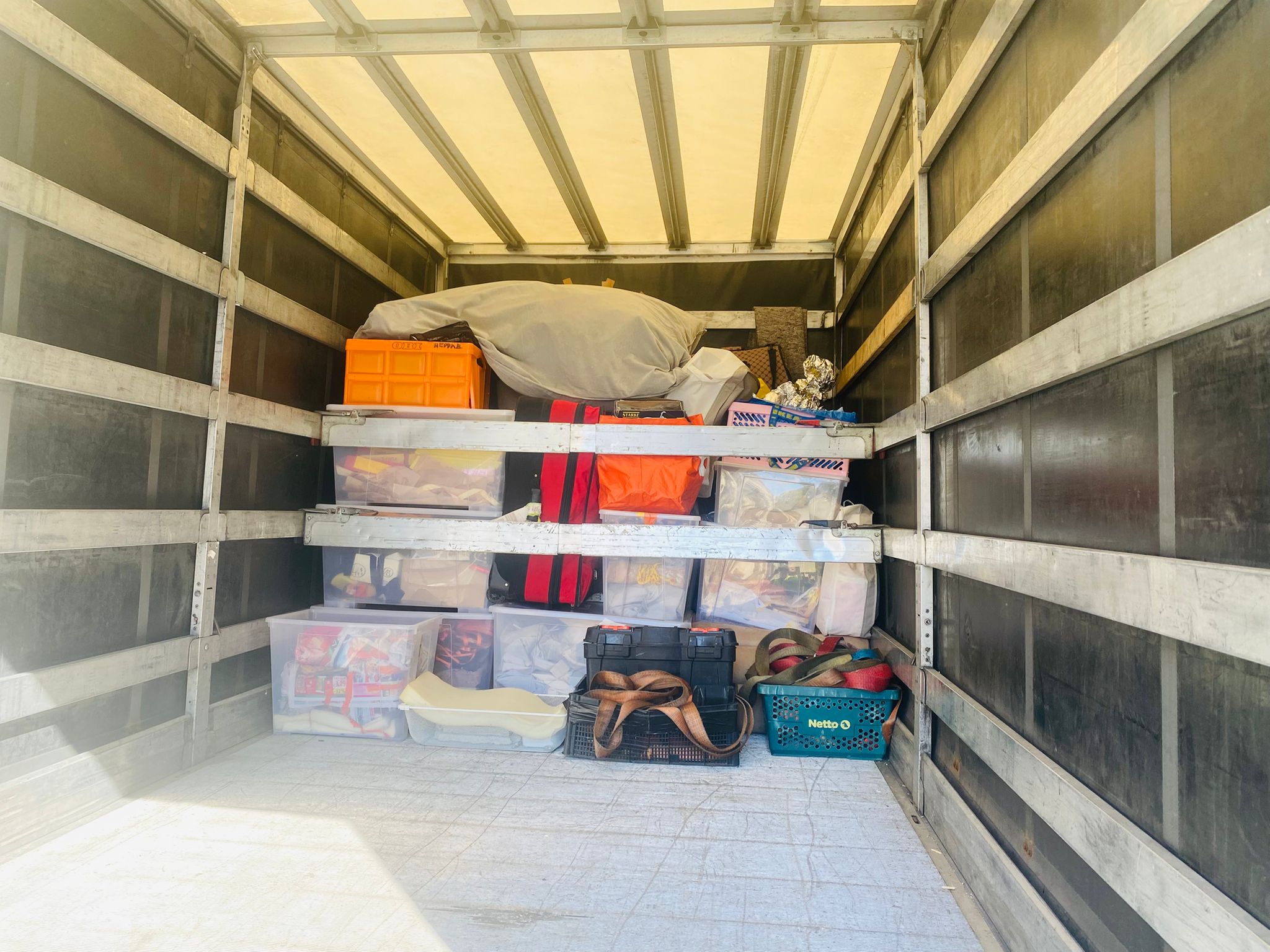
That is why flexible moving can be so useful. You may not want to bring everything on day one. A compact man and van move can cover essentials first. Larger furniture can follow later. Storage can bridge the gap between leaving one home and securing another.
VANonsite can support staged moves, furniture removals, packing services and storage solutions, which can reduce pressure when the Swiss housing market refuses to move at your pace.
3. Strict Paperwork and Local Rules
Switzerland is orderly, but that order comes with paperwork. Rules can exist at federal, cantonal and municipal level. This means your exact obligations may depend on where you live.
Important formal steps may include:
- Checking residence and work permit requirements.
- Registering with the local commune.
- Arranging mandatory health insurance.
- Preparing customs documents for household goods.
- Confirming tax obligations.
- Registering children for school if relevant.
- Checking driving licence rules.
- Preparing pet documents if moving with animals.
New residents should review official Swiss guidance on moving to Switzerland, residence permits and working in Switzerland.
The paperwork is not impossible. It simply needs respect. Switzerland is not a country where you can improvise everything at the border and hope for the best.
4. Mandatory Health Insurance Costs
Healthcare in Switzerland is excellent, but the system can be expensive for newcomers. Basic health insurance is mandatory for residents, and each family member usually needs individual coverage.
New residents generally need to arrange health insurance within 3 months after taking up residence. Premiums vary by canton, age, insurer, deductible and model.
This is one of the most important cons of moving to Switzerland because the cost is separate from rent and taxes. A family can face a significant monthly bill, so insurance must be included in the relocation budget from the beginning.
For official details, check the Swiss Federal Office of Public Health page on health insurance for people resident in Switzerland.
5. Language Differences
Switzerland has 4 national languages, and each region feels different. German is widely spoken, but Swiss German can be difficult even for people who learned standard German. French dominates in Geneva, Lausanne and much of western Switzerland. Italian is spoken in Ticino. Romansh is used by a smaller community in parts of Graubünden.
English is useful in many international workplaces, especially in Zurich, Geneva, Basel and Zug. Still, daily life becomes easier when you learn the local language.
Language affects:
- Housing applications
- School communication
- Medical appointments
- Local administration
- Neighbour relationships
- Social integration
- Everyday confidence
If you want to feel at home, learn more than survival phrases. Switzerland opens slowly, but language is one of the keys.
6. Social Integration Can Take Time
Swiss life can feel reserved at first. People are polite, but not always instantly warm. Social circles may be well established. Neighbours may value privacy. Work relationships may stay professional for a long time.
This does not mean people are unfriendly. It often means trust is built steadily. Reliability matters. Punctuality matters. Respect for rules matters.
Join clubs, language classes, sports groups or local associations. In Switzerland, community often grows through shared routines, not loud introductions.
7. Rules Can Feel Restrictive
Switzerland has rules for many things: recycling, laundry rooms, noise, parking, building access, waste bags and communal spaces. Some newcomers find this comforting. Others find it suffocating.
The best approach is simple. Learn the rules early. Ask politely. Observe what neighbours do. Once you understand the rhythm, Swiss life becomes much easier.
Pros and Cons Moving to Switzerland by Lifestyle Type
The pros and cons moving to Switzerland can look completely different depending on who is moving. A student with 6 boxes has different needs from a family of 5. A corporate relocation is not the same as a last minute apartment move.
| Type of mover | Biggest advantage | Biggest challenge | Best moving approach |
|---|---|---|---|
| Single professional | Strong salaries and career growth | Rent and social adjustment | Compact apartment move or man and van |
| Family | Safety, schools and nature | Housing, insurance and childcare costs | Planned home removal with packing help |
| Student | Excellent universities and international network | Budget pressure and shared housing | Student removals with small vehicle |
| Remote worker | Calm lifestyle and central location | Permit, tax and insurance details | Essentials first, storage if needed |
| Business owner | Stable market and premium reputation | Administration and office setup | Office removals with phased planning |
| Retiree | Peace, scenery and high quality services | Insurance and canton choice | Downsizing, storage and careful delivery |
The pros and cons of moving to Switzerland are not universal. They depend on your income, your expectations and your tolerance for structure. The best relocation plan is the one that matches your real life, not someone else’s Instagram version of Swiss living.
Documents Needed When Moving to Switzerland
Documents are where many relocations become stressful. The key is to prepare early and keep everything in one digital folder and one printed folder.
Residence and Work Documents
Depending on your nationality and reason for moving, you may need:
- Valid passport or national ID
- Employment contract
- Rental agreement or address confirmation
- Proof of income or financial means
- University admission letter if studying
- Marriage or birth certificates if moving with family
- Health insurance documents
- Permit application documents
- Passport photos if required by canton
- Previous residence documents if relevant
EU/EFTA citizens should review the official SEM page for living and working in Switzerland. Non EU/EFTA nationals should check the official Swiss migration guidance before signing contracts or booking transport.
Local Registration After Arrival
After moving, you usually need to register with your new commune or municipality. In general, registration is expected within 14 days of your move.
You may need to bring:
- Passport or national ID.
- Rental agreement.
- Employment contract.
- Civil status documents.
- Health insurance details if already arranged.
- Passport photo if required.
- Residence permit documents if applicable.
Check the Swiss public portal page on notification of departure and registration.
This step matters. Registration connects you to local administration, permits, taxation, schooling and other essential services.
Customs Documents for Household Goods
Switzerland is not in the EU customs union, so customs paperwork matters even if you are moving from another European country.
For household effects, prepare:
- Detailed inventory of goods
- Passport or ID copy
- Proof of transfer of residence
- Swiss rental agreement or address proof
- Customs form for household effects
- Vehicle documents if importing a car
- Separate list of valuable items
- Pet documents if moving with animals
- Evidence that goods have been used personally for at least 6 months, where required
Official customs information is available through the Federal Office for Customs and Border Security pages on moving household effects and relocation import procedure.
A professional mover helps reduce the risk of border delays. VANonsite focuses on organised loading, secure transport and GPS tracking, which is especially valuable when crossing into Switzerland with personal goods.
Customs and Moving Goods to Switzerland
Customs is one of the most practical parts of moving to Switzerland pros and cons. On the positive side, personal household goods may qualify for duty free import if the official conditions are met. On the negative side, missing documents or unclear inventories can slow everything down.
Before the van is loaded, create a clear inventory. It should be simple, readable and numbered.
Example structure:
| Box or item number | Description | Room | Notes |
|---|---|---|---|
| 1 | Kitchen plates and glasses | Kitchen | Fragile |
| 2 | Winter clothes | Bedroom | 2 suitcases |
| 3 | Office chair | Office | Used furniture |
| 4 | Books | Living room | Heavy box |
| 5 | TV | Living room | Wrapped separately |
You should also separate items that may need extra attention, such as alcohol, tobacco, new purchases, vehicles, pets, antiques, expensive electronics or professional equipment.
Do not treat customs as a detail for moving morning. A clean inventory can save time, protect your goods and help your moving company plan the load correctly.
Choosing the Right Moving Service for Switzerland
The right moving service depends on your volume, timing, budget and destination. Switzerland has narrow streets, apartment buildings, controlled parking zones and strict delivery windows in some areas. Choosing the wrong vehicle can make moving day far harder than it needs to be.
VANonsite offers a wide range of European moving services, including:
- Last Minute Moving
- Furniture Removals
- Home Removals
- Packing Service
- White Glove Delivery
- Office Removals
- Storage
- Student Removals
- Office Furniture Installation
This matters because not every move needs the same solution. Some people only need a man and van for 1 room of belongings. Others need packing, furniture protection, storage and a large vehicle.
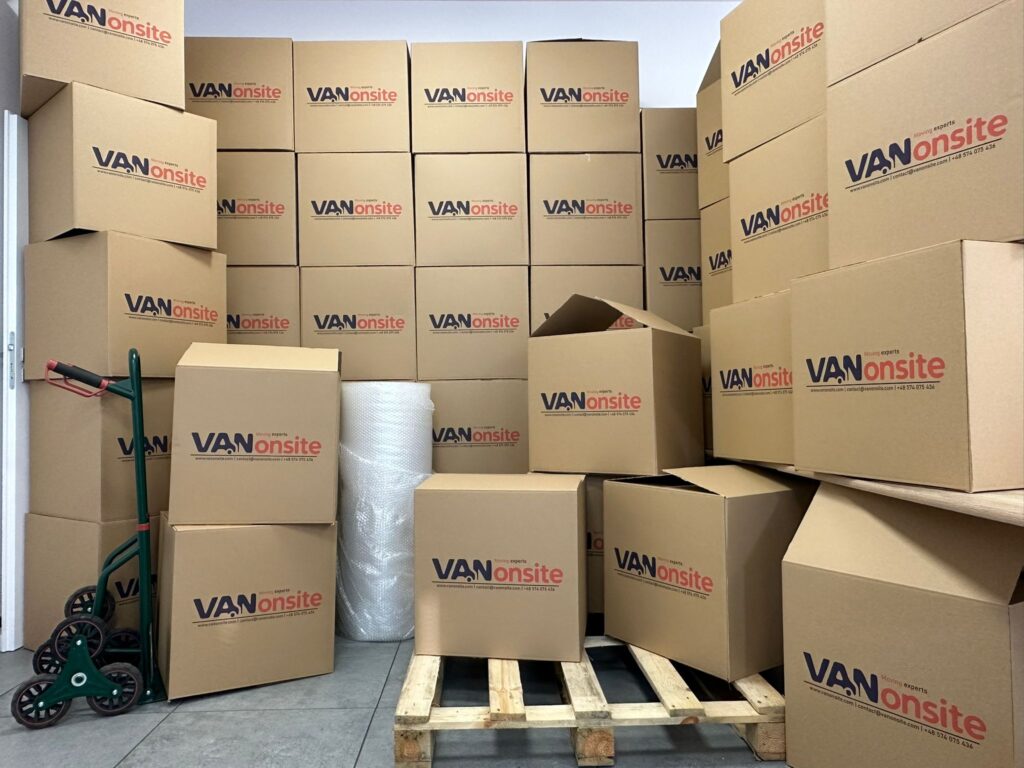
VANonsite Vehicle Size Guide
| VANonsite option | Capacity | Weight limit | Best for |
|---|---|---|---|
| Moving One | 1 m3 | 100 kg | Suitcases, documents, urgent essentials |
| Moving Basic | 5 m3 | 300 kg | Studio items, student move, compact man and van |
| Moving Medium | 10 m3 | 500 kg | One bedroom apartment or partial relocation |
| Moving Premium | 15 m3 | 1100 kg | Larger apartment with furniture and boxes |
| Moving Premium Plus | 30 m3 | 3500 kg | Family move or substantial household load |
| Moving Full House XXL | 90 m3 | 20000 kg | Full house relocation or large office move |
The right vehicle can cut waste, stress and cost. Too small, and moving day becomes a puzzle with no solution. Too large, and you pay for space you do not need.
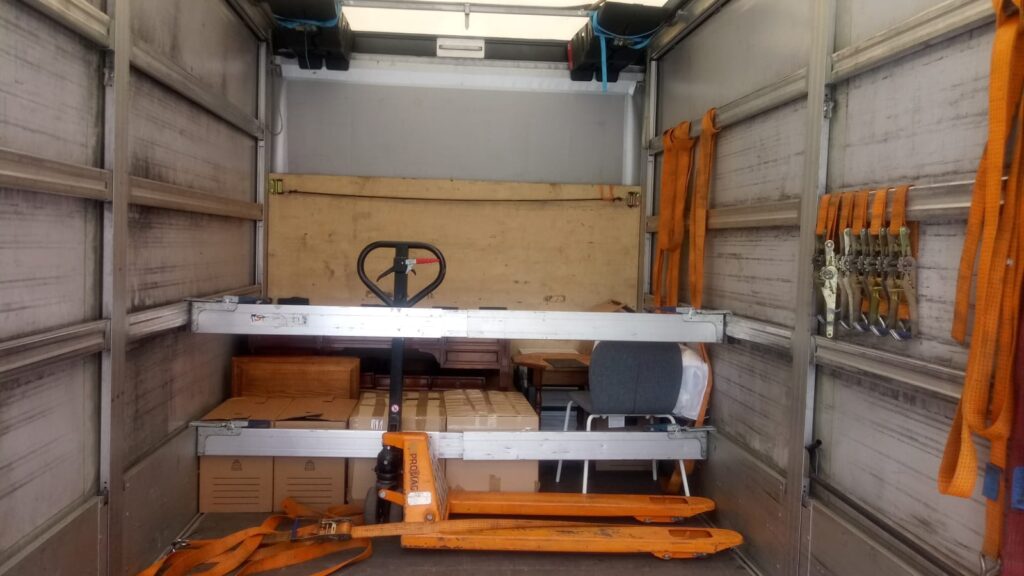
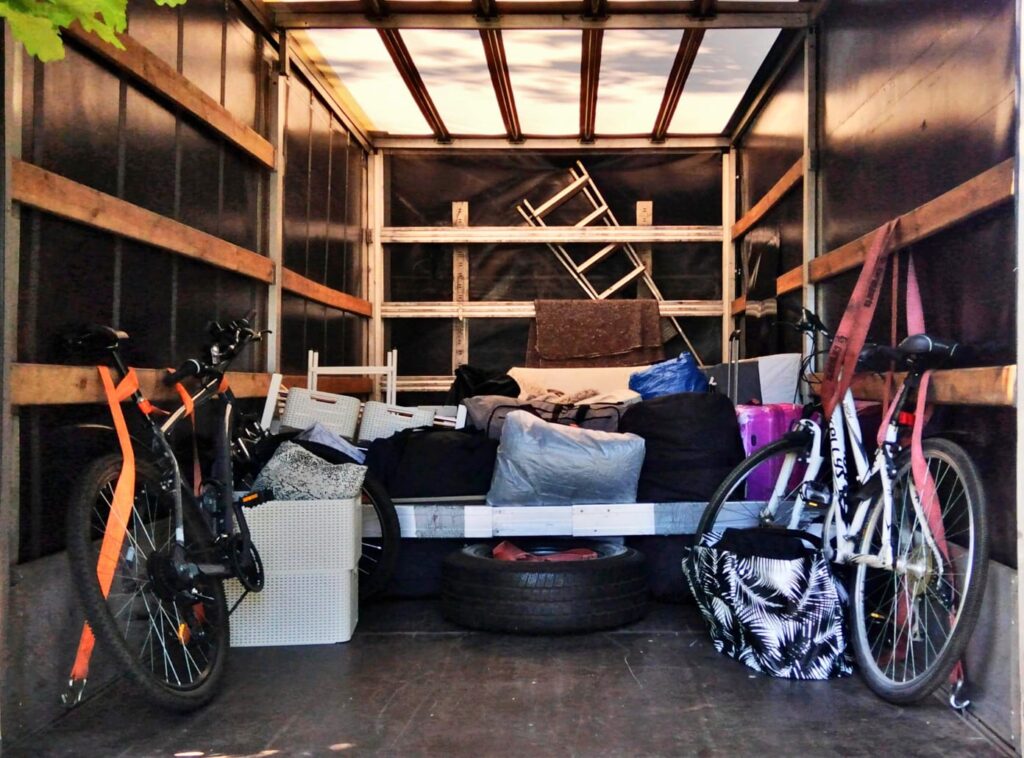
VANonsite helps match the load to the move. Every shipment can be GPS tracked, so you know where your belongings are during the journey. That visibility is powerful when your life is packed inside a vehicle crossing Europe.


How Much Does Moving to Switzerland Cost?
There is no single honest price without details. Moving costs depend on route, volume, access, timing and service level.
The main cost factors are:
| Cost factor | Why it matters | How to reduce stress |
|---|---|---|
| Distance | Longer routes need more fuel and driving time | Share exact pickup and delivery addresses |
| Volume | More m3 means a larger vehicle | Declutter before packing |
| Weight | Heavy loads affect handling and vehicle choice | Separate books, tools and dense items |
| Access | Stairs, lifts and narrow roads affect labour | Send photos of both addresses |
| Packing | Fragile items need materials and time | Use professional packing for valuables |
| Customs | Missing documents may cause delays | Prepare inventory and forms early |
| Timing | Last minute moves need faster coordination | Book early where possible |
| Storage | Temporary housing may require storage | Decide what must arrive first |
A useful rule is to plan your move in 3 layers:
- Essentials you need immediately.
- Furniture and household goods you want in the new home.
- Items that can go into storage or be sold before the move.
This prevents panic. It also helps you choose between a small man and van move, a medium apartment move or a full household relocation.
Best Places to Live in Switzerland for Newcomers
Choosing the right place can change the entire relocation experience. Salary, rent, taxes, commute, language and lifestyle all matter.
Zurich
Zurich is strong for finance, technology, insurance, startups and corporate careers. It is clean, stylish and efficient, with excellent transport and a beautiful lake.
Best for: ambitious professionals, tech workers, finance specialists, international careers
Main challenge: high rent and strong competition for housing
Zurich can be dazzling if your income supports the lifestyle. If not, it can feel financially tight very quickly.
Geneva
Geneva is international, elegant and French speaking. It is home to global organisations, NGOs, finance firms and diplomatic institutions.
Best for: international workers, French speakers, NGO professionals, diplomats
Main challenge: expensive housing and high daily costs
Geneva feels global, but space is limited. Plan housing early.
Basel
Basel is practical, cultural and well connected. It is especially strong for pharmaceuticals, life sciences and cross border living.
Best for: pharma professionals, researchers, families, people who value calm cities
Main challenge: language and canton specific administration
Basel is also close to France and Germany, which can help with travel and lifestyle flexibility.
Lausanne
Lausanne offers lake views, student life and a strong French speaking environment. It is lively without feeling overwhelming.
Best for: students, academics, young professionals, lake lifestyle
Main challenge: rental demand and rising costs
Lausanne is a beautiful choice if you want energy, education and scenery in one place.
Zug
Zug is polished, business friendly and attractive to international professionals. It is known for its corporate environment and strong local economy.
Best for: business owners, executives, finance professionals
Main challenge: very expensive rent and limited availability
Zug can be excellent, but you need a serious budget.
Ticino
Ticino offers Italian language, warmer weather and a softer pace. Lugano is the main hub.
Best for: Italian speakers, retirees, remote workers, lifestyle movers
Main challenge: fewer specialist jobs in some sectors
Ticino can feel like Switzerland with Mediterranean light.
First 30 Days After Moving to Switzerland
The first month can feel intense. There are appointments, forms, insurance decisions, housing details and practical errands. A simple checklist can keep everything under control.
Your first 30 day checklist
- Register with your commune or municipality.
- Confirm your residence or work permit steps.
- Arrange mandatory health insurance.
- Open a Swiss bank account if needed.
- Set up mobile phone and internet.
- Confirm tax and social security obligations.
- Register children for school if applicable.
- Check driving licence exchange rules.
- Update your address with banks, employers and insurers.
- Register pets if required.
- Review waste and recycling rules in your commune.
- Confirm parking, storage and building access.
- Unpack documents and essentials first.
- Inspect delivered furniture and boxes.
- Save all moving and customs paperwork.
Switzerland loves order. Arrive with order, and the country becomes easier. Keep documents in one folder. Label boxes clearly. Photograph valuable items. Save customs forms and delivery notes.
This is where a professional moving partner can make a visible difference. VANonsite’s GPS tracked transport and structured loading process help you focus on settling in, not chasing boxes across borders.
Moving to Switzerland With Furniture
Furniture can be expensive in Switzerland, so bringing quality items may make financial sense. However, moving bulky pieces only works if they fit your new home and are worth the transport cost.
Before moving furniture, check:
- Room measurements
- Door widths
- Staircase access
- Lift size
- Parking access
- Delivery time restrictions
- Floor number
- Fragile item protection
- Assembly needs
If you are moving high value furniture, artwork, designer pieces or delicate items, consider white glove delivery. It provides a higher level of care, handling and protection.
VANonsite’s furniture removals and white glove delivery service can help protect items that carry financial or emotional value. Some belongings are not just objects. They are memory, comfort and history.
Moving to Switzerland as a Student
Students usually need a lean, smart move. Most do not need a full truck. They need clothes, books, bedding, small furniture, electronics and a few personal items that make a new room feel less lonely.
A student move may include:
- Suitcases
- Study materials
- Laptop and electronics
- Bedding
- Small desk or chair
- Clothes
- Kitchen basics
- Personal boxes
For this type of relocation, a compact man and van service can be ideal. VANonsite’s smaller vehicle options, such as Moving One or Moving Basic, can support student removals without unnecessary space.
Switzerland is not cheap for students, so every smart saving matters. Moving only what you truly need is often the best decision.
Moving an Office or Business to Switzerland
Business relocation is not just transport. It is continuity. Every desk, chair, monitor, archive box and meeting room item must arrive in the right place at the right time.
An office move may involve:
- Workstations and chairs.
- Meeting room furniture.
- IT equipment.
- Confidential documents.
- Reception furniture.
- Storage units.
- Kitchen equipment.
- Branded materials.
- Office furniture installation.
Downtime can be expensive. A delayed office move can affect staff, clients and operations. That is why planning matters.
VANonsite supports office removals and office furniture installation, helping companies move into Switzerland or relocate across Europe with less disruption.
Packing Tips for a Move to Switzerland
Packing is where a calm move is often won or lost. Good packing protects your items, helps customs and makes unloading easier.
Use this structure:
| Item type | Packing tip | Why it helps |
|---|---|---|
| Documents | Keep in one personal bag | You may need them during registration or customs |
| Glassware | Wrap individually and label fragile | Reduces breakage risk |
| Books | Use small boxes | Prevents overweight cartons |
| Clothes | Use suitcases and wardrobe boxes | Saves time after arrival |
| Electronics | Keep cables labelled | Faster setup |
| Furniture | Protect corners and surfaces | Prevents scratches |
| Essentials | Pack a first night box | Avoids searching after a long trip |
Your first night box should include:
- Toiletries
- Chargers
- Medication
- Basic clothes
- Important documents
- Snacks
- Bedding
- Cleaning wipes
- Kettle or coffee basics
- Children’s essentials if needed
A packing service can be worth it when time is short or items are fragile. It can also help when customs inventories need to be neat and readable.
Moving to Switzerland Pros and Cons: Money Reality Check
Money deserves its own reality check because it shapes almost every relocation decision.
Switzerland can offer high salaries, but your first months may include several large expenses close together:
- Rental deposit
- First rent payment
- Temporary accommodation
- Health insurance
- Transport or moving costs
- Furniture purchases
- Public transport pass
- Residence and registration related costs
- School or childcare setup
- Storage if your housing is delayed
A practical safety buffer is essential. For many newcomers, having at least 2 to 3 months of living costs available can reduce stress dramatically. Families may need more, especially if housing and childcare are not finalised before arrival.
The financial side of moving to Switzerland pros and cons is not only about income. It is about cash flow. A great salary paid at the end of the month does not help if deposits, insurance and moving costs are due immediately.
Is Switzerland Good for Families?
Switzerland can be excellent for families. Safety, schools, nature and reliable infrastructure make family life feel secure. Children can grow up with clean air, outdoor activities and strong public services.
However, family relocation can be expensive. Larger apartments cost more. Health insurance is required for each family member. Childcare can be a serious cost. School language may also be a challenge if children arrive without German, French or Italian.
Families should plan:
- School options.
- Housing size.
- Commute times.
- Health insurance for every family member.
- Childcare costs.
- Language support.
- Moving volume.
- Storage needs.
- Furniture delivery timing.
For families, VANonsite’s Moving Premium Plus or Moving Full House XXL options may be more suitable, especially if the move includes furniture, bikes, children’s items and a full household load.
Is Switzerland Good for Single Professionals?
For single professionals, Switzerland can be one of Europe’s most powerful career moves. Salaries can be strong, networking opportunities can be valuable and cities like Zurich, Geneva and Basel offer serious professional ecosystems.
The main challenges are rent, loneliness and lifestyle cost. A single person may have more flexibility, but also fewer shared expenses.
A smart first move may be modest: bring essentials, secure housing, understand your budget and expand later. A man and van relocation is often enough for this stage. It keeps the move controlled and flexible.
Is Switzerland Good for Remote Workers?
Switzerland can be beautiful for remote workers, but it is not automatically simple. Permit rules, taxes and insurance need careful checking. High living costs may also reduce the financial benefit of remote work unless your income is strong.
The best remote worker setup usually includes:
- Clear legal residence status
- Strong health insurance plan
- Reliable internet
- Affordable canton choice
- Good transport links
- A realistic monthly budget
- Workspace furniture or office setup
Remote workers should avoid making assumptions. Switzerland is precise. Your plan should be precise too.
When a Man and Van Move Makes Sense
A man and van move to Switzerland can be the right choice when your load is smaller, timing matters or you want a more flexible transport option.
It may suit:
- Students
- Single professionals
- Studio apartments
- Shared flats
- Last minute moves
- Partial relocations
- Furniture only moves
- Boxes and essentials
- Temporary accommodation moves
It may not be enough for:
- Full family homes
- Large furniture collections
- Office relocations
- Heavy equipment
- Moves over 30 m3
- Large storage clearances
The advantage is control. You move what matters, when it matters, without turning a small relocation into a giant operation.
Common Mistakes When Moving to Switzerland
Avoid these costly mistakes:
- Underestimating the cost of living.
- Booking transport before checking customs requirements.
- Moving too much furniture without measuring the new home.
- Forgetting mandatory health insurance.
- Assuming EU rules apply the same way in Switzerland.
- Leaving municipal registration too late.
- Not preparing an inventory.
- Choosing the wrong vehicle size.
- Ignoring parking and building access.
- Arriving without a financial buffer.
Most moving problems are preventable. They begin as small assumptions and become expensive delays. Slow down before the move, and moving day becomes much lighter.
Moving to Switzerland Pros and Cons: Final Verdict
The honest moving to Switzerland pros and cons verdict is clear: Switzerland is not the easiest country to enter casually, but it can be one of the most rewarding countries to settle in seriously.
Move to Switzerland if you value safety, order, high quality services, beautiful nature and strong career potential. Think carefully if you dislike rules, have no financial buffer or expect a cheap, spontaneous lifestyle.
Switzerland works best for people who plan. It rewards preparation, punctuality and clarity. If you arrive with documents ready, budget prepared and transport organised, the country can feel exceptional.
And when the physical move begins, the right moving partner matters. VANonsite offers European removals to Switzerland with secure handling, GPS tracking, packing options, storage solutions and vehicle sizes for everything from 1 m3 essentials to 90 m3 full house moves.
Explore removals to Switzerland and start your relocation with more confidence, less chaos and a clear route from door to door.
FAQ: Pros and Cons of Moving to Switzerland
What are the biggest pros of moving to Switzerland?
The biggest pros are high salaries, safety, clean cities, efficient public transport, strong public services and incredible access to nature. For many people, Switzerland offers a rare mix of career opportunity and calm daily life.
What are the biggest cons of moving to Switzerland?
The biggest cons are high living costs, expensive health insurance, competitive housing, strict paperwork and language differences between regions. The country is rewarding, but it expects serious preparation.
Is moving to Switzerland worth it?
Yes, moving to Switzerland can be worth it if your income, job offer and lifestyle match the country’s costs. It is especially attractive for skilled professionals, families who value safety and people who want outdoor living with strong infrastructure.
How much money should I have before moving to Switzerland?
It depends on your canton, household size and housing plan. As a practical buffer, many movers should prepare at least 2 to 3 months of living costs, plus rental deposit, moving costs, insurance and setup expenses.
Can I move household goods to Switzerland duty free?
Household goods may qualify for duty free import if official customs conditions are met. You should prepare a clear inventory, proof of residence transfer and the required customs documents before moving.
Do I need health insurance after moving to Switzerland?
Yes. Basic health insurance is mandatory for residents. Newcomers generally need to arrange cover within 3 months of taking up residence in Switzerland.
Is a man and van service enough for moving to Switzerland?
A man and van service can be enough for students, single professionals, small apartments, partial moves and last minute essentials. Larger households may need a bigger vehicle, packing support or storage.
What is the best city to move to in Switzerland?
Zurich is strong for finance and technology, Geneva for international work, Basel for pharma, Lausanne for students, Zug for business and Ticino for Italian speaking lifestyle. The best city depends on salary, rent, taxes, commute and language.
What should I do first after arriving in Switzerland?
Start with local registration, permit steps, health insurance and basic services such as bank account, phone and internet. Then handle school, driving licence, tax and long term housing details.
Why choose VANonsite for removals to Switzerland?
VANonsite offers secure European transport, GPS tracking for every shipment, flexible vehicle sizes, packing support, storage, furniture removals and home removals. This makes relocation to Switzerland more organised, visible and controlled from pickup to delivery.