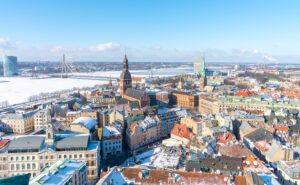

Moving to Switzerland can feel like opening the door to a life built with rare precision. The trains have rhythm. The streets feel calm. Lakes sit beside business districts like polished glass. Mountains rise in the background, not as distant holiday dreams, but as part of ordinary weekends.
For many newcomers, the best things about living in Switzerland are not limited to high salaries, safe cities or beautiful Alpine views. The deeper appeal is the way everything works together. Safety, nature, public transport, career opportunity and everyday order create a lifestyle that feels grounded and quietly luxurious.
Still, moving to Switzerland is not a casual leap. The country rewards preparation. Documents matter. Customs rules matter. Packing matters. So does choosing the right moving vehicle, especially when furniture, family belongings, student boxes or office equipment must cross a border safely.
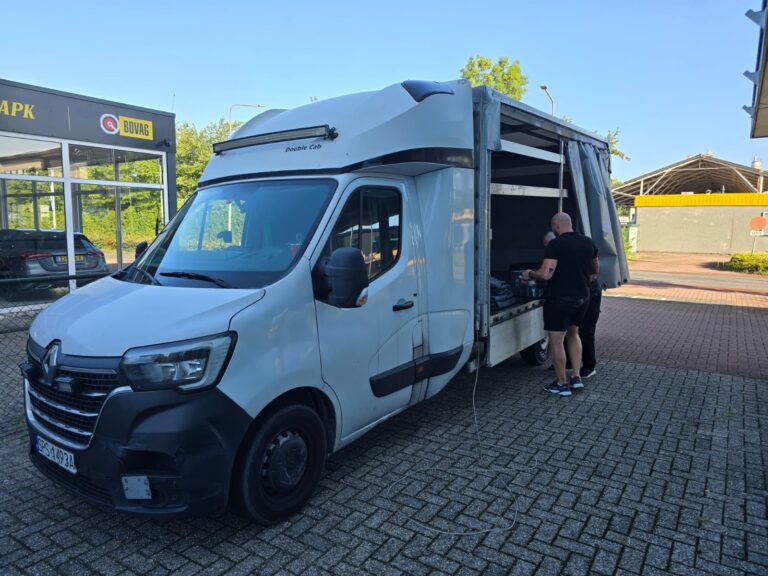
That is where VANonsite can make the move easier. With secure European removals, flexible man and van options, professional packing support and GPS tracking for every load, VANonsite helps people arrive in Switzerland with more confidence and less chaos.
TL:DR
- The best things about living in Switzerland include safety, high salaries, clean cities, reliable transport, stunning nature, strong healthcare and an exceptional quality of life.
- If you ask “what’s the best part about living in Switzerland”, many residents would point to the calm balance between career, comfort, nature and personal security.
- Switzerland has 26 cantons and 4 national languages, which gives each region its own flavour, rules and lifestyle.
- Living costs are high, especially rent, insurance, groceries and services, but salaries and public infrastructure are also strong.
- If you stay in Switzerland for more than 3 months, residence formalities usually apply, depending on nationality, purpose of stay and canton.
- Household goods may be imported duty free when Swiss customs conditions are met, but you need a clear inventory and correct paperwork.
- VANonsite supports removals to Switzerland with GPS tracked transport, packing services, storage options, man and van moves and vehicle sizes from 1 m3 to 90 m3.




Why Switzerland Attracts So Many New Residents
Switzerland does not need to sell itself loudly. It does something more persuasive. It lets you experience small, daily proof of quality. A clean tram stop. A quiet residential street. A mountain view from a train window. A public service that answers clearly. A lake path where people walk before work.
These are the details that turn curiosity into relocation plans.
The best things about living in Switzerland start with stability. The country is known for safety, reliable infrastructure, strong institutions and a lifestyle where public spaces feel respected. For people moving from busy, unpredictable or overcrowded places, that calm can feel almost startling.
Switzerland is also one of Europe’s strongest career destinations. Zurich attracts finance, technology and startup talent. Geneva draws people from diplomacy, global organisations, NGOs and luxury industries. Basel is a powerhouse for pharma, science and research. Lausanne appeals to students, families and professionals who want French speaking Switzerland with lake views. Zug attracts business owners and international professionals. Bern offers a slower, historic and beautifully balanced pace.
The country has 26 cantons and 4 national languages: German, French, Italian and Romansh. This means Switzerland is not one single lifestyle. It is a collection of local identities. The experience of living in Zurich can feel very different from living in Lugano, Geneva or Lucerne.
That variety is part of the magic, but it also means movers need to prepare carefully. Housing rules, parking access, local registration, language expectations and delivery conditions may differ by canton or municipality. A professional man and van service can help make the physical move feel less fragile, especially when belongings are crossing several European borders.
Quick Overview: The Best Things About Living in Switzerland
The best things about living in Switzerland become most powerful when you imagine them in daily life. It is not just that Switzerland is beautiful. It is that beauty sits beside usefulness. The train gets you to work. The lake gives you air after a long day. The street feels safe. The job market offers ambition. The weekend gives you mountains.
| Benefit | Why it matters | What it means for newcomers |
|---|---|---|
| Safety | Daily life feels calmer and more predictable | Families and solo movers settle faster |
| High salaries | Strong earning potential in many sectors | Higher costs become easier to manage |
| Clean cities | Streets, stations and public areas feel cared for | Arrival feels more comfortable |
| Public transport | Trains, trams and buses connect everyday life | You may not need a car immediately |
| Nature | Lakes, mountains and trails are close | Work life balance becomes easier |
| Healthcare | Strong medical services support long term living | Insurance planning is essential |
| International culture | Global companies and expat communities are common | Newcomers can find support faster |
| Central location | France, Germany, Italy and Austria are nearby | Travel and cross border business are simpler |
So, what’s the best thing about living in Switzerland? For many people, it is quality of life. Not loud luxury. Not flash. Something quieter and more dependable.
It is the trust that things will function. It is the pleasure of clean surroundings. It is the freedom to build a career without losing access to nature. It is the confidence that your children, furniture, savings, work and future have a stable place to land.
That is why a move to Switzerland deserves careful planning. The country itself is precise. Your relocation should be too.
Safety, Stability and Everyday Peace of Mind
Safety is one of the best things about living in Switzerland, and it changes the emotional texture of ordinary life. A safe place does not only protect you from danger. It gives you mental space. You walk more freely. You let children grow more confidently. You return home later without the same tension in your shoulders.
For newcomers, that sense of safety can be deeply reassuring. Moving country is a vulnerable moment. Your routines are gone. Your furniture is packed. Your documents are in a folder. Your life is temporarily split between old address, new address and a van full of belongings.
This is exactly when visibility matters. VANonsite offers GPS tracking for every load, so customers can follow their belongings during transport. That simple detail can turn a stressful cross border move into something calmer. Instead of wondering where your boxes, wardrobes, desks or family items are, you know the journey is being monitored.
Safety also applies to handling. A rushed move can damage more than furniture. It can damage confidence. Proper packing, careful lifting, correct vehicle choice and clear communication make a huge difference, especially when moving valuable items, office equipment or fragile pieces.
For people moving to Switzerland with families, antiques, technology, workstations or full household loads, professional removals are not an indulgence. They are a protective decision.
High Salaries and Strong Career Opportunities
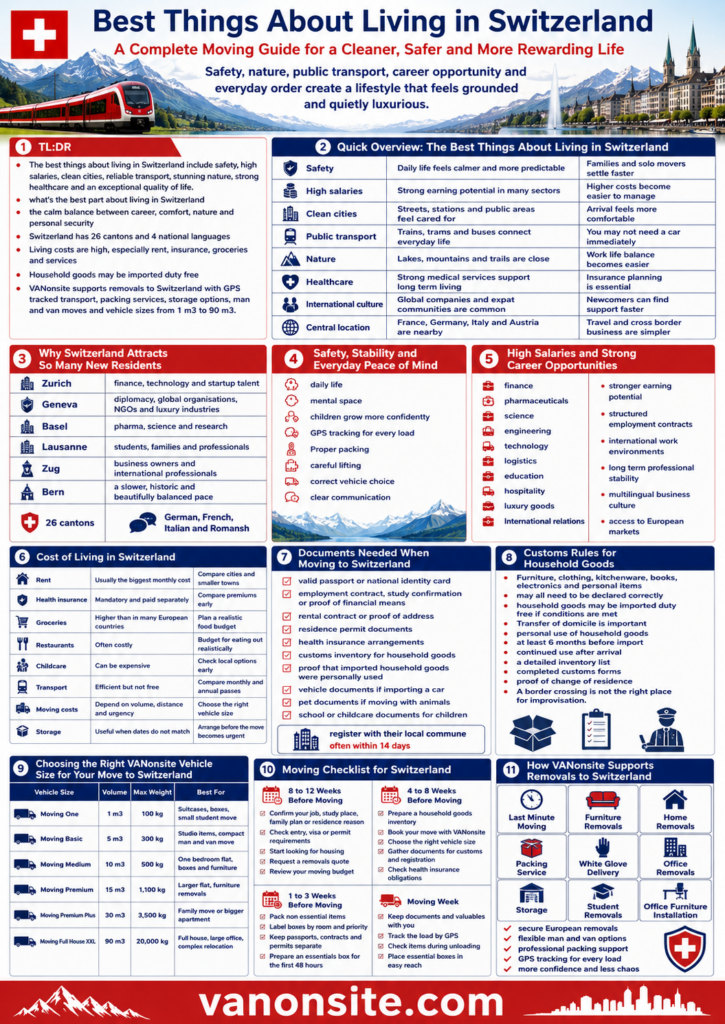
One of the best things about living in Switzerland is the strength of its job market. The country attracts skilled workers in finance, pharmaceuticals, science, engineering, technology, logistics, education, hospitality, luxury goods and international relations.
Zurich is often associated with finance, insurance, technology and startups. Geneva is home to international organisations, private banking, diplomacy and NGOs. Basel is one of Europe’s major life science and pharmaceutical hubs. Lausanne and Bern offer strong education, public sector and research opportunities. Zug is attractive for business and corporate roles.
Higher salaries are a major reason people relocate. In many professions, earning potential in Switzerland can be significantly stronger than in other European countries. However, the full picture is more nuanced. Rent, health insurance, childcare, groceries, restaurants and services can all be expensive. A high salary can go far, but only when paired with realistic budgeting.
Newcomers often move to Switzerland for:
- stronger earning potential
- structured employment contracts
- international work environments
- long term professional stability
- multilingual business culture
- access to European markets
- opportunities in specialist industries
- a cleaner balance between ambition and lifestyle
This is where relocation timing becomes important. Many people do not move to Switzerland slowly. They move because a contract starts, a semester begins, a family decision is made or a business needs someone on site. When time is tight, a last minute moving service or compact man and van option can be invaluable.
VANonsite supports different types of moves, from student removals to full home removals and office relocations. That flexibility helps customers choose the right service for their actual situation, rather than forcing every move into the same rigid format.
Clean Cities, Fresh Air and Public Spaces That Feel Respected
Cleanliness is one of the best things about living in Switzerland because it affects your mood every day. It is not only about impressive scenery. It is about the small environments you touch constantly: stations, pavements, parks, apartment entrances, lakefront paths, playgrounds and shopping streets.
In many Swiss cities, public spaces feel carefully maintained. That creates trust. You sense that the place is looked after, and that people are expected to look after it too. This social discipline may feel strict at first, but it is part of why daily life can feel so smooth.
Clean surroundings also help newcomers settle faster. After a complicated international move, arriving in a tidy neighbourhood can feel like a relief. Even if your apartment is still full of boxes, the world outside the door feels orderly.
Switzerland’s recycling culture is also strong. Waste disposal rules can be detailed and local. New residents should learn how rubbish bags, recycling points, paper collection, glass disposal and bulky item rules work in their municipality. These details may seem small, but they are part of living well in Switzerland.
For movers, cleanliness and building rules also matter. Some apartment buildings have strict access times, protected floors, narrow lifts or clear expectations about noise. Professional packing and careful furniture handling help avoid problems. VANonsite Furniture Removals, Packing Service and White Glove Delivery can be useful for people moving delicate, premium or heavy items into Swiss homes.
A clean country deserves a clean move. That means labelled boxes, protected furniture, a realistic loading plan and a team that treats the building as respectfully as the belongings.
Mountains, Lakes and Weekend Freedom
For many people, the best things about living in Switzerland become obvious the first time they leave the city and reach the mountains in less time than it once took them to cross town. Nature is not far away. It is stitched into ordinary life.
This is where Switzerland feels almost unreal. You can work in a polished city during the week, then hike above a valley on Saturday. You can finish a meeting in Geneva and walk by the lake before dinner. You can live near Zurich and still reach mountain trails, ski areas or quiet villages without turning the weekend into a military operation.
The country gives people access to:
- Alpine hiking routes
- ski resorts and winter sports
- lake swimming in summer
- mountain railways and scenic train journeys
- peaceful picnic spots
- cycling and walking routes
- clean outdoor spaces for families
- dramatic views without long distance travel
For someone asking “what’s the best part about living in Switzerland”, nature is often the answer. Not nature as a postcard. Nature as a habit.
This outdoor lifestyle can change how people feel. Weekends become restorative. Children spend more time outside. Stress has somewhere to go. Even people who do not consider themselves especially sporty often find themselves walking more, exploring more and breathing more deeply.
This is one reason moving to Switzerland can feel like a lifestyle reset. The move is not only about changing address. It is about changing the rhythm of life.
Public Transport That Actually Makes Life Easier
Public transport is one of the best things about living in Switzerland because it reduces friction. Trains, trams, buses and boats are not treated as backup options. They are part of the country’s nervous system.
For newcomers, this can be liberating. You can attend viewings, commute to work, visit nearby cities, reach the airport or explore a canton without immediately needing a car. This matters during the first weeks, when you may still be learning local roads, parking rules and neighbourhood layouts.
Swiss transport is especially helpful for:
- city to city commuting
- apartment hunting
- student life
- family travel
- airport access
- weekend trips
- cross border connections
- exploring before choosing a permanent location
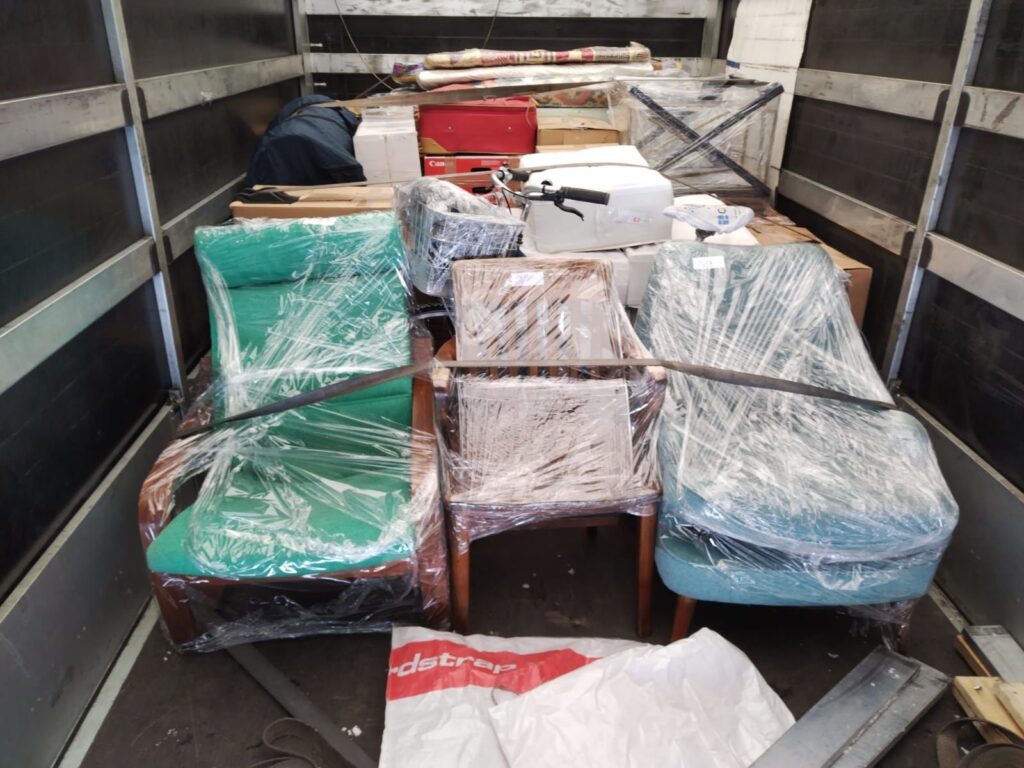
However, excellent public transport does not replace professional removals. A train can carry you to your new city, but it will not move a sofa, bed frame, office desk, dining table, wardrobe, washing machine or 40 boxes.
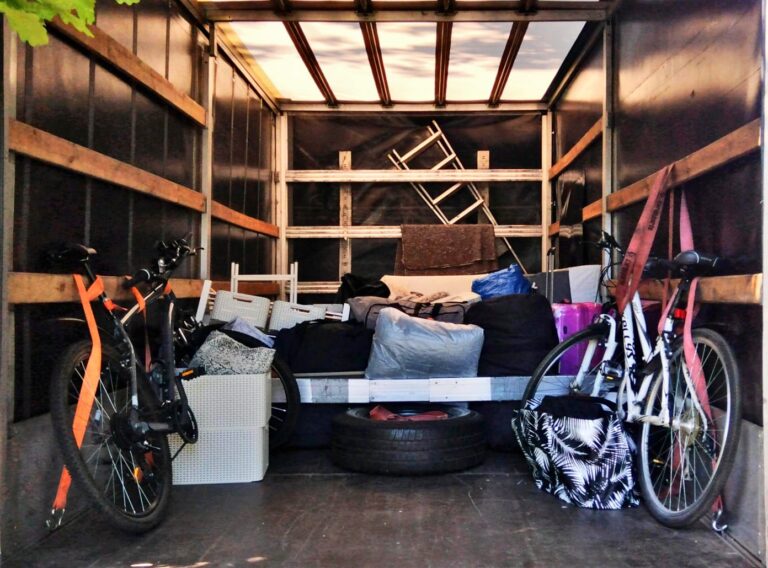
That is where the right man and van service becomes practical. Small moves may only need a compact vehicle. Larger home removals require more volume, stronger load planning and careful handling. Office removals may need timed delivery, furniture installation and extra coordination.
VANonsite offers vehicle sizes from 1 m3 to 90 m3, which means a move can be matched to real volume. This matters because the wrong size can create unnecessary cost, delays or multiple trips. A well planned move feels controlled from the first lift to the last box.
Healthcare, Education and Family Life
Families often see Switzerland as a place where long term life can feel more secure. Healthcare is strong, education has a solid reputation and many neighbourhoods feel calm, structured and family friendly.
The best things about living in Switzerland are especially meaningful when children are involved. Safety matters more. Clean air matters more. Predictable transport matters more. Outdoor access matters more. A country that feels orderly can give families a powerful sense of relief.
That said, Switzerland requires administrative preparation. Health insurance is mandatory for residents, and newcomers should arrange it within the required timeframe. Schooling and childcare systems vary by canton and municipality. Registration rules also matter, especially after arrival.
Families should prepare:
- passports or national identity cards
- residence or permit documents
- employment or study confirmation
- rental contract or proof of address
- health insurance arrangements
- school records and childcare documents
- medical documents where needed
- customs inventory for household goods
- pet documents if animals are moving too
The first week after arrival can be intense. Parents need beds assembled, kitchen items found, school bags ready and documents accessible. Children need familiarity quickly. A chaotic move can make the transition harder than necessary.
VANonsite Home Removals and Packing Service can help families protect the first days after arrival. Fragile items can be packed properly. Boxes can be organised by room. Larger furniture can be moved with care. When the move is planned well, the new home starts functioning faster.
A successful family relocation is not just about reaching Switzerland. It is about creating normal life again.
Multicultural Cities and International Communities
Switzerland is small, but it is not simple. Each city has a different personality, and choosing the right one can shape your entire experience.
| City | Best for | Lifestyle feel |
|---|---|---|
| Zurich | Finance, tech, startups, corporate roles | Efficient, polished, energetic |
| Geneva | NGOs, diplomacy, banking, luxury sectors | International, elegant, lakeside |
| Basel | Pharma, research, culture, cross border work | Creative, calm, scientific |
| Lausanne | Students, families, French speaking professionals | Scenic, youthful, relaxed |
| Zug | Business, corporate roles, professionals | Compact, premium, quiet |
| Bern | Government, families, slower living | Historic, balanced, warm |
| Lucerne | Tourism, families, lake and mountain access | Beautiful, traditional, picturesque |
| Lugano | Italian speaking lifestyle, finance, sunshine | Mediterranean, relaxed, scenic |
The best things about living in Switzerland will feel different depending on where you land. Zurich may energise you. Geneva may make the world feel close. Basel may suit someone who loves culture and science. Lausanne may feel softer and more youthful. Lugano may appeal to people who want Swiss order with Italian warmth.
International communities can make the transition easier. Many Swiss cities have expat groups, international schools, multilingual workplaces and social networks for newcomers. English is often used in large companies, especially in business hubs, but learning the local language remains valuable.
German, French or Italian will help with neighbours, local offices, school communication, healthcare appointments and daily confidence. It also shows respect. Switzerland may be international, but it still values local integration.
From a moving perspective, city choice also affects logistics. A central Geneva apartment may have strict delivery access. A Zurich building may require careful lift protection. A mountain town may need route planning. A business move to Basel may require coordinated office furniture installation. VANonsite can support different relocation types, from student moves to premium furniture delivery and office removals.
Cost of Living in Switzerland: The Beautiful Reality Check
Switzerland is expensive. That truth should be faced early, not discovered painfully after arrival.
Rent can be high, especially in Zurich, Geneva, Zug and other popular areas. Health insurance is mandatory and can take a serious share of the monthly budget. Groceries, restaurants, childcare, transport passes and services may also cost more than newcomers expect.
Yet the cost of living is only half the story. The best things about living in Switzerland are often connected to what those costs support: clean infrastructure, reliable transport, public safety, high standards, strong salaries and a sense that daily life is well maintained.
A realistic budget should include:
| Cost area | What to expect | Smart preparation |
|---|---|---|
| Rent | Often the largest monthly expense | Compare cantons and commute times |
| Health insurance | Mandatory for residents | Research providers before arrival |
| Groceries | Higher than many European countries | Plan weekly spending carefully |
| Restaurants | Often costly | Budget for eating out realistically |
| Childcare | Can be expensive | Check local options early |
| Transport | Efficient but not free | Compare monthly and annual passes |
| Moving costs | Depend on volume, distance and urgency | Choose the right vehicle size |
| Storage | Useful when dates do not match | Arrange before the move becomes urgent |
Moving is one cost that can be controlled with good planning. If the van is too small, you may need an extra trip. If it is too large, you may pay for unused space. If packing is poor, damage can become expensive. If customs paperwork is weak, delays can create stress.
VANonsite offers different vehicle sizes to match different moves, from compact man and van transport to large household and office relocations. This flexibility helps customers plan more precisely and avoid paying for the wrong solution.
A move to Switzerland should feel premium, but it should not feel wasteful.
Documents Needed When Moving to Switzerland
The best things about living in Switzerland are easier to enjoy when the paperwork is under control. Switzerland is orderly, but that order depends on rules. Before moving, check your entry rights, residence status, work situation, customs requirements and local registration duties.
Useful official sources include:
- Moving to Switzerland on ch.ch
- Entry and stay in Switzerland by FDFA
- Swiss residence permits on ch.ch
- Notification of departure and registration on ch.ch
In many cases, you may need:
- valid passport or national identity card
- employment contract, study confirmation or proof of financial means
- rental contract or proof of address
- residence permit documents where required
- health insurance arrangements
- customs inventory for household goods
- proof that imported household goods were personally used
- vehicle documents if importing a car
- pet documents if moving with animals
- school or childcare documents for children
Requirements depend on nationality, length of stay, purpose of stay and canton. Many foreign nationals staying in Switzerland for more than 3 months need a residence permit. Newcomers are also generally expected to register with their local commune after arrival, often within 14 days.
This is why preparation matters. A beautiful move can be ruined by a missing document. Keep essential papers with you, not buried inside a box. Make digital copies. Label folders clearly. If your household goods are travelling separately, make sure your inventory is accurate and easy to understand.
Switzerland likes precision. Bring precision with you.
Customs Rules for Household Goods
A move to Switzerland is a border move, which means customs rules cannot be ignored. Furniture, clothing, kitchenware, books, electronics and personal items may all need to be declared correctly.
Official customs information is available here:
- Moving household effects by the Swiss Federal Office for Customs and Border Security
- Moving to Switzerland procedure
- Moving: importing goods into Switzerland
In many relocation cases, household goods may be imported duty free if conditions are met. Transfer of domicile is important. Swiss customs guidance also refers to personal use of household goods, often for at least 6 months before import, and continued use after arrival.
Before the move, prepare:
- a detailed inventory list
- completed customs forms where required
- proof of change of residence
- passport or national ID
- employment, residence or rental documents
- vehicle papers if importing a car
- pet documents if bringing animals
- details for restricted or unusual goods
The inventory should be clear, not poetic. “Kitchen items, 4 boxes” is better than vague descriptions. High value items should be listed carefully. If you are moving office equipment, furniture or specialist items, prepare separate notes where needed.
A professional man and van service can help make the customs side feel less chaotic by keeping the load organised, labelled and easier to explain. VANonsite also gives customers GPS visibility during transport, which adds reassurance while belongings are moving across Europe.
A border crossing is not the right place for improvisation. It is the place where careful preparation pays off.
Choosing the Right VANonsite Vehicle Size for Your Move to Switzerland
Choosing the right vehicle is one of the most practical decisions in a Switzerland relocation. A small move does not need a huge truck. A family move should not be squeezed into a van that is too small. A business move needs volume, timing and coordination.
VANonsite offers several moving sizes:
| VANonsite option | Capacity | Weight limit | Best for |
|---|---|---|---|
| Moving One | 1 m3 | 100 kg | Suitcases, boxes, small student move |
| Moving Basic | 5 m3 | 300 kg | Studio items, compact man and van move |
| Moving Medium | 10 m3 | 500 kg | One bedroom flat, boxes and furniture |
| Moving Premium | 15 m3 | 1,100 kg | Larger flat, furniture removals |
| Moving Premium Plus | 30 m3 | 3,500 kg | Family move or bigger apartment |
| Moving Full House XXL | 90 m3 | 20,000 kg | Full house, large office, complex relocation |
A student moving to Lausanne with boxes, clothes and a small desk may only need Moving One or Moving Basic. A couple relocating to Zurich with a bed, sofa, chairs and kitchen items may fit better into Moving Medium or Moving Premium. A family moving to Geneva, Basel or Zug may need Moving Premium Plus. A full home or business relocation may require Moving Full House XXL.
The best things about living in Switzerland begin after arrival, but the mood of the new chapter is shaped by the move itself. If your belongings arrive safely, on time and with clear tracking, you start with confidence. If the move is messy, that stress follows you into the new home.
For dedicated relocation support, visit VANonsite removals to Switzerland.

Moving Checklist for Switzerland
The best things about living in Switzerland are easier to enjoy when the move has structure. Use this checklist to turn a complex relocation into a clear sequence.
8 to 12 Weeks Before Moving
- Confirm your job, study place, family plan or residence reason.
- Check entry, visa or permit requirements.
- Research cantons, cities and commute times.
- Start looking for housing.
- Request a removals quote.
- Estimate the volume of your belongings.
- Decide whether you need packing, storage or furniture removals.
- Check school and childcare options if moving with children.
- Review your moving budget.
4 to 8 Weeks Before Moving
- Prepare a household goods inventory.
- Sort items into keep, sell, donate, recycle and store.
- Book your move with VANonsite.
- Choose the right vehicle size.
- Gather documents for customs and registration.
- Check health insurance obligations.
- Confirm building access at both addresses.
- Ask about parking rules near the old and new property.
1 to 3 Weeks Before Moving
- Pack non essential items.
- Label boxes by room and priority.
- Keep passports, contracts and permits separate.
- Photograph valuable furniture before loading.
- Prepare an essentials box for the first 48 hours.
- Confirm arrival address and unloading instructions.
- Check whether your new building has lift or delivery restrictions.
Moving Week
- Keep documents and valuables with you.
- Make sure fragile items are clearly marked.
- Protect floors, corners and delicate furniture.
- Confirm timing with the moving team.
- Track the load by GPS where available.
- Check items during unloading.
- Place essential boxes in easy reach.
First 14 Days After Arrival
- Register with the local commune where required.
- Finalise health insurance.
- Set up utilities and internet.
- Update your address with banks, employers and authorities.
- Register children for school if applicable.
- Learn local rubbish and recycling rules.
- Explore transport routes, shops and healthcare options nearby.
A good checklist protects attention. Instead of reacting to every problem, you move through the relocation step by step. That calm approach fits Switzerland beautifully.
How VANonsite Supports Removals to Switzerland
VANonsite is a strong fit for people who want their move to Switzerland to feel secure, visible and carefully handled. The company supports European transport with a focus on safety, speed and practical flexibility.
Services include:
- Last Minute Moving for urgent relocations
- Furniture Removals for sofas, wardrobes, beds and tables
- Home Removals for apartments and houses
- Packing Service for fragile or high value belongings
- White Glove Delivery for premium items
- Office Removals for business moves
- Storage when dates do not align
- Student Removals for smaller loads
- Office Furniture Installation for business setup
This range matters because not every move is the same. Some customers need a simple man and van move with a few boxes. Others need a full household relocation with furniture, packing and careful scheduling. A company may need office desks, chairs, monitors and storage units moved with minimal disruption.
VANonsite also offers GPS tracking for every load. This is one of the most reassuring features during an international move. When your belongings are travelling across Europe, visibility matters. It gives you a sense of control at a moment when much of life feels temporarily packed away.
The best moving service does not make the process dramatic. It makes it dependable. Your belongings are not random cargo. They are your bed, your books, your work tools, your family table, your child’s favourite things and the pieces that make a new apartment feel like home.
Final Verdict: What’s the Best Thing About Living in Switzerland?
So, what’s the best thing about living in Switzerland? It is the feeling that life has been designed with care.
The mountains are spectacular. The lakes are clear. The salaries can be strong. The cities are clean. The trains are famous. But the deeper magic is quieter. It is trust. Trust that the street will feel safe. Trust that the train will come. Trust that public spaces will be respected. Trust that your weekend can become extraordinary without months of planning.
The best things about living in Switzerland are not only postcard moments. They are daily moments. A tidy platform. A peaceful commute. A serious job market. A clean lake after work. A mountain view that appears when the clouds lift. A neighbourhood that feels composed.
If Switzerland is becoming your next home, plan the move with the same precision the country is known for. Prepare the documents. Check the customs rules. Choose the right van size. Protect your furniture. Keep your essentials close. Do not let a beautiful relocation become a stressful scramble.
VANonsite offers secure, GPS tracked European removals and flexible man and van options for different relocation sizes. Whether you are moving student boxes, premium furniture, a family household or an office, the right moving team can make the journey calmer, clearer and far more controlled.
Explore VANonsite removals to Switzerland and start your Swiss chapter with confidence.
FAQ
What are the best things about living in Switzerland?
The best things about living in Switzerland include safety, strong salaries, clean cities, reliable public transport, access to lakes and mountains, high quality healthcare, good education options and an overall sense of stability. For many newcomers, the biggest advantage is the quality of everyday life.
What’s the best part about living in Switzerland?
What’s the best part about living in Switzerland? For many residents, it is the balance. You can build a serious career while still enjoying nature, clean air, safe streets and efficient public services. Switzerland makes ordinary routines feel smoother.
What’s the best thing about living in Switzerland for families?
For families, the best thing about living in Switzerland is often peace of mind. Safe neighbourhoods, outdoor spaces, reliable transport, healthcare access and structured public services make the country attractive for long term family life.
Is Switzerland expensive to live in?
Yes, Switzerland is expensive. Rent, health insurance, childcare, restaurants, groceries and personal services can cost more than in many other European countries. However, salaries are often higher, and many people feel the quality of infrastructure and safety helps balance the cost.
Do I need a residence permit to live in Switzerland?
If you plan to stay in Switzerland for more than 3 months, you will usually need a residence permit. The exact requirements depend on nationality, employment status, purpose of stay and canton. Always check official Swiss government guidance before moving.
Can I bring my furniture to Switzerland duty free?
Household goods may be imported duty free when Swiss customs conditions are met. Transfer of domicile, prior personal use and correct paperwork are important. Prepare a detailed inventory before moving and check official customs guidance.
How soon do I need to register after moving to Switzerland?
Newcomers are generally expected to register with the local commune after arrival, often within 14 days. Rules can vary by canton and municipality, so check the local requirements for your destination.
Is a man and van service enough for moving to Switzerland?
A man and van service can be enough for small moves, student removals, partial loads, compact apartments and urgent relocations. Larger homes, offices or heavy furniture may need a bigger vehicle and more detailed planning.
Does VANonsite offer GPS tracking for moves to Switzerland?
Yes. VANonsite offers GPS tracking for every load, helping customers follow their belongings during transport and feel more confident throughout the move.
What VANonsite vehicle size should I choose for Switzerland removals?
It depends on the volume and weight of your belongings. Moving One may suit a few boxes or suitcases. Moving Basic can work for compact loads. Moving Medium and Moving Premium are useful for apartments. Moving Premium Plus and Moving Full House XXL are better for family homes, large furniture loads and office removals.