
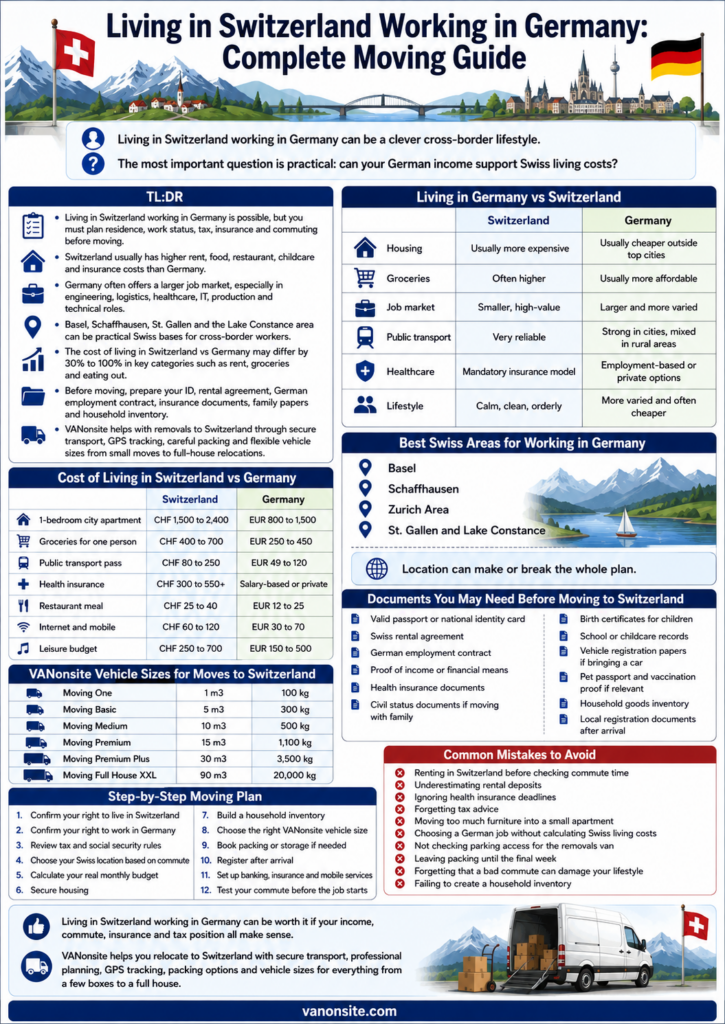
Living in Switzerland working in Germany can be a clever cross-border lifestyle. You enjoy Swiss order, clean streets, safe towns, mountain weekends and excellent infrastructure, while building your career in one of Europe’s strongest job markets. Germany offers opportunities in engineering, healthcare, logistics, IT, manufacturing, science, education and skilled trades. Switzerland offers calm, precision and quality of life that many people find hard to leave once they experience it.
Yet this lifestyle is not automatically simple. Switzerland is not a member of the European Union, even though it has agreements with the EU and EFTA. Germany is an EU member state. That means residence rules, work rights, taxation, health insurance, social security and registration duties must be checked before you move.
The most important question is practical: can your German income support Swiss living costs? Rent, health insurance, groceries and services in Switzerland can be significantly higher than in Germany. At the same time, the lifestyle benefit can be enormous if you choose the right location, plan the commute and prepare your documents well.
This guide explains how living in Switzerland working in Germany works, how to compare living in Germany vs Switzerland, what to know about the cost of living in Switzerland vs Germany and how to plan a smooth move with VANonsite. If Switzerland is your next base, VANonsite can support your relocation with GPS-tracked transport, dedicated European removals, packing services, storage, furniture removals and flexible man and van options.
TL:DR
- Living in Switzerland working in Germany is possible, but you must plan residence, work status, tax, insurance and commuting before moving.
- Switzerland usually has higher rent, food, restaurant, childcare and insurance costs than Germany.
- Germany often offers a larger job market, especially in engineering, logistics, healthcare, IT, production and technical roles.
- Basel, Schaffhausen, St. Gallen and the Lake Constance area can be practical Swiss bases for cross-border workers.
- The cost of living in Switzerland vs Germany may differ by 30% to 100% in key categories such as rent, groceries and eating out.
- Before moving, prepare your ID, rental agreement, German employment contract, insurance documents, family papers and household inventory.
- VANonsite helps with removals to Switzerland through secure transport, GPS tracking, careful packing and flexible vehicle sizes from small moves to full-house relocations.
Can You Live in Switzerland and Work in Germany?
Yes, living in Switzerland working in Germany can be possible. It is common in border areas where people cross between the two countries for work, shopping, family or business. However, it is not something to organise blindly. The rules depend on your nationality, residence status, employment contract, tax residence, remote work pattern and family situation.
For EU and EFTA citizens, the process is often more straightforward. Switzerland has specific residence rules for EU/EFTA citizens, while Germany allows EU citizens to work under freedom of movement. You can check Swiss residence information on ch.ch and the Swiss State Secretariat for Migration. For Germany, the official Make it in Germany portal explains work access for EU citizens.
If you are not an EU or EFTA citizen, get advice before signing a rental agreement or employment contract. Your right to live in Switzerland and work in Germany may require more checks.
This lifestyle works best when four things are clear:
- Your legal right to live in Switzerland
- Your legal right to work in Germany
- Your estimated net income after tax and social contributions
- Your real Swiss monthly budget, including transport and insurance
A move like this is not only about changing address. It is a financial, professional and logistical decision. VANonsite can make the physical relocation easier with door-to-door European removals, GPS tracking and vehicle sizes that match your real volume.
Living in Germany vs Switzerland: What Changes in Daily Life?
When people compare living in Germany vs Switzerland, they often start with salary. That makes sense, but salary alone can be misleading. The real difference appears in everyday life: rent, food, transport, insurance, paperwork, time, comfort and peace of mind.
Germany is bigger, more varied and usually cheaper. It has large cities, industrial regions, university towns and rural areas with very different price levels. Switzerland is smaller, cleaner, more expensive and often more predictable. Public transport is excellent. Streets are tidy. Local services are efficient. Life can feel calmer and more controlled.
For someone living in Switzerland working in Germany, the key challenge is balance. You may earn in euros and spend heavily in Swiss francs. You may work in a busy German region but sleep in a quiet Swiss town. You may gain Swiss quality of life but lose time on commuting.
| Category | Switzerland | Germany | Practical meaning |
|---|---|---|---|
| Housing | Usually more expensive | Usually cheaper outside top cities | Swiss rent can take a larger part of income |
| Groceries | Often higher | Usually more affordable | Many border residents compare prices carefully |
| Job market | Smaller, high-value | Larger and more varied | Germany may offer more roles |
| Public transport | Very reliable | Strong in cities, mixed in rural areas | Route planning is essential |
| Healthcare | Mandatory insurance model | Employment-based or private options | Cross-border status must be checked |
| Lifestyle | Calm, clean, orderly | More varied and often cheaper | Choice depends on priorities |
Living in Germany vs Switzerland is not only a cost comparison. It is also a lifestyle comparison. Germany gives scale and affordability. Switzerland gives safety, order and a premium everyday environment.
Living in Switzerland vs Germany: Main Pros and Cons
Living in Switzerland vs Germany creates a different emotional rhythm. Switzerland can feel polished and peaceful. Germany can feel broader, more flexible and more affordable. Neither is automatically better. The right choice depends on your priorities.
Benefits of Living in Switzerland
Switzerland is one of Europe’s most desirable places to live because it combines safety, natural beauty and strong infrastructure. For families, professionals and people who enjoy outdoor life, it can feel exceptional.
Key benefits include:
- High safety levels in many towns and cities
- Clean streets and well-maintained buildings
- Excellent public transport
- Beautiful lakes, mountains and hiking routes
- Strong local administration
- Reliable public services
- International communities in cities such as Basel and Zurich
- Calm environment for family life
For many people, living in Switzerland working in Germany is attractive because Switzerland gives them stability and Germany gives them career access.
Challenges of Living in Switzerland
The main challenge is cost. Switzerland can be painfully expensive if your budget is not ready. Rent, health insurance, restaurants, childcare, repairs and everyday services can quickly reduce disposable income.
Common challenges include:
- High rental deposits
- Strong competition for good apartments
- Expensive groceries and services
- Strict registration rules
- More complex cross-border tax questions
- Smaller housing options in popular areas
- Higher moving and settling costs
This is why a selective move makes sense. Bring what you truly need. Avoid paying to transport heavy clutter, damaged furniture or low-value items that are cheaper to replace.
Benefits of Working in Germany
Germany has one of the most powerful labour markets in Europe. It offers serious opportunities in engineering, IT, logistics, healthcare, science, automotive, manufacturing, skilled trades and administration.
Working in Germany may give you:
- A larger choice of employers
- Strong labour protections
- More role variety
- Access to major industrial areas
- Competitive salaries in technical sectors
- Good training and qualification pathways
- More affordable services near your workplace
Living in Switzerland working in Germany can be especially powerful when your German workplace is close to the border and your Swiss home gives you a better private lifestyle.
Cost of Living in Switzerland vs Germany
The cost of living in Switzerland vs Germany is usually the deciding factor. Switzerland often feels premium because it is premium. The comfort is real, but the price is real too.
Rent is usually the biggest shock. A one-bedroom apartment in a Swiss city or desirable commuter area can cost much more than a similar place in Germany. Groceries, restaurants, healthcare insurance and personal services are also often more expensive.
Germany is not always cheap. Munich, Frankfurt, Stuttgart and Hamburg can be costly. Still, everyday costs in Germany are usually more forgiving than in Switzerland.
| Monthly cost category | Switzerland estimate | Germany estimate | Practical meaning |
|---|---|---|---|
| 1-bedroom city apartment | CHF 1,500 to 2,400 | EUR 800 to 1,500 | Swiss rent may be 50% to 100% higher |
| Groceries for one person | CHF 400 to 700 | EUR 250 to 450 | Germany is usually cheaper for food |
| Public transport pass | CHF 80 to 250 | EUR 49 to 120 | Route and region decide the real cost |
| Health insurance | CHF 300 to 550+ | Salary-based or private | Cross-border rules must be checked |
| Restaurant meal | CHF 25 to 40 | EUR 12 to 25 | Eating out is often far cheaper in Germany |
| Internet and mobile | CHF 60 to 120 | EUR 30 to 70 | Switzerland can be nearly double |
| Leisure budget | CHF 250 to 700 | EUR 150 to 500 | Lifestyle choices matter |
| Moving budget | Depends on volume | Depends on distance | Vehicle size and access affect cost |
For living in Switzerland working in Germany, the hidden cost is not only money. It is time. A 30-minute commute can work well. A 75-minute commute each way can become exhausting after a few months. Add border traffic, parking, train changes, fuel, lunch costs and currency exchange, and the lifestyle becomes less simple.
A realistic monthly budget helps you decide clearly.
| Expense | Conservative estimate | Higher estimate |
|---|---|---|
| Rent | CHF 1,400 | CHF 2,600 |
| Utilities | CHF 150 | CHF 300 |
| Health insurance | CHF 300 | CHF 600 |
| Groceries | CHF 400 | CHF 750 |
| Transport to Germany | CHF 150 | CHF 600 |
| Phone and internet | CHF 70 | CHF 140 |
| Eating out and leisure | CHF 250 | CHF 700 |
| Emergency buffer | CHF 300 | CHF 800 |
| Total | CHF 3,020 | CHF 6,490 |
These figures are planning ranges, not fixed prices. Your real budget depends on the canton, city, apartment, family size, insurance choice, work location and commuting pattern. Still, the message is clear: living in Switzerland working in Germany should be calculated before it becomes your daily life.
Best Swiss Areas for Working in Germany
Location can make or break the whole plan. A beautiful Swiss apartment loses its charm if the commute destroys your mornings.
Basel
Basel is one of the strongest choices for living in Switzerland working in Germany. It sits close to the German and French borders, making it practical for people working around Weil am Rhein, Lörrach, Freiburg or wider Baden-Württemberg.
Basel is international, well connected and business-friendly. It is not cheap, but the convenience can justify the cost, especially for hybrid workers or people with strong salaries.
Schaffhausen
Schaffhausen offers a quieter Swiss setting with good access to southern Germany. It can suit people who want Swiss calm without the intensity of Zurich or Basel.
It is a strong option for people who prefer smaller cities, scenic surroundings and a more relaxed home base.
Zurich Area
Zurich is expensive, but it can work for people who do not need to commute daily. It offers international schools, excellent transport, strong services and a highly professional environment.
If you work in Germany only two or three days per week, Zurich may be realistic. If you need to cross the border every day, test the route carefully before committing.
St. Gallen and Lake Constance
St. Gallen and the Lake Constance region can be attractive for people connected to Bavaria, Baden-Württemberg or companies near the lake. The area combines Swiss structure with scenic surroundings and practical access to Germany.
For many people comparing living in Switzerland vs Germany, this region offers a softer landing than the biggest cities.
Documents You May Need Before Moving to Switzerland
Documents are not exciting, but they protect your move from delays and expensive mistakes. Switzerland values preparation. Germany does too.
You may need:
- Valid passport or national identity card
- Swiss rental agreement
- German employment contract
- Proof of income or financial means
- Health insurance documents
- Civil status documents if moving with family
- Birth certificates for children
- School or childcare records
- Vehicle registration papers if bringing a car
- Pet passport and vaccination proof if relevant
- Household goods inventory
- Local registration documents after arrival
For living in Switzerland working in Germany, the German employment contract is especially important. It helps explain why your income comes from Germany while your home is in Switzerland.
If you are moving household goods, prepare a clear inventory. It should list furniture, boxes, personal items, electronics and high-value goods. This also helps VANonsite recommend the correct vehicle size and plan safe loading.
Taxes When Living in Switzerland Working in Germany
Tax is one of the most important parts of cross-border life. It is also one of the easiest areas to misunderstand.
Germany and Switzerland have double taxation rules, and cross-border worker situations can have specific treatment. However, your exact position can depend on where you live, where you work, how often you return home, whether you work remotely, who pays your salary and whether you are employed or self-employed.
Useful official sources include the Swiss Federal Tax Administration Germany page and the German Federal Ministry of Finance double taxation information.
A tax adviser is strongly recommended before you sign long-term contracts.
| Question | Why it matters |
|---|---|
| Where is your main home? | It may influence tax residence |
| Where is your employer based? | Payroll and withholding rules may apply |
| How many days do you work from home? | Remote work can change obligations |
| Do you return home daily or weekly? | Cross-border treatment may depend on routine |
| Are you employed or self-employed? | Contractor status can be more complex |
| Do you have family in Switzerland? | Family residence can influence your position |
Living in Switzerland working in Germany can be financially attractive, but only when the tax calculation is clear. Keep payslips, contracts, rental documents and travel records organised.
Health Insurance and Social Security
Health insurance is not a minor detail. It can affect your monthly budget, doctor access and family protection.
When living in Switzerland working in Germany, your insurance and social security position may depend on employment location, residence, remote work pattern and applicable cross-border rules. In many European work situations, social security is linked to the country of employment, but exceptions can apply.
Before moving, ask these questions:
- Which country’s social security system applies?
- What happens if you work from home in Switzerland?
- Does your German employer understand your Swiss residence setup?
- Which health insurance option covers you?
- Are your family members covered?
- Do you need a specific certificate or form?
This area can affect hundreds of francs or euros every month. It can also affect access to healthcare. Do not leave it until after arrival.
Moving to Switzerland: What to Bring and What to Leave Behind
A move to Switzerland rewards precision. Bring what has value. Leave what creates weight, clutter and cost.
Swiss homes can be beautiful, but storage may be limited. Apartment buildings can have strict access rules. Lifts may be narrow. Parking for a moving van may require planning. In some towns, delivery timing matters because streets are tight or building rules are strict.
Bring items that make your first months easier:
- Essential work equipment
- Important documents in one folder
- Clothes for all seasons
- Winter clothing and durable shoes
- High-quality furniture that fits your new home
- Sentimental items
- Kitchen basics
- Children’s school materials
- Medical records and prescriptions
- Valuable electronics
Consider leaving behind:
- Oversized furniture
- Old mattresses
- Weak flat-pack wardrobes
- Cheap appliances
- Duplicate kitchen items
- Heavy clutter
- Damaged furniture
- Items that cost more to move than replace
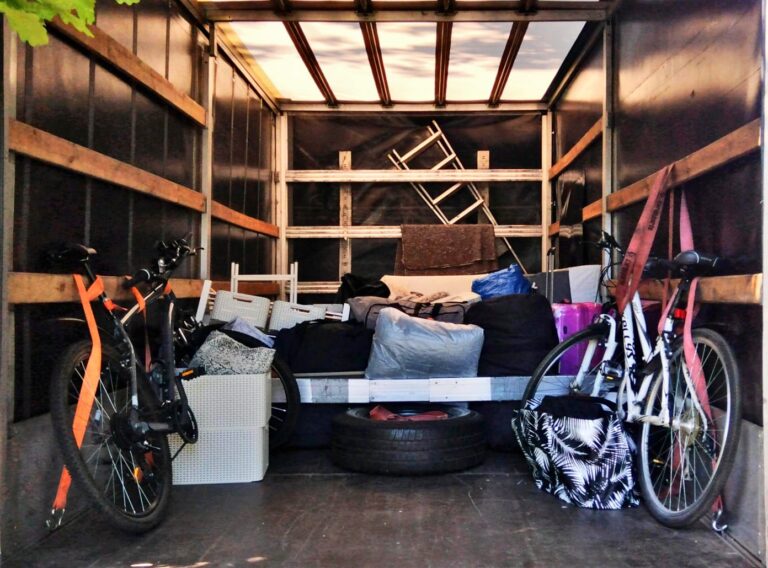
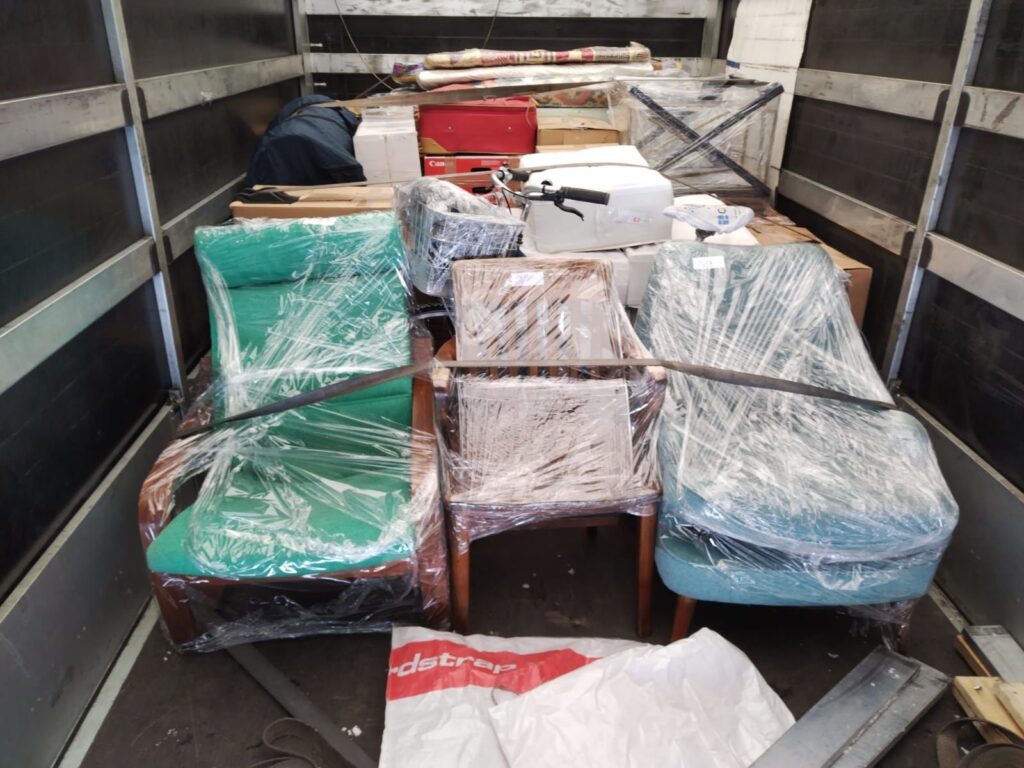
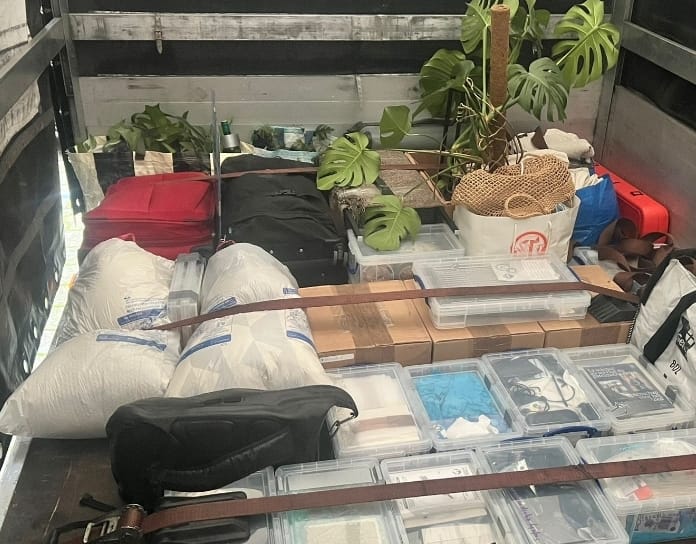
VANonsite can help you choose the right type of move. A small man and van relocation may be ideal if you are starting with essentials. A larger dedicated vehicle is better for a full apartment or family move. For fragile, premium or high-value items, packing support and careful handling can prevent avoidable damage.
VANonsite Vehicle Sizes for Moves to Switzerland
Your move should match your real volume. Too small creates stress. Too large can waste money. VANonsite offers flexible vehicle sizes for different European relocation needs.
| Package | Volume | Weight | Best for |
|---|---|---|---|
| Moving One | 1 m3 | 100 kg | Suitcases, boxes, compact student move |
| Moving Basic | 5 m3 | 300 kg | Studio move or small man and van relocation |
| Moving Medium | 10 m3 | 500 kg | Small apartment, boxes and key furniture |
| Moving Premium | 15 m3 | 1,100 kg | Larger apartment or partial house move |
| Moving Premium Plus | 30 m3 | 3,500 kg | Family relocation or full apartment move |
| Moving Full House XXL | 90 m3 | 20,000 kg | Large house, office or complex relocation |
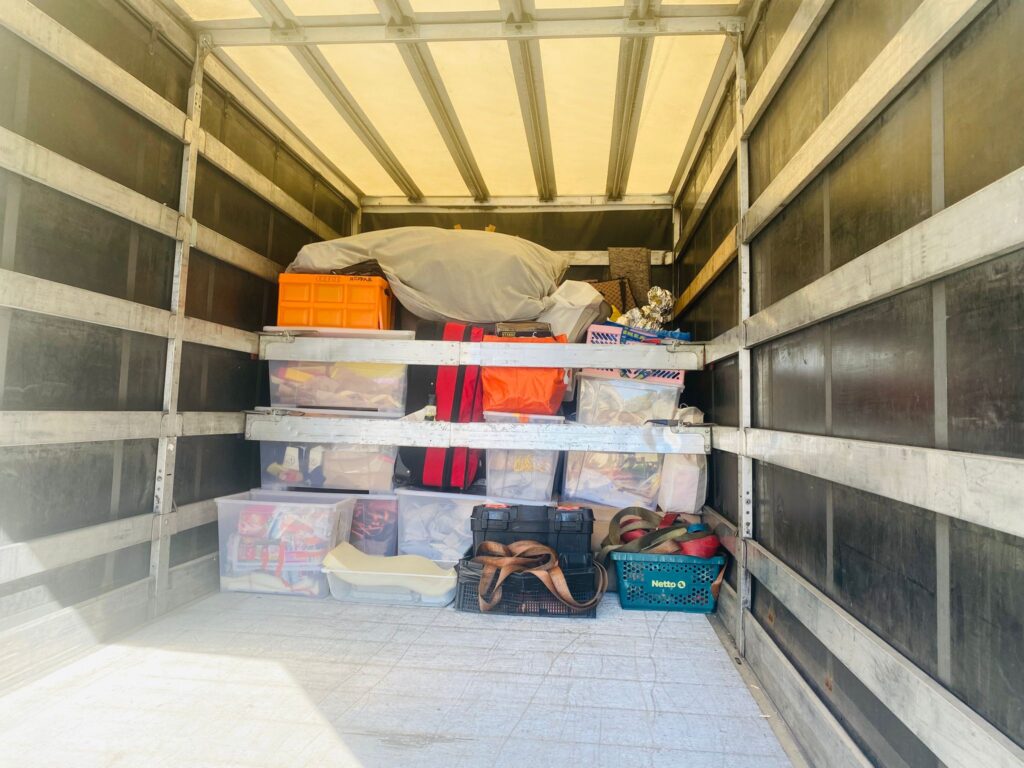
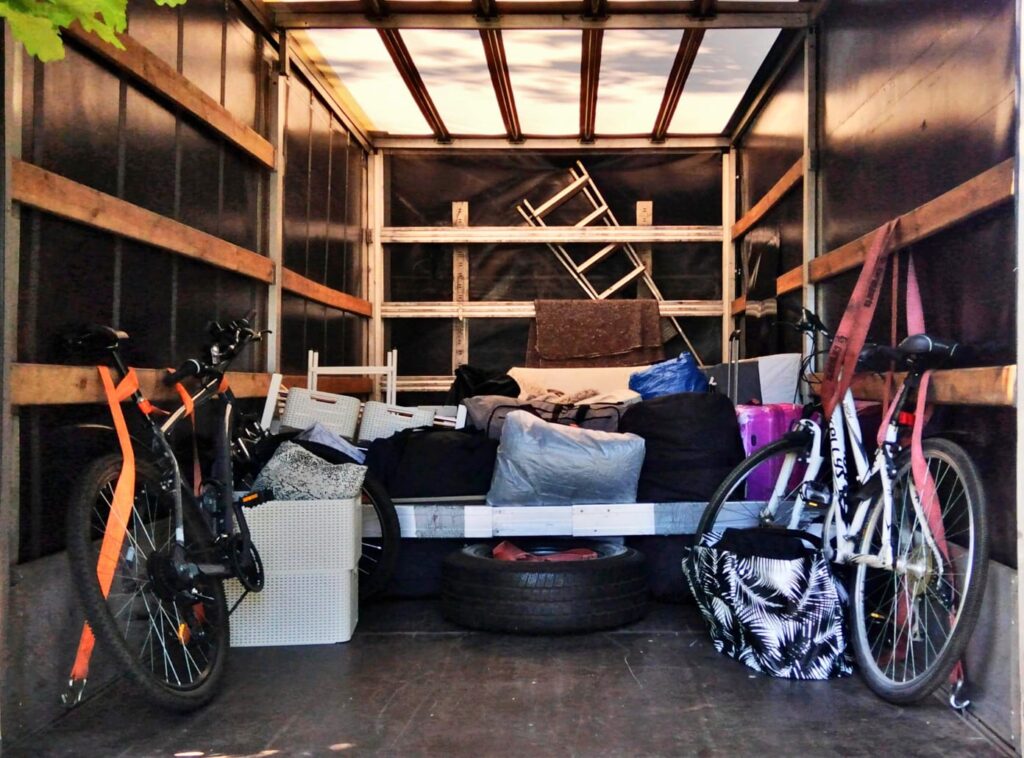
Many people living in Switzerland working in Germany start lean. They bring documents, clothes, work tools, key furniture and personal items. Later, once the job, commute and housing situation feel stable, they move more belongings.
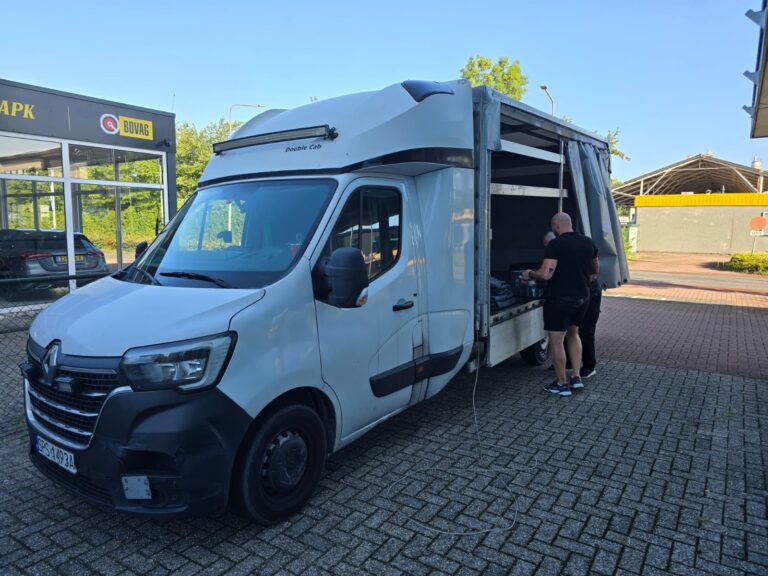
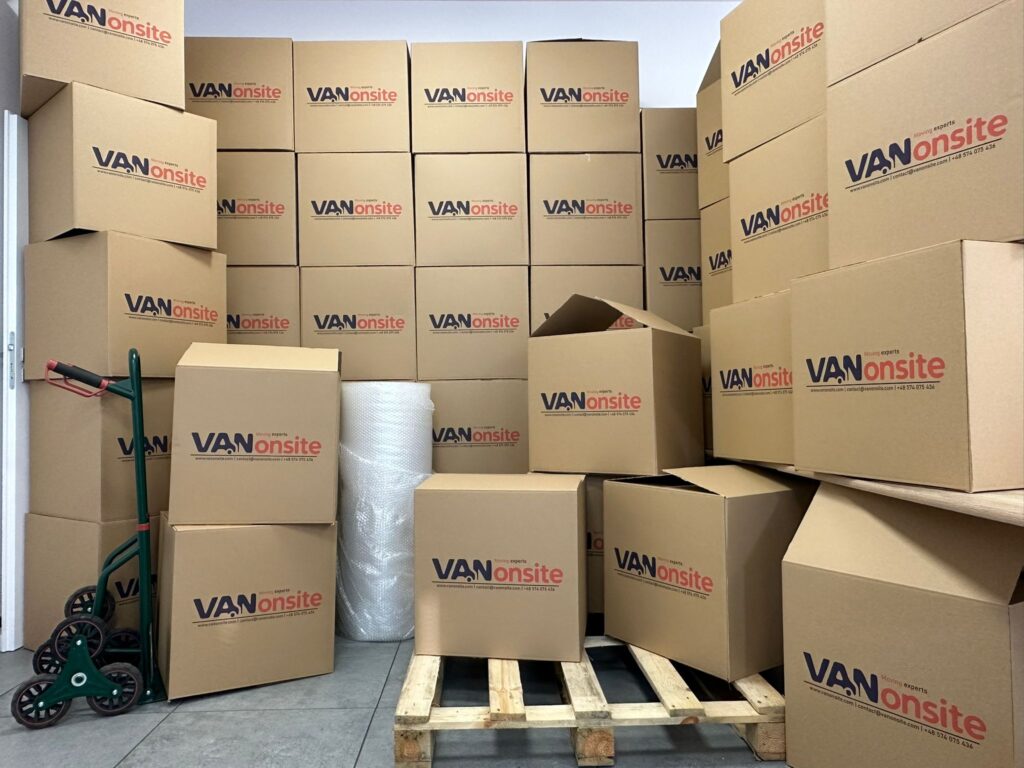
For larger moves, VANonsite can support home removals, furniture removals, packing services, storage and delivery coordination. Each load can be GPS-tracked, which gives peace of mind when your life is split between two countries.
For dedicated relocation support, visit Removals to Switzerland.

VANonsite Services That Help with a Switzerland Move
Living in Switzerland working in Germany often means timing is tight. You may collect keys in Switzerland on Friday, start work in Germany on Monday and need your belongings delivered before the first commute. There is little room for confusion.
VANonsite supports European moves with practical services such as:
- Last Minute Moving
- Furniture Removals
- Home Removals
- Packing Service
- White Glove Delivery
- Office Removals
- Storage
- Student Removals
- Office Furniture Installation
- Man and van transport for smaller moves
The strongest advantage is control. With GPS tracking, you can follow your load. With dedicated transport, your belongings are handled with care. With the right vehicle size, you avoid unnecessary waste and pressure.
Step-by-Step Moving Plan
A successful move is built on sequence, not hope. Follow a clear plan and the process becomes far less stressful.
- Confirm your right to live in Switzerland
Check your nationality, permit needs and registration obligations before signing a lease. - Confirm your right to work in Germany
EU citizens usually benefit from freedom of movement, but non-EU nationals should verify work permission carefully. - Review tax and social security rules
Speak to a specialist before assuming where your income will be taxed. - Choose your Swiss location based on commute
Do not choose only by beauty. Test the morning route. - Calculate your real monthly budget
Include rent, insurance, transport, food, tax advice, emergency savings and currency exchange. - Secure housing
Swiss rental markets can be competitive. Prepare documents early. - Build a household inventory
List what you are moving. This helps with removals planning and customs preparation. - Choose the right VANonsite vehicle size
Match your belongings to Moving One, Moving Basic, Moving Medium, Moving Premium or a larger option. - Book packing or storage if needed
Professional packing can protect fragile items. Storage can help if your move-in date shifts. - Register after arrival
Complete local registration and administrative steps within the required timeframe. - Set up banking, insurance and mobile services
Handle essentials quickly so your first working week feels controlled. - Test your commute before the job starts
One real test journey can reveal problems that online maps hide.
This process is especially useful for anyone living in Switzerland working in Germany because the move is residential, professional, financial and logistical at the same time.
Common Mistakes to Avoid
Cross-border living can be exciting, but it punishes assumptions. The most expensive mistakes often happen before the moving van arrives.
Avoid these errors:
- Renting in Switzerland before checking commute time
- Assuming Switzerland follows identical EU rules
- Underestimating rental deposits
- Ignoring health insurance deadlines
- Forgetting tax advice
- Moving too much furniture into a small apartment
- Choosing a German job without calculating Swiss living costs
- Not checking parking access for the removals van
- Leaving packing until the final week
- Choosing the cheapest mover without checking reliability
- Forgetting that a bad commute can damage your lifestyle
- Failing to create a household inventory
The cheapest move is not always the smartest move. A delayed or poorly organised relocation can cost more in stress, broken items and lost working time. VANonsite focuses on secure handling, clear planning and professional transport, so the first stage of your Swiss life starts with confidence.
Is Living in Switzerland Working in Germany Worth It?
Living in Switzerland working in Germany can be worth it if your income, commute, insurance and tax position all make sense. It is especially attractive for people who want Swiss safety, order and landscapes while keeping access to German employers.
It is not the cheapest option. It is not the simplest option. But for the right person, it can be a rewarding lifestyle.
You might love it if:
- You value safety and calm
- You want Swiss quality of life
- Your German workplace is close to the border
- You have a strong salary
- You can manage paperwork well
- You enjoy structured living
- You want a long-term European base
You might prefer living in Germany if:
- Your budget is tight
- You want lower rent
- You dislike administrative complexity
- Your German workplace is far from the Swiss border
- You eat out often
- You want a larger housing market
- You need easier access to cheaper everyday services
The honest answer is simple: living in Switzerland working in Germany is not automatically better than living in Germany. It is better when the lifestyle premium gives you something you truly value.
FAQ
Can I live in Switzerland and work in Germany?
Yes, living in Switzerland working in Germany can be possible, especially for EU/EFTA citizens and people with the correct residence and work status. Always confirm your own situation with official authorities or a qualified adviser.
Is Switzerland more expensive than Germany?
Yes, in many everyday categories. The cost of living in Switzerland vs Germany is usually higher for rent, groceries, restaurants, insurance and services. Some costs can be 30% to 100% higher depending on location and lifestyle.
Is it better to live in Germany or Switzerland?
Living in Germany vs Switzerland depends on your priorities. Germany is usually cheaper and has a larger job market. Switzerland is often safer, cleaner, quieter and more polished. For people who value stability, Switzerland can be extremely attractive.
What is the best Swiss city if I work in Germany?
Basel is one of the strongest options because it is close to the German border. Schaffhausen, St. Gallen and parts of the Lake Constance region can also work well. Zurich may suit hybrid workers, but daily commuting can be expensive and time-consuming.
What documents do I need to move to Switzerland?
You may need a passport or ID card, rental agreement, employment contract, proof of income, insurance documents, family records, vehicle documents and a household goods inventory. Check official Swiss guidance before moving.
Do I need a tax adviser?
Yes, it is strongly recommended. Cross-border taxation between Switzerland and Germany can be complex, especially if you work remotely, travel frequently, have family members in another country or receive income from different sources.
Can VANonsite help with a small move to Switzerland?
Yes. VANonsite offers flexible options for small moves, including man and van style transport, student removals, furniture removals and compact household moves.
Can VANonsite handle a full house move to Switzerland?
Yes. VANonsite offers larger vehicle options, including Moving Premium Plus and Moving Full House XXL, for family homes, large apartments and complex relocations.
Why use VANonsite for removals to Switzerland?
VANonsite offers GPS tracking, careful loading, packing support, flexible vehicle sizes and European removals experience. This is valuable when moving to a country where timing, documents and precision matter.
Moving to Switzerland? Make the First Step Feel Effortless
Living in Switzerland working in Germany can be bold, intelligent and deeply rewarding. It can give you Swiss calm, German opportunity and a rare cross-border lifestyle that feels both practical and aspirational.
But the move itself should not feel chaotic.
VANonsite helps you relocate to Switzerland with secure transport, professional planning, GPS tracking, packing options and vehicle sizes for everything from a few boxes to a full house. Whether you need a compact man and van move, careful furniture removals or complete door-to-door relocation, the right support can turn a complicated move into a confident beginning.
Start your move with VANonsite removals to Switzerland and arrive ready for your next chapter.