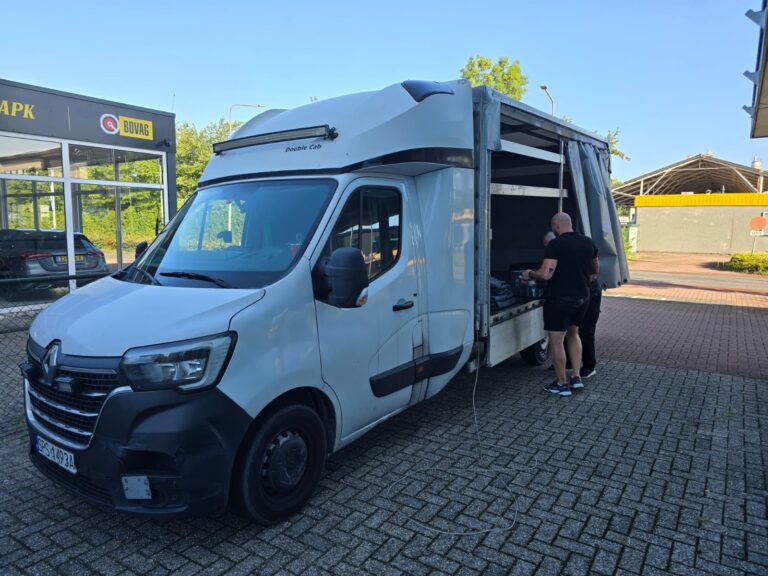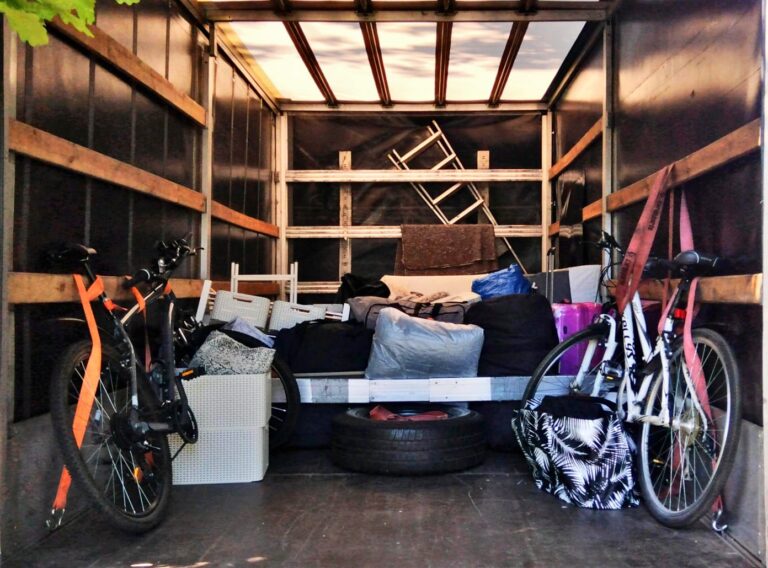

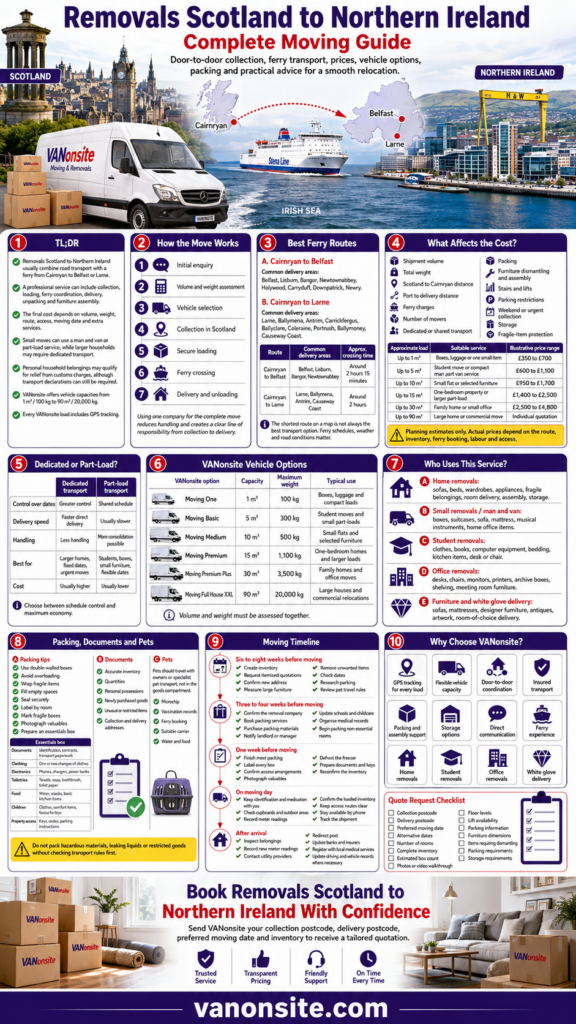
Removals Scotland to Northern Ireland can be arranged as one coordinated, door-to-door service. Your belongings are collected from your home, flat, office, student accommodation or storage unit in Scotland, securely loaded, transported to the ferry terminal and delivered directly to your new address in Northern Ireland.
Although the route includes an Irish Sea crossing, the moving process does not have to feel complicated. With professional planning, the right vehicle and an experienced removal team, the journey can run smoothly from the first packed box to the final piece of furniture placed inside your new property.
VANonsite provides removals Scotland to Northern Ireland for households, students, businesses and customers moving individual items. Every load is protected during transport, covered by appropriate insurance and monitored with GPS tracking. Depending on the size of the move, customers can choose anything from a compact man and van option to a 90 m³ vehicle for a large family home or commercial relocation.
TL:DR
- Removals Scotland to Northern Ireland usually combine road transport with a ferry from Cairnryan to Belfast or Larne.
- A professional service can include collection, loading, ferry coordination, delivery, unpacking and furniture assembly.
- The removals Scotland to Northern Ireland cost depends on volume, weight, route, property access, moving date and additional services.
- Small moves can use a man and van or part-load service, while larger households may require dedicated transport.
- Personal household belongings may qualify for relief from customs charges, although transport declarations can still be required.
- VANonsite offers vehicle capacities from 1 m³ and 100 kg to 90 m³ and 20,000 kg.
- Every VANonsite load includes GPS tracking, providing greater visibility throughout the journey.




How Do Removals Scotland to Northern Ireland Work?
A move between Scotland and Northern Ireland normally includes three connected stages: road collection in Scotland, an Irish Sea ferry crossing and road delivery in Northern Ireland.
A professional removal company coordinates each stage, so the customer does not need to arrange separate carriers, manage ferry bookings or transfer belongings between different vehicles.
The process usually follows seven clear steps.
- Initial enquiryThe customer provides the collection postcode, delivery postcode, preferred moving date and an approximate inventory.
- Volume and weight assessmentThe removal team estimates the required loading space and checks whether any items are unusually heavy, fragile or difficult to transport.
- Vehicle selectionThe correct vehicle is selected according to volume, weight, property access and the type of service required.
- Collection in ScotlandThe belongings are collected from a house, flat, office, student residence or storage facility.
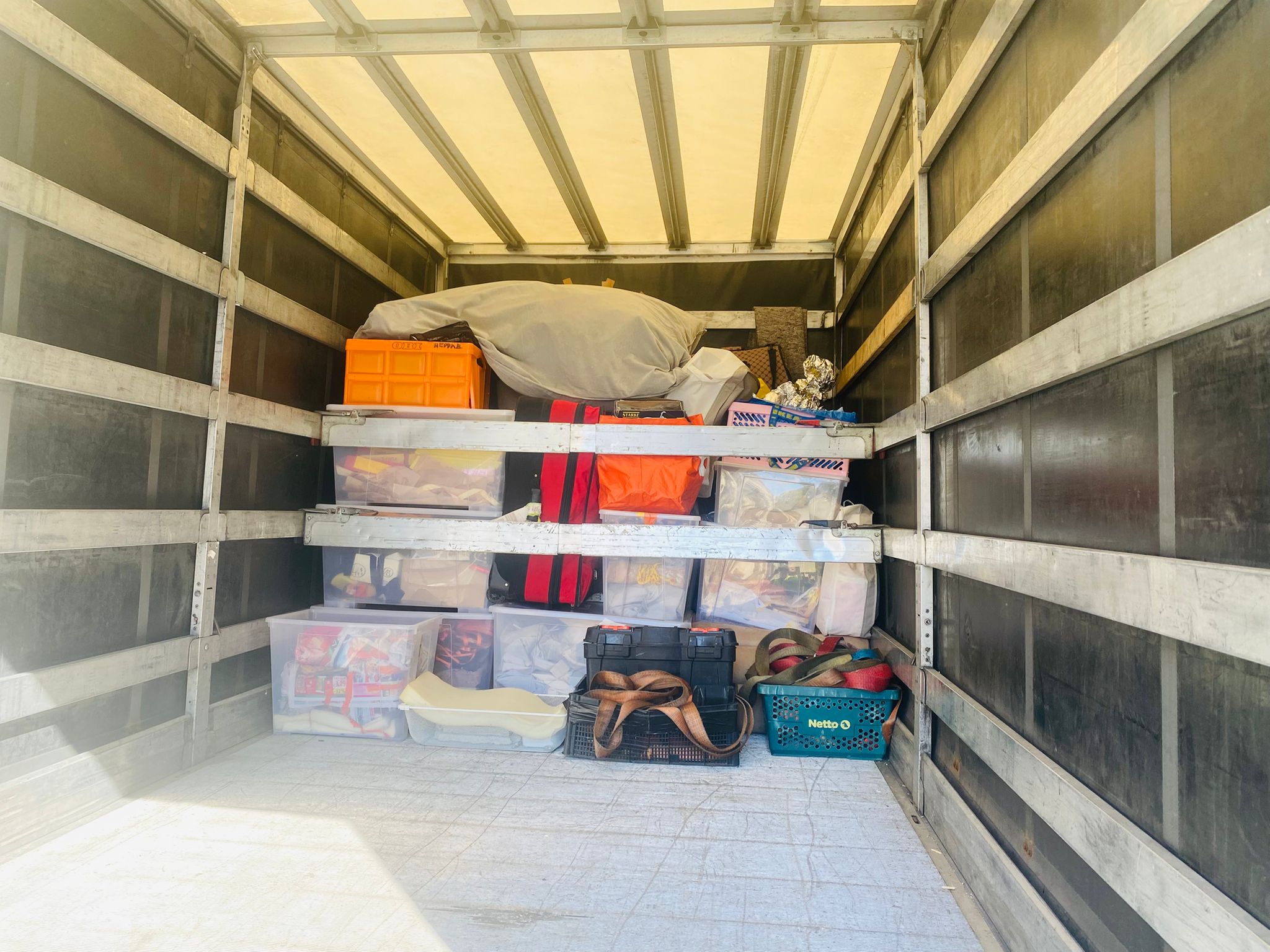
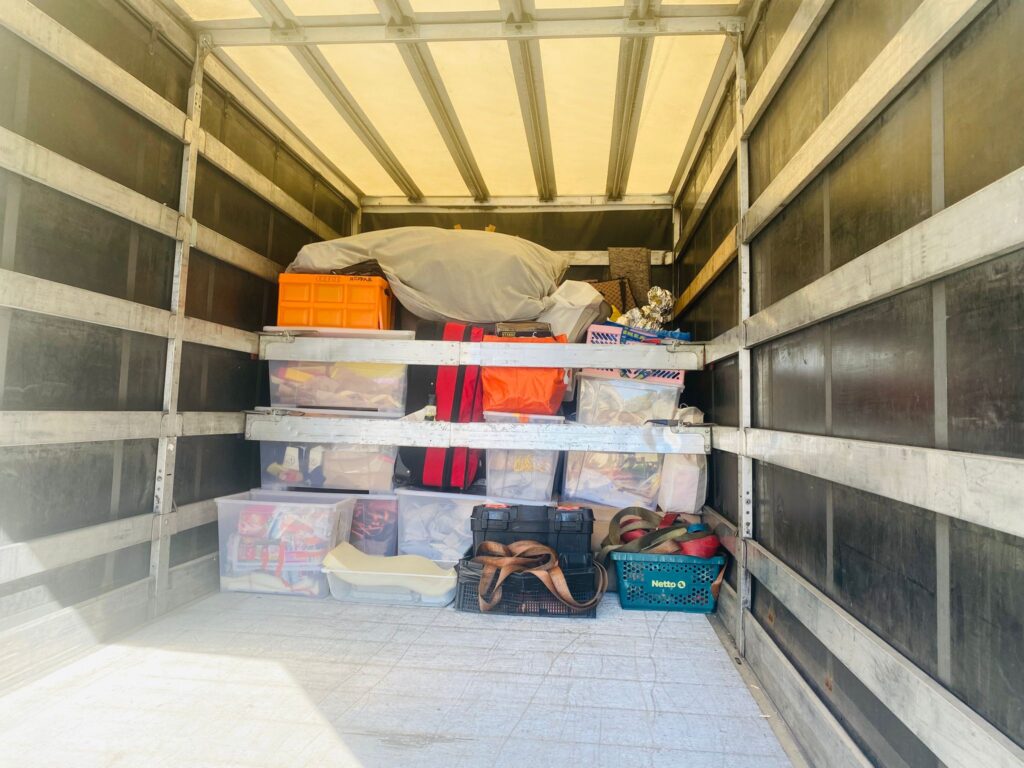
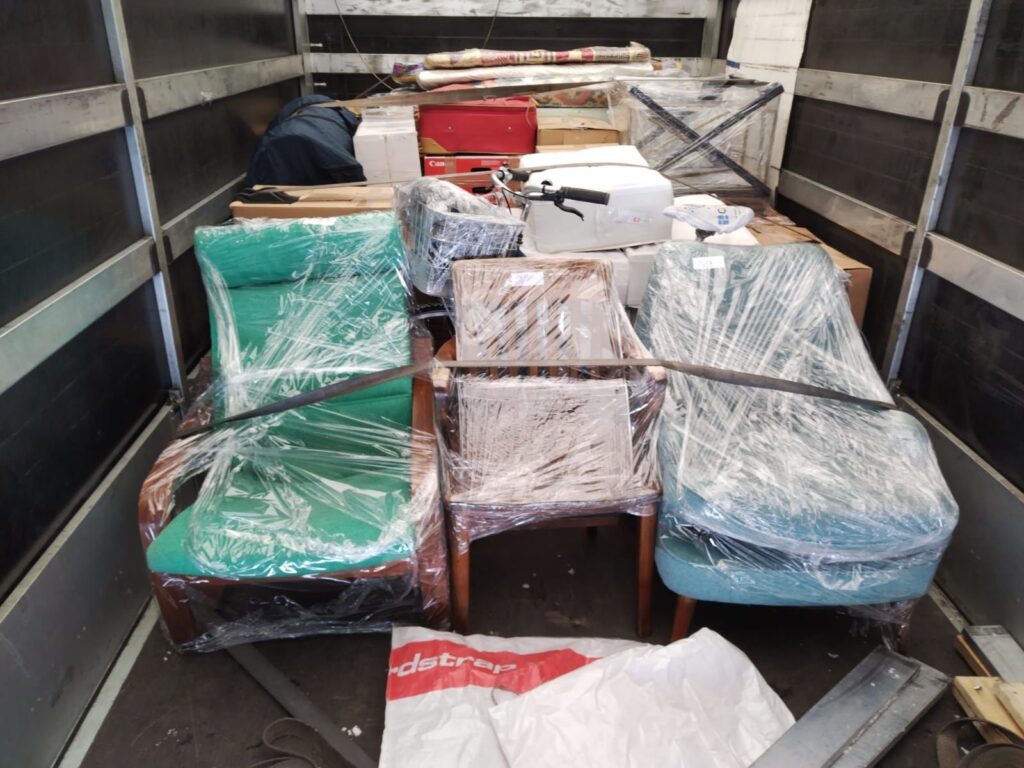
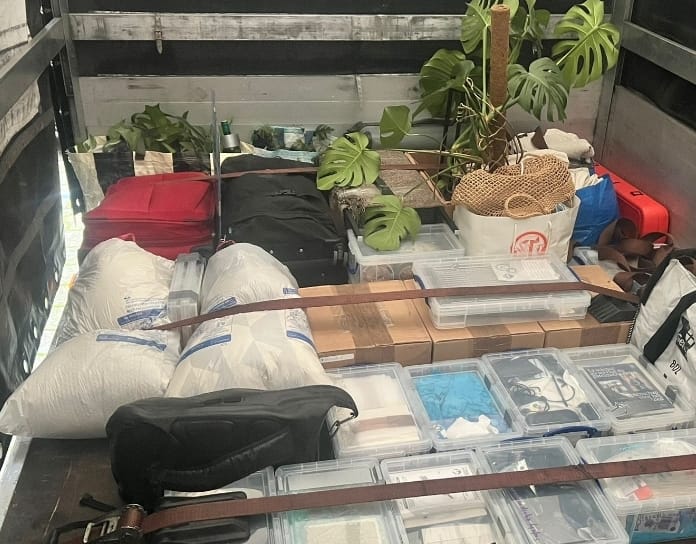
- Secure loadingFurniture is wrapped, boxes are organised and the load is secured to reduce movement during road and ferry transport.
- Ferry crossingThe vehicle normally travels from Cairnryan to Belfast or Larne, depending on the final destination and sailing schedule.
- Delivery and unloadingThe removal team delivers the shipment to the new address and completes any booked unpacking, placement or assembly work.
Using one company for the complete move reduces uncertainty. It also limits unnecessary handling and creates a clear line of responsibility from collection to delivery.
Best Routes for Moving from Scotland to Northern Ireland
Most removals Scotland to Northern Ireland use ferry services from Cairnryan in Dumfries and Galloway.
The two main options are Cairnryan to Belfast and Cairnryan to Larne. The most efficient route depends on the Scottish collection point, the Northern Irish delivery address, ferry availability and current road conditions.
Cairnryan to Belfast
The Cairnryan to Belfast route is often suitable for deliveries to:
- Belfast
- Lisburn
- Bangor
- Newtownabbey
- Holywood
- Carryduff
- Downpatrick
- Newry
The crossing usually takes slightly over two hours, although schedules can change. This route is particularly useful for moves into Belfast and the surrounding metropolitan area.
However, the removal company must also consider final property access. Central Belfast addresses may have limited parking, busy streets, loading restrictions or narrow access points.
Cairnryan to Larne
The Cairnryan to Larne route can be convenient for deliveries to:
- Larne
- Ballymena
- Antrim
- Carrickfergus
- Ballyclare
- Coleraine
- Portrush
- Ballymoney
- The Causeway Coast
Larne may reduce the final road distance for some destinations in the north and east of Northern Ireland.
| Ferry route | Common delivery areas | Approximate crossing time |
|---|---|---|
| Cairnryan to Belfast | Belfast, Lisburn, Bangor, Newtownabbey | Around 2 hours 15 minutes |
| Cairnryan to Larne | Larne, Ballymena, Antrim, Causeway Coast | Around 2 hours |
The shortest route on a map is not always the best transport option. Ferry schedules, vehicle spaces, weather, roadworks and unloading arrangements can all influence the final plan.
What Is the Removals Scotland to Northern Ireland Cost?
The removals Scotland to Northern Ireland cost depends on far more than mileage. The quantity of belongings, required vehicle, ferry price, labour and property access can all significantly affect the final quotation.
A small shipment of ten boxes from Glasgow to Belfast will usually cost less than relocating a furnished four-bedroom property from Aberdeen to Coleraine.
The main pricing factors include:
- Total shipment volume
- Combined shipment weight
- Distance from the collection address to Cairnryan
- Distance from Belfast or Larne to the delivery address
- Ferry charges for the selected vehicle
- Number of movers required
- Dedicated or shared transport
- Packing and unpacking
- Furniture dismantling and assembly
- Stairs, lifts and carrying distances
- Parking restrictions
- Weekend or urgent collection
- Temporary storage
- Specialist protection for fragile items
Illustrative Removals Scotland to Northern Ireland Prices
The following ranges are broad planning estimates. They are not fixed prices, because every move has different requirements.
| Approximate load | Suitable service | Illustrative price range |
|---|---|---|
| Up to 1 m³ | Boxes, luggage or one small item | £350 to £700 |
| Up to 5 m³ | Student move or compact man and van service | £600 to £1,100 |
| Up to 10 m³ | Small flat or selected furniture | £950 to £1,700 |
| Up to 15 m³ | One-bedroom property or larger part-load | £1,400 to £2,500 |
| Up to 30 m³ | Family home or small office | £2,500 to £4,800 |
| Up to 90 m³ | Large home or commercial move | Individual quotation |
Actual removals Scotland to Northern Ireland prices can fall outside these ranges.
A collection from Dumfries with ground-floor access may be easier and less expensive than a collection from the Highlands involving narrow roads, several flights of stairs and furniture dismantling.
For a more accurate quote, provide photographs, a video walkthrough or a detailed inventory. This reduces the risk of an undersized vehicle, unexpected labour charges or additional journeys.
Dedicated Transport or Part-Load Removals?
Customers planning removals Scotland to Northern Ireland can often choose between dedicated transport and part-load transport.
Dedicated Transport
A dedicated vehicle carries only one customer’s belongings. This option normally provides:
- Greater control over dates
- Faster direct delivery
- Less handling
- More predictable scheduling
- Exclusive use of the vehicle
- Easier planning for large households
Dedicated transport is particularly useful when a customer must leave one property and enter another on fixed dates.
Part-Load Transport
A part-load service combines compatible shipments travelling along a similar route. This can reduce the overall cost because ferry and transport expenses are shared.
Part-load transport is commonly used for:
- Student belongings
- Several boxes
- Small furniture orders
- Storage unit contents
- Compact flat moves
- Flexible moving dates
- Non-urgent deliveries
The main compromise is a wider collection or delivery window. Customers should therefore decide whether price or schedule control is more important.
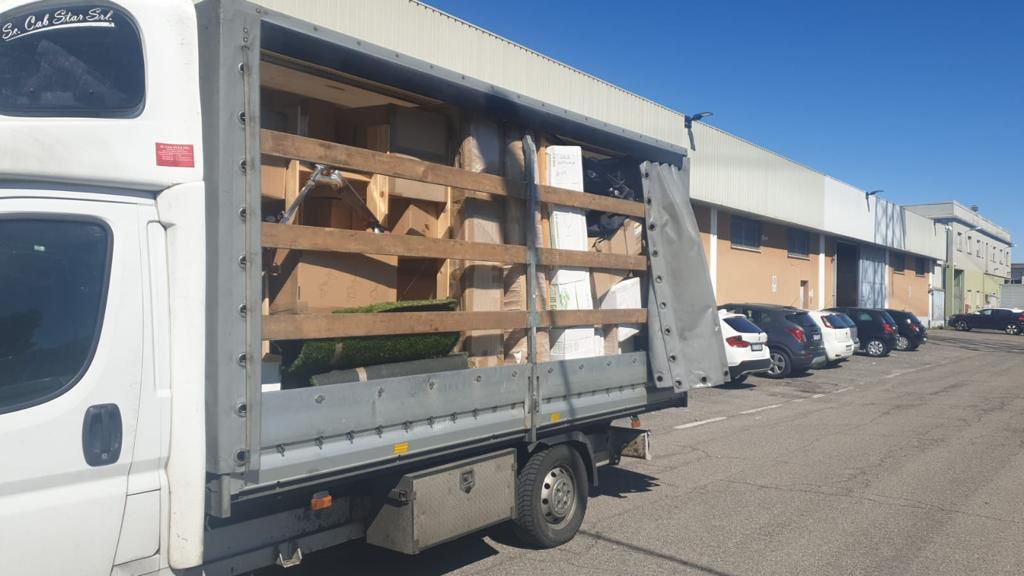
VANonsite Vehicle Options
Choosing the correct vehicle is essential. An undersized van can lead to delays, extra journeys and higher costs.
VANonsite offers six vehicle capacity options for removals Scotland to Northern Ireland.
| VANonsite option | Capacity | Maximum weight | Typical use |
|---|---|---|---|
| Moving One | 1 m³ | 100 kg | Boxes, luggage and compact loads |
| Moving Basic | 5 m³ | 300 kg | Student moves and small part-loads |
| Moving Medium | 10 m³ | 500 kg | Small flats and selected furniture |
| Moving Premium | 15 m³ | 1,100 kg | One-bedroom homes and larger loads |
| Moving Premium Plus | 30 m³ | 3,500 kg | Family homes and office moves |
| Moving Full House XXL | 90 m³ | 20,000 kg | Large houses and commercial relocations |
Volume is only one part of the calculation. Lightweight boxes may occupy substantial space without reaching the weight limit, while books, machinery, gym equipment and solid wood furniture can become heavy very quickly.
VANonsite assesses both volume and weight before recommending a vehicle.
Best Removals Scotland to Northern Ireland: What Should You Look For?
The best removals Scotland to Northern Ireland should offer more than a vehicle and a driver. Ferry-based moves require careful coordination, transparent communication and professional protection.
Before choosing a moving company, check whether it provides:
- A written, itemised quotation
- Goods in transit insurance
- GPS tracking
- Experience with ferry transport
- Protective furniture covers
- Secure loading equipment
- Flexible vehicle capacities
- Packing and unpacking services
- Furniture dismantling and assembly
- Storage options
- Direct customer support
- Assistance with transport documentation
Be cautious when one quotation is dramatically cheaper than all the others. The lowest headline price may exclude ferry costs, labour, waiting time, packing materials or delivery to the final room.
A reliable quotation should clearly explain what is included and which changes may increase the final cost.
Why Customers Choose VANonsite
VANonsite combines transport planning with attentive customer support. The service is designed to protect belongings while giving customers clear information throughout the journey.
GPS Tracking for Every Load
Every VANonsite shipment is monitored with GPS tracking. This is particularly valuable during removals Scotland to Northern Ireland because the journey involves road transport, port procedures and a ferry crossing.
Flexible Vehicle Capacity
Customers do not need to pay for a large vehicle when moving only a few items. Capacity starts at 1 m³ and extends to 90 m³.
Door-to-Door Coordination
Collection, loading, ferry transport and final delivery are organised as one service. This reduces unnecessary handling and communication gaps.
Packing and Assembly Support
Customers can add packing, unpacking, furniture dismantling and reassembly according to the needs of the move.
Direct Communication
Unexpected situations can happen. Ferry schedules may change, property access may be restricted or a key handover may be delayed. Direct communication allows the transport plan to be adjusted quickly.
Home Removals from Scotland to Northern Ireland
A household relocation usually involves more than packed boxes. Sofas, beds, wardrobes, appliances, personal belongings and fragile decorations must all arrive safely.
VANonsite provides Home Removals for flats, cottages, family homes and larger residential properties.
A full home removal can include:
- Collection from one or several addresses
- Professional loading
- Furniture protection
- Dismantling beds and wardrobes
- Packing fragile belongings
- Delivery to specific rooms
- Furniture assembly
- Temporary storage
- Removal of used packing materials
Customers planning a move farther across the island can also learn more about VANonsite removals to Ireland. Requirements may differ when the final destination is in the Republic of Ireland, so the exact delivery country should always be confirmed.
Small Removals and Man and Van Services
Not every customer needs a large removal vehicle. A man and van service can be a practical and cost-conscious option for smaller removals Scotland to Northern Ireland.
It may be suitable for:
- Boxes and suitcases
- Student belongings
- A sofa, bed or mattress
- Home office equipment
- Musical instruments
- Sports equipment
- Several pieces of furniture
- A compact storage unit
Professional handling is still important when the shipment is small. A single antique cabinet or large television may require more care than several ordinary boxes.
Before booking a man and van, provide the dimensions of bulky items and photographs of both properties. The removal company must know whether each item will fit through doorways, staircases and communal entrances.
Student Removals from Scotland to Northern Ireland
Students regularly move between universities and colleges in Glasgow, Edinburgh, Dundee, Aberdeen, Stirling, Belfast, Coleraine and Derry or Londonderry.
A student shipment may include:
- Clothes
- Books
- Computer equipment
- Bedding
- Kitchen items
- Sports equipment
- Musical instruments
- A desk or chair
- Boxes and suitcases
VANonsite Student Removals can be arranged from halls of residence, private rentals or family homes.
A compact man and van or part-load service can help keep the move affordable. Temporary storage can also be added when one tenancy finishes before the next begins.
Students should confirm building access times in advance. Some residences restrict vehicle access or require moving companies to register before arrival.
Office and Business Removals
Business removals Scotland to Northern Ireland require precise planning. Delays can disrupt staff, customers and daily operations.
A commercial move may include:
- Desks and office chairs
- Computers and monitors
- Printers and telecommunications equipment
- Archive boxes
- Reception furniture
- Product samples
- Shelving
- Meeting room furniture
- Specialist equipment
VANonsite Office Removals can be organised in stages to reduce downtime. Essential equipment can be prioritised so that key departments resume work faster.
A practical office moving plan should include:
- A department-by-department inventory
- A clear labelling system
- Data backups
- Confirmed access at both buildings
- A named relocation coordinator
- A plan for essential equipment
- A furniture installation schedule
VANonsite can also provide Office Furniture Installation after delivery.
Furniture Removals and White Glove Delivery
Furniture can be vulnerable during ferry-based transport. Polished surfaces, corners, glass panels and upholstered sections require proper protection.
VANonsite Furniture Removals can be arranged for:
- Sofas
- Beds
- Mattresses
- Wardrobes
- Dining tables
- Cabinets
- Antiques
- Artwork
- Designer furniture
- Office furniture
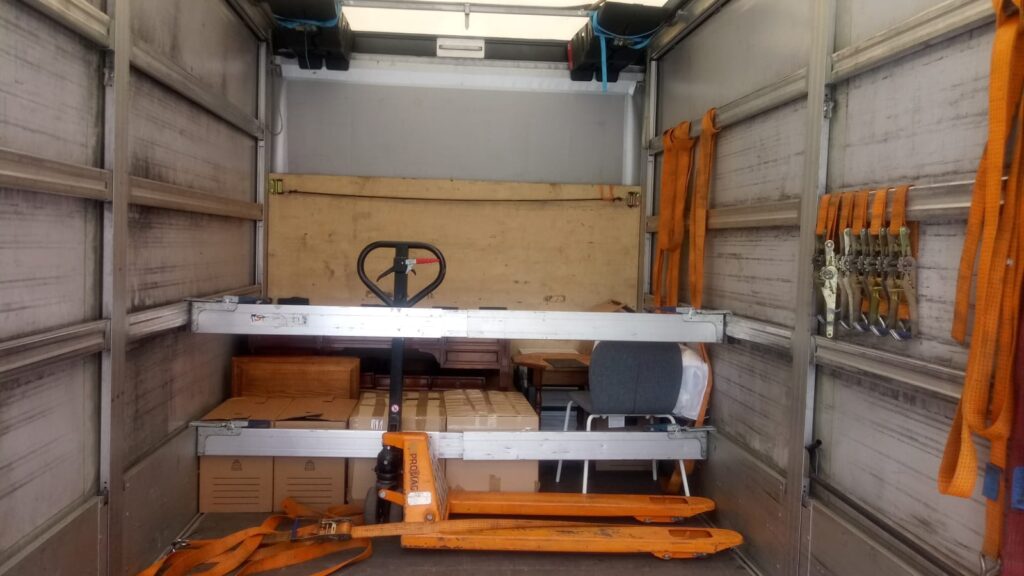
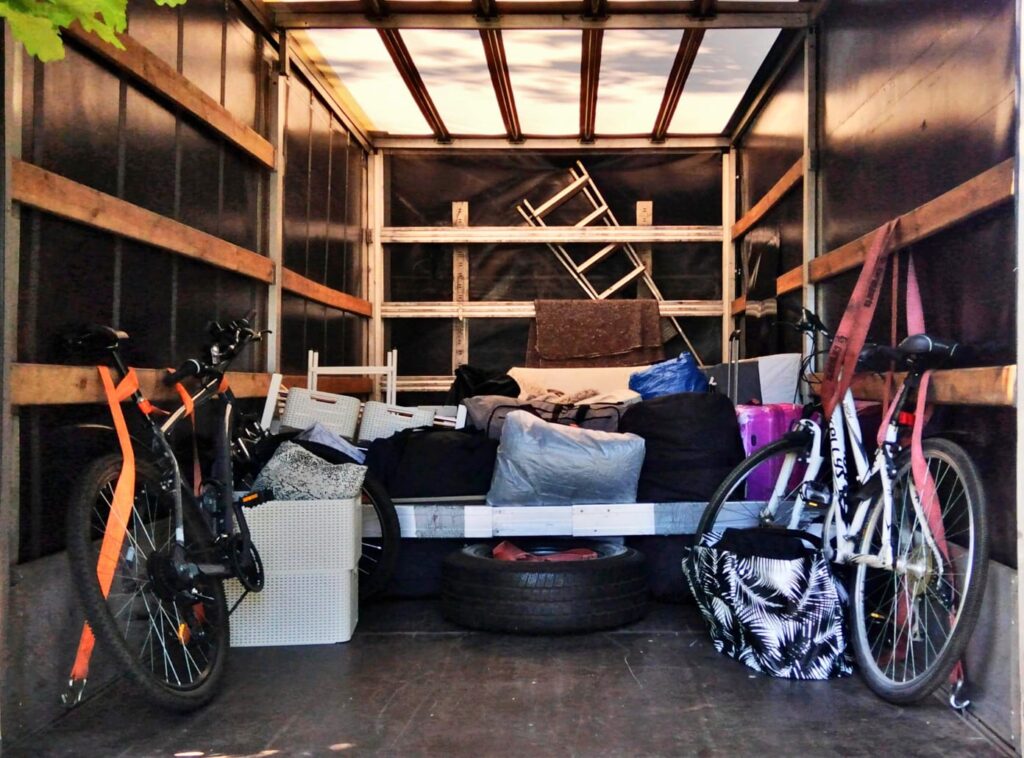
Protection methods may include padded blankets, mattress covers, corner protectors, stretch wrap and secure load restraints.
Customers requiring a premium level of care can choose White Glove Delivery. Depending on the booking, this can include room-of-choice placement, unpacking, assembly and packaging removal.

How to Pack for a Ferry-Based Move
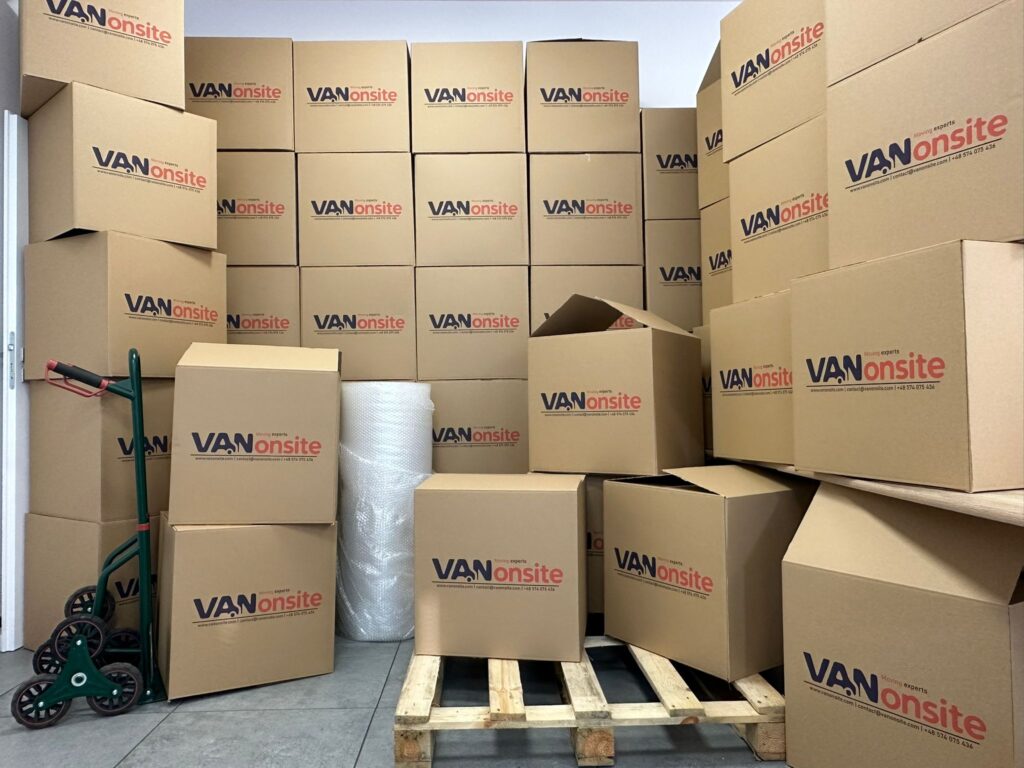
Belongings transported from Scotland to Northern Ireland experience road movement, loading activity and a sea crossing. Strong packing materials are therefore essential.
VANonsite offers a professional Packing Service for complete homes, selected rooms and fragile items.
When packing independently:
- Use double-walled boxes for heavy belongings.
- Avoid overloading large boxes.
- Wrap fragile objects separately.
- Fill empty spaces inside boxes.
- Seal the bottom and top securely.
- Label each box by room.
- Mark fragile boxes clearly.
- Photograph valuable belongings.
- Keep medication and documents with you.
- Prepare an essentials box for the first night.
| Essentials category | Recommended items |
|---|---|
| Documents | Identification, contracts and transport paperwork |
| Clothing | One or two changes of clothes |
| Electronics | Phones, chargers and power banks |
| Toiletries | Towels, soap, toothbrushes and toilet paper |
| Food | Water, snacks and basic kitchen items |
| Children | Clothes, comfort items and favourite toys |
| Property access | Keys, codes and parking instructions |
Do not pack hazardous materials, leaking liquids or restricted goods without checking transport rules first.
Do You Need Customs Documents?
Scotland is part of Great Britain, while Northern Ireland remains part of the United Kingdom. However, specific goods movement arrangements apply between Great Britain and Northern Ireland.
Personal household belongings may qualify for relief from customs charges. When a professional removal company transports the load, the company may still need to complete the relevant transport declarations.
Customers should prepare an accurate inventory containing:
- Descriptions of belongings
- Approximate quantities
- Confirmation that the items are personal possessions
- Details of newly purchased goods
- Information about unusual or restricted items
- Collection and delivery addresses
Additional requirements may apply to commercial goods, stock intended for resale, alcohol, tobacco, plants, some food products and hazardous materials.
Official information is available in the GOV.UK guidance for moving a home from Great Britain to Northern Ireland.
Moving to Northern Ireland With Pets
Pets should normally travel with their owners or through a specialist pet transport provider. They should not travel inside a household goods compartment.
Owners may need:
- A Northern Ireland Pet Travel Document
- A registered microchip
- Correct vaccination records
- Ferry booking confirmation
- A suitable carrier or restraint
- Water and food
- Veterinary advice
The rules can be different when the pet will continue into the Republic of Ireland or another EU country.
Pet owners should review official requirements through the Northern Ireland Pet Travel Document service.
How Long Do Removals Scotland to Northern Ireland Take?
The total journey time depends on the collection address, ferry route, delivery location and type of service.
A collection from south-west Scotland is much closer to Cairnryan than a collection from Aberdeen or Inverness. Delivery to Belfast can also be faster than delivery to a rural destination several hours from the port.
Timing may be affected by:
- Road distance
- Traffic
- Ferry availability
- Port check-in times
- Weather
- Driver working hours
- Loading complexity
- Property access
- Dedicated or part-load transport
- Storage arrangements
A dedicated small move from central or western Scotland may be completed within a relatively short window. Large moves, northern Scotland collections and part-load services usually require more flexibility.
Scotland to Northern Ireland Moving Checklist
Six to Eight Weeks Before Moving
- Create a complete inventory.
- Request itemised quotations.
- Confirm the new address.
- Measure large furniture.
- Remove unwanted items.
- Check tenancy or completion dates.
- Research parking and access.
- Review pet travel rules.
Three to Four Weeks Before Moving
- Confirm the removal company.
- Book packing services.
- Purchase packing materials.
- Notify the landlord or property manager.
- Update schools and childcare providers.
- Organise medical records.
- Begin packing non-essential rooms.
One Week Before Moving
- Finish most packing.
- Label every box.
- Confirm access arrangements.
- Photograph valuable belongings.
- Defrost the freezer.
- Prepare documents and keys.
- Reconfirm the inventory.
On Moving Day
- Keep identification and medication with you.
- Check cupboards, lofts and outdoor areas.
- Record meter readings.
- Confirm the loaded inventory.
- Keep access routes clear.
- Stay available by phone.
- Track the shipment.
After Arrival
- Inspect belongings.
- Record new meter readings.
- Contact utility providers.
- Redirect post.
- Update banks and insurers.
- Register with local medical services.
- Update driving and vehicle records where necessary.
Common Mistakes to Avoid
Even a well-planned move can become stressful when important details are overlooked.
Common mistakes include:
- Booking too close to the moving date
- Choosing a vehicle using box numbers alone
- Forgetting furniture dimensions
- Failing to mention stairs or long carrying distances
- Ignoring parking restrictions
- Packing restricted items
- Using damaged boxes
- Accepting a quote without checking inclusions
- Underestimating volume
- Leaving dismantling until moving day
- Assuming ferry schedules cannot change
- Forgetting pet documentation
- Not preparing an inventory
- Choosing a company without suitable insurance
Clear information is crucial. Tell the removal company about access problems, heavy items and inventory changes before collection.
How to Get an Accurate Removal Quote
To receive an accurate quotation for removals Scotland to Northern Ireland, provide:
- Collection postcode
- Delivery postcode
- Preferred moving date
- Alternative dates
- Number of rooms
- Complete inventory
- Estimated box count
- Photographs or a video walkthrough
- Floor levels
- Lift availability
- Parking information
- Furniture dimensions
- Items requiring dismantling
- Fragile or high-value belongings
- Packing requirements
- Storage requirements
Detailed information allows the removal company to select the correct vehicle, estimate labour and organise the ferry booking properly.
Frequently Asked Questions
How much do removals Scotland to Northern Ireland cost?
The cost depends on volume, weight, collection location, delivery address, ferry charges and additional services. Small moves may cost several hundred pounds, while larger home and office removals require an individual quotation.
What affects removals Scotland to Northern Ireland prices?
The main factors are vehicle size, distance, ferry charges, labour, property access, packing, furniture assembly, storage and moving date flexibility.
Which company offers the best removals Scotland to Northern Ireland?
Choose a company with ferry experience, GPS tracking, transparent pricing, suitable insurance and flexible vehicle options.
Can I book a man and van from Scotland to Northern Ireland?
Yes. A man and van service can be suitable for boxes, student belongings, selected furniture and smaller flat moves.
Do I need customs paperwork?
Personal belongings may qualify for customs relief, although the removal company may still need to complete transport declarations.
Can VANonsite move one sofa or wardrobe?
Yes. VANonsite can transport individual items, compact loads and complete household inventories.
Can packing be included?
Yes. Customers can book full packing, partial packing, fragile-item packing and unpacking.
Are belongings tracked?
Yes. VANonsite provides GPS tracking for every load.
Which ferry route is used?
The vehicle normally travels from Cairnryan to Belfast or Larne. The final route depends on the delivery address and ferry availability.
Can storage be added?
Yes. Storage can be included when collection and delivery dates do not match.
Book Removals Scotland to Northern Ireland With VANonsite
Removals Scotland to Northern Ireland require more than simple road transport. The vehicle, ferry, packing, documentation and delivery must work together as one reliable plan.
VANonsite provides support for home removals, student moves, office relocations, furniture transport and compact man and van services. Customers benefit from flexible vehicle capacities, insured transport, professional protection and GPS tracking for every shipment.
Whether you are moving 1 m³ of personal belongings or the contents of a large family home, the service can be matched to your volume, schedule and access requirements.
Send VANonsite your collection postcode, delivery postcode, preferred moving date and inventory. The team will assess the route, recommend the correct vehicle and prepare a tailored quotation for your move from Scotland to Northern Ireland.