
Moving to Switzerland is a powerful life decision. The country offers clean cities, safe streets, high salaries, precise public transport and landscapes that can make an ordinary Monday feel cinematic. Yet if you are planning on living in Switzerland working abroad, the move needs more than excitement and a packed suitcase.
This lifestyle can work beautifully. You may live in Zurich while serving clients in Germany, settle near Geneva while your employer is in France, or build a peaceful Swiss base while managing international projects online. However, the practical side must be clear. Residence, tax, social security, health insurance, customs and moving logistics all need attention before the van arrives.
Living in Switzerland working abroad is not only about where you sleep. It is about where your life is legally, financially and practically anchored. If Switzerland becomes your home, Swiss rules can affect your permit, insurance, tax position, household goods import and even how you register with the local commune.
That is why a careful relocation plan matters. With the right documents, a realistic timeline and a professional moving partner, your move can feel controlled instead of chaotic. VANonsite supports European relocations with secure transport, GPS tracking for every load, flexible vehicle sizes and reliable man and van options for smaller or urgent moves.
For a dedicated route, visit VANonsite removals to Switzerland.
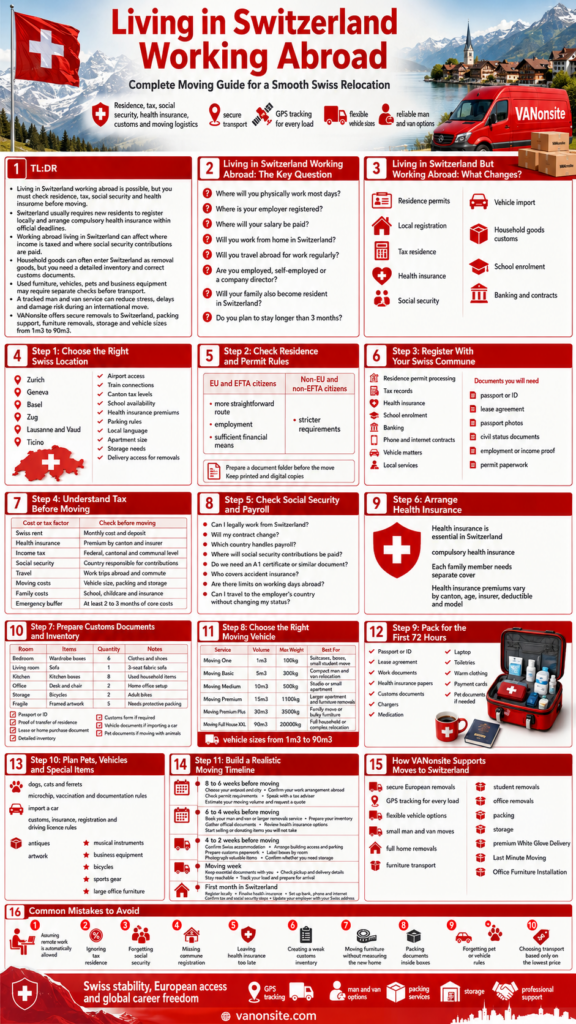
TL:DR
- Living in Switzerland working abroad is possible, but you must check residence, tax, social security and health insurance before moving.
- Switzerland usually requires new residents to register locally and arrange compulsory health insurance within official deadlines.
- Working abroad living in Switzerland can affect where income is taxed and where social security contributions are paid.
- Household goods can often enter Switzerland as removal goods, but you need a detailed inventory and correct customs documents.
- Used furniture, vehicles, pets and business equipment may require separate checks before transport.
- A tracked man and van service can reduce stress, delays and damage risk during an international move.
- VANonsite offers secure removals to Switzerland, packing support, furniture removals, storage and vehicle sizes from 1m3 to 90m3.




Living in Switzerland Working Abroad: The Key Question
Living in Switzerland working abroad means that Switzerland is your home, while your job, employer, clients or business activity remain connected to another country. This setup can look simple from the outside, but it can create important legal and financial questions.
There are several common scenarios. You might work remotely for a foreign employer from a Swiss apartment. You might travel abroad for client meetings several days a month. You might be employed by a Swiss company but posted overseas for a project. You might run a business in another country while moving your family to Switzerland. Each route has different consequences.
Before moving, answer these questions honestly:
- Where will you physically work most days?
- Where is your employer registered?
- Where will your salary be paid?
- Will you work from home in Switzerland?
- Will you travel abroad for work regularly?
- Are you employed, self-employed or a company director?
- Will your family also become resident in Switzerland?
- Do you plan to stay longer than 3 months?
These answers shape the next steps. They influence permits, tax, payroll, insurance and social security. They also help you choose the right moving date, vehicle size and document package.
Why Switzerland Attracts International Workers
Switzerland is one of Europe’s most desirable relocation destinations because it combines comfort with control. The country is orderly, prosperous and well connected. It also gives international workers quick access to Germany, France, Italy, Austria and the wider European market.
For many professionals, living in Switzerland working abroad offers an attractive mix: a stable home base, excellent infrastructure and international career freedom. Zurich, Geneva, Basel, Zug, Lausanne and Lugano all attract people with cross-border careers, remote roles and global business links.
The appeal is strong, but Switzerland rewards precision. Rent is high. Registration rules matter. Health insurance is compulsory for most residents. Customs paperwork must be prepared properly. A move that feels glamorous online can become costly if the practical details are rushed.
That is why planning should begin before you book accommodation or resign from your current lease.
Living in Switzerland But Working Abroad: What Changes?
Living in Switzerland but working abroad can change your official centre of life. If your home, partner, children, belongings, daily routine and long-term plans are in Switzerland, then Switzerland may become your main residence.
That can affect:
- Residence permits.
- Local registration.
- Tax residence.
- Health insurance.
- Social security.
- Vehicle import.
- Household goods customs.
- School enrolment.
- Banking and contracts.
The key mistake is assuming that foreign work keeps everything outside Switzerland. It may not. Even if your employer is abroad, your physical work location and residence can matter.
If your case is complex, speak with a qualified tax or relocation adviser before the move. This is especially important if you have a foreign salary, stock options, a company directorship, freelance clients or income from several countries.
Step 1: Choose the Right Swiss Location
Switzerland is compact, but every canton feels different. Language, taxes, rent, housing supply and lifestyle vary sharply from place to place.
Zurich is ideal for finance, technology, consulting and frequent international travel. Geneva suits people linked to diplomacy, NGOs, finance, luxury, global organisations and France. Basel is strong for life sciences, pharmaceuticals, academia and cross-border work with Germany and France. Zug attracts entrepreneurs, executives and people looking for a business-friendly base. Lausanne and Vaud offer lake life, universities and access to Geneva. Ticino connects Switzerland with northern Italy and offers a warmer, Italian-speaking lifestyle.
When choosing your Swiss base, compare more than rent. Consider:
- Airport access.
- Train connections.
- Canton tax levels.
- School availability.
- Health insurance premiums.
- Parking rules.
- Local language.
- Apartment size.
- Storage needs.
- Delivery access for removals.
A Swiss apartment may be beautifully finished, but smaller than your current home. Before moving furniture, measure carefully. A large sofa, wardrobe or dining table can become a problem in a narrow staircase or compact lift.
Step 2: Check Residence and Permit Rules
Your right to live in Switzerland depends on nationality, purpose of stay and length of residence. EU and EFTA citizens usually have a more straightforward route, especially when they have employment or sufficient financial means. Non-EU and non-EFTA citizens normally face stricter requirements.
If you plan on living in Switzerland working abroad, you should not assume that your foreign job automatically solves the permit question. Switzerland may still need to know why you are staying, how you support yourself and whether you are working in Switzerland physically.
Useful official pages include:
- Entry and stay in Switzerland
- Swiss residence permits
- Moving to Switzerland
- Residence information from SEM
Prepare a document folder before the move. Keep printed and digital copies, because you may need them for housing, registration, insurance, banking and customs.
Step 3: Register With Your Swiss Commune
After arrival, local registration is one of the first formal steps. Switzerland is organised through cantons and communes, so local administration plays a major role in daily life.
Registration can be needed for:
- Residence permit processing.
- Tax records.
- Health insurance.
- School enrolment.
- Banking.
- Phone and internet contracts.
- Vehicle matters.
- Local services.
Common documents include a passport or ID, lease agreement, passport photos, civil status documents, employment or income proof and permit paperwork. Requirements vary, so check with your commune before arrival.
Official information is available here: Notification of departure and registration
For people working abroad living in Switzerland, registration also helps define where your main home is. This can be relevant when tax, insurance and social security questions arise later.
Step 4: Understand Tax Before Moving
Tax is one of the most important parts of living in Switzerland working abroad. You may have obligations in Switzerland, abroad or both. The answer depends on where you live, where you work, where your employer is based and how double taxation agreements apply.
Ask a specialist about:
- Whether Switzerland becomes your tax residence.
- Where your salary should be taxed.
- Whether your employer needs Swiss payroll support.
- Whether your foreign workdays must be tracked.
- Whether bonuses, dividends or stock options need special treatment.
- Whether your spouse or partner has separate obligations.
- Whether foreign bank accounts or assets must be declared.
Switzerland has federal, cantonal and communal taxes. This means your canton and commune can influence your total tax burden. Choosing between Zurich, Zug, Geneva, Vaud, Basel or Ticino is not only a lifestyle choice. It can also affect your yearly budget.
A simple planning table can help:
| Cost or tax factor | Check before moving |
|---|---|
| Swiss rent | Monthly cost and deposit |
| Health insurance | Premium by canton and insurer |
| Income tax | Federal, cantonal and communal level |
| Social security | Country responsible for contributions |
| Travel | Work trips abroad and commute |
| Moving costs | Vehicle size, packing and storage |
| Family costs | School, childcare and insurance |
| Emergency buffer | At least 2 to 3 months of core costs |
Do this early. Switzerland is expensive, but it is also predictable when you plan properly.
Step 5: Check Social Security and Payroll
Social security can become complex when your home and work are not in the same country. Working abroad living in Switzerland may affect pension contributions, accident insurance, unemployment protection, family benefits and employer obligations.
Your employer should confirm whether remote or cross-border work from Switzerland is allowed. If the company has never employed someone living in Switzerland, it may need payroll, legal or HR advice.
Ask your employer:
- Can I legally work from Switzerland?
- Will my contract change?
- Which country handles payroll?
- Where will social security contributions be paid?
- Do we need an A1 certificate or similar document?
- Who covers accident insurance?
- Are there limits on working days abroad?
- Can I travel to the employer’s country without changing my status?
Do not rely on informal approval from a manager. Get written confirmation. A friendly “yes” on a video call is not enough when payroll, tax and insurance are involved.
Step 6: Arrange Health Insurance
Health insurance is essential in Switzerland. Most people who settle in the country must take out compulsory health insurance within the official deadline. Each family member needs separate cover.
If you are living in Switzerland working abroad, your situation may need extra checking. Some cross-border, posted worker, student or pensioner cases can involve exemptions or special rules. Do not assume your foreign policy is enough.
Useful official pages:
Health insurance premiums vary by canton, age, insurer, deductible and model. Add them to your monthly budget before signing a lease. For families, this can be one of the largest recurring costs after rent.
Step 7: Prepare Customs Documents and Inventory
Moving household goods into Switzerland requires organisation. If you are transferring your residence, used personal effects can often be imported as removal goods, provided the official conditions are met.
Start with a detailed inventory. It should be clear, honest and easy to understand. Avoid vague labels like “miscellaneous”. Write what the boxes contain.
| Room | Items | Quantity | Notes |
|---|---|---|---|
| Bedroom | Wardrobe boxes | 6 | Clothes and shoes |
| Living room | Sofa | 1 | 3-seat fabric sofa |
| Kitchen | Kitchen boxes | 8 | Used household items |
| Office | Desk and chair | 2 | Home office setup |
| Storage | Bicycles | 2 | Adult bikes |
| Fragile | Framed artwork | 5 | Needs protective packing |
Prepare:
- Passport or ID.
- Proof of transfer of residence.
- Lease or home purchase document.
- Detailed inventory.
- Customs form if required.
- Vehicle documents if importing a car.
- Pet documents if moving with animals.
Official customs pages:
This is one reason professional transport matters. A strong man and van service does not only move boxes. It helps protect timing, access, communication and traceability.
Step 8: Choose the Right Moving Vehicle
Picking the right vehicle size saves money and stress. Too small, and you may need an upgrade or second trip. Too large, and you pay for space you do not use.
VANonsite offers flexible options for removals to Switzerland:
| VANonsite option | Capacity | Weight limit | Best for |
|---|---|---|---|
| Moving One | 1m3 | 100kg | Suitcases, boxes, small student move |
| Moving Basic | 5m3 | 300kg | Compact man and van relocation |
| Moving Medium | 10m3 | 500kg | Studio or small apartment |
| Moving Premium | 15m3 | 1100kg | Larger apartment and furniture removals |
| Moving Premium Plus | 30m3 | 3500kg | Family move or bulky furniture |
| Moving Full House XXL | 90m3 | 20000kg | Full household or complex relocation |
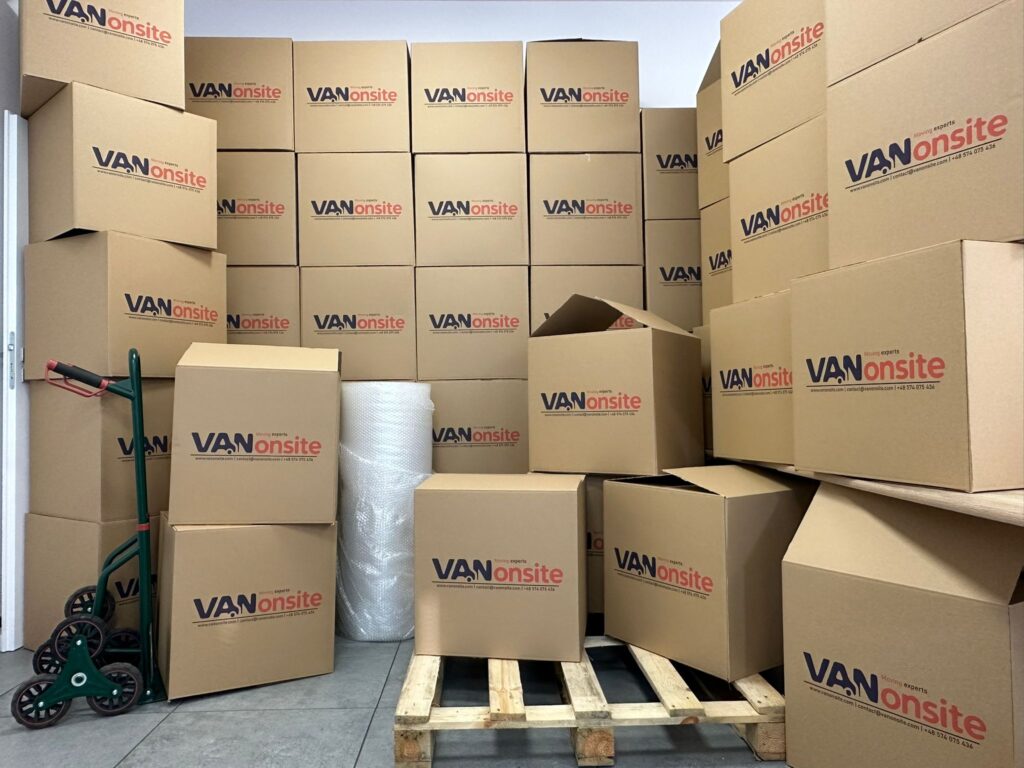
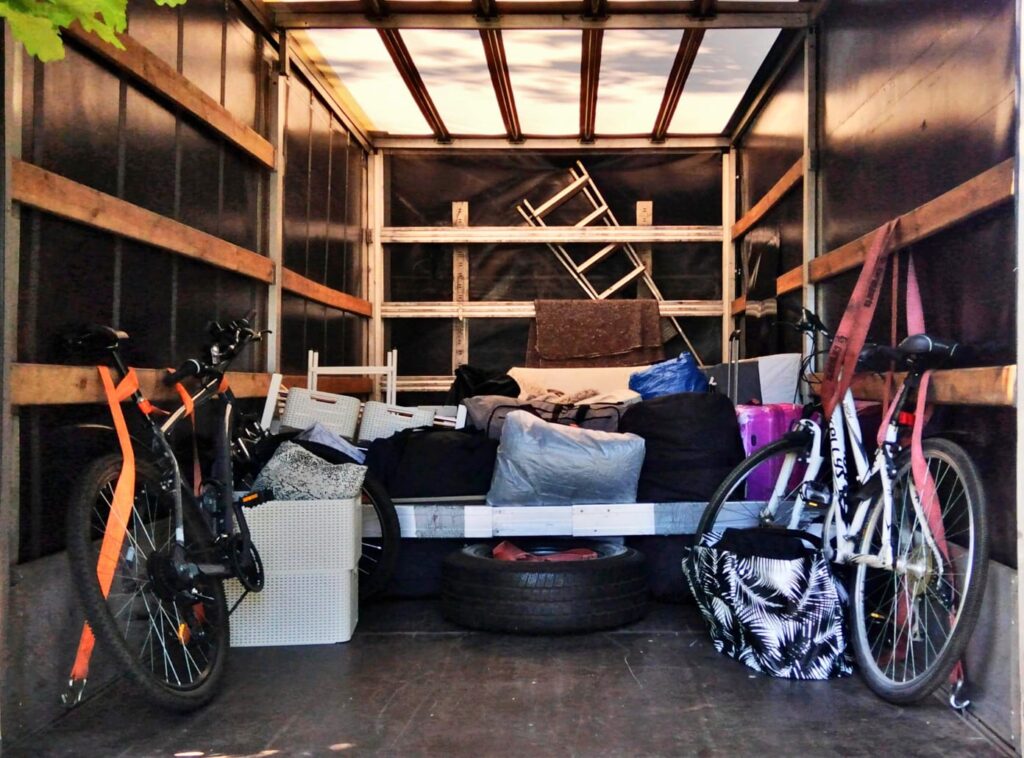
A minimal studio may fit into 5m3 to 10m3. A furnished one-bedroom apartment may need 10m3 to 15m3. A family home can require 30m3 or more. Books, tools, office equipment and kitchenware can be heavier than expected, so weight matters as much as volume.

Step 9: Pack for the First 72 Hours
When you arrive in Switzerland, you may need to register, collect keys, arrange insurance, set up phone service and handle work calls quickly. Pack one essentials bag that never enters the moving load.
Include:
- Passport or ID.
- Lease agreement.
- Work documents.
- Health insurance papers.
- Customs documents.
- Chargers.
- Medication.
- Laptop.
- Toiletries.
- Warm clothing.
- Payment cards.
- Pet documents if needed.
If you work remotely, protect your home office setup. Laptop, monitor, adapter, headset and key documents should be easy to reach. For living in Switzerland working abroad, your workspace is not optional. It is your income base.
VANonsite Packing Service can help protect fragile and valuable items, while White Glove Delivery is useful for premium furniture, artwork, delicate equipment and items that need careful placement.
Step 10: Plan Pets, Vehicles and Special Items
Pets and vehicles are not ordinary luggage. They need separate checks before moving.
For dogs, cats and ferrets, review microchip, vaccination and documentation rules before travel. Official information is available here: Travelling with dogs, cats and ferrets
If you import a car, check customs, insurance, registration and driving licence rules. In large cities such as Zurich, Geneva and Basel, public transport may be enough. In villages or mountain areas, a car may be more practical.
Official driving licence information: Exchanging your driving licence
Special items may also need care. This includes antiques, artwork, musical instruments, business equipment, bicycles, sports gear and large office furniture. If an item is expensive, delicate or difficult to replace, tell your mover before pickup.
Step 11: Build a Realistic Moving Timeline
A calm relocation is built in stages. Do not try to solve everything in one week.
8 to 6 weeks before moving
Choose your canton and city. Confirm your work arrangement abroad. Check permit requirements. Speak with a tax adviser. Estimate your moving volume and request a quote.
6 to 4 weeks before moving
Book your man and van or larger removals service. Prepare your inventory. Gather official documents. Review health insurance options. Start selling or donating items you will not take.
4 to 2 weeks before moving
Confirm Swiss accommodation. Arrange building access and parking. Prepare customs paperwork. Label boxes by room. Photograph valuable items. Confirm whether you need storage.
Moving week
Keep essential documents with you. Check pickup and delivery details. Stay reachable. Track your load and prepare for arrival.
First month in Switzerland
Register locally. Finalise health insurance. Set up bank, phone and internet. Confirm tax and social security steps. Update your employer with your Swiss address.
How VANonsite Supports Moves to Switzerland
A relocation to Switzerland already includes enough pressure. You should not also be worried about where your belongings are, whether furniture is safe or whether the van is suitable.
VANonsite helps with secure European removals, GPS tracking for every load and flexible vehicle options. The service can support small man and van moves, full home removals, furniture transport, student removals, office removals, packing, storage and premium White Glove Delivery.
This is especially helpful when your move has moving parts: foreign employment, Swiss registration, customs paperwork and a new home that may not be ready on the exact delivery day.
VANonsite services include:
- Last Minute Moving.
- Furniture Removals.
- Home Removals.
- Packing Service.
- White Glove Delivery.
- Office Removals.
- Storage.
- Student Removals.
- Office Furniture Installation.
Whether you are moving a few boxes, a home office, a full apartment or a family household, the right transport plan makes the move feel sharper, safer and more controlled.
Common Mistakes to Avoid
Living in Switzerland working abroad can be rewarding, but several mistakes can create costly friction.
Avoid:
- Assuming remote work is automatically allowed.
- Ignoring tax residence.
- Forgetting social security.
- Missing commune registration.
- Leaving health insurance too late.
- Creating a weak customs inventory.
- Moving furniture without measuring the new home.
- Packing documents inside boxes.
- Forgetting pet or vehicle rules.
- Choosing transport based only on the lowest price.
The cheapest move is not always the best value. Delays, damage, poor communication and missing paperwork can cost far more than a professional service.
FAQ
Can I live in Switzerland and work abroad?
Yes. Living in Switzerland working abroad is possible, but you need to check residence, tax, social security, payroll and health insurance rules before moving.
Can I work remotely for a foreign company from Switzerland?
Often yes, but it depends on your nationality, employer, contract and work pattern. Remote work from Switzerland can affect tax, payroll and social security.
Is living in Switzerland but working abroad expensive?
It can be. Switzerland has high rent, insurance and service costs. However, many people value the safety, infrastructure, salaries and quality of life. Build a realistic budget before signing a lease.
Do I need Swiss health insurance?
Most residents need compulsory Swiss health insurance. Some special cases may involve exemptions, but you should verify this before arrival.
Can I import my furniture to Switzerland?
Yes, household goods can often be imported as removal goods if official conditions are met. You will usually need a detailed inventory and supporting documents.
Is a man and van service enough for Switzerland?
For small and medium moves, a man and van service can be ideal. It works well for students, professionals, compact apartments, partial moves and last minute relocations.
What is better: working abroad living in Switzerland or living and working in Switzerland?
Working abroad living in Switzerland gives international flexibility. Living and working in Switzerland may be simpler for payroll, taxes, social security and long-term integration. The better option depends on your job, family and legal situation.
Final Thoughts
Living in Switzerland working abroad can give you a remarkable lifestyle: Swiss stability, European access and global career freedom in one place. Yet the move must be planned with precision. Residence, tax, insurance, social security, customs and transport all need a clear answer.
Prepare early. Build a strong document folder. Check official rules. Measure your furniture. Create a detailed inventory. Choose a moving partner that understands European relocations and treats your belongings with care.
VANonsite makes removals to Switzerland safer and simpler with GPS tracking, flexible vehicle sizes, man and van options, packing services, storage and professional support for homes, students, furniture and offices.
If Switzerland is your next chapter, make the first step calm, secure and beautifully organised.
Start here: VANonsite removals to Switzerland.