
Moving household goods to Switzerland is exciting, but it can also feel like standing at the edge of a very precise machine. Switzerland is organised, punctual and careful about rules. That is part of what makes it such an attractive place to live. It also means your move needs more than enthusiasm, boxes and a rented van.
The good news is simple. With the right paperwork, a clear inventory and a reliable European removals partner, moving household goods to Switzerland can be calm, fast and well controlled. The process becomes much easier when you understand what customs expects, how to choose the right vehicle size and how to protect your belongings during the journey.
VANonsite helps people move across Europe with secure transport, flexible vehicle sizes and GPS tracking for every load. Whether you need a compact man and van move, careful furniture removals, professional packing, storage, White Glove Delivery or a full home relocation, VANonsite gives you practical support from collection to delivery.
For customers planning removals to Switzerland, this guide explains the full process: documents, customs rules, vehicle sizes, costs, packing, timing and common mistakes to avoid.
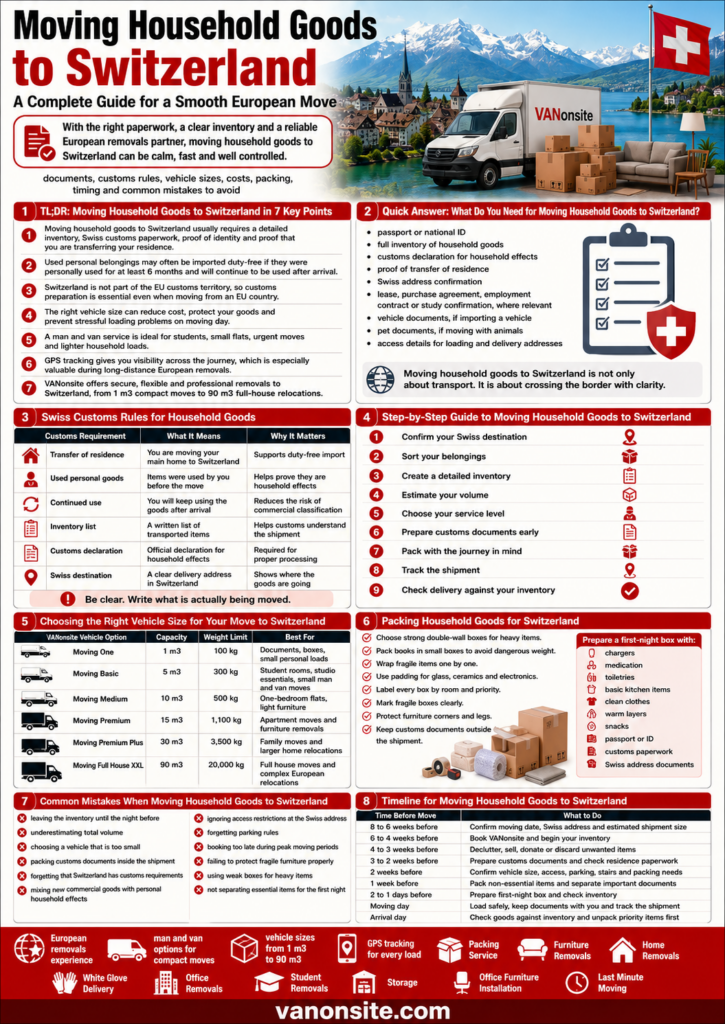
TL;DR: Moving Household Goods to Switzerland in 7 Key Points
- Moving household goods to Switzerland usually requires a detailed inventory, Swiss customs paperwork, proof of identity and proof that you are transferring your residence.
- Used personal belongings may often be imported duty-free if they were personally used for at least 6 months and will continue to be used after arrival.
- Switzerland is not part of the EU customs territory, so customs preparation is essential even when moving from an EU country.
- The right vehicle size can reduce cost, protect your goods and prevent stressful loading problems on moving day.
- A man and van service is ideal for students, small flats, urgent moves and lighter household loads.
- GPS tracking gives you visibility across the journey, which is especially valuable during long-distance European removals.
- VANonsite offers secure, flexible and professional removals to Switzerland, from 1 m3 compact moves to 90 m3 full-house relocations.




Quick Answer: What Do You Need for Moving Household Goods to Switzerland?
For moving household goods to Switzerland, you usually need a full inventory list, the Swiss customs declaration for household effects, proof of identity and documents showing that you are genuinely transferring your residence to Switzerland. Depending on your situation, you may also need a lease agreement, employment contract, study confirmation, residence permit information or other documents linked to your new Swiss address.
Most used personal household goods can often be imported duty-free if they are part of a genuine relocation. In general, the goods should have been used by you personally for at least 6 months before import and should continue to be used by you after arrival in Switzerland.
In practical terms, prepare:
- passport or national ID
- full inventory of household goods
- customs declaration for household effects
- proof of transfer of residence
- Swiss address confirmation
- lease, purchase agreement, employment contract or study confirmation, where relevant
- vehicle documents, if importing a vehicle
- pet documents, if moving with animals
- access details for loading and delivery addresses
Moving household goods to Switzerland is not only about transport. It is about crossing the border with clarity. The better your documents and inventory are, the smoother the journey usually feels.
Why Moving Household Goods to Switzerland Needs Careful Planning
Switzerland is close to many European countries, but customs-wise it is different. If you are moving from Germany, France, Italy, Belgium, the Netherlands, Poland, Austria or another European country, the border still matters. Your furniture, boxes and personal effects need to be declared correctly.
This is where many people get caught out. They assume that because the journey looks simple on the map, the process will be simple at the border. Sometimes it is. Sometimes one missing document, one vague inventory or one overloaded vehicle can cause frustrating delays.
A strong relocation plan protects you from that.
Before moving household goods to Switzerland, you should know:
- what you are taking
- how much space it will need
- whether the goods qualify as household effects
- which documents must stay with you
- which vehicle size is suitable
- whether you need packing support
- whether storage may be useful
- how delivery access works at your Swiss address
VANonsite helps make these decisions easier. Instead of guessing whether your move needs a small man and van service, a medium vehicle or a full-house solution, you can match the load to the right capacity. That means fewer surprises and a more confident moving day.
Swiss Customs Rules for Household Goods
Customs is one of the most important parts of moving household goods to Switzerland. Your furniture, clothing, books, kitchenware, appliances, personal items, bicycles and other household effects may qualify for duty-free import when they are part of a genuine transfer of residence.
The main idea is simple. You are not importing commercial goods for resale. You are moving your personal life from one country to another.
According to the Swiss Federal Office for Customs and Border Security, transferring your domicile to Switzerland is the most important condition for importing household effects duty-free. The goods should generally have been used personally for at least 6 months before import and should continue to be used after arrival.
Official information is available here:
- Swiss Federal Office for Customs and Border Security: Moving household effects
- ch.ch: Moving to Switzerland
| Customs Requirement | What It Means | Why It Matters |
|---|---|---|
| Transfer of residence | You are moving your main home to Switzerland | Supports duty-free import |
| Used personal goods | Items were used by you before the move | Helps prove they are household effects |
| Continued use | You will keep using the goods after arrival | Reduces the risk of commercial classification |
| Inventory list | A written list of transported items | Helps customs understand the shipment |
| Customs declaration | Official declaration for household effects | Required for proper processing |
| Swiss destination | A clear delivery address in Switzerland | Shows where the goods are going |
This is why a careful inventory matters. Do not write “various items” or “many boxes” and hope for the best. Be clear. Write what is actually being moved. Customs officers need to understand the shipment quickly, and your moving company needs accurate information to plan the vehicle and loading process.
Documents Needed for Moving Household Goods to Switzerland
Documents are the backbone of a Swiss move. Without them, even a beautifully packed shipment can become stuck in uncertainty. With them, the process feels sharper and less stressful.
For moving household goods to Switzerland, prepare the following:
- passport or national ID
- completed Swiss customs form for household effects
- detailed inventory list
- proof of transfer of residence to Switzerland
- Swiss lease agreement, property purchase document or address confirmation
- employment contract, study confirmation or residence-related documents, where relevant
- deregistration confirmation from your previous country, if available
- vehicle documents, if importing a car, motorcycle or other vehicle
- pet passport or animal documents, if relocating with pets
Swiss customs may refer to the household effects declaration form as Form 18.44. Requirements can depend on your situation, so always check the latest official guidance before moving.
For residence and work information, especially for EU and EFTA citizens, check the Swiss State Secretariat for Migration:
State Secretariat for Migration: EU/EFTA citizens living and working in Switzerland
One practical rule is worth remembering: keep your documents with you, not inside the moving load. Do not pack your passport, customs form or lease agreement into a sealed box. Keep printed and digital copies available during the journey.
A moving company cannot replace customs authorities, but it can make the transport side much cleaner. VANonsite helps customers organise the move around the real load, route and vehicle requirements, reducing the chaos that often creates last-minute pressure.
Step-by-Step Guide to Moving Household Goods to Switzerland
A successful move is not built in one frantic evening. It is built through clear, controlled steps.
1. Confirm your Swiss destination
Start with the exact delivery address. Switzerland has dense city centres, narrow mountain roads, apartment buildings with access rules and strict parking conditions in some areas. A move to central Zurich is not the same as a move to a village in Valais or a lakeside property near Geneva.
Share the full address, floor level, lift availability and parking details before moving day. These details influence timing, vehicle choice and loading strategy.
2. Sort your belongings
Before moving household goods to Switzerland, divide your items into categories:
- essentials
- furniture
- fragile items
- electronics
- clothing
- kitchen goods
- documents
- valuables
- items for storage
- items to sell, donate or discard
This is a powerful moment. Every unnecessary item takes space. Every unused chair, duplicate appliance or forgotten box adds weight and cost. Decluttering before the move can reduce volume by 10% to 30% in many households, especially when wardrobes, storage rooms and garages are included.
3. Create a detailed inventory
Your inventory should be simple, clear and honest. Customs does not need decorative writing. It needs accuracy.
Instead of writing “home items,” write:
- 1 sofa
- 1 dining table
- 6 chairs
- 12 kitchen boxes
- 8 clothing boxes
- 2 bicycles
- 1 mattress
- 1 desk
- 1 television
- 1 washing machine
A good inventory also helps the removals team choose the right vehicle and prepare for fragile, bulky or heavy items.
4. Estimate your volume
Volume is measured in cubic metres. It affects vehicle choice, loading time and price. Guessing too low can cause a painful surprise on moving day. Guessing too high may mean paying for capacity you do not need.
If you are unsure, VANonsite can help match your shipment to the right option, from a compact man and van move to a large full-house vehicle.
5. Choose your service level
Not every move needs the same service. A student moving 10 boxes and a bicycle needs a different solution than a family moving a four-bedroom home. A business relocating office furniture needs a different plan again.
VANonsite offers:
- Last Minute Moving
- Furniture Removals
- Home Removals
- Packing Service
- White Glove Delivery
- Office Removals
- Storage
- Student Removals
- Office Furniture Installation
The value is in choosing only what you need, while still having access to premium support when the move demands it.
6. Prepare customs documents early
Do not leave documents until the night before loading. Customs preparation should happen before the van arrives. Check your forms, inventory, proof of residence transfer and Swiss address details in advance.
This helps avoid a familiar moving-day nightmare: people standing beside a loaded van, searching through emails, boxes and drawers for paperwork that should have been ready days earlier.
7. Pack with the journey in mind
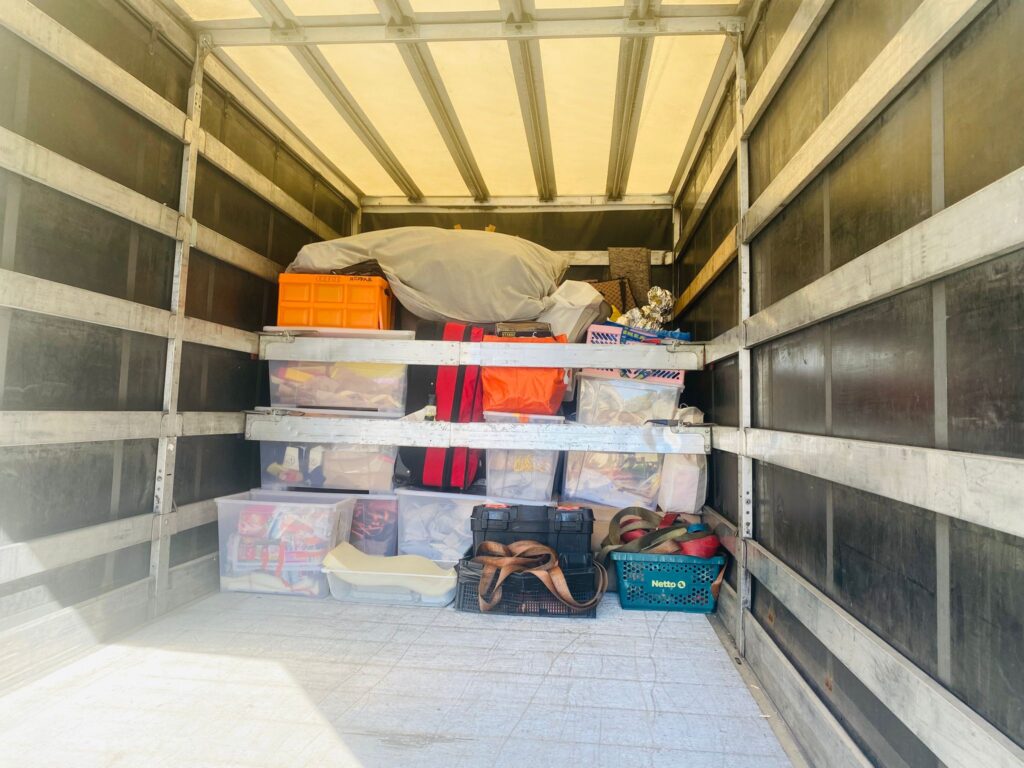
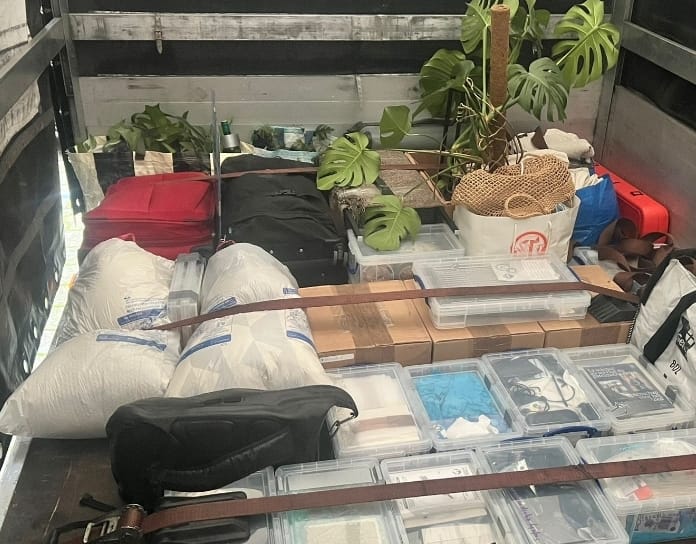
Moving household goods to Switzerland often means a long road journey across several regions and possibly several countries. Boxes need to be strong. Furniture needs protection. Fragile items need padding. Important documents need to stay with you.
Packing is not just about fitting things into boxes. It is about helping them arrive safely.
8. Track the shipment
GPS tracking gives you visibility. This matters when your belongings are travelling across Europe and you are trying to coordinate arrival, keys, landlord access, building rules or family travel.
With VANonsite, every load can be GPS tracked. That visibility can turn nervous waiting into calm planning.
9. Check delivery against your inventory
Once your goods arrive in Switzerland, use your inventory to check the delivery. Start with essential items, fragile boxes, furniture and valuables. A clear list makes this faster and more reliable.
Choosing the Right Vehicle Size for Your Move to Switzerland
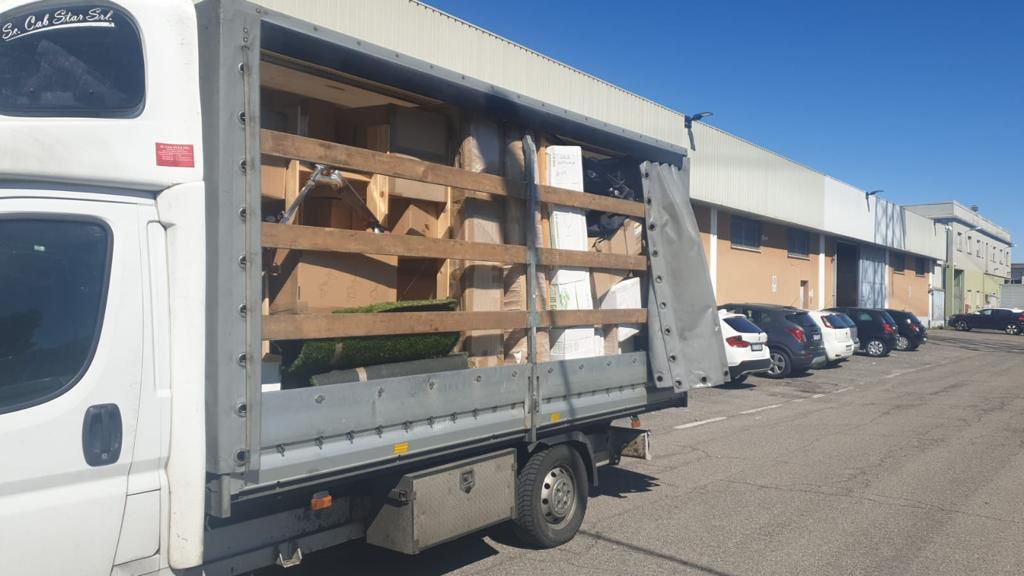
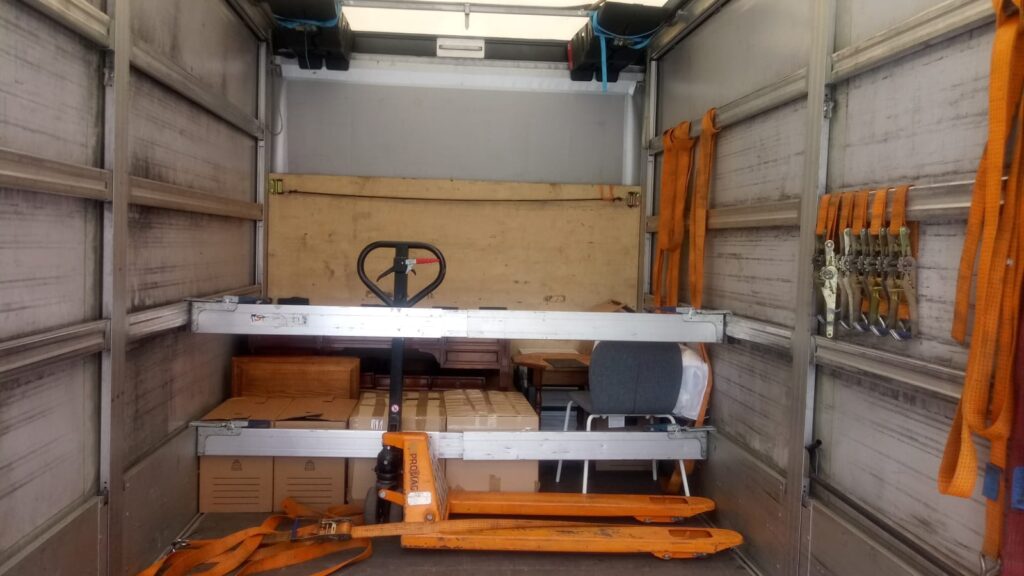
Choosing the right vehicle is one of the most important decisions when moving household goods to Switzerland. It affects cost, loading time, safety and delivery efficiency.
Too small, and you may face extra trips, overloaded space or urgent replanning. Too large, and you may pay for room you never needed. A well-matched vehicle gives the move breathing space without waste.
| VANonsite Vehicle Option | Capacity | Weight Limit | Best For |
|---|---|---|---|
| Moving One | 1 m3 | 100 kg | Documents, boxes, small personal loads |
| Moving Basic | 5 m3 | 300 kg | Student rooms, studio essentials, small man and van moves |
| Moving Medium | 10 m3 | 500 kg | One-bedroom flats, light furniture |
| Moving Premium | 15 m3 | 1,100 kg | Apartment moves and furniture removals |
| Moving Premium Plus | 30 m3 | 3,500 kg | Family moves and larger home relocations |
| Moving Full House XXL | 90 m3 | 20,000 kg | Full house moves and complex European relocations |
A 1 m3 option can work for a very small shipment, such as personal boxes or documents. A 5 m3 man and van service is useful for students, studio flats and compact city moves. A 10 m3 or 15 m3 vehicle may suit a one-bedroom flat or light apartment relocation. Families often need 30 m3 or more, especially when moving sofas, beds, wardrobes, kitchen items and children’s belongings.
The 90 m3 Moving Full House XXL option is designed for serious capacity. It is suitable when moving a full household or a complex relocation with large furniture, many boxes and heavy items.
How Much Does Moving Household Goods to Switzerland Cost?
The cost of moving household goods to Switzerland depends on the size, distance, timing and complexity of the move. A fair quote needs real details. Fixed guesses can be misleading because every relocation has its own shape.
The main cost factors include:
- pickup location
- delivery location in Switzerland
- distance and route
- total volume in m3
- total weight
- vehicle size
- packing needs
- fragile or high-value items
- stairs, lifts and access restrictions
- parking availability
- storage needs
- urgency of the move
- delivery speed
| Cost Factor | Impact on Price | How to Control It |
|---|---|---|
| Volume | Larger loads need larger vehicles | Declutter before packing |
| Distance | Longer routes increase travel time | Book early and plan efficiently |
| Weight | Heavy goods affect vehicle choice | List furniture and appliances accurately |
| Packing | Professional packing adds service cost | Use it where protection matters most |
| Access | Stairs and parking issues slow loading | Share access details before booking |
| Urgency | Last-minute moves may cost more | Reserve early when possible |
A small man and van move may be efficient and cost-effective for light loads. A full family relocation needs more vehicle space, more planning and often more careful packing. The best price is not always the lowest number. It is the price that protects your goods, fits your schedule and avoids costly problems.
VANonsite helps by matching the service to the real shipment. That means you are not forced into a one-size-fits-all solution. You can choose a compact, practical option or a larger premium service depending on your needs.
Packing Household Goods for Switzerland
Packing is where many moves are won or lost. A weak box, loose mirror, unprotected table corner or tangled cable drawer can create frustration after arrival.
When moving household goods to Switzerland, pack for distance. Your belongings may travel hundreds or thousands of kilometres. They may pass through changing weather, long roads and several handling stages. Good packing is not cosmetic. It is protection.
Use these packing rules:
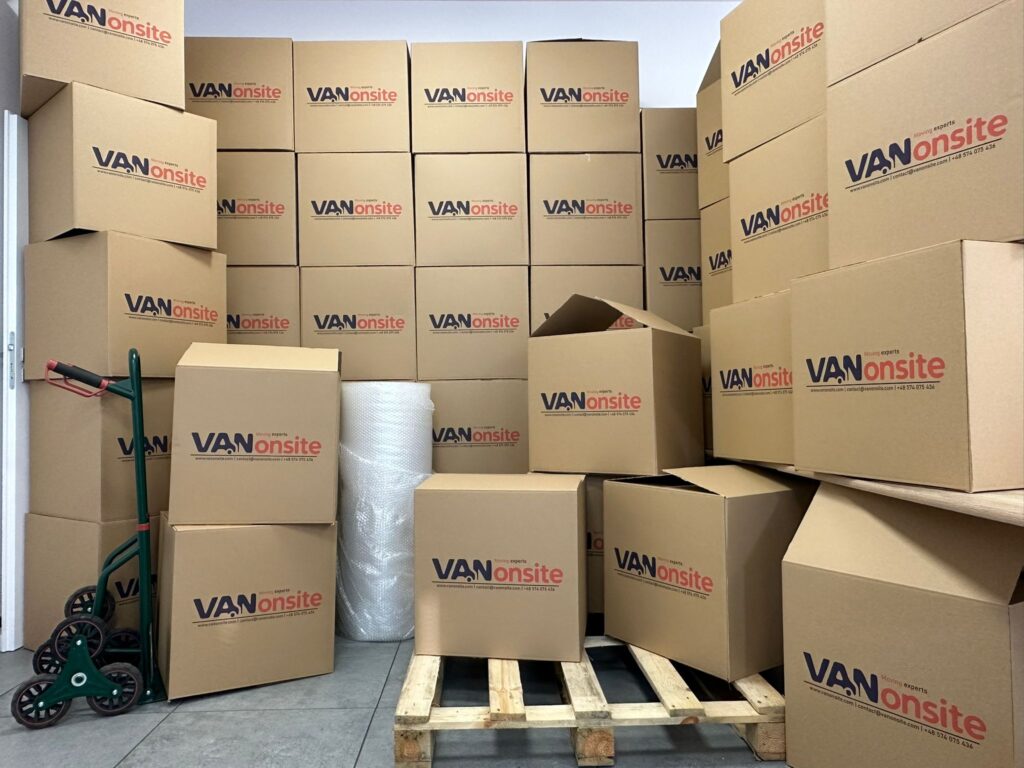
- Choose strong double-wall boxes for heavy items.
- Pack books in small boxes to avoid dangerous weight.
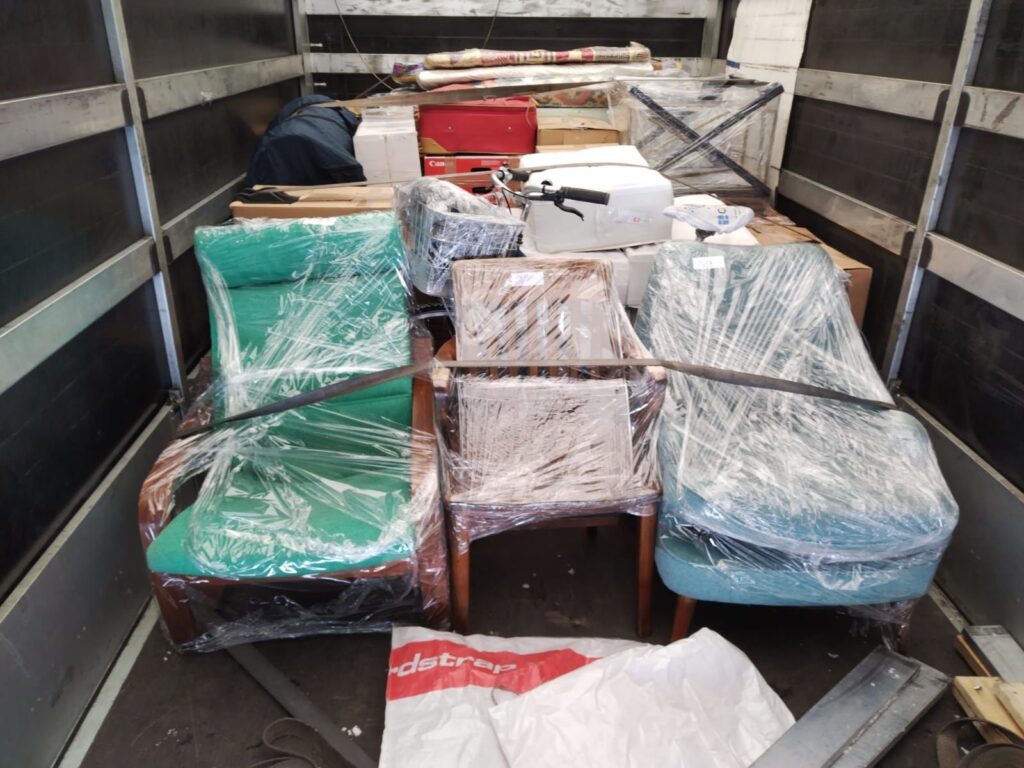
- Wrap fragile items one by one.
- Use padding for glass, ceramics and electronics.
- Label every box by room and priority.
- Mark fragile boxes clearly.
- Photograph electronics before disconnecting cables.
- Place screws and fittings in labelled bags.
- Protect furniture corners and legs.
- Keep customs documents outside the shipment.
Prepare a first-night box with:
- chargers
- medication
- toiletries
- basic kitchen items
- clean clothes
- warm layers
- snacks
- passport or ID
- customs paperwork
- Swiss address documents
This box is small, but it can save your evening. After a long moving day, nobody wants to search through 20 boxes for toothpaste, pyjamas or a phone charger.
If you do not want to pack everything yourself, VANonsite offers a Packing Service that helps protect fragile, bulky and valuable items before the journey begins.


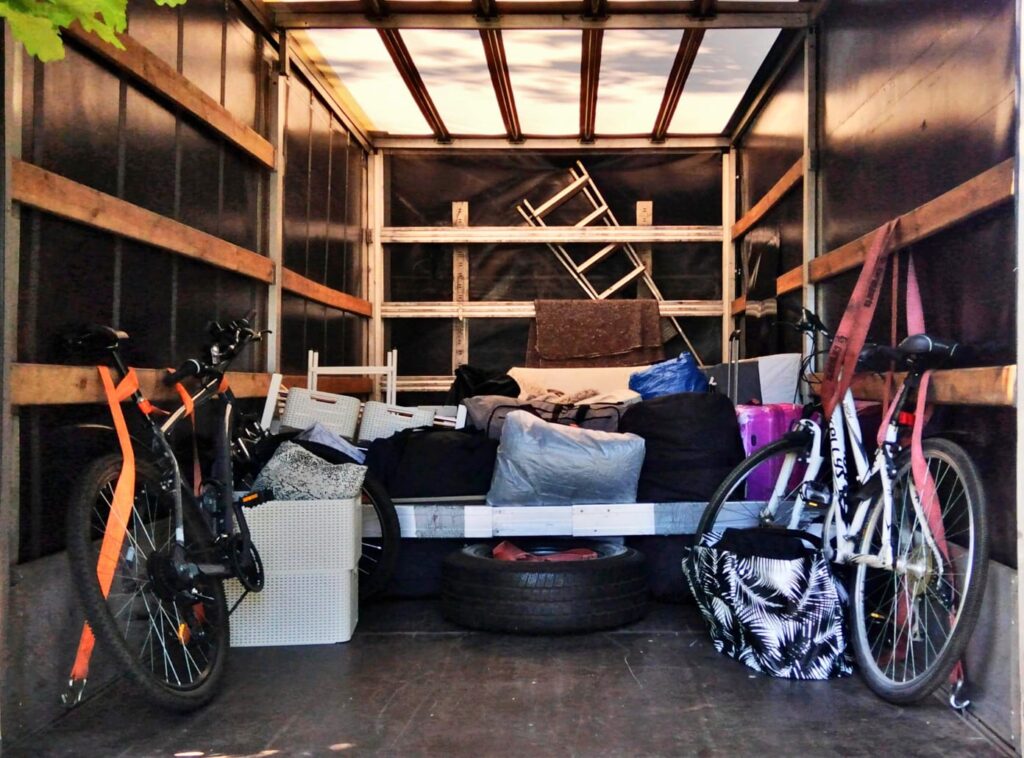
Furniture Removals and Fragile Items
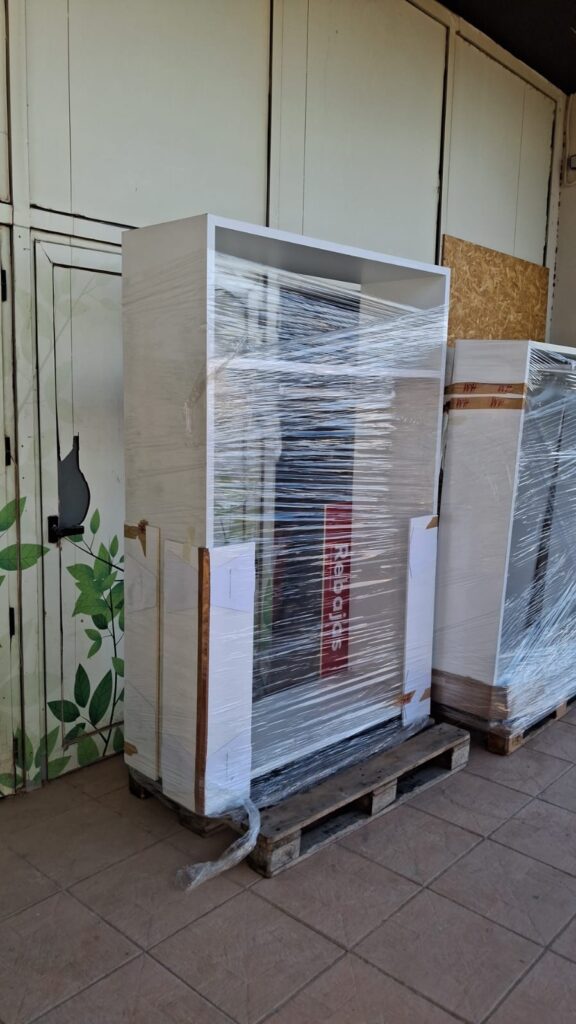
Furniture is often the most difficult part of moving household goods to Switzerland. It is bulky, awkward and easy to damage when handled carelessly. Sofas catch on staircases. Table legs scratch. Wardrobes need dismantling. Glass cabinets demand patience.
Common furniture items include:
- sofas
- dining tables
- chairs
- beds
- mattresses
- wardrobes
- cabinets
- desks
- shelving units
- mirrors
- appliances
For standard furniture, careful wrapping and secure loading are essential. For delicate or high-value pieces, a more premium approach may be needed.
VANonsite offers Furniture Removals and White Glove Delivery for items that need extra care. This can be valuable for designer furniture, artwork, antiques, marble tables, glass cabinets, expensive office furniture or fragile decorative pieces.
The goal is not only to move your belongings quickly. The goal is to move them with respect.
Moving to Switzerland as a Student
Student moves are often compact, emotional and time-sensitive. You may be moving to Zurich, Geneva, Lausanne, Basel, Bern, St. Gallen or another Swiss city with the essentials: clothes, books, bedding, a laptop, kitchen basics, study materials and maybe a bicycle.
For students, a man and van service can be a smart choice. It is lean, flexible and practical. You do not need a huge vehicle when your life fits into a few boxes and one small room.
Moving One or Moving Basic may suit many student removals. With 1 m3 to 5 m3 capacity, these options can work well for lighter shipments and budget-conscious moves.
Student moves still need proper customs awareness. Personal effects and study materials should be listed clearly. Keep your documents close and make sure the Swiss address is confirmed before transport.
Moving to Switzerland with a Family
Family moves carry more weight in every sense. There are more boxes, more furniture, more routines to protect and often more emotion. Children’s toys, kitchen equipment, wardrobes, beds, bikes, school materials and sentimental items all need to arrive safely.
For families, moving household goods to Switzerland is about order. The more structured the move, the calmer the first week feels.
Useful family moving tips include:
- Pack room by room.
- Use colour labels for each room.
- Keep children’s essentials separate.
- Prepare a first-week box, not only a first-night box.
- Use professional packing for fragile items.
- Measure large furniture before moving day.
- Check lift access and parking at both addresses.
- Choose a vehicle with enough capacity.
A family home often needs Moving Premium, Moving Premium Plus or Moving Full House XXL, depending on the total load. VANonsite can help choose the right vehicle so the move feels controlled rather than crowded.
Moving Office Goods to Switzerland
Office removals need speed, precision and low disruption. A delayed desk, missing chair or damaged monitor can slow down the first working day in a new location.
Office moves may include:
- desks
- office chairs
- filing cabinets
- meeting tables
- monitors
- IT equipment
- printers
- storage units
- reception furniture
- branded materials
For companies, the real cost is not only transport. It is downtime. That is why planning matters so much.
VANonsite supports Office Removals and Office Furniture Installation, helping businesses move workstations, furniture and equipment with less friction. GPS tracking also helps managers coordinate delivery times, building access and setup.
Storage When Moving to Switzerland
Sometimes the dates do not fit neatly. Your old lease may end before your new Swiss home is ready. Your furniture may arrive before you get the keys. Your company relocation may happen in stages. In these moments, storage can protect the entire plan.
Storage can help when:
- your delivery date changes
- your Swiss home is not ready
- you are downsizing
- you are moving in stages
- you need time to organise your new space
- your office move has several phases
- you are waiting for final access to the property
Storage gives you breathing room. Instead of rushing decisions or forcing delivery into a bad time slot, you can keep your belongings secure until the move is ready to continue.
GPS Tracking: Why Visibility Matters During a Switzerland Move
Long-distance moves can make people anxious because their belongings are out of sight. Your boxes, furniture and personal items are somewhere on the road, while you are trying to manage travel, keys, family, work and a new address.
GPS tracking changes that feeling.
With VANonsite, every load can be GPS tracked. This gives customers visibility during the journey and helps them prepare for delivery. It is especially useful when moving household goods to Switzerland because international routes can involve long distances, border processes and tight delivery windows.
GPS tracking is valuable when:
- you are moving valuable items
- your delivery window matters
- you are travelling separately from your goods
- your Swiss property has limited access times
- you need to coordinate with a landlord or building manager
- you are managing a family or office relocation
Visibility creates calm. During a move, calm is powerful.
Common Mistakes When Moving Household Goods to Switzerland
Most moving problems start small. A document is packed into a box. The van is too small. The inventory is vague. Nobody checked parking at the delivery address. Then one small issue becomes a stressful delay.
Avoid these mistakes:
- leaving the inventory until the night before
- underestimating total volume
- choosing a vehicle that is too small
- packing customs documents inside the shipment
- forgetting that Switzerland has customs requirements
- mixing new commercial goods with personal household effects
- ignoring access restrictions at the Swiss address
- forgetting parking rules
- booking too late during peak moving periods
- failing to protect fragile furniture properly
- using weak boxes for heavy items
- not separating essential items for the first night
The cure is preparation. Moving household goods to Switzerland becomes far easier when you treat the relocation as a planned project, not a last-minute emergency.
Timeline for Moving Household Goods to Switzerland
A timeline helps you stay in control. It also prevents rushed decisions, which are often the most expensive decisions.
| Time Before Move | What to Do |
|---|---|
| 8 to 6 weeks before | Confirm moving date, Swiss address and estimated shipment size |
| 6 to 4 weeks before | Book VANonsite and begin your inventory |
| 4 to 3 weeks before | Declutter, sell, donate or discard unwanted items |
| 3 to 2 weeks before | Prepare customs documents and check residence paperwork |
| 2 weeks before | Confirm vehicle size, access, parking, stairs and packing needs |
| 1 week before | Pack non-essential items and separate important documents |
| 2 to 1 days before | Prepare first-night box and check inventory |
| Moving day | Load safely, keep documents with you and track the shipment |
| Arrival day | Check goods against inventory and unpack priority items first |
Urgent moves can happen faster, but they need even sharper organisation. VANonsite offers Last Minute Moving for situations where plans change quickly and timing becomes critical.
Why Choose VANonsite for Moving Household Goods to Switzerland?
Moving household goods to Switzerland is not just a physical job. It is a trust job. You are handing over the objects that make your home feel like home: your bed, your books, your kitchen, your desk, your children’s things, your memories.
VANonsite is built for European removals that need speed, security and flexibility. The service combines practical transport options with premium care where it matters most.
VANonsite offers:
- European removals experience
- man and van options for compact moves
- vehicle sizes from 1 m3 to 90 m3
- GPS tracking for every load
- Packing Service
- Furniture Removals
- Home Removals
- White Glove Delivery
- Office Removals
- Student Removals
- Storage
- Office Furniture Installation
- Last Minute Moving
This flexibility matters because no two moves are the same. A student relocation needs agility. A family move needs space. A business move needs timing. A delicate furniture delivery needs care. VANonsite can shape the service around the actual move instead of forcing every customer into the same rigid package.
FAQ: Moving Household Goods to Switzerland
Can I move household goods to Switzerland duty-free?
Yes, many personal household goods can be imported duty-free when you transfer your residence to Switzerland and meet Swiss customs conditions. In general, the goods should have been used personally for at least 6 months and should continue to be used after import.
What documents do I need for moving household goods to Switzerland?
You usually need an inventory list, Swiss customs declaration for household effects, passport or ID, proof of transfer of residence and proof of your Swiss address. Depending on your situation, you may also need employment, study or residence-related documents.
Is Switzerland part of the EU customs territory?
No. Switzerland is not part of the EU customs territory. That is why customs preparation is important even when moving from an EU country.
Is a man and van service enough for a move to Switzerland?
A man and van service can be enough for small moves, student removals, studio flats and lighter household loads. For larger homes, furniture-heavy moves or family relocations, a bigger vehicle is usually more suitable.
What is the best vehicle size for moving household goods to Switzerland?
It depends on your total volume and weight. A very small shipment may fit into 1 m3. A small man and van move may need 5 m3. A one-bedroom flat may need around 10 m3. Larger family moves may need 30 m3 or more. VANonsite also offers a 90 m3 option for full-house relocations.
Can VANonsite help with last-minute moving to Switzerland?
Yes. VANonsite offers Last Minute Moving, subject to availability and route planning. This can be useful when relocation dates change suddenly or when you need fast European transport.
Can I track my goods during the move?
Yes. VANonsite offers GPS tracking for every load, giving you more visibility while your belongings travel across Europe.
Should I use professional packing for a Switzerland move?
Professional packing is recommended for fragile, valuable, bulky or awkward items. It can reduce damage risk and make loading more efficient.
Start Your Move to Switzerland with Confidence
Moving household goods to Switzerland should feel exciting, not overwhelming. Yes, documents matter. Yes, customs rules need attention. Yes, vehicle size, packing and timing can affect the entire experience. But with the right support, the process becomes clear and manageable.
VANonsite brings together secure transport, flexible vehicle sizes, GPS tracking and dependable man and van expertise. Whether you are moving a few boxes, a student room, a family apartment, office furniture or a full house, your belongings can travel with care, speed and visibility.
Start with the essentials: where you are moving from, where in Switzerland you are going and how much you need to transport. VANonsite can help match your relocation to the right service, so moving household goods to Switzerland becomes a controlled journey instead of a stressful leap.
Get your Switzerland moving quote today and move with confidence.