
Switzerland has a rare kind of magnetism. Clean trains. Quiet streets. Lakes that look polished by hand. Mountain towns where the air feels almost expensive. Add strong salaries, excellent public services, and a reputation for safety, and it is easy to understand why so many people ask how to live in Switzerland.
The short answer is yes, many foreigners can live in Switzerland. The longer answer is more precise. Your route depends on your nationality, job, income, family situation, study plans, and how long you want to stay. If you plan to stay for more than 3 months, you usually need the right residence permit. If you want to work, you need to follow Swiss employment and migration rules. If you settle there, you must also deal with registration, health insurance, housing, and customs.
That may sound strict, but it is manageable when you follow the right order. Switzerland rewards preparation. A clear plan can turn a nervous relocation into a controlled, confident move.
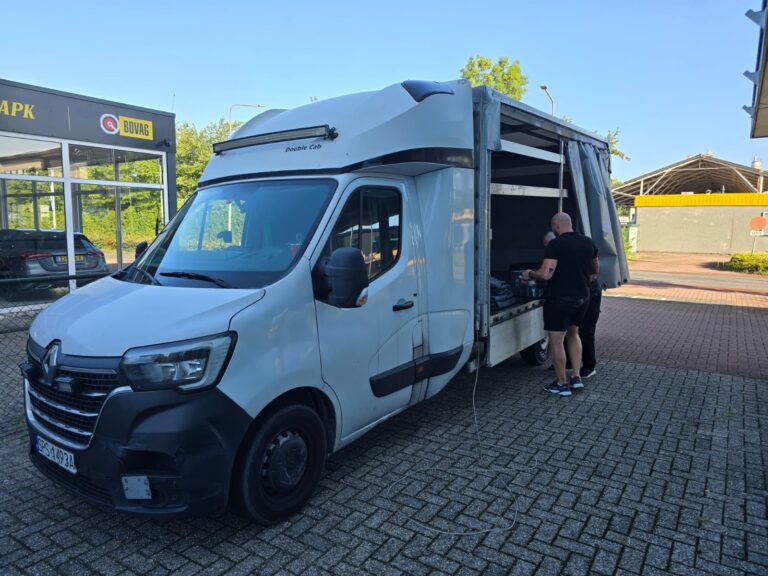
This guide explains how to live in Switzerland step by step, from permits and documents to costs, housing, health insurance, customs, and moving your belongings safely. When you are ready to move, VANonsite removals to Switzerland can support your relocation with secure man and van transport, GPS tracking, packing support, and flexible vehicle sizes for students, families, professionals, and businesses.
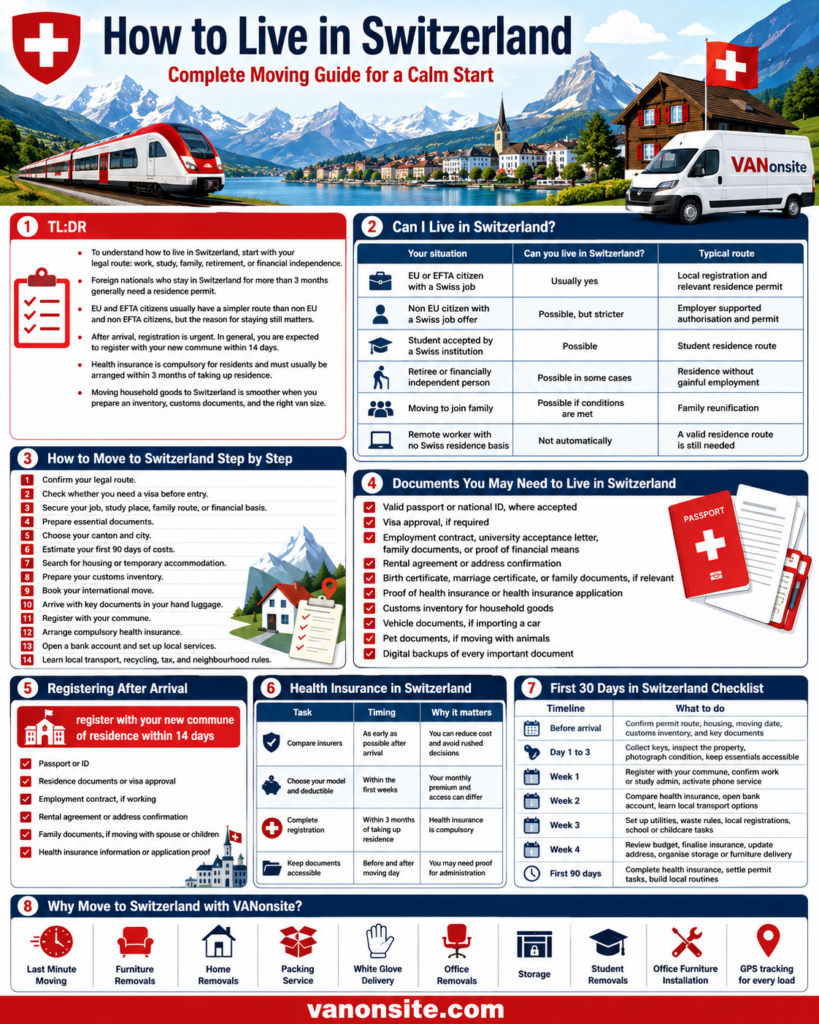
TL:DR
- To understand how to live in Switzerland, start with your legal route: work, study, family, retirement, or financial independence.
- Foreign nationals who stay in Switzerland for more than 3 months generally need a residence permit.
- EU and EFTA citizens usually have a simpler route than non EU and non EFTA citizens, but the reason for staying still matters.
- After arrival, registration is urgent. In general, you are expected to register with your new commune within 14 days.
- Health insurance is compulsory for residents and must usually be arranged within 3 months of taking up residence.
- Moving household goods to Switzerland is smoother when you prepare an inventory, customs documents, and the right van size.
- VANonsite offers secure man and van removals to Switzerland with GPS tracking, packing, storage, furniture removals, student removals, office removals, and white glove delivery.




Can I Live in Switzerland?
Yes, you can live in Switzerland if you meet the right conditions. The real question is not only “can I live in Switzerland?” but “which legal route fits my situation?”
Switzerland is not a country where you simply arrive, rent a flat, and sort everything out later. Your passport, purpose of stay, employment status, financial means, and intended length of stay all shape the process. If you want to know how to live in Switzerland without expensive mistakes, start with eligibility before you start packing.
| Your situation | Can you live in Switzerland? | Typical route |
|---|---|---|
| EU or EFTA citizen with a Swiss job | Usually yes | Local registration and relevant residence permit |
| Non EU citizen with a Swiss job offer | Possible, but stricter | Employer supported authorisation and permit |
| Student accepted by a Swiss institution | Possible | Student residence route |
| Retiree or financially independent person | Possible in some cases | Residence without gainful employment |
| Moving to join family | Possible if conditions are met | Family reunification |
| Remote worker with no Swiss residence basis | Not automatically | A valid residence route is still needed |
Before booking a man and van, make sure your permit route is realistic. Once that is clear, your timeline, moving budget, housing search, and transport plan become much easier to manage.
How to Live in Switzerland Legally
The legal side of how to live in Switzerland depends mainly on nationality and purpose of stay. Switzerland has different rules for EU and EFTA citizens, non EU and non EFTA citizens, workers, students, family members, retirees, and people with private means.
A short visit is not the same as living in Switzerland. If you want to settle, work, rent a home, register locally, and build everyday life there, you need to follow residence rules. Foreign nationals who plan to remain in Switzerland for more than 3 months generally need a permit.
EU and EFTA citizens usually have a more direct route because of free movement arrangements. Still, there are rules. Your permit depends on whether you are working, studying, joining family, or living without gainful employment. Employment length can also matter.
For non EU and non EFTA citizens, the process is usually stricter. Work permission may depend on employer sponsorship, quotas, qualifications, labour market conditions, and cantonal approval. That does not mean impossible. It means Switzerland expects strong documentation and a clear reason to stay.
How to Move to Switzerland Step by Step
The best way to learn how to live in Switzerland is to follow a sequence. A rushed move can become expensive very quickly, especially if paperwork, housing, and customs are handled in the wrong order.
- Confirm your legal route.
- Check whether you need a visa before entry.
- Secure your job, study place, family route, or financial basis.
- Prepare essential documents.
- Choose your canton and city.
- Estimate your first 90 days of costs.
- Search for housing or temporary accommodation.
- Prepare your customs inventory.
- Book your international move.
- Arrive with key documents in your hand luggage.
- Register with your commune.
- Arrange compulsory health insurance.
- Open a bank account and set up local services.
- Learn local transport, recycling, tax, and neighbourhood rules.
This order matters. If you book transport before confirming eligibility, you may create pressure before your paperwork is ready. If you leave housing too late, you may overpay for temporary accommodation. If you ignore customs preparation, your belongings can become a border problem.
VANonsite supports European moves to Switzerland with GPS tracked transport, secure handling, and vehicle options from 1m3 to 90m3. That means you can move a few student boxes, a compact apartment, premium furniture, or a full household without guessing what size you need.
Documents You May Need to Live in Switzerland
Documents are the skeleton key of Swiss relocation. If you want to know how to live in Switzerland smoothly, prepare your paperwork before leaving your current country.
You may need:
- Valid passport or national ID, where accepted
- Visa approval, if required
- Employment contract, university acceptance letter, family documents, or proof of financial means
- Rental agreement or address confirmation
- Birth certificate, marriage certificate, or family documents, if relevant
- Proof of health insurance or health insurance application
- Passport style photos, if requested locally
- Customs inventory for household goods
- Vehicle documents, if importing a car
- Pet documents, if moving with animals
- Copies of qualifications and professional licences, if relevant
- Digital backups of every important document
Keep your most important papers in your hand luggage. Do not pack your passport, permit documents, employment contract, rental confirmation, customs papers, or health documents into the moving load. When the van is already on the road, those papers should still be within reach.
A neat document folder can save hours of stress. Switzerland runs on proof, appointments, and accuracy. The more organised you are, the calmer your first weeks will feel.
Registering After Arrival
Registration is one of your first official tasks after moving. In general, you are expected to register with your new commune of residence within 14 days of your move. If you are coming to work, you should treat this as urgent because registration connects to your permit, local records, employment administration, and health insurance.
You may need to bring:
- Passport or ID
- Residence documents or visa approval
- Employment contract, if working
- Rental agreement or address confirmation
- Passport photos, if requested
- Family documents, if moving with spouse or children
- Health insurance information or application proof, where requested
Do not assume every canton or commune works in exactly the same way. Zurich, Geneva, Basel, Lausanne, Bern, Zug, and smaller towns can have different procedures and appointment systems. Check local requirements before arrival, then book your registration step early.
Health Insurance in Switzerland
Health insurance is compulsory for people resident in Switzerland. Anyone settling in Switzerland must usually take out health insurance within 3 months of taking up residence. Each family member needs individual cover, including children.
This is one of the most important points in any guide on how to live in Switzerland. Do not leave it until your third month becomes a blur of invoices, work stress, apartment problems, and half unpacked boxes.
Health insurance costs vary by canton, age, insurer, deductible, and insurance model. It can become one of your largest monthly expenses, so compare options early.
| Task | Timing | Why it matters |
|---|---|---|
| Compare insurers | Before or soon after arrival | Premiums vary |
| Choose basic compulsory insurance | Within 3 months | Required for residents |
| Keep proof of insurance | Always | Useful for admin and healthcare |
| Review deductible options | Before signing | Affects monthly cost and out of pocket payments |
| Insure each family member | Immediately | Adults and children need individual cover |
Switzerland offers strong access to medical care, but it is not cheap. Build health insurance into your first 90 day budget rather than treating it as a later detail.
How Much Money Do You Need to Live in Switzerland?
Switzerland is beautiful, safe, efficient, and expensive. That mix can feel thrilling in week one and brutal in month two if your budget is too optimistic.
There is no single number that fits everyone. Costs vary by canton, city, household size, lifestyle, and housing standard. Still, the first 90 days often bring several heavy expenses at once.
Plan for:
- Housing deposit
- First rent payment
- Temporary accommodation, if needed
- Health insurance premiums
- Food and household essentials
- Local transport
- Permit and registration fees
- Moving costs
- Customs related costs, if applicable
- Furniture, appliances, or setup items
- Emergency buffer
A sensible emergency buffer is at least 2 to 3 months of essential expenses. That gives you breathing room if your apartment search takes longer, your first salary arrives later, or you need to buy items you did not expect.
| Cost category | Planning note |
|---|---|
| Housing | Often the largest monthly cost |
| Deposit | Prepare a serious upfront cash buffer |
| Health insurance | Mandatory and recurring |
| Groceries | Usually higher than in many European countries |
| Public transport | Excellent, but should be budgeted |
| Moving service | Depends on volume, access, distance, and urgency |
| Furniture | Can be costly to replace locally |
| Emergency fund | Protects your first 90 days |
A precise moving quote helps protect your budget. A vague transport price can quickly turn into a nasty surprise. VANonsite offers clear vehicle options, so you can match your move to your real volume rather than paying for space you do not need.
Where Should You Live in Switzerland?
Choosing where to live in Switzerland is not only about scenery. Almost everywhere is beautiful. The real question is what kind of life you want and what you can afford.
| City or region | Best for | Watch out for |
|---|---|---|
| Zurich | Finance, tech, careers, international life | High rent and competition |
| Geneva | Diplomacy, NGOs, luxury, global companies | Expensive housing |
| Basel | Pharma, culture, cross border access | Language and commute planning |
| Lausanne | Students, lake lifestyle, French speaking life | Strong rental demand |
| Bern | Families, stability, central location | Slower rental rhythm |
| Zug | Business, tax appeal, premium lifestyle | Very high prices |
| Smaller towns | Space, calm, nature | Commute and language needs |
If your job is hybrid, compare commute time with rent. A 35 minute train ride can sometimes save a meaningful amount each month. If you have children, check schools and childcare early. If you do not speak German, French, or Italian, think carefully about how language will shape daily life.
Moving Your Belongings to Switzerland
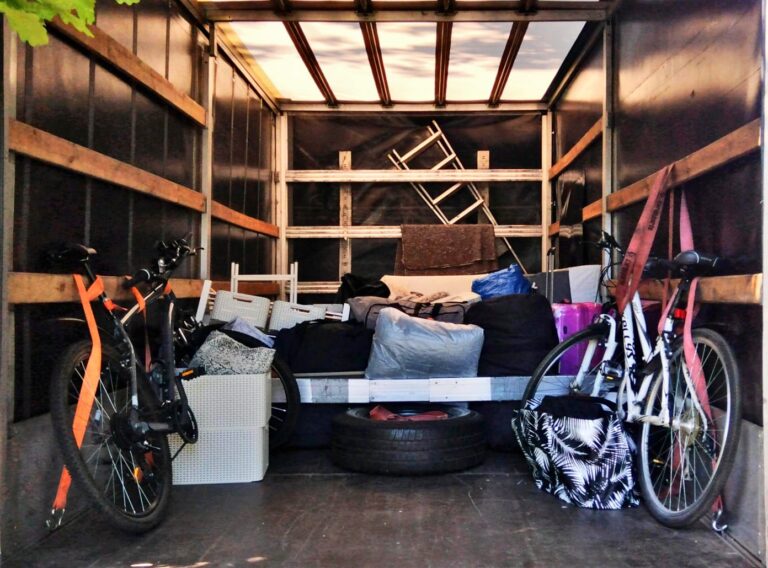
Learning how to live in Switzerland is not only paperwork. At some point, your actual life needs to arrive: clothes, books, chairs, bikes, cookware, office equipment, family photos, musical instruments, children’s toys, and the familiar objects that make a new place feel like home.
Before you move, divide everything into 3 categories:
- Must move: valuable, important, sentimental, or hard to replace.
- Maybe move: useful, but only if space and budget allow.
- Do not move: cheap, bulky, worn out, or easier to replace.
Moving to Switzerland can be expensive, but replacing everything there can also hurt. Quality furniture, ergonomic office chairs, baby equipment, specialist tools, and treasured personal items may be worth transporting.
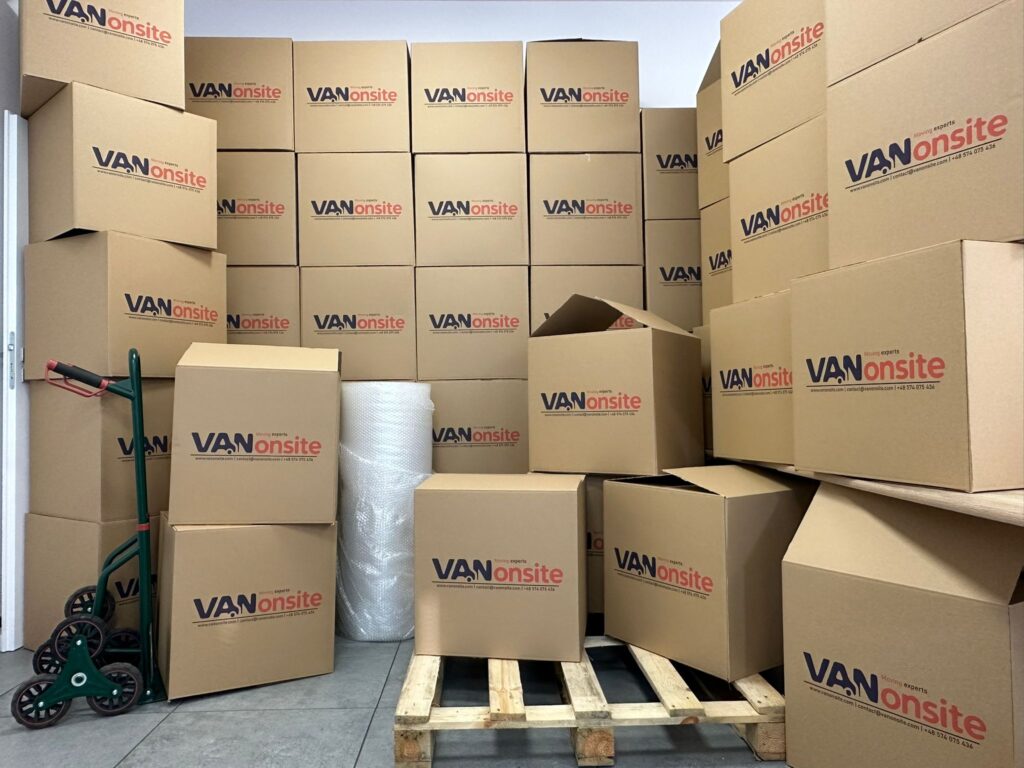
VANonsite offers flexible vehicle sizes for different relocation needs.
| VANonsite option | Capacity | Weight limit | Best for |
|---|---|---|---|
| Moving One | 1m3 | 100kg | Boxes, suitcases, student essentials |
| Moving Basic | 5m3 | 300kg | Compact studio or small man and van move |
| Moving Medium | 10m3 | 500kg | Small apartment, boxes, selected furniture |
| Moving Premium | 15m3 | 1100kg | Larger flat or partial home move |
| Moving Premium Plus | 30m3 | 3500kg | Family relocation with furniture |
| Moving Full House XXL | 90m3 | 20000kg | Full household or large international move |
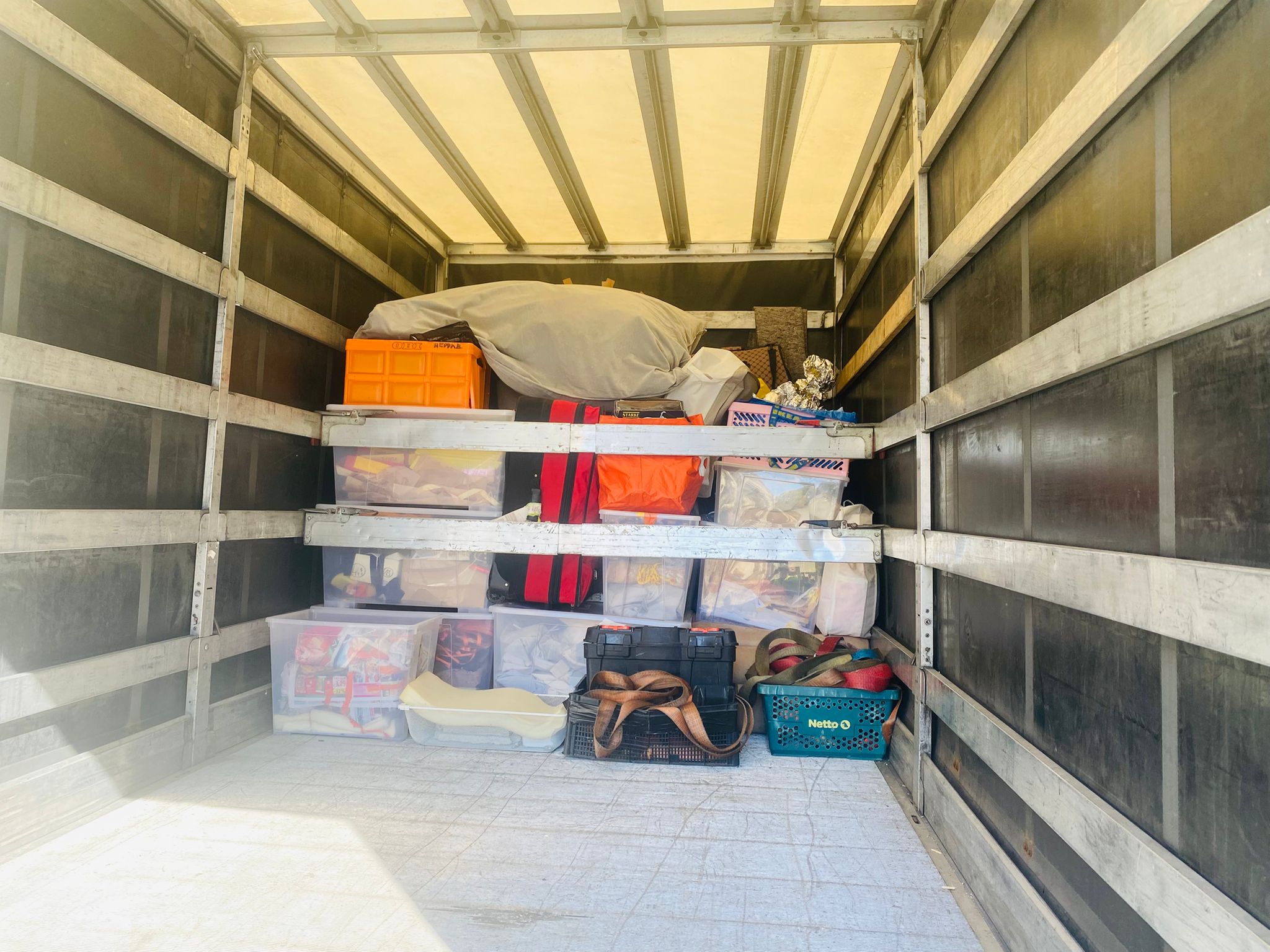
The right size can reduce waste, protect your belongings, and keep your budget under control. A student moving to Lausanne may only need 1m3 or 5m3. A couple moving to Zurich with furniture may need 10m3 or 15m3. A family relocating a full home may need 30m3 or more.
With VANonsite GPS tracking, you are not left wondering where your load is. That visibility matters when your belongings are crossing countries, customs points, and tight delivery windows.
Customs Rules When Moving Household Goods to Switzerland
Customs can feel intimidating, but it becomes manageable when you prepare early. If you are transferring residence to Switzerland, used household effects may be imported without fees when conditions are met. You should prepare a clear inventory and keep proof that the goods are personal, used, and connected to your move.
A practical customs checklist:
- Create a room by room inventory.
- List furniture, boxes, electronics, bikes, tools, and special items.
- Keep ownership proof for valuable goods where possible.
- Label boxes clearly.
- Photograph fragile or high value items.
- Keep passports, permits, rental papers, and customs documents with you.
- Check special rules for alcohol, food, vehicles, pets, and commercial goods.
- Share the inventory with your moving provider before collection.
This is where professional removals support becomes more than convenience. A good moving partner helps you avoid confusion before the van is loaded, not after it reaches the border.
Renting a Home in Switzerland
Housing is often the hardest emotional part of learning how to live in Switzerland. The rental market can be competitive, especially in Zurich, Geneva, Basel, Lausanne, Zug, and other high demand locations.
A strong rental application can help you stand out. Prepare your passport or ID, residence permit or application evidence, employment contract, salary confirmation, references, and a short personal introduction. Some landlords may also ask for local documents, depending on the canton and situation.
Temporary housing can be a smart first step. It gives you time to visit apartments in person, understand neighbourhoods, and avoid signing a poor lease from abroad.
When viewing a property, check more than the pretty parts. Look at storage, laundry rules, heating, noise, access, lift size, parking, bike storage, public transport, and delivery restrictions. For furniture moves, ask about move in slots and building access before delivery day.

Working, Studying, or Living Without Work
Work is one of the most common routes for people who want to live in Switzerland. Salaries can be attractive, but the system is rule driven. Most foreign nationals need a permit to work. The procedure depends on nationality and type of employment.
If you are moving for a job, confirm whether your employer supports the permit process, when you are allowed to start work, which canton handles your case, whether your contract length affects permit type, and whether your qualifications need recognition.
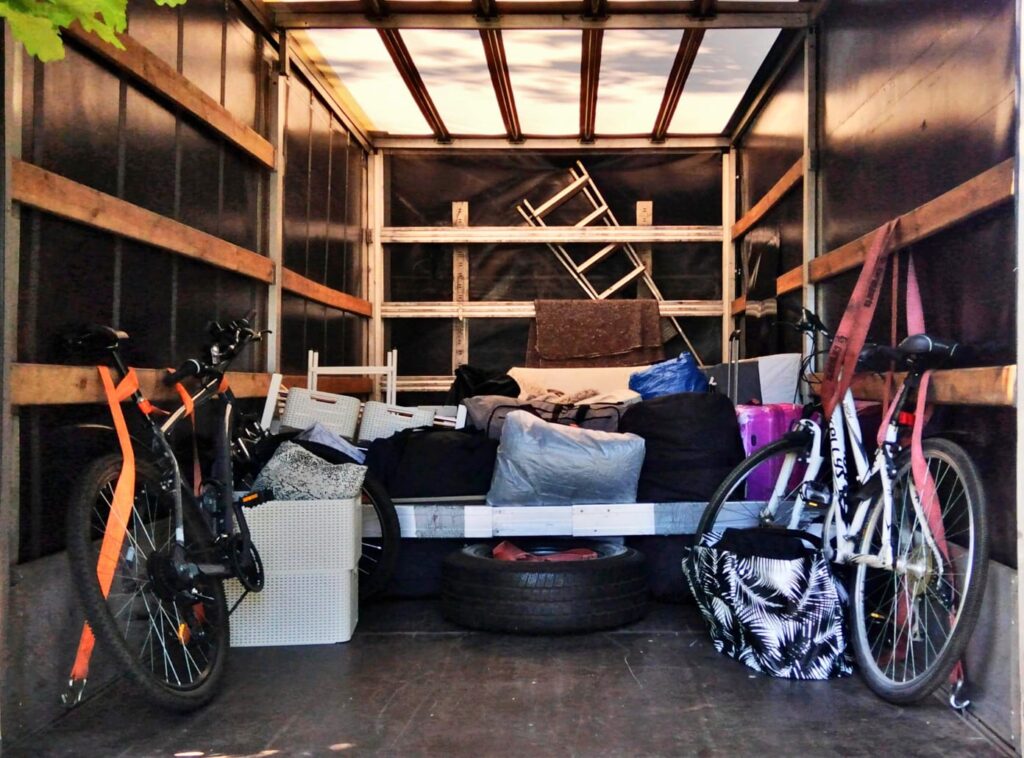
Students can also live in Switzerland if they meet the right conditions, including acceptance by a recognised institution. Student budgeting is crucial because rent, health insurance, food, deposits, and transport can quickly build pressure. A compact man and van move can be ideal for boxes, clothes, books, a desk setup, bedding, kitchen basics, and a bicycle.
You may also be able to live in Switzerland without working if you are a student, pensioner, or person of private means. However, conditions depend on nationality and personal circumstances. You may need to show sufficient financial resources and health insurance.
Bringing Furniture, Office Equipment, and Valuable Items
Furniture decisions can save or waste serious money. Switzerland has excellent stores, but quality furniture is not cheap. If you already own strong, comfortable, valuable, or sentimental pieces, bringing them may be smarter than replacing them.
Move furniture when it is high quality, expensive to replace, emotionally important, ergonomic, custom fitted, or needed immediately after arrival. Sell or donate furniture when it is cheap, bulky, damaged, too large for Swiss apartment access, or more expensive to transport than replace.
Before moving furniture, measure everything. Measure doors, lifts, staircases, basement access, parking distance, and room dimensions. A sofa that looked modest in your old flat can become a monster in a narrow Swiss hallway.
VANonsite can support Furniture Removals, Home Removals, Packing Service, White Glove Delivery, Storage, and careful delivery for delicate items. For designer furniture, antiques, art, instruments, or fragile pieces, white glove handling can be the difference between relief and heartbreak.
Business moves need extra discipline. Office relocations may involve IT equipment, monitors, documents, desks, meeting room setups, storage items, and timed delivery windows. VANonsite Office Removals and Office Furniture Installation can help companies reduce downtime and restart faster.
First 30 Days in Switzerland Checklist
The first 30 days shape your emotional landing. Do not try to do everything at once. Follow a clean order.
| Timeline | What to do |
|---|---|
| Before arrival | Confirm permit route, housing, moving date, customs inventory, and key documents |
| Day 1 to 3 | Collect keys, inspect the property, photograph condition, keep essentials accessible |
| Week 1 | Register with your commune, confirm work or study admin, activate phone service |
| Week 2 | Compare health insurance, open bank account, learn local transport options |
| Week 3 | Set up utilities, waste rules, local registrations, school or childcare tasks |
| Week 4 | Review budget, finalise insurance, update address, organise storage or furniture delivery |
| First 90 days | Complete health insurance, settle permit tasks, build local routines |
Keep one box for the first 48 hours: chargers, toiletries, basic kitchen items, bedding, medicines, documents, towels, and a few clothes. That small box can feel like treasure when everything else is still wrapped.
Common Mistakes When Learning How to Live in Switzerland
Many relocation problems are predictable. Avoid these mistakes and your move becomes calmer.
- Booking removals before checking permit eligibility
- Assuming EU and non EU rules are the same
- Forgetting the 3 month permit threshold for longer stays
- Missing the 14 day registration expectation
- Waiting too long to arrange health insurance
- Underestimating rent and deposit pressure
- Packing without a customs inventory
- Moving bulky low value furniture without comparing replacement cost
- Ignoring canton differences
- Choosing the cheapest mover without GPS tracking or proper care
- Packing passports or key papers into the moving load
- Assuming English is enough for every local task
- Forgetting building access, lift size, and parking restrictions
The most painful mistakes are rarely dramatic. They are small missed steps that multiply: one missing document, one late appointment, one wrong van size, one unlabeled box, one rushed lease. Switzerland works best when you arrive organised.
Why Move to Switzerland with VANonsite?
When people ask how to live in Switzerland, they often focus on visas, jobs, and rent. That is smart. But the physical move matters too. Your belongings carry your comfort, routine, identity, and memories. They deserve more than a random van and crossed fingers.
VANonsite helps make European removals to Switzerland safer, clearer, and more controlled. Services include Last Minute Moving, Furniture Removals, Home Removals, Packing Service, White Glove Delivery, Office Removals, Storage, Student Removals, Office Furniture Installation, flexible man and van options, and GPS tracking for every load.
The vehicle range is practical. A student can move 1m3 of essentials. A couple can move a compact apartment. A family can move a full household. A business can move office furniture and equipment with less disruption.
That flexibility matters because no two moves to Switzerland look the same. One person arrives with 6 boxes and a bicycle. Another arrives with 30m3 of furniture, children’s beds, kitchenware, office screens, and artwork. VANonsite gives each move the right scale.
FAQ: How to Live in Switzerland
Can I live in Switzerland as a foreigner?
Yes. Many foreigners live in Switzerland, but the route depends on nationality, purpose of stay, income, work status, family situation, and length of stay. If you plan to stay more than 3 months, you generally need a residence permit.
Can I live in Switzerland if I am from the EU?
Usually, EU and EFTA citizens have a simpler route under free movement rules. Still, the reason for your stay matters. Work, study, family reunification, and living without gainful employment have different conditions.
Can I live in Switzerland as a non EU citizen?
Yes, but it is usually more difficult. Non EU and non EFTA citizens often need a strong reason, such as a qualifying job, study place, family route, or another recognised residence basis.
Do I need health insurance to live in Switzerland?
Yes. Anyone settling in Switzerland must usually take out health insurance within 3 months of taking up residence. Each family member needs individual cover.
What is the easiest way to move furniture to Switzerland?
The easiest way is often a professional man and van or removals service with clear vehicle sizes, secure loading, customs awareness, and tracking. VANonsite offers GPS tracked removals to Switzerland, packing support, furniture removals, white glove delivery, storage, and flexible van capacity.
Conclusion: How to Live in Switzerland with Less Stress
So, how to live in Switzerland without feeling overwhelmed? Start with the legal route. Confirm whether you can live in Switzerland through work, study, family, retirement, or financial independence. Prepare your documents before you move. Respect the 3 month residence permit threshold, the 14 day registration expectation, and the 3 month health insurance deadline. Choose your canton carefully. Budget for the first 90 days with honesty. Create a customs inventory before your belongings leave.
Then make the physical move feel controlled.
Switzerland can be crisp, costly, demanding, and extraordinary. It is not a place that rewards improvisation. It rewards people who arrive ready.
With VANonsite, your move to Switzerland can be secure, GPS tracked, and shaped around your real load size, from a compact man and van relocation to a full household move. That means fewer blind spots, fewer anxious moments, and a smoother arrival.
If you are planning your next chapter, start with VANonsite removals to Switzerland and move with a team built for safe, fast, professional European relocations.