
Moving to Switzerland with kids is a bright, brave decision. It can mean safer streets, cleaner air, stronger schools, reliable public transport and weekends that smell of pine forests, lake water and fresh mountain snow. For many families, Switzerland feels like a place where life can become more organised, more secure and more intentional.
Still, the move itself can feel enormous.
You are not only moving furniture. You are moving bedtime routines, school bags, favourite toys, bikes, winter coats, medical records, passports, work equipment and the invisible emotional glue that holds family life together. Children may be excited one day and tearful the next. Parents may feel thrilled about the opportunity, then suddenly overwhelmed by permits, insurance, housing, customs and school placement.
The key is structure. Moving to Switzerland with kids becomes much easier when you divide the process into clear steps: documents, schools, healthcare, housing, packing, customs and transport. Switzerland is efficient and well organised, but many rules depend on the canton or municipality. That means early preparation is not a luxury. It is the thing that turns a stressful move into a controlled family transition.
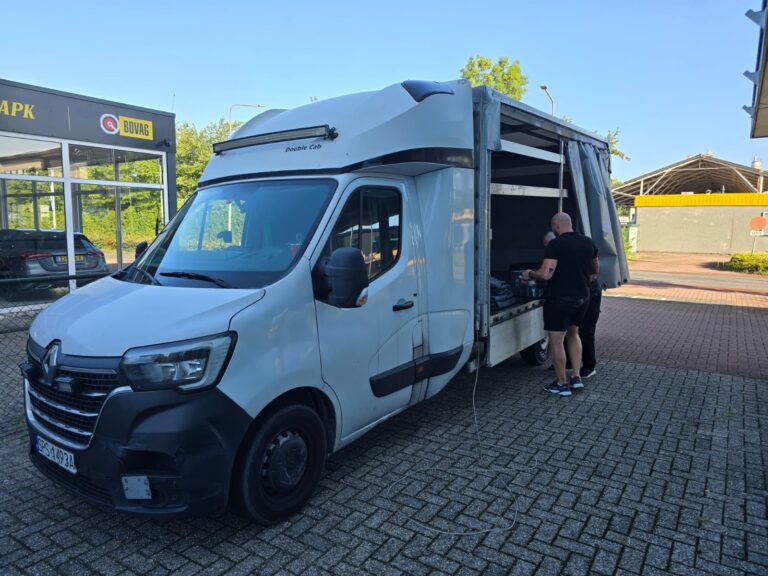
VANonsite helps families relocate across Europe with secure transport, fast coordination, GPS tracking for every load and flexible vehicle sizes. Whether your family needs a compact man and van service for essentials or a complete household relocation, VANonsite can help you move with clarity, care and confidence.
For families planning a safe European relocation, VANonsite provides dedicated removals to Switzerland for small loads, urgent moves, full homes and carefully planned family transitions.
TL:DR
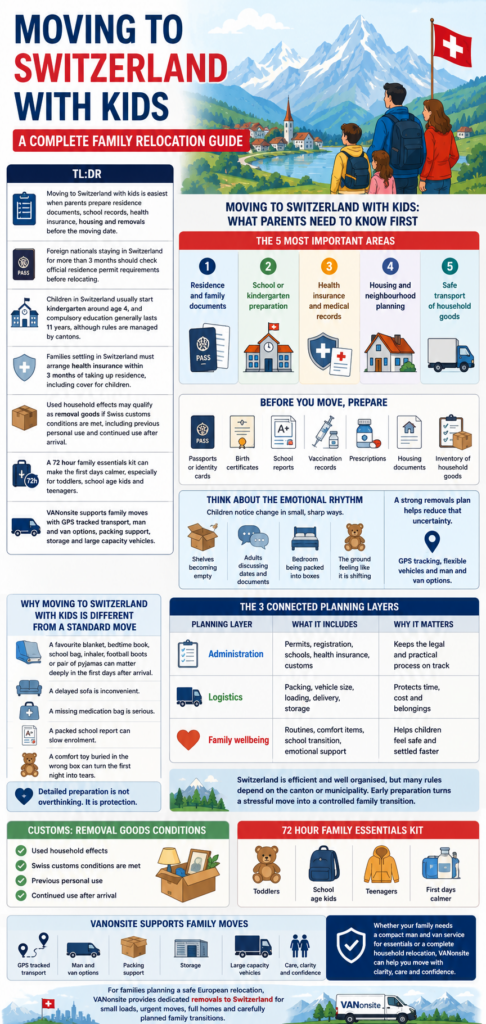
- Moving to Switzerland with kids is easiest when parents prepare residence documents, school records, health insurance, housing and removals before the moving date.
- Foreign nationals staying in Switzerland for more than 3 months should check official residence permit requirements before relocating.
- Children in Switzerland usually start kindergarten around age 4, and compulsory education generally lasts 11 years, although rules are managed by cantons.
- Families settling in Switzerland must arrange health insurance within 3 months of taking up residence, including cover for children.
- Used household effects may qualify as removal goods if Swiss customs conditions are met, including previous personal use and continued use after arrival.
- A 72 hour family essentials kit can make the first days calmer, especially for toddlers, school age kids and teenagers.
- VANonsite supports family moves with GPS tracked transport, man and van options, packing support, storage and large capacity vehicles.




Moving to Switzerland With Kids: What Parents Need to Know First
Moving to Switzerland with kids is manageable, but it rewards planning. Parents should not treat the relocation as one huge task. It works better when broken into connected stages.
The five most important areas are:
- Residence and family documents
- School or kindergarten preparation
- Health insurance and medical records
- Housing and neighbourhood planning
- Safe transport of household goods
These areas affect each other. Your address may influence the school your child attends. Your residence situation may affect registration. Your delivery date may affect whether your children have beds before school starts. Your health insurance deadline starts after taking up residence, so medical preparation cannot be ignored.
Before moving to Switzerland with kids, prepare the essential paperwork and practical details early. This includes valid passports or identity cards, birth certificates, school reports, vaccination records, prescriptions, housing documents and an inventory of household goods for customs.
Parents should also think about the emotional rhythm of the move. Children notice change in small, sharp ways. They see shelves becoming empty. They hear adults discussing dates and documents. They watch their bedroom being packed into boxes. Even when they are excited, the move can feel like the ground is shifting.
A strong removals plan helps reduce that uncertainty. With GPS tracking, flexible vehicles and man and van options, VANonsite helps parents stay informed throughout the journey. That matters because family moves are not only measured in kilometres. They are measured in sleep, school readiness and peace of mind.
Why Moving to Switzerland With Kids Is Different From a Standard Move
A standard move can survive a little disorder. A family move usually cannot.
Adults can often manage a few days without proper furniture or a perfect kitchen setup. Children need stronger anchors. A favourite blanket, bedtime book, school bag, inhaler, football boots or pair of pyjamas can matter deeply in the first days after arrival.
A delayed sofa is inconvenient. A missing medication bag is serious. A packed school report can slow enrolment. A comfort toy buried in the wrong box can turn the first night into tears.
This is why moving to Switzerland with kids requires a different mindset. Detailed preparation is not overthinking. It is protection.
| Planning layer | What it includes | Why it matters |
|---|---|---|
| Administration | Permits, registration, schools, health insurance, customs | Keeps the legal and practical process on track |
| Logistics | Packing, vehicle size, loading, delivery, storage | Protects time, cost and belongings |
| Family wellbeing | Routines, comfort items, school transition, emotional support | Helps children feel safe and included |
The most successful family moves are rarely dramatic. They feel almost quiet because the important decisions were made early. Parents know where the documents are. Children know which box holds their favourite things. The removals team knows the access details. The vehicle size matches the real volume. The first night is planned before anyone arrives tired and hungry.
That is the difference between chaos and control.
Residence Documents for Moving to Switzerland With Kids
Paperwork is not the most exciting part of relocation, but it can make or break the first weeks. When moving to Switzerland with kids, parents should create one complete family document folder before packing begins.
Foreign nationals staying in Switzerland for more than 3 months generally need to check residence permit requirements. The exact situation depends on nationality, employment, family status and the reason for moving. The official Swiss government guidance is available here: Swiss residence permits.
Do this early. Some records may take time to request, translate or update. If parents are separated or divorced, custody and consent documents can be especially important.
Family document checklist
| Document | Who needs it | Why it matters |
|---|---|---|
| Passport or national ID | Parents and kids | Identity, travel and registration |
| Birth certificate | Children | Family proof and school matters |
| Marriage certificate | Parents where relevant | Family registration and administrative steps |
| Custody documents | Separated or divorced parents | Proof of parental responsibility |
| Employment contract | Working parent | Residence, housing and registration support |
| Swiss rental agreement | Whole family | Local registration and school contact |
| School reports | School age kids | Class placement and education continuity |
| Vaccination records | Kids | Healthcare and school preparation |
| Medical summaries | Kids with ongoing care | Treatment continuity |
| Household goods inventory | Whole family | Customs clearance |
Original documents should travel with the family, not inside the moving van. During moving to Switzerland with kids, your document folder is as important as your passport, wallet and phone.
Make digital scans as well. Store them securely and make sure both parents or guardians can access them if needed. Schools, local offices, landlords and insurers may ask for documents at different times, so fast access is a powerful stress reducer.
Documents for Children
Children often need more documentation than parents expect. Schools, doctors, local offices and insurers may all request different records. Prepare these documents before moving day:
- Birth certificate
- Passport or identity card
- Vaccination records
- Recent school reports
- Language certificates if available
- Special educational needs documents
- Medical history
- Allergy information
- Prescriptions
- Custody or consent documents where relevant
- Emergency contact details
If your child has additional learning needs, medical conditions or regular therapy, prepare a short summary in English and, if possible, in the local language of your destination canton. This can help schools and healthcare providers understand the situation faster.
When moving to Switzerland with kids, small administrative details can save large amounts of stress. A clear document folder helps you answer questions quickly and prevents important steps from being delayed.
Swiss Customs Rules for Household Goods
Moving to Switzerland with kids usually means transporting far more than adult furniture. Families bring children’s beds, books, bikes, scooters, toys, prams, baby equipment, school items, sports gear, winter clothes, kitchen supplies and sentimental objects.
Used household effects may qualify as removal goods if Swiss customs conditions are met. Swiss customs guidance explains the rules for moving household effects here: Moving household effects to Switzerland.
The most important practical step is preparing a clear inventory. This list helps organise the move and supports the customs process.
Your customs inventory should include:
- Number of boxes
- Beds and mattresses
- Wardrobes and dressers
- Tables, chairs and sofas
- Children’s furniture
- Toys and books
- Bikes, scooters and sports gear
- Clothes and shoes
- Kitchen items
- Electronics
- Baby equipment
- Home office equipment
- Fragile or high value belongings
Avoid vague descriptions such as “random things” or “miscellaneous boxes.” Use clear categories such as “children’s books,” “bedroom furniture,” “kitchen utensils,” “winter clothes,” “school supplies” and “baby equipment.”
This helps everyone. It helps customs understand the shipment. It helps your removals team load properly. It helps you unpack faster after arrival.
A well planned inventory also helps parents decide what should arrive first. Children’s beds, essential clothes, bathroom items, school bags and kitchen basics should be easy to access. Seasonal items, spare bedding and long term storage boxes can wait.
VANonsite can support families with cross border transport planning, vehicle selection and secure delivery. That matters when the load includes not only furniture, but also the objects your children rely on every day.
Schooling in Switzerland: What Parents Should Prepare
School is often the biggest concern for parents moving to Switzerland with kids. It is not only about academics. It is about friendships, language, confidence and belonging.
In Switzerland, compulsory education generally lasts 11 years, and most children start kindergarten around age 4. Education is managed by cantons, which means families should always check local rules for their destination area. Official Swiss information is available here: Kindergarten and compulsory education in Switzerland.
The right school path depends on your family’s plans, language needs, budget and how long you expect to stay.
| School option | Best for | What to consider |
|---|---|---|
| Local public school | Long term integration | Local language, catchment area and canton rules |
| International school | Temporary assignments or global curriculum | Fees, waiting lists and admission deadlines |
| Private school | Specific learning preferences | Cost, location and curriculum |
| Bilingual school | Language transition | Availability and early application |
| Special support pathway | Children with additional needs | Documentation and early communication |
Public schools can be excellent for families planning to settle long term. Children often absorb language quickly and may build local friendships faster than adults. However, international or bilingual schools may be better for children following a specific curriculum or families expecting another move within a few years.
Contact schools early. Even if you do not yet have every detail confirmed, you can ask what documents are needed and how placement usually works.
School records to bring
Prepare these documents before the move:
- Latest school reports
- Teacher references
- Curriculum notes
- Language certificates
- Special support records
- Vaccination records
- Attendance records if useful
- Birth certificate
- Passport copy
Pack school documents in hand luggage. When moving to Switzerland with kids, school paperwork should never be trapped in a box at the back of the van.
Helping Kids Settle Into a Swiss School
A new school can feel like the emotional peak of moving to Switzerland with kids. Children may worry about language, teachers, lunch routines, playground rules, friendships and whether they will feel different.
Parents can help by making the unknown feel less mysterious.
Before the move, show your child photos of the new town or neighbourhood. Look at the school route. Learn 10 useful local phrases together. Let your child choose a new pencil case, backpack or notebook for the first day. Small choices create a sense of control.
After arrival, keep routines steady. Breakfast at a predictable time. Clothes ready the night before. School bag packed in the same place. A familiar bedtime rhythm. These things sound simple, but they give children a stable frame while everything else changes.
| Child age | Main worry | Parent support |
|---|---|---|
| 0 to 4 | Sleep, routine and separation | Familiar bedding, stable naps and slow transition |
| 5 to 8 | Teacher, classroom and friends | School visit, simple phrases and gentle reassurance |
| 9 to 12 | Belonging and confidence | Sports clubs, hobbies and regular check ins |
| 13 to 17 | Identity, independence and exams | Honest conversations, school guidance and social time |
Ask specific questions after school. Instead of “How was it?”, try:
- Who did you sit next to?
- What was the easiest part of today?
- What felt strange?
- Did anyone help you?
- What do you want to know before tomorrow?
Children do not need everything to be perfect. They need steady parents, familiar routines and time. Moving to Switzerland with kids can be a beautiful growth experience, but it should not be rushed emotionally.
Health Insurance and Medical Preparation for Kids
Health preparation is one of the most important parts of moving to Switzerland with kids. Switzerland has high quality healthcare, but residents must arrange health insurance.
Families settling in Switzerland must take out health insurance within 3 months of taking up residence. Parents must also arrange cover for children. Official information is available here: Health insurance requirement in Switzerland.
Start before arrival. Comparing insurers, premiums and deductibles takes time, especially for families. If your child has asthma, allergies, diabetes, epilepsy, mobility needs or regular therapy, begin medical preparation as early as possible.
Prepare:
- Vaccination records
- Medical summaries
- Prescriptions
- Dental records
- Allergy information
- Specialist reports
- Current medication
- Glasses or contact lens prescriptions
- Emergency contact list
- Health insurance documents from your current country
A calm medical plan can prevent frightening midnight searches in a new country. If your child needs regular medication, ask your current doctor for a written summary and prescription copies before departure.
First week medical kit
Keep this with you:
- Thermometer
- Child safe pain relief
- Plasters
- Antiseptic
- Allergy medication if needed
- Prescription medicine
- Medical devices
- Basic cold and flu items
- Copies of prescriptions
Do not pack this kit into the moving load. It should travel with the family. If your child feels unwell on the first night, you need quick access.
Choosing Where to Live in Switzerland With Kids
Switzerland is compact, but family life can differ greatly by canton, town and neighbourhood. Zurich, Geneva, Basel, Lausanne, Bern, Zug and Lucerne all attract international families, but smaller towns can also offer a peaceful and practical lifestyle.
When moving to Switzerland with kids, do not judge housing only by rent or square metres. Daily life matters more.
A beautiful apartment can become frustrating if the school run is difficult. A cheaper home can become expensive if transport takes too long. A top floor flat without a lift may look charming until you carry a pram, groceries and tired children upstairs every day.
| Factor | Why it matters |
|---|---|
| Distance to school | Easier mornings and less stress |
| Public transport | Independence for older kids |
| Playgrounds and green spaces | Better daily life and weekend comfort |
| Paediatrician nearby | Faster help when needed |
| Grocery access | Easier routines |
| Storage space | Bikes, prams, winter clothes and sports gear |
| Lift access | Important for furniture and young kids |
| Parking and loading access | Crucial for removals |
| Noise rules | Swiss apartment life can be strict |
| Temporary storage options | Useful if dates change |
Before delivery day, check staircases, lifts, parking zones, building rules and allowed moving times. Some apartment buildings may have restrictions that affect removals access.
For narrow streets or city apartments, a man and van option may be efficient. For larger homes, a bigger vehicle may save time and reduce handling.
Housing should support your family’s rhythm. Think about the school run, grocery trips, playground time, commuting and weekend life. The right location can make the first months feel lighter.
Packing for Moving to Switzerland With Kids
Packing for a family move should be built around priority, not just room by room organisation. The first boxes you open can shape the mood of the first week.
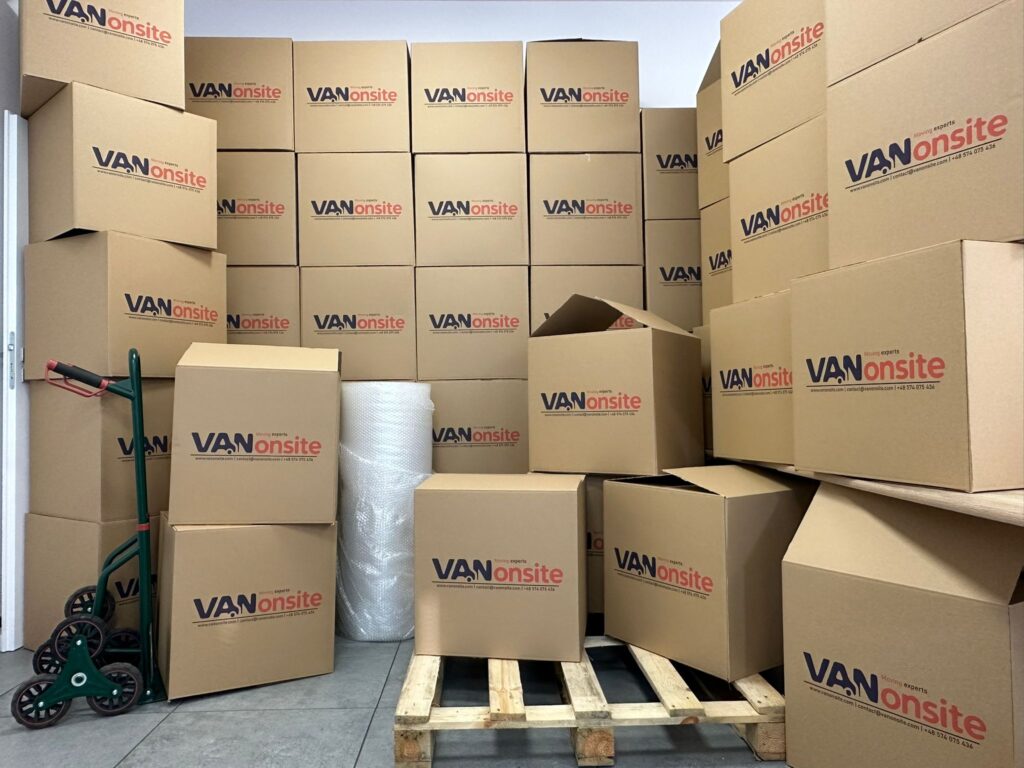
Label clearly. Avoid mystery boxes. Make sure each child’s important items are easy to identify. Use simple labels such as “open first,” “kids bedroom,” “school items,” “baby items,” “kitchen day one,” “bathroom essentials,” “winter clothes,” “toys,” “books” and “fragile.”
The most important packing tool is the 72 hour family essentials kit.
The 72 hour family essentials kit
Keep this kit with you:
- Passports and residence documents
- Housing documents
- School paperwork
- Health insurance notes
- Medication and prescriptions
- Chargers and adapters
- Two outfits per person
- Toiletries
- Pyjamas
- Children’s favourite toy, blanket or book
- Snacks and water bottles
- Basic first aid kit
- One set of bedding
- Baby supplies if needed
- Laptop and work essentials
- Payment cards and some cash
This kit is not optional. During moving to Switzerland with kids, the first 72 hours can feel fragile. Familiar pyjamas, a favourite toy and easy access to medicine can turn a difficult evening into a manageable one.
How to label family boxes
Use labels that tell you what to open and when:
- Open first
- Kids bedroom
- School items
- Baby items
- Kitchen day one
- Bathroom essentials
- Winter clothes
- Toys
- Books
- Documents, do not pack
- Fragile
- Storage
Colour coding can help. Give each child a colour. Mark their boxes with stickers or tape. When the boxes arrive, they can spot their belongings quickly. That small moment of recognition can make a new home feel less strange.


What to Let Professional Movers Pack
Parents often underestimate how exhausting the final packing week can be. You may be closing accounts, saying goodbye to friends, handling school emails, checking travel plans and still trying to keep family life normal.
Professional packing can save time and reduce damage risk. It is especially useful for fragile, heavy or awkward items.
Items worth professional packing include:
- Glassware
- Mirrors
- Artwork
- Lamps
- Children’s beds
- Nursery furniture
- Wardrobes
- Designer furniture
- Electronics
- Musical instruments
- Home office equipment
- Fragile kitchen items
VANonsite can support families through Packing Service, Furniture Removals and White Glove Delivery.
When parents are juggling school forms, work calls, emotional goodbyes and travel plans, professional packing is not a luxury. It is a pressure valve. It protects your time, your belongings and your patience.
For families with delicate furniture, designer items, artwork or fragile heirlooms, White Glove Delivery adds another layer of care. For bulky beds, wardrobes and sofas, Furniture Removals help reduce strain and risk. For busy parents, Packing Service can turn a frantic final week into a far smoother experience.
Choosing the Right VANonsite Vehicle Size
Vehicle size affects cost, timing and access. Families often underestimate volume because children’s belongings add up quickly.
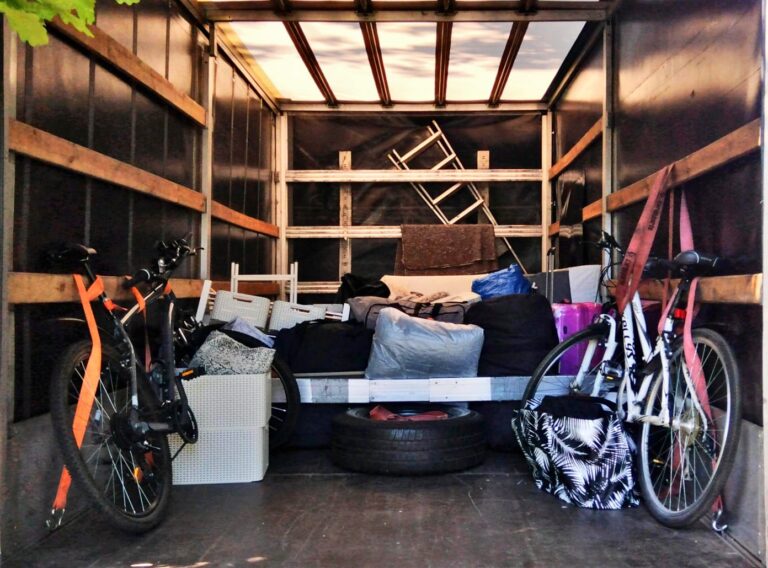
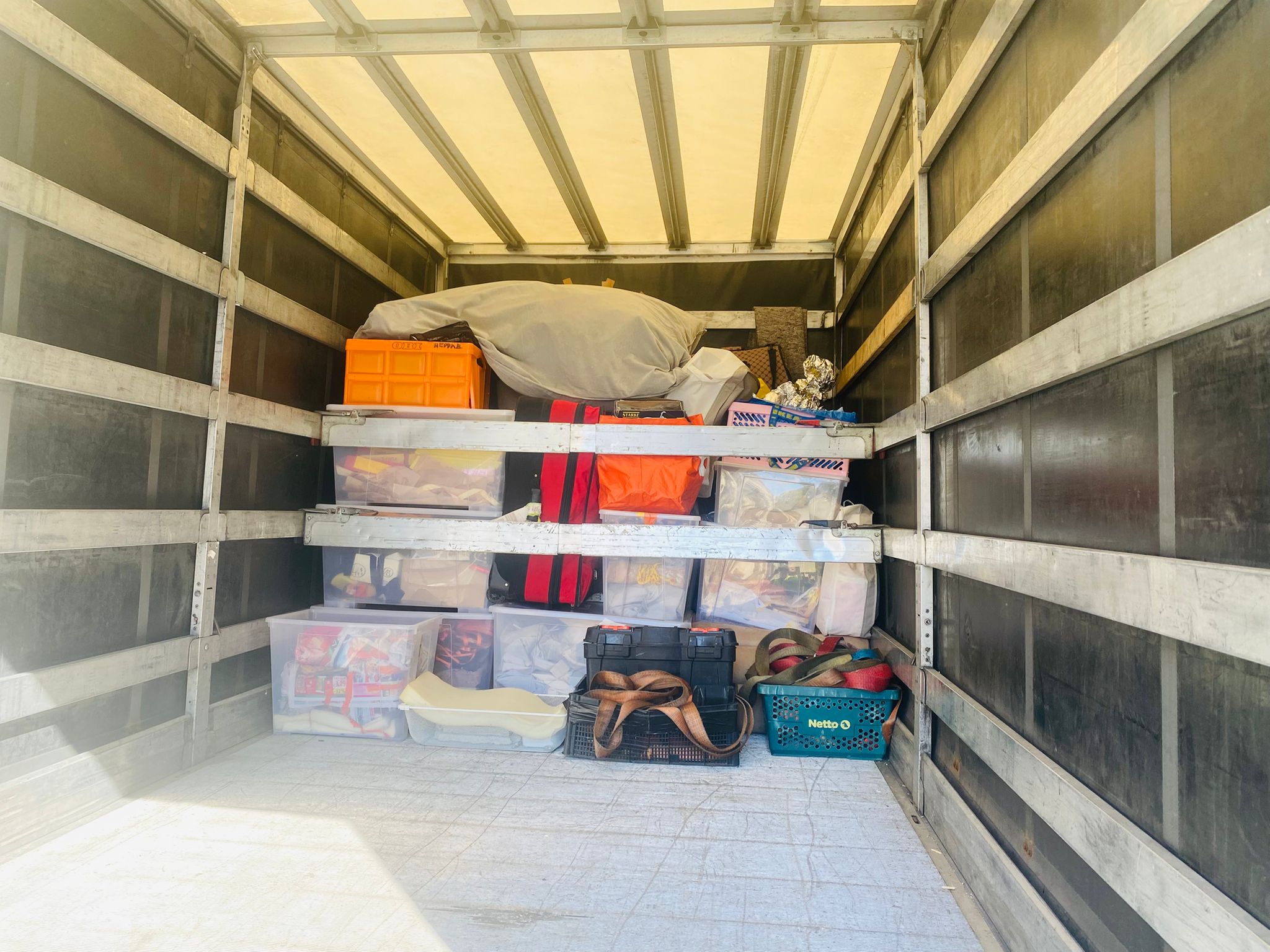
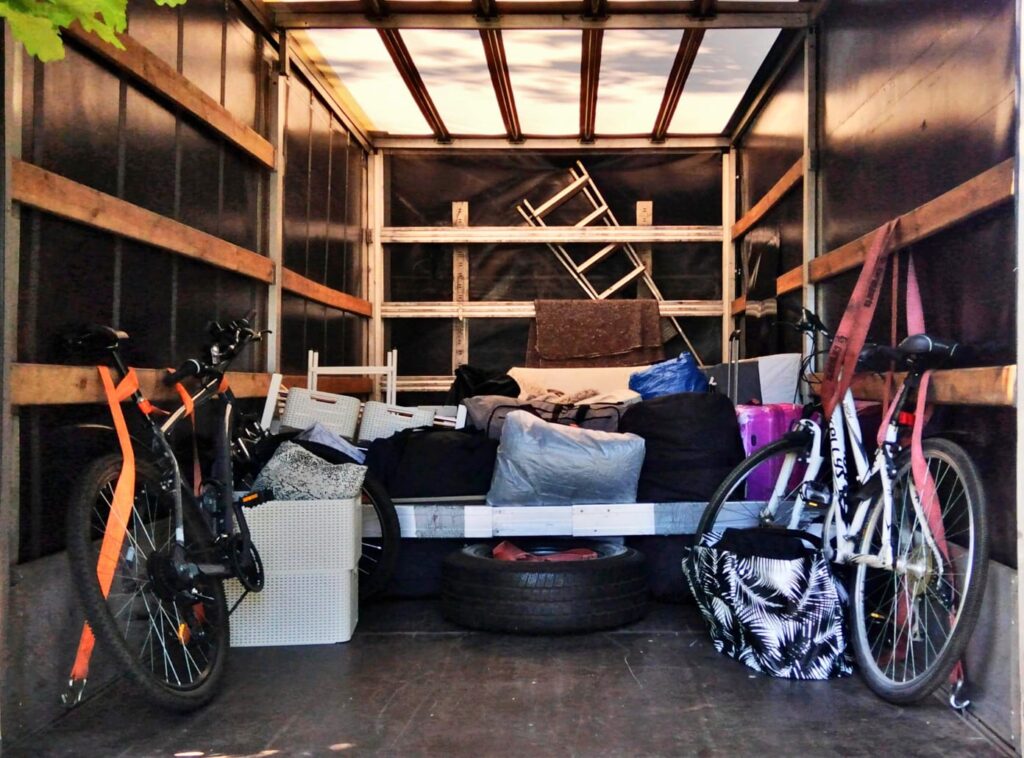
A few boxes become 30. One child’s room becomes a mountain of bedding, books, clothes, toys, sports equipment and school supplies. Add bikes, prams, wardrobes, kitchen items and home office equipment, and the load grows fast.
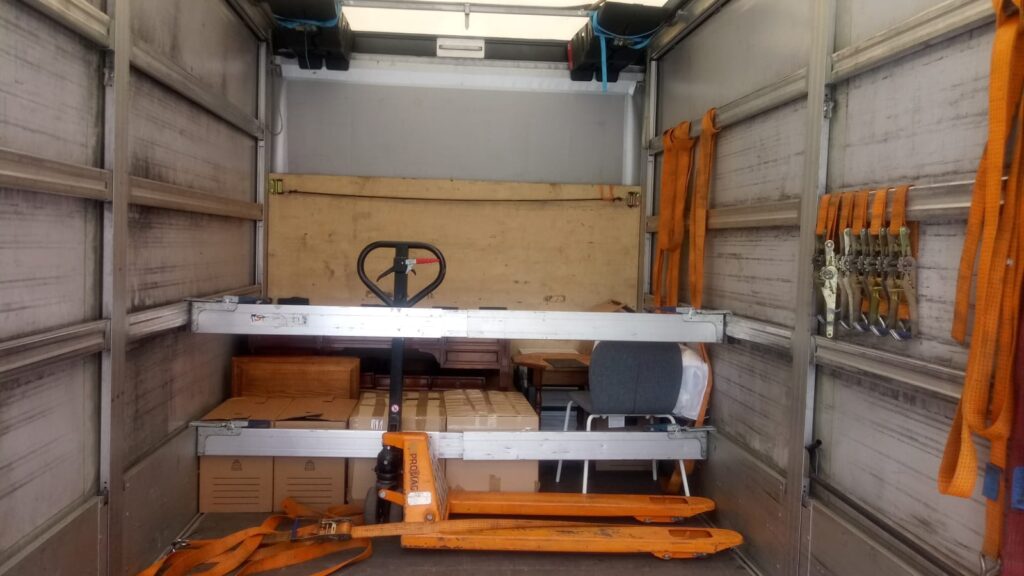
VANonsite offers flexible vehicle options for different move sizes.
| VANonsite option | Capacity | Weight limit | Best for |
|---|---|---|---|
| Moving One | 1 m3 | 100 kg | Small essentials, urgent items and documents |
| Moving Basic | 5 m3 | 300 kg | Light man and van move, boxes or one small room |
| Moving Medium | 10 m3 | 500 kg | Studio, compact apartment or partial move |
| Moving Premium | 15 m3 | 1,100 kg | One bedroom flat or selected family furniture |
| Moving Premium Plus | 30 m3 | 3,500 kg | Larger apartment or family relocation |
| Moving Full House XXL | 90 m3 | 20,000 kg | Full household move to Switzerland |
If you are moving beds, wardrobes, bikes, prams, toys, books, kitchen items and office equipment, do not guess your volume. A proper estimate can prevent a painful second trip.
For smaller moves, a man and van option can be ideal for essentials, temporary accommodation or phased relocation. For larger family homes, a high capacity vehicle can protect time and reduce stress.
Moving to Switzerland with kids is easier when the vehicle matches the real life load, not a rough guess. A family relocation is rarely just “a few boxes.” It is usually a living system of furniture, clothes, school materials, toys, kitchen items and memory packed into cubic metres.
Why GPS Tracking Matters During a Family Move
Waiting for a moving van in a new country can feel like listening for thunder. You know something is coming, but you do not know exactly when. For parents, that uncertainty can be exhausting.
GPS tracking gives families something better than hope. It gives information.
When moving to Switzerland with kids, tracking helps you plan:
- When to be at the new address
- When to prepare building access
- When to contact the landlord or concierge
- When to arrange childcare
- When children’s beds and essentials may arrive
- Whether the delivery schedule is on track
VANonsite provides GPS tracking for every load. This helps parents feel informed instead of stranded in uncertainty.
It also helps with children. Instead of saying, “I do not know where our things are,” you can say, “The van is on the way, and your bed is coming.” That kind of simple certainty can calm a tired child.
Visibility is especially valuable if your family is travelling separately from the load, staying in temporary housing or coordinating with school start dates. When you can see the transport progress, you can make better decisions.
Moving Day With Kids: How to Keep It Calm
Moving day can feel intense for children. They see their home emptying, adults rushing and familiar rooms changing quickly. Even excited kids can become unsettled when the house starts to echo.
The aim is not to make moving day perfect. The aim is to make it predictable.
If possible, arrange childcare during loading hours. If that is not possible, create one safe corner with snacks, books, headphones, a tablet, drawing supplies or a favourite toy. Assign one adult to focus on the kids, not the boxes.
Moving day tips
- Arrange childcare for loading hours if possible.
- Keep snacks, drinks and comfort items outside the packed boxes.
- Assign one adult to focus on the kids.
- Keep documents and medication with you.
- Photograph valuable furniture before loading.
- Confirm Swiss delivery address and access.
- Label children’s boxes clearly.
- Track the moving vehicle.
- Set up kids’ beds first after arrival.
- Create one quiet corner in the new home.
The first night does not need to be beautiful. It needs to be safe, warm and predictable. If children have pyjamas, bedding, comfort items and a familiar bedtime routine, the new home will start to feel less foreign.
Moving day should be built around energy management. Parents need water, snacks, phone chargers and a realistic schedule. Children need reassurance. The removals team needs clear access and instructions. When these pieces fit together, the day feels far less frantic.
Storage and Temporary Housing in Switzerland
Family moves often involve timing gaps. The old home may close before the new one is ready. Temporary accommodation may be too small. School may start before the full household arrives. Work may begin before all furniture is delivered.
Storage can make moving to Switzerland with kids easier and less crowded.
Storage is useful when:
- The Swiss home is not ready
- Temporary housing is small
- You want to move essentials first
- You are downsizing
- You need time to choose furniture
- You want a less crowded arrival
- You have seasonal items, bikes or extra furniture
Split delivery can also work well. Essentials can arrive first: beds, clothes, school items, kitchen basics and medication. Larger furniture and less urgent boxes can follow later.
VANonsite Storage can give families flexibility when dates do not match perfectly. This can be especially helpful if you want to keep the first week calm rather than filling temporary housing with every box you own.
For some families, the smartest move is not one massive delivery. It is a staged arrival. A man and van load can bring essentials first, while the main household shipment follows when the property is ready. This approach can reduce clutter, pressure and decision fatigue.
Cost Factors When Moving to Switzerland With Kids
The cost of moving to Switzerland with kids depends on details, not only distance. A small shipment of essentials is very different from a full household move with beds, wardrobes, bikes, fragile items and storage.
Main cost factors include:
- Distance across Europe
- Total volume in m3
- Total weight
- Vehicle size
- Packing support
- Furniture dismantling
- Furniture assembly
- Floor level
- Lift access
- Parking distance
- Customs preparation
- Storage needs
- Urgency
- Fragile items
- Number of collection or delivery points
The cheapest quote can become expensive if it causes delays, damage, extra vehicles or emergency storage. For family moves, value means control, care and reliability.
Ask clear questions before booking:
- What vehicle size is recommended?
- Is GPS tracking included?
- How are fragile items protected?
- Can furniture be dismantled and reassembled?
- Is storage available if dates change?
- What happens if access is difficult?
- Are packing services available?
A transparent removals plan gives parents confidence. It turns moving to Switzerland with kids from a gamble into a managed process.
If a quote looks unusually low, check what is missing. Is packing included? Is loading access considered? Is the vehicle large enough? Is the delivery date clear? Does the service include tracking? A family move needs answers, not vague promises.
Suggested Timeline for Moving to Switzerland With Kids
A timeline helps families avoid last minute panic. Ideally, start 3 to 6 months before the move. If your move is urgent, focus first on documents, housing, school contact, healthcare and transport.
| Time before move | What to do |
|---|---|
| 3 to 6 months | Research permits, schools, healthcare, housing and canton rules |
| 2 to 3 months | Gather school records, medical documents and removals quotes |
| 6 to 8 weeks | Book removals, confirm accommodation and start decluttering |
| 4 weeks | Prepare customs inventory and confirm vehicle size |
| 2 weeks | Pack non essential items and prepare the 72 hour family kit |
| 1 week | Confirm access, parking, delivery timing and travel documents |
| Moving day | Keep documents, medication and kids’ essentials with you |
| First week | Register locally, contact school and start healthcare setup |
| First 3 months | Complete insurance and residence related obligations |
Decluttering deserves attention. Every item you move costs space, time and energy. Before packing, sort toys, clothes, duplicate items and old school materials. Let children help with age appropriate choices, but do not force them to part with comfort objects during an emotional transition.
If your relocation comes quickly, focus first on documents, accommodation, school contact and transport. VANonsite Last Minute Moving can support urgent relocations when family plans change fast.
VANonsite Services for Families Moving to Switzerland
VANonsite offers flexible services for different types of family relocation. This is useful because moving to Switzerland with kids rarely follows one perfect template. Some families need a small urgent load. Others need a complete household move. Some need packing. Others need storage. Some need careful handling for high value furniture.
| Service | Best for |
|---|---|
| Removals to Switzerland | Complete family relocation to Switzerland |
| Home Removals | Full household moves |
| Furniture Removals | Beds, wardrobes, sofas and tables |
| Packing Service | Busy parents and fragile items |
| White Glove Delivery | Luxury, delicate or high value belongings |
| Storage | Temporary housing or delayed move in |
| Last Minute Moving | Urgent family relocations |
| Office Removals | Work equipment and business relocation |
| Student Removals | Older children or university moves |
| Office Furniture Installation | Home office or company setup |
Families choose VANonsite because the move stays visible, secure and flexible. GPS tracking reduces uncertainty. Vehicle options help match the real size of the load. Packing support protects fragile items. A man and van option keeps smaller moves efficient.
The result is a move that feels less like a gamble and more like a carefully managed route.
Common Mistakes When Moving to Switzerland With Kids
Even organised parents can miss small details. These mistakes are common, but avoidable.
Packing documents into the moving load
Passports, school records, medical papers, insurance notes and residence documents should stay with parents. If they are packed in the van, you may lose access when you need them most.
Underestimating children’s belongings
Kids’ beds, books, toys, bikes, clothes, prams and school supplies add significant volume. A proper estimate helps prevent last minute vehicle problems.
Ignoring building access
Swiss apartment buildings may have strict access, parking and quiet hour rules. Check these before delivery day.
Leaving health insurance too late
Families should compare options before arrival and complete insurance within the required period after taking up residence.
Assuming school rules are the same everywhere
Education is managed by cantons, so local rules matter. Check your destination area before arrival.
Choosing removals only by price
A vague low quote can lead to delays, damage and hidden costs. For family moves, reliability has real value.
Forgetting the first night plan
Beds, pyjamas, toiletries, medication and comfort items should be easy to reach. The first night sets the tone.
Avoiding these mistakes gives your family a smoother arrival. It also gives children the sense that the adults know what is happening, which is often more comforting than any speech about being brave.
First Week in Switzerland With Kids
The first week should focus on stability, not perfection. You do not need every picture hung or every cupboard organised. You need sleep, food, school readiness, medical basics and emotional calm.
During the first week, focus on:
- Registering locally where required
- Contacting the school or kindergarten
- Continuing health insurance setup
- Finding a paediatrician
- Learning public transport routes
- Buying basic groceries
- Understanding waste and recycling rules
- Unpacking kids’ rooms first
- Setting up morning and bedtime routines
- Checking delivered items for damage
- Saving removals documents and inventory
A new home does not need to be fully unpacked to feel safe. Children need beds, clean clothes, food, comfort items and calm adults. The rest can follow.
Unpack children’s rooms early if possible. Even a simple setup with bedding, books and favourite toys can help them feel anchored.
The first week is also a good time to explore gently. Visit the nearest playground. Try the walk to school. Find the closest grocery store. Take a short tram, bus or train ride if your children are curious. These small discoveries turn an unknown place into a map they can understand.
FAQ: Moving to Switzerland With Kids
Is Switzerland a good country for families with kids?
Yes. Switzerland is known for safety, strong infrastructure, clean cities, reliable public transport, good healthcare and easy access to nature. Costs can be high, so families should plan housing, insurance and removals carefully.
Do kids have to go to school in Switzerland?
Yes. Children living in Switzerland attend compulsory education. Rules are managed by cantons, so parents should check the destination canton or municipality.
When should I book removals to Switzerland?
For most family moves, 6 to 8 weeks ahead is sensible. During summer and school holiday periods, earlier booking is better.
Can VANonsite help with a man and van move to Switzerland?
Yes. VANonsite offers flexible man and van options for smaller moves, essentials, temporary housing and phased relocations.
What vehicle size do families usually need?
It depends on volume and weight. Smaller family loads may fit Moving Medium or Moving Premium. Larger households may need Moving Premium Plus or Moving Full House XXL.
Do children need health insurance in Switzerland?
Yes. Children need health insurance if the family settles in Switzerland. Parents must arrange cover within the required period.
Can I bring children’s toys, bikes and furniture to Switzerland?
Yes, used household goods can usually be included in a family move, provided customs conditions are met.
What should kids keep with them during travel?
Comfort items, snacks, clothes, medication, chargers, favourite toys and basic school items should stay with the family.
Is professional packing worth it for a family move?
Yes, especially for fragile items, furniture, glassware, electronics, nursery furniture and homes where parents are short on time.
What if my Swiss home is not ready?
Storage or split delivery can help. You can move essentials first, then deliver larger furniture and non urgent boxes later.
Final CTA: Make Moving to Switzerland With Kids Feel Under Control
Moving to Switzerland with kids is a major family chapter, but it does not have to feel chaotic. With the right documents, school preparation, health insurance plan, customs inventory and removals partner, the process becomes lighter.
VANonsite helps families move across Europe with secure transport, GPS tracking, flexible man and van solutions, packing support, storage and vehicle sizes for everything from small essentials to full household relocations.
Your kids do not need a perfect move. They need calm parents, familiar things and a safe first night in the new home.
Plan the route. Protect the routines. Move with care.
When you are ready, get a Switzerland removals quote and let VANonsite help your family move with control, confidence and peace of mind.